REVIEW 3 major objections 5 minor 96 references
Minimizing Contaminant Leakage in Internal Linear Combination Maps Using a Data-Driven Approach
T0 review · 3 major / 5 minor · reviewed 2026-08-07 · deepseek-v4-flash
Pith's one-line read Deprojecting only a data-driven CIB emissivity index per multipole bin makes ILC tSZ maps unbiased for a given tracer and improves cross-correlation signal-to-noise by 60%.
desk verdict Genuinely new ILC technique for choosing the CIB deprojection SED, with solid simulation work, but the headline S/N gain ignores the uncertainty in the very beta* the method estimates. read the letter →
The pith
A machine-rendered reading of the paper's core claim, the machinery that carries it, and where it could break.
The reading
What carries the argument
The machine at the center of the method is residual-inflation tuning. Starting from a y-map $y_\beta$ built with a trial CIB deprojection index $\beta$, the method subtracts the estimated tSZ contribution from each frequency map to form residuals $R^\beta_\nu$, multiplies them by a dimensionless vector $h_\nu$, and adds the product back to form altered maps $T'_\nu = T_\nu + h_\nu R^\beta_\nu$. The vector $h_\nu$ is chosen so that $\sum_\nu f_\nu^2 h_\nu = 0$, keeping the injected term orthogonal to the tSZ SED $f_\nu$; a second y-map $y^\beta_\alpha$ is built from $T'_\nu$. The difference $y_\beta - y^\beta_\alpha$ contains essentially no tSZ, so its cross-correlation with the halo map isolates CIB leakage, and the $\beta$ that minimizes the $\chi^2$ of that cross-correlation against zero in each $\ell$-bin is the effective CIB SED for that tracer. That per-bin $\beta^*_\ell$ is then used as an $\ell$-dependent deprojection SED in a final constrained harmonic ILC.
What would settle it
A decisive check is to run the pipeline with two different $h_\nu$ vectors that both satisfy the orthogonality condition but differ strongly in their coupling to noise; if the recovered $\beta^*_\ell$ or the final cross-correlation amplitude $A$ shifts by more than the stated statistical uncertainties, the assumption is falsified.
Extended reading notes
Core claim
The central claim is that contaminant leakage into an ILC y-map can be minimized for a specific tSZ-tracer cross-correlation without deprojecting SED moments, by learning the effective CIB emissivity index $\beta^*_\ell$ from the data alone. The estimator inflates the CIB in a copy of the frequency maps, builds a second y-map from those modified maps, and uses the cross-spectrum of the difference between the two y-maps with the tracer to find the $\beta$ that nulls CIB-tracer correlation in each multipole bin. Deprojecting that $\beta^*_\ell$ in the final harmonic ILC map removes exactly the CIB component that is correlated with the chosen tracer. On the simulations, this yields an unbiased tSZ-halo cross-correlation ($A=0.973\pm0.010$, with the mild residual offset driven by one bin near $\ell\approx700$) and a signal-to-noise of 95 compared with 58 for $\beta+d\beta$ moment deprojection, at an error-bar level only about 1.2 times the ideal no-CIB limit.
Load-bearing premise
The load-bearing premise is that the extra term created when the residual maps are inflated is weak enough, after the weights are chosen to be orthogonal to the tSZ signal, that it does not show up as a fake correlation with the halo map; the authors state this term is mitigated but not completely solved.
Editorial extensions
If this is right
- For the example halo sample, the method raises the tSZ-halo detection significance from 58 to 95 (a 60% gain) relative to deprojecting $\beta$ plus its first moment.
- Cross-correlation error bars shrink by 20-50% over the whole multipole range, landing a factor of about 1.2 above the theoretical floor set by a no-CIB ILC map.
- The final y-map is only cleaned for the tracer used to choose $\beta^*_\ell$; cross-correlating it with a different halo selection would leave residual CIB correlated with that new sample.
- Because $\beta^*_\ell$ is selected independently per multipole bin, the method can absorb the effective scale dependence of the CIB SED without modeling decorrelation explicitly.
- With the moment constraint dropped, a y-map can in principle be built from one fewer frequency channel, a practical benefit for ground-based experiments with limited band coverage.
Reading between the lines
- This suggests the same residual-inflation estimator could be adapted to needlet ILC, where a separate $\beta$ per scale would let three-band ground-based experiments build y-maps without a fourth channel for moment deprojection; the paper lists needlet ILC as future work.
- A testable extension is that the optimal $\beta^*_\ell$ should depend on the tracer's redshift distribution even when the underlying CIB is fixed, because the effective dust SED is a line-of-sight average; the paper's two halo samples already show different $\beta^*_\ell$ values, though the paper does not isolate this effect.
- If the spurious term $-h_\nu f_\nu(c_\beta+n_\beta)$ were not suppressed, one would expect $\beta^*_\ell$ to drift with the inflation amplitude $\alpha$; the paper reports little drift for $\alpha=0.1,1,10$, which is consistent with its assumption but not a proof of it.
- Applied to polarized dust, the same logic could infer an effective dust spectral index for CMB B-mode cleaning by cross-correlating ILC maps with a dust tracer, reducing the number of deprojected moments and sharpening tensor-to-scalar ratio constraints; this is an extension the paper mentions but does not test.
Editorial analysis
A structured set of objections, weighed in public.
Referee Report
Summary. The paper presents a data-driven algorithm for determining an effective CIB emissivity index beta*_ell to deproject in harmonic ILC y-maps, specifically for tSZ--halo cross-correlations. The method builds two y-maps, one from original frequency maps and one from maps whose residuals have been inflated by a factor h_nu, and selects beta in each multipole bin that minimizes the cross-correlation of the difference map with the tracer map. The final y-map deprojects the resulting per-bin beta*_ell without deprojecting the first moment. The authors validate the method on AGORA simulations with Planck frequency channels and a halo sample at 0.8<z<1.8, reporting an unbiased cross-correlation (amplitude A=0.973+/-0.010) and a 60% increase in signal-to-noise over moment deprojection, with additional tests for different halo selections and for no-decorrelation simulations.
Significance. If the central claims hold, this is a valuable contribution to CMB component separation: it provides a way to suppress CIB leakage in tSZ--LSS cross-correlations without the noise penalty of moment deprojection, with potential applications beyond tSZ, such as B-mode dust cleaning, kSZ estimation, and patchy screening searches. The method is clearly specified, the code is publicly available, and the simulations include an idealized no-decorrelation case that recovers the injected beta=1.65, which is a genuine check of internal consistency. The main weakness is that the statistical validation currently treats beta*_ell as known when computing final error bars, even though it is estimated from the same halo map used for the final cross-correlation; this must be addressed before the quantitative claims can be considered robust.
major comments (3)
- [Sec. III C and Sec. V] The final cross-correlation error bars use Eq. (20) with the y_beta* map, treating beta*_ell as known, and the text in Sec. III C explicitly states that the central value of beta*_ell is deprojected "without considering the error bar." However, beta*_ell is estimated from the same halo map h that is later cross-correlated with y_beta*, by scanning 84 trial beta values per bin (Sec. IV) and minimizing the chi-square in Eq. (18). This creates two unquantified effects: first, the finite uncertainty on beta*_ell (Fig. 4, roughly 0.05-0.1 in beta) propagates through residual CIB leakage into the final C^{y,h}; second, the minimization over many trial values can over-fit noise in C^{(y_beta - y_beta_alpha),h}, potentially biasing the selected beta*_ell and hence the final cross-spectrum. Until these effects are propagated or shown to be negligible, both the "unbiased" claim and the reported 60% SNR improvement are conditional on an oracle that knows the correct deprojection SED.
- [Sec. V, amplitude fit] The unbiasedness test reports A=0.973+/-0.010, a -2.7 sigma offset from unity, and the paper attributes this to a single outlier near ell~700; removing that point reduces the offset to -1.0 sigma. This shows that the central value and its error are not robust to one multipole bin, and the quoted error on A does not include the uncertainty in beta*_ell or the selection effect from scanning many trial values. The conclusion that the cross-correlation is "unbiased" is therefore stronger than the evidence supports. A more robust validation, such as averaging over multiple noise realizations or quoting a confidence interval that accounts for the outlier and the beta* uncertainty, is needed to support the unbiasedness claim.
- [Sec. III A, Eq. (14)] The derivation of the null test relies on the assumption that the spurious term -h_nu f_nu (c_beta + n_beta) in Eq. (14) is sufficiently suppressed. The paper states that the orthogonality condition Eq. (15) "mitigates this problem, but does not completely solve it." However, the response of the ILC to this term is proportional to sum_i w_i h_i f_i, which is not generally zero under the condition sum_nu f^2_nu h_nu = 0. Since a nonzero contribution would shift the beta*_ell that minimizes the chi-square in Eq. (18), the null hypothesis needs a more careful justification. I recommend either deriving the response of the ILC to this term analytically or running a test simulation where the term is artificially removed, to show that it does not bias the recovered beta*_ell or the final cross-spectrum.
minor comments (5)
- [Sec. V, amplitude fit] The sentence "thus confirming that our method recovers an unbiased cross-power spectrum" is too strong given the 2.7 sigma offset and its sensitivity to a single outlier; please rephrase to reflect the marginal significance.
- [Sec. III B, covariance] The statement that the results are robust to the fiducial beta' used in the covariance matrix would be more convincing if a test with a different beta' were shown, for example in an appendix.
- [Fig. 4] The 1-sigma ranges on beta*_ell are of comparable size to the bin-to-bin variation in the central values; a brief comment on whether this uncertainty is included in any of the final results would help the reader interpret Fig. 5.
- [Sec. IV, trial grid] The description of the 84 trial beta values, with denser sampling near 1.5-1.9, is given only in prose; a table of bin edges and the trial grid would improve reproducibility.
- [Eq. (10)] The constrained ILC weight formula is stated without derivation; while references are given, a short derivation or a note on sign conventions would help readers verify the equation.
Circularity Check
No significant circularity: the data-driven beta selection is validated against external benchmarks (true y-map, idealized no-CIB map, and known-beta simulations) rather than reducing to its inputs by construction.
full rationale
The derivation is self-contained. The paper fits the CIB emissivity index beta*_ell from the data via the chi2 of C^{(y_beta - y_beta_alpha),h} with respect to null (Eqs. 18-19), but the claims of unbiasedness and signal-to-noise improvement are validated against external benchmarks not used in the fit: the true y-map (amplitude fit A = 0.973 +/- 0.010 relative to C^{ytrue,h}), the idealized no-CIB map y_opt, and Appendix C simulations with a known injected beta = 1.65, where the algorithm recovers the input value. The final cross-spectrum y_beta* x h is not equal by construction to any fitted quantity: the beta selection nulls a difference statistic, not C^{y,h} itself, and the unbiasedness check against ytrue x h is an independent consistency test. The use of pyilc (Refs. [15,32], co-authored by J. C. Hill) to construct the moment-deprojected comparison is code-reproduced and is not load-bearing for the central claim. The main residual concern, that beta*_ell is estimated from the same halo map used for the final cross-correlation and its uncertainty is not propagated into the quoted error bars, is a statistical double-use and selection-effect issue rather than a definitional reduction; the paper's own sensitivity discussion, noting that removing the point around ell ~ 700 reduces the bias from -2.7 sigma to -1.0 sigma, partially addresses robustness. No equation in the paper reduces to its inputs by construction, and the central quantitative claim is an empirical simulation result with external checks.
Assumptions & free parameters
free parameters (2)
- Effective CIB emissivity index beta*_ell =
~1.6-1.8 per multipole bin, see Fig. 4
- Dust temperature T_d =
24.0 K, assumed rather than fitted
assumptions (4)
- domain assumption The only residual component correlated with the halo tracer is the CIB.
- ad hoc to paper The spurious term -h_nu f_nu (c_beta + n_beta) in Eq. (14) is suppressed by choosing h_nu with sum f_nu^2 h_nu = 0.
- domain assumption A modified blackbody with a single effective beta per multipole bin can null the CIB correlation with the tracer.
- domain assumption The CIB-tracer cross-spectrum has the same sign across frequencies over the used multipole range.
Cite this review
Pith. "Pith review of Minimizing Contaminant Leakage in Internal Linear Combination Maps Using a Data-Driven Approach." pith.science (2026). https://pith.science/paper/KS6MJOL5
@misc{pith2026250514644,
  author       = {Pith},
  title        = {Pith review of: Minimizing Contaminant Leakage in Internal Linear Combination Maps Using a Data-Driven Approach},
  year         = {2026},
  howpublished = {\url{https://pith.science/paper/KS6MJOL5}},
  note         = {Machine review of arXiv:2505.14644}
}
abstract
The thermal Sunyaev-Zel'dovich (tSZ) effect, the inverse-Compton scattering of cosmic microwave background (CMB) photons off high-energy electrons, is a powerful probe of hot, ionized gas in the Universe. It is often measured via cross-correlations of CMB data with large-scale structure (LSS) tracers to constrain gas physics and improve cosmological constraints. The largest source of bias to these measurements is the leakage of poorly understood thermal dust emission from star-forming galaxies -- the cosmic infrared background (CIB) -- into the tSZ maps. This CIB contamination is difficult to clean via multifrequency component separation methods, such as internal linear combination (ILC), due to uncertainty in its spectral energy distribution (SED), which exhibits spatial and line-of-sight variation and decorrelation. Thus, improved ILC-based techniques have been developed to null ("deproject") both the CIB and its first moment with respect to the emissivity index $\beta$ in order to robustly remove the CIB despite the lack of first-principles knowledge of its SED. While decreasing the bias, such procedures can significantly increase the noise in the resulting ILC maps. In this paper, we develop a data-driven algorithm for determining the optimal CIB SED to deproject when measuring a tSZ-LSS cross-correlation, obviating the need to deproject the first moment in the ILC map used for such a measurement. Our method gives an unbiased cross-correlation with increased signal-to-noise. We demonstrate its efficacy on simulations, finding a 60% improvement in the signal-to-noise ratio for an example tSZ cross-correlation with a halo sample at redshifts $0.8 < z < 1.8$, as compared to moment deprojection approaches. Though used here for CIB removal in tSZ cross-correlations, our method is broadly applicable to minimizing contaminant leakage in ILC maps. Our code is available in CIB-deproj.
Figures


Figures from the paper (13 more)




Reference graph
Works this paper leans on
-
[1]
We then build y-maps both from these modified frequency maps and from the original frequency maps
Altering CIB Contributions: First, we devise a method to construct frequency maps with altered levels of CIB emission. We then build y-maps both from these modified frequency maps and from the original frequency maps
-
[2]
Determining the Optimal β Value: Next, using the two y-map variants, we discuss how to find the β value in each multipole bin that maximally removes the CIB contributions to a given cross-correlation
-
[3]
β deprojection
Constructing the Final Map: Finally, we use the determined β values to construct the final y-map, 1 Here we use the terminology “ β deprojection” as shorthand for deprojecting the CIB with an MBB SED using value β. deprojecting a different CIB SED in each multipole bin. A. Altering CIB Contributions Here we develop a data-driven approach for con- structin...
-
[4]
Start by fixing hν = 0, and compute ˆR
-
[5]
Using that ˆR, find hν that maximizes Eq. (A3). Specifically, using fixed ˆR, find the direction vν and scalar α that maximize the inverse variance in Eq. (A3) and compute hν = αvν/gβ′ ν . ˆR is held fixed in this step to prevent the optimization from being noise-driven
-
[6]
true” value of β. In the case of having decorrelation, there is no “true
Use the new hν to compute ˆR, and repeat the process. We consider the process to have converged when the difference in hν from two rounds is less than some threshold, say 0.001. When ˆR is fixed based on the value of hν from the previous round, the first term in Eq. (A3) is fixed. Thus, maximizing the inverse variance is equivalent to minimizing (fk( ˆR−1...
-
[7]
R. A. Sunyaev and Y. B. Zeldovich, Astrophysics and Space Science 7, 3 (1970)
1970
-
[8]
Planck Collaboration, N. Aghanim, M. Arnaud, M. Ashdown, J. Aumont, C. Baccigalupi, A. J. Banday, R. B. Barreiro, J. G. Bartlett, N. Bartolo, et al., Astron. Astrophys. 594, A22 (2016), 1502.01596
arXiv 2016
Show all 96 references
-
[9]
M. S. Madhavacheril et al., Phys. Rev. D 102, 023534 (2020), 1911.05717, URL https://arxiv.org/abs/1911.05717
2020 arXiv
-
[10]
L. E. Bleem et al. (SPT-SZ), Astrophys. J. Supp. 258, 36 (2022), 2102.05033, URL https://arxiv.org/abs/2102.05033
2022 arXiv
-
[11]
Coulton et al
W. Coulton et al. (ACT), Phys. Rev. D 109, 063530 (2024), 2307.01258, URL https://arxiv.org/abs/2307.01258
2024 arXiv
-
[12]
Birkinshaw, Physics Reports 310, 97–195 (1999), ISSN 0370-1573, URL http://dx.doi.org/10.1016/S0370-1573(98) 00080-5
M. Birkinshaw, Physics Reports 310, 97–195 (1999), ISSN 0370-1573, URL http://dx.doi.org/10.1016/S0370-1573(98) 00080-5
1999 doi
-
[13]
J. E. Carlstrom, G. P. Holder, and E. D. Reese, Ann. Rev. Astron. Astrophys. 40, 643 (2002), astro-ph/0208192, URL https://arxiv.org/abs/astro-ph/0208192
2002 arXiv
-
[14]
Pandey et al
S. Pandey et al. (DES), Phys. Rev. D 100, 063519 (2019), 1904.13347, URL https://arxiv.org/abs/1904.13347
2019 arXiv
-
[15]
Vikram, A
V. Vikram, A. Lidz, and B. Jain, Mon. Not. R. Astron. Soc. 467, 2315 (2017), 1608.04160, URL https://arxiv.org/abs/ 1608.04160
2017 arXiv
-
[16]
J. C. Hill, E. J. Baxter, A. Lidz, J. P. Greco, and B. Jain, Phys. Rev. D 97, 083501 (2018), 1706.03753, URL https: //arxiv.org/pdf/1706.03753
2018 arXiv
-
[17]
Planck Collaboration, P. A. R. Ade, N. Aghanim, M. Arnaud, M. Ashdown, F. Atrio-Barandela, J. Aumont, C. Baccigalupi, A. Balbi, A. J. Banday, et al., Astron. Astrophys. 557, A52 (2013), 1212.4131, URL https://arxiv.org/pdf/1212.4131
2013 arXiv
-
[18]
Tanimura, G
H. Tanimura, G. Hinshaw, I. G. McCarthy, L. Van Waerbeke, N. Aghanim, Y.-Z. Ma, A. Mead, T. Tr¨ oster, A. Hojjati, and B. Moraes, Mon. Not. R. Astron. Soc. 491, 2318 (2020), 1903.06654, URL https://arxiv.org/pdf/1903.06654
2020 arXiv
-
[19]
Koukoufilippas, D
N. Koukoufilippas, D. Alonso, M. Bilicki, and J. A. Peacock, Mon. Not. Roy. Astron. Soc. 491, 5464 (2020), 1909.09102, URL https://arxiv.org/abs/1909.09102
2020 arXiv
-
[20]
Tanimura, M
H. Tanimura, M. Douspis, N. Aghanim, and L. Salvati, Mon. Not. R. Astron. Soc. 509, 300 (2022), 2110.08880
2022 arXiv
-
[21]
McCarthy and J
F. McCarthy and J. C. Hill (2023), 2307.01043, URL https://arxiv.org/pdf/2307.01043.pdf
2023 arXiv
-
[22]
Flaugher and DES Collaboration, Astron
B. Flaugher and DES Collaboration, Astron. J. 150, 150 (2015), 1504.02900, URL https://arxiv.org/abs/1504.02900
2015 arXiv
-
[23]
Bilicki, T
M. Bilicki, T. H. Jarrett, J. A. Peacock, M. E. Cluver, and L. Steward, Astrophys. J. Suppl. 210, 9 (2014), 1311.5246, URL https://arxiv.org/abs/1311.5246
2014 arXiv
-
[24]
Bilicki et al., Astrophys
M. Bilicki et al., Astrophys. J. Suppl. 225, 5 (2016), 1607.01182, URL https://arxiv.org/abs/1607.01182. 16 500 1000 1500 𝓁 1.00 1.25 1.50 1.75 2.00 2.25 β∗ 𝓁 Realistic (α = 0.1) Realistic (α = 1.0) Realistic (α = 10.0) Idealized FIG. 10: Same as Fig. 4 but using halo selectio...
2016 arXiv
-
[25]
S´ anchez et al
J. S´ anchez et al. ((DES) SPT), Mon. Not. Roy. Astron. Soc. 522, 3163 (2023), 2210.08633
2023 arXiv
-
[26]
E. M. Vavagiakis et al., Phys. Rev. D 104, 043503 (2021), 2101.08373, URL https://arxiv.org/abs/2101.08373
2021 arXiv
-
[27]
Amodeo et al., Phys
S. Amodeo et al., Phys. Rev. D 103, 063514 (2021), [Erratum: Phys.Rev.D 107, 063514 (2023)], 2009.05558, URL https: //arxiv.org/abs/2009.05558
2021 arXiv
-
[28]
Schaan et al
E. Schaan et al. (Atacama Cosmology Telescope), Phys. Rev. D 103, 063513 (2021), 2009.05557, URL https://arxiv. org/abs/2009.05557
2021 arXiv
-
[29]
Battaglia, J
N. Battaglia, J. C. Hill, and N. Murray, Astrophys. J. 812, 154 (2015), 1412.5593, URL https://arxiv.org/pdf/1412. 5593
2015 arXiv
-
[30]
Van Waerbeke, G
L. Van Waerbeke, G. Hinshaw, and N. Murray, Phys. Rev. D 89, 023508 (2014), 1310.5721, URL https://arxiv.org/ abs/1310.5721
2014 arXiv
-
[31]
Hojjati et al., Mon
A. Hojjati et al., Mon. Not. Roy. Astron. Soc. 471, 1565 (2017), 1608.07581, URL https://arxiv.org/abs/1608.07581
2017 arXiv
-
[32]
Osato, M
K. Osato, M. Shirasaki, H. Miyatake, D. Nagai, N. Yoshida, M. Oguri, and R. Takahashi, Mon. Not. Roy. Astron. Soc. 492, 4780 (2020), 1910.07526, URL https://arxiv.org/abs/1910.07526
2020 arXiv
-
[33]
Y.-Z. Ma, Y. Gong, T. Troster, and L. Van Waerbeke, Mon. Not. Roy. Astron. Soc. 500, 1806 (2020), 2010.15064, URL https://arxiv.org/abs/2010.15064
2020 arXiv
-
[34]
Pandey et al
S. Pandey et al. (DES, ACT), Phys. Rev. D 105, 123526 (2022), 2108.01601, URL https://arxiv.org/abs/2108.01601
2022
-
[35]
Gatti et al
M. Gatti et al. (DES, ACT), Phys. Rev. D 105, 123525 (2022), 2108.01600, URL https://arxiv.org/abs/2108.01600
2022 arXiv
-
[36]
Troster et al., Astron
T. Troster et al., Astron. Astrophys. 660, A27 (2022), 2109.04458, URL https://arxiv.org/abs/2109.04458
2022 arXiv
-
[37]
J. C. Hill and D. N. Spergel, JCAP 02, 030 (2014), 1312.4525, URL https://arxiv.org/pdf/1312.4525
2014 arXiv
-
[38]
McCarthy and J
F. McCarthy and J. C. Hill (2023), 2308.16260, URL https://arxiv.org/pdf/2308.16260.pdf
2023 arXiv
-
[39]
C. L. Bennett, R. S. Hill, G. Hinshaw, M. R. Nolta, N. Odegard, L. Page, D. N. Spergel, J. L. Weiland, E. L. Wright, M. Halpern, et al., Astrophys. J. Supp. 148, 97 (2003), astro-ph/0302208, URL https://arxiv.org/abs/astro-ph/ 0302208
2003 arXiv
-
[40]
Tegmark, A
M. Tegmark, A. de Oliveira-Costa, and A. J. Hamilton, Phys. Rev. D 68, 123523 (2003), astro-ph/0302496, URL https: //arxiv.org/abs/astro-ph/0302496
2003 arXiv
-
[41]
H. K. Eriksen, A. J. Banday, K. M. G´ orski, and P. B. Lilje, Astrophys. J. 612, 633 (2004), astro-ph/0403098, URL https://arxiv.org/abs/astro-ph/0403098
2004 arXiv
-
[42]
Delabrouille, J
J. Delabrouille, J. F. Cardoso, M. Le Jeune, M. Betoule, G. Fay, and F. Guilloux, Astron. Astrophys. 493, 835 (2009), 0807.0773, URL https://arxiv.org/abs/0807.0773
2009 arXiv
-
[43]
Z. Yan, A. Hojjati, T. Tr¨ oster, G. Hinshaw, and L. van Waerbeke (2018), 1809.09636, URL https://arxiv.org/abs/ 1809.09636
2018 arXiv
-
[44]
Stein, M
G. Stein, M. A. Alvarez, J. R. Bond, A. van Engelen, and N. Battaglia, Journal of Cosmology and Astroparticle Physics 2020, 012 (2020), URL https://arxiv.org/abs/2001.08787
2020 arXiv
-
[45]
Omori (2022), 2212.07420, URL https://arxiv.org/pdf/2212.07420
Y. Omori (2022), 2212.07420, URL https://arxiv.org/pdf/2212.07420
2022 arXiv
-
[46]
D. Lenz, O. Dor´ e, and G. Lagache, Astrophys. J.883, 75 (2019), 1905.00426, URL https://arxiv.org/abs/1905.00426
2019 arXiv
-
[47]
D. S. Y. Mak, A. Challinor, G. Efstathiou, G. Lagache, and G. Lagache, Mon. Not. Roy. Astron. Soc. 466, 286 (2017), 1609.08942, URL https://arxiv.org/abs/1609.08942
2017 arXiv
-
[48]
Chluba, J
J. Chluba, J. C. Hill, and M. H. Abitbol, Mon. Not. R. Astron. Soc. 472, 1195 (2017), 1701.00274, URL https://arxiv. org/pdf/1701.00274
2017 arXiv
-
[49]
Remazeilles, J
M. Remazeilles, J. Delabrouille, and J.-F. Cardoso, Monthly Notices of the Royal Astronomical Society 410, 2481 (2010), URL https://doi.org/10.1111%2Fj.1365-2966.2010.17624.x
2010
-
[50]
Kusiak, K
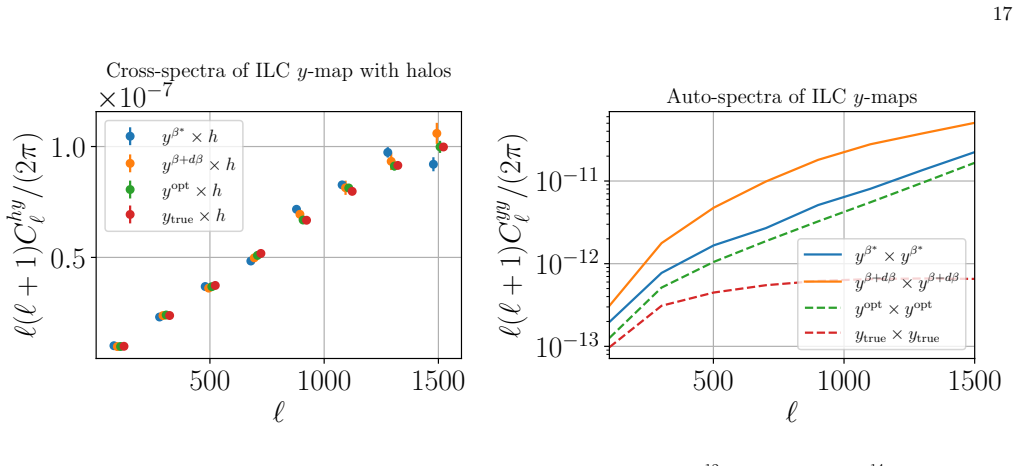
A. Kusiak, K. M. Surrao, and J. C. Hill, Phys. Rev. D 108, 123501 (2023), 2303.08121, URL https://arxiv.org/pdf/ 17 500 1000 1500 𝓁 0.5 1.0 𝓁(𝓁+ 1)C hy 𝓁 /(2π) ×10−7 Cross-spectra of ILC y-map with halos yβ∗ × h yβ+dβ × h yopt × h ytrue × h 500 1000 1500 𝓁 10−13 10−12 10−11 𝓁(...
2023 arXiv
-
[51]
Remazeilles, A
M. Remazeilles, A. Rotti, and J. Chluba, Mon. Not. Roy. Astron. Soc. 503, 2478 (2021), 2006.08628, URL https: //arxiv.org/pdf/2006.08628.pdf
2021 arXiv
-
[52]
Efstathiou and F
G. Efstathiou and F. McCarthy (2025), 2502.10232, URL https://arxiv.org/abs/2502.10232
2025 arXiv
-
[53]
Pandey et al
S. Pandey et al. (2025)
2025
-
[54]
Zonca, L
A. Zonca, L. Singer, D. Lenz, M. Reinecke, C. Rosset, E. Hivon, and K. Gorski, Journal of Open Source Software 4, 1298 (2019), URL https://doi.org/10.21105/joss.01298
2019 doi
-
[55]
K. M. G´ orski, E. Hivon, A. J. Banday, B. D. Wandelt, F. K. Hansen, M. Reinecke, and M. Bartelmann, Astrophys. J. 622, 759 (2005), astro-ph/0409513, URL https://arxiv.org/abs/astro-ph/0409513
2005 arXiv
-
[56]
Klypin, G
A. Klypin, G. Yepes, S. Gottlober, F. Prada, and S. Hess, Mon. Not. Roy. Astron. Soc. 457, 4340 (2016), 1411.4001, URL https://arxiv.org/abs/1411.4001
2016 arXiv
-
[57]
A. J. Mead, T. Tr¨ oster, C. Heymans, L. Van Waerbeke, and I. G. McCarthy, Astron. Astrophys. 641, A130 (2020), 2005.00009, URL https://arxiv.org/pdf/2005.00009
2020 arXiv
-
[58]
I. G. McCarthy, J. Schaye, S. Bird, and A. M. C. Le Brun, Mon. Not. Roy. Astron. Soc. 465, 2936 (2017), 1603.02702, URL https://arxiv.org/pdf/1603.02702
2017 arXiv
-
[59]
Behroozi, R
P. Behroozi, R. H. Wechsler, A. P. Hearin, and C. Conroy, Mon. Not. R. Astron. Soc. 488, 3143 (2019), 1806.07893, URL https://arxiv.org/abs/1806.07893
2019 arXiv
-
[60]
R. C. Kennicutt, Jr., Astrophys. J. 498, 541 (1998), astro-ph/9712213, URL https://arxiv.org/abs/astro-ph/9712213
1998 arXiv
-
[61]
Astrophys
Planck Collaboration, Astron. Astrophys. 594, A15 (2016), 1502.01591, URL https://arxiv.org/abs/1502.01591
2016 arXiv
-
[62]
Dupac et al., Astron
X. Dupac et al., Astron. Astrophys. 404, L11 (2003), astro-ph/0304253, URL https://arxiv.org/abs/astro-ph/0304253
2003 arXiv
-
[63]
P. A. R. Ade, N. Aghanim, C. Armitage-Caplan, M. Arnaud, M. Ashdown, F. Atrio-Barandela, J. Aumont, C. Baccigalupi, A. J. Banday, R. B. Barreiro, et al. (Planck), Astronomy & Astrophysics 571, A9 (2014), ISSN 1432-0746, 1303.5070, URL http://dx.doi.org/10.1051/0004-6361/201321531
2014 arXiv
-
[64]
Naess, Y
S. Naess, Y. Guan, A. J. Duivenvoorden, M. Hasselfield, Y. Wang, I. Abril-Cabezas, G. E. Addison, P. A. R. Ade, S. Aiola, T. Alford, et al., arXiv e-prints arXiv:2503.14451 (2025), 2503.14451
2025 arXiv
-
[65]
Louis, A
T. Louis, A. La Posta, Z. Atkins, H. T. Jense, I. Abril-Cabezas, G. E. Addison, P. A. R. Ade, S. Aiola, T. Alford, D. Alonso, et al., arXiv e-prints arXiv:2503.14452 (2025), 2503.14452
2025 arXiv
-
[66]
Calabrese, J
E. Calabrese, J. C. Hill, H. T. Jense, A. La Posta, I. Abril-Cabezas, G. E. Addison, P. A. R. Ade, S. Aiola, T. Alford, D. Alonso, et al., arXiv e-prints arXiv:2503.14454 (2025), 2503.14454
2025 arXiv
- [67]
-
[68]
Abitbol et al
M. Abitbol et al. (Simons Observatory) (2025), 2503.00636, URL https://arxiv.org/abs/2503.00636
2025 arXiv
-
[69]
CMB-S4 Collaboration, arXiv e-prints arXiv:1610.02743 (2016), 1610.02743
2016 arXiv
-
[70]
Z. Li, G. Puglisi, M. S. Madhavacheril, and M. A. Alvarez, JCAP 08, 029 (2022), 2110.15357, URL https://arxiv.org/ abs/2110.15357
2022 arXiv
-
[71]
A. S. Maniyar, A. Gkogkou, W. R. Coulton, Z. Li, G. Lagache, and A. R. Pullen, Phys. Rev. D 107, 123504 (2023), 2301.10764
2023 arXiv
-
[72]
Kokron, J
N. Kokron, J. L. Bernal, and J. Dunkley, Phys. Rev. D 110, 103535 (2024), 2405.20369
2024 arXiv
-
[73]
Goldstein, F
S. Goldstein, F. McCarthy, C. Mondino, J. C. Hill, J. Huang, and M. C. Johnson, Phys. Rev. Lett. 134, 081001 (2025), 2409.10514, URL https://arxiv.org/abs/2409.10514
2025 arXiv
-
[74]
Mondino, D
C. Mondino, D. P ˆ ırvu, J. Huang, and M. C. Johnson, JCAP 10, 107 (2024), 2405.08059, URL https://arxiv.org/abs/ 2405.08059. 18 500 1000 1500 𝓁 0.6 0.8 1.0 1.2 Ratio of Error Bars (yβ∗ × h Error)/(yβ+dβ × h Error) (yβ∗ × h Error)/(yopt × h Error) FIG. 12: Same as Fig. 6 but u...
2024 arXiv
-
[75]
P ˆ ırvu, J
D. P ˆ ırvu, J. Huang, and M. C. Johnson, J. Cosm. Astrop. Phys.2024, 019 (2024), 2307.15124
2024 arXiv
-
[76]
McCarthy, D
F. McCarthy, D. Pirvu, J. C. Hill, J. Huang, M. C. Johnson, and K. K. Rogers, Phys. Rev. Lett. 133, 141003 (2024), 2406.02546, URL https://arxiv.org/abs/2406.02546
2024 arXiv
-
[77]
O. Dore, J. F. Hennawi, and D. N. Spergel, Astrophys. J. 606, 46 (2004), astro-ph/0309337, URL https://arxiv.org/ abs/astro-ph/0309337
2004 arXiv
-
[78]
DeDeo, D
S. DeDeo, D. N. Spergel, and H. Trac (2005), astro-ph/0511060, URL https://arxiv.org/abs/astro-ph/0511060
2005 arXiv
-
[79]
J. C. Hill, S. Ferraro, N. Battaglia, J. Liu, and D. N. Spergel, Phys. Rev. Lett. 117, 051301 (2016), 1603.01608, URL https://arxiv.org/abs/1603.01608
2016 arXiv
-
[80]
Ferraro, J
S. Ferraro, J. C. Hill, N. Battaglia, J. Liu, and D. N. Spergel, Phys. Rev. D 94, 123526 (2016), 1605.02722, URL https: //arxiv.org/abs/1605.02722
2016 arXiv
-
[81]
Kusiak, B
A. Kusiak, B. Bolliet, S. Ferraro, J. C. Hill, and A. Krolewski, Phys. Rev. D 104, 043518 (2021), 2102.01068, URL http://dx.doi.org/10.1103/PhysRevD.104.043518
2021 arXiv
-
[82]
Patki, N
R. Patki, N. Battaglia, and S. Ferraro, Phys. Rev. D 108, 043507 (2023), 2306.03127, URL https://arxiv.org/abs/ 2306.03127
2023 arXiv
-
[83]
S. E. Clark, J. C. Hill, J. E. G. Peek, M. E. Putman, and B. L. Babler, Phys. Rev. Lett. 115, 241302 (2015), 1508.07005, URL https://arxiv.org/abs/1508.07005
2015 arXiv
-
[84]
Halal, S
G. Halal, S. E. Clark, A. Cukierman, D. Beck, and C.-L. Kuo, Astrophys. J. 961, 29 (2024), 2306.10107, URL https: //arxiv.org/abs/2306.10107
2024
-
[85]
Tassis, A
K. Tassis, A. N. Ramaprakash, A. C. S. Readhead, S. B. Potter, I. K. Wehus, G. V. Panopoulou, D. Blinov, H. K. Eriksen, B. Hensley, A. Karakci, et al., arXiv e-prints arXiv:1810.05652 (2018), 1810.05652, URL https://arxiv.org/abs/1810. 05652
2018 arXiv
-
[86]
Pelgrims, N
V. Pelgrims, N. Mandarakas, R. Skalidis, K. Tassis, G. V. Panopoulou, V. Pavlidou, D. Blinov, S. Kiehlmann, S. E. Clark, B. S. Hensley, et al., Astron. Astrophys. 684, A162 (2024), 2404.10821, URL https://arxiv.org/abs/2404.10821
2024 arXiv
-
[87]
Vacher, J
L. Vacher, J. Aumont, L. Montier, S. Azzoni, F. Boulanger, and M. Remazeilles, Astron. Astrophys. 660, A111 (2022), 2111.07742
2022 arXiv
-
[88]
Azzoni, M
S. Azzoni, M. H. Abitbol, D. Alonso, A. Gough, N. Katayama, and T. Matsumura, J. Cosm. Astrop. Phys. 2021, 047 (2021), 2011.11575
2021 arXiv
-
[89]
Azzoni, D
S. Azzoni, D. Alonso, M. H. Abitbol, J. Errard, and N. Krachmalnicoff, J. Cosm. Astrop. Phys. 2023, 035 (2023), 2210.14838
2023 arXiv
-
[90]
C. R. Harris, K. J. Millman, S. J. van der Walt, R. Gommers, P. Virtanen, D. Cournapeau, E. Wieser, J. Taylor, S. Berg, N. J. Smith, et al., Nature 585, 357 (2020), URL https://arxiv.org/pdf/2006.10256.pdf
2020 arXiv
-
[91]
Virtanen, R
P. Virtanen, R. Gommers, T. E. Oliphant, M. Haberland, T. Reddy, D. Cournapeau, E. Burovski, P. Peterson, W. Weckesser, J. Bright, et al., Nature Methods 17, 261 (2020), URL https://arxiv.org/pdf/1907.10121.pdf
2020 arXiv
-
[92]
J. D. Hunter, Computing in Science & Engineering 9, 90 (2007), URL https://ieeexplore.ieee.org/document/4160265
2007
-
[93]
Astropy Collaboration, T. P. Robitaille, E. J. Tollerud, P. Greenfield, M. Droettboom, E. Bray, T. Aldcroft, M. Davis, A. Ginsburg, A. M. Price-Whelan, et al., Astron. Astrophys. 558, A33 (2013), 1307.6212, URL https://arxiv.org/pdf/ 1307.6212.pdf
2013 arXiv
-
[94]
Astropy Collaboration, A. M. Price-Whelan, B. M. Sip˝ ocz, H. M. G¨ unther, P. L. Lim, S. M. Crawford, S. Conseil, D. L. Shupe, M. W. Craig, N. Dencheva, et al., Astron. J. 156, 123 (2018), 1801.02634, URL https://arxiv.org/pdf/1801. 02634.pdf
2018 arXiv
-
[95]
Astropy Collaboration, A. M. Price-Whelan, P. L. Lim, N. Earl, N. Starkman, L. Bradley, D. L. Shupe, A. A. Patil, L. Corrales, C. E. Brasseur, et al., apj 935, 167 (2022), 2206.14220, URL https://arxiv.org/pdf/2206.14220.pdf
2022 arXiv
-
[96]
Zhou et al
R. Zhou et al. (DESI), Astron. J. 165, 58 (2023), 2208.08515, URL https://arxiv.org/abs/2208.08515. 19 0.0 2.5 5.0 7.5 10.0 χ2 − χ2 min 𝓁=102 𝓁=302 𝓁=502 𝓁=701 𝓁=901 1.5 1.6 1.7 β 0.0 2.5 5.0 7.5 10.0 χ2 − χ2 min 𝓁=1101 1.5 1.6 1.7 β 𝓁=1301 1.5 1.6 1.7 β 𝓁=1500 1.5 1.6 1.7 β 𝓁...
2023 arXiv
Reviewed August 7, 2026 · model on record in the stance chip above.
Discussion (0). Sign in to comment.