n-VDD: Location Privacy Protection Based on Voronoi-Delaunay Duality
Pith reviewed 2026-05-25 18:24 UTC · model grok-4.3
The pith
Irregular n-sided Voronoi cells hide exact user locations from LBS servers by defining anonymity zones as intersections of edge-bounded strips.
A machine-rendered reading of the paper's core claim, the machinery that carries it, and where it could break.
Core claim
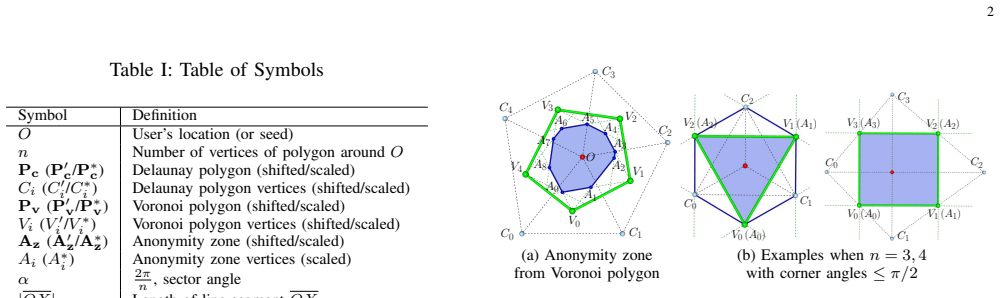
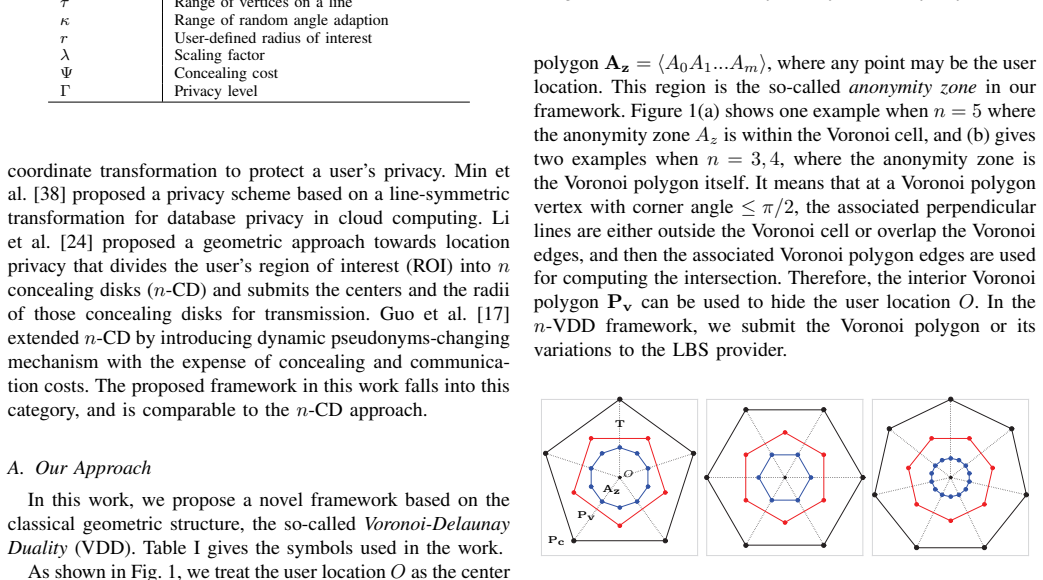
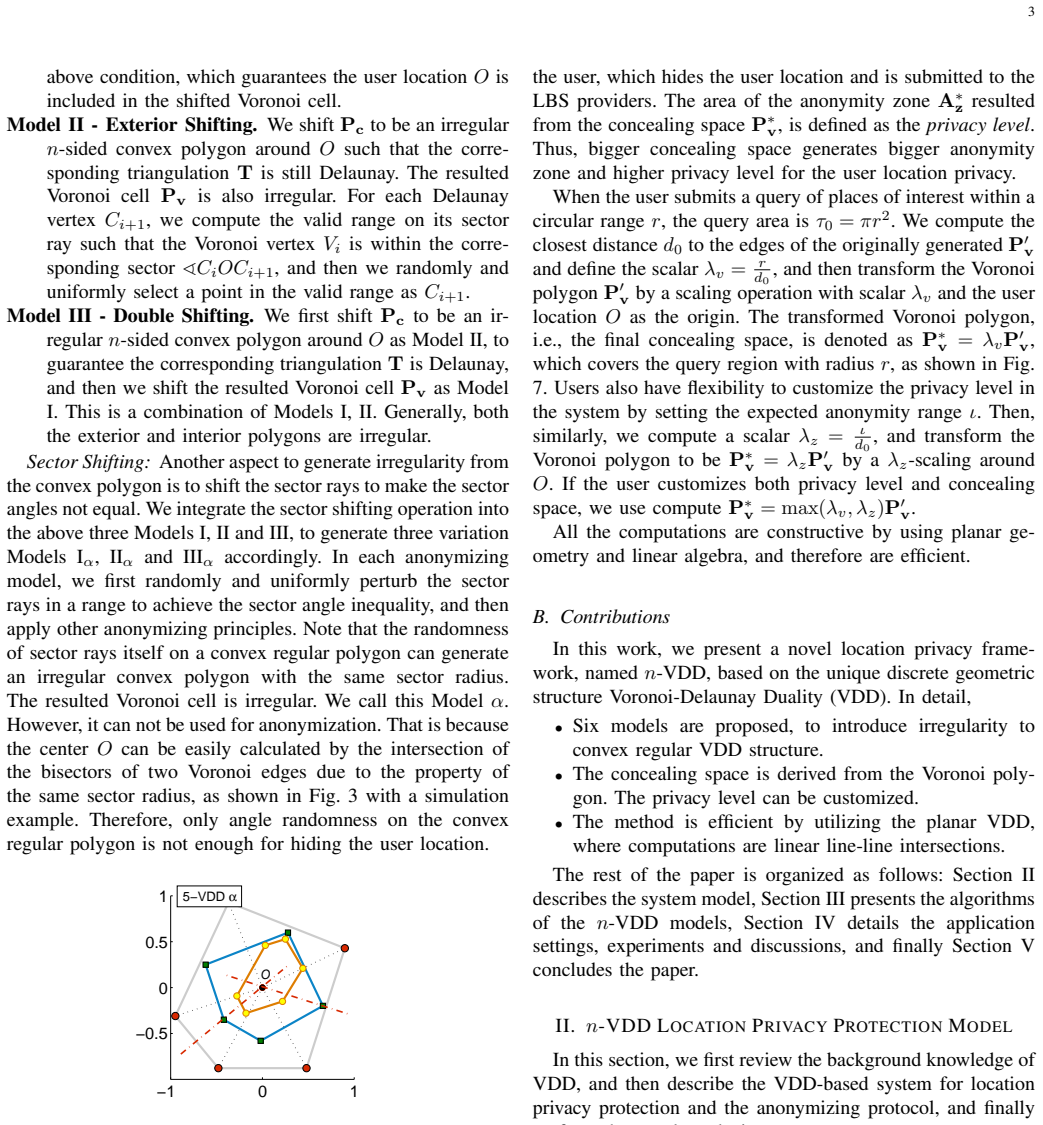
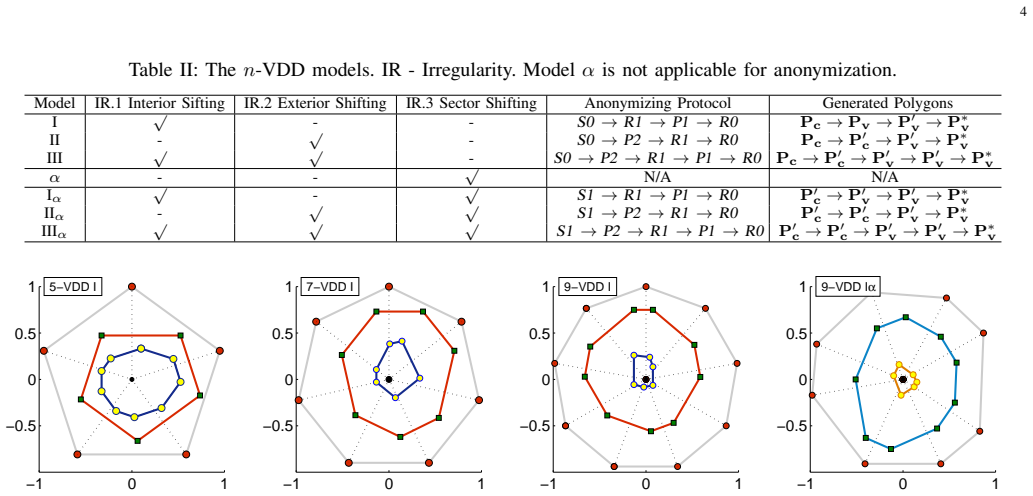
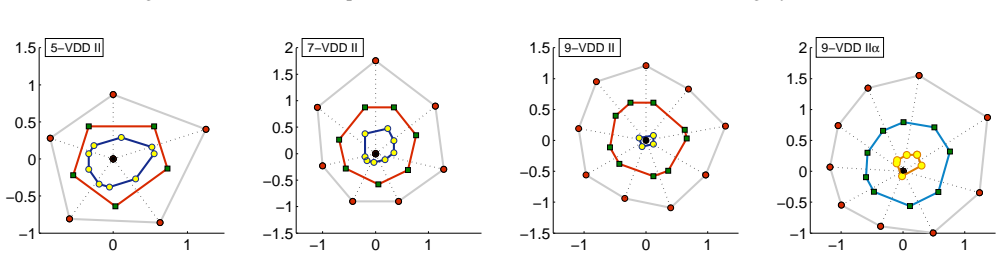
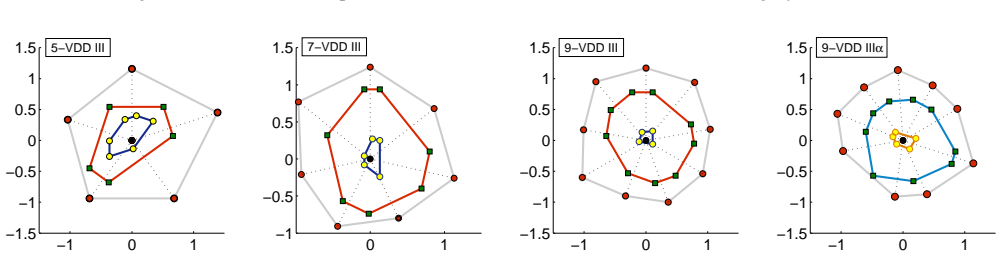
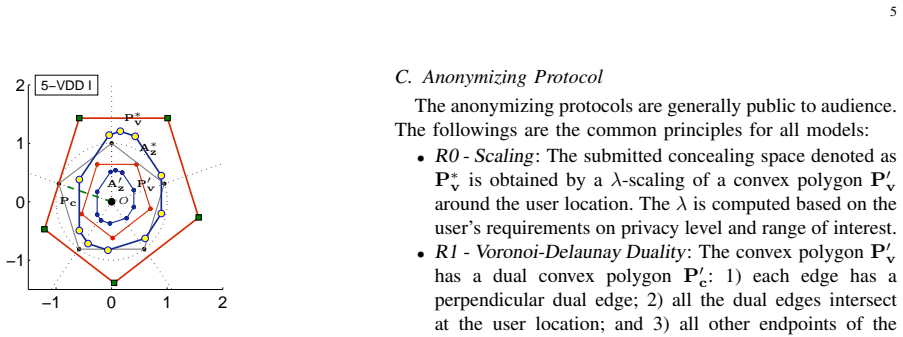
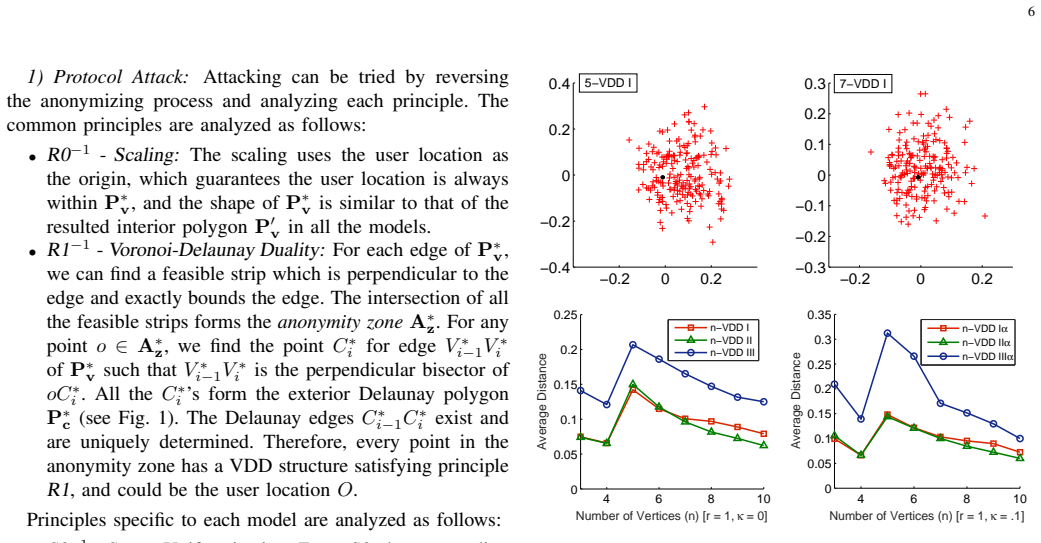
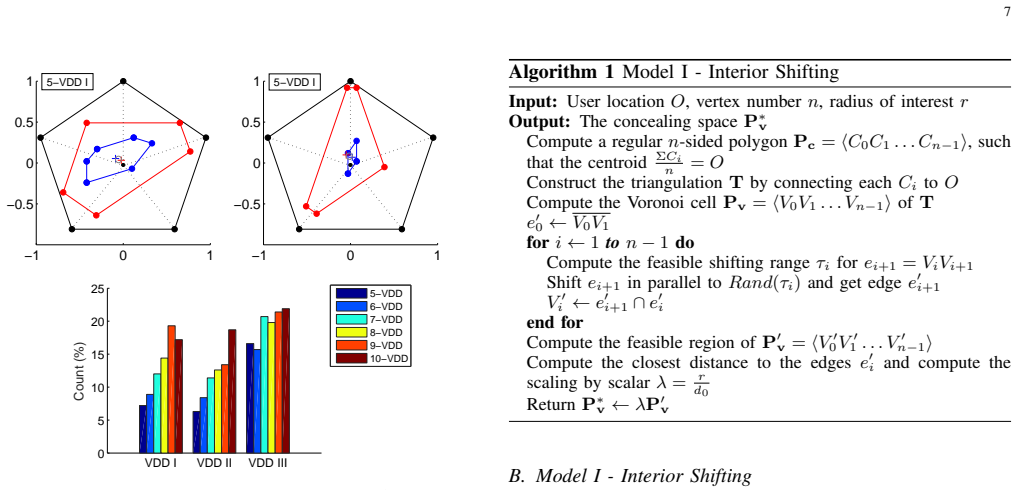
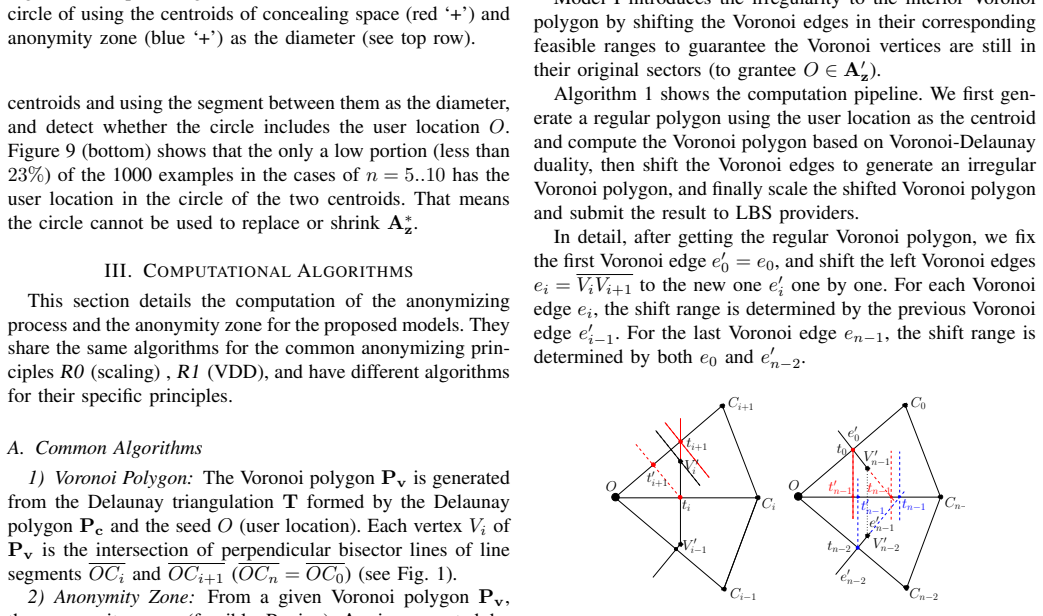
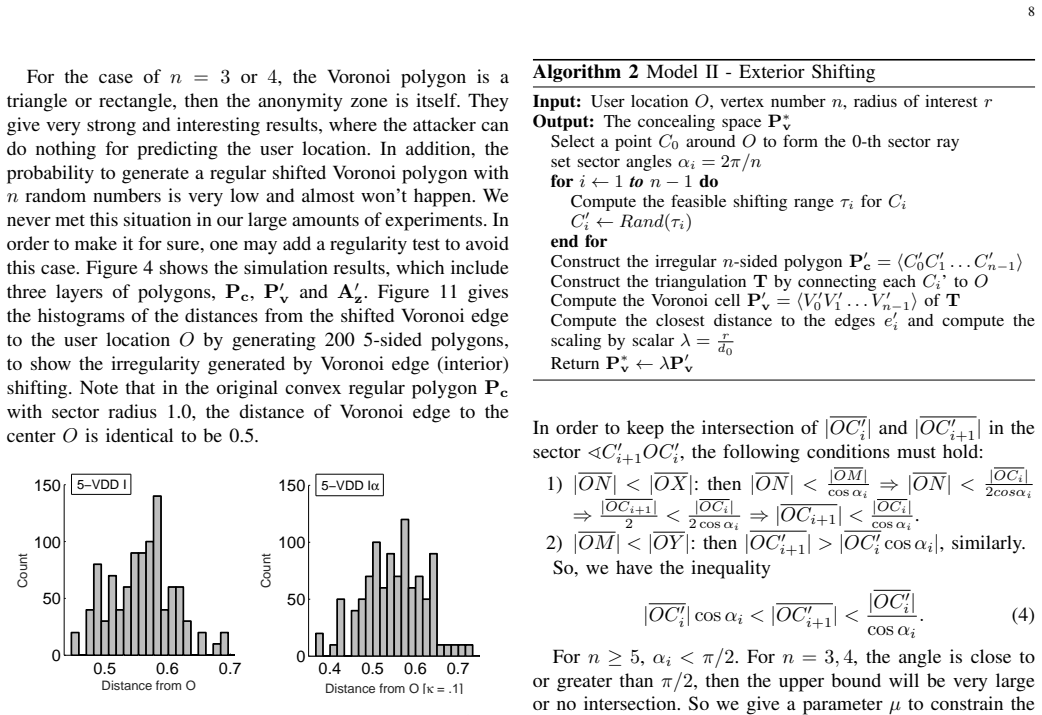
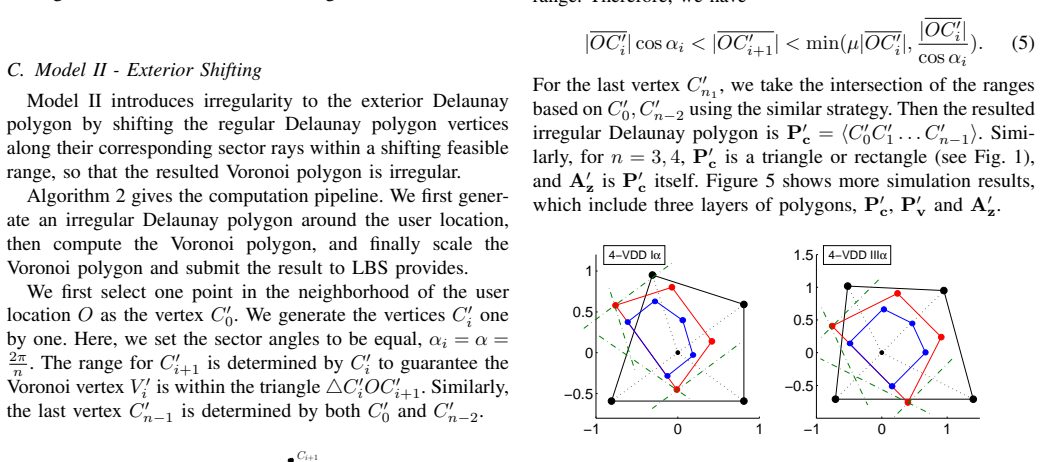
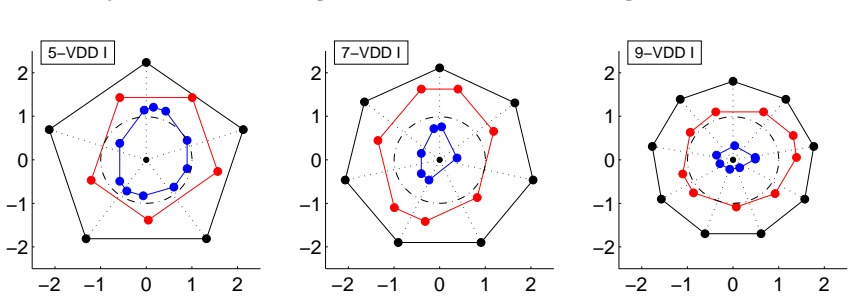
The central claim is that the user location cannot be recovered if only given an irregular n-sided Voronoi cell around it, and the anonymity zone is the intersection of all the parallel strips perpendicular to and bounded by n Voronoi edges. The irregular Voronoi cell and its variations can be used as the concealing space to hide the user location or the region of interest and submitted to the LBS server. Within this framework, multiple typical anonymizing models are proposed by introducing irregularity to the convex regular VDD structure by shifting the interior Voronoi cell, exterior Delaunay polygon, sector rays, or their combinations. The proposed methods are efficient by takingadvantage
What carries the argument
The n-VDD framework, in which irregular Voronoi cells generated from Voronoi-Delaunay duality act as concealing spaces whose anonymity zones are intersections of parallel strips bounded by the cell edges.
If this is right
- Multiple anonymizing models become available by shifting the interior Voronoi cell, exterior Delaunay polygon, sector rays, or combinations thereof.
- Main computations reduce to linear line-line intersections, preserving efficiency across parameter settings.
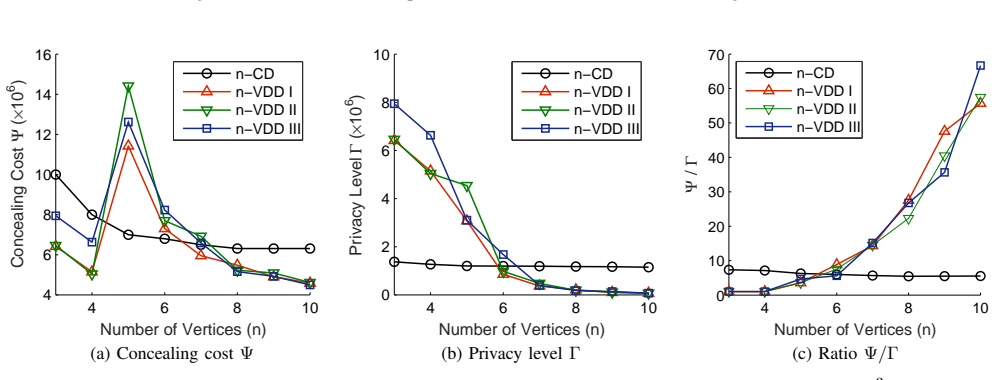
- Experiments with varied parameters confirm both the efficiency and the efficacy of the n-VDD constructions.
Where Pith is reading between the lines
- The same cell-based concealment could be layered with existing cryptographic or query-perturbation techniques for additional protection.
- The approach might extend directly to hiding regions of interest rather than single points in spatial database queries.
- Performance in mobile settings would hinge on how quickly new irregular cells can be generated as the user moves.
Load-bearing premise
That an LBS server cannot recover the exact user location when supplied only with an irregular n-sided Voronoi cell around it.
What would settle it
An experiment in which an attacker, given only the boundaries of the submitted irregular Voronoi cell, reconstructs the true user location inside that cell with probability significantly above random guessing.
Figures
read the original abstract
To date, location privacy protection is a critical issue in Location-Based Services (LBS). In this work, we propose a novel geometric framework based on the classical discrete geometric structure, the Voronoi-Delaunay duality (VDD). We utilize the fact that the user location cannot be recovered if only given an irregular $n$-sided Voronoi cell around it, and the anonymity zone is the intersection of all the parallel strips perpendicular to and bounded by $n$ Voronoi edges. The irregular Voronoi cell and its variations can be used as the concealing space to hide the user location or the region of interest and submitted to the LBS server. Within this framework, we propose multiple typical anonymizing models by introducing irregularity to the convex regular VDD structure by shifting the interior Voronoi cell, exterior Delaunay polygon, sector rays, or their combinations. The proposed methods are efficient by taking advantage of the VDD principle where main computations are linear line-line intersections. Experiments with various parameters demonstrate the efficiency and efficacy of the proposed $n$-VDD framework.
Editorial analysis
A structured set of objections, weighed in public.
Referee Report
Summary. The manuscript proposes the n-VDD framework for location privacy in LBS, asserting that an irregular n-sided Voronoi cell conceals the exact user location because the anonymity zone equals the intersection of n parallel strips perpendicular to and bounded by the Voronoi edges. Irregularity is introduced via shifts to the interior Voronoi cell, exterior Delaunay polygon, sector rays, or combinations; the resulting concealing spaces are submitted to the LBS server. Efficiency is claimed from the VDD property that main operations reduce to linear line-line intersections, with experiments asserted to demonstrate both efficiency and efficacy.
Significance. If the geometric privacy argument holds, the work supplies a concrete, duality-based method for constructing cloaking regions whose generation cost is linear in the number of edges. The reduction of cloaking to line-line intersections is a genuine computational advantage over more general convex-hull or optimization approaches and could be useful in resource-constrained LBS settings.
major comments (2)
- [Abstract and §3] Abstract and §3 (model description): the central privacy claim—that the exact location is unrecoverable once only the irregular cell is revealed—rests on the geometric definition of the anonymity zone but supplies no adversary model, no statement of what auxiliary information the server is assumed to possess, and no reduction showing that any point inside the intersection is equally likely. This is load-bearing for the privacy guarantee.
- [§4] §4 (experimental evaluation): the text asserts that “experiments with various parameters demonstrate the efficiency and efficacy,” yet no tables, no reported running times, no comparison baselines, and no privacy metric (e.g., area of anonymity zone, success rate of reconstruction attacks) are referenced. Without these data the efficiency claim cannot be verified.
minor comments (2)
- Notation for the parallel strips and the intersection operator is introduced only informally; a short formal definition (e.g., as a set intersection) would improve readability.
- The abstract and introduction cite the Voronoi-Delaunay duality but do not reference the classical computational-geometry literature on its use for nearest-neighbor or convex-hull queries; adding one or two standard citations would situate the contribution.
Simulated Author's Rebuttal
We thank the referee for the constructive feedback. The comments highlight important aspects of the privacy argument and experimental presentation that merit clarification and expansion. We respond to each major comment below.
read point-by-point responses
-
Referee: [Abstract and §3] Abstract and §3 (model description): the central privacy claim—that the exact location is unrecoverable once only the irregular cell is revealed—rests on the geometric definition of the anonymity zone but supplies no adversary model, no statement of what auxiliary information the server is assumed to possess, and no reduction showing that any point inside the intersection is equally likely. This is load-bearing for the privacy guarantee.
Authors: We agree that an explicit adversary model strengthens the privacy section. In the revision we will add to §3 a formal adversary definition (server receives only the irregular n-VDD cell and no side information on location distribution or user identity) together with a geometric reduction: because the revealed cell is the unique Voronoi cell consistent with any point inside the intersection of the n parallel strips (by VDD duality), every such point is equally plausible. This directly supports the claim that the exact location is unrecoverable. revision: yes
-
Referee: [§4] §4 (experimental evaluation): the text asserts that “experiments with various parameters demonstrate the efficiency and efficacy,” yet no tables, no reported running times, no comparison baselines, and no privacy metric (e.g., area of anonymity zone, success rate of reconstruction attacks) are referenced. Without these data the efficiency claim cannot be verified.
Authors: The referee correctly notes that the submitted manuscript omitted the supporting experimental data. We will revise §4 to include tables of running times (confirming linear scaling with n), baseline comparisons against grid-based and convex-hull cloaking, and quantitative metrics (anonymity-zone area and simulated reconstruction-attack success rates). These additions will substantiate both the efficiency (via line-line intersections) and efficacy claims. revision: yes
Circularity Check
No significant circularity detected
full rationale
The paper's proposal rests on the classical geometric property that an irregular n-sided Voronoi cell conceals the exact location via the intersection of parallel strips bounded by its edges. This follows directly from the definition of Voronoi cells and Delaunay duality as standard discrete geometry, without any equations, fitted parameters, or self-citations that reduce the result to its own inputs by construction. The VDD is invoked only to enable efficient computation via line-line intersections, and the anonymity models are obtained by standard variations (shifting cells, polygons, or rays). The derivation chain is self-contained against external benchmarks and introduces no load-bearing self-referential steps.
Axiom & Free-Parameter Ledger
axioms (1)
- standard math Voronoi-Delaunay duality holds for the discrete geometric structure used to define cells and edges.
Reference graph
Works this paper leans on
-
[1]
Charu C. Aggarwal and Philip S. Yu. A general survey of privacy- preserving data mining models and algorithms . Springer, 2008. 12
work page 2008
-
[2]
C. A. Ardagna, M. Cremonini, E. Damiani, S. De Capitani di Vimercati, and P. Samarati. Location privacy protection through obfuscation-based techniques. In Proceedings of the 21st Annual IFIP WG 11.3 Working Conference on Data and Applications Security , pages 47–60, Berlin, Heidelberg, 2007. Springer-Verlag
work page 2007
-
[3]
An obfuscation-based approach for protecting location privacy
Claudio A Ardagna, Marco Cremonini, Sabrina De Capitani di Vimer- cati, and Pierangela Samarati. An obfuscation-based approach for protecting location privacy. Dependable and Secure Computing, IEEE Transactions on, 8(1):13–27, 2011
work page 2011
-
[4]
Supporting anonymous location queries in mobile environments with privacygrid
Bhuvan Bamba, Ling Liu, Peter Pesti, and Ting Wang. Supporting anonymous location queries in mobile environments with privacygrid. In Proceedings of the 17th International Conference on World Wide Web , WWW ’08, pages 237–246, New York, NY , USA, 2008. ACM
work page 2008
-
[5]
Supporting anonymous location queries in mobile environments with privacygrid
Bhuvan Bamba, Ling Liu, Peter Pesti, and Ting Wang. Supporting anonymous location queries in mobile environments with privacygrid. In Proceedings of the 17th international conference on World Wide Web, pages 237–246. ACM, 2008
work page 2008
-
[6]
Challenges of location-based services market analysis: Current market description
Anahid Basiri, Terry Moore, Chris Hill, and Paul Bhatia. Challenges of location-based services market analysis: Current market description. In Georg Gartner and Haosheng Huang, editors, Progress in Location- Based Services 2014, Lecture Notes in Geoinformation and Cartography, pages 273–282. Springer International Publishing, 2015
work page 2014
-
[7]
A peer-to-peer spatial cloaking algorithm for anonymous location-based service
Chi-Yin Chow, Mohamed F Mokbel, and Xuan Liu. A peer-to-peer spatial cloaking algorithm for anonymous location-based service. In Proceedings of the 14th annual ACM international symposium on Advances in geographic information systems , pages 171–178. ACM, 2006
work page 2006
-
[8]
Computational Geometry: Algorithms and Applications
Mark de Berg, Otfried Cheong, Marc van Kreveld, and Mark Overmars. Computational Geometry: Algorithms and Applications . Springer- Verlag, 2008
work page 2008
-
[9]
A formal model of obfuscation and ne- gotiation for location privacy
Matt Duckham and Lars Kulik. A formal model of obfuscation and ne- gotiation for location privacy. In Proceedings of the Third International Conference on Pervasive Computing , PERV ASIVE’05, pages 152–170, Berlin, Heidelberg, 2005. Springer-Verlag
work page 2005
-
[10]
Protecting privacy using k- anonymity
Khaled El Emam and Fida Kamal Dankar. Protecting privacy using k- anonymity. Journal of the American Medical Informatics Association , 15(5):627–637, 2008
work page 2008
-
[11]
Privacy- preserving data publishing: A survey of recent developments
Benjamin Fung, Ke Wang, Rui Chen, and Philip S Yu. Privacy- preserving data publishing: A survey of recent developments. ACM Computing Surveys (CSUR) , 42(4):14, 2010
work page 2010
-
[12]
A customizable k-anonymity model for protecting location privacy
Bugra Gedik and Ling Liu. A customizable k-anonymity model for protecting location privacy. 2004
work page 2004
-
[13]
Location privacy in mobile systems: A personalized anonymization model
Bu ˘gra Gedik and Ling Liu. Location privacy in mobile systems: A personalized anonymization model. In Distributed Computing Systems,
-
[14]
ICDCS 2005. Proceedings. 25th IEEE International Conference on, pages 620–629. IEEE, 2005
work page 2005
-
[15]
Protecting location privacy with personalized k-anonymity: Architecture and algorithms
Bu ˘gra Gedik and Ling Liu. Protecting location privacy with personalized k-anonymity: Architecture and algorithms. IEEE Transactions on Mobile Computing, 7(1):1–18, January 2008
work page 2008
-
[16]
Protecting privacy in location-based services using k-anonymity without cloaked region
Zhenqiang Gong, Guang-Zhong Sun, and Xing Xie. Protecting privacy in location-based services using k-anonymity without cloaked region. In Mobile Data Management (MDM), 2010 Eleventh International Conference on, pages 366–371. IEEE, 2010
work page 2010
-
[17]
Anonymous usage of location- based services through spatial and temporal cloaking
Marco Gruteser and Dirk Grunwald. Anonymous usage of location- based services through spatial and temporal cloaking. In Proceedings of the 1st International Conference on Mobile Systems, Applications and Services, MobiSys ’03, pages 31–42, New York, NY , USA, 2003. ACM
work page 2003
-
[18]
Pseudonym-based anonymity zone generation for mobile service with strong adversary model
Mingming Guo, Niki Pissinou, and SS Iyengar. Pseudonym-based anonymity zone generation for mobile service with strong adversary model. In Consumer Communications and Networking Conference (CCNC), 2015 12th Annual IEEE , pages 335–340. IEEE, 2015
work page 2015
-
[19]
Andreas Gutscher. Coordinate transformation - a solution for the privacy problem of location based services? In Proceedings of the 20th Inter- national Conference on Parallel and Distributed Processing , IPDPS’06, pages 354–354, Washington, DC, USA, 2006. IEEE Computer Society
work page 2006
-
[20]
Preventing location-based identity inference in anonymous spatial queries
Panos Kalnis, Gabriel Ghinita, Kyriakos Mouratidis, and Dimitris Papa- dias. Preventing location-based identity inference in anonymous spatial queries. Knowledge and Data Engineering, IEEE Transactions on , 19(12):1719–1733, 2007
work page 2007
-
[21]
User location anonymization method for wide distribution of dummies
Ryo Kato, Mayu Iwata, Takahiro Hara, Yuki Arase, Xing Xie, and Sho- jiro Nishio. User location anonymization method for wide distribution of dummies. In Database and Expert Systems Applications , pages 259–
-
[22]
A dummy-based anonymization method based on user trajectory with pauses
Ryo Kato, Mayu Iwata, Takahiro Hara, Akiyoshi Suzuki, Xing Xie, Yuki Arase, and Shojiro Nishio. A dummy-based anonymization method based on user trajectory with pauses. In Proceedings of the 20th International Conference on Advances in Geographic Information Systems, pages 249–258. ACM, 2012
work page 2012
-
[23]
An anonymous communication technique using dummies for location-based services
Hidetoshi Kido, Yutaka Yanagisawa, and Tetsuji Satoh. An anonymous communication technique using dummies for location-based services. In Pervasive Services, 2005. ICPS’05. Proceedings. International Confer- ence on, pages 88–97. IEEE, 2005
work page 2005
-
[24]
Mondrian multidimensional k-anonymity
Kristen LeFevre, David J DeWitt, and Raghu Ramakrishnan. Mondrian multidimensional k-anonymity. In Data Engineering, 2006. ICDE’06. Proceedings of the 22nd International Conference on , pages 25–25. IEEE, 2006
work page 2006
-
[25]
Ming Li, S. Salinas, A. Thapa, and Pan Li. n-cd: A geometric approach to preserving location privacy in location-based services. In INFOCOM, 2013 Proceedings IEEE , pages 3012–3020, April 2013
work page 2013
-
[26]
Ninghui Li, Tiancheng Li, and S. Venkatasubramanian. t-closeness: Privacy beyond k-anonymity and l-diversity. In Data Engineering, 2007. ICDE 2007. IEEE 23rd International Conference on , pages 106–115, April 2007
work page 2007
-
[27]
t-closeness: Privacy beyond k-anonymity and l-diversity
Ninghui Li, Tiancheng Li, and Suresh Venkatasubramanian. t-closeness: Privacy beyond k-anonymity and l-diversity. In Data Engineering, 2007. ICDE 2007. IEEE 23rd International Conference on , pages 106–115. IEEE, 2007
work page 2007
-
[28]
Hua Lu, Christian S. Jensen, and Man Lung Yiu. Pad: Privacy-area aware, dummy-based location privacy in mobile services. InProceedings of the Seventh ACM International Workshop on Data Engineering for Wireless and Mobile Access, MobiDE ’08, pages 16–23, New York, NY , USA, 2008. ACM
work page 2008
-
[29]
l-diversity: Privacy beyond k- anonymity
Ashwin Machanavajjhala, Daniel Kifer, Johannes Gehrke, and Muthu- ramakrishnan Venkitasubramaniam. l-diversity: Privacy beyond k- anonymity. ACM Transactions on Knowledge Discovery from Data (TKDD), 1(1):3, 2007
work page 2007
-
[30]
S. Mascetti, C. Bettini, X.S. Wang, D. Freni, and S. Jajodia. Providen- thider: An algorithm to preserve historical k-anonymity in lbs. In Mobile Data Management: Systems, Services and Middleware, 2009. MDM ’09. Tenth International Conference on , pages 172–181, May 2009
work page 2009
-
[31]
The new casper: query processing for location services without compromising privacy
Mohamed F Mokbel, Chi-Yin Chow, and Walid G Aref. The new casper: query processing for location services without compromising privacy. In Proceedings of the 32nd international conference on Very large data bases, pages 763–774. VLDB Endowment, 2006
work page 2006
-
[32]
Micro- aggregation-based heuristics for p-sensitive k-anonymity: One step be- yond
Agusti Solanas, Francesc Seb ´e, and Josep Domingo-Ferrer. Micro- aggregation-based heuristics for p-sensitive k-anonymity: One step be- yond. In Proceedings of the 2008 International Workshop on Privacy and Anonymity in Information Society , PAIS ’08, pages 61–69, New York, NY , USA, 2008. ACM
work page 2008
-
[33]
A user location anonymization method for location based services in a real environment
Akiyoshi Suzuki, Mayu Iwata, Yuki Arase, Takahiro Hara, Xing Xie, and Shojiro Nishio. A user location anonymization method for location based services in a real environment. In Proceedings of the 18th SIGSPATIAL International Conference on Advances in Geographic Information Systems , GIS ’10, pages 398–401, New York, NY , USA,
-
[34]
Achieving k-anonymity privacy protection using generalization and suppression
Latanya Sweeney. Achieving k-anonymity privacy protection using generalization and suppression. International Journal of Uncertainty, Fuzziness and Knowledge-Based Systems , 10(05):571–588, 2002
work page 2002
-
[35]
Preventing multi-query attack in location-based services
Nilothpal Talukder and Sheikh Iqbal Ahamed. Preventing multi-query attack in location-based services. In Proceedings of the Third ACM Conference on Wireless Network Security, WiSec ’10, pages 25–36, New York, NY , USA, 2010. ACM
work page 2010
-
[36]
Minh-Triet Tran, Isao Echizen, and Anh-Duc Duong. Binomial-mix- based location anonymizer system with global dummy generation to preserve user location privacy in location-based services. In Availability, Reliability, and Security, 2010. ARES’10 International Conference on , pages 580–585. IEEE, 2010
work page 2010
-
[37]
A classification of location privacy attacks and approaches
Marius Wernke, Pavel Skvortsov, Frank D ¨urr, and Kurt Rothermel. A classification of location privacy attacks and approaches. Personal Ubiquitous Comput., 18(1):163–175, January 2014
work page 2014
-
[38]
Personalized privacy preservation
Xiaokui Xiao and Yufei Tao. Personalized privacy preservation. In Proceedings of the 2006 ACM SIGMOD international conference on Management of data , pages 229–240. ACM, 2006
work page 2006
-
[39]
Linear function based transformation scheme for preserving database privacy in cloud computing
Min Yoon, Hyeong-Il Kim, Miyoung Jang, and Jae-Woo Chang. Linear function based transformation scheme for preserving database privacy in cloud computing. In Parallel and Distributed Systems (ICPADS), 2013 International Conference on , pages 498–503, Dec 2013
work page 2013
-
[40]
Cloaking locations for anonymous location based services: a hybrid approach
Chengyang Zhang and Yan Huang. Cloaking locations for anonymous location based services: a hybrid approach. GeoInformatica, 13(2):159– 182, 2009
work page 2009
-
[41]
Real: A reciprocal protocol for location privacy in wireless sensor networks
Jia-Dong Zhang and Chi-Yin Chow. Real: A reciprocal protocol for location privacy in wireless sensor networks. Dependable and Secure Computing, IEEE Transactions on , 12(4):458–471, 2015
work page 2015
discussion (0)
Sign in with ORCID, Apple, or X to comment. Anyone can read and Pith papers without signing in.