REVIEW 2 major objections 6 minor 50 references
Coherent Structures in Flame Fronts
T0 review · 2 major / 6 minor · reviewed 2026-08-06 · deepseek-v4-flash
Pith's one-line read This paper proves that the nonlinear coordinate-free flame front model has infinitely many vertically traveling periodic wave solutions, bifurcating from the flat front at parameter values below $-3$, where the evolution is ill-posed.
desk verdict A correct existence proof for odd periodic traveling waves, with theorem statements and abstract that overclaim by omitting the oddness qualifier. read the letter →
The pith
A machine-rendered reading of the paper's core claim, the machinery that carries it, and where it could break.
The reading
What carries the argument
The central object is the tangent-angle formulation of the front: the interface is parametrized so that arclength is uniform, the unknown is the tangent angle $\theta(\sigma)$, and the curvature is $\theta_\sigma/s_\sigma$. The traveling wave ansatz $(x,y)_t=(0,-\beta)$ combined with $U=-\beta\cos(\theta)$ turns the model into a single bifurcation equation $F(\theta,\beta;\alpha)=0$. The carrying mechanism is Crandall-Rabinowitz bifurcation from a simple eigenvalue: the linearized operator $L(\alpha)(v,\gamma)=(\alpha-1)v_\sigma+\alpha^2(\alpha+3)v_{\sigma\sigma\sigma}-\gamma$ is Fredholm of index zero on $H^3_{\mathrm{odd}}\times\mathbb{R} \to L^2_{\mathrm{even}}$, with kernel spanned by $(\sin(k_0\sigma),0)$ precisely when $\alpha$ is the unique real root $\alpha_0$ of the cubic $q(\alpha)$; a resultant computation verifies the transversality condition that moves the branch off the flat state.
What would settle it
Compute the linearized traveling-wave operator on the full periodic space without the oddness restriction at $\alpha=\alpha_0$; if the kernel is two-dimensional and the transversality condition fails there, then the odd-only branch is an artifact of the subspace choice. A numerical continuation started from a $\cos(k_0\sigma)$ perturbation of the flat front would provide a direct check for an even-parity branch.
Extended reading notes
Core claim
Using the tangent angle $\theta$ of the front in a normalized arclength parameterization, the traveling wave condition $U = -\beta \cos(\theta)$ becomes a nonlinear equation $F(\theta,\beta;\alpha)=0$, with $\beta$ the vertical speed and $\alpha$ the front-instability parameter. The main existence theorem verifies the Crandall-Rabinowitz hypotheses at $\alpha_0$, the unique real root of $q(\alpha)=(\alpha-1)-\alpha^2(\alpha+3)k_0^2$, which lies below $-3$: the linearized operator has one-dimensional kernel spanned by $(\sin(k_0\sigma),0)$ in $H^3_{\mathrm{odd}} \times \mathbb{R}$, has index zero, and satisfies the transversality condition because a resultant of two polynomials is nonzero. Hence a nontrivial curve of odd, vertically traveling, $2\pi$-periodic solutions bifurcates from the flat front $(\theta=0,\beta=1)$. The companion linear model is treated similarly, with branch points $\alpha_1=4k_0^2+1$. Numerical continuation from small-amplitude asymptotics computes large-amplitude branches; the nonlinear branches approach a curvature singularity as $\alpha$ tends to the well-posedness threshold $-3$, and the linear branches terminate near self-intersecting profiles.
Load-bearing premise
The load-bearing premise is that the wave profile is an odd periodic function, a restriction that makes the linearized operator have a one-dimensional kernel; in the full periodic setting the kernel would also contain $\cos(k_0\sigma)$, and the existence argument would not apply.
Editorial extensions
If this is right
- For the nonlinear model, each integer wavenumber $k_0 \ge 1$ produces a distinct branch of odd, vertically traveling, $2\pi$-periodic waves, so the model has infinitely many coherent structures.
- These nonlinear branches exist at $\alpha < -3$, where the time-dependent problem is linearly ill-posed; consequently they cannot be asymptotically stable in the original evolution, a point the paper makes explicitly.
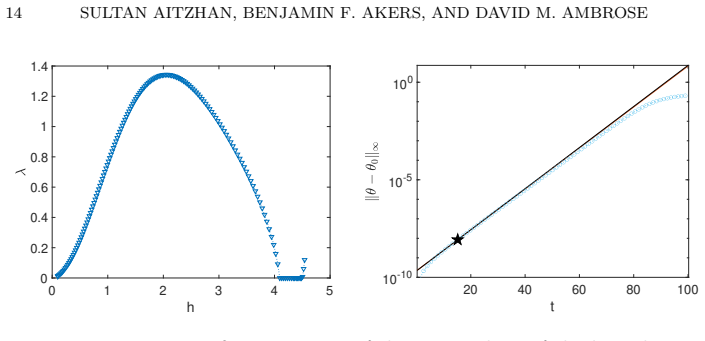
- For the linear model, the computed branches at $\alpha_1=4k_0^2+1$ permit numerical stability tests: the $k_0=2,3$ branches are unstable, while the $k_0=1$ branch shows small-amplitude instability and a narrow amplitude window with no observed instability.
- As $\alpha$ approaches $-3$ from below, the computed nonlinear wave profiles develop a curvature singularity, and the continuation branches do not cross into the well-posed regime.
- The computed waves can overhang, with tangent angle beyond $\pi/2$, so they are outside the reach of weakly nonlinear models such as the Kuramoto-Sivashinsky equation.
Reading between the lines
- The existence proof restricts the profile to odd periodic functions; on the full periodic space the linearized kernel at $\alpha_0$ would also contain $\cos(k_0\sigma)$, so the paper leaves open whether even or mixed-parity vertically traveling waves exist.
- Because the nonlinear branches live in the ill-posed regime, a natural next question is whether they appear as transient coherent structures in a regularized evolution or are recovered by the weakly nonlinear Kuramoto-Sivashinsky dynamics before it fails.
- The same arclength-parameterization bifurcation framework could be applied to the two-dimensional coordinate-free flame front model, whose well-posedness is known, to search for analogous vertical traveling waves.
Editorial analysis
A structured set of objections, weighed in public.
Referee Report
Summary. The paper studies traveling-wave solutions of the Frankel–Sivashinsky coordinate-free flame-front model in a horizontally periodic, vertically unbounded geometry. Using the arclength-parametrization framework of Akers–Ambrose–Wright, the authors formulate the traveling-wave problem as a nonlinear equation F(θ, β; α)=0 for the tangent angle θ, the vertical speed β, and the parameter α. For the nonlinear curvature model (2), Theorem 3 proves, by Crandall–Rabinowitz bifurcation from the flat state, that for every integer k0≥1 there is a branch of nontrivial solutions bifurcating from θ=0, β=1, α=α0, where α0 is the unique real root of q(α)=(α−1)−α²(α+3)k0²; this value lies below −3, outside the well-posedness range of the initial-value problem. Theorem 4 gives the analogous result for the linear curvature model (1), with bifurcation values α1=4k0²+1. The paper also presents numerical continuation results for branches of these waves, including eigenvalue estimates for the linear model and a discussion of apparent curvature-singularity limits in the nonlinear model.
Significance. If read with the correct symmetry qualifier, the paper provides a rigorous existence proof for nontrivial periodic vertically traveling waves in a coordinate-free flame-front model, including the nonlinear model in the ill-posed regime α<−3. The proof is largely self-contained: the linearization, kernel/cokernel computation, unique-root argument, and transversality resultant are all given explicitly, and the use of Crandall–Rabinowitz is appropriate. The numerical computations illustrate the branches and supply stability information for the well-posed linear model. The main weakness is that the theorem statements and abstract omit the oddness restriction under which the simple-eigenvalue hypothesis actually holds, so the claims are broader than the proof supports. There is also an unsupported assertion in the numerical section about even solutions. These issues are fixable, but they affect the precision of the central claims.
major comments (2)
- [Abstract; §3, Theorems 3 and 4] The abstract and the statements of Theorems 3 and 4 assert unqualified existence of vertically traveling waves, but the proof applies Crandall–Rabinowitz only on the space X=H^3_odd × R with range space Z=L^2_even. In the full periodic space the kernel of L(α0) is two-dimensional, spanned by both sin(k0σ) and cos(k0σ), so the simple-eigenvalue hypothesis fails there. Consequently the theorems as proved establish only the odd branch, and even or mixed-parity branches are neither established nor excluded. The theorem statements and abstract should explicitly say that the solutions are odd in the tangent angle, or otherwise clarify that only the odd-symmetry class is treated.
- [§4.0.2, near Eq. (16)] The sentence 'Brief inspection of (16) reveals that it could support odd θ, but cannot have even θ' is not justified. For even θ, the odd part of (16) simplifies to an equation for y=θσ of the form (α−1)(2π/L)y + α²(α+3)(2π/L)³y'' + ((2α+5α²−α³)/3)(2π/L)³y³ = 0. For α<−3 this is a nonlinear oscillator equation that can admit nontrivial 2π-periodic odd solutions, which would correspond to even θ. The assertion should be removed or replaced by a proof.
minor comments (6)
- [§3, Theorem 3 proof] In the transversality computation, the coefficient of cos(k0x) in Lα(α0)(sin(k0σ),0) has the opposite sign: it should be k0(1 − 3k0²α0(α0+2)), not k0(−1 + 3k0²α0(α0+2)). The sign does not affect the conclusion, but the displayed formula should be corrected.
- [§4, Figures 1–8] The numerical sections do not report the number of Fourier modes N_x, the tolerances for the quasi-Newton iteration, or any resolution/convergence study. Since the stability estimates and branch-termination criteria depend on these computations, a brief convergence check would substantially strengthen the numerical claims.
- [Figure captions, Figures 1–3] The captions refer to 'the standing wave', but the waves are traveling vertically; using 'vertically traveling wave' consistently would avoid confusion, especially because 'standing wave' usually denotes a nontraveling oscillation.
- [§4, Theorem 4 proof] In the proof of Theorem 4 there is a missing closing parenthesis in 'range(L(α1)'; this is a typographical error but should be fixed.
- [§2, §3] The symbol L denotes both the length of the interface and the linearized operator; the authors acknowledge the collision in §3, but renaming one of the two would improve readability.
- [§1, Remark 1] The remark that no waves with nontrivial horizontal speed c were 'found' is anecdotal; either label it explicitly as a numerical observation or remove it, since it is not a proven statement.
Circularity Check
No significant circularity: the existence proof is a self-contained Crandall–Rabinowitz bifurcation argument, with bifurcation values computed from the linearized operator rather than fitted, and the self-citations are methodological rather than load-bearing.
full rationale
The paper's central claim is proved by a direct application of an external bifurcation theorem, Crandall–Rabinowitz (Theorem 2, quoted from Kielhöfer [40]). Section 3 defines the mapping F(θ,β;α), linearizes at (θ,β)=(0,1), explicitly computes L(α)(v,γ)=(α−1)v_σ+α^2(α+3)v_{σσσ}−γ, finds the kernel by solving q(α)=(α−1)−α^2(α+3)k0^2=0, checks the Fredholm index by computing the cokernel, and verifies transversality via a resultant computation. None of these steps imports its conclusion: the bifurcation parameter α0 is derived in the paper, not fitted to a computed branch, and the branch existence follows from the stated hypotheses of an independent theorem. The self-citations to [1], [6], [7], [16] are used as parameterization framework, numerical method, and well-posedness context; they do not supply the existence result, and the present proof re-derives the equation and the linearized operator from the original Frankel–Sivashinsky model. The numerical continuation uses the theorem's bifurcation values as initial guesses, but the existence proof does not rely on the numerics. The flagged concerns—Theorem 3's proof is carried out in H^3_odd while the statement omits the oddness qualifier, and the numerical section's claim that even θ is impossible is unsupported—are scope or correctness issues, not circularity. The equations are not equivalent to their inputs by construction, and no fitted parameter is renamed as a prediction.
Assumptions & free parameters
assumptions (5)
- domain assumption Frankel-Sivashinsky coordinate-free flame front models with normal velocities (1) and (2) govern the front motion.
- domain assumption Traveling wave ansatz (x,y)_t = (0,-beta), i.e., vertical translation with no horizontal component.
- domain assumption Normalized arclength parameterization with s_sigma = L/(2pi) and length relation (9).
- standard math Crandall-Rabinowitz bifurcation theorem (Theorem 2, cited from [40]).
- ad hoc to paper Restriction to odd theta functions in H^3_odd.
Cite this review
Pith. "Pith review of Coherent Structures in Flame Fronts." pith.science (2026). https://pith.science/paper/KTXYFDNR
@misc{pith2026250720918,
  author       = {Pith},
  title        = {Pith review of: Coherent Structures in Flame Fronts},
  year         = {2026},
  howpublished = {\url{https://pith.science/paper/KTXYFDNR}},
  note         = {Machine review of arXiv:2507.20918}
}
read the original abstract
We study traveling waves in a coordinate-free model of flame fronts. The flame front is the interface between the burnt and unburnt phases of a gas undergoing combustion. The front therefore moves in a preferred direction, as the unburnt gas is consumed. In the horizontally periodic, vertically unbounded setting, we prove the existence of waves of permanent form which are traveling in the vertical direction. We also compute these waves. The analysis and computation use the framework of traveling waves in the arclength parameterization as previously developed by two of the authors and Wright.
Figures


Figures from the paper (5 more)


Reference graph
Works this paper leans on
-
[1]
B. Akers, D.M. Ambrose, and J.D Wright. Traveling waves f rom the arclength pa- rameterization: Vortex sheets with surface tension. Interfaces Free Bound., 15(3):359– 380, 2013
work page 2013
-
[2]
B. Akers and P.A. Milewski. Dynamics of three-dimension al gravity-capillary solitary waves in deep water. SIAM J. Appl. Math. , 70(7):2390–2408, 2010
work page 2010
-
[3]
B. Akers and D.P. Nicholls. The spectrum of finite depth wa ter waves. Eur. J. Mech. B Fluids , 46:181–189, 2014
work page 2014
-
[4]
B. Akers and D.P. Nicholls. Wilton ripples in weakly nonl inear dispersive models of water waves: existence and analyticity of solution branche s. Water Waves , 3(1):25– 47, 2021
work page 2021
-
[5]
B.F. Akers. On ripples: bifurcations of resonant bimoda l traveling waves. Nonlinear- ity, 38(6):Paper No. 065005, 16, 2025
work page 2025
-
[6]
B.F. Akers and D.M. Ambrose. Efficient computation of coor dinate-free models of flame fronts. ANZIAM J. , 63(1):58–69, 2021
work page 2021
-
[7]
B.F. Akers and D.M. Ambrose. Internal capillary-gravit y Wilton ripples. Water Waves, 7(2):201–223, 2025
work page 2025
-
[8]
B.F. Akers, D.M. Ambrose, K. Pond, and J.D. Wright. Overt urned internal capillary- gravity waves. Eur. J. Mech. B Fluids , 57:143–151, 2016. 18 SULTAN AITZHAN, BENJAMIN F. AKERS, AND DA VID M. AMBROSE
work page 2016
Show all 50 references
-
[9]
Akers, D.M
B.F. Akers, D.M. Ambrose, and D.W. Sulon. Periodic trave ling interfacial hydroe- lastic waves with or without mass. Z. Angew. Math. Phys. , 68(6):Paper No. 141, 27, 2017
2017
-
[10]
Akers, D.M
B.F. Akers, D.M. Ambrose, and D.W. Sulon. Periodic trav elling interfacial hydroe- lastic waves with or without mass II: Multiple bifurcations and ripples. European J. Appl. Math. , 30(4):756–790, 2019
2019
-
[11]
Akers, D.M
B.F. Akers, D.M. Ambrose, and J.D. Wright. Gravity pert urbed Crapper waves. Proc. R. Soc. Lond. Ser. A Math. Phys. Eng. Sci. , 470(2161):20130526, 14, 2014
2014
-
[12]
Akers and W
B.F. Akers and W. Gao. Wilton ripples in weakly nonlinea r model equations. Com- mun. Math. Sci. , 10(3):1015–1024, 2012
2012
-
[13]
Akers and M
B.F. Akers and M. Seiders. Numerical simulations of ove rturned traveling waves. In Nonlinear water waves—an interdisciplinary interface , Tutor. Sch. Workshops Math. Sci., pages 109–122. Birkh¨ auser/Springer, Cham, 2019
2019
-
[14]
D.M. Ambrose. Well-posedness of vortex sheets with sur face tension. SIAM J. Math. Anal., 35(1):211–244, 2003
2003
-
[15]
D.M. Ambrose. The zero surface tension limit of two-dim ensional interfacial Darcy flow. J. Math. Fluid Mech. , 16(1):105–143, 2014
2014
-
[16]
Ambrose, F
D.M. Ambrose, F. Hadadifard, and J.D. Wright. Well-pos edness and asymptotics of a coordinate-free model of flame fronts. SIAM J. Appl. Dyn. Syst. , 20(4):2261–2294, 2021
2021
-
[17]
Brauner, M
C.-M. Brauner, M. Frankel, J. Hulshof, and V. Roytburd. Stability and attractors for the quasi-steady equation of cellular flames. Interfaces Free Bound. , 8(3):301–316, 2006
2006
-
[18]
Brauner, M
C.-M. Brauner, M. Frankel, J. Hulshof, and G.I. Sivashi nsky. Weakly nonlinear asymptotics of the κ-θ model of cellular flames: the Q-S equation. Interfaces Free Bound., 7(2):131–146, 2005
2005
-
[19]
Brauner, M.L
C.-M. Brauner, M.L. Frankel, J. Hulshof, A. Lunardi, an d G.I. Sivashinsky. On the κ-θ model of cellular flames: existence in the large and asymptot ics. Discrete Contin. Dyn. Syst. Ser. S , 1(1):27–39, 2008
2008
-
[20]
Y. Cho. Computation of steady gravity-capillary waves on deep water based on the pseudo-arclength continuation method. Comput. & Fluids , 96:253–263, 2014
2014
-
[21]
Claassen and M.A
K.M. Claassen and M.A. Johnson. Numerical bifurcation and spectral stability of wavetrains in bidirectional Whitham models. Stud. Appl. Math. , 141(2):205–246, 2018
2018
-
[22]
Craig and D.P
W. Craig and D.P. Nicholls. Traveling gravity water wav es in two and three dimen- sions. Eur. J. Mech. B Fluids , 21(6):615–641, 2002
2002
-
[23]
A.D.D. Craik. George Gabriel Stokes on water wave theor y. Annu. Rev. Fluid Mech. , 37(1):23–42, 2005
2005
-
[24]
Creedon, B
R. Creedon, B. Deconinck, and O. Trichtchenko. High-fr equency instabilities of the Kawahara equation: a perturbative approach. SIAM J. Appl. Dyn. Syst. , 20(3):1571– 1595, 2021
2021
-
[25]
Deconinck and J.N
B. Deconinck and J.N. Kutz. Computing spectra of linear operators using the Floquet- Fourier-Hill method. J. Comput. Phys. , 219(1):296–321, 2006
2006
-
[26]
Deconinck and K
B. Deconinck and K. Oliveras. The instability of period ic surface gravity waves. J. Fluid Mech. , 675:141–167, 2011
2011
-
[27]
Ehrnstr¨ om, M.A
M. Ehrnstr¨ om, M.A. Johnson, O.I.H. Maehlen, and F. Rem onato. On the bifurca- tion diagram of the capillary-gravity Whitham equation. Water Waves, 1(2):275–313, 2019
2019
-
[28]
Fornberg and D.M Sloan
B. Fornberg and D.M Sloan. A review of pseudospectral me thods for solving partial differential equations. Acta Numer. , 3:203–267, 1994
1994
-
[29]
Frankel, P.V
M.L. Frankel, P.V. Gordon, and G.I. Sivashinsky. On dis integration of near-limit cellular flames. Phys. Lett. A , 310(5-6):389–392, 2003. COHERENT STRUCTURES IN FLAME FRONTS 19
2003
-
[30]
Frankel and G.I
M.L. Frankel and G.I. Sivashinsky. On the nonlinear the rmal diffusive theory of curved flames. J. Physique , 48:25–28, 1987
1987
-
[31]
Frankel and G.I
M.L. Frankel and G.I. Sivashinsky. On the equation of a c urved flame front. Phys. D , 30(1-2):28–42, 1988
1988
-
[32]
Gelfand, M.M
I.M. Gelfand, M.M. Kapranov, and A.V. Zelevinsky. Discriminants, resultants and multidimensional determinants. Modern Birkh¨ auser Classics. Birkh¨ auser Boston, Inc., Boston, MA, 2008. Reprint of the 1994 edition
2008
-
[33]
Guan, J.-M
X. Guan, J.-M. Vanden-Broeck, and Z. Wang. New solution s for interfacial capillary waves of permanent form. J. Fluid Mech. , 951:A43, 2022
2022
-
[34]
Haupt and J.P
S.E. Haupt and J.P. Boyd. Modeling nonlinear resonance : a modification to the Stokes’ perturbation expansion. Wave Motion , 10(1):83–98, 1988
1988
-
[35]
Hou, J.S
T.Y. Hou, J.S. Lowengrub, and M.J. Shelley. Removing th e stiffness from interfacial flows with surface tension. J. Comput. Phys. , 114(2):312–338, 1994
1994
-
[36]
Hou, J.S
T.Y. Hou, J.S. Lowengrub, and M.J. Shelley. The long-ti me motion of vortex sheets with surface tension. Phys. Fluids , 9(7):1933–1954, 1997
1933
-
[37]
R.S. Irving. Integers, polynomials, and rings: A course in algebra . Undergraduate Texts in Mathematics. Springer-Verlag, New York, 2004
2004
-
[38]
Jones, W.C
J. Jones, W.C. Troy, and A.D. MacGillivray. Steady solu tions of the Kuramoto- Sivashinsky equation for small wave speed. J. Differential Equations , 96(1):28–55, 1992
1992
-
[39]
Kalogirou, E.E
A. Kalogirou, E.E. Keaveny, and D.T. Papageorgiou. An i n-depth numerical study of the two-dimensional Kuramoto-Sivashinsky equation. Proc. A., 471(2179):20140932, 20, 2015
2015
-
[40]
Kielh¨ ofer.Bifurcation theory: An introduction with applications to P DEs, volume 156 of Applied Mathematical Sciences
H. Kielh¨ ofer.Bifurcation theory: An introduction with applications to P DEs, volume 156 of Applied Mathematical Sciences . Springer-Verlag, New York, 2004
2004
-
[41]
Lane and B.F
J.S. Lane and B.F. Akers. Steady Boussinesq convection : parametric analyticity and computation. Stud. Appl. Math. , 153(3):Paper No. e12740, 24, 2024
2024
-
[42]
J.S. Lane, J. Cook, M. Richardson, and B.F. Akers. Numer ical simulation of steady- state thermal blooming with natural convection. Applied Optics , 62(8):2092–2099, 2023
2023
-
[43]
Liu and D.M
S. Liu and D.M. Ambrose. Well-posedness of a two-dimens ional coordinate-free model for the motion of flame fronts. Phys. D , 447:Paper No. 133682, 11, 2023
2023
-
[44]
T. Liu, S. Bouaziz, and L. Kavan. Quasi-Newton methods f or real-time simulation of hyperelastic materials. ACM Transactions on Graphics , 36(3):1–16, 2017
2017
-
[45]
Nicholls
D.P. Nicholls. Boundary perturbation methods for wate r waves. GAMM-Mitt., 30(1):44–74, 2007
2007
-
[46]
Nicholls and F
D.P. Nicholls and F. Reitich. On analyticity of travell ing water waves. Proc. R. Soc. Lond. Ser. A Math. Phys. Eng. Sci. , 461(2057):1283–1309, 2005
2005
-
[47]
Schwartz
L.W. Schwartz. Computer extension and analytic contin uation of Stokes’ expansion for gravity waves. J. Fluid Mech. , 62(3):553–578, 1974
1974
-
[48]
Trichtchenko, B
O. Trichtchenko, B. Deconinck, and J. Wilkening. The in stability of Wilton ripples. Wave Motion , 66:147–155, 2016
2016
-
[49]
W.C. Troy. The existence of steady solutions of the Kura moto-Sivashinsky equation. J. Differential Equations , 82(2):269–313, 1989
1989
-
[50]
Wang, Y.-S
H.-H. Wang, Y.-S. Lo, F.-T. Hwang, and F.-N. Hwang. A ful l-space quasi-Lagrange- Newton-Krylov algorithm for trajectory optimization prob lems. Electron. Trans. Nu- mer. Anal. , 49:103–125, 2018. 20 SULTAN AITZHAN, BENJAMIN F. AKERS, AND DA VID M. AMBROSE Department of Mathem...
2018
Reviewed August 6, 2026 · model on record in the stance chip above.
Discussion (0). Continue with ORCID to comment.