REVIEW 3 major objections 6 minor 118 references
Jellyfish galaxies with the IllustrisTNG simulations -- Supermassive black hole activity in dense environments with ram-pressure stripped satellites
T0 review · 3 major / 6 minor · reviewed 2026-08-07 · deepseek-v4-flash
Pith's one-line read According to the simulations studied here, ram pressure from the cluster medium compresses gas in jellyfish galaxies and can feed their central supermassive black holes, making them more likely to shine as AGN.
desk verdict Robust AGN excess in TNG jellyfish, but the ram-pressure-feeding mechanism is underdetermined without a matched control. read the letter →
The pith
A machine-rendered reading of the paper's core claim, the machinery that carries it, and where it could break.
The reading
What carries the argument
The load-bearing object is the Bondi-Hoyle-Lyttleton accretion prescription used in the simulation's black-hole model, $\dot{M}_{\rm Bondi} \propto M_{\rm SMBH}^2 \rho / c_s^3$, which converts the gas density $\rho$ and sound speed $c_s$ within a kiloparsec of the black hole directly into an accretion rate and hence into an AGN luminosity. This is paired with the classic ram-pressure formula $P_{\rm ram} = \rho_{\rm LBE}\, v_{\rm rel}^2$, computed from the gas in the local background environment around each satellite. Together they carry the causal argument: as a jellyfish approaches the cluster centre, rising $P_{\rm ram}$ is associated with higher central $\rho$ and lower central $c_s$, and the Bondi formula turns those changes into enhanced accretion and luminosity. The analysis also relies on the simulation's thermal-versus-kinetic AGN feedback threshold, because jellyfish almost always sit in the thermal, high-accretion mode, whereas gas-poor satellites fall into the kinetic, low-accretion mode.
What would settle it
Re-run the identical simulation suite with ram pressure artificially disabled while keeping orbital dynamics and gas content identical; if jellyfish still show the same central-gas density and AGN luminosity peaks near pericenter, the claim that ram pressure feeds SMBHs is falsified.
Extended reading notes
Core claim
According to the cosmological simulations analysed in this paper, jellyfish galaxies have more active supermassive black holes than centrals and other satellites of the same stellar mass: their SMBHs have higher accretion rates and luminosities, with nearly all jellyfish above $L_{\rm AGN} \gtrsim 10^{42}\ \mathrm{erg\,s^{-1}}$ and 50–70 percent above $10^{44}\ \mathrm{erg\,s^{-1}}$. The AGN fraction rises with stellar mass and is highest above $M_{\rm stellar} \gtrsim 10^{10}\,M_\odot$, where it declines for other galaxy populations but keeps rising for jellyfish. The paper attributes this to the environment: ram pressure from the cluster medium compresses gas within a kiloparsec of the nucleus, raising its density and lowering its sound speed, which in the Bondi accretion prescription raises the accretion rate and the AGN luminosity. The direct chain — ram-pressure peak, then central gas density and AGN luminosity peak near the first pericentric passage — is clearly visible in about half of the jellyfish, with another 15 percent showing delayed AGN enhancement; the remaining third shows enhanced central gas without an AGN response.
Load-bearing premise
The causal link assumes that the observed alignment between ram-pressure peaks, central gas density rises, and AGN luminosity peaks near the first pericentric passage is actually caused by the ram pressure, rather than by the purely orbital phase or by the fact that jellyfish are selected because they are gas-rich.
Editorial extensions
If this is right
- Jellyfish galaxies are, on average, more likely than other galaxies of the same mass to host a luminous AGN, with 50–70 percent above $10^{44}$ erg s$^{-1}$ and a fraction that continues to rise with stellar mass even as other populations decline.
- In about two-thirds of jellyfish, the first close passage to the cluster centre is accompanied by enhanced central gas density and a direct or delayed increase in AGN luminosity, indicating that ram pressure can act as an environmental trigger of black-hole accretion.
- The one-third of jellyfish with compressed central gas but no AGN enhancement shows that ram-pressure feeding is not guaranteed; some additional condition — stellar mass, orbital configuration, or feedback state — determines whether the nuclear response occurs.
- Jellyfish almost all remain in the high-accretion thermal feedback mode, while gas-poor satellites fall into the low-accretion kinetic mode; this reinforces the picture that the availability of central gas is the key link between environment and observable nuclear activity.
- The same stripping that temporarily feeds the black hole ultimately removes the gas, so the environmental AGN boost is transient and coexists with the long-term quenching of satellite galaxies.
Reading between the lines
- The quantitative AGN enhancement in the simulations is tied to the Bondi formula's steep dependence on sound speed ($c_s^{-3}$); a more realistic accretion model that accounts for angular momentum and radiation pressure could substantially change the magnitude or even the sign of the environmental effect, so the claim should be re-tested with higher-resolution runs that resolve the accretion regio
- Because jellyfish are selected to be gas-rich, part of the reported AGN excess may be a selection effect rather than a direct consequence of ram pressure; a clean experiment would compare gas-rich satellites with identical gas fractions and orbital histories, with and without environmental stripping, to isolate the causal contribution.
- The same feeding mechanism would plausibly apply in other dense gas environments, such as galaxy groups, protoclusters, or the early universe; a search for enhanced AGN incidence in compact groups or high-redshift protoclusters would be a direct observational test of the general mechanism.
- The presence of about one-third of jellyfish with compressed central gas but no AGN response suggests that either the inflow's angular momentum or the AGN duty cycle controls whether environmental feeding actually lights up the black hole; this could be investigated by tracking the angular momentum and radial velocity structure of the gas within the Bondi radius in the simulations.
Editorial analysis
A structured set of objections, weighed in public.
Referee Report
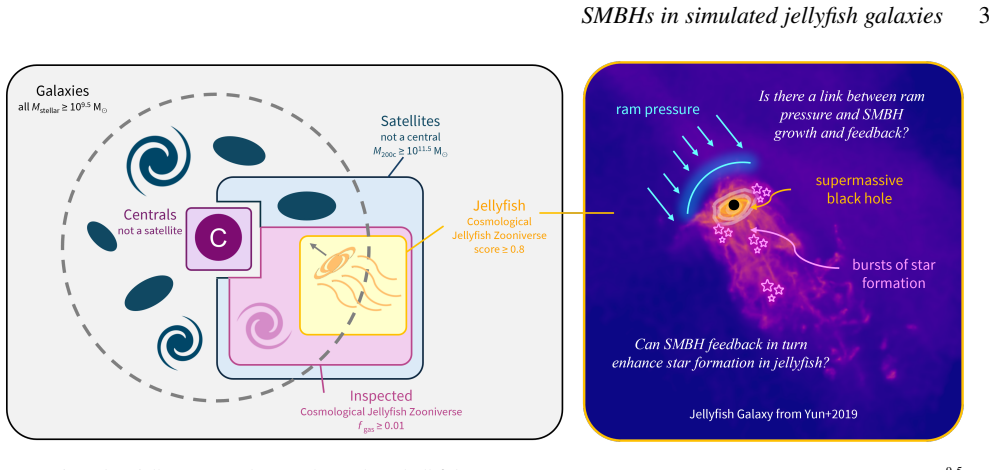
Summary. This manuscript uses the IllustrisTNG simulations (TNG50 and TNG100) to study supermassive black hole (SMBH) activity in z=0 jellyfish galaxies identified by the Cosmological Jellyfish Zooniverse project, comparing them to central galaxies, all satellites, and gas-rich inspected satellites that are not classified as jellyfish. The authors report that jellyfish have higher AGN fractions than centrals and satellites of the same stellar mass, especially at M_stellar > 10^10 Msun, and that jellyfish have higher central gas densities and lower central sound speeds than other gas-rich satellites. From individual evolutionary tracks and a stacked time evolution, they claim that ram pressure peaks near first pericenter together with central gas density and sometimes AGN luminosity, and they interpret this as evidence that ram pressure compresses central gas and feeds SMBH accretion. The paper includes robustness tests with different AGN luminosity thresholds, a treatment of missing SMBHs, and a discussion of AGN feedback modes.
Significance. If the causal claim holds, this would be one of the first population-scale simulation results supporting the idea that ram pressure can directly fuel SMBHs in cluster satellites, providing a theoretical counterpart to some observational claims (e.g., GASP). The population-level finding that jellyfish have elevated AGN fractions is robust and is a valuable, falsifiable TNG prediction; the luminosity-cut tests and the comparison to gas-rich inspected satellites strengthen this part of the paper. The mechanistic claim (ram pressure compresses central gas and boosts accretion) is the novel and most important contribution, but it is currently the least supported part of the analysis.
major comments (3)
- [Section 4.1 and Figure 5] The stacked time evolution that forms the main evidence for ram-pressure feeding is shown only for jellyfish galaxies; there is no control sample of gas-rich inspected non-jellyfish satellites matched in stellar mass, gas fraction at infall and at z=0, and host halo mass. Because jellyfish are by construction gas-rich and are visually identified at a time when they show a stripped tail, the temporal alignment of P_ram, n_gas, and L_AGN near first pericenter could be a generic orbital-phase effect or a consequence of gas-rich selection rather than a causal effect of ram pressure on the SMBH. The manuscript itself states that the correlation between ram pressure and AGN luminosity is 'somewhat weak' (Figure 5 caption) and that only about 50% of jellyfish fall in Case 1. A matched control stack is needed to distinguish the proposed mechanism from the alternative that any gas-rich satellite near pericenter shows the same behavior.
- [Section 4.1, Cases 1-3] The classification of jellyfish into Cases 1, 2, and 3 is based on visual inspection of individual evolutionary tracks, with no quantitative criterion or blinded procedure described. The fractions (50%, 15%, 35%) are used to argue that ram pressure feeds SMBHs in a majority of jellyfish, but the subjectivity of this classification makes the quantitative claim difficult to evaluate. A reproducible measure, such as a cross-correlation or peak-triggered average of P_ram and L_AGN within a defined window around first pericenter, with a pre-specified threshold, would make the case fractions verifiable and would also allow the stacked result in Figure 5 to be interpreted more cleanly.
- [Sections 3.1, 5, and Appendix C] The paper acknowledges that jellyfish must be gas-rich and in the thermal AGN feedback mode to be classified as jellyfish (e.g., 'jellyfish are necessarily biased towards accretion and feedback in the thermal mode to even have the chance to retain gas and to appear ram-pressure stripped'). Since the Bondi accretion rate in Equation (1) scales with gas density and inversely with the cube of the sound speed, the higher n_gas and lower c_s of jellyfish could be a direct consequence of this selection rather than of ram-pressure compression during pericenter passage. The causal interpretation requires controlling for the pre-infall central gas density or gas fraction, or demonstrating that the pericentric increase in n_gas exceeds what is expected from the gas-rich selection alone. As written, the evidence does not exclude the simpler explanation that jellyfish are selected to have high central gas density, which directly raises their Bondi accretion rates.
minor comments (6)
- [Section 2.1.2] Equation (2) and the surrounding text refer to the 'Thompson' cross section; the standard spelling is 'Thomson' cross section.
- [Section 2.1.1] The text says 'utilizes the arepocode'; this should be 'Arepo code' with a capital letter for the code name.
- [Section 2.4.2 and Appendix A] The robustness of the results to the 'fudge' SMBH assignment for galaxies with missing black holes is not tested; excluding the 1-3% of jellyfish with lost SMBHs would confirm that the high AGN fractions are not driven by the assigned Gaussian values.
- [Figure 5 and Section 4.1] The text says 'we test, but we do not show, whether the peak in the AGN luminosity would be stronger in a high stellar mass bin'; this test could usefully be moved to an appendix since the mass dependence is a central part of the population-level result.
- [Section 4.1 and Figure 4] There are several instances where 'effect' is used where 'affect' is intended, for example 'ram pressure can indirectly effect SMBH activity' and 'could inhibit or enhance the impact of ram pressure on the SMBH'.
- [Figure 6 caption] The caption describes the inner r=2 ckpc as a 'dashed white circle' and r=1 ckpc as 'solid dashed circle'; the latter should likely read 'solid white circle'.
Circularity Check
Minor circularity in the Case-1 sub-stack; population-level AGN result is self-contained.
-
self definitional
[Section 4.1, Figure 5 caption and following paragraph]
"we categorize them as 'Case 1' (Direct Effect), 'Case 2' (Delayed Effect), and 'Case 3' (No Effect) and quantify them in the above bar plot by visual inspection of the evolutionary tracks of all individual galaxies (as those of Figure 4). ... The time correlation between ram pressure and AGN luminosity is somewhat weak. However, when we stack across only jellyfish galaxies of the first case (green circles), a strong and timely increase of AGN luminosity manifests with an increase of ram pressure and central gas density."
Case 1 is defined, by visual inspection, as galaxies whose P_ram peak directly corresponds to peaks in n_gas and L_AGN at first pericentric passage. Restacking exactly those galaxies and 'recovering' a strong P_ram-n_gas-L_AGN coincidence is therefore a restatement of the selection criterion, not an independent confirmation. The only unselected stacked diagnostic, the full-sample stack, shows only a 'somewhat weak' correlation, so this self-selected sub-stack carries part of the evidentiary weight for the causal claim. The 65 per cent figure (Case 1 + Case 2) similarly comes from the same visual classification and is not an independent test of ram-pressure feeding.
full rationale
The paper's headline population result—jellyfish have elevated AGN fractions—is not circular: the Zooniverse jellyfish classification uses gas-density morphology with no knowledge of SMBH accretion, and the comparison against inspected non-jellyfish gas-rich satellites controls for the f_gas>0.01 selection. The TNG model parameters were calibrated to global galaxy properties, not to jellyfish AGN fractions, and the GASP observations provide an external benchmark. The Bondi relation (Eq. 1) means SMBH luminosity responds to central gas density and sound speed by construction, but the finding that jellyfish differ from gas-matched satellites in n_gas and c_s is emergent and independent. The one circular element is the Case-1 stacked 'recovery': objects are placed in Case 1 precisely because their P_ram, n_gas, and L_AGN peaks coincide, so restacking them and reporting a coincident peak is a restatement of the classification, not a test. This step bolsters the causal interpretation but is not the sole basis for the AGN fraction comparison, so the overall circularity is minor. Self-citations to Zinger et al. 2024, Rohr et al. 2023, and Weinberger et al. 2017 provide data and model definitions rather than imported uniqueness theorems; none is load-bearing in a way that forces the conclusion.
Assumptions & free parameters
free parameters (4)
- AGN luminosity threshold =
10^44 erg/s
- Jellyfish score threshold =
0.8
- Gas fraction selection threshold =
f_gas >= 0.01
- Fudge SMBH distribution for missing black holes =
Gaussian matched to similar-mass galaxies
assumptions (5)
- domain assumption The TNG subgrid model for SMBH seeding, Bondi accretion, and thermal/kinetic feedback (Weinberger et al. 2017; Pillepich et al. 2018a) provides a valid representation of AGN activity in galaxies.
- domain assumption The Cosmological Jellyfish Zooniverse visual classifications identify physically ram-pressure-stripped galaxies.
- domain assumption The local background environment (LBE) ram pressure measurement (Ayromlou et al. 2019) captures the actual stripping force on the galaxy.
- domain assumption Gas density and sound speed within 1 ckpc of the SMBH determine the Bondi accretion rate, so simulated central gas properties are a valid intermediary between ram pressure and AGN luminosity.
- ad hoc to paper Temporal alignment of P_ram, n_gas, and L_AGN peaks near pericentric passage indicates causation by ram pressure.
Cite this review
Pith. "Pith review of Jellyfish galaxies with the IllustrisTNG simulations -- Supermassive black hole activity in dense environments with ram-pressure stripped satellites." pith.science (2026). https://pith.science/paper/KU43T64F
@misc{pith2026250605474,
  author       = {Pith},
  title        = {Pith review of: Jellyfish galaxies with the IllustrisTNG simulations -- Supermassive black hole activity in dense environments with ram-pressure stripped satellites},
  year         = {2026},
  howpublished = {\url{https://pith.science/paper/KU43T64F}},
  note         = {Machine review of arXiv:2506.05474}
}
abstract
Jellyfish galaxies are extreme examples of how galaxies can transform due to dense environmental effects. These satellite galaxies suffer from ram-pressure stripping, leading to the formation of their distinctive gaseous tails. Some recent observational studies find that jellyfish galaxies are more likely to host active galactic nuclei (AGN) compared to central galaxies of the same mass, suggesting a link between ram pressure and supermassive black hole (SMBH) accretion. We use the IllustrisTNG cosmological-magnetohydrodynamical simulations, namely TNG50 and TNG100, to explore the presence of AGN in jellyfish galaxies with $M_{\rm{stellar}}\simeq10^{9.5-10.8}\,\rm{M}_\odot$ at redshift $z=0$ from the Zooniverse "Cosmological Jellyfish" citizen-science project. Compared to central galaxies, jellyfish are more likely to host an AGN ($L_{\rm AGN}\geq10^{44}\,\mathrm{erg\,s^{-1}}$) particularly at high stellar masses ($M_{\rm stellar}\gtrsim10^{10}\,\mathrm{M_\odot}$). Jellyfish are also more likely to host an AGN than satellites of the same mass, largely because many satellite galaxies are gas-poor and therefore have lower SMBH accretion rates. Compared to non-jellyfish satellites with similar gas content, jellyfish typically undergo stronger ram pressure and have higher central gas densities along with lower central gas sound speeds, although these effects are smaller at lower stellar masses ($M_{\rm stellar}\lesssim10^{10}\,\mathrm{M_\odot}$). Together with case studies of individual galaxies, our population analysis indicates that ram pressure can play a key role in fuelling AGN activity in a large fraction of jellyfish, where gas compression can lead to intense episodes of AGN feedback and star formation. Thus, it is essential to consider both environmental and secular processes for a more complete picture of satellite galaxy evolution.
Figures


Figures from the paper (6 more)


Reference graph
Works this paper leans on
-
[1]
M., Smith R., Marasco A., 2023, @doi [ ] 10.3847/1538-4357/acbf4d , 948, 18
Akerman N., Tonnesen S., Poggianti B. M., Smith R., Marasco A., 2023, @doi [ ] 10.3847/1538-4357/acbf4d , 948, 18
-
[2]
Amiri A., Tavasoli S., De Zotti G., 2019, @doi [ ] 10.3847/1538-4357/ab08e7 , https://ui.adsabs.harvard.edu/abs/2019ApJ...874..140A 874, 140
-
[3]
Arnold T. J., Martini P., Mulchaey J. S., Berti A., Jeltema T. E., 2009, @doi [ ] 10.1088/0004-637X/707/2/1691 , https://ui.adsabs.harvard.edu/abs/2009ApJ...707.1691A 707, 1691
-
[4]
Ayromlou M., Nelson D., Yates R. M., Kauffmann G., White S. D. M., 2019, @doi [ ] 10.1093/mnras/stz1549 , 487, 4313–4331
-
[5]
Ayromlou M., Kauffmann G., Yates R. M., Nelson D., White S. D. M., 2021, @doi [ ] 10.1093/mnras/stab1245 , https://ui.adsabs.harvard.edu/abs/2021MNRAS.505..492A 505, 492
-
[6]
Ayromlou M., Nelson D., Pillepich A., 2023, @doi [ ] 10.1093/mnras/stad2046 , https://ui.adsabs.harvard.edu/abs/2023MNRAS.524.5391A 524, 5391
-
[7]
Baldwin J. A., Phillips M. M., Terlevich R., 1981, @doi [ ] 10.1086/130766 , https://ui.adsabs.harvard.edu/abs/1981PASP...93....5B 93, 5
doi:10.1086/130766 1981
-
[8]
Balogh M. L., Navarro J. F., Morris S. L., 2000, @doi [ ] 10.1086/309323 , https://ui.adsabs.harvard.edu/abs/2000ApJ...540..113B 540, 113
doi:10.1086/309323 2000
Show all 118 references
-
[10]
Bluck A. F. L., Piotrowska J. M., Maiolino R., 2023, @doi [ ] 10.3847/1538-4357/acac7c , https://ui.adsabs.harvard.edu/abs/2023ApJ...944..108B 944, 108
2023 doi
-
[11]
Boselli A., et al., 2016, @doi [ ] 10.1051/0004-6361/201527795 , 587, A68
2016 doi
-
[12]
G., Benson A
Bower R. G., Benson A. J., Malbon R., Helly J. C., Frenk C. S., Baugh C. M., Cole S., Lacey C. G., 2006, @doi [ ] 10.1111/j.1365-2966.2006.10519.x , https://ui.adsabs.harvard.edu/abs/2006MNRAS.370..645B 370, 645
2006
-
[14]
Ciotti L., D'Ercole A., Pellegrini S., Renzini A., 1991, @doi [ ] 10.1086/170289 , https://ui.adsabs.harvard.edu/abs/1991ApJ...376..380C 376, 380
1991 doi
-
[15]
C., O’Neil K., Sakai S., 2006, @doi [ ] 10.1051/0004-6361:20064873 , 453, 847–861
Cortese L., Gavazzi G., Boselli A., Franzetti P., Kennicutt R. C., O’Neil K., Sakai S., 2006, @doi [ ] 10.1051/0004-6361:20064873 , 453, 847–861
2006 doi
-
[16]
A., et al., 2015, @doi [ ] 10.1093/mnras/stv725 , https://ui.adsabs.harvard.edu/abs/2015MNRAS.450.1937C 450, 1937
Crain R. A., et al., 2015, @doi [ ] 10.1093/mnras/stv725 , https://ui.adsabs.harvard.edu/abs/2015MNRAS.450.1937C 450, 1937
2015 doi
-
[17]
J., et al., 2006, @doi [ ] 10.1111/j.1365-2966.2005.09675.x , https://ui.adsabs.harvard.edu/abs/2006MNRAS.365...11C 365, 11
Croton D. J., et al., 2006, @doi [ ] 10.1111/j.1365-2966.2005.09675.x , https://ui.adsabs.harvard.edu/abs/2006MNRAS.365...11C 365, 11
2006
-
[18]
S., White S
Davis M., Efstathiou G., Frenk C. S., White S. D. M., 1985, @doi [ ] 10.1086/163168 , https://ui.adsabs.harvard.edu/abs/1985ApJ...292..371D 292, 371
1985 doi
-
[19]
H., Appleby S., 2019, @doi [ ] 10.1093/mnras/stz937 , 486, 2827–2849
Davé R., Anglés-Alcázar D., Narayanan D., Li Q., Rafieferantsoa M. H., Appleby S., 2019, @doi [ ] 10.1093/mnras/stz937 , 486, 2827–2849
2019 doi
-
[20]
World Scientific, pp 149--225
Di Matteo T., Angles-Alcazar D., Shankar F., 2023, Massive Black Holes in Galactic Nuclei: Theory. World Scientific, pp 149--225
2023
-
[21]
Donnari M., et al., 2019, @doi [ ] 10.1093/mnras/stz712 , https://ui.adsabs.harvard.edu/abs/2019MNRAS.485.4817D 485, 4817
2019 doi
-
[22]
Donnari M., et al., 2021a, @doi [ ] 10.1093/mnras/staa3006 , 500, 4004
-
[23]
Donnari M., Pillepich A., Nelson D., Marinacci F., Vogelsberger M., Hernquist L., 2021b, @doi [ ] 10.1093/mnras/stab1950 , 506, 4760
-
[24]
B., Shectman S
Dressler A., Thompson I. B., Shectman S. A., 1985, @doi [ ] 10.1086/162813 , https://ui.adsabs.harvard.edu/abs/1985ApJ...288..481D 288, 481
1985 doi
-
[25]
N., Edge A
Ebeling H., Stephenson L. N., Edge A. C., 2014, @doi [ ] 10.1088/2041-8205/781/2/L40 , https://ui.adsabs.harvard.edu/abs/2014ApJ...781L..40E 781, L40
2014 doi
-
[26]
Fabian A., 2012, @doi [ ] 10.1146/annurev-astro-081811-125521 , 50, 455–489
2012 doi
-
[27]
Fumagalli M., Fossati M., Hau G. K. T., Gavazzi G., Bower R., Sun M., Boselli A., 2014, @doi [ ] 10.1093/mnras/stu2092 , https://ui.adsabs.harvard.edu/abs/2014MNRAS.445.4335F 445, 4335
2014 doi
-
[28]
T., Peter A
Garling C. T., Peter A. H. G., Spekkens K., Sand D. J., Hargis J., Crnojevi \'c D., Carlin J. L., 2024, @doi [ ] 10.1093/mnras/stae014 , https://ui.adsabs.harvard.edu/abs/2024MNRAS.528..365G 528, 365
2024 doi
-
[29]
M., Carrasco L., 2001, @doi [ ] 10.1086/338389 , https://ui.adsabs.harvard.edu/abs/2001ApJ...563L..23G 563, L23
Gavazzi G., Boselli A., Mayer L., Iglesias-Paramo J., V \' lchez J. M., Carrasco L., 2001, @doi [ ] 10.1086/338389 , https://ui.adsabs.harvard.edu/abs/2001ApJ...563L..23G 563, L23
2001 doi
-
[30]
L., Boselli A., Yoshida M., 2018, @doi [ ] 10.1051/0004-6361/201833427 , 618, A130
Gavazzi G., Consolandi G., Gutierrez M. L., Boselli A., Yoshida M., 2018, @doi [ ] 10.1051/0004-6361/201833427 , 618, A130
2018 doi
-
[31]
Genel S., et al., 2014, @doi [ ] 10.1093/mnras/stu1654 , 445, 175–200
2014 doi
-
[32]
George K., et al., 2019, @doi [ ] 10.1093/mnras/stz1443 , https://ui.adsabs.harvard.edu/abs/2019MNRAS.487.3102G 487, 3102
2019 doi
-
[33]
George K., et al., 2024, @doi [ ] 10.1051/0004-6361/202450302 , https://ui.adsabs.harvard.edu/abs/2024A&A...690A.337G 690, A337
2024 doi
-
[34]
Y., 2003, @doi [ ] 10.1086/344636 , https://ui.adsabs.harvard.edu/abs/2003ApJ...582..141G 582, 141
Gnedin O. Y., 2003, @doi [ ] 10.1086/344636 , https://ui.adsabs.harvard.edu/abs/2003ApJ...582..141G 582, 141
2003 doi
-
[35]
D., Rohr E., Zinger E., Pillepich A., 2023, @doi [ ] 10.1093/mnras/stad2551 , https://ui.adsabs.harvard.edu/abs/2023MNRAS.525.3551G 525, 3551
G \"o ller J., Joshi G. D., Rohr E., Zinger E., Pillepich A., 2023, @doi [ ] 10.1093/mnras/stad2551 , https://ui.adsabs.harvard.edu/abs/2023MNRAS.525.3551G 525, 3551
2023 doi
-
[36]
H., Bluck A
Goubert P. H., Bluck A. F. L., Piotrowska J. M., Maiolino R., 2024, @doi [ ] 10.1093/mnras/stae269 , https://ui.adsabs.harvard.edu/abs/2024MNRAS.528.4891G 528, 4891
2024 doi
-
[37]
E., Gott III J
Gunn J. E., Gott III J. R., 1972, @doi [ ] 10.1086/151605 , https://ui.adsabs.harvard.edu/abs/1972ApJ...176....1G 176, 1
1972 doi
-
[38]
Habouzit M., et al., 2019, @doi [ ] 10.1093/mnras/stz102 , 484, 4413–4443
2019 doi
-
[39]
R., et al., 2020, @doi [Nature] 10.1038/s41586-020-2649-2 , 585, 357
Harris C. R., et al., 2020, @doi [Nature] 10.1038/s41586-020-2649-2 , 585, 357
2020 doi
-
[40]
D., 2007, @doi [Computing in Science & Engineering] 10.1109/MCSE.2007.55 , 9, 90
Hunter J. D., 2007, @doi [Computing in Science & Engineering] 10.1109/MCSE.2007.55 , 9, 90
2007 doi
-
[41]
J \'a chym P., Combes F., Cortese L., Sun M., Kenney J. D. P., 2014, @doi [ ] 10.1088/0004-637X/792/1/11 , https://ui.adsabs.harvard.edu/abs/2014ApJ...792...11J 792, 11
2014 doi
-
[42]
D., Pillepich A., Nelson D., Marinacci F., Springel V., Rodriguez-Gomez V., Vogelsberger M., Hernquist L., 2020, @doi [ ] 10.1093/mnras/staa1668 , 496, 2673
Joshi G. D., Pillepich A., Nelson D., Marinacci F., Springel V., Rodriguez-Gomez V., Vogelsberger M., Hernquist L., 2020, @doi [ ] 10.1093/mnras/staa1668 , 496, 2673
2020 doi
-
[43]
D., Pillepich A., Nelson D., Zinger E., Marinacci F., Springel V., Vogelsberger M., Hernquist L., 2021, @doi [ ] 10.1093/mnras/stab2573 , 508, 1652
Joshi G. D., Pillepich A., Nelson D., Zinger E., Marinacci F., Springel V., Vogelsberger M., Hernquist L., 2021, @doi [ ] 10.1093/mnras/stab2573 , 508, 1652
2021 doi
-
[44]
Jáchym P., et al., 2017, @doi [ ] 10.3847/1538-4357/aa6af5 , 839, 114
2017 doi
-
[45]
Kauffmann G., White S. D. M., Heckman T. M., M \'e nard B., Brinchmann J., Charlot S., Tremonti C., Brinkmann J., 2004, @doi [ ] 10.1111/j.1365-2966.2004.08117.x , https://ui.adsabs.harvard.edu/abs/2004MNRAS.353..713K 353, 713
2004
-
[46]
Kenney J. D. P., van Gorkom J. H., Vollmer B., 2004, @doi [ ] 10.1086/420805 , 127, 3361–3374
2004 doi
-
[47]
C., 2013, @doi [ ] 10.1146/annurev-astro-082708-101811 , https://ui.adsabs.harvard.edu/abs/2013ARA&A..51..511K 51, 511
Kormendy J., Ho L. C., 2013, @doi [ ] 10.1146/annurev-astro-082708-101811 , https://ui.adsabs.harvard.edu/abs/2013ARA&A..51..511K 51, 511
2013 doi
-
[48]
Koulouridis E., Gkini A., Drigga E., 2024, @doi [ ] 10.1051/0004-6361/202348212 , https://ui.adsabs.harvard.edu/abs/2024A&A...684A.111K 684, A111
2024 doi
-
[49]
arXiv:2503.01969
Lehle K., Nelson D., Pillepich A., 2025, @doi [arXiv e-prints] 10.48550/arXiv.2503.01969 , https://ui.adsabs.harvard.edu/abs/2025arXiv250301969L p. arXiv:2503.01969
2025 doi
-
[50]
Lopes P. A. A., Ribeiro A. L. B., Rembold S. B., 2017, @doi [ ] 10.1093/mnras/stx2046 , https://ui.adsabs.harvard.edu/abs/2017MNRAS.472..409L 472, 409
2017 doi
-
[51]
R., Nulsen P., 2006, @doi [ ] 10.1086/503350 , 644, 155–166
Machacek M., Jones C., Forman W. R., Nulsen P., 2006, @doi [ ] 10.1086/503350 , 644, 155–166
2006 doi
-
[52]
Man Z.-y., Peng Y.-j., Kong X., Guo K.-x., Zhang C.-p., Dou J., 2019, @doi [ ] 10.1093/mnras/stz1706 , https://ui.adsabs.harvard.edu/abs/2019MNRAS.488...89M 488, 89
2019 doi
-
[53]
Marinacci F., et al., 2018, @doi [ ] 10.1093/mnras/sty2206 , https://ui.adsabs.harvard.edu/abs/2018MNRAS.480.5113M 480, 5113
2018 doi
-
[54]
S., Kelson D
Martini P., Mulchaey J. S., Kelson D. D., 2007, @doi [ ] 10.1086/519158 , https://ui.adsabs.harvard.edu/abs/2007ApJ...664..761M 664, 761
2007 doi
-
[55]
J., Ma C.-P., 2013, @doi [ ] 10.1088/0004-637X/764/2/184 , https://ui.adsabs.harvard.edu/abs/2013ApJ...764..184M 764, 184
McConnell N. J., Ma C.-P., 2013, @doi [ ] 10.1088/0004-637X/764/2/184 , https://ui.adsabs.harvard.edu/abs/2013ApJ...764..184M 764, 184
2013 doi
-
[56]
Merluzzi P., et al., 2024, @doi [ ] 10.1093/mnras/stae1867 , https://ui.adsabs.harvard.edu/abs/2024MNRAS.533.1394M 533, 1394
2024 doi
-
[57]
K., Perola G
Miley G. K., Perola G. C., van der Kruit P. C., van der Laan H., 1972, @doi [ ] 10.1038/237269a0 , https://ui.adsabs.harvard.edu/abs/1972Natur.237..269M 237, 269
1972 doi
-
[58]
J., Nichol R
Miller C. J., Nichol R. C., G \'o mez P. L., Hopkins A. M., Bernardi M., 2003, @doi [ ] 10.1086/378383 , https://ui.adsabs.harvard.edu/abs/2003ApJ...597..142M 597, 142
2003 doi
-
[59]
Moore B., Katz N., Lake G., Dressler A., Oemler A., 1996, @doi [ ] 10.1038/379613a0 , https://ui.adsabs.harvard.edu/abs/1996Natur.379..613M 379, 613
1996 doi
-
[60]
P., et al., 2018, @doi [ ] 10.1093/mnras/sty618 , https://ui.adsabs.harvard.edu/abs/2018MNRAS.477.1206N 477, 1206
Naiman J. P., et al., 2018, @doi [ ] 10.1093/mnras/sty618 , https://ui.adsabs.harvard.edu/abs/2018MNRAS.477.1206N 477, 1206
2018 doi
-
[62]
Nelson D., et al., 2018a, @doi [ ] 10.1093/mnras/stx3040 , https://ui.adsabs.harvard.edu/abs/2018MNRAS.475..624N 475, 624
-
[63]
Nelson D., et al., 2019a, @doi [Computational Astrophysics and Cosmology] 10.1186/s40668-019-0028-x , https://ui.adsabs.harvard.edu/abs/2019ComAC...6....2N 6, 2
-
[65]
Nelson D., et al., 2019c, @doi [ ] 10.1093/mnras/stz2306 , 490, 3234
-
[66]
Pakmor R., Bauer A., Springel V., 2011, @doi [ ] 10.1111/j.1365-2966.2011.19591.x , https://ui.adsabs.harvard.edu/abs/2011MNRAS.418.1392P 418, 1392
2011
-
[67]
Peluso G., et al., 2022, @doi [ ] 10.3847/1538-4357/ac4225 , 927, 130
2022 doi
-
[68]
Peng Y., Maiolino R., Cochrane R., 2015, @doi [Nature] 10.1038/nature14439 , 521, 192–195
2015 doi
-
[69]
Pillepich A., et al., 2018a, @doi [ ] 10.1093/mnras/stx2656 , 473, 4077
-
[70]
Pillepich A., et al., 2018b, @doi [ ] 10.1093/mnras/stx3112 , https://ui.adsabs.harvard.edu/abs/2018MNRAS.475..648P 475, 648
-
[71]
Pillepich A., et al., 2019, @doi [ ] 10.1093/mnras/stz2338 , https://ui.adsabs.harvard.edu/abs/2019MNRAS.490.3196P 490, 3196
2019 doi
-
[72]
M., Hernquist L., 2021, @doi [ ] 10.1093/mnras/stab2779 , https://ui.adsabs.harvard.edu/abs/2021MNRAS.508.4667P 508, 4667
Pillepich A., Nelson D., Truong N., Weinberger R., Martin-Navarro I., Springel V., Faber S. M., Hernquist L., 2021, @doi [ ] 10.1093/mnras/stab2779 , https://ui.adsabs.harvard.edu/abs/2021MNRAS.508.4667P 508, 4667
2021 doi
-
[73]
Pillepich A., et al., 2024, @doi [ ] 10.1093/mnras/stae2165 , https://ui.adsabs.harvard.edu/abs/2024MNRAS.535.1721P 535, 1721
2024 doi
-
[74]
M., et al., 2017a, @doi [Nature] 10.1038/nature23462 , 548, 304
Poggianti B. M., et al., 2017a, @doi [Nature] 10.1038/nature23462 , 548, 304
-
[75]
M., et al., 2017b, @doi [ ] 10.3847/1538-4357/aa78ed , 844, 48
Poggianti B. M., et al., 2017b, @doi [ ] 10.3847/1538-4357/aa78ed , 844, 48
-
[76]
Predehl P., et al., 2020, @doi [ ] 10.1038/s41586-020-2979-0 , https://ui.adsabs.harvard.edu/abs/2020Natur.588..227P 588, 227
2020 doi
-
[77]
Prunier M., Hlavacek-Larrondo J., Pillepich A., Lehle K., Nelson D., 2025, @doi [ ] 10.1093/mnras/stae2743 , https://ui.adsabs.harvard.edu/abs/2025MNRAS.536.3200P 536, 3200
2025 doi
-
[78]
L., Moretti A., Bettoni D., Gullieuszik M., Vulcani B., Fritz J., 2019, @doi [ ] 10.1093/mnras/stz809 , https://ui.adsabs.harvard.edu/abs/2019MNRAS.486..486R 486, 486
Radovich M., Poggianti B., Jaff \'e Y. L., Moretti A., Bettoni D., Gullieuszik M., Vulcani B., Fritz J., 2019, @doi [ ] 10.1093/mnras/stz809 , https://ui.adsabs.harvard.edu/abs/2019MNRAS.486..486R 486, 486
2019 doi
-
[79]
C., P\' e rez-Villegas A., 2018, @doi [ ] 10.1093/mnras/sty393 , 476, 3781–3792
Ramos-Mart\' nez M., G\' o mez G. C., P\' e rez-Villegas A., 2018, @doi [ ] 10.1093/mnras/sty393 , 476, 3781–3792
2018 doi
-
[80]
Ricarte A., Tremmel M., Natarajan P., Quinn T., 2020, @doi [ Letters] 10.3847/2041-8213/ab9022 , 895, L8
2020 doi
-
[81]
D., et al., 2021, @doi [ ] 10.1051/0004-6361/202140784 , 650, A111
Roberts I. D., et al., 2021, @doi [ ] 10.1051/0004-6361/202140784 , 650, A111
2021 doi
-
[82]
D., et al., 2022, @doi [ ] 10.3847/1538-4357/ac9e9f , https://ui.adsabs.harvard.edu/abs/2022ApJ...941...77R 941, 77
Roberts I. D., et al., 2022, @doi [ ] 10.3847/1538-4357/ac9e9f , https://ui.adsabs.harvard.edu/abs/2022ApJ...941...77R 941, 77
2022 doi
-
[83]
D., et al., 2023, @doi [ ] 10.1051/0004-6361/202346599 , https://ui.adsabs.harvard.edu/abs/2023A&A...675A..78R 675, A78
Roberts I. D., et al., 2023, @doi [ ] 10.1051/0004-6361/202346599 , https://ui.adsabs.harvard.edu/abs/2023A&A...675A..78R 675, A78
2023 doi
-
[84]
Rohr E., Pillepich A., Nelson D., Zinger E., Joshi G., Ayromlou M., 2023, @doi [ ] 10.1093/mnras/stad2101 , 524, 3502
2023 doi
-
[85]
Rohr E., Pillepich A., Nelson D., Ayromlou M., Zinger E., 2024, @doi [ ] 10.1051/0004-6361/202348583 , https://ui.adsabs.harvard.edu/abs/2024A&A...686A..86R 686, A86
2024 doi
-
[86]
V., Chies-Santos A
Roman-Oliveira F. V., Chies-Santos A. L., Rodr \' guez del Pino B., Arag \'o n-Salamanca A., Gray M. E., Bamford S. P., 2019, @doi [ ] 10.1093/mnras/stz007 , https://ui.adsabs.harvard.edu/abs/2019MNRAS.484..892R 484, 892
2019 doi
-
[87]
N., Argudo-Fern \'a ndez M., 2013, @doi [ ] 10.1093/mnras/sts675 , https://ui.adsabs.harvard.edu/abs/2013MNRAS.430..638S 430, 638
Sabater J., Best P. N., Argudo-Fern \'a ndez M., 2013, @doi [ ] 10.1093/mnras/sts675 , https://ui.adsabs.harvard.edu/abs/2013MNRAS.430..638S 430, 638
2013 doi
-
[88]
Schaye J., et al., 2015, @doi [ ] 10.1093/mnras/stu2058 , https://ui.adsabs.harvard.edu/abs/2015MNRAS.446..521S 446, 521
2015 doi
-
[90]
F., Nelson D., Hernquist L., 2015, @doi [ ] 10.1093/mnras/stv1340 , 452, 575–596
Sijacki D., Vogelsberger M., Genel S., Springel V., Torrey P., Snyder G. F., Nelson D., Hernquist L., 2015, @doi [ ] 10.1093/mnras/stv1340 , 452, 575–596
2015 doi
-
[91]
R., Martini P., Zabludoff A
Sivakoff G. R., Martini P., Zabludoff A. I., Kelson D. D., Mulchaey J. S., 2008, @doi [ ] 10.1086/589686 , https://ui.adsabs.harvard.edu/abs/2008ApJ...682..803S 682, 803
2008 doi
-
[93]
Sparre M., Pfrommer C., Puchwein E., 2024, @doi [ ] 10.1093/mnras/stad3607 , https://ui.adsabs.harvard.edu/abs/2024MNRAS.527.5829S 527, 5829
2024 doi
-
[94]
Springel V., 2010, @doi [ ] 10.1111/j.1365-2966.2009.15715.x , https://ui.adsabs.harvard.edu/abs/2010MNRAS.401..791S 401, 791
2010
-
[95]
Springel V., Hernquist L., 2003, @doi [ ] 10.1046/j.1365-8711.2003.06206.x , 339, 289–311
2003
-
[96]
Springel V., White S. D. M., Tormen G., Kauffmann G., 2001, @doi [ ] 10.1046/j.1365-8711.2001.04912.x , 328, 726–750
2001
-
[97]
Springel V., et al., 2018, @doi [ ] 10.1093/mnras/stx3304 , https://ui.adsabs.harvard.edu/abs/2018MNRAS.475..676S 475, 676
2018 doi
-
[98]
Stevens A. R. H., et al., 2019, @doi [ ] 10.1093/mnras/sty3451 , https://ui.adsabs.harvard.edu/abs/2019MNRAS.483.5334S 483, 5334
2019 doi
-
[99]
Stevens A. R. H., et al., 2021, @doi [ ] 10.1093/mnras/staa3662 , https://ui.adsabs.harvard.edu/abs/2021MNRAS.502.3158S 502, 3158
2021 doi
-
[100]
Sun M., Jones C., Forman W., Nulsen P. E. J., Donahue M., Voit G. M., 2006, @doi [ ] 10.1086/500590 , https://ui.adsabs.harvard.edu/abs/2006ApJ...637L..81S 637, L81
2006 doi
-
[101]
A., et al., 2020, @doi [ ] 10.1093/mnras/staa374 , https://ui.adsabs.harvard.edu/abs/2020MNRAS.493.1888T 493, 1888
Terrazas B. A., et al., 2020, @doi [ ] 10.1093/mnras/staa374 , https://ui.adsabs.harvard.edu/abs/2020MNRAS.493.1888T 493, 1888
2020 doi
- [102]
-
[103]
L., 2009, @doi [ ] 10.1088/0004-637x/694/2/789 , 694, 789–804
Tonnesen S., Bryan G. L., 2009, @doi [ ] 10.1088/0004-637x/694/2/789 , 694, 789–804
2009 doi
-
[104]
L., 2012, @doi [ ] 10.1111/j.1365-2966.2012.20737.x , 422, 1609–1624
Tonnesen S., Bryan G. L., 2012, @doi [ ] 10.1111/j.1365-2966.2012.20737.x , 422, 1609–1624
2012
-
[105]
Torrey P., Vogelsberger M., Genel S., Sijacki D., Springel V., Hernquist L., 2014, @doi [ ] 10.1093/mnras/stt2295 , https://ui.adsabs.harvard.edu/abs/2014MNRAS.438.1985T 438, 1985
2014 doi
-
[106]
R., Pontzen A., Anderson L., Bellovary J., 2017, @doi [ ] 10.1093/mnras/stx1160 , 470, 1121–1139
Tremmel M., Karcher M., Governato F., Volonteri M., Quinn T. R., Pontzen A., Anderson L., Bellovary J., 2017, @doi [ ] 10.1093/mnras/stx1160 , 470, 1121–1139
2017 doi
-
[107]
Truong N., et al., 2020, @doi [ ] 10.1093/mnras/staa685 , https://ui.adsabs.harvard.edu/abs/2020MNRAS.494..549T 494, 549
2020 doi
-
[108]
Truong N., Pillepich A., Werner N., 2021, @doi [ ] 10.1093/mnras/staa3880 , https://ui.adsabs.harvard.edu/abs/2021MNRAS.501.2210T 501, 2210
2021 doi
-
[109]
Verdugo C., Combes F., Dasyra K., Salomé P., Braine J., 2015, @doi [ ] 10.1051/0004-6361/201526551 , 582, A6
2015 doi
-
[110]
Virtanen P., et al., 2020, @doi [Nature Methods] 10.1038/s41592-019-0686-2 , https://rdcu.be/b08Wh 17, 261
2020 doi
-
[111]
Vogelsberger M., Genel S., Sijacki D., Torrey P., Springel V., Hernquist L., 2013, @doi [ ] 10.1093/mnras/stt1789 , 436, 3031–3067
2013 doi
-
[112]
Vogelsberger M., et al., 2014, @doi [ ] 10.1093/mnras/stu1536 , 444, 1518–1547
2014 doi
-
[113]
Vogelsberger M., Marinacci F., Torrey P., Puchwein E., 2020, @doi [Nature Reviews Physics] 10.1038/s42254-019-0127-2 , https://ui.adsabs.harvard.edu/abs/2020NatRP...2...42V 2, 42
2020 doi
-
[114]
Vulcani B., et al., 2018, @doi [ ] 10.3847/2041-8213/aae68b , https://ui.adsabs.harvard.edu/abs/2018ApJ...866L..25V 866, L25
2018 doi
-
[115]
Vulcani B., et al., 2024, @doi [ ] 10.1051/0004-6361/202348135 , https://ui.adsabs.harvard.edu/abs/2024A&A...682A.117V 682, A117
2024 doi
-
[116]
R., Harrison C
Ward S. R., Harrison C. M., Costa T., Mainieri V., 2022, @doi [ ] 10.1093/mnras/stac1219 , https://ui.adsabs.harvard.edu/abs/2022MNRAS.514.2936W 514, 2936
2022 doi
-
[117]
Weinberger R., et al., 2017, @doi [ ] 10.1093/mnras/stw2944 , 465, 3291
2017 doi
-
[118]
Weinberger R., et al., 2018, @doi [ ] 10.1093/mnras/sty1733 , https://ui.adsabs.harvard.edu/abs/2018MNRAS.479.4056W 479, 4056
2018 doi
-
[119]
J., Lagos C
Wright R. J., Lagos C. d. P., Power C., Stevens A. R. H., Cortese L., Poulton R. J. J., 2022, @doi [ ] 10.1093/mnras/stac2042 , https://ui.adsabs.harvard.edu/abs/2022MNRAS.516.2891W 516, 2891
2022 doi
-
[120]
Yun K., et al., 2019, @doi [ ] 10.1093/mnras/sty3156 , 483, 1042
2019 doi
-
[121]
Zinger E., et al., 2020, @doi [ ] 10.1093/mnras/staa2607 , 499, 768
2020 doi
-
[122]
D., Pillepich A., Rohr E., Nelson D., 2024, @doi [ ] 10.1093/mnras/stad3716 , https://ui.adsabs.harvard.edu/abs/2024MNRAS.527.8257Z 527, 8257
Zinger E., Joshi G. D., Pillepich A., Rohr E., Nelson D., 2024, @doi [ ] 10.1093/mnras/stad3716 , https://ui.adsabs.harvard.edu/abs/2024MNRAS.527.8257Z 527, 8257
2024 doi
-
[123]
von der Linden A., Wild V., Kauffmann G., White S. D. M., Weinmann S., 2010, @doi [ ] 10.1111/j.1365-2966.2010.16375.x , https://ui.adsabs.harvard.edu/abs/2010MNRAS.404.1231V 404, 1231
2010
-
[124]
write newline
" write newline "" before.all 'output.state := FUNCTION fin.entry write newline FUNCTION new.block output.state before.all = 'skip after.block 'output.state := if FUNCTION new.sentence output.state after.block = 'skip output.state before.all = 'skip after.sentence 'output.stat...
Reviewed August 7, 2026 · model on record in the stance chip above.
Discussion (0). Sign in to comment.