REVIEW 2 major objections 5 minor 1 cited by
A Sampling-Based Adaptive Rank Approach to the Wigner-Poisson System
T0 review · 2 major / 5 minor · reviewed 2026-08-06 · deepseek-v4-flash
Pith's one-line read Adaptive-rank solver cuts Wigner-Poisson cost to O(N) while conserving mass
desk verdict Worth refereeing: the adaptive-rank Wigner-Poisson extension is real, but the O(N) claim rests on an admitted gap in ACA error control. read the letter →
The pith
A machine-rendered reading of the paper's core claim, the machinery that carries it, and where it could break.
The reading
What carries the argument
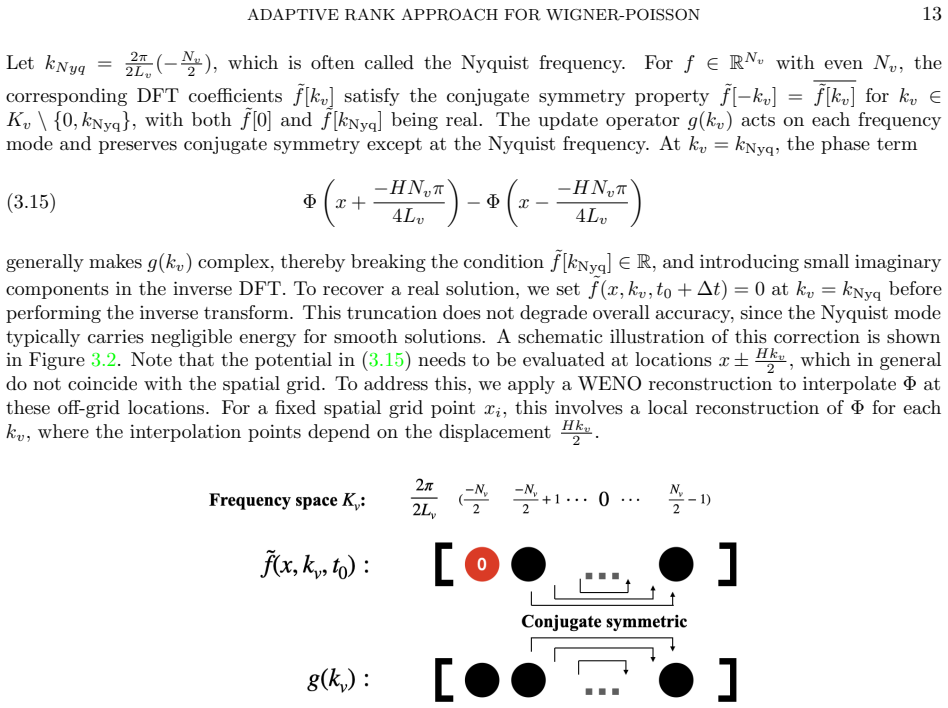
The load-bearing mechanism is the CUR decomposition built by adaptive cross approximation (ACA) with greedy pivot selection, coupled with SVD truncation. For each solution snapshot, the ACA procedure samples a small set of rows and columns of the full matrix, using the local numerical solver as a function handle, and constructs a rank-r approximation of the form A ≈ C U R. The SVD stage then compresses the core and stabilizes the representation. For the Fourier update, a modified column selection adds for each selected index its conjugate-symmetric counterpart, which guarantees that the CUR output preserves column-wise conjugate symmetry and therefore keeps the inverse-transformed solution real-valued. This structure-preserving property is proven in Theorem 3.3.
What would settle it
Run the two-stream instability test at H = 0.5 on a 2048x2048 mesh for T = 100 and compare the relative L2 error between the adaptive-rank solution (tolerance epsilon_s = 1e-3) and the full-rank solution: if the low-rank approximation accumulates error beyond the truncation tolerance or the rank grows linearly with time, the claim that ACA preserves accuracy at long times fails.
Extended reading notes
Core claim
The paper claims that a full-rank Strang-splitting solver for the 1D1V Wigner-Poisson system can be turned into a structure-preserving, mass-conserving adaptive-rank solver that runs in O(N) time and memory while matching full-rank dynamics, with rigorous preservation of the conjugate-symmetric structure that keeps the Wigner function real. The key numerical observation is that the singular value ranks of Wigner-Poisson solutions remain bounded and even decrease as the dimensionless Planck constant H grows, in contrast to Vlasov-Poisson solutions which develop fine filaments and growing rank. The proposed solver applies a semi-Lagrangian adaptive-rank (SLAR) update for advection and a modified adaptive cross approximation with symmetric column pairing for the Fourier-space nonlocal update, followed by SVD truncation and a Lagrange multiplier step to enforce mass conservation. Numerical tests on two-stream instability and strong Landau damping show visual agreement with full-rank results, mass conservation to machine precision, momentum conservation within $10^{-4}$, second-order temporal convergence, and approximately linear scaling of runtime with mesh size.
Load-bearing premise
The greedy ACA pivot selection, without rook pivoting or the maximal-volume condition, produces a low-rank approximation accurate enough for long-time Wigner-Poisson dynamics, even though the theoretical convergence theorem does not apply.
Editorial extensions
If this is right
- If the claimed O(N) scaling holds, the bottleneck of Wigner-Poisson simulation moves from the cost of the nonlocal integral to the rank of the solution, making much larger meshes and longer time horizons feasible.
- The observed low-rank structure for H ≥ 0.1 means the method is most effective exactly in the quantum regime relevant to warm dense plasma studies, where classical kinetic models fail.
- The mass-conservation Lagrange multiplier combined with SVD truncation bounds momentum error at the truncation tolerance, giving predictable accuracy limits over the 50-plasma-period simulations shown.
- The success of the structure-preserving Fourier update suggests that the same symmetric-pairing ACA strategy can be applied to other equations with conjugate-symmetric Fourier structures.
- The method's linear complexity in N provides evidence that the extension to a tensor-based 6D Wigner-Poisson solver is a viable research direction.
Reading between the lines
- The paper does not prove that the greedy ACA pivot selection converges for Wigner-Poisson dynamics; it explicitly defers error analysis to future work, so the practical reliability of the method rests on empirical robustness rather than a theoretical guarantee.
- A natural testable extension would be to compare the sampling-based ACA with a maximal-volume or rook-pivoting alternative on the same test problems, to see whether the O(N) cost savings come with a hidden accuracy cost at late times.
- The connection to gamma = 0.1511 damping rate at H = 8 suggests the low-rank method captures not just solution morphology but also physically meaningful linear response, which could be validated against other quantum plasma diagnostics.
- If the rank remains bounded as the spatial mesh is refined, the method may enable a practical tradeoff: smaller H values require higher rank, so the computational frontier will be at the transition to the near-classical regime.
Editorial analysis
A structured set of objections, weighed in public.
Referee Report
Summary. The paper develops an adaptive-rank solver for the 1D1V Wigner-Poisson system. It first improves a full-rank Strang-splitting solver by adding a structure-preserving Fourier update that keeps intermediate solutions real-valued. Numerical experiments show that Wigner-Poisson solutions exhibit low-rank structure for moderate to large dimensionless Planck constants (H ≥ 0.1). The authors then build an adaptive-rank solver that combines a semi-Lagrangian advection step (SLAR) with ACA-SVD compression and a structure-preserving Fourier update, together with a Lagrange-multiplier correction to conserve mass. The paper claims O(N) complexity in storage and time, mass conservation up to machine precision, momentum conservation up to truncation error, and rigorous structure preservation, supported by numerical tests for two-stream instability and strong Landau damping.
Significance. If the central claims hold, this is a substantial contribution to kinetic simulation of quantum plasmas: it offers the first adaptive-rank, arbitrary-CFL solver for the Wigner-Poisson system, with a plausible path toward higher-dimensional simulation for NIF-type stopping-power studies. The paper provides several strong forms of evidence: second-order temporal convergence tests (Figure 4.3a), mass and momentum diagnostics (Figures 4.2 and 4.6), a structure-preserving theorem for the CUR stage (Theorem 3.3), and a damping-rate check against an independent prediction (Figure 4.8b, γ=0.1511 vs. 0.1516). These are genuine falsifiable checks, and the absence of parameter fitting strengthens the empirical case. However, the theoretical support for the ACA pivot-selection step is admitted to be incomplete, and the structure-preserving proof does not cover the SVD-truncation stage of the actual algorithm; these gaps are load-bearing for the paper's headline accuracy and structure-preservation claims.
major comments (2)
- [§3.2.2 (Theorem 3.2 and following paragraph)] The central O(N)-accuracy claim rests on the greedy ACA pivot selection of Algorithm 3.2, yet the paper explicitly states that the assumptions of Theorem 3.2 (Goreinov-Tyrtyshnikov) do not hold and defers error analysis to future work. Because the only theoretical guarantee cited for CUR-type approximations requires a maximal-volume submatrix, and Phase I in Section 3.2.1 selects pivots by random sampling plus one row/column refinement, a dominant residual could be missed at later times, causing the low-rank approximation to silently lose a physical feature while diagnostics appear smooth. The numerical tests are encouraging but cover finitely many initial data and parameter values; they do not close this gap. The authors should either supply an a posteriori error estimator that monitors ACA approximation quality per step, or substantially qualify the accuracy claims to make their conditional nature explicit.
- [§3.2.3, Theorem 3.3] Theorem 3.3 proves that the modified CUR stage preserves column-wise conjugate symmetry, but Algorithm 3.2 then applies an SVD truncation (Section 3.2.1) before the inverse FFT. The proof does not show that the truncated factors (U Σ V^T) retain the symmetry, so the statement that a 'rigorous proof of structure-preserving property is provided' for the implemented solver is not fully supported. This is likely repairable—the symmetric column pairing should survive the QR/SVD step under a suitable ordering—but as written, the proof covers only the intermediate CUR representation, not the final low-rank approximation used in the simulation.
minor comments (5)
- [Abstract (keywords)] The keyword 'Stang splitting methods' is a typo and should read 'Strang splitting methods'.
- [§3.1.1] The sentence containing 'the stincel shifts be one to the right' appears to be garbled; it should read 'the stencil shifts one index to the right'.
- [§3.2.3, proof of Theorem 3.3] The notation '1 ∈ J' is unclear because J is defined as a set of column indices; the condition should be phrased as 'if the index 1 is contained in J' to avoid ambiguity.
- [§4.1] The statement that low-rank results for H=1,8 are 'visually indistinguishable' from full-rank results is subjective; a quantitative comparison (e.g., L2 or L∞ difference between the two solutions) would strengthen the accuracy claim.
- [Algorithm 3.1, Step 5] The Lagrange-multiplier correction rescales the entire solution by Lx/L^{n+1,*}; this conserves total mass but is a global scaling whose effect on local truncation error and on the structure-preserving property is not discussed.
Circularity Check
No circularity: the solver's predictions are checked against full-rank simulations and an external damping-rate benchmark; the unproved ACA error bound is a correctness gap, not a circular reduction.
full rationale
The paper's central claims are not circular reductions. H is an independent physical input, the ACA tolerances are user-set parameters, and mass conservation is enforced by an explicit Lagrange-multiplier correction rather than being inferred from the model. Momentum accuracy is reported as a measured quantity below the SVD truncation tolerance, not as a fitted target. The strong-Landau-damping rate for H=8 is compared against the independent value gamma=0.1516 from Suh et al. [43], providing an external benchmark. The structure-preserving theorem (Theorem 3.3) is an algebraic invariant proof: given a column-wise conjugate-symmetric input and paired column selection, the CUR factors inherit the symmetry; this is a genuine derivation rather than a definitional equivalence. The only significant caveat is the paper's own admission in Section 3.2.2 that the greedy ACA pivot selection does not satisfy the maximal-volume assumptions of the only error bound offered (Theorem 3.2), with detailed error analysis deferred to future work. That is an unproved assumption and a correctness risk, but it is not a circular step: the solver does not fit the target result, import a uniqueness theorem from the authors' prior work, or smuggle in an ansatz via self-citation. Reuse of the SLAR scheme from [47] is normal component reuse, and the Wigner-specific Fourier update and structure-preserving adaptation are independently developed and validated against full-rank results.
Assumptions & free parameters
free parameters (3)
- ACA initial sample size p =
12
- ACA stopping tolerance epsilon_c =
1e-4
- SVD truncation tolerance epsilon_s =
1e-3
assumptions (4)
- domain assumption Strang splitting for the Wigner-Poisson system with a frozen field is stable and second-order accurate.
- domain assumption Solutions at H >= 0.1 remain low rank over long times on refined meshes.
- ad hoc to paper Greedy ACA without rook pivoting or maximal-volume selection gives accurate low-rank approximations.
- domain assumption Velocity domain truncation with trapezoidal quadrature has negligible error because f decays exponentially in v.
Cite this review
Pith. "Pith review of A Sampling-Based Adaptive Rank Approach to the Wigner-Poisson System." pith.science (2026). https://pith.science/paper/KV3HKA64
@misc{pith2026250621314,
  author       = {Pith},
  title        = {Pith review of: A Sampling-Based Adaptive Rank Approach to the Wigner-Poisson System},
  year         = {2026},
  howpublished = {\url{https://pith.science/paper/KV3HKA64}},
  note         = {Machine review of arXiv:2506.21314}
}
abstract
We develop a mass-conserving, adaptive-rank solver for the 1D1V Wigner-Poisson system. Our work is motivated by applications to the study of the stopping power of $\alpha$ particles at the National Ignition Facility (NIF). In this regime, electrons are in a warm dense state, requiring more than a standard kinetic model. They are hot enough to neglect Pauli exclusion, yet quantum enough to require accounting for uncertainty. The Wigner-Poisson system captures these effects but presents challenges due to its nonlocal nature. Based on a second-order Strang splitting method, we first design a full-rank solver with a structure-preserving Fourier update that ensures the intermediate solutions remain real-valued (up to machine precision), improving upon previous methods. Simulations demonstrate that the solutions exhibit a low rank structure for moderate to high dimensionless Planck constants ($H \ge 0.1$). This observed low rank structure motivates the development of an adaptive-rank solver, built on a Semi-Lagrangian adaptive-rank (SLAR) scheme for advection and an adaptive-rank, structure-preserving Fourier update for the Wigner integral terms, with a rigorous proof of structure-preserving property provided. Our solver achieves $O(N)$ complexity in both storage and computation time, while preserving mass and maintaining momentum accuracy up to the truncation error. The adaptive rank simulations are visually indistinguishable from the full-rank simulations in capturing solution structures. These results highlight the potential of adaptive rank methods for high-dimensional Wigner-Poisson simulations, paving the way toward fully kinetic studies of stopping power in warm dense plasmas.
Figures


Figures from the paper (12 more)




Forward citations
Cited by 1 Pith paper
-
Quantum Kinetic Modeling of KEEN waves in a Warm-Dense Regime
As the quantum parameter H grows, KEEN waves lose their higher harmonics and trapped vortices and relax to a lower, stationary electrostatic energy faster.
Reference graph
Works this paper leans on
-
[1]
W. F. Ames , Numerical methods for partial differential equations, Academic press, 2014
work page 2014
-
[2]
A. Arnold and C. Ringhofer , Operator splitting methods applied to spectral discretizations of quantum transport equations, SIAM journal on numerical analysis, 32 (1995), pp. 1876–1894
work page 1995
- [3]
-
[4]
Bonitz, Quantum kinetic theory, vol
M. Bonitz, Quantum kinetic theory, vol. 412, Springer, 2016
work page 2016
-
[5]
J. P. Boyd, Chebyshev and Fourier spectral methods, Courier Corporation, 2001
2001
-
[6]
G. Ceruti and C. Lubich , An unconventional robust integrator for dynamical low-rank approximation, BIT Numerical Mathematics, 62 (2022), pp. 23–44
work page 2022
-
[7]
Z. Chen, H. Jiang, and S. Shao , A higher-order accurate operator splitting spectral method for the wigner–poisson system, Journal of Computational Electronics, 21 (2022), pp. 756–770
work page 2022
-
[8]
Z. Chen, S. Shao, and W. Cai , A high order efficient numerical method for 4-d wigner equation of quantum double-slit interferences, Journal of Computational Physics, 396 (2019), pp. 54–71
work page 2019
Show all 48 references
-
[9]
Z. Chen, Y. Xiong, and S. Shao , Numerical methods for the wigner equation with unbounded potential, Journal of Scientific Computing, 79 (2019), pp. 345–368
2019
-
[10]
Cheng and G
C.-Z. Cheng and G. Knorr , The integration of the vlasov equation in configuration space, Journal of Computational Physics, 22 (1976), pp. 330–351
1976
-
[11]
Civril and M
A. Civril and M. Magdon-Ismail, Finding maximum volume sub-matrices of a matrix, RPI Comp Sci Dept TR, (2007), pp. 07–08
2007
-
[12]
Dektor, A
A. Dektor, A. Rodgers, and D. Venturi , Rank-adaptive tensor methods for high-dimensional nonlinear pdes, Journal of Scientific Computing, 88 (2021), p. 36
2021
-
[13]
Dektor and D
A. Dektor and D. Venturi , Dynamic tensor approximation of high-dimensional nonlinear pdes, Journal of Computa- tional Physics, 437 (2021), p. 110295
2021
-
[14]
Dolgov and D
S. Dolgov and D. Savostyanov, Parallel cross interpolation for high-precision calculation of high-dimensional integrals, Computer Physics Communications, 246 (2020), p. 106869
2020
-
[15]
Dorda and F
A. Dorda and F. Sch ¨urrer, A weno-solver combined with adaptive momentum discretization for the wigner transport equation and its application to resonant tunneling diodes, Journal of computational physics, 284 (2015), pp. 95–116
2015
-
[16]
Einkemmer and I
L. Einkemmer and I. Joseph , A mass, momentum, and energy conservative dynamical low-rank scheme for the vlasov equation, Journal of Computational Physics, 443 (2021), p. 110495. 26 A. CHRISTLIEB, S. GONG, J. QIU, AND N. ZHENG
2021
-
[17]
Einkemmer and C
L. Einkemmer and C. Lubich , A low-rank projector-splitting integrator for the vlasov–poisson equation, SIAM Journal on Scientific Computing, 40 (2018), pp. B1330–B1360
2018
-
[18]
W. R. Frensley , Wigner-function model of a resonant-tunneling semiconductor device, Physical Review B, 36 (1987), p. 1570
1987
-
[19]
Furtmaier, S
O. Furtmaier, S. Succi, and M. Mendoza , Semi-spectral method for the wigner equation, Journal of Computational Physics, 305 (2016), pp. 1015–1036
2016
-
[20]
S. A. Goreinov and E. E. Tyrtyshnikov , The maximal-volume concept in approximation by low-rank matrices, Con- temporary Mathematics, 280 (2001), pp. 47–52
2001
-
[21]
Graziani, J
F. Graziani, J. Bauer, and M. Murillo , Kinetic theory molecular dynamics and hot dense matter: Theoretical foundations, Physical Review E, 90 (2014), p. 033104
2014
-
[22]
G¨uc ¸l¨u, A
Y. G¨uc ¸l¨u, A. J. Christlieb, and W. N. Hitchon, Arbitrarily high order convected scheme solution of the vlasov–poisson system, Journal of Computational Physics, 270 (2014), pp. 711–752
2014
-
[23]
Guo and J.-M
W. Guo and J.-M. Qiu , A low rank tensor representation of linear transport and nonlinear Vlasov solutions and their associated flow maps, Journal of Computational Physics, 458 (2022), p. 111089
2022
-
[24]
Guo and J.-M
W. Guo and J.-M. Qiu , A conservative low rank tensor method for the vlasov dynamics, SIAM Journal on Scientific Computing, 46 (2024), pp. A232–A263
2024
-
[25]
, A local macroscopic conservative (lomac) low rank tensor method for the vlasov dynamics, Journal of Scientific Computing, 101 (2024), p. 61
2024
-
[26]
Haas, Quantum plasmas: An hydrodynamic approach, vol
F. Haas, Quantum plasmas: An hydrodynamic approach, vol. 65, Springer Science & Business Media, 2011
2011
-
[27]
Jensen and F
K. Jensen and F. Buot , Numerical calculation of particle trajectories and tunneling times for resonant tunneling barrier structures, Applied physics letters, 55 (1989), pp. 669–671
1989
-
[28]
2337–2347
, The methodology of simulating particle trajectories through tunneling structures using a wigner distribution approach, IEEE Transactions on Electron Devices, 38 (1991), pp. 2337–2347
1991
-
[29]
Jiang, T
H. Jiang, T. Lu, and W. Zhang, A hybrid sinc-galerkin/finite-difference method for the time-dependent wigner equation, Journal of Computational and Applied Mathematics, 409 (2022), p. 114152
2022
-
[30]
D. E. Knuth , The Art of Computer Programming: Seminumerical Algorithms, Volume 2, Addison-Wesley Professional, 2014
2014
-
[31]
Koch and C
O. Koch and C. Lubich , Dynamical low-rank approximation, SIAM Journal on Matrix Analysis and Applications, 29 (2007), pp. 434–454
2007
-
[32]
Kormann, A semi-lagrangian vlasov solver in tensor train format, SIAM Journal on Scientific Computing, 37 (2015), pp
K. Kormann, A semi-lagrangian vlasov solver in tensor train format, SIAM Journal on Scientific Computing, 37 (2015), pp. B613–B632
2015
-
[33]
Lubich and I
C. Lubich and I. V. Oseledets , A projector-splitting integrator for dynamical low-rank approximation, BIT Numerical Mathematics, 54 (2014), pp. 171–188
2014
-
[34]
Nedjalkov, H
M. Nedjalkov, H. Kosina, S. Selberherr, C. Ringhofer, and D. K. Ferry , Unified particle approach to wigner-boltzmann transport in small semiconductor devices, Physical Review B—Condensed Matter and Materials Physics, 70 (2004), p. 115319
2004
-
[35]
Qiu and A
J.-M. Qiu and A. Christlieb , A conservative high order semi-lagrangian weno method for the vlasov equation, Journal of Computational Physics, 229 (2010), pp. 1130–1149
2010
-
[36]
Ringhofer , A spectral method for the numerical simulation of quantum tunneling phenomena, SIAM journal on numerical analysis, 27 (1990), pp
C. Ringhofer , A spectral method for the numerical simulation of quantum tunneling phenomena, SIAM journal on numerical analysis, 27 (1990), pp. 32–50
1990
-
[37]
, A spectral collocation technique for the solution of the wigner–poisson problem, SIAM journal on numerical analysis, 29 (1992), pp. 679–700
1992
-
[38]
J. M. Sellier, M. Nedjalkov, and I. Dimov , An introduction to applied quantum mechanics in the wigner monte carlo formalism, Physics Reports, 577 (2015), pp. 1–34
2015
-
[39]
J. M. Sellier, M. Nedjalkov, I. Dimov, and S. Selberherr , A benchmark study of the wigner monte carlo method, Monte Carlo Methods and Applications, 20 (2014), pp. 43–51
2014
-
[40]
S. Shao, T. Lu, and W. Cai , Adaptive conservative cell average spectral element methods for transient wigner equation in quantum transport, Communications in Computational Physics, 9 (2011), pp. 711–739
2011
-
[41]
Shao and J
S. Shao and J. M. Sellier , Comparison of deterministic and stochastic methods for time-dependent wigner simulations, Journal of Computational Physics, 300 (2015), pp. 167–185
2015
-
[42]
T. Shi, D. Hayes, and J.-M. Qiu, Distributed memory parallel adaptive tensor-train cross approximation, arXiv preprint arXiv:2407.11290, (2024)
2024 arXiv
-
[43]
N.-D. Suh, M. R. Feix, and P. Bertrand , Numerical simulation of the quantum liouville-poisson system, Journal of Computational Physics, 94 (1991), pp. 403–418
1991
-
[44]
Z. Sun, W. Yao, and Q. Yu, A hybrid sbp-sat/fourier pseudo-spectral method for the transient wigner equation involving inflow boundary conditions, Journal of Scientific Computing, 100 (2024), p. 38
2024
-
[45]
Wigner, On the quantum correction for thermodynamic equilibrium, Physical review, 40 (1932), p
E. Wigner, On the quantum correction for thermodynamic equilibrium, Physical review, 40 (1932), p. 749
1932
-
[46]
Xiong, Z
Y. Xiong, Z. Chen, and S. Shao, An advective-spectral-mixed method for time-dependent many-body wigner simulations, SIAM Journal on Scientific Computing, 38 (2016), pp. B491–B520
2016
-
[47]
Zheng, D
N. Zheng, D. Hayes, A. Christlieb, and J.-M. Qiu, A semi-lagrangian adaptive-rank (slar) method for linear advection and nonlinear vlasov-poisson system, Journal of Computational Physics, (2025), p. 113970
2025
-
[48]
Zylstra, O
A. Zylstra, O. Hurricane, D. Callahan, A. Kritcher, J. Ralph, H. Robey, J. Ross, C. Young, K. Baker, D. Casey, et al. , Burning plasma achieved in inertial fusion, Nature, 601 (2022), pp. 542–548
2022
Reviewed August 6, 2026 · model on record in the stance chip above.
Discussion (0). Continue with ORCID to comment.