REVIEW 3 major objections 7 minor 47 references
Universality in multispecies traffic
T0 review · 3 major / 7 minor · reviewed 2026-08-10 · deepseek-v4-flash
Pith's one-line read Heterogeneous city traffic belongs to the directed-percolation universality class and, near its critical point, behaves like water seeping through a porous medium.
desk verdict A serious, well-documented modeling and empirical paper whose central DP claim rests on a circular fitting procedure: Tc is chosen to make the fitted exponent match the DP value, so the confirmation is not independent. read the letter →
The pith
A machine-rendered reading of the paper's core claim, the machinery that carries it, and where it could break.
The reading
What carries the argument
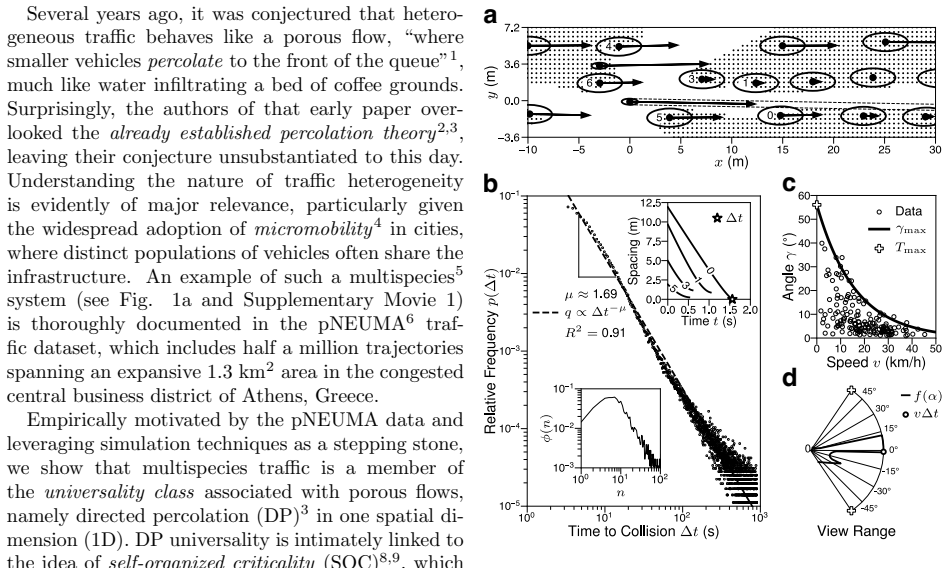
The load-bearing mechanism is a two-module agent-based model: a steering module with a speed-dependent dynamic view range $\gamma_{\max}(v) = \exp(bv + c)$ that acts as a stochastic, temperature-like porosity or percolation probability, and a heterogeneous optimal-velocity module with a mean-reverting Gaussian noise term and an anticipation weight based on time to collision. The order parameter $\Delta\Phi = \Phi_{\mathrm{moto}} - \Phi_{\mathrm{car}}$ and the control parameter T (the mean view range) are used to extract the critical power law, with the critical temperature fixed by the condition $T_c = \arg\min|\nu - \nu_\perp|$ so that the fitted exponent reports the theoretical 1D directed-percolation value.
What would settle it
Run the same simulations and extract the remaining one-dimensional directed-percolation exponents, the order-parameter exponent $\beta$ and the temporal-correlation exponent $\nu_\parallel$, together with a data collapse of $\langle\Delta\Phi\rangle_T^+$, without imposing $T_c = \arg\min|\nu - \nu_\perp|$; if either exponent disagrees with the 1D DP values or the collapse fails, the universality claim is refuted.
Extended reading notes
Core claim
The central claim is that multispecies traffic is an instance of one-dimensional directed percolation. The authors define a temperature-like control parameter T as the mean dynamic view range of microvehicles and an order parameter ΔΦ = Φ_moto − Φ_car that measures whether microvehicles are on average faster than cars. Near a critical temperature Tc the ensemble-averaged order parameter vanishes, and on the supercritical side it follows $\langle\Delta\Phi\rangle_T^+ \sim |T - T_c|^{\nu}$ with $\nu \approx \nu_\perp$, the spatial-correlation exponent of 1D directed percolation. The paper reads this as macroscopic equivalence to porous flows: smaller vehicles percolate through lanes of cars much as water infiltrates a porous bed, and states that the hypothesis is unambiguously confirmed with an average $R^2 = 0.993$ across statistically significant density and motorcycle-count permutations.
Load-bearing premise
The identification of mixed traffic with directed percolation rests on a fitting rule that chooses the critical temperature to make the measured exponent match the theoretical value; without that rule, the data alone do not establish the universality class.
Editorial extensions
If this is right
- If the universality claim holds, mixed urban traffic near its phase transition has no characteristic length scale, and macroscopic flow statistics obey a universal power law independent of behavioral details and vehicle geometry.
- The calibrated nonequilibrium model predicts a strongly nonlinear drop in car flow as the motorcycle share grows, contradicted only by an earlier unvalidated simulation study that predicted a linear reduction.
- The heavy-tailed time-to-collision distribution observed in the field implies that equilibrium is a rare event, so equilibrium-based traffic theories cannot describe the phase transition; nonequilibrium, noisy, driven models are required.
- The same modeling logic should apply to other heterogeneous crowds, such as pedestrians mixed with e-scooters, where universality could be tested outside the vehicle context.
Reading between the lines
- Editorial inference: the reported agreement $\nu \approx \nu_\perp$ is steered by the fitting rule $T_c = \arg\min|\nu - \nu_\perp|$ introduced right after Eq. 11 in the Results, so the exponent value alone is not independent evidence for directed percolation; the empirical content is the clean power-law form and the density-dependent thresholds.
- Editorial inference: because the paper itself notes that all three DP exponents should be measured, a decisive test would extract $\beta$ and $\nu_\parallel$ plus a data collapse from the same simulations without the Tc-optimization; failure there would falsify the universality assignment.
- Editorial inference: if the universality is real, the same critical exponent should appear in other multimodal trajectory datasets beyond the one studied here, which is a testable prediction that does not require rerunning the simulator.
Signed reviews
Editorial analysis
A structured set of objections, weighed in public.
Referee Report
Summary. This manuscript claims, on the basis of the pNEUMA drone data and a stochastic two-lane simulation model, that heterogeneous multispecies traffic belongs to the 1D directed percolation (DP) universality class. The authors calibrate a nonlinear optimal-velocity model with an anticipatory steering module, validate the aggregate fundamental diagram against field measurements, and report a power-law divergence of a speed-difference order parameter with mean view range; the fitted exponent is claimed to match the 1D DP value ν⊥. The abstract and Results present this as an 'unambiguous' confirmation of the DP hypothesis.
Significance. If the DP claim were independently supported, this would be a notable contribution that links urban traffic heterogeneity to nonequilibrium universality and offers an explanation for observed scatter in mixed-traffic data. The paper has genuine strengths: it draws on a large field dataset, provides an open simulation framework, reports a new empirical time-to-collision power law, and validates flow-speed relations against measurements. However, the quantitative evidence for DP is compromised by a circular fitting procedure, and the additional exponents and scaling collapse needed to identify a universality class are absent. I therefore cannot recommend publication without a substantially different analysis.
major comments (3)
- [Multispecies traffic as DP, Eq. (11) and following paragraph] The central test of the DP hypothesis is not independent. Equation (11) has two unknowns, Tc and ν, and the authors impose the optimality condition Tc = argmin |ν − ν⊥|, where ν⊥ is the theoretical 1D DP exponent. Because Tc is chosen for each density permutation to make the fitted ν as close as possible to ν⊥, the reported agreement ν ≈ ν⊥ is a built-in consequence of the selection rule, not an empirical confirmation. The average R² = 0.993 only shows that, conditional on this choice of Tc, a power law describes the curves; it does not test whether the system is in the DP universality class. An unbiased test would fit Eq. (11) with free Tc and ν and report the resulting exponent distribution, or fix ν = ν⊥ and test for data collapse; neither is provided.
- [Multispecies traffic as DP, Eq. (11) and Discussion] Only one of the three DP exponents is measured, and no scaling collapse is shown. DP in 1D is characterized by the exponents β, ν⊥, and ν∥; the paper measures only ν (fitted as described above) and explicitly defers β, ν∥, and the negative-⟨ΔΦ⟩ branch to future work. A universality-class assignment requires at least the full set of exponents or a data collapse with the DP scaling form; a single exponent obtained from a circular fitting procedure is insufficient to support the abstract's claim that 'multispecies traffic is a member of ... directed percolation in one spatial dimension.'
- [Multispecies traffic as DP, Eqs. (9)-(10) and Fig. 4] The identification of the mean view range T as a temperature-like control parameter and of the speed difference ΔΦ as the percolation order parameter is asserted rather than derived. No finite-size scaling analysis is reported despite the small system size (L = 90 m), no correlation-length scaling is shown, and the non-universal thresholds pc are not tested against any independent prediction. Without such tests, even a non-circular power-law fit would not by itself establish the existence of a genuine phase transition in the DP class.
minor comments (7)
- [Fig. 3d caption] The word 'micovehicles' should be 'microvehicles'.
- [Discussion, first paragraph] The word 'nonequilibirum' should be 'nonequilibrium'.
- [Eq. (6)] The bracket structure in the exponential term is confusing; please rewrite with clear parentheses, e.g., exp[−λ v0^{-1}(s − s0)].
- [Eq. (4) and surrounding text] The target direction is written both as a0 and as α0; please use a single consistent symbol throughout.
- [Methods, Maneuver detection] 'arch traveled' should be 'arc traveled'.
- [Fig. 1b and main text] The power-law distribution q ∝ Δt^{−μ} is stated without reporting the estimated exponent μ or the statistical test used to support the power-law claim; please provide the estimate, its uncertainty, and the goodness-of-fit measure.
- [Fig. 4c and related text] The reported standard deviation σν = 1.4 × 10^{-5} for the fitted exponents seems implausibly small given the 256 independent runs and the bootstrapped error bars shown in Fig. 4a; the provenance of this value should be clarified.
Circularity Check
The DP confirmation is circular: Tc is chosen by minimizing |ν − ν⊥|, so the reported agreement ν ≈ ν⊥ is set by the fitting rule rather than independently measured.
-
fitted input called prediction
[Results, 'Multispecies traffic as DP', paragraph following Eq. (11)]
"For each permutation, we fit a distinct power-law by also imposing the optimality condition Tc = argmin |ν − ν⊥|, where ν⊥ is the theoretically expected value of the spatial correlation exponent for 1D DP, as reported in 3. Rather than maximizing the goodness of fit, our objective is to minimize the deviation from the theoretical value, thus producing consistent estimates of the critical thresholds."
Equation (11), ⟨ΔΦ⟩+_T ∼ |T − Tc|^ν, has two unknowns, Tc and ν. The paper selects Tc by the rule Tc = argmin |ν − ν⊥|, using the target DP exponent ν⊥ as the optimization target. Consequently, for every density permutation, the fitted ν is forced as close as possible to ν⊥, so the later statement that the 1D DP hypothesis is confirmed with ν ≈ ν⊥ and average R² = 0.993 is not an independent confirmation but a consequence of the fitting protocol. The R² only indicates that a power law describes the data after this choice of Tc; it does not test whether the universality class is DP. The remaining DP exponents β and ν∥ are not measured, and no data collapse is shown, so the sole quantitative evidence for DP membership is this self-imposed agreement.
full rationale
The paper's central claim—that multispecies traffic belongs to the 1D directed percolation universality class—rests on the exponent agreement reported after Eq. (11). That agreement is manufactured by construction: Tc is chosen to minimize |ν − ν⊥|, where ν⊥ is the DP value the authors are trying to confirm. The reported ν is therefore the optimization target, not a measured critical exponent, and the R² does not discriminate DP from any other power-law description. The independent empirical contributions (the Δt power-law distribution, the capacity diagrams, and the fundamental-diagram validation) are useful but do not bear on the DP identification. No self-citation chain is load-bearing here; the problem is the fitting rule itself. Because the central 'confirmation' reduces to the selection rule, the circularity score is high, though the paper also contains independent non-DP results that prevent a maximal score.
Assumptions & free parameters
free parameters (6)
- View-range slope b and intercept c (Eq. 1) =
From quantile regression on pNEUMA data (Supplementary Table 1)
- OV shape parameters s0, λ, v0 and their distributions =
Per-agent fits then distribution parameters (Supplementary Tables 3-4)
- Noise relaxation time τ and amplitude a =
Estimated from residual autocorrelation (Fig. 2b)
- Steering relaxation time τ =
0.6 s
- Critical temperature Tc =
Varies by density permutation
- Critical exponent ν =
≈ 1.097 (ν⊥)
assumptions (5)
- domain assumption The off-lattice simulation on a moving substrate has the same DP universality as lattice DP (Hinrichsen 2000).
- ad hoc to paper The mean view range T acts as a temperature-like control parameter.
- ad hoc to paper The relative speed difference ΔΦ is the correct order parameter for the percolation transition.
- domain assumption Hard elliptical discs and the calibrated steering/OV rules capture the essential physics of multispecies traffic.
- standard math The stochastic noise does not affect stability and the stability condition (Eq. 13) applies.
Cite this review
Pith. "Pith review of Universality in multispecies traffic." pith.science (2026). https://pith.science/paper/KVIDTRD5
@misc{pith2026250102980,
  author       = {Pith},
  title        = {Pith review of: Universality in multispecies traffic},
  year         = {2026},
  howpublished = {\url{https://pith.science/paper/KVIDTRD5}},
  note         = {Machine review of arXiv:2501.02980}
}
read the original abstract
Understanding the nature of traffic heterogeneity is of major importance, given the widespread adoption of micromobility in cities. Based on massive field data and a nonequilibrium model, we demonstrate that heterogeneous, multispecies traffic is a member of an inherently nonequilibrium universality class associated with porous flows, namely directed percolation (DP) in one spatial dimension. Our central finding is that, macroscopically, multispecies traffic behaves like water percolating through a porous medium. This hypothesis remained unresolved for years mainly due to the incompatibility of equilibrium approaches with phenomena that are quite far from equilibrium and the limited resonance of complexity theory in the transportation literature. DP entails the existence of a nontrivial phase transition from a disordered subcritical phase to an ordered supercritical phase that depends on a temperature-like control parameter and is governed by a universal power-law. Our model explains the large scatter found in experimental data by taking into account the nonlinear, stochastic perturbations present in multispecies traffic configurations due to coupling of a predominantly lane-based host system with a layer of lane-free parasitic flows.
Figures


Figures from the paper (1 more)

Reference graph
Works this paper leans on
-
[1]
Nair, R., Mahmassani, H. S. & Miller-Hooks, E. A porous flow approach to modeling heteroge- neous traffic in disordered systems. Transporta- tion Research Part B: Methodological 45, 1331– 1345 (Nov. 2011)
work page 2011
-
[2]
Stauffer, D. & Aharony, A. Introduction to per- colation theory 2nd ed. en (Taylor & Francis, London, England, July 1994)
work page 1994
-
[3]
Non-equilibrium critical phe- nomena and phase transitions into absorbing states
Hinrichsen, H. Non-equilibrium critical phe- nomena and phase transitions into absorbing states. Advances in Physics 49, 815–958 (Nov. 2000)
work page 2000
-
[4]
O’ Hern, S. & Estgfaeller, N. A scientometric review of powered micromobility. Sustainability 12, 9505 (2020)
work page 2020
-
[5]
Mason, A. D. & Woods, A. W. Car-following model of multispecies systems of road traffic. Physical Review E 55, 2203–2214 (Mar. 1997)
work page 1997
-
[6]
Barmpounakis, E. & Geroliminis, N. On the new era of urban traffic monitoring with mas- sive drone data: The pNEUMA large-scale field experiment. Transportation Research Part C: Emerging Technologies 111, 50–71 (Feb. 2020)
work page 2020
-
[7]
Thurner, S., Klimek, P. & Hanel, R. Introduc- tion to the Theory of Complex Systems (Oxford University Press, Nov. 2018)
work page 2018
-
[8]
Bak, P., Tang, C. & Wiesenfeld, K. Self- organized criticality: An explanation of the 1/f noise. Physical review letters 59, 381 (1987)
work page 1987
Show all 47 references
-
[9]
Introduction to Phase Transitions and Critical Phenomena (Oxford University Press, 1987)
Stanley, H. Introduction to Phase Transitions and Critical Phenomena (Oxford University Press, 1987). 9
1987
-
[10]
Lighthill, M. J. & Whitham, G. B. On kine- matic waves II. A theory of traffic flow on long crowded roads. Proceedings of the royal society of london. series a. mathematical and physical sciences 229, 317–345 (1955)
1955
-
[11]
Richards, P. I. Shock waves on the highway. Op- erations research 4, 42–51 (1956)
1956
-
[12]
& Colombo, R
Benzoni-Gavage, S. & Colombo, R. M. An n- populations model for traffic flow. European Journal of Applied Mathematics 14, 587–612 (2003)
2003
-
[13]
A theory of nonequilibrium traffic flow
Zhang, H. A theory of nonequilibrium traffic flow. Transportation Research Part B: Method- ological 32, 485–498 (Sept. 1998)
1998
-
[14]
& Shochet, O
Vicsek, T., Czir´ ok, A., Ben-Jacob, E., Cohen, I. & Shochet, O. Novel type of phase transition in a system of self-driven particles. Physical review letters 75, 1226 (1995)
1995
-
[15]
& Bartolo, D
Bain, N. & Bartolo, D. Critical mingling and universal correlations in model binary active liq- uids. Nature Communications 8 (June 2017)
2017
-
[16]
Far from the equilibrium crowd
Schmiedeberg, M. Far from the equilibrium crowd. Nature Physics 19, 1078–1079 (July 2023)
2023
-
[17]
& Donikian, S
Ondˇ rej, J., Pettr´ e, J., Olivier, A.-H. & Donikian, S. A synthetic-vision based steering approach for crowd simulation. ACM Transactions on Graphics (TOG) 29, 1–9 (2010)
2010
-
[18]
& Theraulaz, G
Moussa ¨ ıd, M., Helbing, D. & Theraulaz, G. How simple rules determine pedestrian behav- ior and crowd disasters. Proceedings of the Na- tional Academy of Sciences 108, 6884–6888 (Apr. 2011)
2011
-
[19]
& Guy, S
Karamouzas, I., Skinner, B. & Guy, S. J. Univer- sal power law governing pedestrian interactions. Physical review letters 113, 238701 (2014)
2014
-
[20]
& Seyfried, A
Xu, Q., Chraibi, M. & Seyfried, A. Anticipation in a velocity-based model for pedestrian dynam- ics. Transportation Research Part C: Emerging Technologies 133, 103464 (Dec. 2021)
2021
-
[21]
& Palffy-Muhoray, P
Zheng, X. & Palffy-Muhoray, P. Distance of closest approach of two arbitrary hard ellipses in two dimensions. Physical Review E 75 (June 2007)
2007
-
[22]
Stumpf, M. P. & Porter, M. A. Critical truths about power laws. Science 335, 665–666 (2012)
2012
-
[23]
Why heuristics work
Gigerenzer, G. Why heuristics work. Perspec- tives on psychological science 3, 20–29 (2008)
2008
-
[24]
& Thurner, S
Corominas-Murtra, B., Hanel, R. & Thurner, S. Understanding scaling through history- dependent processes with collapsing sample space. Proceedings of the National Academy of Sciences 112, 5348–5353 (Apr. 2015)
2015
-
[25]
& Thurner, S
Corominas-Murtra, B., Hanel, R. & Thurner, S. Sample space reducing cascading processes pro- duce the full spectrum of scaling exponents. Sci- entific Reports 7 (Sept. 2017)
2017
-
[26]
Fast Poisson disk sampling in ar- bitrary dimensions in ACM SIGGRAPH 2007 sketches (ACM, Aug
Bridson, R. Fast Poisson disk sampling in ar- bitrary dimensions in ACM SIGGRAPH 2007 sketches (ACM, Aug. 2007)
2007
-
[27]
& Hallock, K
Koenker, R. & Hallock, K. F. Quantile regres- sion. Journal of economic perspectives 15, 143– 156 (2001)
2001
-
[28]
Guo, N. et al. Bicycle flow dynamics on wide roads: Experiments and simulation. Transporta- tion Research Part C: Emerging Technologies 125, 103012 (Apr. 2021)
2021
-
[29]
& Sugiyama, Y
Bando, M., Hasebe, K., Nakayama, A., Shibata, A. & Sugiyama, Y. Dynamical model of traffic congestion and numerical simulation. Physical Review E 51, 1035–1042 (Feb. 1995)
1995
-
[30]
Newell, G. F. Nonlinear effects in the dynamics of car following. Operations research 9, 209–229 (1961)
1961
-
[31]
Daganzo, C. F. In Memoriam: Gordon F. Newell, 1925–2001. Transportation Science 35, iii–v (2001)
2001
-
[32]
& Schadschneider, A
Tordeux, A. & Schadschneider, A. White and relaxed noises in optimal velocity models for pedestrian flow with stop-and-go waves. Jour- nal of Physics A: Mathematical and Theoretical 49, 185101 (Apr. 2016). 10
2016
-
[33]
& Haj-Salem, H
Mammar, S., Mammar, S. & Haj-Salem, H. A modified optimal velocity model for vehicle fol- lowing. IF AC Proceedings Volumes38, 120–125 (2005)
2005
-
[34]
Wu, X., Liu, H. X. & Geroliminis, N. An em- pirical analysis on the arterial fundamental dia- gram. Transportation Research Part B: Method- ological 45, 255–266 (Jan. 2011)
2011
-
[35]
W., Chiou, Y.-C., Lin, Z.-S
Lan, L. W., Chiou, Y.-C., Lin, Z.-S. & Hsu, C.-C. Cellular automaton simulations for mixed traffic with erratic motorcycles’ behaviours. Physica A: Statistical Mechanics and its Appli- cations 389, 2077–2089 (May 2010)
2010
-
[36]
Li, D. et al. Percolation transition in dynami- cal traffic network with evolving critical bottle- necks. Proceedings of the National Academy of Sciences 112, 669–672 (Dec. 2014)
2014
-
[37]
E., C ¸ olak, S., Shafiei, S., Saberi, M
Olmos, L. E., C ¸ olak, S., Shafiei, S., Saberi, M. & Gonz´ alez, M. C. Macroscopic dynamics and the collapse of urban traffic. Proceedings of the Na- tional Academy of Sciences 115, 12654–12661 (Dec. 2018)
2018
-
[38]
Saberi, M. et al. A simple contagion process de- scribes spreading of traffic jams in urban net- works. Nature Communications 11 (Apr. 2020)
2020
-
[39]
Zeng, G. et al. Multiple metastable network states in urban traffic. Proceedings of the Na- tional Academy of Sciences 117, 17528–17534 (July 2020)
2020
-
[40]
& Gonz´ alez, M
Amb¨ uhl, L., Menendez, M. & Gonz´ alez, M. C. Understanding congestion propagation by com- bining percolation theory with the macroscopic fundamental diagram. Communications Physics 6 (Feb. 2023)
2023
-
[41]
Laval, J. A. & Daganzo, C. F. Lane-changing in traffic streams. Transportation Research Part B: Methodological 40, 251–264 (Mar. 2006)
2006
-
[42]
& Helbing, D
Kesting, A., Treiber, M. & Helbing, D. General lane-changing model MOBIL for car-following models. Transportation Research Record 1999, 86–94 (2007)
2007
-
[43]
J., Pu, Y
Yang, D., Jin, P. J., Pu, Y. & Ran, B. Stabil- ity analysis of the mixed traffic flow of cars and trucks using heterogeneous optimal velocity car- following model. Physica A: Statistical Mechan- ics and its Applications 395, 371–383 (2014)
2014
-
[44]
Huijberts, H. J. C. Improved stability bound for steady-state flow in a car-following model of road traffic on a circular route. Physical Review E 65 (Apr. 2002)
2002
-
[45]
Laval, J. A. & Leclercq, L. A mechanism to de- scribe the formation and propagation of stop- and-go waves in congested freeway traffic.Philo- sophical Transactions of the Royal Society A: Mathematical, Physical and Engineering Sci- ences 368, 4519–4541 (Oct. 2010)
2010
-
[46]
Ngoduy, D., Lee, S., Treiber, M., Keyvan- Ekbatani, M. & Vu, H. Langevin method for a continuous stochastic car-following model and its stability conditions. Transportation Research Part C: Emerging Technologies 105, 599–610 (Aug. 2019)
2019
-
[47]
pNEUMA: On the new era of urban traffic models with massive empirical data from aerial footage
Kim, S., Anagnostopoulos, G., Barmpounakis, E. & Geroliminis, N. Visual extensions and anomaly detection in the pNEUMA experi- ment with a swarm of drones. Transportation Research Part C: Emerging Technologies 147, 103966 (Feb. 2023). Acknowledgements Our paper was partially f...
2023
Reviewed August 10, 2026 · model on record in the stance chip above.
Discussion (0). Continue with ORCID to comment.