REVIEW 4 major objections 5 minor 2 cited by
Misty, patchy, and turbulent: constraining the cool circumgalactic medium with mCC
T0 review · 4 major / 5 minor · reviewed 2026-08-12 · deepseek-v4-flash
Pith's one-line read The cool circumgalactic medium around Milky Way-like galaxies can be described as roughly 1,000 ten-kiloparsec cloud complexes, each a mist of tiny cloudlets, holding about 10^10 solar masses of gas.
desk verdict A useful, computationally cheap toy model for the clumpy cool CGM, but the headline mass is calibrated on the same data it claims to infer. read the letter →
The pith
A machine-rendered reading of the paper's core claim, the machinery that carries it, and where it could break.
The reading
What carries the argument
The load-bearing object is the misty cloud complex: a spherical region of radius R_CC that contains cool cloudlets dense enough that any sightline through the complex intersects cool gas (unit area covering fraction), allowing the complex to be smoothed into an average density ⟨n_gas⟩ = 3M_CC/($4πR_CC^{3}$ μ m_p). The model's second mechanism is a Kolmogorov turbulent broadening ansatz, σ_turb,CC = σ_turb,CGM (R_CC/R_CGM)^{1/3}, anchored to a hot-phase Mach number ~0.5, which sets the Doppler parameter b_tot and therefore the equivalent width from the curve of growth. The primary observable identity is ⟨N_MgII⟩ × f_CC^A ≈ const for fixed cool mass, which connects the data products to M_cool. The advanced model replaces identical complexes with power-law distributions of complex size, mass, and radius, but preserves the same mass-proxy relation.
What would settle it
Measure the line-of-sight velocity dispersion of the hot CGM around a Milky Way-mass galaxy at ~10 kpc scales with high-resolution X-ray spectroscopy; if the one-dimensional dispersion is much larger or smaller than the assumed ~20 km/s, the predicted MgII equivalent-width distribution from the fiducial mCC model will not match the observed spectra, falsifying the turbulent-broadening ansatz.
Extended reading notes
Core claim
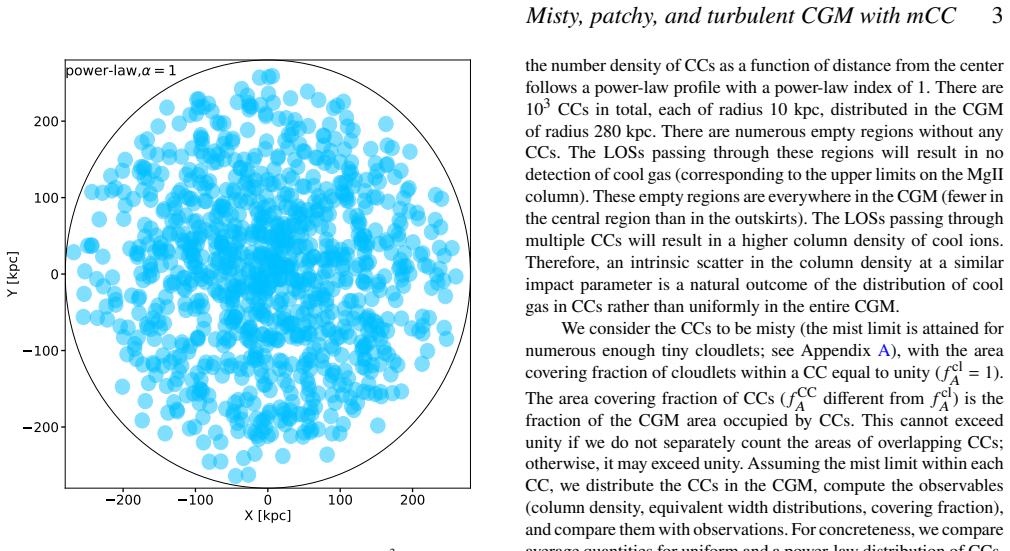
The central discovery is that the observed clumpiness of the cool CGM can be captured by a two-level 'misty cloud complex' (mCC) model: within each complex, tiny cloudlets are so numerous that the area covering fraction is unity, while the complexes themselves cover only a small fraction of the CGM volume. Monte Carlo realizations with $10^{3}$ complexes of radius 10 kpc, a power-law radial distribution with index α=1, and total cool mass $10^{10}$ M_sun match the MgII column density and equivalent-width trends with impact parameter in the COS-Halos sample and the covering fraction data of Huang et al. 2021. The authors further show that ⟨N_MgII⟩ × f_CC^A, the average column density times the area covering fraction, is nearly constant for a fixed cool-gas mass across wide variations in complex number, size, and mass, so the pair of observables can be used to weigh the cool CGM. Directly placing parsec-scale cloudlets inside complexes shows that absorption from many cloudlets blends to reproduce the same turbulent broadening that the analytic mist prescription assumes.
Load-bearing premise
The equivalent widths and covering fractions that validate the model depend on an assumed internal velocity spread for each cloud complex, estimated from hot-gas turbulence whose strength has not been directly measured; if that spread is wrong, the inferred complex size and number change.
Editorial extensions
If this is right
- For Milky Way-like galaxies, the cool CGM mass is constrained to ~10^10 M_sun, with about 10^3 cloud complexes of radius ~10 kpc distributed with a dN/dR ∝ R^{-1} profile.
- Large intrinsic scatter in MgII column density at fixed impact parameter is a natural prediction of the patchy CC distribution, not an observational artifact.
- The product of average MgII column density and covering fraction can be used as a mass estimator for cool CGM without needing to know the detailed cloud geometry.
- Spectra toward a single complex should show blended absorption that mimics turbulent broadening even if individual cloudlets are tiny, implying that resolved components do not directly map to 3D structures.
- The same machinery applied to OVI reproduces the COS-Halos OVI column spread, suggesting the CC picture extends to warm gas.
Reading between the lines
- Future surveys with many quasar–galaxy pairs could map cool CGM mass as a function of stellar mass and environment simply by binning average column density and covering fraction without velocity-resolved fits; this extension is not developed in the paper.
- The turbulent broadening ansatz is the least protected link: a direct measurement of hot CGM turbulence around Milky Way-mass halos would either validate the ~20 km/s CC-scale dispersion or require re-fitting the CC size and number, since EW and column density are degenerate there.
- The two-level mist picture suggests that unresolved multiphase gas in cosmological simulations could be represented statistically by CCs rather than resolved cloudlets, a subgrid scheme the paper mentions but does not implement.
- The same ⟨N⟩ × f_cov proxy could in principle be applied to FRB dispersion measures to cross-check the cool-mass estimate against the total electron column, since dispersion measure is insensitive to metallicity and ionization corrections.
Editorial analysis
A structured set of objections, weighed in public.
Referee Report
Summary. The paper introduces the 'mCC' (misty cloud complex) model, in which the cool (~10^4 K) circumgalactic medium around L* galaxies is not a uniform mist but is concentrated in ~10^3 clumpy complexes of radius ~10 kpc, each internally in the mist limit with a large number of tiny cloudlets. Analytic expressions are derived for the mean MgII column density and its variance along lines of sight for uniform and power-law radial distributions of complexes, and Monte Carlo realizations are used to generate predicted distributions of column density, equivalent width, and covering fraction. Comparing with COS-Halos and M3/Huang et al. data, the authors conclude that M_cool ~ 10^10 M_sun, N_CC ~ 10^3, R_CC ~ 10 kpc, and alpha = 1 reproduce the observed trends; they further propose that the product of area-averaged MgII column density and area covering fraction is a robust mass proxy. The paper also presents an 'advanced' model with distributed complex sizes and masses, direct cloudlet-level modeling over the full CGM, and an analogous OVI prediction for warm gas.
Significance. If validated, the mCC framework would be a useful and computationally cheap bridge between analytic misty-CGM models and cloudlet-resolved models such as CloudFlex. The paper's strengths include publicly released code and data, closed-form analytic expressions (Eqs. 6 and 9, and the variance estimate in Appendix C), a careful Monte Carlo description, a concrete mist-limit criterion (Appendix A), and an explicit demonstration that line blending of small cloudlets converges to the misty-CC absorption profile (Section 4). The main physical claims, however, rest on two load-bearing choices that the manuscript itself flags as uncertain: the turbulent broadening ansatz of Section 3.4.2, which has no direct observational calibration for L* halos, and the calibration of the fiducial model on the same COS-Halos data that are later used to 'infer' the cool CGM mass. These issues do not invalidate the framework as a phenomenological tool, but they currently prevent the paper from delivering a robust quantitative constraint on the cool CGM mass.
major comments (4)
- [Section 3.4.2 and Section 3.6] The turbulent broadening across a cloud complex is the main link between the model's column densities and the observed equivalent widths, yet it is set by an unvalidated ansatz: a hot-phase Mach number of 0.5 at ~2x10^6 K, scaled to the CC scale with a Kolmogorov factor. Footnote 6 concedes that no direct observations of hot CGM turbulence in Milky Way-mass halos exist, and the only empirical anchor cited (Hitomi) gives ICM Mach ~0.2. Because MgII column densities near 10^13 cm^-2 lie on the flat part of the curve of growth (Fig. 3), the predicted EW and the EW-threshold covering fraction (Fig. 6, bottom panel; also the recommendation in Section 6.3.1) depend directly on the adopted broadening. If the true hot-phase Mach number were 0.2 instead of 0.5, the 1D turbulent dispersion across a 10 kpc CC would drop from 20 to ~8 km/s and b_turb,CC from ~28 to ~11 km/s; the saturated-component EWs would shrink and the EW>0.3 A covering fraction would fall, so matching the observed covering fraction would require a different M_cool and/or different CC parameters. The claimed ~10^10 M_sun mass and the statement that the model 'reproduces' the observations are therefore contingent on a factor-of-2.5 uncertainty in the broadening parameter that is not propagated into the quoted constraint.
- [Section 3.5 and Section 3.7] The inference of M_cool ~ 10^10 M_sun is circular as presented. The fiducial mass is selected in the top panels of Fig. 5 by matching the COS-Halos column density distribution, and the same COS-Halos data are then placed on the mass-proxy diagram of Fig. 7 to conclude that the cool CGM mass is ~10^10 M_sun. The green point in Fig. 7 thus confirms a value that was already built into the model through Fig. 5, not an independent measurement. The mass-proxy relation itself is a model prediction, but its application to COS-Halos is not a test. To support the title's 'constraining' claim, the model should be calibrated on one sample (or on a subset of sightlines) and validated on an independent one (for example, the M3/Huang et al. EW data, or a different ion such as OVI with an independent mass estimate), or the manuscript should be reframed as a demonstration of the framework rather than a measurement of the cool CGM mass.
- [Section 3.5 and Fig. 5] The claim that the fiducial parameter set 'best matches' or 'most consistent with' the COS-Halos data is based on qualitative, by-eye comparison of scatter plots with highly heterogeneous data (detections, upper limits, and lower limits). No quantitative goodness-of-fit statistic, likelihood, or sensitivity of the visual ranking to the adopted binning is provided. Given the large intrinsic scatter and the presence of censored measurements, a quantitative comparison (for instance, a two-dimensional Anderson-Darling or KS test with proper handling of limits, or a likelihood over the impact-parameter distribution) is needed before 'reproduces' can be taken as a rigorous claim. This is fixable and would materially strengthen the paper's central conclusion.
- [Section 3.7 and Section 6.3.1] The advertised robustness of the mass proxy is overstated. Fig. 7 shows that the product of the detection-averaged column density and the covering fraction is approximately constant for different N_CC and R_CC at fixed M_cool, which is a useful degeneracy-breaking result. However, the product is not independent of all other model parameters: it depends on the assumed cool-gas density normalization (Eq. 13), metallicity (0.3 Z_sun), and the MgII ion fraction model (Appendix B), all of which are fixed assumptions rather than fitted quantities. Moreover, Section 6.3.1 recommends defining the covering fraction with an EW threshold of 0.3 A, which reintroduces the dependence on the turbulent broadening ansatz discussed above. The text should state explicitly that the proxy is independent only of the CC configuration parameters (N_CC, R_CC, alpha) conditional on the assumed gas physics, and that the EW-threshold version is sensitive to b_turb.
minor comments (5)
- [Section 3.4.2] The notation for the turbulent broadening parameter is confusing: the text gives sigma_3D,turb,CC = 35 km/s, then sigma_1D = 20 km/s, and then defines b_turb,CC = sqrt(2) sigma_1D, which gives b_turb,CC ~ 28 km/s, not 20 km/s. Please define a single symbol for the Doppler broadening parameter and use it consistently in Figs. 3 and 4 and in the text.
- [Fig. 2, bottom panel] The dotted lines representing the expected standard deviation around the mean column density are not labeled in the legend; please add an explicit legend entry and state in the caption whether the spread is computed from Eq. C2 or from the Monte Carlo realizations.
- [Section 4] The cloudlet-generation cylinder in Section 4 has a height of 20 kpc while the CC radius is 10 kpc; please justify why the cylinder extends beyond the CC, or state explicitly that this is a numerical convenience for the line-blending test.
- [Eq. (10)] The volume-fraction estimate in Eq. (10) uses n_cool = 10^-2 cm^-3, while the adopted density profile in Eq. (13) is radius-dependent and gives n_cool = 10^-3 cm^-3 at R_CGM = 280 kpc. Please clarify which density is used for the fiducial numerical values in Eq. (10).
- [Section 2] The description of the M3 sample states a stellar mass range of 2x10^8 - 4x10^11 M_sun with median 4x10^10 M_sun, but the comparison in Figs. 6 and 12 treats the sample as comparable to COS-Halos; a brief statement on the stellar-mass and redshift matching between the two samples would help the reader assess the validity of the joint comparison.
Circularity Check
The kinematic 'verification' of the misty CC turbulent broadening in §4 is tautological: cloudlet velocities are drawn from the same σ_turb,CC that defines b_turb,CC, so the emergent broadening is input, not prediction.
-
self definitional
[Section 4 (line blending with smaller cloudlets) vs Section 3.4.2]
"These assumptions give σ3Dturb,CGM≈107 km/s. For RCC=10 kpc and RCGM=280 kpc, we get σ3Dturb,CC=35 km/s... σturb,CC=σ3Dturb,CC/√3=20 km/s. In §4: 'The velocity field has zero mean and standard deviation σ3Dturb,CC=σ3Dturb,CGM×(RCC/RCGM)^{1/3}=35 km/s ... estimated in the previous section.' ... 'This signifies that the turbulent velocity of individual tiny cloudlets results in the turbulent broadening across a CC, well modeled by our misty CC ansatz.'"
The cloudlet velocities in §4 are drawn from a Kolmogorov field whose standard deviation is set to the very σ3D,turb,CC=35 km/s used in §3.4.2 to define b_turb,CC=20 km/s. With enough cloudlets, the blended absorption profile must have a width equal to that input velocity dispersion, so matching the misty CC profile is tautological. The test therefore does not validate the turbulent-broadening ansatz; it re-inserts it. Because EW and EW-threshold covering fraction depend on b_turb, the ansatz remains unvalidated by an external constraint, and the 'convergence' claim in the abstract is an input-output identity.
full rationale
Most of the paper is a legitimate model-fitting exercise: M_cool, N_CC, R_CC, and α are constrained by matching COS-Halos column densities and EWs, and the Fig. 7 mass proxy is a mass-conservation relation whose contours are independent of R_CC and N_CC; the Huang+21 covering fraction provides a partially independent check. I find no circularity in those steps. The one genuinely circular step is the §4 'verification' of the misty-CC turbulent broadening. The cloudlet velocity field is generated with the identical σ3D,turb,CC=35 km/s that defines b_turb,CC=20 km/s in the ansatz, so the blended profile is guaranteed to reproduce the misty-CC profile in the many-cloudlet limit. This is input-output identity, not an emergent result. The score is 6 because one advertised prediction reduces by construction, while the rest of the derivation is self-contained.
Assumptions & free parameters
free parameters (9)
- R_CGM =
280 kpc
- M_cool =
1e10 M_sun
- N_CC =
1e3
- R_CC =
10 kpc
- alpha =
1
- sigma_3D,turb,CGM =
107 km/s
- n_cool normalization =
1e-3 cm^-3 at R_CGM, slope -1
- Z =
0.3 Z_sun
- f_MgII =
0.2
assumptions (5)
- domain assumption Cool gas in the CGM is confined to cloud complexes (CCs) with a unit area covering fraction within each CC (mist limit).
- domain assumption Turbulence cascades from the CGM scale to CC scales via Kolmogorov scaling with no energy loss.
- domain assumption The cool gas density profile follows n_cool ∝ R^{-1}.
- domain assumption The MgII ion fraction is computed in photoionization equilibrium at T = 10^4 K with the KS18 background and 0.3 solar metallicity.
- domain assumption The CGM and cloud complexes are spherically symmetric.
Cite this review
Pith. "Pith review of Misty, patchy, and turbulent: constraining the cool circumgalactic medium with mCC." pith.science (2026). https://pith.science/paper/KXG6VNJJ
@misc{pith2026241117173,
  author       = {Pith},
  title        = {Pith review of: Misty, patchy, and turbulent: constraining the cool circumgalactic medium with mCC},
  year         = {2026},
  howpublished = {\url{https://pith.science/paper/KXG6VNJJ}},
  note         = {Machine review of arXiv:2411.17173}
}
abstract
The circumgalactic medium (CGM) is the largest baryon reservoir around galaxies, but its extent, mass, and temperature distribution remain uncertain. We propose that cool gas ($\sim 10^4$ K) in the CGM resides in clumpy structures referred to as cloud complexes (CCs) rather than uniformly filling the entire CGM volume. Each CC contains a mist of tiny cool cloudlets dispersed in a warm/hot medium ($\sim 10^5$ - $10^6$~K). Modeling CCs in the mist limit (unit area covering fraction within a CC) simplifies the calculation of observables like ion absorption columns, equivalent widths, compared to modeling individual cloudlets from first principles. Through Monte Carlo realizations of CCs, we explore how CC properties affect the observed variation in observables. We find that a power-law distribution of CCs ($dN_{\rm CC}/dR \propto R^{-1}$) with a total of $\sim 10^3$ CCs each with a radius of $\sim 10$ kpc and total cool gas mass of $\sim 10^{10} M_\odot$ reproduces MgII column density and equivalent width distribution trends with impact parameter for the COS-Halos sample (Werk+ 2013). We further show that the area-averaged MgII column density, combined with the area covering fraction, provides a robust proxy for estimating the cool CGM mass, independent of other model parameters. Modeling a larger number of (smaller size) cloudlets within a CC shows that line blending from individual cloudlets results in turbulent broadening on the CC scale. This work presents a practical framework for linking CGM models with observations of a multiphase CGM, illuminating the distribution of cool gas in galaxy halos.
Figures


Figures from the paper (10 more)


Forward citations
Cited by 2 Pith papers
-
MOGLI: Model for Multiphase Gas using Multifluid hydrodynamics
A two-fluid subgrid model with only two tuned parameters reproduces resolved multiphase gas evolution in turbulent boxes, enabling unresolved cold gas in large-scale astrophysical simulations.
-
Upper Limits on the Mass of Cool Gas in the Circumgalactic Medium of Dwarf Galaxies
Hydrogen absorption limits the cool circumgalactic gas in dwarf galaxies to 5e8-2e9 solar masses, below 10% of the halo baryon budget.
Reference graph
Works this paper leans on
-
[1]
Afruni A., Fraternali F., Pezzulli G., 2019, @doi [ ] 10.1051/0004-6361/201835002 , https://ui.adsabs.harvard.edu/abs/2019A&A...625A..11A 625, A11
-
[2]
Afruni A., et al., 2023, @doi [ ] 10.1051/0004-6361/202347867 , https://ui.adsabs.harvard.edu/abs/2023A&A...680A.112A 680, A112
-
[3]
Anand A., Nelson D., Kauffmann G., 2021, @doi [ ] 10.1093/mnras/stab871 , https://ui.adsabs.harvard.edu/abs/2021MNRAS.504...65A 504, 65
-
[4]
Armillotta L., Fraternali F., Werk J. K., Prochaska J. X., Marinacci F., 2017, @doi [ ] 10.1093/mnras/stx1239 , https://ui.adsabs.harvard.edu/abs/2017MNRAS.470..114A 470, 114
-
[5]
Asplund M., Grevesse N., Sauval A. J., Scott P., 2009, @doi [ ] 10.1146/annurev.astro.46.060407.145222 , https://ui.adsabs.harvard.edu/abs/2009ARA&A..47..481A 47, 481
arXiv 2009
-
[6]
Augustin R., P \'e roux C., Hamanowicz A., Kulkarni V., Rahmani H., Zanella A., 2021, @doi [ ] 10.1093/mnras/stab1673 , https://ui.adsabs.harvard.edu/abs/2021MNRAS.505.6195A 505, 6195
-
[7]
Augustin R., et al., 2025, @doi [arXiv e-prints] 10.48550/arXiv.2501.06551 , https://ui.adsabs.harvard.edu/abs/2025arXiv250106551A p. arXiv:2501.06551
-
[8]
Bera A., Kanekar N., Chengalur J. N., Bagla J. S., 2023, @doi [ ] 10.3847/2041-8213/acf71a , https://ui.adsabs.harvard.edu/abs/2023ApJ...956L..15B 956, L15
Show all 89 references
-
[9]
Bordoloi R., et al., 2011, @doi [ ] 10.1088/0004-637X/743/1/10 , https://ui.adsabs.harvard.edu/abs/2011ApJ...743...10B 743, 10
2011 doi
-
[10]
N., Hodges-Kluck E., Qu Z., Pratt C., Li J.-T., Yun Y., 2022, @doi [ ] 10.3847/1538-4357/ac51de , https://ui.adsabs.harvard.edu/abs/2022ApJ...928...14B 928, 14
Bregman J. N., Hodges-Kluck E., Qu Z., Pratt C., Li J.-T., Yun Y., 2022, @doi [ ] 10.3847/1538-4357/ac51de , https://ui.adsabs.harvard.edu/abs/2022ApJ...928...14B 928, 14
2022 doi
-
[11]
N., Rubin K
Burchett J. N., Rubin K. H. R., Prochaska J. X., Coil A. L., Vaught R. R., Hennawi J. F., 2021, @doi [ ] 10.3847/1538-4357/abd4e0 , https://ui.adsabs.harvard.edu/abs/2021ApJ...909..151B 909, 151
2021 doi
-
[12]
S., Fielding D
Butsky I. S., Fielding D. B., Hayward C. C., Hummels C. B., Quinn T. R., Werk J. K., 2020, @doi [ ] 10.3847/1538-4357/abbad2 , https://ui.adsabs.harvard.edu/abs/2020ApJ...903...77B 903, 77
2020 doi
-
[13]
S., Hummels C
Butsky I. S., Hummels C. B., Hopkins P. F., Quinn T. R., Werk J. K., 2024, @doi [ ] 10.1093/mnras/stae2459 , https://ui.adsabs.harvard.edu/abs/2024MNRAS.535.1672B 535, 1672
2024 doi
-
[14]
C., Ding J., Zonak S
Charlton J. C., Ding J., Zonak S. G., Churchill C. W., Bond N. A., Rigby J. R., 2003, @doi [ ] 10.1086/374353 , https://ui.adsabs.harvard.edu/abs/2003ApJ...589..111C 589, 111
2003 doi
-
[15]
L., Gauthier J.-R., Helsby J
Chen H.-W., Wild V., Tinker J. L., Gauthier J.-R., Helsby J. E., Shectman S. A., Thompson I. B., 2010, @doi [ ] 10.1088/2041-8205/724/2/L176 , https://ui.adsabs.harvard.edu/abs/2010ApJ...724L.176C 724, L176
2010 doi
-
[16]
Chen H.-W., et al., 2023, @doi [ ] 10.3847/2041-8213/acf85b , https://ui.adsabs.harvard.edu/abs/2023ApJ...955L..25C 955, L25
2023 doi
-
[17]
C., et al., 2024, @doi [ ] 10.3847/1538-4357/ad1406 , https://ui.adsabs.harvard.edu/abs/2024ApJ...962...98C 962, 98
Chen M. C., et al., 2024, @doi [ ] 10.3847/1538-4357/ad1406 , https://ui.adsabs.harvard.edu/abs/2024ApJ...962...98C 962, 98
2024 doi
-
[18]
Cherrey M., et al., 2025, @doi [ ] 10.1051/0004-6361/202451165 , https://ui.adsabs.harvard.edu/abs/2025A&A...694A.117C 694, A117
2025 doi
-
[19]
Connor L., et al., 2025, @doi [Nature Astronomy] 10.1038/s41550-025-02566-y , https://ui.adsabs.harvard.edu/abs/2025NatAs.tmp..131C
2025 doi
-
[20]
M., et al., 2023, @doi [ ] 10.3847/1538-4357/acbbd0 , https://ui.adsabs.harvard.edu/abs/2023ApJ...946...58C 946, 58
Cook A. M., et al., 2023, @doi [ ] 10.3847/1538-4357/acbbd0 , https://ui.adsabs.harvard.edu/abs/2023ApJ...946...58C 946, 58
2023 doi
-
[21]
K., Gronke M., 2024, @doi [ ] 10.1093/mnras/stad3125 , https://ui.adsabs.harvard.edu/abs/2024MNRAS.527..991D 527, 991
Das H. K., Gronke M., 2024, @doi [ ] 10.1093/mnras/stad3125 , https://ui.adsabs.harvard.edu/abs/2024MNRAS.527..991D 527, 991
2024 doi
-
[22]
Das S., Chiang Y.-K., Mathur S., 2023, @doi [ ] 10.3847/1538-4357/acd764 , https://ui.adsabs.harvard.edu/abs/2023ApJ...951..125D 951, 125
2023 doi
-
[23]
Decataldo D., Shen S., Mayer L., Baumschlager B., Madau P., 2024, @doi [ ] 10.1051/0004-6361/202346972 , https://ui.adsabs.harvard.edu/abs/2024A&A...685A...8D 685, A8
2024 doi
-
[24]
M., 2022, @doi [ ] 10.1016/j.physrep.2022.04.005 , https://ui.adsabs.harvard.edu/abs/2022PhR...973....1D 973, 1
Donahue M., Voit G. M., 2022, @doi [ ] 10.1016/j.physrep.2022.04.005 , https://ui.adsabs.harvard.edu/abs/2022PhR...973....1D 973, 1
2022 doi
-
[25]
T., 2011, Physics of the Interstellar and Intergalactic Medium
Draine B. T., 2011, Physics of the Interstellar and Intergalactic Medium . Princeton University Press
2011
-
[26]
Dutta R., et al., 2020, @doi [ ] 10.1093/mnras/staa3147 , https://ui.adsabs.harvard.edu/abs/2020MNRAS.499.5022D 499, 5022
2020 doi
-
[27]
B., Fossati M., 2024a, @doi [ ] 10.1093/mnras/stae048 , https://ui.adsabs.harvard.edu/abs/2024MNRAS.528.1895D 528, 1895
Dutta R., Acebron A., Fumagalli M., Grillo C., Caminha G. B., Fossati M., 2024a, @doi [ ] 10.1093/mnras/stae048 , https://ui.adsabs.harvard.edu/abs/2024MNRAS.528.1895D 528, 1895
-
[28]
S., Sharma P., Ghosh R., Roy M., Nath B
Dutta A., Bisht M. S., Sharma P., Ghosh R., Roy M., Nath B. B., 2024b, @doi [ ] 10.1093/mnras/stae977 , https://ui.adsabs.harvard.edu/abs/2024MNRAS.531.5117D 531, 5117
-
[29]
K., 2023, @doi [ ] 10.3847/1538-4357/acf217 , https://ui.adsabs.harvard.edu/abs/2023ApJ...956...92F 956, 92
Faerman Y., Werk J. K., 2023, @doi [ ] 10.3847/1538-4357/acf217 , https://ui.adsabs.harvard.edu/abs/2023ApJ...956...92F 956, 92
2023 doi
-
[30]
D., 2025, @doi [ ] 10.3847/2041-8213/adba51 , https://ui.adsabs.harvard.edu/abs/2025ApJ...982L..30F 982, L30
Faerman Y., Zheng Y., Oppenheimer B. D., 2025, @doi [ ] 10.3847/2041-8213/adba51 , https://ui.adsabs.harvard.edu/abs/2025ApJ...982L..30F 982, L30
2025 doi
-
[31]
P., 2023, @doi [ ] 10.1146/annurev-astro-052920-125203 , https://ui.adsabs.harvard.edu/abs/2023ARA&A..61..131F 61, 131
Faucher-Gigu \`e re C.-A., Oh S. P., 2023, @doi [ ] 10.1146/annurev-astro-052920-125203 , https://ui.adsabs.harvard.edu/abs/2023ARA&A..61..131F 61, 131
2023 doi
- [32]
-
[33]
P., Ji S., Norman C., 2022, @doi [ ] 10.1093/mnras/stab3351 , https://ui.adsabs.harvard.edu/abs/2022MNRAS.511..859G 511, 859
Gronke M., Oh S. P., Ji S., Norman C., 2022, @doi [ ] 10.1093/mnras/stab3351 , https://ui.adsabs.harvard.edu/abs/2022MNRAS.511..859G 511, 859
2022 doi
-
[34]
Guo Y., et al., 2023, @doi [ ] 10.1038/s41586-023-06718-w , https://ui.adsabs.harvard.edu/abs/2023Natur.624...53G 624, 53
2023 doi
-
[35]
Haardt F., Madau P., 2012, @doi [ ] 10.1088/0004-637X/746/2/125 , https://ui.adsabs.harvard.edu/abs/2012ApJ...746..125H 746, 125
2012 doi
-
[36]
Hitomi Collaboration et al., 2016, @doi [ ] 10.1038/nature18627 , https://ui.adsabs.harvard.edu/abs/2016Natur.535..117H 535, 117
2016 doi
-
[37]
F., ed., American Institute of Physics Conference Series Vol
Holweger H., 2001, in Wimmer-Schweingruber R. F., ed., American Institute of Physics Conference Series Vol. 598, Joint SOHO/ACE workshop ``Solar and Galactic Composition''. AIP, pp 23--30 ( @eprint arXiv astro-ph/0107426 ), @doi 10.1063/1.1433974
2001 arXiv
-
[38]
H., Putman M
Hsu W. H., Putman M. E., Heitsch F., Stanimirovi \'c S., Peek J. E. G., Clark S. E., 2011, @doi [ ] 10.1088/0004-6256/141/2/57 , https://ui.adsabs.harvard.edu/abs/2011AJ....141...57H 141, 57
2011 doi
-
[39]
A., Johnson S
Huang Y.-H., Chen H.-W., Shectman S. A., Johnson S. D., Zahedy F. S., Helsby J. E., Gauthier J.-R., Thompson I. B., 2021, @doi [ ] 10.1093/mnras/stab360 , https://ui.adsabs.harvard.edu/abs/2021MNRAS.502.4743H 502, 4743
2021 doi
-
[40]
B., Rubin K
Hummels C. B., Rubin K. H. R., Schneider E. E., Fielding D. B., 2024, @doi [ ] 10.3847/1538-4357/ad5965 , https://ui.adsabs.harvard.edu/abs/2024ApJ...972..148H 972, 148
2024 doi
-
[41]
Khaire V., Srianand R., 2019, @doi [ ] 10.1093/mnras/stz174 , https://ui.adsabs.harvard.edu/abs/2019MNRAS.484.4174K 484, 4174
2019 doi
-
[42]
N., 1991, @doi [Proceedings of the Royal Society of London Series A] 10.1098/rspa.1991.0075 , https://ui.adsabs.harvard.edu/abs/1991RSPSA.434....9K 434, 9
Kolmogorov A. N., 1991, @doi [Proceedings of the Royal Society of London Series A] 10.1098/rspa.1991.0075 , https://ui.adsabs.harvard.edu/abs/1991RSPSA.434....9K 434, 9
1991
-
[43]
Lan T.-W., Mo H., 2019, @doi [ ] 10.1093/mnras/stz839 , https://ui.adsabs.harvard.edu/abs/2019MNRAS.486..608L 486, 608
2019 doi
-
[44]
Lehner N., et al., 2020, @doi [ ] 10.3847/1538-4357/aba49c , https://ui.adsabs.harvard.edu/abs/2020ApJ...900....9L 900, 9
2020 doi
-
[45]
P., et al., 2020, @doi [ ] 10.1038/s41586-020-2300-2 , https://ui.adsabs.harvard.edu/abs/2020Natur.581..391M 581, 391
Macquart J. P., et al., 2020, @doi [ ] 10.1038/s41586-020-2300-2 , https://ui.adsabs.harvard.edu/abs/2020Natur.581..391M 581, 391
2020 doi
-
[46]
J., 2012, @doi [ ] 10.1111/j.1365-2966.2011.19972.x , https://ui.adsabs.harvard.edu/abs/2012MNRAS.419.3319M 419, 3319
McCourt M., Sharma P., Quataert E., Parrish I. J., 2012, @doi [ ] 10.1111/j.1365-2966.2011.19972.x , https://ui.adsabs.harvard.edu/abs/2012MNRAS.419.3319M 419, 3319
2012
-
[47]
K., 2018, @doi [ ] 10.3847/1538-4357/aa9d3f , https://ui.adsabs.harvard.edu/abs/2018ApJ...852...33M 852, 33
McQuinn M., Werk J. K., 2018, @doi [ ] 10.3847/1538-4357/aa9d3f , https://ui.adsabs.harvard.edu/abs/2018ApJ...852...33M 852, 33
2018 doi
-
[48]
W.H.Freeman & Co Ltd
Mihalas D., 1978, Stellar atmospheres . W.H.Freeman & Co Ltd
1978
-
[49]
Mohapatra R., Jetti M., Sharma P., Federrath C., 2022a, @doi [ ] 10.1093/mnras/stab3429 , https://ui.adsabs.harvard.edu/abs/2022MNRAS.510.2327M 510, 2327
-
[50]
Mohapatra R., Jetti M., Sharma P., Federrath C., 2022b, @doi [ ] 10.1093/mnras/stab3603 , https://ui.adsabs.harvard.edu/abs/2022MNRAS.510.3778M 510, 3778
- [51]
-
[52]
Nelson D., et al., 2020, @doi [ ] 10.1093/mnras/staa2419 , https://ui.adsabs.harvard.edu/abs/2020MNRAS.498.2391N 498, 2391
2020 doi
-
[53]
V., et al., 2025, @doi [arXiv e-prints] 10.48550/arXiv.2503.11139 , https://ui.adsabs.harvard.edu/abs/2025arXiv250311139N p
Ng Y. V., et al., 2025, @doi [arXiv e-prints] 10.48550/arXiv.2503.11139 , https://ui.adsabs.harvard.edu/abs/2025arXiv250311139N p. arXiv:2503.11139
2025 doi
-
[54]
M., Churchill C
Nielsen N. M., Churchill C. W., Kacprzak G. G., 2013, @doi [ ] 10.1088/0004-637X/776/2/115 , https://ui.adsabs.harvard.edu/abs/2013ApJ...776..115N 776, 115
2013 doi
-
[55]
M., Fisher D
Nielsen N. M., Fisher D. B., Kacprzak G. G., Chisholm J., Martin D. C., Reichardt Chu B., Sandstrom K. M., Rickards Vaught R. J., 2024, @doi [Nature Astronomy] 10.1038/s41550-024-02365-x
2024 doi
-
[56]
Pessa I., et al., 2024, @doi [ ] 10.1051/0004-6361/202450547 , https://ui.adsabs.harvard.edu/abs/2024A&A...691A...5P 691, A5
2024 doi
-
[57]
X., Zheng Y., 2019, @doi [ ] 10.1093/mnras/stz261 , https://ui.adsabs.harvard.edu/abs/2019MNRAS.485..648P 485, 648
Prochaska J. X., Zheng Y., 2019, @doi [ ] 10.1093/mnras/stz261 , https://ui.adsabs.harvard.edu/abs/2019MNRAS.485..648P 485, 648
2019 doi
-
[58]
X., et al., 2017, @doi [ ] 10.3847/1538-4357/aa6007 , https://ui.adsabs.harvard.edu/abs/2017ApJ...837..169P 837, 169
Prochaska J. X., et al., 2017, @doi [ ] 10.3847/1538-4357/aa6007 , https://ui.adsabs.harvard.edu/abs/2017ApJ...837..169P 837, 169
2017 doi
-
[59]
Qu Z., et al., 2023, @doi [ ] 10.1093/mnras/stad1886 , https://ui.adsabs.harvard.edu/abs/2023MNRAS.524..512Q 524, 512
2023 doi
-
[60]
Rahmani H., et al., 2018, @doi [ ] 10.1093/mnras/stx2726 , https://ui.adsabs.harvard.edu/abs/2018MNRAS.474..254R 474, 254
2018 doi
-
[61]
Ramesh R., Nelson D., 2024, @doi [ ] 10.1093/mnras/stae237 , https://ui.adsabs.harvard.edu/abs/2024MNRAS.528.3320R 528, 3320
2024 doi
-
[62]
Ramesh R., Nelson D., Fielding D., Br \"u ggen M., 2025, @doi [ ] 10.1051/0004-6361/202451303 , https://ui.adsabs.harvard.edu/abs/2025A&A...699A..10R 699, A10
2025 doi
-
[63]
M., Sardane G., Turnshek D
Rao S. M., Sardane G., Turnshek D. A., Thilker D., Walterbos R., Vanden Berk D., York D. G., 2013, @doi [ ] 10.1093/mnras/stt417 , https://ui.adsabs.harvard.edu/abs/2013MNRAS.432..866R 432, 866
2013 doi
-
[64]
B., Faucher-Gigu \`e re C.-A., 2024, @doi [ ] 10.1093/mnras/stad3142 , https://ui.adsabs.harvard.edu/abs/2024MNRAS.527..265R 527, 265
Roy M., Su K.-Y., Tonnesen S., Fielding D. B., Faucher-Gigu \`e re C.-A., 2024, @doi [ ] 10.1093/mnras/stad3142 , https://ui.adsabs.harvard.edu/abs/2024MNRAS.527..265R 527, 265
2024 doi
-
[65]
Rubin K. H. R., Prochaska J. X., Koo D. C., Phillips A. C., 2012, @doi [ ] 10.1088/2041-8205/747/2/L26 , https://ui.adsabs.harvard.edu/abs/2012ApJ...747L..26R 747, L26
2012 doi
-
[66]
Sameer et al., 2024, @doi [ ] 10.1093/mnras/stae962 , https://ui.adsabs.harvard.edu/abs/2024MNRAS.530.3827S 530, 3827
2024 doi
-
[67]
D., Sembach K
Savage B. D., Sembach K. R., 1991, @doi [ ] 10.1086/170498 , https://ui.adsabs.harvard.edu/abs/1991ApJ...379..245S 379, 245
1991 doi
-
[68]
Schaan E., et al., 2021, @doi [ ] 10.1103/PhysRevD.103.063513 , https://ui.adsabs.harvard.edu/abs/2021PhRvD.103f3513S 103, 063513
2021 doi
-
[69]
P., Grete P., 2021, @doi [ ] 10.1051/0004-6361/202140920 , https://ui.adsabs.harvard.edu/abs/2021A&A...654A.115S 654, A115
Schmidt W., Schmidt J. P., Grete P., 2021, @doi [ ] 10.1051/0004-6361/202140920 , https://ui.adsabs.harvard.edu/abs/2021A&A...654A.115S 654, A115
2021 doi
-
[70]
Shaban A., et al., 2025, @doi [ ] 10.3847/1538-4357/add0b9 , https://ui.adsabs.harvard.edu/abs/2025ApJ...986..190S 986, 190
2025 doi
-
[71]
R., Field G
Shapiro P. R., Field G. B., 1976, @doi [ ] 10.1086/154332 , https://ui.adsabs.harvard.edu/abs/1976ApJ...205..762S 205, 762
1976 doi
-
[72]
J., Quataert E., 2010, @doi [ ] 10.1088/0004-637X/720/1/652 , https://ui.adsabs.harvard.edu/abs/2010ApJ...720..652S 720, 652
Sharma P., Parrish I. J., Quataert E., 2010, @doi [ ] 10.1088/0004-637X/720/1/652 , https://ui.adsabs.harvard.edu/abs/2010ApJ...720..652S 720, 652
2010 doi
-
[73]
J., Quataert E., 2012, @doi [ ] 10.1111/j.1365-2966.2012.22050.x , https://ui.adsabs.harvard.edu/abs/2012MNRAS.427.1219S 427, 1219
Sharma P., McCourt M., Parrish I. J., Quataert E., 2012, @doi [ ] 10.1111/j.1365-2966.2012.22050.x , https://ui.adsabs.harvard.edu/abs/2012MNRAS.427.1219S 427, 1219
2012
-
[74]
B., Majumdar S., Silk J., 2015, @doi [ ] 10.1093/mnras/stv155 , https://ui.adsabs.harvard.edu/abs/2015MNRAS.448.2384S 448, 2384
Singh P., Nath B. B., Majumdar S., Silk J., 2015, @doi [ ] 10.1093/mnras/stv155 , https://ui.adsabs.harvard.edu/abs/2015MNRAS.448.2384S 448, 2384
2015 doi
-
[75]
Srianand R., Khare P., 1993, @doi [ ] 10.1086/173018 , https://ui.adsabs.harvard.edu/abs/1993ApJ...413..486S 413, 486
1993 doi
-
[76]
F., Prochaska J
Stern J., Hennawi J. F., Prochaska J. X., Werk J. K., 2016, @doi [ ] 10.3847/0004-637X/830/2/87 , https://ui.adsabs.harvard.edu/abs/2016ApJ...830...87S 830, 87
2016 doi
-
[77]
B., 2024, @doi [ ] 10.1093/mnras/stad3793 , https://ui.adsabs.harvard.edu/abs/2024MNRAS.527.9683T 527, 9683
Tan B., Fielding D. B., 2024, @doi [ ] 10.1093/mnras/stad3793 , https://ui.adsabs.harvard.edu/abs/2024MNRAS.527.9683T 527, 9683
2024 doi
-
[78]
S., Werk J
Tumlinson J., Peeples M. S., Werk J. K., 2017, @doi [ ] 10.1146/annurev-astro-091916-055240 , https://ui.adsabs.harvard.edu/abs/2017ARA&A..55..389T 55, 389
2017 doi
-
[79]
M., Meece G., Li Y., O'Shea B
Voit G. M., Meece G., Li Y., O'Shea B. W., Bryan G. L., Donahue M., 2017, @doi [ ] 10.3847/1538-4357/aa7d04 , https://ui.adsabs.harvard.edu/abs/2017ApJ...845...80V 845, 80
2017 doi
-
[80]
Weinberger R., Hernquist L., 2023, @doi [ ] 10.1093/mnras/stac3708 , https://ui.adsabs.harvard.edu/abs/2023MNRAS.519.3011W 519, 3011
2023 doi
-
[81]
K., Prochaska J
Werk J. K., Prochaska J. X., Thom C., Tumlinson J., Tripp T. M., O'Meara J. M., Meiring J. D., 2012, @doi [ ] 10.1088/0067-0049/198/1/3 , https://ui.adsabs.harvard.edu/abs/2012ApJS..198....3W 198, 3
2012 doi
-
[82]
K., Prochaska J
Werk J. K., Prochaska J. X., Thom C., Tumlinson J., Tripp T. M., O'Meara J. M., Peeples M. S., 2013, @doi [ ] 10.1088/0067-0049/204/2/17 , https://ui.adsabs.harvard.edu/abs/2013ApJS..204...17W 204, 17
2013 doi
-
[83]
K., et al., 2014, @doi [ ] 10.1088/0004-637X/792/1/8 , https://ui.adsabs.harvard.edu/abs/2014ApJ...792....8W 792, 8
Werk J. K., et al., 2014, @doi [ ] 10.1088/0004-637X/792/1/8 , https://ui.adsabs.harvard.edu/abs/2014ApJ...792....8W 792, 8
2014 doi
-
[84]
K., et al., 2016, @doi [ ] 10.3847/1538-4357/833/1/54 , https://ui.adsabs.harvard.edu/abs/2016ApJ...833...54W 833, 54
Werk J. K., et al., 2016, @doi [ ] 10.3847/1538-4357/833/1/54 , https://ui.adsabs.harvard.edu/abs/2016ApJ...833...54W 833, 54
2016 doi
-
[85]
N., Ji L., 2025, @doi [ ] 10.1093/mnras/staf407 , https://ui.adsabs.harvard.edu/abs/2025MNRAS.538.1871Y 538, 1871
Yang H., Qu Z., Bregman J. N., Ji L., 2025, @doi [ ] 10.1093/mnras/staf407 , https://ui.adsabs.harvard.edu/abs/2025MNRAS.538.1871Y 538, 1871
2025 doi
-
[86]
Zabl J., et al., 2021, @doi [ ] 10.1093/mnras/stab2165 , https://ui.adsabs.harvard.edu/abs/2021MNRAS.507.4294Z 507, 4294
2021 doi
-
[87]
Zhang H., Zaritsky D., Behroozi P., Werk J., 2019, @doi [ ] 10.3847/1538-4357/ab2761 , https://ui.adsabs.harvard.edu/abs/2019ApJ...880...28Z 880, 28
2019 doi
-
[88]
write newline
" write newline "" before.all 'output.state := FUNCTION fin.entry write newline FUNCTION new.block output.state before.all = 'skip after.block 'output.state := if FUNCTION new.sentence output.state after.block = 'skip output.state before.all = 'skip after.sentence 'output.stat...
-
[89]
write newline
" write newline "" before.all 'output.state := FUNCTION fin.entry write newline FUNCTION new.block output.state before.all = 'skip after.block 'output.state := if FUNCTION new.sentence output.state after.block = 'skip output.state before.all = 'skip after.sentence 'output.stat...
Reviewed August 12, 2026 · model on record in the stance chip above.
Discussion (0). Continue with ORCID to comment.