REVIEW 2 major objections 8 minor 37 references
Combined VERITAS and NuSTAR observations of the gamma-ray binary HESS J0632+057
T0 review · 2 major / 8 minor · reviewed 2026-08-14 · deepseek-v4-flash
Pith's one-line read The gamma-ray binary HESS J0632+057 is consistently described by a pulsar-wind termination-shock model, constraining the wind magnetization to 0.003-0.03.
desk verdict Useful new two-epoch NuSTAR/VERITAS data and an honest pulsar-wind fit, but the headline sigma0 constraint is hostage to an unpropagated stellar wind mass-loss rate. read the letter →
The pith
A machine-rendered reading of the paper's core claim, the machinery that carries it, and where it could break.
The reading
What carries the argument
The central object is the termination shock formed where the pulsar wind collides with the stellar wind of the Be star. The shock standoff distance is set by hydrodynamic momentum balance, $R_{\rm sh} = \frac{\sqrt{\eta}}{1+\sqrt{\eta}}D$, with $\eta = L_{\rm sd}/(\dot{M}_w v_w c)$ and $D$ the orbital separation. The magnetic field immediately downstream of the shock is computed from the standard Kennel-Coroniti-type expression $B = \sqrt{L_{\rm sd}\sigma_0 / (R_{\rm sh} c (1+\sigma_0))}$, so the two free parameters $L_{\rm sd}$ and $\sigma_0$ jointly set both the shock location and the field strength. The electron spectrum is taken as a power law with an exponential cutoff, and the emitted synchrotron and inverse Compton radiation is computed including the orbital geometry and photon-photon absorption. The model is fit to both SEDs simultaneously by $\chi^2$ minimization, and the key output is the allowed $L_{\rm sd}$-$\sigma_0$ region rather than individual parameter values.
What would settle it
A measurement of the companion's wind mass-loss rate from ultraviolet line profiles that falls outside the assumed $10^{-9}$-$10^{-8}\,M_\odot/\mathrm{yr}$ range, or an independent detection of pulsar spin-down that pins down $L_{\rm sd}$, would place the model's predicted $\sigma_0$ region in direct tension with the data.
Extended reading notes
Core claim
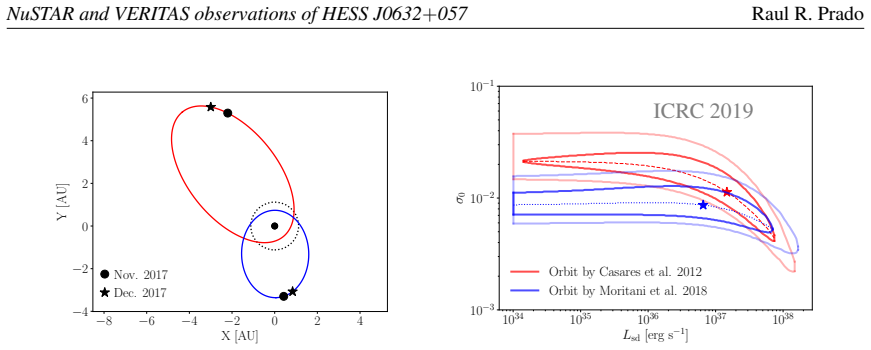
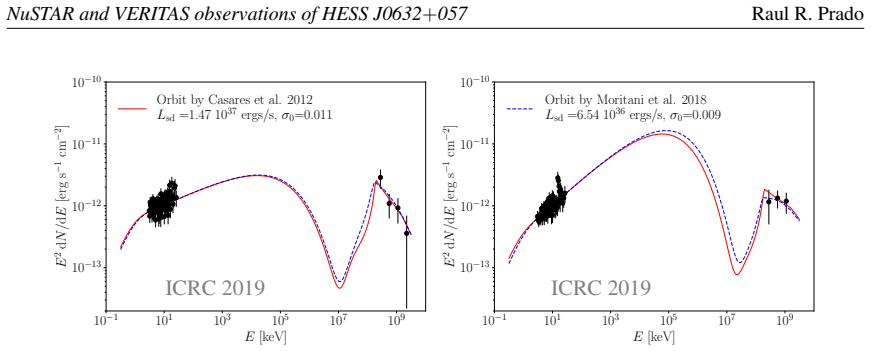
The paper's central claim is that two sets of simultaneous NuSTAR and VERITAS spectra, taken about three weeks apart, can be explained by a single-zone termination-shock model powered by a pulsar wind. The fitted spectral energy distributions are reproduced with a power-law electron population injected at the shock, with electron indices fixed to the measured X-ray photon indices, and with the predicted TeV emission attenuated by pair-production absorption in the stellar radiation field. Within this model the data do not independently pin down the spin-down luminosity $L_{\rm sd}$, but they do delineate a degenerate $L_{\rm sd}$-$\sigma_0$ region: the magnetization at the shock is constrained to $\sigma_0 \in [0.003, 0.03]$, and $L_{\rm sd}$ is bounded above by roughly $7\times10^{37}\,\mathrm{erg\,s^{-1}}$ at 1$\sigma$ for both published orbital solutions. The paper concludes that the observations are consistently described by a pulsar-wind model and that the implied shock standoff distances and magnetic fields are reasonable for this system.
Load-bearing premise
The model's shock location depends on the stellar wind mass-loss rate, which is assumed to lie between $10^{-9}$ and $10^{-8}$ solar masses per year; if the true wind is denser, faster, or slower, the inferred spin-down and magnetization region shifts.
Editorial extensions
If this is right
- If the pulsar-wind model is right, the compact object in HESS J0632+057 is a neutron star rather than a black hole, and the observed X-ray and TeV emission during the outburst rise is ultimately powered by pulsar spin-down.
- The magnetization at the shock, $\sigma_0 \sim 0.003$-$0.03$, is much less than unity, meaning the wind has already become particle-dominated at distances of order $10^{13}$-$10^{14}$ cm, providing a direct observational probe of the so-called sigma problem.
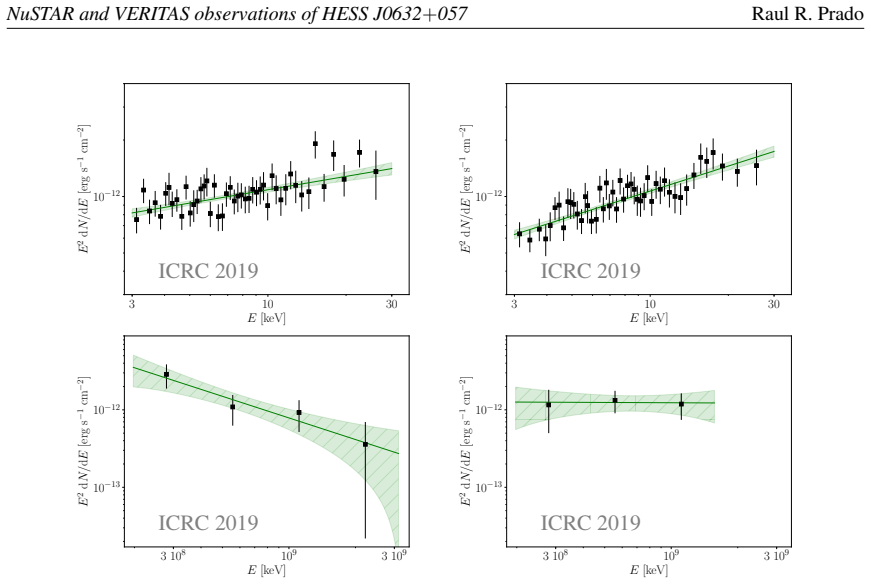
- The spectral hardening between November ($\Gamma = 1.77$) and December ($\Gamma = 1.56$) is captured by tying the injected electron index to the measured X-ray slope, so the same shock physics can account for both epochs.
- Both competing orbital solutions (Casares et al. and Moritani et al.) yield equally good fits, indicating that the orbital geometry does not discriminate the pulsar scenario in this system.
- The upper limit $L_{\rm sd} \lesssim 7\times10^{37}\,\mathrm{erg\,s^{-1}}$ is consistent with expectations for young pulsars, so the model does not require an unusually energetic or evolved neutron star.
Reading between the lines
- If the stellar wind mass-loss rate were measured to lie near the upper end of the assumed range ($10^{-8}\,M_\odot/\mathrm{yr}$), the inferred spin-down luminosity would shift downward, making the neutron star appear less energetic; a dedicated UV or optical campaign could break this degeneracy.
- The $L_{\rm sd}$-$\sigma_0$ degeneracy could be broken by observing the system at several orbital phases, because the shock standoff distance and the inverse Compton scattering angle change with orbital position, giving independent leverage on the two parameters.
- A contemporaneous radio observation of the termination shock's synchrotron emission could independently measure the magnetic field and, combined with the X-ray and TeV fluxes, would place a separate constraint on $\sigma_0$, a testable extension of the model.
Signed reviews
Editorial analysis
A structured set of objections, weighed in public.
Referee Report
Summary. The paper reports contemporaneous NuSTAR (3-30 keV) and VERITAS (0.2-3 TeV) observations of the gamma-ray binary HESS J0632+057 taken in November and December 2017. The X-ray spectra harden between the two epochs (photon index 1.77 +/- 0.05 to 1.56 +/- 0.05) while the TeV fluxes are comparable. The authors fit a one-zone pulsar-wind termination-shock model to the combined SEDs, with synchrotron emission for X-rays and anisotropic inverse-Compton emission for TeV gamma-rays, including gamma-gamma absorption. The free parameters are the pulsar spin-down luminosity L_sd, the wind magnetization sigma_0 at the shock, and the electron normalization for each epoch; the electron spectral indices are fixed to the measured X-ray photon indices. The fit yields chi2/dof = 0.786 for both orbital solutions and gives an allowed region in the L_sd-sigma_0 plane, with sigma_0 in the range ~0.003-0.03 and L_sd < 7e37 erg/s.
Significance. The simultaneous hard X-ray and TeV coverage of HESS J0632+057 is valuable, and the paper is one of the few attempts to constrain the pulsar-wind magnetization at a termination shock in a gamma-ray binary. If the quoted constraints survive a proper treatment of the dominant systematic uncertainty, they would be a useful input to the sigma problem. The paper is clearly written and uses standard analysis tools, and the modeling goes beyond earlier work by including anisotropic IC, gamma-gamma absorption, and two orbital solutions. However, the quantitative claims are currently conditioned on a fixed stellar-wind mass-loss rate and on a debatable mapping between electron spectral index and the observed photon index.
major comments (2)
- [Sections 3 and 5] Section 3 adopts Mdot_w = 10^-8.5 Msun/yr with an allowed range 10^-9 to 10^-8 Msun/yr, and Section 5 states that Mdot_w is 'by far the most relevant source of uncertainty', yet the paper does not show how the L_sd-sigma_0 contours in Fig. 2 (right) shift across this range. Because Mdot_w enters the shock standoff distance R_sh = sqrt(eta)/(1+sqrt(eta)) D with eta = L_sd/(Mdot_w v_w c), a factor of about three change in Mdot_w can plausibly move the quoted sigma_0 = 0.003-0.03 and L_sd < 7e37 erg/s bounds outside the stated regions. The paper must propagate this dominant systematic, for example by overlaying contours for the endpoint values of Mdot_w, before the headline constraint can be regarded as supported.
- [Section 4, last paragraph] The paper states that 'the slopes of the electron spectrum (Gamma_0 and Gamma_1) were fixed to the values derived from the single power-law fit of the X-ray spectrum'. In standard synchrotron theory, the photon index from a power-law electron distribution with differential index p is approximately (p+1)/2, so equating p to the observed X-ray photon index (1.77 and 1.56) is inconsistent and would predict synchrotron spectra that are harder than observed. Since the electron index sets both the synchrotron and inverse-Compton spectral shapes, this inconsistency likely biases the fitted L_sd and sigma_0 values and the reported chi2/dof of 0.786. The authors should either use the correct mapping between electron and photon indices or leave the electron index as a free parameter and check whether the data can constrain it.
minor comments (8)
- [Abstract] The phrase 'As a results of the model fitting' should read 'As a result of the model fitting'.
- [Section 1] The sentence 'In the GeV gamma-ray band, the system is very faint where it was only recently detected in Fermi-LAT data' contains a grammatical error; consider '...is very faint, and it was only recently detected...'.
- [Section 3 and Fig. 2 caption] The text in Section 3 says the average disk radius of 1.12 AU is indicated by dotted lines, while the Fig. 2 caption describes a dashed black line; please harmonize the wording.
- [Section 4] The sentence 'The values of Emin and Emax have no impact on the model fitting' appears to refer to Emin and Ecut rather than Emax, since Ecut = 5 TeV is defined in the previous sentence; please correct the notation.
- [Section 4, B-field formula] In the expression for the magnetic field, the denominator appears to be 'Rsh c' as printed; the dimensions of the expression would be correct with 'Rsh^2 c' instead. Please verify the formula and correct any typographical error.
- [Section 4] The radial four-velocity u is used without definition; please state its definition and the value assumed in the model.
- [Section 5] The paper does not report the best-fit values or uncertainties of the electron normalizations Ne,0 and Ne,1; including them would improve reproducibility.
- [Sections 5 and 6] Section 5 notes that L_sd and sigma_0 cannot be individually constrained, but the abstract and Section 6 state a sigma range as if it were a direct constraint; consider emphasizing in both places that the result is a joint allowed region.
Circularity Check
No significant circularity: the Lsd-sigma0 constraints are outputs of a model fit to the observed SEDs, not restatements of the model inputs.
full rationale
The paper's derivation chain is an explicit model-fitting exercise. The measured NuSTAR and VERITAS SEDs are used as data; the electron spectral indices are fixed from the X-ray power-law fits (Sec. 2.1) and then fed into the pulsar-wind model (Sec. 4); the free parameters Lsd, sigma0, and normalization are determined by chi-squared minimization against those same SEDs. The quoted results (sigma0 = 0.003-0.03, Lsd < 7e37 erg/s) are outputs of that fit, not restatements of an input equation. The shock standoff distance Rsh = sqrt(eta)/(1+sqrt(eta)) D and the upstream B-field expression are taken from standard external literature (Harding & Gaisser, Tavani & Arons, Kennel & Coroniti), not from the authors' own prior claims. The paper does not present an independent prediction and then claim it as confirmation; it claims consistency, which is what a fit can legitimately show. The acknowledged Mdot_w uncertainty is a robustness limitation, not circularity: varying Mdot_w changes the mapping from the SEDs to the Lsd-sigma0 plane, but the displayed contours remain genuine fit outcomes rather than inputs. No load-bearing self-citation, no imported uniqueness theorem, and no fitted parameter renamed as a prediction appear. The modest claim that the observations are consistently described by a pulsar-wind model is supported by the reported chi2/dof = 0.786. Therefore the paper exhibits no significant circularity.
Assumptions & free parameters
free parameters (6)
- Lsd (spin-down luminosity) =
1.47e37 erg/s (Casares orbit), 6.54e36 erg/s (Moritani orbit)
- sigma0 (wind magnetization at the shock) =
0.011 (Casares), 0.009 (Moritani); 1-2 sigma range about 0.003 to 0.03
- Ne0 and Ne1 (electron spectrum normalizations) =
not quoted in the paper
- X-ray photon indices Gamma_0 and Gamma_1 =
1.77 +/- 0.05 (November), 1.56 +/- 0.05 (December)
- Mdot_w (stellar wind mass-loss rate) =
10^-8.5 Msun/yr as reference; range 10^-9 to 10^-8
- Electron injection boundaries Emin and Ecut =
Emin = 0.2 TeV, Ecut = 5 TeV
assumptions (6)
- domain assumption The compact object is a pulsar with mass 1.4 Msun.
- domain assumption X-rays and gamma-rays come from a single electron population accelerated at the pulsar wind termination shock, radiating via synchrotron and inverse Compton.
- domain assumption Shock standoff radius and magnetic field follow standard pulsar wind formulas: Rsh = sqrt(eta)/(1+sqrt(eta)) D and B = sqrt(Lsd sigma/(Rsh c (1+sigma))) times a wind radial factor.
- domain assumption The Be star parameters TBe = 30 kK, RBe = 7.8 Rsun, and distance d = 1.4 kpc are adopted from optical spectroscopy.
- ad hoc to paper For the Casares orbital solution, the mass function f(M) is set to its lower limit to allow a pulsar-compatible inclination.
- domain assumption The Be circumstellar disk does not affect shock formation or the orbital geometry.
Cite this review
Pith. "Pith review of Combined VERITAS and NuSTAR observations of the gamma-ray binary HESS J0632+057." pith.science (2026). https://pith.science/paper/KXLQ7B2R
@misc{pith2026190803083,
  author       = {Pith},
  title        = {Pith review of: Combined VERITAS and NuSTAR observations of the gamma-ray binary HESS J0632+057},
  year         = {2026},
  howpublished = {\url{https://pith.science/paper/KXLQ7B2R}},
  note         = {Machine review of arXiv:1908.03083}
}
read the original abstract
HESS J0632+057 is a gamma-ray binary composed of a compact object and a Be star, with an orbital period of about 315 days. The actual nature of its non-thermal emission, spanning from radio to very-high-energy (VHE, >100 GeV) gamma-rays, is currently unknown. In this contribution we will present the results of a set of simultaneous observations performed by the NuSTAR X-ray telescope and the VERITAS observatory. The combination of hard X-rays (3-30 keV) and VHE gamma-rays (0.1-5 TeV) provide valuable information for the understanding of the radiative processes occurring in the system. The spectral energy distributions (SED) derived from the observations are used to probe the pulsar scenario, in which the system is powered by a rapidly rotating neutron star. The non-thermal emission is produced by the particles accelerated at the shock formed by the collision of the pulsar and stellar winds. As a results of the model fitting, we constrain the relation between the pulsar spin-down luminosity and the magnetization of the pulsar wind.
Figures
Reference graph
Works this paper leans on
-
[1]
2013, Astronomy and Astrophysics Review, 21, 64
Dubus, G. 2013, Astronomy and Astrophysics Review, 21, 64. [arXiv:1307.7083]
arXiv 2013
-
[2]
Paredes, J. M. & Bordas, P. 2019, Rendiconti Lincei. Scienze Fisiche e Naturali, 1. [arXiv:1902.09898]
work page Pith review arXiv 2019
-
[3]
2019, AAS/High Energy Astrophysics Division, 112.04
Corbet, R., et al. 2019, AAS/High Energy Astrophysics Division, 112.04
work page 2019
- [4]
-
[5]
Acciari, V . A., et al. 2009, ApJ, 698, L94. [arXiv:0905.3139]
work page Pith review arXiv 2009
-
[6]
Probing the Nature of the unidentified TeV Gamma-ray source HESS J0632+057 with Swift
Falcone, A. D., et al. 2010, ApJ, 708, L52. [arXiv:0912.0941]
work page Pith review arXiv 2010
-
[7]
Long-term TeV and X-ray Observations of the Gamma-ray Binary HESS J0632+057
Aliu, E., et al. 2014, ApJ, 780, 168. [arXiv:1311.6083]
work page Pith review arXiv 2014
-
[8]
Aleksi ´c, J., et al. 2012, ApJ, 754, L10. [arXiv:1203.2867]
Show all 37 references
- [9]
- [10]
-
[11]
2012, Monthly Notices of the RAS, 421, 1103
Casares, J., et al. 2012, Monthly Notices of the RAS, 421, 1103
2012
-
[12]
2018, Publications of the Astronomical Society of Japan, 70, 61
Moritani, Y ., et al. 2018, Publications of the Astronomical Society of Japan, 70, 61. [arXiv:1804.03831]
2018 arXiv
-
[13]
Zamanov, R., Martí, J., & García-Hernández, M. T. 2017, Bulgarian Astronomical Journal, 27, 57. [arXiv:1702.06947]
2017 arXiv
- [14]
-
[15]
K., et al
Madsen, K. K., et al. 2015, ApJS, 220, 8
2015
- [16]
-
[17]
for the VERITAS Collaboration 2015, 34th ICRC, 771
Park, N. for the VERITAS Collaboration 2015, 34th ICRC, 771. [arXiv:1510.01639]
2015 arXiv
- [18]
-
[19]
Hillas, A. M. 1985, ICRC, 3, 445
1985
- [20]
-
[21]
Daniel, M. K. 2008, ICRC, 3, 1325. [arXiv:0709.4006]
2008 arXiv
-
[22]
V ., & De Becker, M
Aragona, C., McSwain, M. V ., & De Becker, M. 2010, ApJ, 724, 306
2010
-
[23]
Waters, L. B. F. M., et al. 1988, A&A, 198, 200
1988
- [24]
- [25]
-
[26]
Snow, T. P. 1981, ApJ, 251, 139
1981
-
[27]
Harding, A. K. & Gaisser, T. K. 1990, ApJ, 358, 561
1990
-
[28]
& Arons, J
Tavani, M. & Arons, J. 1997, ApJ, 477, 439
1997
- [29]
-
[30]
Kennel, C. F. & Coroniti, F. V . 1984a, ApJ, 283, 694
-
[31]
Kennel, C. F. & Coroniti, F. V . 1984b, ApJ, 283, 710
-
[32]
Gould, R. J. & Schréder, G. P. 1967, Physical Review, 155, 1404
1967
-
[33]
& van Soelen, B
Sushch, I. & van Soelen, B. 2017, ApJ, 837,
2017
- [34]
-
[35]
& Roos, M
James, F. & Roos, M. 1975, Computer Physics Communications, 10, 343
1975
-
[36]
2002, 34th COSPAR Scientific Assembly, 1533
Arons, J. 2002, 34th COSPAR Scientific Assembly, 1533. [arXiv:astro-ph/0201439]
2002 arXiv
-
[37]
G., Lyubarsky, Y
Kirk, J. G., Lyubarsky, Y . & Petri, J. 2009, Astrophysics and Space Science Library, 421. [arXiv:astro-ph/0309573] 7
2009 arXiv
Reviewed August 14, 2026 · model on record in the stance chip above.
Discussion (0). Continue with ORCID to comment.