REVIEW 3 major objections 4 minor 17 references
Structural Instability of Semi-Siegel H\'enon maps
T0 review · 3 major / 4 minor · reviewed 2026-08-14 · deepseek-v4-flash
Pith's one-line read The golden-mean semi-Siegel Hénon family is structurally unstable at every sufficiently small nonzero parameter.
desk verdict A genuinely new instability route for semi-Siegel Hénon maps, but the main theorem needs a real proof of the density step before the 'every parameter' conclusion is trustworthy. read the letter →
The pith
A machine-rendered reading of the paper's core claim, the machinery that carries it, and where it could break.
The reading
What carries the argument
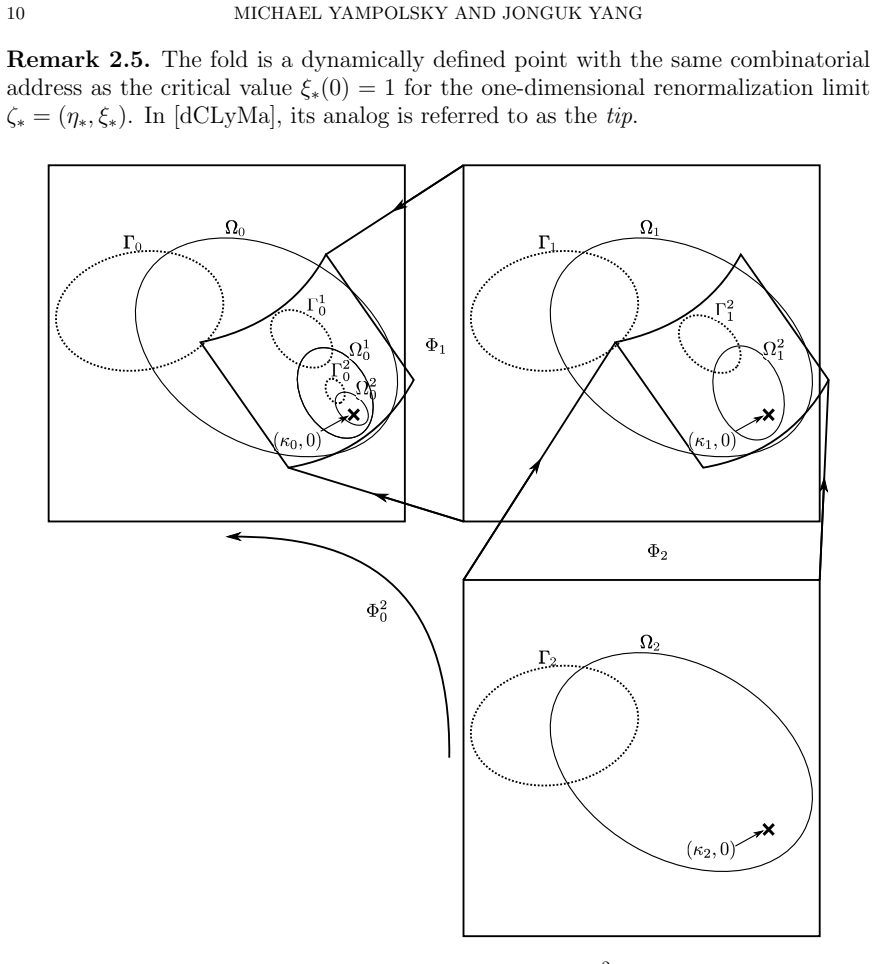
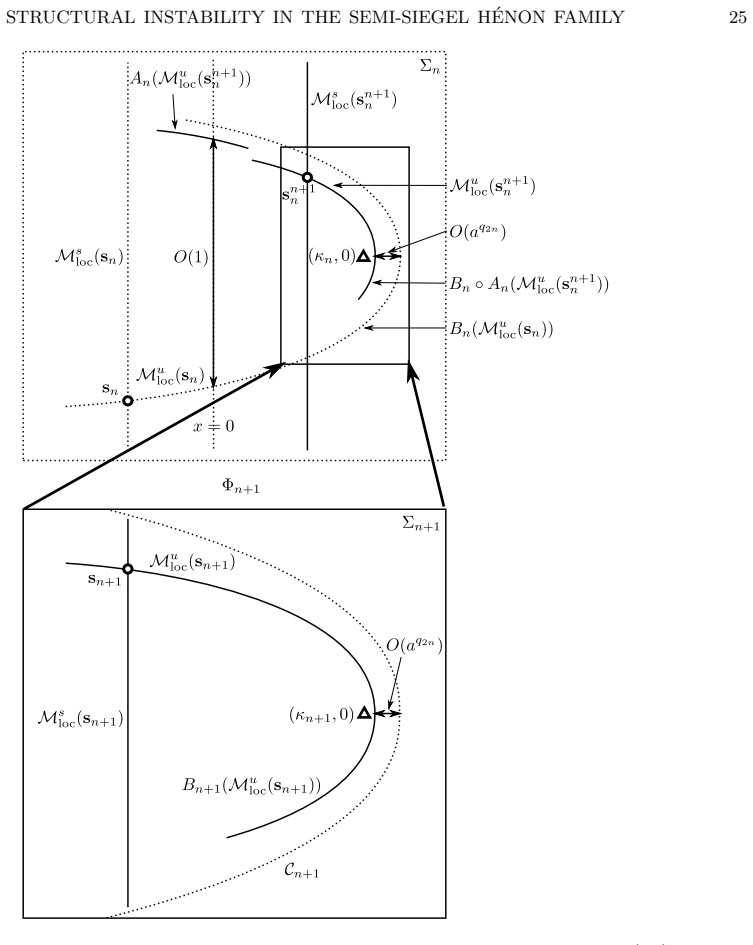
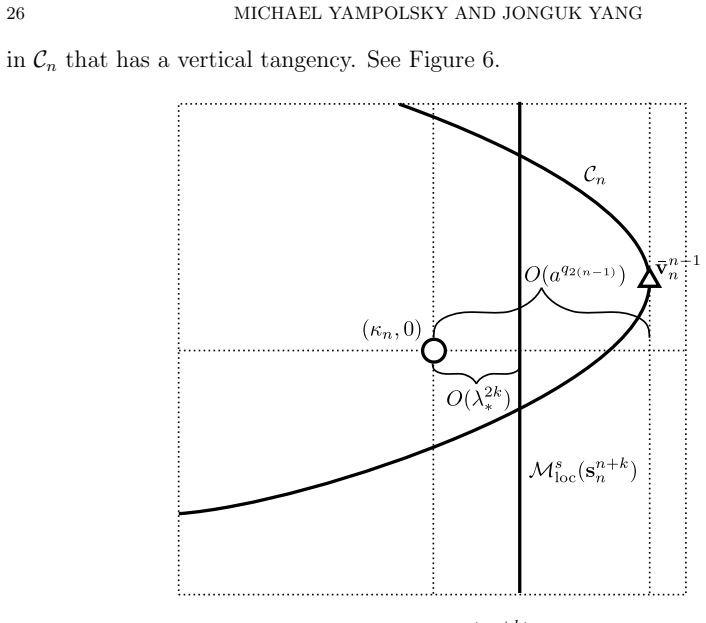
The central mechanism is the renormalization microscope of the golden-mean semi-Siegel family. The $n$-th renormalization $\Sigma_n=(A_n,B_n)$ is a rescaled first-return map whose one-dimensional projections $\eta_n,\xi_n$ converge to the universal renormalization fixed point $(\eta_*,\xi_*)$, with universal scaling factor $\lambda_*$. A dynamically defined point $(\kappa_n,0)$, the $n$-th fold, arises as the limit of the microscope maps $\Phi_n^k$ and moves holomorphically in $a$. Near this fold, the local stable manifolds of selected saddle periodic points are graphs $y\mapsto\psi_n^k(y)$ with derivative $O(a^{q_{2n}})$, while a related unstable manifold $\mathcal{C}_n$ is the graph of a map $y\mapsto\tau_n(y)$ that is $O(a^{q_{2(n-1)}})$-close to $\xi_n$ and has a unique vertical tangency. Equating the horizontal positions of these manifolds via Proposition 4.5 and Corollary 5.7 gives the tangency equation (6.2), whose solutions over $n,k\in\mathbb{N}$ are asserted to be dense; that density is the step that turns local geometry into global instability.
What would settle it
A reader could test the density claim by computing the universal constants $\lambda_*$, $u_*(x_*-1)$ and $\bar{\Delta}_v$ from the renormalization fixed point and then solving $a^{q_{2(n-1)}} = \lambda_*^{2k}u_*(x_*-1)/\bar{\Delta}_v$ for all $n,k$; if the resulting solutions leave an open gap anywhere in $\mathbb{D}_{\bar{\epsilon}}\setminus\{0\}$, the Main Theorem collapses. A direct numerical search for non-persistent heteroclinic tangencies in small parameter windows would also settle the question.
Extended reading notes
Core claim
The central claim is the Main Theorem: there exists $\bar{\epsilon}>0$ such that the golden-mean semi-Siegel Hénon family $(F_a)$ is not weakly $J^*$-stable at every parameter $a\in\mathbb{D}_{\bar{\epsilon}}\setminus\{0\}$. For each such $a$, no neighborhood admits an equivariant unbranched holomorphic motion of the saddle periodic points, and no equivariant branched motion of $J^*(F_a)$ exists over any neighborhood. The proof shows, via renormalization, that near a dynamically defined point called the fold, the stable manifolds of certain saddle orbits are nearly vertical while unstable manifolds are quadratic graphs, and their relative position changes with $a$ at the tiny scale $a^{q_{2n}}$. This forces, in every neighborhood of every parameter, a heteroclinic tangency between a stable and an unstable manifold that cannot persist; by the stability criterion of Theorem 1.3(v), such a tangency would have to persist if the family were weakly $J^*$-stable. Consequently, the family is unstable at every small nonzero parameter, and the corollaries of that criterion give a dense $G_\delta$ set of Newhouse parameters and a dense set of parameters with disconnected Julia sets.
Load-bearing premise
The load-bearing premise is the assertion after equation (6.2) that the set of parameters $a$ solving the tangency equation is dense in $\mathbb{D}_{\bar{\epsilon}}\setminus\{0\}$; the word 'Observe' is the only support given, and if that solution set merely accumulates at $0$ rather than being dense, the conclusion that every parameter is unstable does not follow.
Editorial extensions
If this is right
- At every $a\in\mathbb{D}_{\bar{\epsilon}}\setminus\{0\}$, the family bifurcates immediately: no neighborhood is weakly $J^*$-stable, so saddle periodic points cannot be followed by any equivariant holomorphic motion, branched or unbranched.
- A dense $G_\delta$ set of these Hénon maps exhibits the Newhouse phenomenon: infinitely many coexisting attracting periodic orbits.
- A dense set of parameters has disconnected Julia set $J(F_a)$.
- Heteroclinic tangencies occur at parameters accumulating at every point of the punctured disk, making the bifurcation set dense rather than isolated.
Reading between the lines
- Inference: if the density assertion in equation (6.2) can be proved, the same argument is likely to extend to any bounded-type rotation number whose renormalization converges, so this instability may be a general feature of semi-Siegel Hénon maps rather than a golden-mean special case.
- Inference: the tangencies occur at exponentially small scales $a^{q_{2n}}$, so the unstable set, while dense, could still be small in measure; the paper does not estimate the measure of stable parameters, and a measure estimate would be a natural next step.
- Inference: numerically computing the universal constants $\lambda_*$, $u_*(x_*-1)$ and $\bar{\Delta}_v$ would give explicit predicted locations of non-persistent tangencies, offering a direct quantitative check of the renormalization geometry.
- Inference: if the open question $J^*(F_a)=J(F_a)$ were answered positively for this family, the theorem would upgrade automatically to ordinary $J$-instability at every small parameter; the paper leaves this upgrade conditional.
Signed reviews
Editorial analysis
A structured set of objections, weighed in public.
Referee Report
Summary. This paper studies the family F_a of sufficiently dissipative golden-mean semi-Siegel Hénon maps. The main theorem asserts that there exists \bar{\epsilon}>0 such that F_a is not weakly J*-stable at every parameter a in D_{\bar{\epsilon}}\{0\}. The proof uses the renormalization theory from the authors' prior work: for each n,k, the stable manifold of a saddle point near the nth fold is nearly vertical, while a pulled-back unstable manifold is a nearly quadratic graph. The horizontal distance between these two graphs is computed asymptotically, and a tangency occurs exactly when equation (6.2) holds. The paper then claims, with the single word "Observe," that the set of solutions to (6.2) forms a "discrete dense" subset of D_{\bar{\epsilon}}\{0\}, and uses this to conclude that every parameter admits arbitrarily close non-persistent heteroclinic tangencies. Invoking Dujardin--Lyubich's Theorem 1.3(v), the authors derive the Main Theorem and the corollaries on the Newhouse phenomenon and disconnected Julia sets.
Significance. If the Main Theorem is correct, it is a significant result: it gives the first example of a dissipative Hénon family that is weakly J*-unstable at every parameter in a punctured disk, and it yields, via [DuLy], a dense G_delta set of Newhouse parameters and a dense set of parameters with disconnected Julia set in the semi-Siegel family. The geometric strategy, comparing nearly vertical stable manifolds with quadratic unstable graphs via renormalization microscope maps, is illuminating and well-suited to the problem. The paper builds on published theorems [Yan1], [Yan2], [GaRaYam] with independent derivations, and I do not see circularity. However, the final step contains an unproved and internally contradictory density assertion that is load-bearing for the "every parameter" conclusion; the gap appears fillable by a Rouché-type argument, so the result should be treated as conditional pending that proof.
major comments (3)
- [Section 6, after Eq. (6.2)] The assertion that the set X of parameters solving (6.2) is a "discrete dense subset" of D_{\bar{\epsilon}}\{0\} is unproved and self-contradictory: a topologically discrete subset of a connected open set cannot be dense. If "discrete" is only intended to mean that solutions are isolated for each fixed pair (n,k), density still requires a separate argument. Equation (6.2) is of the form a^{q_{2(n-1)}} = \lambda_*^{2k} u_*(x_*-1) / \bar{\Delta}_v (1+O(\rho^n)+O(\rho^k)), whose leading-order solutions lie on a grid with angular spacing 2\pi/q_{2(n-1)}; density is plausible as n grows, but the error terms depend on a, and the paper neither states the required uniformity nor bounds how far the true roots move from the leading-order roots. Without a proof that every open U \subset D_{\bar{\epsilon}}\{0\} meets X, the Main Theorem, and consequently Corollaries 1.13 and 1.14, is unsupported.
- [Proof of Main Theorem, last paragraph] The proof asserts that the tangency q_{n,k} "does not persist in any neighborhood of a1" without demonstrating that it is a simple tangency whose separating distance has nonzero derivative with respect to a. Weak J*-stability requires that the intersection point moves under an equivariant unbranched holomorphic motion, so a tangency at a1 only contradicts stability if no holomorphic branch of the intersection point exists near a1. The paper should show, for instance, that the horizontal separation between M^s_loc(s_n^{n+k}) and C_n near the tangency changes at first order in (a-a1), so that the double intersection splits into two or disappears and no single branch persists. This is a standard unfolding argument, but it is not supplied.
- [Section 6, equation (6.2)] The density argument is the only place where the conclusion is upgraded from "there exist unstable parameters" to "the family is not weakly J*-stable at every parameter." If the solution set X were merely infinite with an accumulation point at 0, the argument would only show instability at 0, not at every a. The paper must prove that X accumulates at every point of D_{\bar{\epsilon}}\{0\}, including points away from 0 where the error terms in (6.2) have not been controlled. This is a load-bearing step that cannot be replaced by the heuristic observation about the leading-order roots.
minor comments (4)
- [Section 6, Eq. (6.2)] The error term in (6.2) is printed as (1+O(\rho^n)+O(\rho^n)); the second error should almost certainly be O(\rho^k), matching Proposition 4.5.
- [Abstract] The abstract says the maps are "not J-stable in a very strong sense," while the Main Theorem concerns weak J*-stability; the terminology should be aligned to avoid confusing readers who distinguish structural J-stability from weak J*-stability.
- [Section 6, paragraph before proof of Main Theorem] The phrase "discrete dense subset" is contradictory and should be replaced by a precise statement such as "the union over n,k of the solution sets is dense."
- [Throughout] The paper would benefit from a short discussion of why the tangencies produced by (6.2) are heteroclinic tangencies for the original Hénon map F_a and not merely for the renormalized pair; this is implicit in the identifications of Sections 4--5, but an explicit sentence would improve readability.
Circularity Check
No circularity: the proof relies on prior renormalization theorems and an external stability criterion, and the unproved density assertion is a correctness gap rather than a circular reduction.
full rationale
I found no circular step. The Main Theorem is obtained by combining renormalization estimates (Theorems 2.10–2.12, 3.3) from [Yan1]/[Yan2] with the external stability criterion Theorem 1.3 from [DuLy]. These cited results have assumptions (golden-mean semi-Siegel Hénon maps, small dissipation) that do not include the target instability; they are parameter-free universality estimates, so invoking them is normal mathematical dependence, not circularity. The only questionable inference is the unproved assertion after (6.2) that the solution set X is a 'discrete dense subset' of D_{\bar{\epsilon}}\{0\}; even if this is a serious gap, it is not a circular reduction—the conclusion is not assumed by the equation or by the cited theorems. Hence no step of the form fit-renamed-as-prediction, self-definitional reduction, or uniqueness imported from the authors occurs.
Assumptions & free parameters
assumptions (5)
- standard math Siegel's theorem: local linearizability for bounded-type rotation numbers.
- domain assumption Renormalization convergence and universality theorems from [Yan1], [Yan2], [GaYam].
- domain assumption Dujardin-Lyubich Theorem 1.3: equivalence of weak J*-stability with persistence of tangencies.
- standard math Existence and graph representation of local stable and unstable manifolds for saddle fixed points.
- standard math Denjoy-Wolff theorem for iterates of inverse branches of ξ_n.
Cite this review
Pith. "Pith review of Structural Instability of Semi-Siegel H\'enon maps." pith.science (2026). https://pith.science/paper/KXQI3ORG
@misc{pith2026190806465,
  author       = {Pith},
  title        = {Pith review of: Structural Instability of Semi-Siegel H\'enon maps},
  year         = {2026},
  howpublished = {\url{https://pith.science/paper/KXQI3ORG}},
  note         = {Machine review of arXiv:1908.06465}
}
abstract
We show that the dynamics of sufficiently dissipative semi-Siegel complex H\'enon maps with golden-mean rotation number is not $J$-stable in a very strong sense. By the work of Dujardin and Lyubich, this implies that the Newhouse phenomenon occurs for a dense $G_\delta$ set of parameters in this family. Another consequence is that the Julia sets of such maps are disconnected for a dense set of parameters.
Figures

Figures from the paper (4 more)
Reference graph
Works this paper leans on
-
[1]
E. Bedford, J. Smillie, Polynomial diffeomorphisms of ^2 II: Stable manifolds and recurrence , J. Am. Math. Soc. 4(4) (1991), 657-679
work page 1991
-
[2]
A. de Carvalho, M. Lyubich, M. Martens, Renormalization in the H\'enon Family, I: Universality but Non-Rigidity , J. Stat. Phys. (2006) 121 5/6, 611-669
work page 2006
-
[3]
A closing lemma for polynomial automorphisms of C^2
R. Dujardin, Closing lemma for polynomial automorphisms of ^2 , e-print arXiv:1709.01378
-
[4]
R. Dujardin, M. Lyubich, Stability and bifurcations for dissipative polynomial automorphisms of ^2 , Invent. math. (2015) 200: 439
work page 2015
-
[5]
J.-E. Fornaess, N. Sibony, Complex H\'enon mappings in ^2 and Fatou-Bieberbach domains , Duke Math. J. 65 (1992), no. 2, 345-380
work page 1992
-
[6]
Renormalization of almost commuting pairs
D. Gaidashev, M. Yampolsky, Renormalization of almost commuting pairs , e-print arXiv:1604.00719
-
[7]
Renormalization and Siegel disks for complex H\'enon maps
D. Gaidashev, R. Radu, M. Yampolsky, Renormalization and Siegel disks for complex Henon maps , e-print ArXiv:1604.07069
-
[8]
J.H. Hubbard, R.W. Oberste-Vorth, H\'enon mappings in the complex domain II: Projective and inductive limits of polynomials , in Real and Complex Dynamical Systems, Branner and Hjorth, eds., Kluwer Academic Publishers (1995), 89-132
work page 1995
Show all 17 references
-
[9]
M. Yu. Lyubich, Some typical properties of the dynamics of rational maps , Uspekhi Mat. Nauk, 1983, Volume 38, Issue 5(233), 197–198
1983
-
[10]
Lyubich and M
M. Lyubich and M. Martens, Renormalization in the H\'enon family, II: The heteroclinic web , Invent. Math. 186 (2001), 115-189
2001
-
[11]
Morosawa, Y
S. Morosawa, Y. Nishimura, M. Taniguchi, T. Ueda, Holomorphic dynamics , Cambridge Studies in Advanced Mathematics, 66. Cambridge University Press, Cambridge, 2000
2000
-
[12]
Ma\ n\'e, P
R. Ma\ n\'e, P. Sad, D. Sullivan, On the dynamics of rational maps , Ann. sci. de l`\'Ec. Norm. Sup., 16(1983), 193-217
1983
-
[13]
R. Radu, R. Tanase, A structure theorem for semi-parabolic H\'enon maps , e-print arXiv:1411.3824
-
[14]
Siegel, Iteration of analytic functions , Ann
C.L. Siegel, Iteration of analytic functions , Ann. Math. 43(1942), 607-612
1942
-
[15]
Yampolsky, Siegel disks and renormalization fixed points , Fields Institute Communications, 53(2008)
M. Yampolsky, Siegel disks and renormalization fixed points , Fields Institute Communications, 53(2008)
2008
-
[16]
Yang, Renormalization in the Golden-Mean Semi-Siegel H\'enon Family: Universality and Non-Rigidity , Ergodic Theory and Dynamical Systems 83(2018), 1-45
J. Yang, Renormalization in the Golden-Mean Semi-Siegel H\'enon Family: Universality and Non-Rigidity , Ergodic Theory and Dynamical Systems 83(2018), 1-45
2018
-
[17]
Yang, Renormalization in the Golden-Mean Semi-Siegel H\'enon Family: Nonquasisymmetry , e-print arXiv:1905.03357
J. Yang, Renormalization in the Golden-Mean Semi-Siegel H\'enon Family: Nonquasisymmetry , e-print arXiv:1905.03357
1905 arXiv
Reviewed August 14, 2026 · model on record in the stance chip above.
Discussion (0). Continue with ORCID to comment.