REVIEW 3 major objections 4 minor 92 references
HingePlace: Harnessing the neural thresholding behavior to optimize Transcranial Electrical Stimulation
T0 review · 3 major / 4 minor · reviewed 2026-08-09 · deepseek-v4-flash
Pith's one-line read Replacing zero-forcing penalties with a symmetrized hinge loss that ignores sub-threshold electric fields yields more focal neural responses in transcranial stimulation simulations, with off-target activation reduced by up to about 60…
desk verdict Solid unification theorem and a genuinely new loss idea, but the headline gains are inflated by tuning tolerances on the evaluation metric; still worth refereeing. read the letter →
The pith
A machine-rendered reading of the paper's core claim, the machinery that carries it, and where it could break.
The reading
What carries the argument
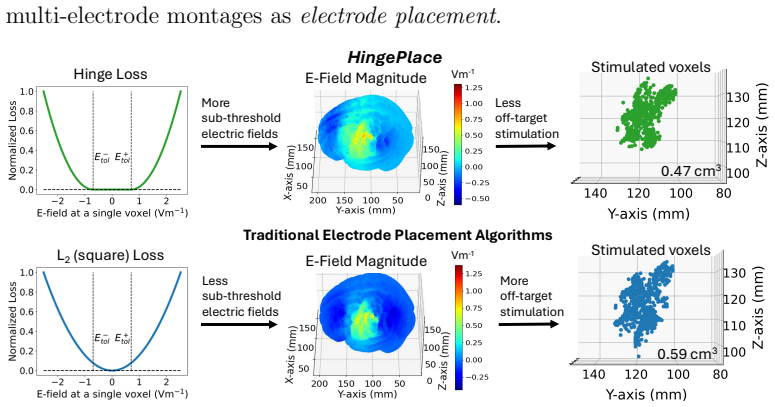
The load-bearing object is the symmetrized hinge loss, L_hinge(I) = ‖Γ_C L_HP(I)‖_p, where L_HP(I) = max(0, T_c I − E⁺_tol) + max(0, −T_c I − E⁻_tol) for the off-target forward matrix T_c, voxel-volume weights Γ_C, and user-set upper and lower tolerance vectors. It is what lets the algorithm leave sub-threshold off-target fields unpenalized while still punishing supra-threshold leakage. The argument also rests on Theorem 1, which proves that the CDM and LCMV-E optimization problems are essentially equivalent (for α < α_max they are dual with identical unique solutions; for α ≥ α_max, LCMV-E picks the CDM solution with least off-target energy), so the four major traditional algorithm families are all special cases of HingePlace at zero tolerances.
What would settle it
In an animal or ex-vivo preparation, compare HingePlace and LCMV-E montages delivering matched target activation while recording off-target spiking or calcium activity across the stimulated region: if LCMV-E produces equal or fewer off-target responses, the thresholding-based focality gains claimed here do not transfer to real tissue.
Extended reading notes
Core claim
The paper's central discovery is that the traditional objective in electrode placement—minimizing the off-target electric field magnitude—is stricter than the neural response requires, because neurons respond nonlinearly and only fire or change state when the local field crosses a threshold. Theorem 1 establishes that the CDM and LCMV-E formulations are essentially equivalent (they are each other's dual for α < α_max, and for larger α, LCMV-E selects the most relevant CDM solution), thereby completing the unification of the four major algorithm families and showing that all of them force off-target fields to be close to zero. HingePlace replaces the quadratic off-target term with a symmetrized hinge loss, L_hinge(I) = ‖Γ_C L_HP(I)‖_p, whose per-voxel components max(0, T_c I − E⁺_tol) + max(0, −T_c I − E⁻_tol) are zero whenever the field stays within user-set tolerances; the problem stays convex and reduces to LCMV-E when p=2 and the tolerances are zero. In two simulation platforms, HingePlace montages generated more focal neural responses than LCMV-E montages, with off-target activation volume or spike counts reduced by up to about 60 percent (MRI head model) and up to 75 percent (sea-of-neurons model), and the paper shows that the L1L1-norm method is a special case of HingePlace with equal tolerances in all directions.
Load-bearing premise
The load-bearing premise is that sub-threshold off-target electric fields are behaviorally irrelevant—fields below a neuron's activation threshold have no meaningful off-target effect—so if they still modulate plasticity, network activity, or subthreshold membrane dynamics, the simulated focality gains could shrink or vanish in real tissue.
Editorial extensions
If this is right
- All four major traditional algorithm families (WLS, reciprocity-based, CDM, LCMV-E) are subsumed by HingePlace at zero tolerances, so the measured focality gains apply to the whole classical family, not just the LCMV-E baseline used in the simulations.
- Direction-specific tolerances matter: encoding the neuronal preference for certain field orientations (instead of one scalar tolerance) substantially improves focality, which means physiological orientation-sensitivity should be built into the loss.
- Since the hinge-loss problem is convex, the thresholding idea can be added to existing electrode-placement pipelines with modest extra computation, the only added hyperparameters being the three tolerance vectors.
- The same loss applies to other multi-electrode stimulation modalities—ECoG, deep brain stimulation, TTFields, temporal interference—wherever below-threshold off-target fields are known to be inert.
- The correct design target is the focal neural response, not the focal electric field, opening the door to incorporating further neural response properties (e.g., orientation selectivity, adaptation) into montage optimization.
Reading between the lines
- If sub-threshold off-target fields in real tissue still modulate plasticity, network synchrony, or subthreshold membrane dynamics, the simulated focality gains could shrink or vanish; a direct plasticity assay comparing HingePlace and LCMV-E montages at matched target activation would settle this.
- The tolerance vectors could be made patient-specific by deriving them from individual input-output curves or neuron models, which the paper tunes only by grid or random search in simulation; this may increase the gains beyond the reported values.
- Because the paper proves equivalence of the classical families, attaching the same hinge loss to reciprocity-based or weighted-least-squares formulations should yield comparable focality gains without re-deriving the algorithm.
- A testable prediction of the thresholding hypothesis: the relative focality gain should be largest when the desired target field is just above the neural threshold, and should shrink when off-target fields are far supra-threshold.
Signed reviews
Editorial analysis
A structured set of objections, weighed in public.
Referee Report
Summary. The paper proposes HingePlace, a convex optimization algorithm for multi-electrode transcranial electrical stimulation montages that penalizes off-target electric field components only above user-specified tolerance levels, thereby exploiting the thresholding behavior of neural response. It extends the unification result of Fernández-Corazza et al. by proving (Theorem 1, Appendix A) that the CDM and LCMV-E formulations are essentially equivalent, and shows (Appendix C) that the L1L1-norm optimization of Prieto et al. is a special case of HingePlace with p=1 and direction-independent tolerances. The algorithm is evaluated in two simulation platforms: an MRI head model (ROAST) using the VTh metric, and a sea-of-neurons model combining spherical head models with biophysically realistic neurons using the Nact metric. The authors report consistent focality improvements over LCMV-E in both platforms, with reductions in off-target activation as high as 60-75% in some conditions.
Significance. If the empirical claims hold, the paper makes two contributions: a clean theoretical unification of major electrode placement algorithms, and a novel, convex design objective that permits sub-threshold off-target fields to improve focality. The formal equivalence proof in Appendix A is detailed and accompanied by numerical illustrations, and the sea-of-neurons evaluation is a strong independent check that goes beyond common field-based surrogates. The code is publicly available, which supports reproducibility. However, the headline performance numbers currently rest on simulation studies whose tolerance hyperparameters are selected to minimize the very metric used for evaluation, and the sub-threshold irrelevance assumption is embedded in both the loss and the MRI-head-model metric. The significance is therefore conditional on a more rigorous validation protocol.
major comments (3)
- [Appendix D.3 / Sec. 5] The tolerance hyperparameters are selected on the evaluation metric. For the MRI studies, Etol is chosen by grid search and the paper states 'We always present the result with the least VTh'; for the sea-of-neurons studies, [Extol,Eytol,Eztol] is chosen by a 30-point random search minimizing Nact, and if HingePlace underperforms LCMV-E at some (Isafe, Imultot) the tolerances are re-tuned at that operating point. Because the same 800 sampled neuron locations are used both for tuning and scoring, and because no cross-validation, independent tuning set, or bootstrap confidence intervals are reported, the reported 60-75% reductions in off-target activation are not protected against selection bias and are likely optimistic. Please add an independent tuning/validation split (or fix tolerances a priori from biophysical thresholds), and report means and confidence intervals over repeated neuron samples.
- [Sec. 5.2.1 / Appendix C] The comparison against 'L1L1-norm optimization' may not implement Prieto et al.'s method correctly. Appendix C shows that the l1 regularizer in (C.1) is equivalent to reducing the total-current constraint to Itot=∥I∗∥1/2 on the HingePlace side, and that the target-fit term becomes a hard constraint. The text in Sec. 5.2.1 says only that L1L1 was analyzed 'by implementing the HingePlace algorithm with p=1 and the same tolerance across all directions,' with a footnote replacing the one-sided l∞ constraint. If the reduced Itot and/or the l1 regularizer are not included, the baseline is not the [28] algorithm, and the conclusion that direction-specific tolerances are essential may rest on an unfair comparison. Please state the exact optimization solved and verify the equivalence numerically for the reported operating points.
- [Sec. 1, Eq. (9), Appendix D.1] The hinge-loss objective and the MRI-head-model metric VTh both presuppose that sub-threshold off-target fields are harmless: the loss does so through E+tol and E−tol, and VTh through its 80%-of-Edes activation threshold. Consequently, the MRI results cannot independently validate the thresholding hypothesis, and the sea-of-neurons results test only direct spiking, not possible subthreshold modulation of plasticity or network activity (a limitation acknowledged in Sec. 6 but not examined). Since the paper's central claim is that HingePlace produces more focal neural responses in real tissue, please either provide a sensitivity analysis over tolerance values (for example, showing the focality gain as a function of the assumed threshold) or explicitly bound the conditions under which subthreshold fields can be ignored.
minor comments (4)
- [Abstract / Sec. 1 / Sec. 5.2] The maximum reported focality improvement is stated inconsistently: the abstract says 60%, Sec. 1 says '~30% (MRI) and ~60% (sea of neurons)', Sec. 5.2.1 reports up to 75%, and Sec. 5.2.3 reports up to 65%. Please harmonize the headline numbers with the exact values in the results.
- [Fig. 7 caption] The sentence 'TP refers to target point in l and k' is unclear because k and l are subplot labels; please specify which panels are meant and what TP denotes.
- [Sec. 5.1.4] The text says 'We run the same study as Sec. 5.1.4' but should refer to a preceding study (e.g., Sec. 5.1.3 or Sec. 5.1.1); please correct the cross-reference.
- [Appendix D.3] The grid for p=2,3 is listed as {0.01Vm−1, 0.65Vm−1, 0.55Vm−1, 0.35Vm−1}; please explain the ordering and the inclusion of 0.01, and state whether the same grid was used for both p=2 and p=3.
Circularity Check
Reported focality gains are in-sample optima: HingePlace's tolerances are tuned on the exact VTh/Nact metrics used to measure improvement.
-
fitted input called prediction
[Appendix D.3 ('Implementing LCMV-E and HingePlace') and Sec. 5.1 (MRI head model results)]
"We used a grid-search to determine the value of Etol. For p = 1 and p = 2, 3, we searched across the values {0.1Vm−1, 0.5Vm−1, 0.6Vm−1, 0.7Vm−1} and {0.01Vm−1, 0.65Vm−1, 0.55Vm−1, 0.35Vm−1}, respectively. We always present the result with the least VTh."
The MRI-head-model comparison in Sec. 5.1 reports the relative reduction in VTh as HingePlace's measured focality gain. But the HingePlace tolerance Etol is selected by grid search to minimize exactly this VTh metric, and the paper always presents the least-VTh result. LCMV-E has no analogous tuned parameter. Hence the reported improvement is not a prediction from a fixed algorithm; it is the minimum of a hyperparameter search over the evaluation metric itself, so the numerical gain is partly forced by the selection rule.
-
fitted input called prediction
[Appendix D.3 and Sec. 5.2 (sea of neurons studies)]
"We determined the value of [ Ex tol, Ey tol, Ez tol] using a random search across 30 points for each sea of neurons model study. We chose [ Ex tol, Ey tol, Ez tol] with the least Nact value... If these chosen values of [ Ex tol, Ey tol, Ez tol] were severely sub-optimal for some values of Itot and Isaf e leading to HingePlace performing worse than LCMV-E, then we re-tuned [ Ex tol, Ey tol, Ez tol] at those values of Isaf e and Itot through the same random-search."
Nact is the exact metric used to report the up-to-75% reductions in off-target stimulation in Sec. 5.2.1. The tolerance vector is chosen by random search to minimize Nact on the same 800 neuron locations used to score the final montage, with no separate tuning set or cross-validation described. Re-tuning whenever HingePlace underperforms LCMV-E makes the comparison additionally favorable. The headline neural-activation gains are therefore an in-sample optimum of the evaluation label rather than an independent estimate of HingePlace's advantage.
full rationale
The theoretical contributions are not circular: Theorem 1 (CDM/LCMV-E equivalence) is proved in Appendix A via KKT conditions with stated assumptions, and the unification with WLS/reciprocity-based methods is imported from Fernández-Corazza et al. as external prior work. The hinge loss in Eq. (9) is not definitionally equal to the VTh or Nact metrics, and the sea-of-neurons spiking metric is an independently biophysical outcome, so there is no self-definitional collapse. However, the paper's central empirical claim—that HingePlace montages reduce off-target neural response by up to 60-75%—is partially self-confirming: in every simulation study the tolerance hyperparameters are selected by grid or random search to minimize the exact metric used for comparison, the same 800 sampled neuron locations are used for both tuning and scoring, and re-tuning is performed when HingePlace underperforms. No held-out validation, independent tuning set, or error bars are reported, so the magnitude of the headline gains is statistically forced by the selection procedure rather than demonstrated by an out-of-sample comparison. This warrants a score of 6 rather than a lower score: the algorithmic idea and theoretical unification have independent content, but the quantitative focal-neural-response claim reduces in part to fitting the tolerance to the evaluation metric.
Assumptions & free parameters
free parameters (5)
- E_tol (MRI head model) =
p=1 grid {0.1,0.5,0.6,0.7} V/m; p=2,3 grid {0.01,0.35,0.55,0.65} V/m, chosen by least VTh
- [E^x_tol, E^y_tol, E^z_tol] (sea of neurons) =
30-point random search between 0.1 and 0.7 Edes, selected by least Nact, then retuned if HingePlace underperformed
- p (HingePlace loss exponent) =
1, 2, 3 after preliminary studies over p=1..5 using Nact
- Edes (desired target field) =
1 V/m for MRI; 84.93, 84.94, 70.27 V/m for sea-of-neurons studies
- Etol for L1L1-norm comparison =
grid 0.1 to 0.9 Edes, least Nact per operating point
assumptions (7)
- domain assumption The forward model TI=E is linear under quasi-static Maxwell assumptions and provided by ROAST or the 4-sphere analytical model.
- domain assumption Neural response under tES is threshold-like, so off-target fields below a non-zero threshold have no significant effect.
- domain assumption Cortical pyramidal neurons are activated primarily by the radial-in component of the electric field.
- domain assumption The 80 percent of Edes threshold from Forssell et al. [43] approximates the true activation boundary.
- standard math Ac is full rank, and Slater's conditions hold for the convex problems.
- domain assumption The biophysical neuron models from Aberra et al. [37] and Blue Brain [55] predict human cortical activation thresholds.
- domain assumption All major traditional algorithms are representable by CDM, LCMV-E, or the magnitude-maximization-D trick.
Cite this review
Pith. "Pith review of HingePlace: Harnessing the neural thresholding behavior to optimize Transcranial Electrical Stimulation." pith.science (2026). https://pith.science/paper/KYGTSLET
@misc{pith2026250201382,
  author       = {Pith},
  title        = {Pith review of: HingePlace: Harnessing the neural thresholding behavior to optimize Transcranial Electrical Stimulation},
  year         = {2026},
  howpublished = {\url{https://pith.science/paper/KYGTSLET}},
  note         = {Machine review of arXiv:2502.01382}
}
read the original abstract
Transcranial Electrical Stimulation (tES) is a neuromodulation technique that utilizes electrodes on the scalp to stimulate target brain regions. tES has shown promise in treating many neurological conditions, such as stroke rehabilitation and chronic pain. Several electrode placement algorithms have been proposed to optimize tES-based therapies by designing multi-electrode montages that create focal neural responses. We first extend a well-known unification result by Fernandez-Corazza et al. to unify all major traditional electrode placement algorithms. We utilize this unification result to identify a common restriction among traditional electrode placement algorithms: they do not harness the thresholding behavior of neural response. Consequently, these algorithms only partially harness the properties of neural response to optimize tES, particularly increasing the focality of neural response. We propose a new electrode placement algorithm, HingePlace, that utilizes a symmetrized hinge loss to harness the thresholding behavior of neural response. We extensively compare the HingePlace algorithm with traditional electrode placement algorithms in two simulation platforms. Across both platforms, we find that HingePlace-designed montages consistently generate more focal neural responses -- by as much as 60% -- than the electrode montages designed by traditional electrode placement algorithms.
Figures


Figures from the paper (4 more)


Reference graph
Works this paper leans on
-
[28]
Fernando Galaz Prieto, Atena Rezaei, Maryam Samavaki, and Sampsa Pursiainen. L1-norm vs. l2-norm fitting in optimizing fo- cal multi-channel tES stimulation: linear and semidefinite program- ming vs. weighted least squares. Computer Methods and Programs in Biomedicine, 226:107084, 2022
work page 2022
-
[1]
Transcranial di- rect current stimulation in the treatment of major depression: a meta- analysis
UG Kalu, CE Sexton, CK Loo, and KP Ebmeier. Transcranial di- rect current stimulation in the treatment of major depression: a meta- analysis. Psychological medicine, 42(9):1791, 2012. 25
2012
-
[2]
Effects of anodal transcranial direct current stim- ulation on chronic neuropathic pain in patients with multiple sclerosis
Francesco Mori, Claudia Codec` a, Hajime Kusayanagi, Fabrizia Mon- teleone, Fabio Buttari, Stefania Fiore, Giorgio Bernardi, Giacomo Koch, and Diego Centonze. Effects of anodal transcranial direct current stim- ulation on chronic neuropathic pain in patients with multiple sclerosis. The Journal of Pain , 11(5):436–442, 2010
2010
-
[3]
Suppression of seizure by cathodal transcranial di- rect current stimulation in an epileptic patient-a case report
Soon-Won Yook, Sung-Hee Park, Jeong-Hwan Seo, Sun-Jun Kim, and Myoung-Hwan Ko. Suppression of seizure by cathodal transcranial di- rect current stimulation in an epileptic patient-a case report. Annals of rehabilitation medicine, 35(4):579–582, 2011
2011
-
[4]
Transcranial direct current stimulation: challenges, opportunities, and impact on psychiatry and neurorehabilitation
Andre R Brunoni, Felipe Fregni, Alberto Priori, Roberta Ferrucci, and Paulo S´ ergio Boggio. Transcranial direct current stimulation: challenges, opportunities, and impact on psychiatry and neurorehabilitation. Fron- tiers in psychiatry , 4:19, 2013
2013
-
[5]
Non-invasive human brain stimulation in cognitive neuroscience: a primer
Beth L Parkin, Hamed Ekhtiari, and Vincent F Walsh. Non-invasive human brain stimulation in cognitive neuroscience: a primer. Neuron, 87(5):932–945, 2015
2015
-
[6]
Comparing cortical plasticity induced by conventional and high-definition 4× 1 ring tdcs: a neurophysiological study
Hsiao-I Kuo, Marom Bikson, Abhishek Datta, Preet Minhas, Walter Paulus, Min-Fang Kuo, and Michael A Nitsche. Comparing cortical plasticity induced by conventional and high-definition 4× 1 ring tdcs: a neurophysiological study. Brain stimulation, 6(4):644–648, 2013
2013
-
[7]
Multifocal tdcs targeting the resting state motor network increases cortical excitability beyond traditional tdcs targeting unilateral motor cortex
David B Fischer, Peter J Fried, Giulio Ruffini, Oscar Ripolles, Ricardo Salvador, Jaume Banus, William Tyler Ketchabaw, Emiliano Santarnec- chi, Alvaro Pascual-Leone, and Michael D Fox. Multifocal tdcs targeting the resting state motor network increases cortical excitability beyond traditional tdcs targeting unilateral motor cortex. Neuroimage, 157:34– 44, 2017
2017
Show all 92 references
-
[8]
Dmochowski, Abhishek Dutta, Marom Bikson, Yuzhuo Su, and Lucas C
Jacek P. Dmochowski, Abhishek Dutta, Marom Bikson, Yuzhuo Su, and Lucas C. Parra. Optimized multi-electrode stimulation increases focality and intensity at target. Journal of Neural Engineering , 8(4):046011, 2011
2011
-
[9]
Transcranial di- rect current stimulation: five important issues we aren’t discussing (but probably should be)
Jared C Horvath, Olivia Carter, and Jason D Forte. Transcranial di- rect current stimulation: five important issues we aren’t discussing (but probably should be). Frontiers in systems neuroscience, 8:2, 2014. 26
2014
-
[10]
Jared Cooney Horvath, Jason D Forte, and Olivia Carter. Evidence that transcranial direct current stimulation (tdcs) generates little-to-no reliable neurophysiologic effect beyond mep amplitude modulation in healthy human subjects: a systematic review. Neuropsychologia, 66:213...
2015
-
[11]
A Antal, D Keeser, A Priori, F Padberg, and MA Nitsche. Concep- tual and procedural shortcomings of the systematic review “evidence that transcranial direct current stimulation (tdcs) generates little-to- no reliable neurophysiologic effect beyond mep amplitude modulation in h...
2015
-
[12]
Can electric fields explain inter-individual variability in transcranial direct current stimulation of the motor cortex? Scientific reports, 9(1):626, 2019
Ilkka Laakso, Marko Mikkonen, Soichiro Koyama, Akimasa Hirata, and Satoshi Tanaka. Can electric fields explain inter-individual variability in transcranial direct current stimulation of the motor cortex? Scientific reports, 9(1):626, 2019
2019
-
[13]
Unification of optimal targeting methods in transcranial elec- trical stimulation
Mariano Fern´ andez-Corazza, Sergei Turovets, and Carlos Horacio Mu- ravchik. Unification of optimal targeting methods in transcranial elec- trical stimulation. NeuroImage, 209:116403, 2020
2020
-
[14]
Determination of optimal electrode positions for transcra- nial direct current stimulation (tDCS)
Chang-Hwan Im, Hui-Hun Jung, Jung-Do Choi, Soo Yeol Lee, and Ki- Young Jung. Determination of optimal electrode positions for transcra- nial direct current stimulation (tDCS). Physics in Medicine & Biology , 53(11):N219, 2008
2008
-
[15]
A novel array-type transcranial direct current stimulation (tdcs) system for accurate focusing on targeted brain areas.IEEE Trans- actions on Magnetics , 47(5):882–885, 2011
Ji-Hye Park, Seung Bong Hong, Do-Won Kim, Minah Suh, and Chang- Hwan Im. A novel array-type transcranial direct current stimulation (tdcs) system for accurate focusing on targeted brain areas.IEEE Trans- actions on Magnetics , 47(5):882–885, 2011
2011
-
[16]
Vannorsdall, David J
Rosalind Sadleir, Tracy D. Vannorsdall, David J. Schretlen, and Barry Gordon. Target optimization in transcranial direct current stimulation. Frontiers in Psychiatry, 3, 2012
2012
-
[17]
Using electromagnetic reciprocity and magnetic resonance current density imaging to fit multi-electrode montage for non-invasive brain stimulation
Arindam Dutta and Anirban Dutta. Using electromagnetic reciprocity and magnetic resonance current density imaging to fit multi-electrode montage for non-invasive brain stimulation. In 2013 6th International 27 IEEE/EMBS Conference on Neural Engineering (NER), pages 447–451. IEEE, 2013
2013
-
[18]
Fox, Oscar Ripolles, Pedro Cavaleiro Miranda, and Alvaro Pascual-Leone
Giulio Ruffini, Michael D. Fox, Oscar Ripolles, Pedro Cavaleiro Miranda, and Alvaro Pascual-Leone. Optimization of multifocal transcranial cur- rent stimulation for weighted cortical pattern targeting from realistic modeling of electric fields. NeuroImage, 89:216–225, 2014
2014
-
[19]
Seyhmus Guler, Moritz Dannhauer, Burak Erem, Rob Macleod, Don Tucker, Sergei Turovets, Phan Luu, Deniz Erdogmus, and Dana H. Brooks. Optimization of focality and direction in dense electrode ar- ray transcranial direct current stimulation (tDCS). Journal of Neural Engineering,...
2016
-
[20]
Concurrency in electrical neuroinformatics: par- allel computation for studying the volume conduction of brain electrical fields in human head tissues
Adnan Salman, Allen Malony, Sergei Turovets, Vasily Volkov, David Ozog, and Don Tucker. Concurrency in electrical neuroinformatics: par- allel computation for studying the volume conduction of brain electrical fields in human head tissues. Concurrency and Computation: Practice...
2016
-
[21]
A simple method for EEG guided transcranial electrical stimulation without models
Andrea Cancelli, Carlo Cottone, Franca Tecchio, Dennis Q Truong, Jacek Dmochowski, and Marom Bikson. A simple method for EEG guided transcranial electrical stimulation without models. Journal of neural engineering, 13(3):036022, 2016
2016
-
[22]
Sven Wagner, Martin Burger, and Carsten H. Wolters. An optimization approach for well-targeted transcranial direct current stimulation.SIAM Journal on Applied Mathematics , 76(6):2154–2174, 2016
2016
-
[23]
Transcranial electrical neuromodulation based on the reciprocity principle
Mariano Fern´ andez-Corazza, Sergei Turovets, Phan Luu, Erik Anderson, and Don Tucker. Transcranial electrical neuromodulation based on the reciprocity principle. Frontiers in Psychiatry, 7, 2016
2016
-
[24]
Optimal use of eeg recordings to target active brain areas with transcranial electrical stimulation
Jacek P Dmochowski, Laurent Koessler, Anthony M Norcia, Marom Bikson, and Lucas C Parra. Optimal use of eeg recordings to target active brain areas with transcranial electrical stimulation. Neuroimage, 157:69–80, 2017
2017
-
[25]
Com- 28 putationally optimized ECoG stimulation with local safety constraints
Seyhmus Guler, Moritz Dannhauer, Biel Roig-Solvas, Alexis Gkogkidis, Rob Macleod, Tonio Ball, Jeffrey G Ojemann, and Dana H Brooks. Com- 28 putationally optimized ECoG stimulation with local safety constraints. Neuroimage, 173:35–48, 2018
2018
-
[26]
Accessibility of cortical regions to fo- cal tes: Dependence on spatial position, safety, and practical constraints
Guilherme Bicalho Saturnino, Hartwig Roman Siebner, Axel Thielscher, and Kristoffer Hougaard Madsen. Accessibility of cortical regions to fo- cal tes: Dependence on spatial position, safety, and practical constraints. NeuroImage, 203:116183, 2019
2019
-
[27]
Asad Khan, Marios Antonakakis, Nikolas Vogenauer, Jens Haueisen, and Carsten H. Wolters. Individually optimized multi-channel tDCS for targeting somatosensory cortex. Clinical Neurophysiology, 134:9–26, 2022
2022
-
[29]
Multi-objective optimization via evolutionary algorithm (movea) for high-definition transcranial electrical stimulation of the human brain
Mo Wang, Kexin Lou, Zeming Liu, Pengfei Wei, and Quanying Liu. Multi-objective optimization via evolutionary algorithm (movea) for high-definition transcranial electrical stimulation of the human brain. NeuroImage, 280:120331, 2023
2023
-
[30]
McGraw-hill New York, 2000
Eric R Kandel, James H Schwartz, Thomas M Jessell, Steven Siegel- baum, A James Hudspeth, and Sarah Mack.Principles of neural science, volume 4. McGraw-hill New York, 2000
2000
-
[31]
Robust enhancement of motor sequence learning with 4 ma transcranial electric stimulation
Gavin Hsu, A Duke Shereen, Leonardo G Cohen, and Lucas C Parra. Robust enhancement of motor sequence learning with 4 ma transcranial electric stimulation. Brain stimulation, 16(1):56–67, 2023
2023
-
[32]
Re- alistic volumetric-approach to simulate transcranial electric stimula- tion—roast—a fully automated open-source pipeline
Yu Huang, Abhishek Datta, Marom Bikson, and Lucas C Parra. Re- alistic volumetric-approach to simulate transcranial electric stimula- tion—roast—a fully automated open-source pipeline. Journal of neural engineering, 16(5):056006, 2019
2019
-
[33]
Barth, and Pulkit Grover
Sara Caldas-Martinez, Chaitanya Goswami, Mats Forssell, Jiaming Cao, Alison L. Barth, and Pulkit Grover. Cell-specific effects of temporal interference stimulation on cortical function. Communications Biology, 7(1):1076, Sep 2024. 29
2024
-
[34]
Introduction to electrodynamics, 2005
David J Griffiths. Introduction to electrodynamics, 2005
2005
-
[35]
Hingeplace: Focused transcra- nial electrical current stimulation that allows subthreshold fields outside the stimulation target
Chaitanya Goswami and Pulkit Grover. Hingeplace: Focused transcra- nial electrical current stimulation that allows subthreshold fields outside the stimulation target. In 2021 43rd Annual International Conference of the IEEE Engineering in Medicine & Biology Society (EMBC) , pa...
2021
-
[36]
Perspectives on optimized transcranial electrical stimulation based on spatial electric field modeling in humans
Jose Gomez-Tames and Mariano Fern´ andez-Corazza. Perspectives on optimized transcranial electrical stimulation based on spatial electric field modeling in humans. Journal of Clinical Medicine , 13(11), 2024
2024
-
[37]
Biophysically realistic neuron models for simulation of cortical stimulation
Aman S Aberra, Angel V Peterchev, and Warren M Grill. Biophysically realistic neuron models for simulation of cortical stimulation. Journal of neural engineering , 15(6):066023, 2018
2018
-
[38]
Analysis of models for external stimulation of axons
Frank Rattay. Analysis of models for external stimulation of axons. IEEE Transactions on Biomedical Engineering , BME-33(10):974–977, 1986
1986
-
[39]
The basic mechanism for the electrical stimulation of the nervous system
Frank Rattay. The basic mechanism for the electrical stimulation of the nervous system. Neuroscience, 89(2):335–346, 1999
1999
-
[40]
A finite element method framework to model extracellular neural stim- ulation
Andreas Fellner, Amirreza Heshmat, Paul Werginz, and Frank Rattay. A finite element method framework to model extracellular neural stim- ulation. Journal of Neural Engineering , 19(2):022001, 2022
2022
-
[41]
Parra, Jacobo D
Bertrand Hermann, Federico Raimondo, Lukas Hirsch, Yu Huang, M´ elanie Denis-Valente, Pauline P´ erez, Denis Engemann, Fr´ ed´ eric Faugeras, Nicolas Weiss, Sophie Demeret, Benjamin Rohaut, Lucas C. Parra, Jacobo D. Sitt, and Lionel Naccache. Combined behavioral and electrophy...
2020
-
[42]
Transcranial electric stimulation modulates fir- ing rate at clinically relevant intensities
Forouzan Farahani, Niranjan Khadka, Lucas C Parra, Marom Bikson, and Mih´ aly V¨ or¨ oslakos. Transcranial electric stimulation modulates fir- ing rate at clinically relevant intensities. Brain Stimulation, 17(3):561– 571, 2024
2024
-
[43]
Effect of focality of transcranial 30 currents on neural responses
Mats Forssell, Vishal Jain, Chaitanya Goswami, Sara Caldas-Martinez, Pulkit Grover, and Maysam Chamanzar. Effect of focality of transcranial 30 currents on neural responses. In 2021 10th International IEEE/EMBS Conference on Neural Engineering (NER) , pages 289–292, 2021
2021
-
[44]
Stroke rehabilitation using noninvasive cortical stimulation: motor deficit
Samar S Ayache, Wassim H Farhat, Hela G Zouari, Hassan Hosseini, Veit Mylius, and Jean-Pascal Lefaucheur. Stroke rehabilitation using noninvasive cortical stimulation: motor deficit. Expert review of neu- rotherapeutics, 12(8):949–972, 2012
2012
-
[45]
Repetitive transcranial magnetic stimulation for pa- tients with fibromyalgia: a systematic review with meta-analysis
Pingping Sun, Lei Fang, Jianzhong Zhang, Yang Liu, Guodong Wang, and Rui Qi. Repetitive transcranial magnetic stimulation for pa- tients with fibromyalgia: a systematic review with meta-analysis. Pain Medicine, 23(3):499–514, 2022
2022
-
[46]
Transcranial electric stimulation for intraoperative motor evoked potential monitor- ing: stimulation parameters and electrode montages
Andrea Szel´ enyi, Karl F Kothbauer, and Vedran Deletis. Transcranial electric stimulation for intraoperative motor evoked potential monitor- ing: stimulation parameters and electrode montages. Clinical neuro- physiology, 118(7):1586–1595, 2007
2007
-
[47]
Spatial and polarity precision of concentric high-definition transcranial direct current stimulation (hd-tdcs)
Mahtab Alam, Dennis Q Truong, Niranjan Khadka, and Marom Bikson. Spatial and polarity precision of concentric high-definition transcranial direct current stimulation (hd-tdcs). Physics in Medicine & Biology , 61(12):4506, 2016
2016
-
[48]
Predicting the electric field distribution in the brain for the treatment of glioblastoma
Pedro C Miranda, Abeye Mekonnen, Ricardo Salvador, and Peter J Basser. Predicting the electric field distribution in the brain for the treatment of glioblastoma. Physics in Medicine & Biology , 59(15):4137, 2014
2014
-
[49]
Convex optimization
Stephen Boyd, Stephen P Boyd, and Lieven Vandenberghe. Convex optimization. Cambridge university press, 2004
2004
-
[50]
Biconvex sets and optimization with biconvex functions: a survey and extensions
Jochen Gorski, Frank Pfeuffer, and Kathrin Klamroth. Biconvex sets and optimization with biconvex functions: a survey and extensions. Mathematical methods of operations research, 66(3):373–407, 2007
2007
-
[51]
Convex analysis and minimization algorithms I: Fundamentals , volume 305
Jean-Baptiste Hiriart-Urruty and Claude Lemar´ echal. Convex analysis and minimization algorithms I: Fundamentals , volume 305. Springer science & business media, 1996
1996
-
[52]
Convex optimization theory , volume 1
Dimitri Bertsekas. Convex optimization theory , volume 1. Athena Sci- entific, 2009. 31
2009
-
[53]
The five percent electrode system for high-resolution eeg and erp measurements
Robert Oostenveld and Peter Praamstra. The five percent electrode system for high-resolution eeg and erp measurements. Clinical neuro- physiology, 112(4):713–719, 2001
2001
-
[54]
Effect of skull thickness and conductiv- ity on current propagation for noninvasively injected currents
Mats Forssell, Chaitanya Goswami, Ashwati Krishnan, Maysamreza Chamanzar, and Pulkit Grover. Effect of skull thickness and conductiv- ity on current propagation for noninvasively injected currents. Journal of Neural Engineering , 2021
2021
-
[55]
Reconstruction and simulation of neocortical microcircuitry
Henry Markram, Eilif Muller, Srikanth Ramaswamy, Michael W Reimann, Marwan Abdellah, Carlos Aguado Sanchez, Anastasia Ail- amaki, Lidia Alonso-Nanclares, Nicolas Antille, Selim Arsever, et al. Reconstruction and simulation of neocortical microcircuitry. Cell, 163(2):456–492, 2015
2015
-
[56]
The neuron book, 2006
Nicholas T Carnevale and Michael L Hines. The neuron book, 2006
2006
-
[57]
Neuron and python
Michael Hines, Andrew P Davison, and Eilif Muller. Neuron and python. Frontiers in neuroinformatics, 3:391, 2009
2009
-
[58]
Stimulation of the cerebral cortex in the intact human subject
PA Merton and HB Morton. Stimulation of the cerebral cortex in the intact human subject. Nature, 285(5762):227–227, 1980
1980
-
[59]
CVXPY: A Python-embedded modeling language for convex optimization
Steven Diamond and Stephen Boyd. CVXPY: A Python-embedded modeling language for convex optimization. Journal of Machine Learn- ing Research, 17(83):1–5, 2016
2016
-
[60]
A rewriting system for convex optimization problems
Akshay Agrawal, Robin Verschueren, Steven Diamond, and Stephen Boyd. A rewriting system for convex optimization problems. Journal of Control and Decision , 5(1):42–60, 2018
2018
-
[61]
Guido Van Rossum and Fred L. Drake. Python 3 reference manual, 2009
2009
-
[62]
relevant
Luciano da F Costa. Further generalizations of the jaccard index. arXiv preprint arXiv:2110.09619, 2021. 32 Appendix A. In this appendix, we discuss the mathematical proof of Theorem 1. We have divided the section into six parts describing the problem, discussing an informal p...
2021 arXiv
-
[63]
(A.5) 34 Appendix A.3.2. l 1 and l ∞ constraint alternative formulation The l1 and l∞ constraints of (A.1) and (A.2) can be alternatively formu- lated in terms of affine inequalities which makes certain parts of proof easier to analyze. Hence, we briefly discuss this alternati...
-
[64]
Hence, (A.2) satisfies the relaxed Slater’s condition and the solution of (A.19) must satisfy its K.K.T
Hence, we conclude that the constraint set of (A.2) is not empty as I∗ 1 must lie in the constraint set of (A.2). Hence, (A.2) satisfies the relaxed Slater’s condition and the solution of (A.19) must satisfy its K.K.T. conditions stated in (A.20)-(A.25). We prove the equivalen...
-
[65]
conditions in (A.11)-(A.16)) also are a solution of the K.K.T
of the CDM optimization problem (which necessarily satisfy their K.K.T. conditions in (A.11)-(A.16)) also are a solution of the K.K.T. system of LCMV-E stated in (A.20)-(A.25) (for Edes = Af I∗ 1). Hence, all solutions of the CDM optimization problem must also be the solution ...
-
[66]
(A.13) = 0
(A.39) 1T N I∗ 1| {z } =0 due to eq. (A.13) = 0. (A.40) 1 λ(1)∗ δ(1)∗(gT j I∗ 1 − 2Itot)| {z } =0 due to eq. (A.14) = 0 ∀ j ∈ {1, . . . ,2N }. (A.41) 1 λ(1)∗ ν(1)∗ j (eT j I∗ 1 − Isaf e) | {z } =0 due to eq. (A.15) = 0 ∀ j ∈ {1, . . . , N}. (A.42) 1 λ(1)∗ ...
-
[67]
Furthermore, Observe that I∗ 1 = I∗ 2, λ(1)∗ = −1/β(2), µ(1)∗ = −µ(1)∗ /β(2)∗, κ(1)∗ = −κ(1)∗ /β(2)∗,ν(1)∗ = −ν(1)∗ /β(2)∗, and δ(1)∗ = −δ(1)∗ /β(2)∗ solves the K.K.T
Note that for Edes < Af I∗ M Ethe corresponding α = ∥AcI∗ 2∥2 2 < αM AX thereby ensuring that λ(1)∗ ̸= 0. Furthermore, Observe that I∗ 1 = I∗ 2, λ(1)∗ = −1/β(2), µ(1)∗ = −µ(1)∗ /β(2)∗, κ(1)∗ = −κ(1)∗ /β(2)∗,ν(1)∗ = −ν(1)∗ /β(2)∗, and δ(1)∗ = −δ(1)∗ /β(2)∗ solves the K.K.T. sys...
-
[68]
Using the fact that I∗ M Eis the solution of (A.1), we can further conclude that I∗ 2 must also be a solution of (A.1)
(A.47) Observing (A.4) and (A.47), we can conclude that I∗ 2 = I∗ M E. Using the fact that I∗ M Eis the solution of (A.1), we can further conclude that I∗ 2 must also be a solution of (A.1). Consequently, I∗ 2 is the solution of (A.1) with the least value of ∥AcI∥2 2 due to th...
-
[69]
There- fore, ifr (A.3) has a unique solution, then LCMV-E and CDM are exactly equivalent optimization formulations. If (A.3) has multiple solutions, then LCMV-E and CDM are exactly equivalent for α <Af I∗ M E, and approximately equivalent for α >Af I∗ M E, where LCMV-E picks t...
-
[70]
We first solve the LCMV-E optimization problem for a chosen set of hyperparameters Edes, Itot, Isaf e, Af , and Ac to design I∗ LCM V−E
-
[71]
Using I∗ LCM V−E, we specify the value α = ∥AcI∗ LCM V−E∥2 2 in the CDM optimization problem and obtain the corresponding solution I∗ CDM
-
[72]
We quantified the difference betweenI∗ LCM V−E and I∗ CDM for five different tar- get locations
We calculate the difference between I∗ CDM and I∗ LCM V−E empirically by ∥I∗ CDM −I∗ LCM V−E ∥1/∥I∗ CDM ∥1 × 100. We quantified the difference betweenI∗ LCM V−E and I∗ CDM for five different tar- get locations. The target region was chosen as a disc of 1cm radius centered at t...
-
[73]
∥ max{0|C|, TcI−νϵ1|C|}∥1 + ∥ max{0|C|, −TcI−νϵ1|C|}∥1
To do so, we will make use of the K.K.T. conditions to show that the I∗ 1 also solves the K.K.T. conditions of (C.3). Appendix C.3. Proof We start our proof by simplifying (C.1) as follows: I∗ 1 = arg min I∈RN ∥Tf I − Edes∥1 + Ψϵ ν−1TcI 1 +αζ∥I∥1, s.t. I ⪯ Isaf e1N , ∥I∥1 ≤ 2I...
-
[74]
= ∂L(I∗ 1)+( αζν + δ(1)∗)∂∥I∗ 1∥1 + µ(1)∗1N + NX j=1 ν(1)∗ j ej ∋ 0N , (C.17) 1T N I∗ 1 = 0, (C.18) δ(1)∗(∥I∗ 1∥1 − 2Itot) = 0, (C.19) ν(1)∗ j (eT j I∗ 1 − Isaf e) = 0, ∀ j ∈ {1, . . . , N}. (C.20) Similarly, we write the Largrangian of (C.13): L(3)(I)= L(I) + µ(3) 1T N I + δ(...
-
[75]
= ∂L(I∗ 3)+ µ(3)∗1N + δ(3)∗∂∥I∗ 3∥1 + NX j=1 ν(3)∗ j ej ∋ 0N , (C.23) 1T N I∗ 3 = 0, (C.24) δ(3)∗(∥I∗ 3∥1 − 2 ˜Itot) = 0, (C.25) ν(3)∗ j (eT j I∗ 3 − Isaf e) = 0 ∀ j ∈ {1, . . . , N}. (C.26) We now choose the value of ˜Itot as ∥I∗ 1∥1/2, i.e., ˜Itot = ∥I∗ 1∥1/2. Substituting I...
-
[76]
(C.27) Now note that due to (C.17), we know that ∂L(3)(I∗
+ µ(1)∗1N + (δ(1)∗ + αζν )∂∥I∗ 1∥1 + NX j=1 ν(1)∗ j ej. (C.27) Now note that due to (C.17), we know that ∂L(3)(I∗
-
[77]
Hence, L(3)(I∗
and conse- quently, must contain the element 0N . Hence, L(3)(I∗
-
[78]
∋ 0N . (C.28) 59 Similarly, 1T N I∗ 1| {z } =0 due to (C.18) = 0, (C.29) δ(1)∗(∥I∗ 1∥1 − 2 ˜Itot)| {z } =0 due to˜Itot=∥I∗ 1 ∥1/2 = 0, (C.30) ν(1)∗ j (eT j I∗ 1 − Isaf e) | {z } =0 due to (C.20)] = 0 ∀ j ∈ {1, . . . , N}. (C.31) Hence, the solution set {I∗ 1, µ(1)∗, δ(1)∗ +αζν...
-
[79]
Furthermore, by the particular choice of gEdes = Tf I∗ 3, we know that I∗ 3 lies in the constraint set of (C.33)
Now note that (C.33) is a con- vex optimization problem with only affine inequalities. Furthermore, by the particular choice of gEdes = Tf I∗ 3, we know that I∗ 3 lies in the constraint set of (C.33). Consequently, (C.33) satisfies the relaxed Slater’s condition and strong dua...
-
[80]
, N}, (C.38) Tf I∗ 2 − gEdes = 0|F |
= ∂Lhinge(I∗ 2)+ TT f β∗ +δ(2)∗∥∂I∗ 2∥1 + µ(2)∗1N + NX j=1 ν(2)∗ j ej ∋ 0N , (C.35) 1T N I∗ 2 = 0, (C.36) δ(2)∗(∥I∗ 2∥1 − 2 ˜Itot) = 0, (C.37) ν(2)∗ j (eT j I∗ 2 − Isaf e) = 0 ∀ j ∈ {1, . . . , N}, (C.38) Tf I∗ 2 − gEdes = 0|F |. (C.39) 61 From lemma 4, we also can simplify (C...
-
[81]
(C.40) Let T ∈ ∂∥Tf I∗ 3 − Edes∥, b ∈ ∂∥I∗ 3∥1, and c ∈ ∂Lhinge(I∗
+ TT f (ν∂ ∥Tf I∗ 3 − Edes∥1) + δ(3)∗∂∥I∗ 3∥1+ NX j=1 ν(3)∗ j ej + µ(3)∗1N ∋ 0N . (C.40) Let T ∈ ∂∥Tf I∗ 3 − Edes∥, b ∈ ∂∥I∗ 3∥1, and c ∈ ∂Lhinge(I∗
-
[82]
(C.41) Note that by (C.23), we are guaranteed the existence of at least one such T, b, and c
such that: c+TT f (νT)+ δ(3)∗b+ NX j=1 ν(3)∗ j ej +µ(3)∗1N = 0N . (C.41) Note that by (C.23), we are guaranteed the existence of at least one such T, b, and c. Then, we make the following substitutions in K.K.T. conditions of (C.33), i.e., in (C.35)- (C.35): I∗ 2 = I∗ 3, (C.42...
-
[83]
(C.47) We know that T ∈ ∂Lhinge(I∗
=∂Lhinge(I∗ 3)+ TT f (νb)+ δ(3)∗∂∥I∗ 3∥1 +µ(3)∗1N + NX j=1 ν(3)∗ j ej. (C.47) We know that T ∈ ∂Lhinge(I∗
-
[84]
Hence, we can conclude that: ∂L(2)(I∗
and c ∈ ∂∥I∗ 3∥1 by their definition in (C.41). Hence, we can conclude that: ∂L(2)(I∗
-
[85]
(C.48) Combining (C.48) and (C.41), we can conclude that: ∂L(2)(I∗
∋ c+TT f (νT)+ δ(3)∗b+ NX j=1 ν(3)∗ j ej +µ(3)∗1N . (C.48) Combining (C.48) and (C.41), we can conclude that: ∂L(2)(I∗
-
[86]
∋ 0N . (C.49) 62 Similarly, 1T N I∗ 3| {z } =0 due to (C.24) = 0, (C.50) δ(3)∗(∥I∗ 3∥1 − 2 ˜Itot)| {z } =0 due to (C.25) = 0, (C.51) ν(3)∗ j (eT j I∗ 3 − Isaf e) | {z } =0 due to (C.26) = 0 ∀ j ∈ {1, . . . , N}, (C.52) Tf I∗ 3 − gEdes | {z } =0|F |due to gEdes=Tf I∗ 3 = 0|F |....
-
[87]
We first solve the L1L1-norm optimization problem and obtain the solution I∗ L1L1
-
[88]
Using I∗ L1L1, we specify the values of the values of Edes = Af I∗ L1L1, Itot = ∥I∗ L1L1∥1/2, and E+ tol = E− tol = νϵ1|C| in the modified HingePlace optimization problem (stated in (C.3)), and obtain the corresponding solution I∗ HP
-
[89]
64 We quantified the difference between I∗ L1L1 and I∗ HP for five different target locations
We calculate the difference between I∗ L1L1 and I∗ HP empirically by, ∥I∗ L1L1 − I∗ HP ∥1 ∥I∗ HP ∥1 × 100 . 64 We quantified the difference between I∗ L1L1 and I∗ HP for five different target locations. The corresponding spherical coordinates for the five targets are as follow...
-
[90]
radial-in
(C.64) Proof. From (C.12), we know that: L(I) = Lhinge(I) + ν∥TT f I − Edes∥1. (C.65) 68 Taking sub-differential on both sides, we obtain: ∂L(I) = ∂Lhinge(I) + ∂ν ∥TT f I − Edes∥1. (C.66) where the above inequality comes from property (R2). Using property (R1) and (R3) in the ...
-
[91]
Add all voxels lying within 40mm of the target location into the off- target region C excluding the target region voxels
-
[92]
sea of neurons
Randomly choose 25% of the rest of the voxels and add them to C. Construct the matrix Tc by only considering the voxels that lie on C. The above sub-sampling procedure utilizes the smoothness of transcranial fields to significantly reduce the size of Tc, thereby allowing faste...
Reviewed August 9, 2026 · model on record in the stance chip above.
Discussion (0). Continue with ORCID to comment.