REVIEW 4 major objections 5 minor 13 references
On the local structure of oriented graphs -- a case study in flag algebras
T0 review · 4 major / 5 minor · reviewed 2026-08-14 · deepseek-v4-flash
Pith's one-line read Every oriented graph has at least 1/9 transitive or independent triples.
desk verdict A real new result in oriented graph extremal combinatorics with an unusually readable flag-algebra proof, but the main theorem currently rests on an unverifiable computer claim. read the letter →
The pith
A machine-rendered reading of the paper's core claim, the machinery that carries it, and where it could break.
The reading
What carries the argument
The load-bearing mechanism is a 'flag-algebra certificate': a positive semidefinite matrix $Q$ indexed by flags (small oriented graphs with labeled vertices) whose inner products with the flag probability matrices $A_{G_i}$ satisfy $c_i-\langle Q,A_{G_i}\rangle\ge 1/9$ for every 4-vertex oriented graph type $G_i$. Such a certificate turns the combinatorial lower bound into a semidefinite program: if it exists, then every large oriented graph has $t(G)+i(G)\ge 1/9-o(1)$. The paper constructs $Q$ by projecting onto the complement of the kernel forced by the extremal construction, imposing linear equations from eleven 'sharp' 4-vertex graphs that appear at linear rate in the edge-deleted blow-up, solving the reduced semidefinite program numerically, and rounding the output to a rational matrix with entries in $\mathbb{Q}[\sqrt2,\sqrt3]$.
What would settle it
Independently verify in exact arithmetic the matrix displayed in Section 9: check positive definiteness and all 42 inequalities c_i - inner product(Q, A_i) >= 1/9. A single violated inequality, or a negative eigenvalue, would invalidate Theorem 1.2 as proved; alternatively, constructing an infinite sequence of oriented graphs with t(G)+i(G) < 1/9 - o(1) would refute the statement itself.
Extended reading notes
Core claim
The paper's central discovery is that the asymptotic minimum is exactly $1/9$: every $n$-vertex oriented graph $G$ satisfies $t(G)+i(G)\ge 1/9-o_n(1)$, where $t(G)$ is the probability that three random vertices form a transitive triangle and $i(G)$ the probability they are independent. The balanced cyclic blow-up $B_n$---three roughly equal parts with all edges directed from part $i$ to part $i+1$---shows the constant cannot be raised. The extremal structure is rigid: near-extremal graphs are $\varepsilon$-close to $B_n$, and for sufficiently large $n$ every exact minimizer is obtained from $B_n$ by deleting a union of three matchings between the parts.
Load-bearing premise
The proof leans on a computer calculation, mentioned but not fully documented in the paper, that checks the key certificate matrix satisfies the required inequalities; if that check cannot be reproduced or contains an error, the proof of the 1/9 bound is incomplete.
Editorial extensions
If this is right
- The asymptotic value of the minimum of $t(G)+i(G)$ over oriented graphs is settled at $1/9$; no future construction can push the combined density below this.
- Any oriented graph with $t(G)+i(G)\le 1/9+\delta$ must be close, in edit distance, to the balanced cyclic blow-up $B_n$; this is a stability statement with explicit quantitative form.
- For all sufficiently large $n$, the exact extremal graphs are exactly the balanced cyclic blow-up with a union of three matchings deleted; this rigidity contrasts with the undirected case, where many extremal graphs exist.
- In the special case of oriented graphs with no transitive triangles, the bound implies the independent-triple density is at least $1/9-o(1)$, recovering earlier results as a corollary.
Reading between the lines
- Editorial inference: the same certificate template could be used to prove other directed induced-density inequalities, such as the conjectural minimum $3/16$ for $t(G)$ among oriented graphs with $i(G)=0$, which the paper leaves as future work.
- Editorial inference: since the final certificate has rational entries in a finite extension of $\mathbb{Q}$, the central inequality could in principle be turned into a fully formal, machine-checkable proof; the paper itself relies on software for positive-definiteness verification without supplying that formal artifact.
- Editorial inference: the 'phantom edge' random deletion variant $B_n^\varepsilon$ suggests that near-extremal behavior may be richer than the exact extremal family, and a quantitative stability theorem with matching lower-order terms may be provable.
- Editorial inference: if the unverified computational assertion is confirmed, the paper provides a reusable, transparent workflow for flag-algebra proofs, potentially lowering the barrier to applying the method to other three-vertex and four-vertex density problems.
Signed reviews
Editorial analysis
A structured set of objections, weighed in public.
Referee Report
Summary. The paper proves that every n-vertex oriented graph G satisfies t(G)+i(G) ≥ 1/9 - o(1), and that the constant is tight, with equality approached by balanced cyclic blowups B_n. The proof is conducted in the flag algebra framework: after setting up the SDP (20) with k = 4, the authors reduce it to a projected SDP (29), derive necessary kernel vectors and sharp-graph equations, and then claim in Theorem 5.1 that a 1/9-certificate exists, witnessed by an explicit 15×15 matrix Qbar displayed in Section 9. Building on this certificate and additional arguments, the paper also proves a stability theorem (Theorem 1.4) and an exact structural theorem (Theorem 1.5) describing all sufficiently large extremal graphs. Much of the text is a self-contained exposition of the flag algebra workflow, including warm-up proofs of weaker bounds and of Goodman's theorem.
Significance. If the central computational certificate is independently verifiable, this is a substantial contribution: it settles a natural Goodman-type question for oriented graphs with the exact asymptotic constant 1/9, provides an explicit and tight extremal construction, and goes beyond the usual flag-algebra paper by proving stability and exact structure with quantitative error terms. The paper is also pedagogically valuable: the derivations of the kernel-vector restrictions (Section 6), the sharp-graph equations (Section 7), the projection argument (Section 8), and the stability/exactness proofs (Sections 10–11) are presented in unusual detail and are largely human-checkable. The main weakness is that the proof of Theorem 1.2 rests on unshipped computer verification of the certificate matrix in Section 9, and several auxiliary computational claims are similarly not accompanied by code or machine-readable data. The paper should be accepted only after those computations are made fully auditable.
major comments (4)
- [§9, certificate matrix Qbar (pp. 28–29)] The proof of Theorem 5.1, and hence of Theorem 1.2, rests on the sentence 'We have verified by computer software that the matrix Qbar is PD (positive definite) and that it satisfies ci - <Qbar, Abar_i> ≥ 1/9 for every 1 ≤ i ≤ 42.' No machine-readable certificate, no verification code, and no independent check are supplied. Because the entries of Qbar involve sqrt(2), sqrt(3), and sqrt(6), positive definiteness and the 42 inequalities are not a routine visual check. This is a load-bearing computational assertion: without it, the existence of a 1/9-certificate for SDP (20) is unproved. I request that the authors provide (a) a machine-readable version of Qbar and of the pulled-back Q = R Qbar R^T, (b) a verification script that checks positive definiteness and all 42 required inequalities with exact arithmetic or certified error bounds, and (c) the data defining the matrices A_i and the projection R, or a reproducible procedure that generates them.
- [§7, paragraph after Lemma 7.2 (p. 26)] The statement 'Straightforward computer aided calculations reveal that dim W - dim tilde W = 9' is used to justify that the eleven sharp-graph equations reduce to exactly nine independent restrictions. That rank computation is essential for the construction of Qbar in Section 9, where the remaining nine coordinates are said to be determined by the sharp-graph equations. This is another unverified computational claim; the authors should supply the calculation, the matrix whose rank is being computed, or a reproducible script.
- [§10, Lemma 10.1 (p. 29)] The proof of Lemma 10.1 depends on the assertion that eta_i = c_i - <Q, A_i> - 1/9 > 0 for i = 39, ..., 42, which is stated to be 'a straightforward albeit tedious calculation (which can be performed by computer software)'. Since Lemma 10.1 is the first step toward the stability theorem (Theorem 1.4) and hence toward the exact theorem (Theorem 1.5), this positivity check must be reproducible. Once a certified Qbar is supplied, this becomes a finite check, but at present it is unsupported in the manuscript.
- [§9, rounding procedure (p. 29)] The description of how Qbar was obtained from the numerical SDP solution is not fully specified: the ordering of the 58 coordinates, the exact floating-point values used for the 49 coordinates retained from the rounded solution, and the linear equations defining the remaining nine entries are not given. This makes the construction non-reproducible even apart from the absence of the final certificate. If the authors ship the machine-readable matrix and a script that reconstructs it from the displayed data, this point becomes a documentation issue; as written, it is an obstacle to audit.
minor comments (5)
- [§10, proof of Proposition 10.6] There is a typo: 'orineted graph' should read 'oriented graph'.
- [§2, p. 5] The notation p(F1, F2; G) and tilde-p(F1, F2; G) is introduced carefully, but the reader would benefit from a short intuitive gloss distinguishing the two before the formal definitions, especially because the difference between them is later used in Lemma 2.1.
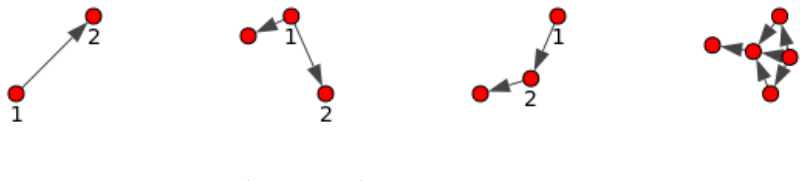
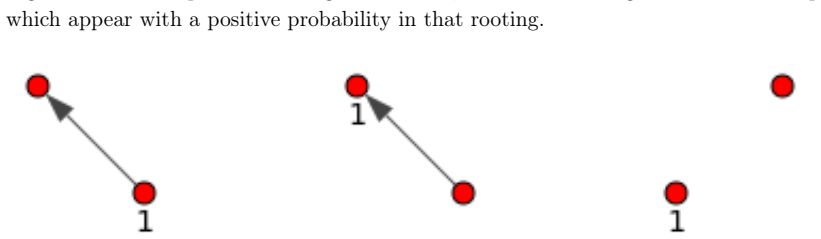
- [Figures 8–10, §5] The flags are depicted only by small drawings; since the coordinate order of the vectors in Lemma 6.3 is tied to these figures, the captions should state explicitly that the order is left-to-right and top-to-bottom as displayed, and the figures should be large enough that the orientation of each edge is unambiguous.
- [§4, Proposition 4.6] The proof uses the graph removal lemma with a specific constant n(n-1)/1080; this is fine, but the reader should be warned that the constant 1/180 in the subsequent display relies on the fact that deleting an edge creates at most 6 independent triples, which is not stated at that point.
- [§12, Concluding remarks] The notation f(k, l, n) and g(k, l, n) is defined and then used in 'g(3, 3) = 1/9 and f(3, 3) ≈ 3/16'; the meaning is clear, but a sentence explicitly matching the indices to the earlier theorems would improve readability.
Circularity Check
No significant circularity: the 1/9-certificate is an explicit finite object and the lower bound does not reduce to the extremal construction.
full rationale
The paper's derivation chain is self-contained and non-circular. The upper bound tau <= 1/9 comes from the explicit cyclic blow-up B_n in Observation 1.3, and the lower bound is obtained by constructing a 1/9-certificate for the SDP (20): Theorem 3.3 and Proposition 3.6 show that any such certificate yields tau >= 1/9, while Section 9 displays an explicit 15x15 matrix Qbar with algebraic entries. The certificate inequalities c_i - <Qbar, Abar_i> >= 1/9 are finite algebraic conditions, not consequences of assuming the theorem. The kernel vectors and sharp-graph equations in Sections 6 and 7 are derived as necessary conditions on any certificate, using only B_n and B_epsilon_n as test graphs; Remark 6.2 explicitly states that this is conditional reasoning. The extremal constructions are used to constrain a certificate, but the validity of the displayed certificate is an independent finite check. Lemma 2.1 is attributed in passing to [9], which shares an author, but it is fully proved in the text, so that citation is not load-bearing. External results such as Theorem 10.2 from [5] are used for stability, not for the main asymptotic bound. The unverified 'We have verified by computer software' assertion in Section 9 is a real auditability concern, but it is not circularity: the displayed matrix is an explicit mathematical object whose positive definiteness and inequalities can in principle be checked directly, and no fitted parameter is relabeled as a prediction.
Assumptions & free parameters
assumptions (5)
- standard math Flag algebra PSD machinery: Theorems 3.3 and Proposition 3.6 convert a PSD certificate into the lower bound tau >= 1/9.
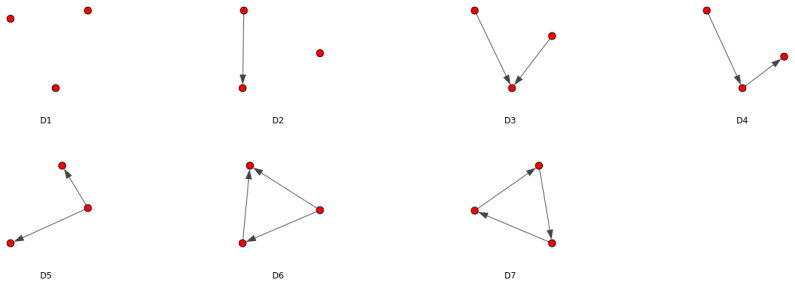
- domain assumption The list G1,...,G42 exhausts the 4-vertex oriented graphs up to isomorphism.
- domain assumption Theorem 10.2 of [5] gives a quantitative lower bound on independent triples in K4-free undirected graphs.
- domain assumption Graph removal lemma from [1] and the Andrasfai-Erdos-Sos theorem from [2].
- ad hoc to paper The computer calculations (flagmatic, csdp, Mathematica) and the verification of the displayed certificate matrix are correct.
Cite this review
Pith. "Pith review of On the local structure of oriented graphs -- a case study in flag algebras." pith.science (2026). https://pith.science/paper/KYK54YYT
@misc{pith2026190806480,
  author       = {Pith},
  title        = {Pith review of: On the local structure of oriented graphs -- a case study in flag algebras},
  year         = {2026},
  howpublished = {\url{https://pith.science/paper/KYK54YYT}},
  note         = {Machine review of arXiv:1908.06480}
}
abstract
Let $G$ be an $n$-vertex oriented graph. Let $t(G)$ (respectively $i(G)$) be the probability that a random set of $3$ vertices of $G$ spans a transitive triangle (respectively an independent set). We prove that $t(G) + i(G) \geq \frac{1}{9}-o_n(1)$. Our proof uses the method of flag algebras that we supplement with several steps that make it more easily comprehensible. We also prove a stability result and an exact result. Namely, we describe an extremal construction, prove that it is essentially unique, and prove that if $H$ is sufficiently far from that construction, then $t(H) + i(H)$ is significantly larger than $\frac{1}{9}$. We go to greater technical detail than is usually done in papers that rely on flag algebras. Our hope is that as a result this text can serve others as a useful introduction to this powerful and beautiful method.
Figures

Figures from the paper (7 more)




Reference graph
Works this paper leans on
-
[1]
N. Alon, R. A. Duke, H. Lefmann, V. Rödl and R. Yuster, The algorithmic aspects of the regularity lemma, J. Algorithms 16 (1994), 80–109
work page 1994
-
[2]
B. Andrásfai, P. Erdős, V. Sós, On the connection between chromatic number, maxi- mal clique and minimal degree of a graph, Discrete Math. 8 (1974), 205–218
work page 1974
-
[3]
D. Conlon and J. Fox, Graph removal lemmas, Surveys in Combinatorics, Cambridge University Press, 2013, 1–50
work page 2013
-
[4]
CSDP, A C Library for Semidefinite Programming, https://projects.coin-or.org/Csdp
-
[5]
S. Das, H. Huang, J. Ma, H. Naves and B. Sudakov, A problem of Erdős on the minimum number of k-cliques, J. Combinatorial Theory Ser. B 103 (2013), 344–373
work page 2013
-
[6]
P. Erdős and L. Moser, On the representation of directed graphs as unions of orderings, Publ. Math. Inst. Hungar. Acad. Sci. 9 (1964), 125–132. 43
work page 1964
-
[7]
On applications of Razborov's flag algebra calculus to extremal 3-graph theory
V. Falgas-Ravry, E. R. Vaughan, On applications of Razborov’s flag algebra calculus to extremal 3-graph theory. arXiv:1110.1623 (2011)
work page Pith review arXiv 2011
-
[8]
A. W. Goodman, On sets of acquaintances and strangers at any party, Am. Math Mon 66 (1959), 778–783
work page 1959
Show all 13 references
-
[9]
Huang, N
H. Huang, N. Linial, H. Naves, Y. Peled, and B. Sudakov, On the 3-local profiles of graphs, Journal of Graph Theory, 76, (2014), 236–248
2014
-
[10]
Pikhurko and E
O. Pikhurko and E. R. Vaughan, Minimum Number of k-Cliques in Graphs with Bounded Independence Number, Combinatorics Probability and Computing, 22 (2013), 910–934
2013
-
[11]
Razborov, Flag algebras, Journal of Symbolic Logic, 72(4):1239–1282, 2007
A. Razborov, Flag algebras, Journal of Symbolic Logic, 72(4):1239–1282, 2007
2007
-
[12]
Stearns, The voting problem, Amer
R. Stearns, The voting problem, Amer. Math. Monthly 66 (1959), 761–763
1959
-
[13]
E. R. Vaughan, Flagmatic software, A tool for researchers in extremal graph theory. http://www.maths.qmul.ac.uk/ ev/flagmatic/ 44
Reviewed August 14, 2026 · model on record in the stance chip above.
Discussion (0). Continue with ORCID to comment.