REVIEW 3 major objections 6 minor 39 references
Deep Learning Option Pricing with Market Implied Volatility Surfaces
T0 review · 3 major / 6 minor · reviewed 2026-08-15 · deepseek-v4-flash
Pith's one-line read This paper claims that a single neural network — a VAE encoder that compresses each implied-volatility surface into ten latent variables plus a multilayer perceptron — reproduces QuantLib prices for American puts and arithmetic Asian…
desk verdict A plausible VAE+MLP surrogate for QuantLib prices, but the missing label-generation specification and lack of numerical evaluation make the 'high accuracy' claim unverified. read the letter →
The pith
A machine-rendered reading of the paper's core claim, the machinery that carries it, and where it could break.
The reading
What carries the argument
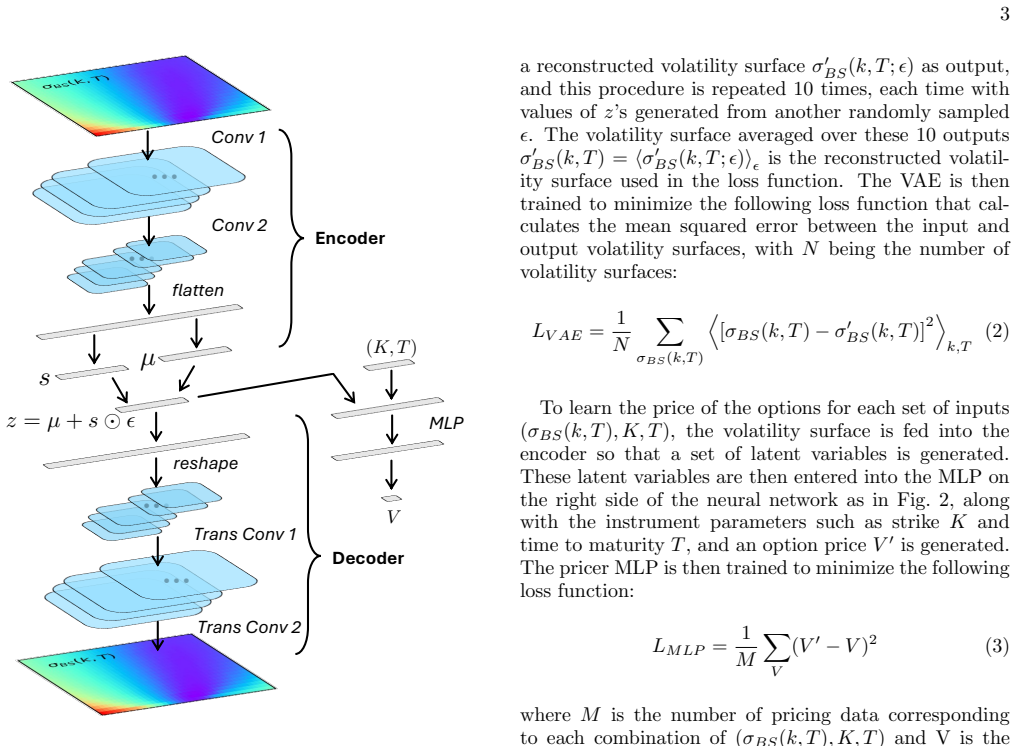
The machinery is a two-part neural network. The left part is a variational autoencoder: an encoder with two convolutional layers compresses each 41×20 surface into ten latent variables z, one mean and one variance per dimension, using the reparameterization $z = \mu + s \odot \epsilon$; a decoder reconstructs the surface, and the VAE is trained by mean-squared reconstruction error averaged over ten samples of $\epsilon$. The right part is a multilayer perceptron that takes the latent code together with strike $K$ and maturity $T$ and outputs an option price $V'$. Training proceeds in three stages — VAE only, then MLP with a frozen encoder, then joint fine-tuning — with loss $L_{\mathrm{MLP}}$ equal to the mean-squared error against QuantLib prices. This structure lets the pricer see the whole surface through a compact bottleneck while keeping the final price prediction a single differentiable forward pass.
What would settle it
Inspect the released code (linked in the paper) to see how the volatility surface is handed to QuantLib: if the American and Asian engines receive either a flat volatility at each (K,T) or a surface-consistent calibration, the central claim stands or falls. Concretely, re-running the same pipeline with a single at-the-money volatility per date in place of the full surface and showing equal pricing accuracy would demonstrate that the network is not actually using the surface; conversely, showing that accuracy degrades when the surface is scrambled would confirm that it is.
Extended reading notes
Core claim
The central discovery is that an 820-dimensional implied-volatility surface can be reduced to a 10-dimensional latent code without losing the information needed to price non-vanilla options. A singular-value decomposition of 1,051 SPX volatility surfaces shows rapidly decaying singular values, and the trained VAE reconstructs held-out surfaces accurately even on an extreme day such as 2020-03-10. The pricing network then maps the latent code with strike and maturity to option prices; on 4,000 American-put and 2,000 each of Asian-call and Asian-put test points it matches QuantLib prices within small errors, with the residual errors concentrated where bid-ask spreads are wide. The paper's stated conclusion is that a single feed-forward network can serve as a fast, scalable substitute for numerical pricing of these exotics.
Load-bearing premise
The load-bearing premise is that the QuantLib ground-truth prices were generated by passing the entire, arbitrage-free volatility surface into the pricer in a way that actually uses its shape — if each option was instead priced from a single flat volatility read at its own strike and maturity, the full-surface input is decorative and the benchmark loses economic meaning.
Editorial extensions
If this is right
- A trained network prices a new American or Asian option from one surface and a $(K,T)$ pair in a single forward pass, so repricing an entire book becomes a batched GPU operation rather than a sequence of numerical solves.
- Because the network learns from labels, it can be retrained on any slow or proprietary pricing model, yielding fast valuations that are consistent with that model by construction.
- Errors concentrate at long maturities and at-the-money strikes, where absolute bid-ask spreads are wide; the pricing error is therefore concentrated in the region where market price uncertainty is largest.
- The same architecture extends to other asset classes and exotic payoff types, with the latent dimension and network size adjusted to the new surface structure.
Reading between the lines
- The SVD analysis shows that five to ten singular vectors capture the surface variation, so the pricing network may work equally well with a five-dimensional latent code; a compression-versus-pricing-error sweep would settle how much of the surface information pricing really needs.
- If the QuantLib labels were generated with a surface-consistent model, the latent variables likely encode economically meaningful factors such as volatility level, smile curvature, and term-structure steepness; testing which latent dimensions drive which price changes could turn the encoder into an interpretable volatility factor model.
- The network is differentiable in $K$, $T$, and the latent code, so it can supply greeks and surface-sensitivity measures for hedging; the paper does not demonstrate this, but it is a direct consequence of the MLP architecture.
- Since American puts, Asian calls, and Asian puts are trained as separate outputs on the same surfaces, training a single multi-head network on all three jointly could enforce cross-instrument consistency and improve generalization on sparse surfaces.
Signed reviews
Editorial analysis
A structured set of objections, weighed in public.
Referee Report
Summary. The manuscript proposes a deep-learning option pricer that takes a full market implied volatility (IV) surface as input. The authors construct 41x20 arbitrage-free IV surfaces from end-of-day S&P 500 index option quotes over 2018-2023, compress each surface with a variational autoencoder into a 10-dimensional latent variable, and feed the latent variables together with strike and maturity into a multilayer perceptron to predict prices. Ground-truth prices for American puts and arithmetic Asian calls and puts are generated with QuantLib. The model is trained in three stages: VAE reconstruction, MLP pricing, and joint fine-tuning. The paper reports qualitative evidence of accurate pricing, with errors said to concentrate near long maturities and at-the-money strikes, and claims that the resulting single-forward-pass method offers an efficient alternative to numerical pricing.
Significance. If the central claim is fully supported, the contribution is a practical architecture-level combination of surface compression and option pricing: a fast, GPU-friendly pricer for exotics that uses the entire IV surface rather than a single flat volatility. The manuscript deserves credit for using real SPX data over a six-year window, for providing a public code/data link, and for explicitly separating training and testing volatility surfaces. The SVD analysis of the surface dataset is a useful motivation for the latent dimension. However, the paper's novelty as a deep-learning pricing method is moderate, and the verification of the claimed accuracy is currently qualitative. The decisive issue is whether the generated QuantLib labels actually use the full IV surface in an economically meaningful way; the manuscript does not provide enough specification to establish this, and the absence of quantitative error statistics leaves 'high accuracy' unsupported as stated.
major comments (3)
- [II.A Data preparation] The generation of the ground-truth QuantLib labels is underspecified in a way that is load-bearing. The text states that 'the entire volatility surface for the corresponding date is passed onto the QuantLib pricer', but QuantLib pricing engines require a concrete stochastic process and model parameters, not an IV surface alone. The paper does not state the stochastic model used for the American and Asian pricing engines, how the IV surface is converted into that model's parameters (e.g., whether a flat Black-Scholes volatility is extracted at each (K,T), whether a local-volatility or other calibration is performed), the risk-free rate, the dividend yield of the S&P 500, the averaging frequency and monitor dates for the Asian options, or which specific QuantLib engines and settings are used. If each label is produced with a flat Black-Scholes process using only the single implied volatility at that (K,T), then the 41x20 surface is not actually used to form prices, the 'full-surface' conditioning claim collapses, and the benchmark reduces to interpolating between inconsistent pointwise prices. This missing specification is separable from the neural-network contribution and must be clarified before the central claim can be evaluated.
- [III.C Evaluation of neural network pricer] The paper reports no quantitative accuracy metrics. Figures 7 and 8 show scatter plots and error heatmaps, but the abstract's 'high accuracy' claim is never backed by RMSE, MAE, maximum absolute error, relative error, or any comparison with the bid-ask spread or with a baseline pricer. For example, the text says errors are 'overall small' but does not give a number; the reader cannot tell whether a typical error is 1 cent, 10 cents, or 1 dollar, nor whether the errors are economically material relative to bid-ask widths. Without such metrics, the central claim of high accuracy is not supported as stated. The authors should report, at minimum, out-of-sample error statistics for the three option types, ideally stratified by moneyness and maturity, and compare against a simple baseline such as an MLP using only the single at-the-money flat volatility.
- [II.A and II.B] The data filtering and arbitrage-free construction procedure is not reproducible as described. The paper says some interpolated surfaces 'appear not to be arbitrage-free' and are filtered out after 'test pricing on vanilla option valuation using QuantLib', but it does not specify the interpolation scheme, the precise arbitrage conditions checked, the number of discarded surfaces, the treatment of SPX dividends, or the source and interpolation of the risk-free rate. These details are needed to understand how the 1051 surfaces were obtained from the raw optionsDX data and whether the filtering introduces selection bias. In addition, Section II.B's VAE loss in Eq. (2) is only a reconstruction mean-squared error; no KL-divergence term is shown, which is unusual for a variational autoencoder. If the KL term is absent, the model is effectively a stochastic autoencoder and statements about a trained 'VAE' and latent regularization need qualification. Please clarify what exactly is minimized and whether the standard VAE objective was modified.
minor comments (6)
- [II.B and Fig. 2] The architecture text refers to a 'multilayer perception'; this should be 'multilayer perceptron'.
- [III.A and Fig. 3] In Fig. 3(a) the horizontal axis is labeled 'SVR', which is ambiguous; the text indicates it should be the singular value rank. The log-log axis tick labels also appear unconventional (e.g., '101, 103'), which makes the plot harder to read.
- [II.B, Eq. (2)] Eq. (2) contains a notational artifact with D[...]E in place of an expectation operator; the loss convention should be written cleanly.
- [II.A] The sentence 'The scatter points in Fig. 1 shows...' has a subject-verb agreement issue, and a few other minor grammatical errors appear near the training description ('In the second stage, We focus...').
- [III.B and Fig. 5] Fig. 5(b) uses the notation '2log s' for the log-variance distribution; please define the symbols precisely, since s is introduced as a standard deviation and the plot appears to show log-variance.
- [Summary] The Summary repeats the 'high accuracy' claim without referencing the missing quantitative support, so it should be revised after the evaluation section is updated.
Circularity Check
No significant circularity: the paper performs a supervised regression from volatility surfaces to QuantLib-generated prices, with a held-out split, so the central accuracy claims are not forced by construction.
full rationale
The paper's derivation chain is self-contained and non-circular. Implied volatilities are computed from market quotes via Eq. (1), interpolated onto a 41x20 grid, and then used as inputs to QuantLib to generate ground-truth prices for American puts and arithmetic Asian options. The VAE compresses the surface and the MLP regresses option prices against those QuantLib prices, with training and testing sets separated by volatility-surface date. The reported test accuracy therefore measures generalization to unseen surfaces rather than reproducing a fitted parameter or an input by construction. The only same-author citation is Ref. [31], used in the introduction as an example of a parameterization-based limitation; it is not load-bearing for any result or architecture choice. The label-generation procedure is under-specified (no stochastic model, calibration step, or Asian averaging convention is stated), which is a reproducibility and correctness concern, but not a circularity: even if QuantLib used a flat volatility per (K,T), the network would still be learning a nontrivial mapping from surfaces and contract parameters to numerical prices, not equating outputs to inputs by definition. No self-definitional, fitted-input-called-prediction, or self-citation-chain circularity is exhibited in the manuscript.
Assumptions & free parameters
free parameters (3)
- VAE latent dimension =
10
- Volatility surface grid =
41 log-moneyness points over [-0.3,0.3] and 20 maturities over [0.05,1]
- QuantLib pricing setup =
not stated
assumptions (5)
- standard math Implied volatility is defined by inverting Black-Scholes for each SPX option quote.
- domain assumption Interpolation of sparse option quotes to a regular 41x20 grid preserves the relevant arbitrage and pricing information.
- ad hoc to paper QuantLib's pricing engines produce correct American and Asian prices from a volatility surface passed as input.
- domain assumption Ten latent dimensions are sufficient to represent volatility surfaces for option pricing.
- domain assumption The filtered set of 1,051 volatility surfaces is representative and arbitrage-free for the 2018-2023 period.
invented entities (1)
-
10-dimensional VAE latent representation z
Cite this review
Pith. "Pith review of Deep Learning Option Pricing with Market Implied Volatility Surfaces." pith.science (2026). https://pith.science/paper/KYKJGYIP
@misc{pith2026250905911,
  author       = {Pith},
  title        = {Pith review of: Deep Learning Option Pricing with Market Implied Volatility Surfaces},
  year         = {2026},
  howpublished = {\url{https://pith.science/paper/KYKJGYIP}},
  note         = {Machine review of arXiv:2509.05911}
}
read the original abstract
We present a deep learning framework for pricing options based on market-implied volatility surfaces. Using end-of-day S\&P 500 index options quotes from 2018-2023, we construct arbitrage-free volatility surfaces and generate training data for American puts and arithmetic Asian options using QuantLib. To address the high dimensionality of volatility surfaces, we employ a variational autoencoder (VAE) that compresses volatility surfaces across maturities and strikes into a 10-dimensional latent representation. We feed these latent variables, combined with option-specific inputs such as strike and maturity, into a multilayer perceptron to predict option prices. Our model is trained in stages: first to train the VAE for volatility surface compression and reconstruction, then options pricing mapping, and finally fine-tune the entire network end-to-end. The trained pricer achieves high accuracy across American and Asian options, with prediction errors concentrated primarily near long maturities and at-the-money strikes, where absolute bid-ask price differences are known to be large. Our method offers an efficient and scalable approach requiring only a single neural network forward pass and naturally improve with additional data. By bridging volatility surface modeling and option pricing in a unified framework, it provides a fast and flexible alternative to traditional numerical approaches for exotic options.
Figures


Figures from the paper (3 more)


Reference graph
Works this paper leans on
-
[1]
author author F. Black \ and\ author M. Scholes ,\ title title The pricing of options and corporate liabilities , \ @noop journal journal Journal of Political Economy \ volume 81 ,\ pages 637--654 ( year 1973 ) NoStop
work page 1973
-
[2]
author author P. Wilmott ,\ @noop title Paul Wilmott on quantitative finance \ ( publisher John Wiley & Sons ,\ year 2013 ) NoStop
work page 2013
-
[3]
author author S. E. \ Shreve et al. ,\ @noop title Stochastic calculus for finance II: Continuous-time models ,\ Vol. volume 11 \ ( publisher Springer ,\ year 2004 ) NoStop
work page 2004
-
[4]
author author J. C. \ Hull ,\ @noop title Options, Futures, and Other Derivatives ,\ edition 9th \ ed.\ ( publisher Pearson ,\ year 2017 ) NoStop
work page 2017
-
[5]
author author R. Cont \ and\ author P. Tankov ,\ @noop title Financial modelling with jump processes \ ( publisher Chapman and Hall/CRC ,\ year 2003 ) NoStop
work page 2003
-
[6]
author author P. Glasserman ,\ @noop title Monte Carlo Methods in Financial Engineering \ ( publisher Springer ,\ year 2004 ) NoStop
work page 2004
-
[7]
author author D. Duffie ,\ @noop title Dynamic asset pricing theory \ ( publisher Princeton University Press ,\ year 2010 ) NoStop
work page 2010
-
[8]
author author K. P. \ Murphy ,\ @noop title Machine learning: a probabilistic perspective \ ( publisher MIT press ,\ year 2012 ) NoStop
2012
Show all 39 references
-
[9]
Goodfellow , author Y
author author I. Goodfellow , author Y. Bengio , author A. Courville ,\ and\ author Y. Bengio ,\ @noop title Deep learning ,\ Vol. volume 1 \ ( publisher MIT press Cambridge ,\ year 2016 ) NoStop
2016
-
[10]
author author M. F. \ Dixon , author I. Halperin ,\ and\ author P. Bilokon ,\ @noop title Machine Learning in Finance: From Theory to Practice \ ( publisher Springer ,\ year 2020 ) NoStop
2020
-
[11]
Liu , author C
author author S. Liu , author C. W. \ Oosterlee ,\ and\ author S. M. \ Bohte ,\ title title Pricing options and computing implied volatilities using neural networks , \ @noop journal journal Risks \ volume 7 ,\ pages 16 ( year 2019 ) NoStop
2019
-
[12]
Hirsa , author T
author author A. Hirsa , author T. Karatas ,\ and\ author A. Oskoui ,\ title title Supervised deep neural networks (dnns) for pricing/calibration of vanilla/exotic options , \ @noop journal journal SSRN Electronic Journal \ ( year 2019 ) NoStop
2019
-
[13]
Raissi , author P
author author M. Raissi , author P. Perdikaris ,\ and\ author G. E. \ Karniadakis ,\ title title Physics-informed neural networks: A deep learning framework for solving forward and inverse problems involving nonlinear partial differential equations , \ @noop journal journal Jo...
2019
-
[14]
Gatta , author V
author author F. Gatta , author V. S. \ Di Cola , author F. Giampaolo , author F. Piccialli ,\ and\ author S. Cuomo ,\ title title Meshless methods for american option pricing through physics-informed neural networks , \ @noop journal journal Engineering Analysis with Boundary...
2023
-
[15]
Hainaut \ and\ author A
author author D. Hainaut \ and\ author A. Casas ,\ title title Option pricing in the heston model with physics inspired neural networks , \ @noop journal journal Annals of Finance \ volume 20 ,\ pages 353--376 ( year 2024 ) NoStop
2024
-
[16]
Wang , author J
author author X. Wang , author J. Li ,\ and\ author J. Li ,\ title title A deep learning based numerical pde method for option pricing , \ @noop journal journal Computational economics \ volume 62 ,\ pages 149--164 ( year 2023 ) NoStop
2023
-
[17]
Bai , author T
author author Y. Bai , author T. Chaolu ,\ and\ author S. Bilige ,\ title title The application of improved physics-informed neural network (ipinn) method in finance , \ @noop journal journal Nonlinear Dynamics \ volume 107 ,\ pages 3655--3667 ( year 2022 ) NoStop
2022
-
[18]
De Spiegeleer , author D
author author J. De Spiegeleer , author D. B. \ Madan , author S. Reyners ,\ and\ author W. Schoutens ,\ title title Machine learning for quantitative finance: fast derivative pricing, hedging and fitting , \ @noop journal journal Quantitative Finance \ volume 18 ,\ pages 1635...
2018
-
[19]
Ndikum ,\ title title Machine learning algorithms for financial asset price forecasting , \ @noop journal journal arXiv preprint arXiv:2004.01504 \ ( year 2020 ) NoStop
author author P. Ndikum ,\ title title Machine learning algorithms for financial asset price forecasting , \ @noop journal journal arXiv preprint arXiv:2004.01504 \ ( year 2020 ) NoStop
2004 arXiv
-
[20]
author author R. M. \ Gaspar , author S. D. \ Lopes ,\ and\ author B. Sequeira ,\ title title Neural network pricing of american put options , \ @noop journal journal Risks \ volume 8 ,\ pages 73 ( year 2020 ) NoStop
2020
-
[21]
Anderson \ and\ author U
author author D. Anderson \ and\ author U. Ulrych ,\ title title Accelerated american option pricing with deep neural networks , \ @noop journal journal Quantitative Finance and Economics \ volume 7 ,\ pages 207--228 ( year 2023 ) NoStop
2023
-
[22]
Cao , author J
author author J. Cao , author J. Chen , author J. Hull ,\ and\ author Z. Poulos ,\ title title Deep learning for exotic option valuation , \ @noop journal journal arXiv preprint arXiv:2103.12551 \ ( year 2021 ) NoStop
2021 arXiv
-
[23]
Ruf \ and\ author W
author author J. Ruf \ and\ author W. Wang ,\ title title Neural networks for option pricing and hedging: a literature review , \ @noop journal journal arXiv preprint arXiv:1911.05620 \ ( year 2019 ) NoStop
1911 arXiv
-
[24]
author author D. A. \ Bloch ,\ title title Option pricing with machine learning , \ @noop journal journal Available at SSRN 3486224 \ ( year 2019 ) NoStop
2019
-
[25]
Culkin \ and\ author S
author author R. Culkin \ and\ author S. R. \ Das ,\ title title Machine learning in finance: the case of deep learning for option pricing , \ @noop journal journal Journal of Investment Management \ volume 15 ,\ pages 92--100 ( year 2017 ) NoStop
2017
-
[26]
Doersch ,\ title title Tutorial on variational autoencoders , \ @noop journal journal arXiv preprint arXiv:1606.05908 \ ( year 2016 ) NoStop
author author C. Doersch ,\ title title Tutorial on variational autoencoders , \ @noop journal journal arXiv preprint arXiv:1606.05908 \ ( year 2016 ) NoStop
2016 arXiv
-
[27]
Pu , author Z
author author Y. Pu , author Z. Gan , author R. Henao , author X. Yuan , author C. Li , author A. Stevens ,\ and\ author L. Carin ,\ title title Variational autoencoder for deep learning of images, labels and captions , \ @noop journal journal Advances in neural information pr...
2016
-
[28]
Bergeron , author N
author author M. Bergeron , author N. Fung , author J. Hull ,\ and\ author Z. Poulos ,\ title title Variational autoencoders: A hands-off approach to volatility , \ @noop journal journal arXiv preprint arXiv:2102.03945 \ ( year 2021 ) NoStop
2021 arXiv
-
[29]
author author J. Vecer ,\ title title A new pde approach for pricing arithmetic average asian options , \ @noop journal journal Journal of computational finance \ volume 4 ,\ pages 105--113 ( year 2001 ) NoStop
2001
-
[30]
Gatheral \ and\ author A
author author J. Gatheral \ and\ author A. Jacquier ,\ title title Arbitrage-free svi volatility surfaces , \ @noop journal journal Quantitative Finance \ volume 14 ,\ pages 59--71 ( year 2014 ) NoStop
2014
-
[31]
Ding , author E
author author L. Ding , author E. Lu ,\ and\ author K. Cheung ,\ title title Fast derivative valuation from volatility surfaces using machine learning , \ @noop journal journal arXiv preprint arXiv:2505.22957 \ ( year 2025 ) NoStop
2025 arXiv
-
[32]
author author J. R. \ Varma \ and\ author V. Virmani ,\ @noop title Derivatives Pricing using QuantLib: An Introduction \ ( publisher Indian Institute of Management ,\ year 2015 ) NoStop
2015
-
[33]
author author J. R. \ Varma \ and\ author V. Virmani ,\ title title Computational finance using quantlib-python , \ @noop journal journal Computing in Science & Engineering \ volume 18 ,\ pages 78--88 ( year 2016 ) NoStop
2016
-
[34]
Ackerer , author N
author author D. Ackerer , author N. Tagasovska ,\ and\ author T. Vatter ,\ title title Deep smoothing of the implied volatility surface , \ @noop journal journal Advances in Neural Information Processing Systems \ volume 33 ,\ pages 11552--11563 ( year 2020 ) NoStop
2020
-
[35]
Ning , author S
author author B. Ning , author S. Jaimungal , author X. Zhang ,\ and\ author M. Bergeron ,\ title title Arbitrage-free implied volatility surface generation with variational autoencoders , \ @noop journal journal SIAM Journal on Financial Mathematics \ volume 14 ,\ pages 1004-...
2023
-
[36]
Wang , author S
author author J. Wang , author S. Liu ,\ and\ author C. Vuik ,\ title title Controllable generation of implied volatility surfaces with variational autoencoders , \ @noop journal journal arXiv preprint arXiv:2509.01743 \ ( year 2025 ) NoStop
2025 arXiv
-
[37]
author author B. T. \ Kelly , author B. Kuznetsov , author S. Malamud ,\ and\ author T. A. \ Xu ,\ title title Deep learning from implied volatility surfaces , \ @noop journal journal Swiss Finance Institute Research Paper \ ( year 2023 ) NoStop
2023
-
[38]
Fan , author A
author author R. Fan , author A. Gupta ,\ and\ author P. Ritchken ,\ title title Hedging in the possible presence of unspanned stochastic volatility: Evidence from swaption markets , \ @noop journal journal The Journal of Finance \ volume 58 ,\ pages 2219--2248 ( year 2003 ) NoStop
2003
-
[39]
Hagan , author A
author author P. Hagan , author A. Lesniewski ,\ and\ author D. Woodward ,\ title title Probability distribution in the sabr model of stochastic volatility , \ in\ @noop booktitle Large deviations and asymptotic methods in finance \ ( publisher Springer ,\ year 2015 )\ pp.\ pa...
2015
Reviewed August 15, 2026 · model on record in the stance chip above.
Discussion (0). Continue with ORCID to comment.