NetPTR: Optimal Differentially Private Spectral Community Detection on Sparse Networks
Pith reviewed 2026-06-26 06:36 UTC · model grok-4.3
The pith
NetPTR releases a noisy spectral embedding after a stability test to achieve edge differential privacy while preserving consistency guarantees for community detection.
A machine-rendered reading of the paper's core claim, the machinery that carries it, and where it could break.
Core claim
NetPTR achieves edge differential privacy for ordinary networks by releasing a noisy empirical spectral embedding after a stability test, establishing error bounds under the degree-corrected stochastic blockmodel that separate non-private spectral clustering error from additional privacy error, guaranteeing weak consistency in sparse networks and exact recovery in moderate sparse networks, with a matching lower bound showing the privacy budget is sharp up to log factors. It also extends to column-node-DP for bipartite networks under bipartite degree-corrected block model.
What carries the argument
The stability test on empirical eigenspaces that yields computable stability certificates and local sensitivity bounds, allowing calibrated noise to be added to the spectral embedding while controlling the privacy-accuracy tradeoff.
If this is right
- Weak consistency holds for community detection on sparse networks under edge differential privacy.
- Exact recovery becomes possible on moderately sparse networks once the privacy noise is added.
- The privacy budget required is information-theoretically tight up to logarithmic factors.
- A column-node differential privacy version yields consistent recovery for the left-side communities in bipartite networks.
Where Pith is reading between the lines
- The same stability-test-plus-noise pattern could be applied to other eigenvector-based graph algorithms such as spectral ranking.
- Networks whose degree distribution deviates strongly from the model assumptions would require separate verification of the perturbation bounds.
- The clean separation of error terms suggests that privacy overhead becomes negligible once average degree exceeds a moderate threshold.
- Adaptive choice of the stability threshold on real data could be tested by monitoring how often the test rejects valid embeddings.
Load-bearing premise
Perturbation bounds for empirical eigenspaces under neighboring-network changes must hold so that stability certificates and local sensitivity bounds can be computed.
What would settle it
A sparse network drawn from the degree-corrected stochastic blockmodel in which the observed clustering error after privacy noise exceeds the derived upper bound, or in which the stability test passes on an embedding whose neighboring-network change is large.
Figures
read the original abstract
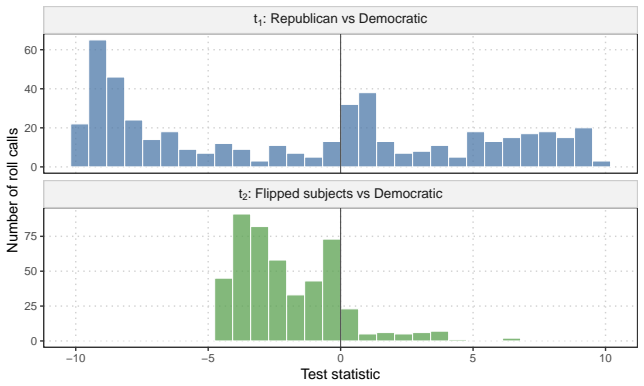
Spectral community detection estimates latent labels from the leading eigenspace of a network adjacency matrix, but releasing the resulting labels can disclose sensitive relational information. We consider this problem under differential privacy for both ordinary and bipartite networks. For ordinary networks, the protected unit is a single edge, leading to edge differential privacy (edge-DP). For bipartite networks, the inferential target is the community structure of the left-side nodes, while the protected unit is an entire right-side incidence profile, leading to column-node-DP. We propose NetPTR, a private spectral clustering procedure that releases a noisy empirical spectral embedding after a stability test. The algorithm requires perturbation bounds for empirical eigenspaces under neighboring-network changes, which yield computable stability certificates and local sensitivity bounds. For ordinary networks, we establish edge-DP and the error bound under the degree-corrected stochastic blockmodel, which separates the non-private spectral clustering error from the additional privacy-induced error. It therefore guarantees weak consistency in sparse networks and exact recovery in moderate sparse networks. A matching lower bound shows that the required privacy budget is sharp up to logarithmic factors. We further develop a column-node-DP algorithm for bipartite networks and prove consistency under a bipartite degree-corrected block model. Simulations and real-data examples illustrate the resulting privacy--accuracy tradeoff.
Editorial analysis
A structured set of objections, weighed in public.
Referee Report
Summary. The paper proposes NetPTR, a private spectral clustering procedure for community detection in ordinary and bipartite networks under differential privacy. For ordinary networks, it achieves edge differential privacy and provides an error bound under the degree-corrected stochastic blockmodel that separates the non-private spectral clustering error from the privacy-induced error, guaranteeing weak consistency in sparse networks and exact recovery in moderately sparse networks, with a matching lower bound on the privacy budget. A similar algorithm is developed for bipartite networks with column-node-DP and consistency under a bipartite degree-corrected block model. Simulations and real-data examples are used to illustrate the privacy-accuracy tradeoff.
Significance. If the claimed perturbation bounds for empirical eigenspaces under neighboring-network changes hold and yield computable stability certificates and local sensitivity bounds, the work supplies a theoretically grounded method for differentially private community detection that explicitly decomposes statistical and privacy errors in the sparse DC-SBM regime. The matching lower bound on the privacy budget and the extension to bipartite networks with column-node-DP strengthen the optimality and generality claims.
minor comments (2)
- The abstract states that the algorithm 'requires perturbation bounds... which yield computable stability certificates'; the main text should include an explicit statement (e.g., in the algorithm description or §3) of where these bounds are proved and how they are used to set the noise scale.
- Notation for the privacy budget (ε, δ) and the local sensitivity quantities should be introduced consistently in the introduction and reused without redefinition in the consistency theorems.
Simulated Author's Rebuttal
We thank the referee for the positive summary, significance assessment, and recommendation of minor revision. No specific major comments were listed in the report, so we have no points to address point-by-point. We will incorporate any minor editorial suggestions during revision.
Circularity Check
No significant circularity; derivation self-contained via perturbation analysis
full rationale
The paper claims to establish edge-DP error bounds under the DC-SBM by separating non-private spectral error from privacy noise via perturbation bounds on empirical eigenspaces, yielding consistency guarantees and a matching lower bound on the privacy budget. These steps are presented as derived from standard perturbation analysis rather than reducing by construction to fitted parameters, self-citations, or ansatzes defined in terms of the target result. No equations or claims in the provided text exhibit self-definitional, fitted-input, or self-citation load-bearing circularity; the central results remain independent of the inputs they bound.
Axiom & Free-Parameter Ledger
axioms (2)
- domain assumption The observed network is generated from a degree-corrected stochastic blockmodel
- domain assumption Perturbation bounds for empirical eigenspaces under neighboring-network changes are valid and yield computable stability certificates
Reference graph
Works this paper leans on
-
[1]
The European physical journal B , volume=
Detecting community structure in networks , author=. The European physical journal B , volume=. 2004 , publisher=
2004
-
[2]
Europhysics Letters , volume=
Community detection and graph partitioning , author=. Europhysics Letters , volume=. 2013 , publisher=
2013
-
[3]
The Annals of Statistics , volume=
Spectral clustering and the high-dimensional stochastic blockmodel , author=. The Annals of Statistics , volume=. 2011 , publisher=
2011
-
[4]
The Annals of Statistics , pages=
Consistency of spectral clustering in stochastic block models , author=. The Annals of Statistics , pages=. 2015 , publisher=
2015
-
[5]
Journal of the American Statistical Association , volume=
Covariate regularized community detection in sparse graphs , author=. Journal of the American Statistical Association , volume=. 2021 , publisher=
2021
-
[6]
IEEE Transactions on information theory , volume=
Exact recovery in the stochastic block model , author=. IEEE Transactions on information theory , volume=. 2015 , publisher=
2015
-
[7]
Foundations and Trends
Spectral methods for data science: A statistical perspective , author=. Foundations and Trends. 2021 , publisher=
2021
-
[8]
The Journal of Machine Learning Research , volume=
Achieving optimal misclassification proportion in stochastic block models , author=. The Journal of Machine Learning Research , volume=. 2017 , publisher=
2017
-
[9]
Physical Review E , volume=
Spectral methods for community detection and graph partitioning , author=. Physical Review E , volume=. 2013 , publisher=
2013
-
[10]
Social networks , volume=
Stochastic blockmodels: First steps , author=. Social networks , volume=. 1983 , publisher=
1983
-
[11]
Proceedings of the National Academy of Sciences , volume=
A nonparametric view of network models and Newman--Girvan and other modularities , author=. Proceedings of the National Academy of Sciences , volume=. 2009 , publisher=
2009
-
[12]
Physical Review E , volume=
Stochastic blockmodels and community structure in networks , author=. Physical Review E , volume=. 2011 , publisher=
2011
-
[13]
The Annals of Statistics , volume=
Consistency of community detection in networks under degree-corrected stochastic block models , author=. The Annals of Statistics , volume=. 2012 , publisher=
2012
-
[14]
The Annals of Applied Statistics , volume=
Uncovering latent structure in valued graphs: a variational approach , author=. The Annals of Applied Statistics , volume=. 2010 , publisher=
2010
-
[15]
The Annals of Statistics , volume=
Likelihood-based model selection for stochastic block models , author=. The Annals of Statistics , volume=. 2017 , publisher=
2017
-
[16]
The Annals of Statistics , volume=
Pseudo-likelihood methods for community detection in large sparse networks , author=. The Annals of Statistics , volume=. 2013 , publisher=
2013
-
[17]
Sankhya A , pages=
Improvements on score, especially for weak signals , author=. Sankhya A , pages=. 2021 , publisher=
2021
-
[18]
Proceedings of the National Academy of Sciences , volume=
Spectral redemption in clustering sparse networks , author=. Proceedings of the National Academy of Sciences , volume=. 2013 , publisher=
2013
-
[19]
The Annals of Statistics , volume=
Impact of regularization on spectral clustering , author=. The Annals of Statistics , volume=. 2016 , publisher=
2016
-
[20]
Electronic Communications in Probability , volume=
Hanson-wright inequality and sub-gaussian concentration , author=. Electronic Communications in Probability , volume=. 2013 , publisher=
2013
-
[21]
1997 , publisher=
Spectral graph theory , author=. 1997 , publisher=
1997
-
[22]
Conference on Learning Theory , pages=
Spectral clustering of graphs with general degrees in the extended planted partition model , author=. Conference on Learning Theory , pages=. 2012 , organization=
2012
-
[23]
Uniform error bound for
Tong, Xin T and Wang, Wanjie and Wang, Yuguan , journal=. Uniform error bound for. 2025 , publisher=
2025
-
[24]
Foundations and Trends
A survey of statistical network models , author=. Foundations and Trends. 2010 , publisher=
2010
-
[25]
2009 , publisher=
Statistical Analysis of Network Data: Methods and Models , author=. 2009 , publisher=
2009
-
[26]
Fast community detection by
Jin, Jiashun , journal=. Fast community detection by. 2015 , publisher=
2015
-
[27]
Biometrika , volume =
Network-adjusted covariates for community detection , author=. Biometrika , volume =. 2024 , publisher=
2024
-
[28]
arXiv preprint arXiv:2504.04866 , year=
Optimal Network-Guided Covariate Selection for High-Dimensional Data Integration , author=. arXiv preprint arXiv:2504.04866 , year=
-
[29]
Foundations and trends
The algorithmic foundations of differential privacy , author=. Foundations and trends. 2014 , publisher=
2014
-
[30]
Proceedings of the forty-first annual ACM symposium on Theory of computing , pages=
Differential privacy and robust statistics , author=. Proceedings of the forty-first annual ACM symposium on Theory of computing , pages=
-
[31]
Conference on Learning Theory , pages=
Differential privacy and robust statistics in high dimensions , author=. Conference on Learning Theory , pages=. 2022 , organization=
2022
-
[32]
Journal of the American Statistical Association , volume=
Privacy-preserving parametric inference: A case for robust statistics , author=. Journal of the American Statistical Association , volume=. 2021 , publisher=
2021
-
[33]
The Annals of Statistics , volume=
Differentially private inference via noisy optimization , author=. The Annals of Statistics , volume=. 2023 , publisher=
2023
-
[34]
The Annals of Statistics , volume=
The cost of privacy: Optimal rates of convergence for parameter estimation with differential privacy , author=. The Annals of Statistics , volume=. 2021 , publisher=
2021
-
[35]
arXiv preprint arXiv:2406.06755 , year=
Optimal federated learning for nonparametric regression with heterogeneous distributed differential privacy constraints , author=. arXiv preprint arXiv:2406.06755 , year=
-
[36]
Optimal differentially private
Cai, T Tony and Xia, Dong and Zha, Mengyue , journal=. Optimal differentially private
-
[37]
arXiv preprint arXiv:2002.08774 , year=
Propose, test, release: Differentially private estimation with high probability , author=. arXiv preprint arXiv:2002.08774 , year=
arXiv 2002
-
[38]
International Conference on Artificial Intelligence and Statistics , pages=
Generalized ptr: User-friendly recipes for data-adaptive algorithms with differential privacy , author=. International Conference on Artificial Intelligence and Statistics , pages=. 2023 , organization=
2023
-
[39]
Advances in Neural Information Processing Systems , volume=
Renyi differential privacy of propose-test-release and applications to private and robust machine learning , author=. Advances in Neural Information Processing Systems , volume=
-
[40]
Advances in Neural Information Processing Systems , volume=
Posthoc privacy guarantees for collaborative inference with modified propose-test-release , author=. Advances in Neural Information Processing Systems , volume=
-
[41]
arXiv preprint arXiv:2605.03264 , year=
Efficient Proposal-Test-Release for Minimax Optimal Estimation , author=. arXiv preprint arXiv:2605.03264 , year=
-
[42]
Fan, Jianqing and Wang, Weichen and Zhong, Yiqiao , journal=. An _
-
[43]
Largest eigenvalues of sparse inhomogeneous Erd
Benaych-Georges, Florent and Bordenave, Charles and Knowles, Antti , journal=. Largest eigenvalues of sparse inhomogeneous Erd. 2019 , publisher=
2019
-
[44]
Fan, Jianqing and Wang, Weichen and Zhong, Yiqiao , journal=. An _. 2018 , publisher=
2018
-
[45]
Linear Algebra and its applications , volume=
A lower bound for the smallest singular value of a matrix , author=. Linear Algebra and its applications , volume=. 1975 , publisher=
1975
-
[46]
The Annals of Probability , volume=
Sharp nonasymptotic bounds on the norm of random matrices with independent entries , author=. The Annals of Probability , volume=. 2016 , publisher=
2016
-
[47]
Electronic Journal of Probability , publisher =
Isotropic local laws for sample covariance and generalized Wigner matrices , author=. Electronic Journal of Probability , publisher =
-
[48]
III , author=
The rotation of eigenvectors by a perturbation. III , author=. SIAM Journal on Numerical Analysis , volume=. 1970 , publisher=
1970
-
[49]
The Annals of statistics , volume=
Entrywise eigenvector analysis of random matrices with low expected rank , author=. The Annals of statistics , volume=. 2020 , publisher=
2020
-
[50]
International Conference on Machine Learning , pages=
Differentially private community detection for stochastic block models , author=. International Conference on Machine Learning , pages=. 2022 , organization=
2022
-
[51]
ACM Computing Surveys , volume=
Private graph data release: A survey , author=. ACM Computing Surveys , volume=. 2023 , publisher=
2023
-
[52]
Mueller, Tamara T and Usynin, Dmitrii and Paetzold, Johannes C and Rueckert, Daniel and Kaissis, Georgios , journal=
-
[53]
2009 Ninth IEEE International Conference on Data Mining , pages=
Accurate estimation of the degree distribution of private networks , author=. 2009 Ninth IEEE International Conference on Data Mining , pages=. 2009 , organization=
2009
-
[54]
Annals of Statistics , volume=
Inference using noisy degrees: Differentially private -model and synthetic graphs , author=. Annals of Statistics , volume=. 2016 , publisher=
2016
-
[55]
Advances in Neural Information Processing Systems , volume=
Faster approximate subgraph counts with privacy , author=. Advances in Neural Information Processing Systems , volume=
-
[56]
Journal of the American statistical association , volume=
Randomized response: A survey technique for eliminating evasive answer bias , author=. Journal of the American statistical association , volume=. 1965 , publisher=
1965
-
[57]
30th USENIX security symposium (USENIX Security 21) , pages=
Locally differentially private analysis of graph statistics , author=. 30th USENIX security symposium (USENIX Security 21) , pages=
-
[58]
Journal of the Royal Statistical Society Series C: Applied Statistics , volume=
Sharing social network data: differentially private estimation of exponential family random-graph models , author=. Journal of the Royal Statistical Society Series C: Applied Statistics , volume=. 2017 , publisher=
2017
-
[59]
IEEE Transactions on Information Forensics and Security , volume=
Optimal differentially private mechanisms for randomised response , author=. IEEE Transactions on Information Forensics and Security , volume=. 2017 , publisher=
2017
-
[60]
The Journal of privacy and confidentiality , volume=
Consistent spectral clustering of network block models under local differential privacy , author=. The Journal of privacy and confidentiality , volume=
-
[61]
, author=
Privacy-Integrated Graph Clustering Through Differential Privacy. , author=. EDBT/ICDT Workshops , volume=
-
[62]
Workshop on Privacy in the Electronic Society-WPES 206 , pages=
Detecting Communities under Differential Privacy , author=. Workshop on Privacy in the Electronic Society-WPES 206 , pages=
-
[63]
Transactions on Machine Learning Research , issn=
Local Differential Privacy-Preserving Spectral Clustering for General Graphs , author=. Transactions on Machine Learning Research , issn=. 2025 , url=
2025
-
[64]
Proceedings of the ACM on Management of Data , volume=
Common neighborhood estimation over bipartite graphs under local differential privacy , author=. Proceedings of the ACM on Management of Data , volume=. 2024 , publisher=
2024
-
[65]
arXiv preprint arXiv:2406.14772 , year=
Consistent community detection in multi-layer networks with heterogeneous differential privacy , author=. arXiv preprint arXiv:2406.14772 , year=
-
[66]
International Conference on Machine Learning , pages=
Differentially private exact recovery for stochastic block models , author=. International Conference on Machine Learning , pages=. 2024 , organization=
2024
-
[67]
arXiv preprint arXiv:2604.09078 , year=
Node-Private Community Detection in Stochastic Block Models , author=. arXiv preprint arXiv:2604.09078 , year=
-
[68]
arXiv preprint arXiv:2605.15943 , year=
Node-private community estimation in stochastic block models: Tractable algorithms and lower bounds , author=. arXiv preprint arXiv:2605.15943 , year=
-
[69]
SUPPLEMENTARY MATERIAL FOR ``
Wang, Wanjie and Shen, Tao , journal =. SUPPLEMENTARY MATERIAL FOR ``
-
[70]
See https://voteview
Voteview: Congressional roll-call votes database , author=. See https://voteview. com/(accessed 27 July 2018) , year=
2018
-
[71]
Political Science Computational Laboratory , volume=
Package ‘pscl’ , author=. Political Science Computational Laboratory , volume=
-
[72]
Spectral clustering on aggregated multilayer networks with covariates , Url =
Zhao, Da and Wang, Wanjie and Li, Jialiang , Doi =. Spectral clustering on aggregated multilayer networks with covariates , Url =. Statistics and Computing , Number =
discussion (0)
Sign in with ORCID, Apple, or X to comment. Anyone can read and Pith papers without signing in.