REVIEW 2 major objections 5 minor 67 references
Flares of accretion activity of the 20 Myr old UXOR RZ Psc
T0 review · 2 major / 5 minor · reviewed 2026-08-14 · deepseek-v4-flash
Pith's one-line read RZ Psc, an isolated star of about 20 million years, still shows brief magnetospheric accretion flares in archival high-resolution spectra, implying its gas disk survived well past the usual 10-million-year dispersal time.
desk verdict Solid detection of sporadic accretion in an old isolated UXOR; the propeller switch is plausible but hinges on an unmeasured field strength. read the letter →
The pith
A machine-rendered reading of the paper's core claim, the machinery that carries it, and where it could break.
The reading
What carries the argument
An inverse P Cygni profile, meaning a redshifted absorption dip in an emission line, is the spectroscopic signature of matter falling toward the star, and here identifies the magnetospheric accretion flow. The switch between accretion and outflow is governed by the ratio of the magnetospheric truncation radius to the corotation radius. Using the standard relation $r_{\rm tr}/R_* = 7.1\,B^{4/7}\dot{M}_{-8}^{-2/7}M_{0.5}^{-1/7}R_2^{5/7}$, the authors show that for an assumed dipolar field of a few tenths of a kG the ratio crosses the boundary between regimes as the accretion rate varies between $7\times10^{-12}$ and $5\times10^{-11}$ solar masses per year. The simultaneous presence of infall and outflow in Ca II 8542 links the two regimes and makes the wind accretion-driven.
What would settle it
Direct measurement of RZ Psc's surface magnetic field through spectropolarimetry or Zeeman Doppler imaging: if the dipolar component is found to be larger than about 0.5 kG, then for both quoted accretion rates the truncation radius stays outside corotation and the propeller should always dominate, so the inverse P Cygni profile would need a different explanation. Repeated high-cadence H-alpha monitoring that never again catches a redshifted absorption component would also weaken the claim that accretion episodes recur.
Extended reading notes
Core claim
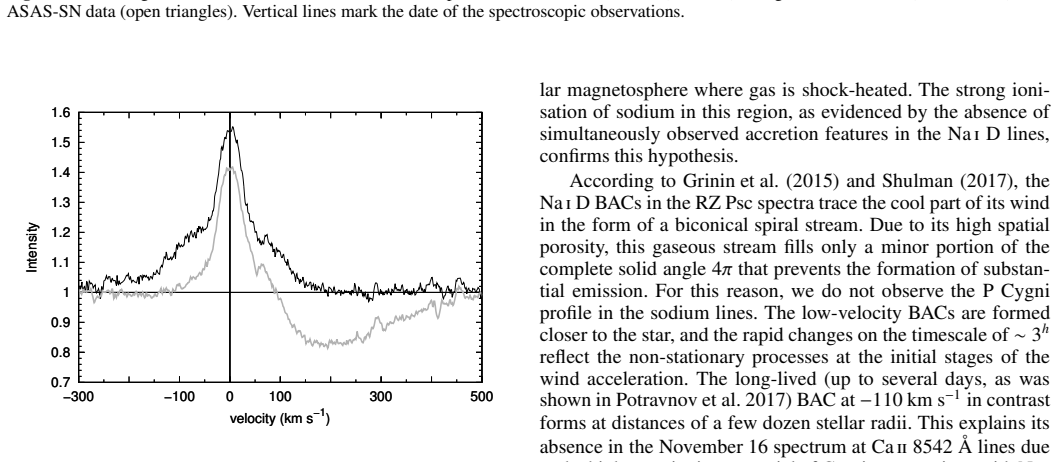
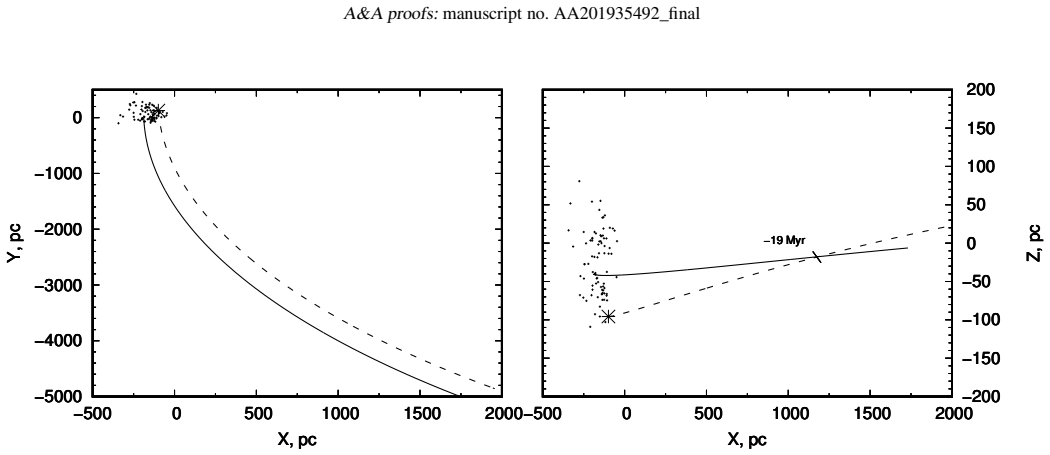
On 2013 November 16, high-resolution HIRES spectra showed a prominent inverse P Cygni profile in H-$\alpha$ and Ca II 8542, with redshifted absorption extending to about +580 km/s, corresponding to gas in free fall from roughly 10 stellar radii, close to the corotation radius $r_{\rm cor} = 9.2\,R_*$. The same Ca II profile simultaneously carried the blueshifted absorption components typical of the wind, showing infall and outflow in one line. Together with the veiling of strong photospheric lines by a hot accretion spot during a deep photometric minimum, this is taken as evidence that RZ Psc episodically accretes at a rate of about $5\times10^{-11}$ solar masses per year while usually ejecting matter through a magnetic propeller. The authors argue that at the star's likely position on the H-R diagram the dipole field should be a few tenths of a kG, so whether the truncation radius falls inside or outside the corotation radius depends on the variable accretion rate. GAIA DR2 astrometry places RZ Psc at 196 pc with space velocities close to the Cas-Tau OB association, giving a median age of $t = 20^{+3}_{-5}$ Myr and suggesting the star was born there and has preserved its primordial disk.
Load-bearing premise
The load-bearing premise is that RZ Psc's magnetic field is a few tenths of a kilogauss; the field is not measured, and if it is substantially stronger the propeller would dominate even during the observed accretion episode, breaking the claimed switch between regimes.
Editorial extensions
If this is right
- If RZ Psc is truly accreting at about 20 Myr, inner gaseous disks can survive roughly twice the commonly quoted 10 Myr dispersal timescale in isolated low-mass stars.
- The wind traced in Na I D and Ca II lines is fed by gas that first reaches the magnetosphere, so the low-excitation outflow and the accretion flares are two phases of one disk-star coupling.
- Variable accretion rate alone can flip a star between propeller and magnetospheric accretion without any change in magnetic-field topology.
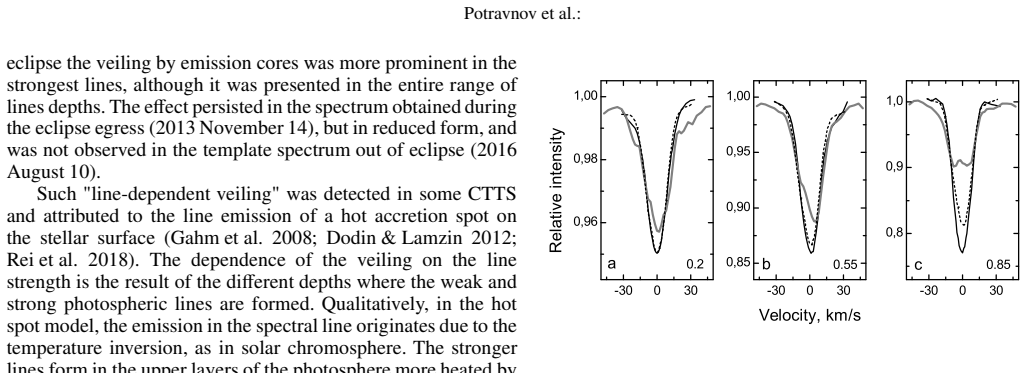
- The appearance of accretion-spot veiling in line strengths during a deep UXOR minimum provides a way to detect weak accretion even when H-alpha emission is masked by eclipses.
- RZ Psc's probable birth in Cas-Tau makes it a nearby, old benchmark for studying how accretion decays and how residual gas is finally cleared from a protoplanetary disk.
Reading between the lines
- If the assumed dipolar field is confirmed by direct measurement, similar old, isolated stars that show only blueshifted alkali absorptions could be propeller-phase accretors; their apparent debris-disk winds may actually be recycled primordial gas.
- The coronographic effect at deep minima could be used deliberately: eclipses by dusty clumps act as natural coronagraphs that reveal weak accretion spots on other UXORs, extending this detection method beyond RZ Psc.
- A targeted search in Cas-Tau for other low-mass members with lithium absorption, X-ray emission, mid-infrared excess, and weak H-alpha emission could test whether delayed disk clearing is common in this association.
- Monitoring over several rotational periods should show a testable pattern: wind intensification following each accretion episode, as gas accumulated at the truncation radius is partially accreted and partially flung outward.
Signed reviews
Editorial analysis
A structured set of objections, weighed in public.
Referee Report
Summary. The paper analyzes archival high-resolution spectra of the isolated UX Ori-type star RZ Psc obtained with Keck/HIRES and Lick/Hamilton. On 2013 November 16 the Hα and Ca II 8542 Å lines show inverse P Cygni profiles, interpreted as the first direct evidence of magnetospheric accretion; on 2013 October 21 weak Hα emission and veiling in LSD profiles suggest enhanced accretion, and during a deep photometric minimum on November 13 the line-dependent veiling is attributed to a hot accretion spot. The authors combine these observations with the persistent blueshifted alkali absorptions to argue that RZ Psc switches between magnetospheric accretion and a magnetic propeller-driven wind depending on the mass accretion rate. Using GAIA DR2 astrometry they derive a distance of about 196 pc, kinematics consistent with possible membership in the Cas-Tau OB association, and an age of 20+3−5 Myr, implying that a primordial gas disk can survive to roughly 20 Myr.
Significance. The observational centerpiece—the IPC profiles with photospheric subtraction and the LSD veiling analysis—is credible and valuable: it provides direct spectroscopic evidence that a very old, isolated UXOR can undergo accretion episodes. If the age and kinematics hold, RZ Psc becomes a benchmark object for long-lived disk evolution. The paper also benefits from the use of independent GAIA astrometry and from presenting the archival data with sufficient detail for reproducibility. However, the broader claim that the system toggles between accretion and propeller regimes rests on an unmeasured dipolar magnetic field strength, and the age and membership are probabilistic rather than definitive; these caveats should be stated in the abstract and conclusions rather than only in the final paragraph.
major comments (2)
- [Section 6.1, Fig. 8] The key interpretation that RZ Psc moves between magnetospheric accretion and propeller ejection depends on the dipolar magnetic field strength B, which is not measured. The adopted 'few tenths of a kG' range follows from Gregory et al. (2012) based on the star's position on the H-R diagram. Figure 8 shows that, for the two accretion rates considered (7e-12 and 5e-11 Msun/yr), r_tr/r_cor crosses unity only for B in the approximate interval 0.2-0.4 kG. Because B is a free parameter not constrained by the present observations, the unified propeller/accretion scenario is not uniquely established. The authors correctly acknowledge in the final paragraph that magnetic field measurements are desirable, but the abstract and Section 7 conclusions present the toggle as a result. I recommend rephrasing the propeller interpretation as a model-dependent hypothesis that is testable with future spectropolarimetry, while keeping the accretion detection as the firm empirical result. The mass accretion rates used in Fig. 8 are derived from the Fang et al. (2009) empirical calibration, whose intrinsic scatter (about 0.5 dex) adds further uncertainty to the location of the regime boundary; quoting this systematic uncertainty would strengthen the discussion.
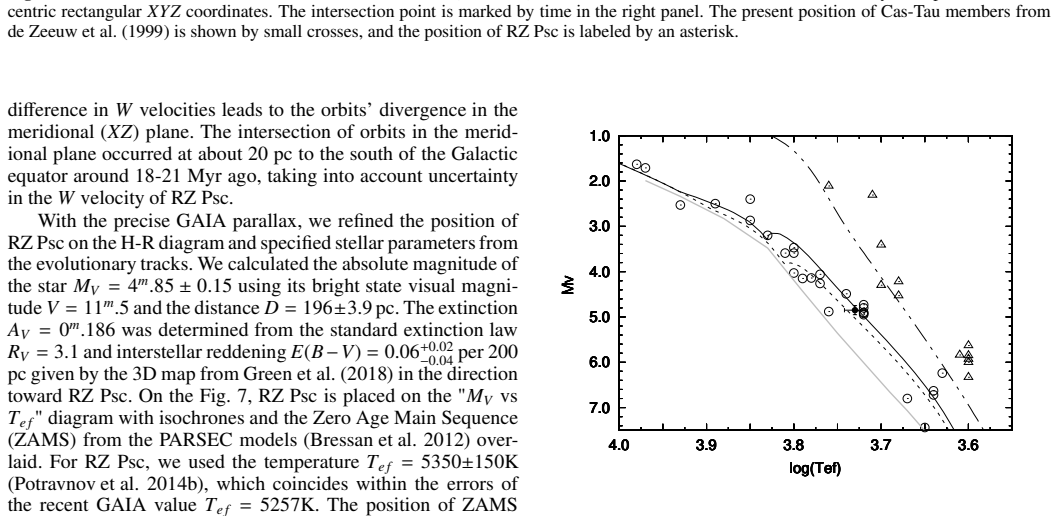
- [Section 5] The claimed age of 20+3−5 Myr is based on two components: the isochronal position (15-23 Myr) and a kinematic birth-origin argument involving possible membership in Cas-Tau. The membership probability is only 52% (or 77% with a higher assumed internal velocity dispersion), and the Cas-Tau age itself is uncertain (20-30 Myr isochronal vs about 50 Myr kinematic). The title and abstract state '20 Myr old UXOR' as a fact. Since the long-lived-disk conclusion depends on this age, the abstract should carry a caveat such as 'probable age' or 'age consistent with 15-25 Myr', and the precision of the number in the title should be reconsidered unless the authors can defend the membership more strongly.
minor comments (5)
- [Section 3.5] In the description of the LSD method, the authors state that the profiles for the intermediate line-depth groups are obtained with interpolation, but the exact interpolation procedure (e.g., in which quantity and over which line-depth grid) is not specified; a brief note would make the analysis reproducible.
- [Section 4] The argument that the line-dependent veiling at the deep minimum is produced by a hot accretion spot rather than solely by the coronographic effect would benefit from a quantitative comparison with the model predictions of Gahm et al. (2008) or Dodin and Lamzin (2012), for example the predicted ratio of veiling between weak and strong lines.
- [Section 6.1] The formula for r_tr/R* is presented without an equation number; since Figure 8 depends on it, adding a numbered equation would help the reader and would allow later work to refer to it precisely.
- [Section 5] The orbit calculations use the geometrical center of the Cas-Tau box and an assumed mean distance of 200 pc; the sensitivity of the orbital intersection epoch to these choices and to the adopted Galactic potential is not discussed.
- [Table 1] The note for the V magnitude on 2013 November 16 states that the value relates to the first of three spectrograms; please clarify whether the photometry corresponds to the same UT time as the first exposure or to a different epoch within the night.
Circularity Check
No circularity: the accretion signatures are directly observed and the interpretation is not forced by the paper's own definitions or fitted parameters.
full rationale
The paper's central new claim—that RZ Psc occasionally shows short-lived magnetospheric accretion events—rests on directly observed inverse P Cygni profiles in H-alpha and Ca II 8542 in archival HIRES spectra, not on a quantity fitted from the model being tested. The mass accretion rate estimates use the external empirical Fang et al. (2009) H-alpha calibration, and the age and kinematics use independent Gaia DR2 astrometry plus external isochrones and membership statistics. The propeller mechanism invoked to explain the persistent blueshifted alkali absorptions is taken from the authors' prior work, but the new IPC detection acts as an independent observational test of that model, and the MHD simulations cited (Romanova et al. 2004, 2018) come from other groups. The unmeasured dipolar field strength is an acknowledged assumption (Section 6.1, Fig. 8; 'the strength of the dipolar component of the stellar magnetic field B, which is unknown for RZ Psc'), and the paper explicitly recommends measuring it ('measurements of the RZ Psc magnetic field are desirable', Section 7). This is a correctness risk, not a circular step, because B is neither fitted from the target claim nor defined in terms of it. No equation or construction in the paper reduces its conclusions to its inputs, and the conclusions do not depend on a self-citation chain for their force.
Assumptions & free parameters
free parameters (1)
- Dipolar magnetic field strength B =
not measured; assumed 0.1 to 1 kG
assumptions (4)
- domain assumption Standard magnetospheric accretion and propeller theory (r_tr versus r_cor framework) applies to RZ Psc.
- domain assumption The empirical H-alpha luminosity to accretion rate relation of Fang et al. (2009) holds for RZ Psc.
- domain assumption RZ Psc has a radiative core and therefore a low dipole field, as argued by Gregory et al. (2012) for pre-main-sequence stars with Mcore/M* > 0.4.
- standard math GAIA DR2 astrometry and the adopted radial velocity are accurate.
Cite this review
Pith. "Pith review of Flares of accretion activity of the 20 Myr old UXOR RZ Psc." pith.science (2026). https://pith.science/paper/KZ6NO4TZ
@misc{pith2026190808673,
  author       = {Pith},
  title        = {Pith review of: Flares of accretion activity of the 20 Myr old UXOR RZ Psc},
  year         = {2026},
  howpublished = {\url{https://pith.science/paper/KZ6NO4TZ}},
  note         = {Machine review of arXiv:1908.08673}
}
abstract
We discuss a revision of accretion activity and kinematics of the enigmatic isolated UX Ori type star RZ Psc. Previously, RZ Psc was known to possess only spectroscopic signatures of outflow in the low-excitation lines of alkali metals. The archival high-resolution spectra reveal a short-lived episode of magnetospheric accretion in the system observed via inverse P Cyg profiles at the H$\alpha$ and CaII 8542 $\unicode{x212B}$ lines. The simultaneous presence of accretion and outflow signatures at CaII 8542 $\unicode{x212B}$ is suggestive of an accretion-driven origin of the RZ Psc wind. We argue that RZ Psc experiences matter ejection via the magnetic propeller mechanism but variable accretion episodes allow it to sometimes move in the magnetospheric accretion regime. The presence of the weak accretion in the system is also supported by the radiation of the hot accretion spot on the stellar surface observed spectroscopically at the deep photometric minimum of the star. The Galactic motion of RZ Psc calculated with new GAIA DR2 astrometric data suggests possible membership in Cas-Tau OB association with an age of $t=20^{+3}_{-5}$ Myr.
Figures


Figures from the paper (5 more)


Reference graph
Works this paper leans on
- [1]
- [2]
-
[3]
Bhatt, H. C. 2000, A&A, 362, 715
work page 2000
- [4]
- [5]
-
[6]
Boller, T., Freyberg, M. J., Trümper, J., et al. 2016, A&A, 58 8, A103
work page 2016
-
[7]
Bouvier, J., Alencar, S. H. P ., Harries, T. J., Johns-Krull, C. M., & Romanova, M. M. 2007, Protostars and Planets V , 479
work page 2007
-
[8]
2012, MNRAS, 427 , 127
Bressan, A., Marigo, P ., Girardi, L., et al. 2012, MNRAS, 427 , 127
2012
Show all 67 references
-
[9]
Cutri, R. M. & et al. 2013, VizieR Online Data Catalog, 2328 de Bruijne, J. H. J. 1999, MNRAS, 306, 381 de Wit, W. J., Grinin, V . P ., Potravnov, I. S., et al. 2013, A&A, 553, L1 de Zeeuw, P . T., Hoogerwerf, R., de Bruijne, J. H. J., Brown, A. G. A., & Blaauw, A. 1999, AJ, 1...
2013
-
[10]
Dodin, A. V . & Lamzin, S. A. 2012, Astronomy Letters, 38, 649
2012
-
[11]
H., et al
Donati, J.-F., Bouvier, J., Alencar, S. H., et al. 2019, MNRA S, 483, L1
2019
-
[12]
M., et al
Donati, J.-F., Bouvier, J., Walter, F. M., et al. 2011, MNRAS , 412, 2454
2011
-
[13]
B., Bouvier, J., et al
Donati, J.-F., Skelly, M. B., Bouvier, J., et al. 2010, MNRAS , 409, 1347
2010
-
[14]
1994 , AJ, 108
Edwards, S., Hartigan, P ., Ghandour, L., & Andrulis, C. 1994 , AJ, 108
1994
-
[15]
2009, A&A, 504, 461
Fang, M., van Boekel, R., Wang, W., et al. 2009, A&A, 504, 461
2009
-
[16]
E., Henning, T., Jayawardhana , R., & Oliveira, J
Fedele, D., van den Ancker, M. E., Henning, T., Jayawardhana , R., & Oliveira, J. M. 2010, A&A, 510, A72
2010
-
[17]
M., & Madjar, A
Ferlet, R., Hobbs, L. M., & Madjar, A. V . 1987, A&A, 185, 267
1987
-
[18]
F., Walter, F
Gahm, G. F., Walter, F. M., Stempels, H. C., Petrov, P . P ., & Herczeg, G. J. 2008, A&A, 482, L35 Gaia Collaboration, Brown, A. G. A., V allenari, A., et al. 20 18, ArXiv e-prints [arXiv:1804.09365] Gaia Collaboration, Prusti, T., de Bruijne, J. H. J., et al. 2 016, A&A, 595, A1
2008 arXiv
-
[19]
Grankin, K. N. 2016, Astronomy Letters, 42, 314
2016
-
[20]
M., Schlafly, E
Green, G. M., Schlafly, E. F., Finkbeiner, D., et al. 2018, MNR AS, 478, 651
2018
-
[21]
G., Donati, J.-F., Morin, J., et al
Gregory, S. G., Donati, J.-F., Morin, J., et al. 2012, ApJ, 75 5, 97
2012
-
[22]
C., Gahm, G
Grinin, V ., Stempels, H. C., Gahm, G. F., et al. 2008, A&A, 489 , 1233
2008
-
[23]
P ., Mitskevich, A
Grinin, V . P ., Mitskevich, A. S., & Tambovtseva, L. V . 2006, Astronomy Letters, 32, 110
2006
-
[24]
P ., Potravnov, I
Grinin, V . P ., Potravnov, I. S., Ilyin, I. V ., & Shulman, S. G. 2015, Astronomy Letters, 41, 407
2015
-
[25]
P ., Potravnov, I
Grinin, V . P ., Potravnov, I. S., & Musaev, F. A. 2010, A&A, 524, A8
2010
-
[26]
P ., The, P
Grinin, V . P ., The, P . S., de Winter, D., et al. 1994, A&A, 292,165
1994
-
[27]
2016, ARA&A, 54, 135
Hartmann, L., Herczeg, G., & Calvet, N. 2016, ARA&A, 54, 135
2016
-
[28]
1994, ApJ, 426, 669
Hartmann, L., Hewett, R., & Calvet, N. 1994, ApJ, 426, 669
1994
-
[29]
Illarionov, A. F. & Siuniaev, R. A. 1975, Soviet Astronomy Le tters, 1, 73
1975
-
[30]
M., Kenworthy, M
Kennedy, G. M., Kenworthy, M. A., Pepper, J., et al. 2017, Roy al Society Open Science, 4, 160652
2017
-
[31]
Kenyon, S. J. & Hartmann, L. 1995, ApJS, 101, 117
1995
-
[32]
N., Minikulov, N
Kiselev, N. N., Minikulov, N. K., & Chernova, G. P . 1991, Astrophysics, 34, 175
1991
-
[33]
S., Shappee, B
Kochanek, C. S., Shappee, B. J., Stanek, K. Z., et al. 2017, PA SP , 129, 104502
2017
-
[34]
2016, A&A, 590, A9 6
Kreplin, A., Madlener, D., Chen, L., et al. 2016, A&A, 590, A9 6
2016
-
[35]
2013, A&A, 551, A2 1
Kreplin, A., Weigelt, G., Kraus, S., et al. 2013, A&A, 551, A2 1
2013
-
[36]
G., Ryabchikova, T
Kupka, F. G., Ryabchikova, T. A., Piskunov, N. E., Stempels, H. C., & Weiss, W. W. 2000, Baltic Astronomy, 9, 590
2000
-
[37]
1996, A&A, 310, 547
Lagrange, A.-M., Plazy, F., Beust, H., et al. 1996, A&A, 310, 547
1996
-
[38]
Mamajek, E. E. 2016, in IAU Symposium, V ol. 314, Y oung Stars a nd Planets Near the Sun, ed. J. H. Kastner, B. Stelzer, & S. A. Metchev, 21 –26
2016
-
[39]
Mamajek, E. E. & Bell, C. P . M. 2014, MNRAS, 445, 2169
2014
-
[40]
E., Meyer, M
Mamajek, E. E., Meyer, M. R., & Liebert, J. 2002, AJ, 124, 1670
2002
-
[41]
C., Petit, P ., Jeffers, S
Marsden, S. C., Petit, P ., Jeffers, S. V ., et al. 2014, MNRAS, 444, 3517
2014
-
[42]
V ., Pignatari, M., Korotin, S
Mishenina, T. V ., Pignatari, M., Korotin, S. A., et al. 2013, A&A, 552, A128
2013
-
[43]
& Nagai, R
Miyamoto, M. & Nagai, R. 1975, PASJ, 27, 533
1975
-
[44]
A., Prugniel, P ., & Soubiran, C
Moultaka, J., Ilovaisky, S. A., Prugniel, P ., & Soubiran, C. 2004, PASP , 116, 693
2004
-
[45]
J., Mamajek, E
Murphy, S. J., Mamajek, E. E., & Bell, C. P . M. 2018, MNRAS, 476 , 3290
2018
-
[46]
2001, ApJ, 550, 944
Muzerolle, J., Calvet, N., & Hartmann, L. 2001, ApJ, 550, 944
2001
-
[47]
Pecaut, M. J. & Mamajek, E. E. 2016, MNRAS, 461, 794
2016
-
[48]
E., Kupka, F., Ryabchikova, T
Piskunov, N. E., Kupka, F., Ryabchikova, T. A., Weiss, W. W., & Jeffery, C. S. 1995, A&AS, 112, 525
1995
-
[49]
Potravnov, I. S. & Grinin, V . P . 2013, Astronomy Letters, 39,776
2013
-
[50]
S., Grinin, V
Potravnov, I. S., Grinin, V . P ., & Ilyin, I. V . 2013, Astrophysics, 56, 453
2013
-
[51]
S., Mkrtichian, D
Potravnov, I. S., Mkrtichian, D. E., Grinin, V . P ., Ilyin, I. V ., & Shakhovskoy, D. N. 2017, A&A, 599, A60
2017
-
[52]
M., Kastner, J
Punzi, K. M., Kastner, J. H., Melis, C., et al. 2018, AJ, 155, 3 3
2018
-
[53]
Rei, A. C. S., Petrov, P . P ., & Gameiro, J. F. 2018, A&A, 610, A40
2018
-
[54]
H., Grinin, V ., Shakhovsky, D., & Natta, A
Rodgers, B., Wooden, D. H., Grinin, V ., Shakhovsky, D., & Natta, A. 2002, ApJ, 564, 405
2002
-
[55]
Lovelace, R. V . E. 2018, New A, 62, 94
2018
-
[56]
M., Ustyugova, G
Romanova, M. M., Ustyugova, G. V ., Koldoba, A. V ., & Lovelace, R. V . E. 2004, ApJ, 616, L151
2004
-
[57]
L., et al
Ryabchikova, T., Piskunov, N., Kurucz, R. L., et al. 2015, Ph ys. Scr, 90, 054005
2015
-
[58]
N., Grinin, V
Shakhovskoi, D. N., Grinin, V . P ., & Rostopchina, A. N. 2003, Astronomy Re- ports, 47, 580
2003
-
[59]
L., Allers, K
Shkolnik, E. L., Allers, K. N., Kraus, A. L., Liu, M. C., & Flag g, L. 2017, AJ, 154, 69
2017
-
[60]
Shulman, S. G. 2017, Astrophysics, 60, 188
2017
-
[61]
Stempels, H. C. & Piskunov, N. 2003, A&A, 408, 693
2003
-
[62]
2013, A&A, 560, A37
Tkachenko, A., V an Reeth, T., Tsymbal, V ., et al. 2013, A&A, 560, A37
2013
-
[63]
1996, in Astronomical Society of the Pacific Conf erence Series, V ol
Tsymbal, V . 1996, in Astronomical Society of the Pacific Conf erence Series, V ol. 108, M.A.S.S., Model Atmospheres and Spectrum Synthes is, ed. S. J
1996
-
[64]
Williams, J. P . & Cieza, L. A. 2011, ARA&A, 49, 67
2011
-
[65]
Zajtseva, G. V . 1985, Peremennye Zvezdy, 22, 181
1985
-
[66]
2015, ApJ, 798, 86
Zuckerman, B. 2015, ApJ, 798, 86
2015
-
[67]
city l ight
Zuckerman, B. & Song, I. 2004, ARA&A, 42, 685 Article number, page 8 of 10 Potravnov et al.: Appendix A: Observed H αand Na i 5889 Å profiles Article number, page 9 of 10 A&A proofs: manuscript no. AA201935492_final 0.5 0.7 0.9 1.1 1.3 2013 Oct. 21 Hα 0.5 0.7 0.9 1.1 1.3 2013 No...
2004
Reviewed August 14, 2026 · model on record in the stance chip above.
Discussion (0). Continue with ORCID to comment.