HFORD: Hybrid Forward Optimization and Reverse Design Method and Its Applications to On-Chip Millimeter-Wave Inductive Elements
Pith reviewed 2026-06-26 09:59 UTC · model grok-4.3
The pith
HFORD maps performance targets for on-chip mmWave inductors directly to DRC-compliant layout seeds by combining random forest topology selection, variational autoencoder feature generation, mixture density network inverse mapping, and parti
A machine-rendered reading of the paper's core claim, the machinery that carries it, and where it could break.
Core claim
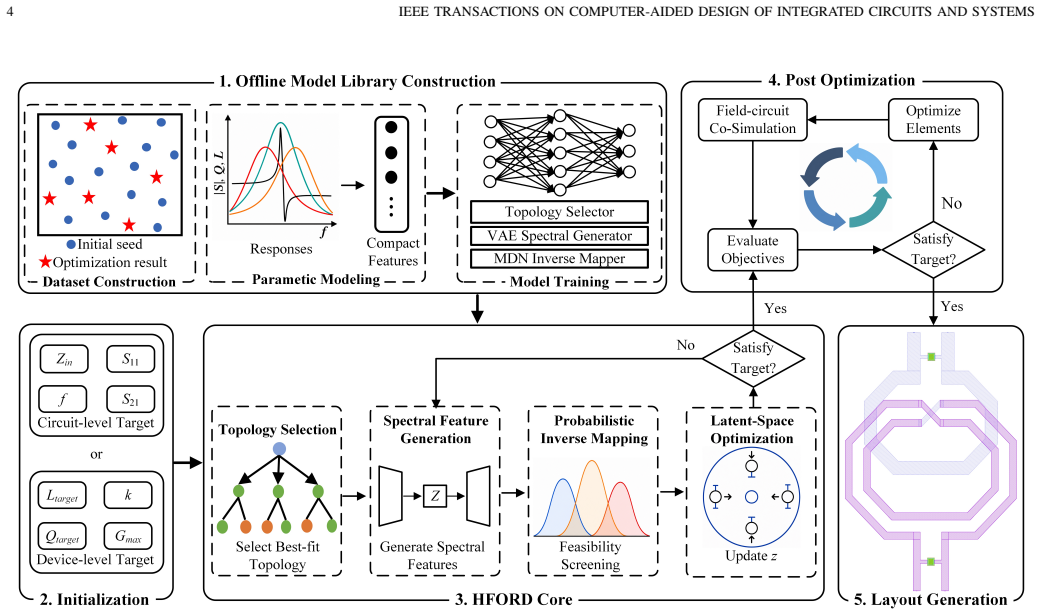
HFORD structures direct device targets into a hierarchical synthesis flow for mmWave inductive elements by integrating a random forest for topology selection, a variational autoencoder for spectral feature generation, a mixture density network for probabilistic inverse mapping, and particle swarm optimization for latent space exploration, producing layout seeds that satisfy performance targets and design rule check constraints.
What carries the argument
The HFORD core, a unified mapping system that combines random forest, variational autoencoder, mixture density network, and particle swarm optimization to translate device requirements into feasible layout seeds.
If this is right
- Layout seeds satisfy both performance targets and DRC constraints.
- Design cycle time drops from hours to minutes compared with conventional optimization.
- Sparse-fitting sampling improves coverage in critical performance regions.
- The method handles topology-dependent design spaces and non-uniqueness of inverse design.
Where Pith is reading between the lines
- The approach could extend to synthesis of other on-chip passives such as capacitors or transformers.
- It might reduce reliance on repeated full-wave simulations during early circuit exploration.
- The probabilistic outputs from the mixture density network could support uncertainty-aware design decisions.
Load-bearing premise
Models trained on electromagnetic simulation data generate layout seeds that satisfy performance targets and design rule constraints when the devices are actually fabricated.
What would settle it
Fabricate the generated layouts, perform measurements of key metrics such as inductance and quality factor, and compare results against the input targets while confirming the layouts pass DRC.
Figures
read the original abstract
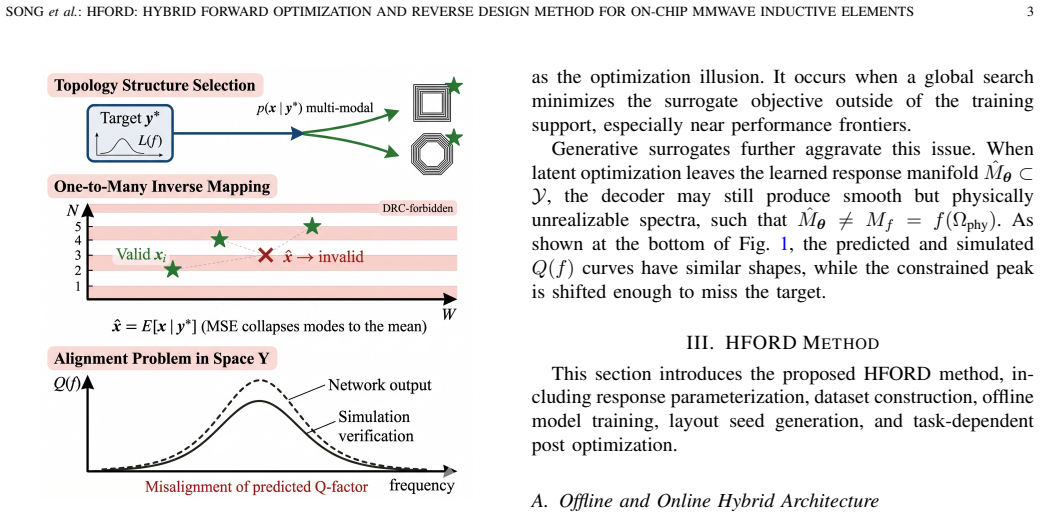
On-chip inductive elements are pivotal in determining both the silicon footprint and performance of millimeter-wave (mmWave) integrated circuits. However, the layout-level synthesis of these passive devices is severely challenged by highly nonlinear geometry-to-performance mappings, computationally expensive full-wave electromagnetic simulations, topology-dependent design spaces, and the inherent non-uniqueness of inverse design. To overcome these bottlenecks, we propose a hybrid forward optimization and reverse design (HFORD) method for the target-to-layout synthesis of mmWave inductive elements. Utilizing a unified core to map device-level requirements to layout-level seeds, HFORD structures direct device targets and translates circuit specifications into a hierarchical synthesis flow. Specifically, sparse-fitting sampling is introduced to improve coverage across critical performance regions, while compact response-fitting coefficients significantly reduce training dimensionality. The HFORD core integrates a random forest for topology selection, a variational autoencoder for spectral feature generation, a mixture density network for probabilistic inverse mapping, and particle swarm optimization for latent space exploration. This integration improves the feasibility of the generated layout seeds under design rule check (DRC) constraints. Two design examples demonstrate that the proposed method accelerates the design cycle from hours to minutes compared to conventional optimization methods.
Editorial analysis
A structured set of objections, weighed in public.
Referee Report
Summary. The paper proposes HFORD, a hybrid forward optimization and reverse design method for target-to-layout synthesis of on-chip mmWave inductive elements. It combines sparse-fitting sampling for training data, compact response coefficients, a random forest for topology selection, a variational autoencoder for spectral features, a mixture density network for probabilistic inverse mapping, and particle swarm optimization in latent space to generate DRC-feasible layout seeds. Two design examples are presented to claim that HFORD reduces the design cycle from hours to minutes versus conventional optimization methods.
Significance. If the speedup claim holds after including all workflow costs and if the generated seeds are shown to meet targets under EM validation, the approach could meaningfully accelerate passive component design in mmWave ICs by reducing reliance on repeated full-wave simulations. The integration of multiple ML components for handling non-uniqueness and topology dependence addresses a recognized challenge in the field.
major comments (2)
- [Design Examples] Design Examples section: The central acceleration claim (hours to minutes) is load-bearing. The HFORD workflow requires upfront generation of training data via multiple full-wave EM simulations under sparse-fitting sampling, followed by model training. It is unclear whether the reported HFORD times include these costs or only record the final PSO/inference stage; conventional baselines appear to pay full iterative EM costs each time. Without an explicit total-workflow timing table or statement that upfront costs are amortized and excluded for new targets, the net speedup is not established.
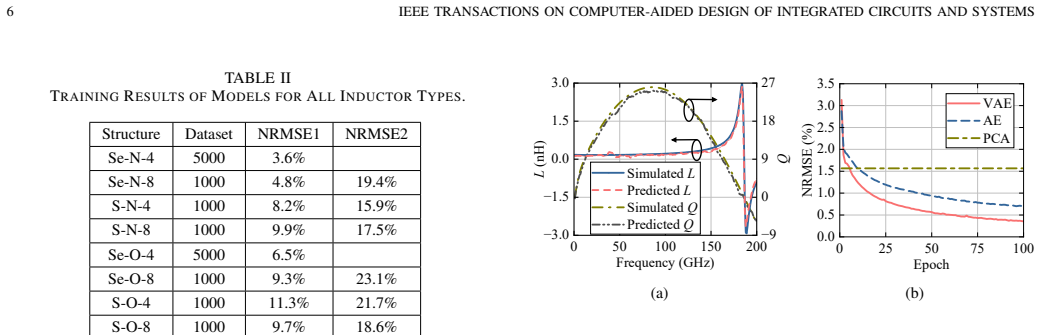
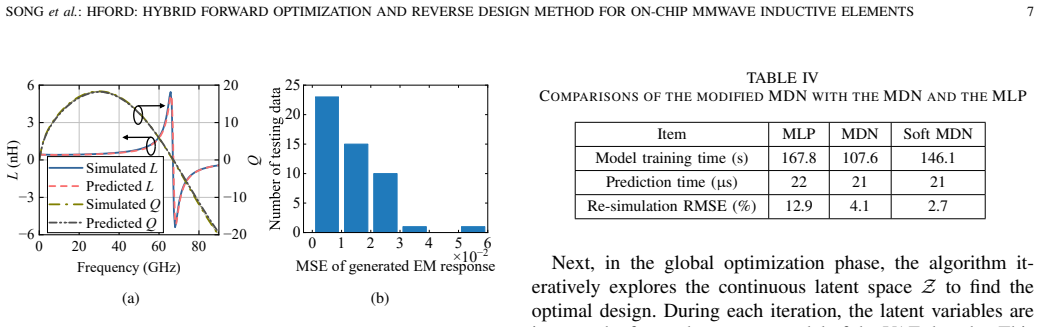
- [Validation and Results] Validation and Results sections: The feasibility claim that layout seeds satisfy performance targets and DRC constraints when fabricated rests on EM simulation data, yet no quantitative metrics (prediction error, success rate, baseline comparisons, or error bars) are referenced. Without these, the assertion that the combined RF+VAE+MDN+PSO pipeline produces usable seeds cannot be assessed.
minor comments (1)
- [Abstract] Abstract: The description of the HFORD core is compressed; expanding the sentence on model integration would improve readability without altering length substantially.
Simulated Author's Rebuttal
We thank the referee for the constructive feedback on our manuscript describing the HFORD method. We address each major comment below with clarifications and proposed revisions to improve the presentation of our results and claims.
read point-by-point responses
-
Referee: [Design Examples] Design Examples section: The central acceleration claim (hours to minutes) is load-bearing. The HFORD workflow requires upfront generation of training data via multiple full-wave EM simulations under sparse-fitting sampling, followed by model training. It is unclear whether the reported HFORD times include these costs or only record the final PSO/inference stage; conventional baselines appear to pay full iterative EM costs each time. Without an explicit total-workflow timing table or statement that upfront costs are amortized and excluded for new targets, the net speedup is not established.
Authors: We agree that explicit clarification of workflow costs is necessary to substantiate the acceleration claim. The times reported for the two design examples in the manuscript correspond to the per-target synthesis stage (MDN inference, VAE decoding, and PSO in latent space) after model training is complete. Data generation via sparse-fitting sampling and subsequent model training represent a one-time upfront cost that is amortized over multiple subsequent designs. To resolve the ambiguity, we will revise the Design Examples section to add a timing breakdown table that separately lists data generation time, training time, and per-design synthesis time, together with an explicit statement on amortization for new targets. This will permit direct comparison with conventional methods that repeat full EM costs for each design. revision: yes
-
Referee: [Validation and Results] Validation and Results sections: The feasibility claim that layout seeds satisfy performance targets and DRC constraints when fabricated rests on EM simulation data, yet no quantitative metrics (prediction error, success rate, baseline comparisons, or error bars) are referenced. Without these, the assertion that the combined RF+VAE+MDN+PSO pipeline produces usable seeds cannot be assessed.
Authors: We acknowledge that additional quantitative metrics would strengthen the validation of the pipeline. The manuscript already shows EM simulation results confirming that the generated layout seeds for the two examples satisfy the target specifications and DRC constraints. In the revised manuscript we will expand the Validation and Results sections to include the mean absolute prediction error of the MDN and VAE on held-out test sets, the success rate (fraction of generated seeds that meet targets within a specified tolerance after EM verification), quantitative baseline comparisons (e.g., final performance and total time versus conventional optimization), and error bars or standard deviations for any repeated trials. These additions will allow a more rigorous evaluation of the combined RF+VAE+MDN+PSO approach. revision: yes
Circularity Check
No circularity; method is standard data-driven ML synthesis
full rationale
The paper describes a hybrid ML pipeline (random forest + VAE + MDN + PSO) trained on EM simulation data for layout synthesis. No equations, derivations, or self-citations are presented that reduce any claimed result to its inputs by construction. The acceleration claim rests on two design examples comparing final-stage inference times to conventional optimization; this is an empirical performance statement, not a mathematical derivation that collapses to fitted quantities. The approach is self-contained against external benchmarks (fabricated devices and EM validation) and exhibits none of the enumerated circularity patterns.
Axiom & Free-Parameter Ledger
axioms (1)
- domain assumption Machine learning models trained on EM simulation data can learn accurate mappings from layout geometry to performance metrics and back.
Reference graph
Works this paper leans on
-
[1]
R. G. Meyer,Design, simulation and applications of inductors and transformers for Si RF ICs. Springer, 2000
2000
-
[2]
Robust design of absorbers using genetic algorithms and the finite element-boundary integral method,
S. Cui and D. S. Weile, “Robust design of absorbers using genetic algorithms and the finite element-boundary integral method,”IEEE Trans. Antennas Propagat., vol. 51, no. 12, pp. 3249–3258, 2003
2003
-
[3]
Design of dual- frequency probe-fed microstrip antennas with genetic optimization algo- rithm,
O. Ozgun, S. Mutlu, M. I. Aksun, and L. Alatan, “Design of dual- frequency probe-fed microstrip antennas with genetic optimization algo- rithm,”IEEE Trans. Antennas Propagat., vol. 51, no. 8, pp. 1947–1954, 2003
1947
-
[4]
Design of a single- feed dual-band dual-polarized printed microstrip antenna using a boolean particle swarm optimization,
F. Ashinnmanesh, A. Dorandi, and M. Shahabadi, “Design of a single- feed dual-band dual-polarized printed microstrip antenna using a boolean particle swarm optimization,”IEEE Trans. Antennas Propagat., vol. 56, no. 7, pp. 1845–1852, 2008
2008
-
[5]
Design of single-feed reflectarray antennas with asymmetric multiple beams using the particle swarm optimization method,
P. Nayeri, F. Yang, and A. Z. Elsherbeni, “Design of single-feed reflectarray antennas with asymmetric multiple beams using the particle swarm optimization method,”IEEE Trans. Antennas Propagat., vol. 61, no. 9, pp. 4598–4605, 2013
2013
-
[6]
Multistage collaborative machine learning and its application to antenna modeling and optimization,
Q. Wu, H. Wang, and W. Hong, “Multistage collaborative machine learning and its application to antenna modeling and optimization,”IEEE Trans. Antennas Propagat., vol. 68, no. 5, pp. 3397–3409, 2020
2020
-
[7]
Machine-learning- assisted optimization for antenna geometry design,
Q. Wu, W. Chen, C. Yu, H. Wang, and W. Hong, “Machine-learning- assisted optimization for antenna geometry design,”IEEE Trans. Anten- nas Propagat., vol. 72, no. 3, pp. 2083–2095, 2024
2083
-
[8]
Machine-learning-powered EM-based framework for efficient and reliable design of low scattering metasur- faces,
S. Koziel and M. Abdullah, “Machine-learning-powered EM-based framework for efficient and reliable design of low scattering metasur- faces,”IEEE Trans. Microwave Theory Techn., vol. 69, no. 4, pp. 2028– 2041, 2021
2028
-
[9]
Wideband shaped-beam reflectarray design using support vector regression analysis,
D. R. Prado, J. A. L ´opez-Fern´andez, M. Arrebola, M. Rodr ´ıguez-Pi˜no, and G. Goussetis, “Wideband shaped-beam reflectarray design using support vector regression analysis,”IEEE Antennas Wireless Propag. Lett., vol. 18, no. 11, pp. 2287–2291, 2019
2019
-
[10]
Computationally efficient multi-fidelity bayesian support vector regression modeling of planar antenna input characteristics,
J. P. Jacobs, S. Koziel, and S. Ogurtsov, “Computationally efficient multi-fidelity bayesian support vector regression modeling of planar antenna input characteristics,”IEEE Trans. Antennas Propagat., vol. 61, no. 2, pp. 980–984, 2013
2013
-
[11]
Hybrid method of artificial neural network and simulated annealing algorithm for optimizing wideband patch antennas,
Y . He, J. Huang, W. Li, L. Zhang, S.-W. Wong, and Z. N. Chen, “Hybrid method of artificial neural network and simulated annealing algorithm for optimizing wideband patch antennas,”IEEE Trans. Antennas Prop- agat., vol. 72, no. 1, pp. 944–949, 2024
2024
-
[12]
Dynamic adjustment kernel extreme learning machine for microwave component design,
L.-Y . Xiao, W. Shao, X. Ding, and B.-Z. Wang, “Dynamic adjustment kernel extreme learning machine for microwave component design,” IEEE Trans. Microwave Theory Techn., vol. 66, no. 10, pp. 4452–4461, 2018
2018
-
[13]
Rep- resentation learning-driven fully automated framework for the inverse design of frequency-selective surfaces,
Z. Zhou, Z. J. Wei, Y . Ren, Y . Yin, G. F. Pedersen, and M. Shen, “Rep- resentation learning-driven fully automated framework for the inverse design of frequency-selective surfaces,”IEEE Trans. Microwave Theory Techn., vol. 71, no. 6, pp. 2409–2421, 2023. 12 IEEE TRANSACTIONS ON COMPUTER-AIDED DESIGN OF INTEGRATED CIRCUITS AND SYSTEMS
2023
-
[14]
Space mapping approach to electromagnetic-centric multiphysics parametric modeling of microwave components,
W. Zhanget al., “Space mapping approach to electromagnetic-centric multiphysics parametric modeling of microwave components,”IEEE Trans. Microwave Theory Techn., vol. 66, no. 7, pp. 3169–3185, 2018
2018
-
[15]
Support vector regression to accelerate design and cross-polar opti- mizations of shaped-beam reflectarray antennas,
D. R. Prado, J. A. L ´opez-Fern´andez, M. Arrebola, and G. Goussetis, “Support vector regression to accelerate design and cross-polar opti- mizations of shaped-beam reflectarray antennas,”IEEE Trans. Antennas Propagat., vol. 67, no. 3, pp. 1659–1668, 2019
2019
-
[16]
Tandem neural network based design of multiband antennas,
A. Gupta, E. A. Karahan, C. Bhat, K. Sengupta, and U. K. Khankhoje, “Tandem neural network based design of multiband antennas,”IEEE Trans. Antennas Propagat., vol. 71, no. 8, pp. 6308–6317, 2023
2023
-
[17]
Inverse design of dual-band microstrip filters based on generative adversarial network,
Y . Zhang and J. Xu, “Inverse design of dual-band microstrip filters based on generative adversarial network,”IEEE Microw. Wireless Technol. Lett., vol. 34, no. 1, pp. 29–32, 2024
2024
-
[18]
Multivalued neural network inverse modeling and applications to microwave filters,
C. Zhang, J. Jin, Q. Na, M. Zhang, and M. Yu, “Multivalued neural network inverse modeling and applications to microwave filters,”IEEE Trans. Microwave Theory Techn., vol. 66, no. 8, pp. 3781–3797, 2018
2018
-
[19]
An efficient arti- ficial neural network model for inverse design of metasurfaces,
L. Yuan, X.-S. Wang, H. Huang, and B.-Z. Wang, “An efficient arti- ficial neural network model for inverse design of metasurfaces,”IEEE Antennas Wireless Propag. Lett., vol. 20, no. 6, pp. 2013–2017, 2021
2013
-
[20]
End-to-end machine-learning framework for electromagnetic inverse design: From practical constraints to optimized structures,
Z. Zhou, Z. H. Wei, J. Ren, Y . Z. Yin, J. Li, and T.-T. Chan, “End-to-end machine-learning framework for electromagnetic inverse design: From practical constraints to optimized structures,”IEEE Trans. Microwave Theory Techn., vol. 73, no. 11, pp. 8690–8708, 2025
2025
-
[21]
Deep-learning enabled generalized inverse design of multi-port radio-frequency and sub-terahertz passives and integrated circuits,
E. A. Karahan, Z. Liu, A. Gupta, Z. Shao, J. Zhou, U. Khankhoje, and K. Sengupta, “Deep-learning enabled generalized inverse design of multi-port radio-frequency and sub-terahertz passives and integrated circuits,”Nat. Commun., vol. 15, no. 10734, 2024
2024
-
[22]
PulseRF: Physics augmented ML modeling and synthesis for high-frequency RFIC design,
H. Chae, H. Yu, S. Li, and D. Z. Pan, “PulseRF: Physics augmented ML modeling and synthesis for high-frequency RFIC design,” inProc. IEEE/ACM Int. Conf. Computer-Aided Design (ICCAD), 2024, pp. 1–9
2024
-
[23]
MOTIF-RF: Multi- template on-chip transformer synthesis incorporating frequency-domain self-transfer learning for RFIC design automation,
H. He, Y . Xu, L. Xia, Y . Hu, F. Cai, and T. Chi, “MOTIF-RF: Multi- template on-chip transformer synthesis incorporating frequency-domain self-transfer learning for RFIC design automation,” inProceedings of the Asia and South Pacific Design Automation Conference (ASP-DAC), 2026, pp. 1138–1144
2026
-
[24]
Highly efficient automatic synthesis of a millimeter-wave on-chip deformable spiral inductor using a hybrid knowledge-guided and data-driven technique,
J. Weiet al., “Highly efficient automatic synthesis of a millimeter-wave on-chip deformable spiral inductor using a hybrid knowledge-guided and data-driven technique,”IEEE Trans. Comput.-Aided Des. Integr. Circuits Syst., vol. 42, no. 12, pp. 4413–4422, 2023
2023
-
[25]
A comparison of three methods for selecting values of input variables in the analysis of output from a computer code,
M. D. McKay, R. J. Beckman, and W. J. Conover, “A comparison of three methods for selecting values of input variables in the analysis of output from a computer code,”Technometrics, vol. 21, no. 2, pp. 239– 245, 1979
1979
-
[26]
A. I. J. Forrester, A. S ´obester, and A. J. Keane,Engineering Design via Surrogate Modelling: A Practical Guide. Chichester, UK: John Wiley & Sons, 2008
2008
-
[27]
Running up those hills: Multi-modal search with the niching migratory multi-swarm optimiser,
J. E. Fieldsend, “Running up those hills: Multi-modal search with the niching migratory multi-swarm optimiser,” in2014 IEEE Congress on Evolutionary Computation (CEC), 2014, pp. 2593–2600
2014
-
[28]
Random forests,
L. Breiman, “Random forests,”Machine Learning, vol. 45, no. 1, pp. 5–32, 2001
2001
-
[29]
Auto-encoding variational Bayes,
D. P. Kingma and M. Welling, “Auto-encoding variational Bayes,” in 2nd International Conference on Learning Representations, ICLR 2014, Banff, AB, Canada, April 14–16, 2014, Conference Track Proceedings, 2014
2014
-
[30]
Reservoir optimization in recurrent neural networks using properties of Kronecker product,
A. A. Rad, M. Hasler, and M. Jalili, “Reservoir optimization in recurrent neural networks using properties of Kronecker product,”Logic Journal of the IGPL, vol. 18, no. 5, pp. 670–685, 2010
2010
-
[31]
C. M. Bishop,Pattern Recognition and Machine Learning. New York, NY , USA: Springer, 2006
2006
-
[32]
Coyote optimization algorithm: A new metaheuristic for global optimization problems,
J. Pierezan and L. Dos Santos Coelho, “Coyote optimization algorithm: A new metaheuristic for global optimization problems,” in2018 IEEE Congress on Evolutionary Computation (CEC), 2018, pp. 1–8
2018
-
[33]
Neural- network-based automated synthesis of transformer matching circuits for RF amplifier design,
D. Lee, G. Shin, S. Lee, K. Kim, T.-H. Oh, and H.-J. Song, “Neural- network-based automated synthesis of transformer matching circuits for RF amplifier design,”IEEE Trans. Microwave Theory Techn., vol. 70, no. 11, pp. 4726–4739, 2022
2022
discussion (0)
Sign in with ORCID, Apple, or X to comment. Anyone can read and Pith papers without signing in.