REVIEW 2 major objections 5 minor 39 references
On convex bodies that are characterizable by volume function
T0 review · 2 major / 5 minor · reviewed 2026-08-14 · deepseek-v4-flash
Pith's one-line read The convex-hull function of a body is just its volume plus its shadow area.
desk verdict A useful survey of volume-function characterizations with a correct elementary lemma and prism construction, but the advertised equivalence with Petty's polar projection problem is asserted without proof and should be either proved or explicitly labeled a conjecture. read the letter →
The pith
A machine-rendered reading of the paper's core claim, the machinery that carries it, and where it could break.
The reading
What carries the argument
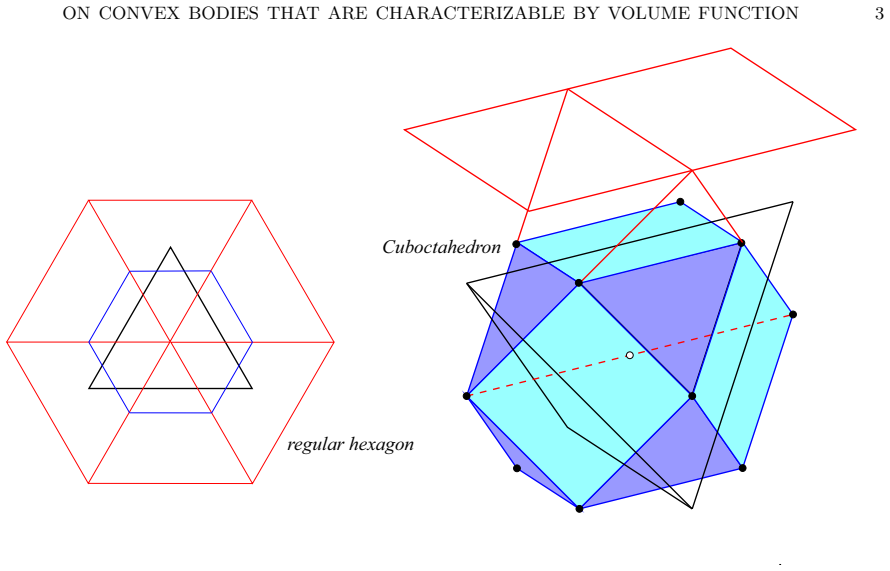
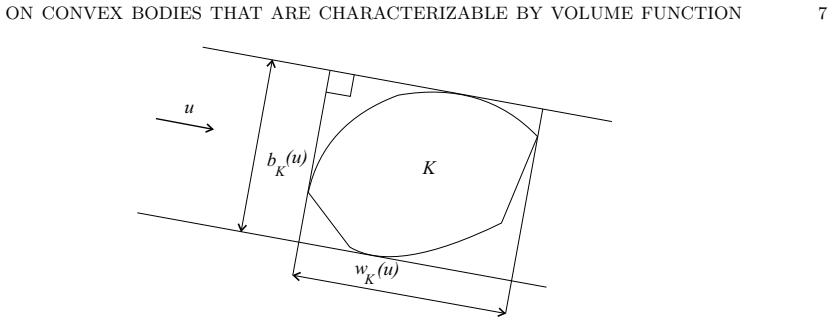
The load-bearing object is the convex-hull function $G_K(t)=\operatorname{vol}(\operatorname{conv}(K\cup(K+t)))$, together with the identity $G_K(\alpha u)=\operatorname{vol}_n(K)+|\alpha|\operatorname{vol}_{n-1}(K|u^\perp)$, where the second term is the brightness function, the area of the orthogonal projection of $K$ onto a hyperplane perpendicular to $u$. This identity, obtained from the Cavalieri principle, reduces every question about the convex-hull function to the classical pair (volume, brightness) and ties the whole survey together.
What would settle it
Find a centrally symmetric convex body in $\mathbb{R}^3$ that satisfies the translative constant-volume property, meaning the hull volume for touching translates is constant, but that is not an ellipsoid; such a body would disprove Conjecture 5, and under the asserted equivalence would also refute the polar projection conjecture.
Extended reading notes
Core claim
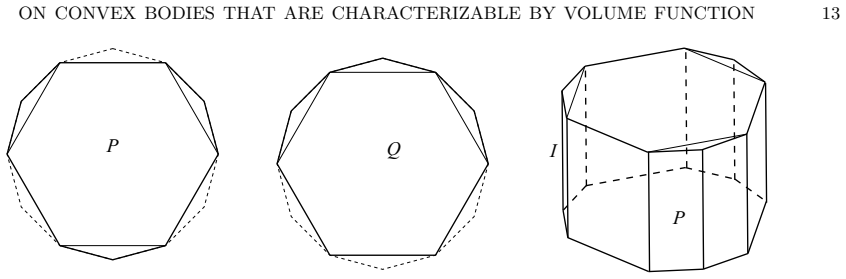
The paper's central discovery is Lemma 1: for any convex body, unit direction, and real translation length, $G_K(\alpha u)=\operatorname{vol}_n(K)+|\alpha|\operatorname{vol}_{n-1}(K|u^\perp)$; that is, the convex-hull function is determined by the volume and the brightness function. From this it follows immediately that the convex-hull function cannot characterize a convex body in any situation where volume and brightness fail to do so, and the survey exhibits such pairs via prisms built over equal-volume, equal-width polygons. Around this reduction, the survey organizes a century of related problems: the covariogram determines centrally symmetric bodies, plane bodies, and three-dimensional polytopes, but fails in dimension four and higher; bodies of constant width and constant brightness in three dimensions are balls; and the translative constant-volume property in the plane is equivalent to having a Radon curve as the boundary of the central symmetral. The open conjectures assert that in dimension three or higher this property forces an ellipsoid, and that the same conclusion holds for the polar projection problem.
Load-bearing premise
The load-bearing premise is that the translative constant-volume property is equivalent to the polar projection problem, an equivalence the paper states without proof and defers to a forthcoming paper.
Editorial extensions
If this is right
- In every dimension, any two convex bodies with the same volume and the same brightness function have the same convex-hull function.
- The convex-hull function therefore fails to determine a body in dimension four and above, where covariogram counterexamples already provide equal-volume, equal-brightness pairs.
- In the plane, a convex body satisfies the translative constant-volume property exactly when the boundary of its central symmetral is a Radon curve, equivalently when the body has constant width in a Radon norm.
- If the conjectures are true, the only centrally symmetric bodies in dimensions three and higher whose touching-translate hull volume is constant are ellipsoids.
- Three-dimensional bodies of constant width and constant brightness are balls, and the minimum-volume candidates in the constant-width, constant-thickness, and constant-brightness classes are all tetrahedron-derived bodies.
Reading between the lines
- If the asserted equivalence between the translative constant-volume property and the polar projection problem holds, then a computational search for non-ellipsoidal bodies with constant hull volume along touching translates would simultaneously test a seventy-year-old conjecture.
- The reduction to brightness suggests that counterexample searches for the convex-hull function can be restricted to pairs of bodies with equal volume and equal brightness, a much smaller search space than arbitrary pairs of non-congruent bodies.
- The paper's framing implies that the old minimum-volume problems are ripe for numerical optimization; the conjectured optimizers are all built from tetrahedra, so testing requires only few parameters.
- Differentiating the convex-hull identity suggests that higher derivatives of $G_K$ may encode curvature information beyond the brightness function, potentially yielding finer invariants that separate bodies brightness cannot.
Signed reviews
Editorial analysis
A structured set of objections, weighed in public.
Referee Report
Summary. This survey collects and connects results about volume functions attached to a convex body: the covariogram, the width function, the brightness function, the projection body, and the more recently studied convex-hull function. The main technical content is Lemma 1, which states that the convex-hull function along a line through the origin is determined by volume and brightness, and Theorem 5, which constructs non-congruent prisms with equal brightness and equal volume from planar bodies with equal width and area. The paper also surveys open problems, including the Bonnesen-Fenchel conjecture on Meissner tetrahedra, Campi-Colesanti-Gronchi problems on minimal volume, the translative constant volume property, and Petty's polar projection problem, and it asserts that the latter two are equivalent. The survey is organized around the theme that some classical and recent volume functions do or do not determine a convex body.
Significance. If the claims are taken as established, the survey would be a useful map of old and recent problems in geometric tomography and volume-function characterization, with a clean identity (Lemma 1) connecting the convex-hull function to the brightness function and volume. The proof of Lemma 1 is correct and easy to check, and Theorem 5 gives an explicit construction principle that is plausible and checkable by hand. The literature summary broadly matches standard results in convex geometry, and the survey cites many relevant sources. However, the novel angle of the survey hinges on an unproved announced equivalence between the translative constant volume property and Petty's polar projection problem; as written, that equivalence is neither proved nor cited, so the advertised unification is currently unsupported. The planar example used to build the 3-dimensional counterexample is also under-specified. These issues are local and reparable, so the manuscript could be acceptable after a substantial revision that either proves or properly labels the equivalence and tightens the example.
major comments (2)
- [§3, immediately after Conjecture 6] The sentence 'The reason that we mentioned here the polar projection problem that it is equivalent to the conjecture on translative constant volume property. (We will prove it in a forthcoming paper.)' is an unsupported asserted equivalence, and it is load-bearing for the survey's stated novelty: it is what makes the translative constant volume conjecture a modern form of Petty's old problem. No proof, sketch, or reference is supplied. Since the equivalence appears to be short (using Eq. (12), the identity h_{ΠK} = b_K, and the polar formula ρ_{K^\circ}(u) = 1/h_K(u), the translative constant volume property reduces to b_K(u)ρ_K(u) being constant, while ΠK^\circ = λK reduces to the same relation), the author should either include this proof in the manuscript or explicitly label the equivalence as a conjecture/open problem. As it stands, the reader cannot distinguish an established theorem from a research announcement.
- [§3, planar pair construction (pp. 12–13)] The construction of the non-congruent nine-sided polygons P and Q is described only qualitatively ('add in a suitable manner ... three congruent suitable equilateral triangles') and relies on Figure 9. This example is load-bearing: Theorem 5 uses it to produce, in every dimension, non-congruent convex bodies with equal brightness and equal volume, and therefore to show that the convex-hull function does not determine a body. The text should either give an explicit coordinate construction, specify the required size and placement of the three triangles, or cite a reference where such a pair is constructed. The present level of detail does not allow the reader to verify convexity, equality of area, or equality of width.
minor comments (5)
- [Throughout] The spelling 'covariagram' is used repeatedly; the standard term is 'covariogram'.
- [§2, paragraph on the covariogram problem] The phrase 'as the author [4] proved' is misleading: reference [4] is Bianchi's paper, not a paper by the present author. Please write 'as Bianchi [4] proved' or 'as proved in [4]'.
- [§2.3, differential equation for Blaschke body] The Gaussian curvature is denoted by K, which collides with the notation for a convex body K; using κ or another symbol would remove avoidable confusion.
- [Reference [24]] In the text this reference is cited as 'Bernd and Weber', but the authors are Kawohl and Weber. Please correct the citation.
- [§3, Remark after Lemma 1] The sentence 'Since the covariogram function also holds this two properties in dimension n for n≥4 the answer should be "no"' is informal; the intended logic is that the covariogram determines volume and brightness and fails to determine K in dimension at least 4. Please spell out this implication explicitly.
Circularity Check
No circular reduction of results to inputs; the main flagged issue is an announced, unproved equivalence, which is a proof gap rather than circularity.
-
other
[Section 3, immediately after Conjecture 6 (p. 14)]
"The reason that we mentioned here the polar projection problem that it is equivalent to the conjecture on translative constant volume property. (We will prove it in a forthcoming paper.)"
Not circular by construction: the asserted equivalence is a load-bearing omitted proof, not a reduction to an input. The survey's advertised unification of Petty's polar projection problem with Conjecture 5 rests entirely on this sentence, and no argument or reference is supplied here. If the equivalence fails, the survey's framing is unsupported; however, nothing in the present derivation reduces the claim to its own inputs, so this is a proof gap rather than a circular step.
full rationale
The paper's main local derivation, Lemma 1, proves the identity G_K(alpha u) = vol_n(K) + |alpha| vol_{n-1}(K|u^perp) via Cavalieri's principle and then observes the converse by definition of the brightness function. This is a genuine mathematical equivalence, not a circular construction: the convex-hull function is shown to be recoverable from volume and brightness, and the identity is derived from standard principles rather than assumed. The translative constant volume property is imported from the author's earlier published paper [16], and Theorem 6 is quoted from [16]; this is self-citation, but the cited result is not being used to prove itself and is external to the present survey, so it does not make the derivation circular. The most serious concern is the unproved announced equivalence between Conjecture 5 and Petty's polar projection problem; the paper says the proof is forthcoming and gives none. That is an omitted proof and a load-bearing gap for the survey's novel angle, but it is not a case of an equation reducing to its own input or a fitted parameter being renamed as a prediction. No fitted inputs, no ansatz smuggled through self-citation, and no renaming of a known result as a new derivation appear. Overall circularity is minimal and mostly limited to reliance on the author's prior work, while the central survey content remains independent.
Assumptions & free parameters
assumptions (7)
- standard math Brunn-Minkowski inequality: vol_n(K+L)^(1/n) <= vol_n(K)^(1/n) + vol_n(L)^(1/n)
- standard math Alexandrov's projection theorem: equal volumes of projections onto all k-dimensional subspaces imply a translate for centrally symmetric convex bodies
- standard math Cauchy's projection formula connecting the brightness function to the surface area measure
- standard math Minkowski's existence theorem for surface area measures
- standard math Minkowski's first inequality for mixed volumes
- standard math For d >= 3, if every planar section of a normed space is Radon, then the space is Euclidean
- standard math Definition and properties of Radon curves in Minkowski planes
Cite this review
Pith. "Pith review of On convex bodies that are characterizable by volume function." pith.science (2026). https://pith.science/paper/KZVWCIJL
@misc{pith2026190803196,
  author       = {Pith},
  title        = {Pith review of: On convex bodies that are characterizable by volume function},
  year         = {2026},
  howpublished = {\url{https://pith.science/paper/KZVWCIJL}},
  note         = {Machine review of arXiv:1908.03196}
}
read the original abstract
The "old-new" concept of convex-hull function was investigated by several authors in the last seventy years. A recent research on it led to some other volume functions as the covariogram function, the widthness function or the so-called brightness functions, respectively. A very interesting fact that there are many long-standing open problems connected with these functions whose serious investigation closed before the "age of computers". In this survey, we concentrate only on the three-dimensional case, we will mention the most important concepts, statements, and problems.
Figures


Figures from the paper (6 more)



Reference graph
Works this paper leans on
-
[1]
and Ben´ ıtez, C., Orthogonality in normed linear spaces: a survey, II
Alonso, J. and Ben´ ıtez, C., Orthogonality in normed linear spaces: a survey, II. Relations between main orthogonalities, Extracta Math. 4 (1989), 121-131
work page 1989
-
[2]
Averkov, G., Bianchi, G.: Retrieving convex bodies from restricted covariogram functions, Adv. in Appl. Probab. 39 (2007) 613–629
work page 2007
-
[3]
Bianchi, G., Segala, F., Volcic, A.: The solution of the covariogram problem for plane C + 2 - bodies, J. Differential Geom. 60 (2002) 177–198
work page 2002
-
[4]
Bianchi, G.: Matherons conjecture for the covariogram problem, J. London Math. Soc. (2) 71 (2005) 203–220
work page 2005
-
[5]
Bianchi, G.: The covariogram determines three-dimensional convex polytopes Advances in Mathe- matics 220 (2009) 1771–1808
work page 2009
-
[6]
Blaschke, W.: Konvexe Bereiche gegebener konstanter Breite und kleinsten Inhalts, Math. Annalen 76/4, (1915) 504–513
work page 1915
-
[7]
Blaschke, W.: Kreis and Kugel , Chelsea, New-York, 1949
work page 1949
-
[8]
Bonnesen, T., Fenchel, W.: Theorie der konvexen Krper Springer-Verlag, 1934
work page 1934
Show all 39 references
-
[9]
Castro J.J.: The Volume of the Convex Hull of a Body and its Homothetic Copies The American Mathematical Monthly 122/5 (2015), 486–489
2015
-
[10]
Campi, S., Colesanti, A., Gronchi, P.: Minimum problems for volume of convex bodies in Partial differential equations and Applications, Collected papers in Honour of Carlo Pucci, ed.: Marcellini, Talenti, Vesentini Marcel Decker, 1996
1996
-
[11]
Croft, K.J
H.T. Croft, K.J. Falconer and R.K. Guy, Unsolved Problems in Geometry , Vol. 2, Springer, New York, 1991
1991
-
[12]
Der zentralsymmetrische Kern und die zentralsymmetrische H¨ ulle von konvexen K¨ orpern.Math
F´ ary, I., R´ edei, L. Der zentralsymmetrische Kern und die zentralsymmetrische H¨ ulle von konvexen K¨ orpern.Math. Annalen. 122 (1950), 205-220
1950
-
[13]
J., Geometric Tomography Cambridge University Press, 1995
Gardner, R. J., Geometric Tomography Cambridge University Press, 1995. 16 ´A. G.HORV´ATH
1995
-
[14]
London Math
Goodey, P., Schneider, R., Weil, W.: On the determination of convex bodies by projection functions, Bull. London Math. Soc. 29 (1997) 82–88
1997
-
[15]
Springer Proceedings in Mathematics and Statistics; 234
G.Horv´ ath,´A., Volume of convex hull of two bodies and related problems In: Conder Marston; Deza Antoine; Weiss Asia Ivic (szerk.) Discrete Geometry and Symmetry. Springer Proceedings in Mathematics and Statistics; 234. (2018) ISBN:978-3-319-78433-5
2018
-
[16]
G.Horv´ ath,´A., L´ angi, Zs.: On the volume of the convex hull of two convex bodies Monatshefte f¨ ur Mathematik 174/2 (2014) 219-229
2014
-
[17]
(2014) 181/2, (2016) 341-354
G.Horv´ ath,´A., L´ angi, Zs., Maximum volume polytopes inscribed in the unit sphere. (2014) 181/2, (2016) 341-354
2014
-
[18]
G.Horv´ ath,´A., L´ angi, Zs., Spirova, M., Semi inner products and the concept of semi-polarity.Results in Mathematics DOI: 10.1007/s00025-015-0510-y (2015)
2015 doi
-
[19]
DOI: 10.13140/2.1.3416.6566 (2014) orhttp://www.math.bme.hu/ ~ghorvath/calculationmath.pdf
G.Horv´ ath,´A., Computations with Mathematica 10, an addendum to the paper ”On the icosahedron inequality of L´ aszl´ o Fejes-T´ oth”. DOI: 10.13140/2.1.3416.6566 (2014) orhttp://www.math.bme.hu/ ~ghorvath/calculationmath.pdf
2014
-
[20]
1, Birkhauser, Basel, (1987), 331-342
Gruber, P.M.: Radons contributions to convexity, in: Johan Radon Collected Works , Vol. 1, Birkhauser, Basel, (1987), 331-342
1987
-
[21]
Preprint no
Heil, E.: Kleinste konvexe Korper gegebener Dicke. Preprint no. 453, Technische Hochschule Darm- stadt, 1978
1978
-
[22]
Hilbert, D., Cohn-Vossen, S.: Anschauliche Geometrie, Springer, Berlin, 1932
1932
-
[23]
Howard, R.: Convex bodies of constant width and constant brightness Advances in Mathematics 204 (2006) 241 – 261
2006
-
[24]
Kawohl, B., Weber, C.: Meissner’s Mysterious Bodies Mathematical Intelligencer 33/3 (2011), 94– 101
2011
-
[25]
Lebesgue, H., Sur le probleme des isoperimetres et sur le domaines de largeur constante, Bull. Soc. Math. Franc, C.R., (1914) 72–76
1914
-
[26]
A, ed.: P.M
Lutwak, E.: Selected affine isoperimetric inequalities, in: Handbook of Convex Geometry, Vol. A, ed.: P.M. Gruber, J. Wills , North-Holland, 1993, 151–176
1993
-
[27]
Martini, H.,: Convex polytopes whose projection bodies and difference sets are polars, Discrete Comput. Geom. 6 (1991) 83–91
1991
-
[28]
Aequationes Math
Martini, H., Swanepoel, K.J.: Antinorms and radon curves. Aequationes Math. 71,(2006) 110–138
2006
-
[29]
Matheron, G.: Le covariogramme gometrique des compacts convexes de R2, Technical report 2/86, 54, Centre de Gostatistique, Ecole des Mines de Paris, 1986
1986
-
[30]
Nat.forsch
Meissner, E.: ¨Uber Punktmengen konstanter Breite, Vierteljahrsschr. Nat.forsch. Ges. Z¨ ur., 56 (1911), 42–50. (http://www.archive.org/stream/vierteljahrsschr56natu#page/n53/mode/ 2up)
1911
-
[31]
Meissner, E., Schilling, Fr.: Drei Gipsmodelle von Flachen konstanter Breite, Z. Math. Phys. 60, (1912) 92–96
1912
-
[32]
Mathematika 40 (1993), 278–289
Meyer, M., Reisner, S., Schmuckenschl¨ ager, M., The volume of the intersection of a convex body with its translates. Mathematika 40 (1993), 278–289
1993
-
[33]
Nagel, W.: Orientation-dependent chord length distributions characterize convex polygons, J. Appl. Probab. 30 (1993) 730–736
1993
-
[34]
Deutsche Math.-Verein 35 (1926) 298–300
Nakajima, S.: Eine charakteristicische Eigenschaft der Kugel, Jber. Deutsche Math.-Verein 35 (1926) 298–300
1926
-
[35]
Annalen 83, (1921), 311–320
Pal, J.: Ein Minimumproblem fur Ovale, Math. Annalen 83, (1921), 311–320
1921
-
[36]
Petty, C.M.: Isoperimetric problems, in: Proc. Conf. Convexity and Combinatorial Geometry, Univ. Oklahoma, University Oklahoma, (1971), 26–41
1971
-
[37]
Soltan, V.: Affine diameters of convex bodiesa survey, Expositiones Mathematicae 23 (2005) 47–63
2005
-
[38]
Schneider, R., Convex Bodies: The BrunnMinkowski Theory, Second Expanded Edition ( in: Ency- clopedia of Mathematics and its Applications 151 ), Cambridge University Press, 2014
2014
-
[39]
Schmitt, M.: On two inverse problems in mathematical morphology, in: Mathematical Morphology in Image Processing, Dekker, New York, 1993, 151–169. ´A. G.Horv´ath, Department of Geometry, Mathematical Institute, Budapest Univer- sity of Technology and Economics, H-1521 Budapest...
1993
Reviewed August 14, 2026 · model on record in the stance chip above.
Discussion (0). Continue with ORCID to comment.