REVIEW 3 major objections 5 minor 1 cited by
Provably-Safe, Online System Identification
T0 review · 3 major / 5 minor · reviewed 2026-08-16 · deepseek-v4-flash
Pith's one-line read A robot arm can identify an unknown payload's inertial parameters online, with interval bounds that provably contain the true values while the identification motion itself provably respects limits and avoids collisions.
desk verdict Strong system-integration paper with a real hardware demo, but the central provable-safety and interval-containment guarantees don't survive scrutiny of the proofs. read the letter →
The pith
A machine-rendered reading of the paper's core claim, the machinery that carries it, and where it could break.
The reading
What carries the argument
Three mathematical objects carry the argument. First, the momentum-based regressor identity (Corollary 10): over a window of $h$ samples, the change in generalized momentum equals a regressor matrix $Y$ times the end-effector's ten inertial parameters plus a known term $U$, so identification never needs acceleration measurements and integration over the window filters noise. Second, the log-Cholesky parameterization $P(\eta)$, a diffeomorphism that encodes physical consistency (positive-definite pseudo-inertia matrix) directly into the decision variables, converting a semidefinite-constrained fit into an unconstrained nonlinear least squares whose local minima correspond to the constrained problem's optima. Third, the perturbation identity $\frac{\partial \eta^*}{\partial m} = -\left(\frac{\partial^2 J}{\partial \eta^2}\right)^{-1}\frac{\partial^2 J}{\partial m\,\partial \eta}$ derived from the first-order optimality condition, composed with the chain rule and evaluated over the interval $[m]$ by the mean-value form, which is exactly the overapproximation in Theorem 13. Around these, a receding-horizon robust planner whose cost is the condition number of the end-effector inverse-dynamics regressor $W$ generates the safe, exciting trajectories, and Algorithm 2 feeds the refined interval back into the planner each round.
What would settle it
Attach a payload with CAD-known inertial parameters, inject synthetic torque noise at exactly the assumed 2.5% bound, and run Algorithm 1 repeatedly: any trial where the true mass falls outside the reported interval violates the perfect-encoder or forward-Euler premise. A computation-only variant compares the forward-Euler momentum sum over the 100 to 120 ms integration window with a high-order accurate quadrature of the same data; if the difference is comparable to the 2.5% torque bound, the interval guarantee does not cover the real plant.
Extended reading notes
Core claim
The paper's central claim is Theorem 13: for any local minimizer of the identification problem, the true end-effector inertial parameters lie in $\theta_e \in \theta_e^*(m) + \frac{\partial \theta_e^*}{\partial m}([m])([m]-m)$, an interval overapproximation produced by differentiating the optimizer's first-order optimality condition and wrapping the result in the mean-value form of interval arithmetic. Together with Lemma 14, which certifies that the robot motion generated by the receding-horizon planner satisfies all joint, velocity, and torque limits and stays collision-free whenever the interval model contains the true parameters, this yields Algorithm 2: the robot repeatedly plans an exciting, certified-safe trajectory, tracks it while collecting measurements, and tightens the payload bound. The experiments report that on a seven-degree-of-freedom arm this pipeline identified four-to-eight-pound dumbbells with intervals containing their true inertial parameters, and completed three obstacle-dodging stacking tasks in all five trials, while every comparison method failed at least one task.
Load-bearing premise
Everything rests on the assumption that joint encoders are exact and that the forward-Euler momentum sums exactly reproduce the continuous-time dynamics: any velocity-estimation or discretization error lies outside the manually set noise bounds, and if it grows large enough it could push the true parameters outside the computed interval.
Editorial extensions
If this is right
- A robot can gather identification data by executing its ordinary certified motions: the data-collection trajectories satisfy joint, velocity, and torque limits and avoid obstacles by construction, not by post-hoc checking.
- Because the output is a rigorous overapproximation rather than a statistical confidence region, the updated interval can be handed directly to certified planners and controllers, and their safety guarantees are inherited by the updated model.
- Only coarse prior bounds are needed, such as mass from zero to the rated payload and center of mass within the gripper geometry, so no offline calibration with fiducial payloads is required before the loop starts.
- Tighter bounds make the robust controller less conservative, which in the reported experiments is the difference between moving an 8 lb dumbbell through a cluttered workspace and exceeding torque limits, colliding, or failing to stack.
Reading between the lines
- The bound could be made to cover encoder noise and forward-Euler discretization error by adding a quadrature-error term to $[m]$; at the 3.5 to 4 kHz control rate the paper records those errors are small but nonzero, and at lower control rates they would likely dominate.
- The planner minimizes the condition number of the inverse-dynamics regressor $W$, while the interval bound depends on the momentum regressor $Y$; the paper's own numerics show the two are only strongly correlated for small integration horizons $h$, so measuring output-interval width versus $h$ would show where exciting trajectories stop being useful.
- The perturbation argument is generic: any parameter identification phrased as a smooth least squares over a diffeomorphic parameterization, including identification of the base robot's own parameters, friction, or end-effector tools, inherits the same interval construction whenever the relevant Hessian stays invertible.
- If the loop runs continuously across a shift, intervals computed for earlier payloads could seed the initial $[\theta]$ of the next pick, turning each task into a warm start rather than a reset.
Signed reviews
Editorial analysis
A structured set of objections, weighed in public.
Referee Report
Summary. This paper presents an integrated framework for safe online identification of payload inertial parameters on robotic manipulators. The identification module uses the momentum regressor and a log-Cholesky parameterization of physically consistent inertial parameters, and derives interval bounds on the end-effector parameters by perturbation analysis of a nonlinear least-squares problem (Theorem 13). The planning module reuses the ARMOUR framework [28] with a cost that promotes excitation of the standard dynamics regressor, and Algorithm 2 interleaves safe trajectory tracking with system identification. Hardware experiments on a Kinova Gen3 with five unknown dumbbells are reported, along with comparisons to adaptive, PID, and non-exciting baselines; the paper claims that only the proposed method succeeds across all three tasks, and that the identification intervals provably contain the true parameters while safety is maintained.
Significance. If the interval inclusion in Theorem 13 and the safety claim in Lemma 14 were fully established, the paper would be a significant advance: it would provide formal safety certificates during online payload identification rather than treating identification and safe planning separately. The open-source implementation, repeated hardware trials, and systematic ablations (exciting vs random trajectories, adaptive and gravity-compensated baselines) are strengths, and the reported experiments are informative. The contribution is therefore potentially valuable, but the central guarantee is not currently supported by the proof as written.
major comments (3)
- [Appendix C, Theorem 13] Appendix C applies Theorem 18 to obtain the sensitivity formula (42) without verifying any of Theorem 18's hypotheses. In particular, no geodesic metric on R^10 is defined for which J in (40) is geodesically convex, and no differentiability or uniqueness argument is given for the selected local minimizer eta*_e(m). The statement in Section VII that the log-Cholesky parameterization turns the SDP into an 'unconstrained convex problem' is unsupported because P in (16) is nonlinear; Corollary 17 only guarantees a diffeomorphism. The interval inclusion (27) is therefore not justified by the supplied proof.
- [Corollary 10, Assumption 12, Section VI-A] Corollary 10 assumes the measurement data are generated by forward Euler integration, and Assumption 12 excludes encoder error. On the Kinova hardware, data arrive from a continuous-time plant at a nonconstant 3.5-4 kHz rate and the encoders have resolutions 0.02 degrees and 0.011 degrees (Section VI-A), so the linear relation (20) is only approximate and the true measurement vector need not lie in [m]. The proof of Theorem 13 begins with theta_e in theta*_e([m]), which requires exact recovery of theta_e for some m in [m]; this step fails when discretization and quantization errors are not included in [m]. The chosen bounds in Section VI-D.1 (2.5% torque, 5% robot parameters) do not cover these errors.
- [Lemma 14, Algorithm 2] Lemma 14 assumes [theta] overapproximates the true parameters, but [theta] is updated in Algorithm 2 (line 8) using [theta_e] computed by Algorithm 1 under Theorem 13. Because Theorem 13's inclusion is not established under the hardware sampling and encoder conditions discussed above, the hypothesis of Lemma 14 is not guaranteed to hold in the reported experiments; consequently the claimed provably-safe behavior of Algorithm 2 lacks a valid certificate. Section VII explicitly acknowledges that the forward-Euler and torque-dominated-noise assumptions are assumptions rather than verified properties of the hardware.
minor comments (5)
- [Section IV-A, Corollary 10] The word 'Intergration' should be 'integration'.
- [Equation (22)] The summand Wc,r(q(t), qdot(t)) should use the sampled time index t_j; as written the expression is ambiguous.
- [Section VI-D.1] The sentence about setting [delta_m] is grammatically awkward and should be rewritten for clarity.
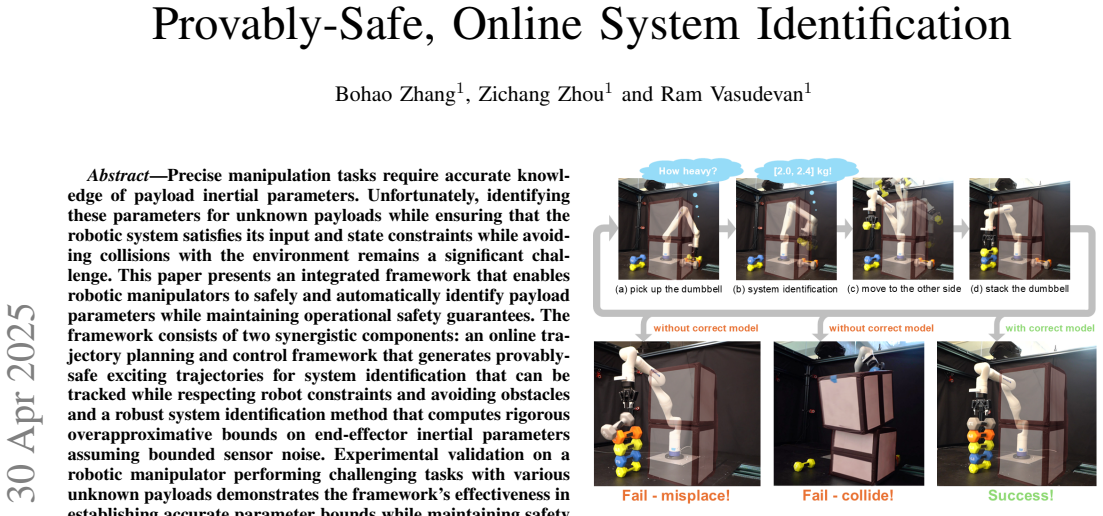
- [Figure 1 caption] The caption should read 'illustrates how the method proposed in this paper works' rather than ending at 'paper'.
- [Algorithm 2, Section V-C] The phrase 'measurement varaibles' should be 'measurement variables'.
Circularity Check
No significant circularity: the interval bound is derived from stated uncertainty assumptions and perturbation analysis, and ARMOUR is used as an external safety module rather than as a restatement of this paper's conclusions.
full rationale
The paper's central identification guarantee (Theorem 13, Eq. 27) is a mean-value-form overapproximation of the optimizer theta*_e(m) over the assumed uncertainty interval [m] (Appendix C). The uncertainty set [m] is fixed in advance from Assumptions 3 and 12 (5% robot-parameter and 2.5% torque uncertainty in Section VI-D), not fitted to experimental outcomes; the output [theta_e] is therefore a derived function of the data and the assumed bounds, not the input renamed. The trajectory-excitation heuristic minimizes the condition number of the standard regressor W as a proxy for the momentum regressor Y, and the paper explicitly acknowledges that no analytic equivalence is proven (Section V-B; Appendix D gives only empirical correlation), so no prediction is smuggled in as a derivation. The safety claim (Lemma 14) is imported from the same group's ARMOUR framework [28, Lemma 22], but this is a modular application of a prior theorem with its own stated assumptions; the present paper adds Theorem 13 to supply the overapproximation hypothesis, and self-citation alone is not circularity. The acknowledged limitations (forward-Euler discretization, perfect encoder measurements, torque-dominated noise) are correctness risks for the hardware instantiation of Assumption 12 and Corollary 10, not places where a claimed result is fed back as its own input. No equation in the paper reduces by construction to its own inputs, and no fitted constant is relabeled as a prediction.
Assumptions & free parameters
free parameters (4)
- Forward integration horizon h =
400
- Measurement uncertainty bounds [delta_m] =
5% for theta_r, 2.5% for torque
- Initial end-effector interval [theta_e] =
mass [1.2,5.2] kg, first moments [-0.4,0.4] kg*m, pz*m [-1.0,-0.1], inertia [-0.2,0.2] kg*m^2
- Trajectory duration and planning time (tf, tp) =
3.0 s, 1.5 s
assumptions (7)
- domain assumption Known conservative interval [theta_r] contains true robot dynamic parameters, and nominal theta_r,0 lies in it (Assumption 3).
- domain assumption Joint position and velocity measurements are perfectly accurate while torque noise is interval-bounded (Assumption 12).
- ad hoc to paper Data are generated by forward Euler integration (Corollary 10, Theorem 11).
- ad hoc to paper The reparameterized objective (25) and the sensitivity formula (37) satisfy the hypotheses of Theorem 18, in particular geodesic convexity and continuous differentiability.
- domain assumption ARMOUR's safety guarantee [28, Lemma 22] holds for this robot, controller, and trajectory parameterization.
- domain assumption Obstacles are static, finitely many, and available as zonotope overapproximations (Assumption 6).
- standard math The log-Cholesky parameterization P is a diffeomorphism onto the physically consistent set (Corollary 17, from [35]).
Cite this review
Pith. "Pith review of Provably-Safe, Online System Identification." pith.science (2026). https://pith.science/paper/L2PKMJBD
@misc{pith2026250421486,
  author       = {Pith},
  title        = {Pith review of: Provably-Safe, Online System Identification},
  year         = {2026},
  howpublished = {\url{https://pith.science/paper/L2PKMJBD}},
  note         = {Machine review of arXiv:2504.21486}
}
read the original abstract
Precise manipulation tasks require accurate knowledge of payload inertial parameters. Unfortunately, identifying these parameters for unknown payloads while ensuring that the robotic system satisfies its input and state constraints while avoiding collisions with the environment remains a significant challenge. This paper presents an integrated framework that enables robotic manipulators to safely and automatically identify payload parameters while maintaining operational safety guarantees. The framework consists of two synergistic components: an online trajectory planning and control framework that generates provably-safe exciting trajectories for system identification that can be tracked while respecting robot constraints and avoiding obstacles and a robust system identification method that computes rigorous overapproximative bounds on end-effector inertial parameters assuming bounded sensor noise. Experimental validation on a robotic manipulator performing challenging tasks with various unknown payloads demonstrates the framework's effectiveness in establishing accurate parameter bounds while maintaining safety throughout the identification process. The code is available at our project webpage: https://roahmlab.github.io/OnlineSafeSysID/.
Figures


Figures from the paper (9 more)


Forward citations
Cited by 1 Pith paper
-
Sling2Sim2Real: One-Shot Elastic System Identification for Non-Destructive Slingshot Policy Learning
A one-shot Real2Sim2Real framework fits five elastic parameters from a single non-destructive interaction and zero-shot transfers a slingshot RL policy to a real Franka arm.
Reference graph
Works this paper leans on
-
[28]
Jonathan Michaux, Patrick Holmes, Bohao Zhang, Che Chen, Baiyue Wang, Shrey Sahgal, Tiancheng Zhang, Sidhartha Dey, Shreyas Kousik, and Ram Vasudevan. Can’t touch this: Real- time, safe motion planning and control for manipulators under uncertainty, 2023
work page 2023
-
[1]
Adaptive robust controller for handling unknown uncertainty of robotic manipulators
Mohamed Abdelwahab, Giulio Giacomuzzo, Alberto Dalla Lib- era, and Ruggero Carli. Adaptive robust controller for handling unknown uncertainty of robotic manipulators. In 2024 IEEE 20th International Conference on Automation Science and En- gineering (CASE), pages 2992–2997. IEEE, 2024
work page 2024
-
[2]
A review of application industrial robotic design
Haider AF Almurib, Haidar Fadhil Al-Qrimli, and Nandha Kumar. A review of application industrial robotic design. In 2011 Ninth International Conference on ICT and Knowledge Engineering, pages 105–112. IEEE, 2012
work page 2011
-
[3]
Estima- tion of inertial parameters of rigid body links of manipulators
Chae An, Christopher Atkeson, and John Hollerbach. Estima- tion of inertial parameters of rigid body links of manipulators. In 1985 24th IEEE Conference on Decision and Control . IEEE, December 1985. doi: 10.1109/cdc.1985.268648
arXiv 1985
-
[5]
Generating persistently exciting trajectory based on condition number optimization
Ko Ayusawa, Antoine Rioux, Eiichi Yoshida, Gentiane Venture, and Maxime Gautier. Generating persistently exciting trajectory based on condition number optimization. In 2017 IEEE Inter- national Conference on Robotics and Automation (ICRA), pages 6518–6524, 2017. doi: 10.1109/ICRA.2017.7989770
arXiv 2017
-
[6]
A. Bahloul, S. Tliba, and Y . Chitour. Dynamic parameters iden- tification of an industrial robot with and without payload. IFAC- PapersOnLine, 51(15):443–448, 2018. ISSN 2405-8963. doi: https://doi.org/10.1016/j.ifacol.2018.09.185. URL https://www. sciencedirect.com/science/article/pii/S2405896318318524. 18th IFAC Symposium on System Identification SYSID 2018
-
[7]
Optimal excit- ing dance for identifying inertial parameters of an anthropomor- phic structure
Vincent Bonnet, Philippe Fraisse, Andre Crosnier, Maxime Gau- tier, Alejandro Gonzalez, and Gentiane Venture. Optimal excit- ing dance for identifying inertial parameters of an anthropomor- phic structure. IEEE Transactions on Robotics , 32(4):823–836, August 2016. ISSN 1941-0468. doi: 10.1109/tro.2016.2583062
-
[8]
Robust trajectory planning with parametric uncertainties
Pascal Brault, Quentin Delamare, and Paolo Robuffo Giordano. Robust trajectory planning with parametric uncertainties. In 2021 IEEE International Conference on Robotics and Au- tomation (ICRA) , pages 11095–11101, 2021. doi: 10.1109/ ICRA48506.2021.9561118
arXiv 2021
Show all 54 references
-
[9]
Pearson correlation coefficient
Israel Cohen, Yiteng Huang, Jingdong Chen, Jacob Benesty, Jacob Benesty, Jingdong Chen, Yiteng Huang, and Israel Cohen. Pearson correlation coefficient. Noise reduction in speech processing, pages 1–4, 2009
2009
-
[10]
Lagrangian neural networks
Miles Cranmer, Sam Greydanus, Stephan Hoyer, Peter Battaglia, David Spergel, and Shirley Ho. Lagrangian neural networks. arXiv preprint arXiv:2003.04630 , 2020
2003 arXiv
-
[11]
Safety-oriented robot payload identification using collision-free path planning and decoupling motions
Saverio Farsoni, Federica Ferraguti, and Marcello Bonf `e. Safety-oriented robot payload identification using collision-free path planning and decoupling motions. Robotics and Computer- Integrated Manufacturing, 59:189–200, 2019
2019
-
[12]
Gautier and W
M. Gautier and W. Khalil. A direct determination of minimum inertial parameters of robots. In Proceedings. 1988 IEEE International Conference on Robotics and Automation , pages 1682–1687 vol.3, 1988. doi: 10.1109/ROBOT.1988.12308
1988
-
[13]
Gautier and W
M. Gautier and W. Khalil. Exciting trajectories for the identi- fication of base inertial parameters of robots. In [1991] Pro- ceedings of the 30th IEEE Conference on Decision and Control, pages 494–499 vol.1, 1991. doi: 10.1109/CDC.1991.261353
1991
-
[14]
Payload estimation based on identified coefficients of robot dynamics — with an appli- cation to collision detection
Claudio Gaz and Alessandro De Luca. Payload estimation based on identified coefficients of robot dynamics — with an appli- cation to collision detection. In 2017 IEEE/RSJ International Conference on Intelligent Robots and Systems (IROS) , pages 3033–3040, 2017. doi: 10.1109/IR...
2017
-
[15]
Trajectory generation for minimum closed-loop state sensitivity
Paolo Robuffo Giordano, Quentin Delamare, and Antonio Franchi. Trajectory generation for minimum closed-loop state sensitivity. In 2018 IEEE International Conference on Robotics and Automation (ICRA) , pages 286–293, 2018. doi: 10.1109/ ICRA.2018.8460546
2018
-
[16]
On differentiating parameterized argmin and argmax problems with application to bi-level optimization
Stephen Gould, Basura Fernando, Anoop Cherian, Peter Ander- son, Rodrigo Santa Cruz, and Edison Guo. On differentiating parameterized argmin and argmax problems with application to bi-level optimization. arXiv preprint arXiv:1607.05447 , 2016
2016 arXiv
-
[17]
Hamil- tonian neural networks
Samuel Greydanus, Misko Dzamba, and Jason Yosinski. Hamil- tonian neural networks. Advances in neural information pro- cessing systems, 32, 2019
2019
-
[18]
Zono- topes as bounding volumes
Leonidas J Guibas, An Thanh Nguyen, and Li Zhang. Zono- topes as bounding volumes. In SODA, volume 3, pages 803– 812, 2003
2003
-
[19]
An iterative approach for accurate dynamic model identification of industrial robots
Yong Han, Jianhua Wu, Chao Liu, and Zhenhua Xiong. An iterative approach for accurate dynamic model identification of industrial robots. IEEE Transactions on Robotics , 36(5):1577– 1594, October 2020. ISSN 1941-0468. doi: 10.1109/tro.2020. 2990368
2020 doi
-
[20]
Matrix analysis
Roger A Horn and Charles R Johnson. Matrix analysis . Cambridge university press, 2012
2012
-
[21]
Precision motion control of a 6-dofs industrial robot with accurate payload estimation
Jinfei Hu, Chen Li, Zheng Chen, and Bin Yao. Precision motion control of a 6-dofs industrial robot with accurate payload estimation. IEEE/ASME Transactions on Mechatronics , 25(4): 1821–1829, 2020. doi: 10.1109/TMECH.2020.2994231
2020
-
[22]
Estimating mass distribution of articulated objects using non- prehensile manipulation
K Niranjan Kumar, Irfan Essa, Sehoon Ha, and C Karen Liu. Estimating mass distribution of articulated objects using non- prehensile manipulation. arXiv preprint arXiv:1907.03964 , 2019
1907 arXiv
-
[23]
Online payload identification for tactile robots using the momentum observer
Alexander Kurdas, Mazin Hamad, Jonathan V orndamme, Nico Mansfeld, Saeed Abdolshah, and Sami Haddadin. Online payload identification for tactile robots using the momentum observer. In 2022 International Conference on Robotics and Automation (ICRA), pages 5953–5959. IEEE, 2022
2022
-
[24]
Common sensors in industrial robots: A review
Peng Li and Xiangpeng Liu. Common sensors in industrial robots: A review. Journal of Physics: Conference Series , 1267 (1):012036, jul 2019. doi: 10.1088/1742-6596/1267/1/012036. URL https://dx.doi.org/10.1088/1742-6596/1267/1/012036
2019 doi
-
[25]
Online optimization- based time-optimal adaptive robust control of linear motors with input and state constraints
Yingqiang Liu, Zheng Chen, and Bin Yao. Online optimization- based time-optimal adaptive robust control of linear motors with input and state constraints. IEEE/ASME Transactions on Mechatronics, 29(4):3157–3165, 2024. doi: 10.1109/TMECH. 2024.3404821
2024
-
[26]
Base pa- rameters of manipulator dynamic models
Hirokazu Mayeda, Koji Yoshida, and Koichi Osuka. Base pa- rameters of manipulator dynamic models. In Proceedings. 1988 IEEE International Conference on Robotics and Automation , pages 1367–1372. IEEE, 1988
1988
-
[27]
Asid: Active exploration for system identification in robotic manipulation
Marius Memmel, Andrew Wagenmaker, Chuning Zhu, Patrick Yin, Dieter Fox, and Abhishek Gupta. Asid: Active exploration for system identification in robotic manipulation. arXiv preprint arXiv:2404.12308, 2024
2024 arXiv
-
[29]
Introduction to interval analysis
Ramon E Moore, R Baker Kearfott, and Michael J Cloud. Introduction to interval analysis . SIAM, 2009
2009
-
[30]
Enhanced adaptive control over robotic systems via generalized momentum dynamic extensions
Simeon Nedelchev, Lev Kozlov, Ramil R Khusainov, and Igor Gaponov. Enhanced adaptive control over robotic systems via generalized momentum dynamic extensions. Russian Journal of Nonlinear Dynamics , 19(4):633–646, 2023
2023
-
[31]
System identification method for robotic manipulator based on dynamic momentum regressor
Kyongho Park and Youngjin Choi. System identification method for robotic manipulator based on dynamic momentum regressor. In 2016 12th IEEE International Conference on Control and Automation (ICCA), pages 755–760, 2016. doi: 10.1109/ICCA. 2016.7505369
2016
-
[32]
A novel high-resolution optical encoder with axially stacked coded disk for modular joints: Physical modeling and experimental validation
Sarbajit Paul, Junghwan Chang, John Edward Fletcher, and Subhas Mukhopadhyay. A novel high-resolution optical encoder with axially stacked coded disk for modular joints: Physical modeling and experimental validation. IEEE Sensors Journal , 18(14):6001–6008, 2018
2018
-
[33]
Presse and M
C. Presse and M. Gautier. New criteria of exciting trajectories for robot identification. In [1993] Proceedings IEEE Interna- tional Conference on Robotics and Automation , pages 907–912 vol.3, 1993. doi: 10.1109/ROBOT.1993.292259
1993
-
[34]
Robot excitation trajectories for dynamic parameter estimation using optimized b-splines
Wolfgang Rackl, Roberto Lampariello, and Gerd Hirzinger. Robot excitation trajectories for dynamic parameter estimation using optimized b-splines. In 2012 IEEE International Con- ference on Robotics and Automation , pages 2042–2047, 2012. doi: 10.1109/ICRA.2012.6225279
2012
-
[35]
Caleb Rucker and Patrick M. Wensing. Smooth parameteriza- tion of rigid-body inertia. IEEE Robotics and Automation Let- ters, 7(2):2771–2778, 2022. doi: 10.1109/LRA.2022.3144517
2022
-
[36]
Pa- rameter identification in mechanical systems with energy-based regressor: Preliminary study
Adelia Sabirova, Simeon Nedelchev, and Igor Gaponov. Pa- rameter identification in mechanical systems with energy-based regressor: Preliminary study. In 2021 International Confer- ence” Nonlinearity, Information and Robotics”(NIR) , pages 1–
2021
-
[37]
Springer handbook of robotics , volume 200
Bruno Siciliano, Oussama Khatib, and Torsten Kr ¨oger. Springer handbook of robotics , volume 200. Springer, 2008
2008
-
[38]
Slotine and Weiping Li
Jean-Jacques E. Slotine and Weiping Li. On the adap- tive control of robot manipulators. The International Jour- nal of Robotics Research , 6(3):49–59, 1987. doi: 10. 1177/027836498700600303. URL https://doi.org/10.1177/ 027836498700600303
1987
-
[39]
Composite adaptive control of robot manipulators
Jean-Jacques E Slotine and Weiping Li. Composite adaptive control of robot manipulators. Automatica, 25(4):509–519, 1989
1989
-
[40]
Sousa and Rui Cortesao
Cristovao D. Sousa and Rui Cortesao. Inertia tensor properties in robot dynamics identification: A linear matrix inequality approach. IEEE/ASME Transactions on Mechatronics , 24(1): 406–411, February 2019. ISSN 1941-014X. doi: 10.1109/ tmech.2019.2891177
2019
-
[41]
Experimental validation of sensitivity-aware trajectory planning for a redundant robotic manipulator under payload uncertainty
Ali Srour, Antonio Franchi, Paolo Robuffo Giordano, and Marco Cognetti. Experimental validation of sensitivity-aware trajectory planning for a redundant robotic manipulator under payload uncertainty. IEEE Robotics and Automation Letters , 2024
2024
-
[42]
Model reference adaptive control of mechanical manipulators
M Tomizuka and R Horowitz. Model reference adaptive control of mechanical manipulators. In Adaptive Systems in Control and Signal Processing 1983 , pages 27–32. Elsevier, 1984
1983
-
[43]
On the differentiabil- ity of the primal-dual interior-point method
Kevin Tracy and Zachary Manchester. On the differentiabil- ity of the primal-dual interior-point method. arXiv preprint arXiv:2406.11749, 2024
2024 arXiv
-
[44]
Torque sensors for robot joint control
Dzmitry Tsetserukou and Susumu Tachi. Torque sensors for robot joint control. Sensors, Focus on Tactile, Force and Stress Sensors, pages 15–36, 2008
2008
-
[45]
Venture, K
G. Venture, K. Ayusawa, and Y . Nakamura. A numerical method for choosing motions with optimal excitation properties for identification of biped dynamics - an application to human. In 2009 IEEE International Conference on Robotics and Automa- tion. IEEE, May 2009. doi: 10.1109...
2009
-
[46]
On the implementation of an interior-point filter line-search algorithm for large-scale nonlinear programming
Andreas W ¨achter and Lorenz T Biegler. On the implementation of an interior-point filter line-search algorithm for large-scale nonlinear programming. Mathematical programming, 106:25– 57, 2006
2006
-
[47]
Recursive composite adaptation for robot ma- nipulators
Hanlei Wang. Recursive composite adaptation for robot ma- nipulators. Journal of Dynamic Systems, Measurement, and Control, 135(2):021010, 11 2012. ISSN 0022-0434. doi: 10.1115/1.4007557. URL https://doi.org/10.1115/1.4007557
2012 doi
-
[48]
A sensitivity-aware motion planner (samp) to generate intrinsically-robust trajectories
Simon Wasiela, Paolo Robuffo Giordano, Juan Cort ´es, and Thierry Sim ´eon. A sensitivity-aware motion planner (samp) to generate intrinsically-robust trajectories. In 2023 IEEE Interna- tional Conference on Robotics and Automation (ICRA) , pages 12707–12713, 2023. doi: 10.110...
2023
-
[49]
Wensing, Sangbae Kim, and Jean-Jacques E
Patrick M. Wensing, Sangbae Kim, and Jean-Jacques E. Slotine. Linear matrix inequalities for physically consistent inertial parameter identification: A statistical perspective on the mass distribution. IEEE Robotics and Automation Letters , 3(1):60– 67, 2018. doi: 10.1109/LRA....
2018
-
[50]
An accurate identification method based on double weighting for inertial parameters of robot payloads
Tian Xu, Jizhuang Fan, Qianqian Fang, Yanhe Zhu, and Jie Zhao. An accurate identification method based on double weighting for inertial parameters of robot payloads. Robot- ica, 40(12):4358–4374, July 2022. ISSN 1469-8668. doi: 10.1017/s0263574722000960
2022 doi
-
[51]
Rapid and robust trajectory optimization for humanoids
Bohao Zhang and Ram Vasudevan. Rapid and robust trajectory optimization for humanoids. arXiv preprint arXiv:2409.00303 , 2024
2024 arXiv
-
[52]
Sys- tem identification for constrained robots
Bohao Zhang, Daniel Haugk, and Ram Vasudevan. Sys- tem identification for constrained robots. arXiv preprint arXiv:2408.08830, 2024
2024 arXiv
-
[53]
A review on model reference adaptive control of robotic manipulators
Dan Zhang and Bin Wei. A review on model reference adaptive control of robotic manipulators. Annual Reviews in Control, 43: 188–198, 2017. APPENDIX A PHYSICAL CONSISTENCY CONSTRAINTS Using the regressors described in the previous subsection, one can cast the system identificat...
2017
-
[54]
f :X×Y→ R is continuously differentiable on both X andY
-
[55]
(37) This sensitivity analysis, discussed extensively in [16], pro- vides the foundation for bounding optimal solutions when problem parameters are subject to bounded perturbations
f is geodesically convex on X and convex onY then the sensitivity of the optimal solution to parameter perturbations is given by ∂x ∂y =−(∂2f ∂x2 (x,y ))−1 ∂2f ∂x∂y (x,y ). (37) This sensitivity analysis, discussed extensively in [16], pro- vides the foundation for bounding op...
Reviewed August 16, 2026 · model on record in the stance chip above.
Discussion (0). Continue with ORCID to comment.