REVIEW 3 major objections 3 minor 26 references
Efficiently Improving and Quantifying Robot Accuracy In Situ
T0 review · 3 major / 3 minor · reviewed 2026-08-14 · deepseek-v4-flash
Pith's one-line read A low-cost motion capture system plus Bayesian inference can calibrate a robot's joint offsets in place, matching laser-tracker results and cutting average positioning error roughly four-fold.
desk verdict A useful, honest robot-calibration paper whose central practical claim holds in the dexterous workspace but whose 'throughout its entire workspace' headline outruns its evidence. read the letter →
The pith
A machine-rendered reading of the paper's core claim, the machinery that carries it, and where it could break.
The reading
What carries the argument
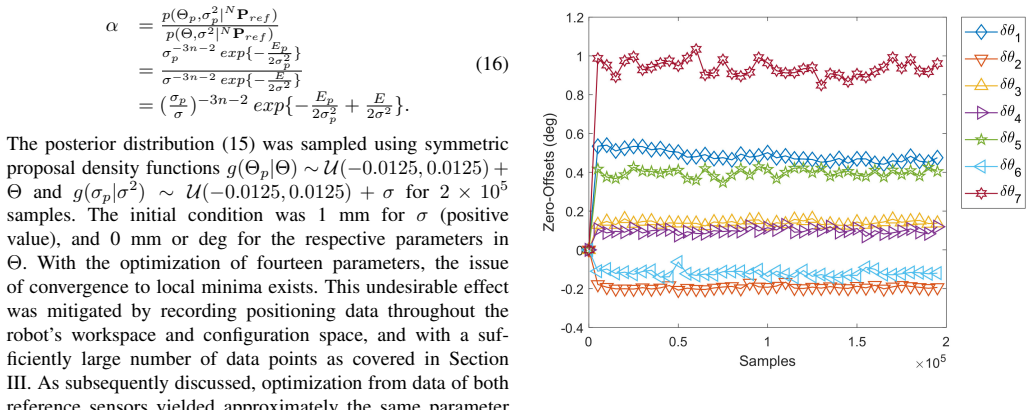
The load-bearing object is the zero-offset vector $\Theta_2 = \{\delta\theta_1,\ldots,\delta\theta_7\}$: seven small angular constants added to the commanded joint angles inside the forward-kinematics model (Eq. 9). Around this vector the paper builds a joint posterior $p(\Theta,\sigma^2 \mid \text{data}) \propto \sigma^{-3n-2}\exp(-E/(2\sigma^2))$ (Eq. 15), where $E$ is the sum of squared residuals between measured marker positions and the robot's predicted marker position under an isotropic Gaussian error model (Eq. 10). This posterior is sampled with the Metropolis algorithm, producing most-likely offsets together with their standard deviations. A six-parameter correctional transform $T^*(\Theta_1)$ is optimized simultaneously to absorb errors from the initial three-point registration between the reference sensor and the robot base, which is what lets the low-cost sensor's unknown low-frequency distortion be compensated rather than leak into the offsets.
What would settle it
Compute the residuals $N p_{i,\text{ref}} - N p_{i,\text{robot}}$ after fitting the fourteen parameters and check whether their per-axis means are zero and whether their variance changes with joint configuration, arm reach, temperature, or marker position in the motion-capture volume. If the residuals show a nonzero mean in any axis for some region of the workspace, or if their spread grows systematically with reach, the isotropic Gaussian model in Eq. (10) is false and the reported offset uncertainties are overconfident.
Extended reading notes
Core claim
The paper's central claim is that a robot's joint zero-offsets can be estimated in situ from a low-cost motion capture system using Bayesian inference, and that the resulting offsets and their uncertainties are essentially the same as those obtained from a benchmark laser tracker. On a held-out validation set, applying the motion-capture-derived offsets to a seven-degree-of-freedom arm reduced mean post-registration absolute error from 4.715 mm to 1.838 mm, while the laser-tracker-derived offsets reduced it from 4.397 mm to 1.509 mm. The paper also proposes three accuracy metrics: relative Cartesian accuracy across joint configurations, post-registration absolute position error, and a theoretical uncertainty-based error computed by sampling the validated robot model. The last metric, evaluated over 1000 configurations spanning the full workspace, supports the claim of a four-fold improvement in absolute positioning accuracy after zero-offset remastering.
Load-bearing premise
All uncertainty numbers and the four-fold improvement claim depend on the assumption that, after fitting six registration corrections and seven zero-offsets, every leftover difference between measured and modeled marker positions is independent, symmetric bell-shaped noise with the same spread in every direction.
Editorial extensions
If this is right
- Zero-offset remastering can be done in situ with a pre-calibrated motion capture unit, about 20 minutes of data per pose set, and no high-accuracy marker plate fixed to the robot base.
- Because the recovered offsets from the motion capture system and the laser tracker agree within their reported uncertainties, the low-cost sensor is sufficient for this calibration task.
- After remastering, the remaining positioning error is dominated by non-zero-offset sources such as unmodeled link parameters and structural deflection, since zero-offset uncertainty explains only about 15 percent of the residual error.
- The same posterior machinery transfers to any robot with known forward and analytical inverse kinematics, provided a marker can be mounted on the tool.
- Across the full workspace sampled with 1000 configurations, the theoretical average absolute error falls from above 5 mm with visual Vernier-scale remastering to below 1.5 mm with Bayesian remastering.
Reading between the lines
- An extension the authors leave implicit is using the posterior to choose the next measurement poses adaptively; a testable variant is selecting poses that most reduce posterior variance in the offset estimates.
- The equivalence claim rests on a single arm and a single motion capture unit; a stronger test would place the same low-cost unit in several positions and check whether the recovered offsets stay within the reported standard deviations.
- Because the motion capture system's absolute accuracy is unknown, the six-parameter registration correction may be absorbing smooth optical distortion; if so, the same pipeline with a different sensor placement could shift the offsets by more than the reported uncertainty.
Signed reviews
Editorial analysis
A structured set of objections, weighed in public.
Referee Report
Summary. The paper proposes a robot zero-offset calibration method that combines a low-cost OptiTrack motion capture system with Bayesian inference to estimate seven joint zero-offsets and six registration-correction parameters. Data are collected from a 7-DOF KUKA arm within a restricted dexterous workspace (Section III-A), and the fitted model is used to report three accuracy metrics: relative Cartesian accuracy, post-registration absolute error, and a theoretical uncertainty-based accuracy. The authors report a roughly four-fold improvement in average positioning accuracy 'throughout its workspace' based on a theoretical extrapolation to 1000 random joint configurations (Table VI), and a held-out validation dataset (Section VI, Table VIII) that shows post-registration absolute error of 1.838 mm (motion capture) versus 4.715 mm before remastering.
Significance. The core experimental result is valuable: the held-out validation in Section VI demonstrates that the low-cost motion capture system, which is far cheaper and faster than a laser tracker, produces zero-offset estimates that improve dexterous-workspace absolute accuracy from 4.715 mm to 1.838 mm, compared with 1.509 mm for the laser tracker. The paper also provides a clear, reproducible pipeline (Latin Hypercube sampling, analytical inverse kinematics, Metropolis sampling) and compares two reference sensors on the same pose set. These contributions are useful for in-situ robot remastering and for quantifying positioning accuracy. However, the headline claim of 'four-fold improvement throughout its workspace' goes beyond the experimental evidence and depends on an unvalidated model extrapolation, so the paper's significance is strongest when the claim is restricted to the tested dexterous workspace.
major comments (3)
- [Section V-C / Table VI] The abstract's 'four-fold throughout its workspace' rests on Table VI, which extrapolates the model in Eq. (10) to 1000 randomly generated joint configurations that the authors themselves state lie 'well outside the dexterous workspace' (Section V-C). All training and validation data were collected in the restricted volume described in Section III-A (r between 200 mm and 500 mm, z between 400 mm and 800 mm), and the validation dataset in Section VI was generated by the same restricted sampler. Systematic errors such as link deflection, uncorrected D-H parameters, and thermal drift are configuration-dependent and need not remain zero-mean, isotropic, or Gaussian hundreds of millimeters outside the sampled region. Without measured residuals at full-workspace configurations, the 'throughout its workspace' claim is unsupported; the direct experimental evidence supports only dexterous-workspace improvement.
- [Section V-B / Tables IV-VII] Tables IV, V, and VII are not independent verifications of the method: the 'after' errors are computed by applying the fitted MLE zero-offsets (Table I) and the fitted noise model (Eq. 10) to the same configurations used for fitting (Tables IV and V) or to random configurations under the same model (Tables VI and VII). The only genuinely held-out evidence is the validation dataset in Section VI, Table VIII, which indeed shows post-registration absolute error of 1.838 mm (motion capture) versus 4.715 mm before remastering. The paper should present Table VIII as the primary evidence for improvement and explicitly label Tables IV-VII as model predictions, not measurements, so that the strength of the empirical claim is not overstated.
- [Eq. (10) / Section IV] The posterior in Eq. (15) and the uncertainty intervals in Tables V-VII all assume that the residual in Eq. (10) is zero-mean, isotropic, independent Gaussian noise with variance sigma^2. The paper provides no residual diagnostics to justify this distribution, such as plots of residuals versus joint configuration, marker location, or time. If systematic errors remain after fitting the zero-offsets and registration corrections, the MLE offsets will be biased and the reported standard deviations will be overconfident. The authors should add residual analysis or explicitly temper the uncertainty claims.
minor comments (3)
- [Table VI] The header row spells 'Vernier' as 'Verier'; please correct this typo.
- [Section II-B] The claim that the motion capture system's distance perception does not significantly distort as a function of marker location is important for the method's validity, but no quantitative check of this distortion is provided. Consider including a short experiment or reference to a prior calibration study.
- [Section VI] The validation uses only the motion capture-derived zero-offsets because the robot interface could not roll back to a previous remastering state. This is a reasonable practical limitation, but it should be stated in the abstract or conclusions so that readers do not infer a direct experimental comparison of both sensors' offsets on the validation set.
Circularity Check
No load-bearing circularity: the held-out validation dataset provides independent support for the central viability claim; the full-workspace 'four-fold' claim is a model extrapolation, not a circular reduction.
full rationale
The paper's central viability claim is not circular. The zero-offset posterior in Eq. (15) is fitted to the optimization dataset, and the theoretical accuracy metrics in Tables V-VII are computed from that same fitted posterior, so those tables are in-sample model re-statements rather than independent predictions. However, Section VI provides a genuine held-out check: the MLE zero-offsets from motion capture data were physically applied to the robot, and post-registration absolute errors were measured with both the motion capture system and the laser tracker on a separate validation dataset (Table VIII, means 1.838 mm and 1.509 mm). This independent evidence supports the method's practical viability and the general magnitude of the claimed improvement. The 'four-fold throughout its entire workspace' statement in the abstract and Section VII relies on Table VI, which extrapolates the fitted isotropic-Gaussian model to 1000 joint configurations outside the dexterous workspace where all data were collected. This is a validity or robustness limitation, not a circularity: the model output is a genuine extrapolation rather than a restatement of the fitted parameters by definition. No load-bearing self-citation chain or imported uniqueness theorem is used; self-citations such as [20] and [23] are supporting references for standard registration techniques and are not the basis of the central result. Overall, the derivation is self-contained and the main claim has independent validation, so no significant circularity is present.
Assumptions & free parameters
free parameters (3)
- Zero-offsets Θ2 (δθ1..δθ7) =
Mocap MLE: 0.477, -0.192, 0.139, 0.099, 0.392, -0.114, 0.936 deg
- Registration correction Θ1 (x,y,z,α,β,γ) =
Mocap MLE: -2.096, 0.502, 3.311 mm and -0.252, -0.334, -0.960 deg
- Isotropic Gaussian noise sigma σ =
Mocap 0.890 mm, laser tracker 0.734 mm
assumptions (6)
- standard math Bayes theorem and Metropolis-Hastings sampling produce the posterior in Eq (15).
- domain assumption The robot kinematic model in Eq (9) is exact except for zero-offsets; all other D-H parameter errors are negligible (<10%).
- domain assumption Residual errors after fitting Θ1 and Θ2 are zero-mean, isotropic, independent Gaussian (Eq 10-11).
- domain assumption The six-parameter registration correction T*(Θ1) fully absorbs the erroneous three-point initial registration.
- domain assumption The Metropolis sampler converged after 1.75e5 samples and the sample mean equals the MLE.
- domain assumption The dexterous workspace (r=200-500 mm, z=400-800 mm) is representative enough to validate a model used to predict full-workspace accuracy.
Cite this review
Pith. "Pith review of Efficiently Improving and Quantifying Robot Accuracy In Situ." pith.science (2026). https://pith.science/paper/L3UPXWX2
@misc{pith2026190807273,
  author       = {Pith},
  title        = {Pith review of: Efficiently Improving and Quantifying Robot Accuracy In Situ},
  year         = {2026},
  howpublished = {\url{https://pith.science/paper/L3UPXWX2}},
  note         = {Machine review of arXiv:1908.07273}
}
read the original abstract
The advancement of simulation-assisted robot programming, automation of high-tolerance assembly operations, and improvement of real-world performance engender a need for positionally accurate robots. Despite tight machining tolerances, good mechanical design, and careful assembly, robotic arms typically exhibit average Cartesian positioning errors of several millimeters. Fortunately, the vast majority of this error can be removed in software by proper calibration of the so-called "zero-offsets" of a robot's joints. This research developed an automated, inexpensive, highly portable, in situ calibration method that fine tunes these kinematic parameters, thereby, improving a robot's average positioning accuracy four-fold throughout its workspace. In particular, a prospective low-cost motion capture system and a benchmark laser tracker were used as reference sensors for robot calibration. Bayesian inference produced optimized zero-offset parameters alongside their uncertainty for data from both reference sensors. Relative and absolute accuracy metrics were proposed and applied for quantifying robot positioning accuracy. Uncertainty analysis of a validated, probabilistic robot model quantified the absolute positioning accuracy throughout its entire workspace. Altogether, three measures of accuracy conclusively revealed multi-fold improvement in the positioning accuracy of the robotic arm. Bayesian inference on motion capture data yielded zero-offsets and accuracy calculations comparable to those derived from laser tracker data, ultimately proving this method's viability towards robot calibration.
Figures


Figures from the paper (2 more)


Reference graph
Works this paper leans on
-
[1]
Robot metrology and calibration systems - a market review,
F. Hidalgo and P. Brunn, “Robot metrology and calibration systems - a market review,” Industrial Robot: An International Journal , vol. 25, no. 1, 1998
work page 1998
-
[2]
2015: By far the highest volume ever recorded,
I. F. of Robotics, “2015: By far the highest volume ever recorded,”
work page 2015
-
[3]
Recent progress on programming methods for industrial robots,
Z. Pan, J. Polden, N. Larkin, S. Van Duin, and J. Norrish, “Recent progress on programming methods for industrial robots,” Robotics and Computer-Integrated Manufacturing, vol. 28, pp. 87–94, 2012
work page 2012
-
[4]
Comparative peg- in-hole testing of a force-based manipulation controlled robotic hand,
K. Van Wyk, M. Culleton, J. Falco, and K. Kelly, “Comparative peg- in-hole testing of a force-based manipulation controlled robotic hand,” IEEE Transactions on Robotics , in press
-
[5]
Addressing perception uncertainty induced failure modes in robotic bin-picking,
K. N. Kaipa, A. S. Kankanhalli-Nagendra, N. B. Kumbla, S. Shriyam, S. S. Thevendria-Karthic, J. A. Marvel, and S. K. Gupta, “Addressing perception uncertainty induced failure modes in robotic bin-picking,” Robotics and Computer-Integrated Manufacturing , vol. 42, pp. 17–38, 2016
work page 2016
-
[6]
J. Mahler, F. T. Pokorny, B. Hou, M. Roderick, M. Laskey, M. Aubry, K. Kohlhoff, T. Kr ¨oger, J. Kuffner, and K. Goldberg, “Dex-net 1.0: A cloud-based network of 3d objects for robust grasp planning using a multi-armed bandit model with correlated rewards,” in Robotics and Automation (ICRA), 2016 IEEE International Conference on . IEEE, 2016, pp. 1957–1964
work page 2016
-
[7]
Kinematic noise propagation and grasp quality evaluation,
S. Liu and S. Carpin, “Kinematic noise propagation and grasp quality evaluation,” inAutomation Science and Engineering (CASE), 2016 IEEE International Conference on . IEEE, 2016, pp. 1177–1183
work page 2016
-
[8]
A technique to calibrate industrial robots with experimental verification,
R. Judd and A. Knasinski, “A technique to calibrate industrial robots with experimental verification,” IEEE Trans. Robotics and Automation , vol. 6, no. 1, pp. 590–596, 1990
work page 1990
Show all 26 references
-
[9]
Robot calibration issues: accuracy, repeatability and calibration,
K. Conrad, P. Shiakolas, and T. Yih, “Robot calibration issues: accuracy, repeatability and calibration,” Proc. 8th Medit. Conf. Control and Autom., 2000
2000
-
[10]
Developing an efficient calibration system for joint offset of industrial robots,
B. Gao, Y . Liu, and Y . Shen, “Developing an efficient calibration system for joint offset of industrial robots,” Journal of Applied Mathematics , pp. 1–9, 2014. [Online]. Available: http://dx.doi.org/10.1155/2014/769343
2014 doi
-
[11]
A geometrical approach for online error compensation of industrial manipulators,
S. Mustafa, P. Tao, G. Yang, and I. Chen, “A geometrical approach for online error compensation of industrial manipulators,” Int. Conf. Adv. Intel. Mech. , pp. 738–743, 2010
2010
-
[12]
Calibration of industrial robots with product- of-exponential (poe) model and adaptive neural networks,
P. Tao and G. Yang, “Calibration of industrial robots with product- of-exponential (poe) model and adaptive neural networks,” Int. Conf. Robotics and Autom. , pp. 1448–1454, 2015
2015
-
[13]
Zero-offset calibration using a screw theory,
Y . Choi, J. Cheong, J. Kyung, and H. Min Do, “Zero-offset calibration using a screw theory,” Int. Conf. Ubiquitous Robots and Ambient Intel. , pp. 526–528, 2016
2016
-
[14]
A new kind of accurate calibration method for robotic kinematic parameters based on extended kalman and particle filter algorithm,
Z. Jiang, W. Zhou, H. Li, Y . Mo, W. Ni, and Q. Huang, “A new kind of accurate calibration method for robotic kinematic parameters based on extended kalman and particle filter algorithm,” IEEE Transactions on Industrial Electronics , 2017
2017
-
[15]
Practical industrial robot zero offset calibration,
H. Chen, T. Fuhlbrigge, S. Choi, J. Wang, and X. Li, “Practical industrial robot zero offset calibration,” Int. Conf. Autom. Science and Eng. , pp. 516–521, 2008
2008
-
[16]
Development and sensitivity analysis of a portable calibration system for joint offset of industrial robot,
Y . Liu, N. Xi, J. Zhao, E. Nieves-Rivera, y. Jia, B. Gao, and J. Lu, “Development and sensitivity analysis of a portable calibration system for joint offset of industrial robot,” IEEE Int. Conf. Int. Robots and Sys. , pp. 3838–3843, 2009
2009
-
[17]
An automated method to calibrate industrial robot joint offset using virtual line-based single-point constraint approach,
Y . Liu, N. Xi, G. Zhang, X. Li, H. Chen, C. Zhang, M. Jeffery, and T. Fuhlbrigge, “An automated method to calibrate industrial robot joint offset using virtual line-based single-point constraint approach,” IEEE Int. Conf. Int. Robots and Sys. , pp. 715–720, 2009
2009
-
[18]
An automated method to calibrate industrial robot kinematic parameters using spherical surface constraint approach,
Y . Liu, D. Shi, and J. Ding, “An automated method to calibrate industrial robot kinematic parameters using spherical surface constraint approach,” IEEE Int. Conf Cyber Techn. Autom. Control and Intel. Sys. , pp. 365– 370, 2014
2014
-
[19]
Nistir 8093: Tools for collaborative robots within sme workcells,
J. Marvel, E. Messina, B. Antonishek, L. Fronczek, and K. Van Wyk, “Nistir 8093: Tools for collaborative robots within sme workcells,” National Institute of Standards and Technology, Tech. Rep. , 2015
2015
-
[20]
Simplified framework for robot coordinate registration for manufacturing applications,
J. A. Marvel and K. Van Wyk, “Simplified framework for robot coordinate registration for manufacturing applications,” Proce. IEEE Int. Symp. Assem. Manufact. , pp. 56–63, 2016
2016
-
[21]
M. W. Spong, S. Hutchinson, and M. Vidyasagar, Robot modeling and control. Wiley New York, 2006, vol. 3
2006
-
[22]
Monte carlo sampling methods using markov chains and their applications,
W. K. Hastings, “Monte carlo sampling methods using markov chains and their applications,” Biometrika, vol. 57, no. 1, pp. 97–109, 1970
1970
-
[23]
Strategies for improving and evaluat- ing robot registration performance,
K. Van Wyk and J. A. Marvel, “Strategies for improving and evaluat- ing robot registration performance,” IEEE Transactions on Automation Science and Engineering , 2017
2017
-
[24]
Prior distributions for variance parameters in hierar- chical models,
A. Gelman et al. , “Prior distributions for variance parameters in hierar- chical models,” Bayesian analysis , vol. 1, no. 3, pp. 515–534, 2006
2006
-
[25]
The selection of prior distributions by formal rules,
R. E. Kass and L. Wasserman, “The selection of prior distributions by formal rules,” Journal of the American Statistical Association , vol. 91, no. 435, pp. 1343–1370, 1996
1996
-
[2016]
Available: http://www.ifr.org/industrial-robots/statistics/
[Online]. Available: http://www.ifr.org/industrial-robots/statistics/
Reviewed August 14, 2026 · model on record in the stance chip above.
Discussion (0). Continue with ORCID to comment.