REVIEW 2 major objections 2 minor 42 references
The Erd\H{o}s-P\'{o}sa property for circle graphs as vertex-minors
T0 review · 2 major / 2 minor · reviewed 2026-08-07 · deepseek-v4-flash
Pith's one-line read For any fixed circle graph H with at least one edge and any positive integer k, every graph either contains k disjoint vertex-minor copies of H or has a bounded perturbation with no vertex-minor copy of H.
desk verdict The main theorem is not established as written: Lemma 5.1's induction invariant fails, so the proof collapses, though the perturbation framework is promising. read the letter →
The pith
A machine-rendered reading of the paper's core claim, the machinery that carries it, and where it could break.
The reading
What carries the argument
The load-bearing object is a robust part: a graph $F$ is $t$-robust for $H$ if every $t$-perturbation of $F$ still has $H$ as a vertex-minor. The proof's engine is a two-stage decomposition: Proposition 4.2 either hands back a bounded perturbation deleting one component of $H$, or produces many pairwise disjoint robust parts of bounded size whose cut-rank is at most $r(m^2+1)$; Proposition 5.2 then orders these parts into a uniform chain and fixes, one by one in lexicographic order, every pair of coordinate positions by Ramsey selection followed by local complementation or edge pivots. Once all pairs are fixed, distinct parts have no edges between them, and each part still contains every component of $H$ as a vertex-minor because robustness degrades only by the bounded perturbation supplied by Lemma 3.4. For matroids, the corresponding mechanism replaces local complementation by pivoting in bipartite fundamental graphs and uses Bouchet's fundamental-graph correspondence between pivot-minors and binary matroid minors.
What would settle it
A concrete check: build a chain satisfying Lemma 5.1's hypotheses in which the $j_2$-th pivot endpoint is adjacent to a vertex in an already fixed set, or in which the first pivot removes the edge the second pivot needs. Running the lemma's described pivot sequence and inspecting whether any earlier fixed pair toggles would decide whether Lemma 5.1, and with it Proposition 5.2 and Theorem 1.1, is supported by the proof.
Extended reading notes
Core claim
Theorem 1.1 is the central claim: for a circle graph $H$ with at least one edge and an integer $k \geq 1$, there exists $t=t(k,H)$ so that every graph $G$ either contains as a vertex-minor the disjoint union of $k$ copies of $H$, or some $t$-perturbation of $G$ has no vertex-minor isomorphic to $H$. The proof first invokes the Grid Theorem for Vertex-Minors to force $G$ into bounded rank-width once $kH$ is excluded, then alternates between two outcomes: a perturbation avoiding a component of $H$, or many pairwise disjoint, bounded-size robust parts with cut-rank bounded independently of $t$. A Ramsey-type extraction procedure fixes all cross-edges between these parts and assembles $kH$. The same proof, reworked with pivots in bipartite graphs, gives the matroid corollary: for every planar multigraph $H$, each binary matroid $M$ either has a minor isomorphic to $M(kH)$ or a rank-$p$ perturbation with no minor isomorphic to $M(H)$.
Load-bearing premise
The whole argument hangs on the claim in Lemma 5.1 that the Ramsey-type pivot procedure can fix pairs one at a time while leaving already fixed pairs untouched, but the verification shown tracks only one endpoint of each pivot.
Editorial extensions
If this is right
- If Theorem 1.1 is correct, then for every fixed circle graph $H$ with an edge, forbidding $k$ disjoint vertex-minor copies of $H$ is equivalent, up to bounded perturbation, to forbidding a single copy of $H$.
- The matroid corollary says binary matroids over the cycle matroid of a fixed planar multigraph satisfy a packing-covering dichotomy with low-rank perturbations as the covering notion.
- The rough converses (Propositions 1.2 and 10.6) make the bounds qualitatively tight: a $t$-perturbation avoiding $H$ blocks packing $(t+1)H$, so the theorem's dependence on $t$ is not an artifact.
- Perturbations are essential: Lemma 7.3 gives graphs with no $2P_4$ vertex-minor whose every local-equivalent graph minus any $t$ vertices still contains $P_4$, so no $0$-perturbation plus vertex-deletion version of Theorem 1.1 holds.
- Since $kH$ is a circle graph whenever $H$ is, the Grid Theorem for Vertex-Minors is the only place the circle-graph hypothesis is used; if a non-circle $H$ ever satisfies the grid theorem, the same proof would give the property for $H$.
Reading between the lines
- Editorial: The suspected positive answer to Problem 1.3 would mark a genuine divergence from the minor setting, where non-planar graphs fail the Erdős-Pósa property; proving it would likely require a different source of bounded rank-width than the grid theorem.
- Editorial: The proof's dependence on the well-quasi-ordering theorem gives huge, non-constructive constants for $t(k,H)$; replacing that step with an explicit bound would turn the theorem into an algorithm for finding either $kH$ or the perturbation.
- Editorial: The robust-parts dichotomy may transfer to other binary-matrix flip operations studied in logic and monadic stability, yielding structural dichotomies for graph classes definable by such flips.
- Editorial: Lemma 5.1's safety claim is checkable in isolation; if a repair exists, Theorem 1.1 may still survive with a different pivot schedule or additional fixed-pair invariants.
Editorial analysis
A structured set of objections, weighed in public.
Referee Report
Summary. The paper proves Theorem 1.1: for every circle graph H with at least one edge and every positive integer k, there is an integer t=t(k,H) such that every graph G either has a vertex-minor isomorphic to kH or has a t-perturbation with no vertex-minor isomorphic to H. It also proves an analogous pivot-minor statement for bipartite circle graphs and derives Corollary 1.4 for binary matroids. The proof strategy is to reduce to bounded rank-width via the Grid Theorem for Vertex-Minors, find many small robust parts of small cut-rank via Proposition 4.2, then use Lemma 5.1 to locally complement or pivot so that cross-edges between these parts disappear, and finally use robustness to extract kH. The matroid results are obtained by translating the bipartite pivot-minor theorem through fundamental graphs.
Significance. If correct, this is a substantial step: it provides an Erdős-Pósa-type theorem for vertex-minors, introduces perturbations as the appropriate replacement for hitting sets, and gives a matroid analogue for planar multigraphs. The use of external black boxes such as the Grid Theorem for Vertex-Minors and Oum's well-quasi-ordering theorem is appropriate, and the paper is generally well organized. However, the proof of the central extraction step, Lemma 5.1, contains a nontrivial gap that is load-bearing for Theorem 1.1 and for the matroid results.
major comments (2)
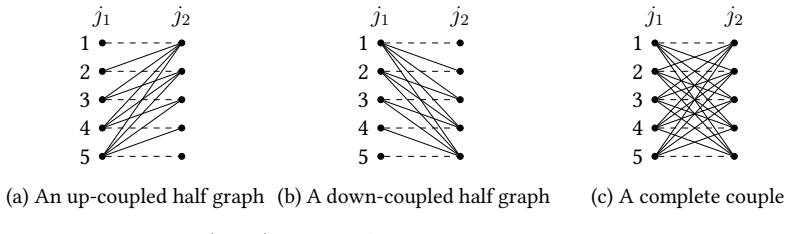
- [Section 5, Lemma 5.1, up-coupled half-graph case] The induction invariant in the up-coupled case is false. Write A_i=Z_i(j1) and B_i=Z_i(j2), and take the canonical up-coupled half-graph on Z_1,...,Z_9 with the additional choices that B_1B_4 is present and B_2B_4 is absent. After the first pivot on B_1A_3, the edge B_2B_4 is toggled from absent to present: B_2 is adjacent to A_3 and not to B_1, while B_4 is adjacent to B_1 and not to A_3, so the two endpoints have different neighbor sets in {u,v}. Thus a j2-vertex of the first remaining part Z_2 has an edge to a j2-vertex of the later part Z_4 in eG_1. This directly contradicts the claim that eG_i has no edge joining the j1th or j2th vertex of any of the first i parts of Y_i to any j1th or j2th vertex in a different part of Y_i, and it invalidates the step in which the proof says 'we only need to worry about the later parts'. The subsequent assertion that the only j2-vertex in N_{eG_i}(v) is Y_{3i+2}(j2) is therefore unsupported. Since the proof of Lemma 5.1 is the mechanism that fixes all cross pairs in Proposition 5.2, and Theorem 1.1 depends on Proposition 5.2, the main theorem is not established as written.
- [Sections 5, 9, and 10] The gap in Lemma 5.1 propagates to the rest of the paper. Proposition 5.2 applies Lemma 5.1 to conclude that the parts Y_j are pairwise non-adjacent in eG; without a valid proof of Lemma 5.1, this conclusion is not justified, and the final extraction of kH in Theorem 1.1 does not follow from the stated arguments. The same flawed pivot-sequence argument is used in Lemma 9.7 and Proposition 9.8, so Theorem 9.9 and Corollary 1.4 inherit the same defect. A repair of the extraction lemma would be needed to restore the proofs of all three main results.
minor comments (2)
- [Proposition 5.2 and Proposition 9.8] The quantifier in the hypothesis 'for all i in [m] and j in [k]' should read 'for all i in [m] and j in [K]', since the sets X_{i,j} are indexed by [K] and the subsequent argument uses all K indices.
- [Lemma 10.3, proof] The proof says 'Fix an arbitrary vertex v of G which is not an element of M1', but if G has exactly |E(M1)| vertices then no such vertex exists. This case is easily handled by the p=0 case, but it should be stated explicitly.
Circularity Check
No circularity: the proof derives Theorem 1.1 from independently established grid theorems and well-quasi-ordering results, and its internal extraction lemmas are not restatements of the conclusion.
full rationale
The derivation chain is self-contained and non-circular. Theorem 1.1 is reduced, via the Grid Theorem for Vertex-Minors [GKMW23], to the bounded-rank-width case; Proposition 4.2 then produces either the desired perturbation or many small robust parts using only perturbation lemmas (Lemmas 3.1–3.4) and Oum's well-quasi-ordering theorem [Oum08]. Proposition 5.2 extracts kH from those robust parts by a Ramsey-type fixing procedure (Lemma 5.1) and perturbation robustness arguments. None of these steps defines the target Erdős-Pósa statement in terms of itself, and no parameter is fitted to data and then renamed a prediction. The proof does rely on self-citations: [GKMW23] includes coauthor McCarty and [Oum08] includes coauthor Oum, but both are independent published theorems used as black boxes, and neither assumes the present theorem or its perturbation conclusion. The skeptical concern about Lemma 5.1's induction invariant, if valid, would be a correctness gap in the proof, not a circularity: the lemma is a genuine combinatorial extraction step and is not equivalent to Theorem 1.1 by construction. No circular step is exhibited. Therefore the circularity score is 0.
Assumptions & free parameters
assumptions (9)
- domain assumption Grid Theorem for Vertex-Minors (Theorem 2.2, Geelen-Kwon-McCarty-Wollan): for any circle graph H, graphs with no H vertex-minor have bounded rank-width.
- domain assumption Oum's well-quasi-ordering theorem (Theorem 2.3): bounded rank-width graphs are well-quasi-ordered under pivot-minors.
- standard math Ramsey's theorem (used implicitly for chains and half-graphs).
- domain assumption Bipartite Ramsey theorem (Theorem 10.1, Beineke-Schwenk).
- domain assumption Geelen-Gerards-Whittle grid theorem for GF(q)-representable matroids (Theorem 8.3).
- domain assumption Geelen-Gerards-Whittle well-quasi-ordering for matroids (Theorem 8.4).
- domain assumption de Fraysseix characterization: fundamental graphs of planar multigraphs are exactly bipartite circle graphs (Theorem 8.2).
- domain assumption Bouchet's correspondence between pivot-minors and matroid minors (Lemma 8.1).
- domain assumption Geelen-Gerards-Whittle lemma on rank-p perturbations and distance (Lemma 10.2).
Cite this review
Pith. "Pith review of The Erd\H{o}s-P\'{o}sa property for circle graphs as vertex-minors." pith.science (2026). https://pith.science/paper/L4M3N32A
@misc{pith2026250603973,
  author       = {Pith},
  title        = {Pith review of: The Erd\Hos-P\'osa property for circle graphs as vertex-minors},
  year         = {2026},
  howpublished = {\url{https://pith.science/paper/L4M3N32A}},
  note         = {Machine review of arXiv:2506.03973}
}
abstract
We prove that for any circle graph $H$ with at least one edge and for any positive integer $k$, there exists an integer $t=t(k,H)$ so that every graph $G$ either has a vertex-minor isomorphic to the disjoint union of $k$ copies of $H$, or has a $t$-perturbation with no vertex-minor isomorphic to $H$. Using the same techniques, we also prove that for any planar multigraph $H$, every binary matroid either has a minor isomorphic to the cycle matroid of $kH$, or is a low-rank perturbation of a binary matroid with no minor isomorphic to the cycle matroid of $H$.
Figures

Figures from the paper (1 more)

Reference graph
Works this paper leans on
-
[1]
Pascal Gollin, Tony Huynh, and O - joung Kwon
Jungho Ahn, J. Pascal Gollin, Tony Huynh, and O - joung Kwon. A coarse E rdős- P ósa theorem. In Proceedings of the 2025 Annual ACM-SIAM Symposium on Discrete Algorithms (SODA) , pages 3363--3381, 2025. https://doi.org/10.1137/1.9781611978322.109 doi:10.1137/1.9781611978322.109
-
[2]
Martin Aigner and Hein van der Holst . Interlace polynomials. Linear Algebra and its Applications , 377:11--30, 2004. https://doi.org/10.1016/j.laa.2003.06.010 doi:10.1016/j.laa.2003.06.010
-
[3]
Andr \'e Bouchet. Isotropic systems. European J. Combin. , 8(3):231--244, 1987. https://doi.org/10.1016/S0195-6698(87)80027-6 doi:10.1016/S0195-6698(87)80027-6
-
[4]
Graphic presentations of isotropic systems
Andr \'e Bouchet. Graphic presentations of isotropic systems. J. Combin. Theory Ser. B , 45(1):58--76, 1988. https://doi.org/10.1016/0095-8956(88)90055-X doi:10.1016/0095-8956(88)90055-X
-
[5]
Lowell W. Beineke and Allen J. Schwenk. On a bipartite form of the R amsey problem. In Proceedings of the F ifth B ritish C ombinatorial C onference ( U niv. A berdeen, A berdeen, 1975) , pages 17--22. Congressus Numerantium, No. XV, Winnipeg, Man., 1976. Utilitas Math
work page 1975
-
[6]
Large-treewidth graph decompositions and applications
Chandra Chekuri and Julia Chuzhoy. Large-treewidth graph decompositions and applications. In S TOC '13--- P roceedings of the 2013 ACM S ymposium on T heory of C omputing , pages 291--300. ACM, New York, 2013. https://doi.org/10.1145/2488608.2488645 doi:10.1145/2488608.2488645
arXiv 2013
-
[7]
A tight E rd o s- P \'o sa function for planar minors
Wouter Cames van Batenburg, Tony Huynh, Gwena\"el Joret, and Jean-Florent Raymond. A tight E rd o s- P \'o sa function for planar minors. Adv. Comb. , pages Paper No. 2, 33, 2019. https://doi.org/10.19086/aic.10807 doi:10.19086/aic.10807
-
[8]
Konrad K. Dabrowski, Fran c ois Dross, Jisu Jeong, Mamadou Moustapha Kant\' e , O - joung Kwon, Sang - il Oum, and Dani\" e l Paulusma. Computing pivot-minors. preprint, 2023. https://arxiv.org/abs/2311.04656 arXiv:2311.04656
arXiv 2023
Show all 42 references
-
[9]
Local complementation and interlacement graphs
Hubert de Fraysseix. Local complementation and interlacement graphs. Discrete Math. , 33(1):29--35, 1981. https://doi.org/10.1016/0012-365X(81)90255-7 doi:10.1016/0012-365X(81)90255-7
1981 doi
-
[10]
Erd o s- P \' o sa property of cycles that are far apart
Vida Dujmović, Gwenaël Joret, Piotr Micek, and Pat Morin. Erd o s- P \' o sa property of cycles that are far apart. preprint, 2025. https://arxiv.org/abs/2412.13893 arXiv:2412.13893
2025 arXiv
-
[11]
On independent circuits contained in a graph
Paul Erd o s and Lajos P \'o sa. On independent circuits contained in a graph. Canad. J. Math. , 17:347--352, 1965. https://doi.org/10.4153/CJM-1965-035-8 doi:10.4153/CJM-1965-035-8
1965 doi
-
[12]
Fon-Der-Flaass
Dmitri G. Fon-Der-Flaass. On local complementations of graphs. In Combinatorics (Eger, 1987) , volume 52 of Colloq. Math. Soc. J\'anos Bolyai , pages 257--266. North-Holland, Amsterdam, 1988
1987
-
[13]
James F. Geelen. A generalization of T utte's characterization of totally unimodular matrices. J. Combin. Theory Ser. B , 70(1):101--117, 1997. https://doi.org/10.1006/jctb.1997.1751 doi:10.1006/jctb.1997.1751
1997
-
[14]
Geelen, A
James F. Geelen, A. M. H. Gerards, and Geoff Whittle. Branch-width and well-quasi-ordering in matroids and graphs. J. Combin. Theory Ser. B , 84(2):270--290, 2002. https://doi.org/10.1006/jctb.2001.2082 doi:10.1006/jctb.2001.2082
2002
-
[15]
Geelen, A
James F. Geelen, A. M. H. Gerards, and Geoff Whittle. Disjoint cocircuits in matroids with large rank. J. Combin. Theory Ser. B , 87(2):270--279, 2003. https://doi.org/10.1016/S0095-8956(02)00010-2 doi:10.1016/S0095-8956(02)00010-2
2003 doi
-
[16]
Excluding a planar graph from GF (q) -representable matroids
Jim Geelen, Bert Gerards, and Geoff Whittle. Excluding a planar graph from GF (q) -representable matroids. J. Combin. Theory Ser. B , 97(6):971--998, 2007. https://doi.org/10.1016/j.jctb.2007.02.005 doi:10.1016/j.jctb.2007.02.005
2007 doi
-
[17]
The highly connected matroids in minor-closed classes
Jim Geelen, Bert Gerards, and Geoff Whittle. The highly connected matroids in minor-closed classes. Ann. Comb. , 19(1):107--123, 2015. https://doi.org/10.1007/s00026-015-0251-3 doi:10.1007/s00026-015-0251-3
2015 doi
-
[18]
The E rd o s- P \'o sa property for matroid circuits
Jim Geelen and Kasper Kabell. The E rd o s- P \'o sa property for matroid circuits. J. Combin. Theory Ser. B , 99(2):407--419, 2009. https://doi.org/10.1016/j.jctb.2008.08.004 doi:10.1016/j.jctb.2008.08.004
2009 doi
-
[19]
The grid theorem for vertex-minors
Jim Geelen, O - joung Kwon, Rose McCarty, and Paul Wollan. The grid theorem for vertex-minors. J. Combin. Theory Ser. B , 158:93--116, 2023. https://doi.org/10.1016/j.jctb.2020.08.004 doi:10.1016/j.jctb.2020.08.004
2023 doi
-
[20]
Flipper games for monadically stable graph classes
Jakub Gajarsk \'y , Nikolas M\"ahlmann, Rose McCarty, Pierre Ohlmann, Micha Pilipczuk, Wojciech Przybyszewski, Sebastian Siebertz, Marek Soko owski, and Szymon Toru\'nczyk. Flipper games for monadically stable graph classes. In 50th I nternational C olloquium on A utomata, L a...
2023 doi
-
[21]
Circle graph obstructions under pivoting
Jim Geelen and Sang - il Oum. Circle graph obstructions under pivoting. J. Graph Theory , 61(1):1--11, 2009. https://doi.org/10.1002/jgt.20363 doi:10.1002/jgt.20363
2009 doi
-
[22]
Algebraic graph theory , volume 207 of Graduate Texts in Mathematics
Chris Godsil and Gordon Royle. Algebraic graph theory , volume 207 of Graduate Texts in Mathematics . Springer-Verlag, New York, 2001. https://doi.org/10.1007/978-1-4613-0163-9 doi:10.1007/978-1-4613-0163-9
2001 doi
-
[23]
Kevin Grace and Stefan H. M. van Zwam. On perturbations of highly connected dyadic matroids. Ann. Comb. , 22(3):513--542, 2018. https://doi.org/10.1007/s00026-018-0396-y doi:10.1007/s00026-018-0396-y
2018 doi
-
[24]
Packing and covering immersions in 4 -edge-connected graphs
Chun-Hung Liu. Packing and covering immersions in 4 -edge-connected graphs. J. Combin. Theory Ser. B , 151:148--222, 2021. https://doi.org/10.1016/j.jctb.2021.06.005 doi:10.1016/j.jctb.2021.06.005
2021 doi
-
[25]
Local structure for vertex-minors
Rose McCarty. Local structure for vertex-minors. P h D thesis, University of Waterloo , Oct 2021. URL: https://uwspace.uwaterloo.ca/handle/10012/17633
2021
-
[26]
Delta-matroids for graph theorists
Iain Moffatt. Delta-matroids for graph theorists. In Surveys in combinatorics 2019 , volume 456 of London Math. Soc. Lecture Note Ser. , pages 167--220. Cambridge Univ. Press, Cambridge, 2019. https://doi.org/10.1017/9781108649094.007 doi:10.1017/9781108649094.007
2019 doi
-
[27]
The average cut-rank of graphs
Huy-Tung Nguyen and Sang - il Oum. The average cut-rank of graphs. European J. Combin. , 90:103183, 22, 2020. https://doi.org/10.1016/j.ejc.2020.103183 doi:10.1016/j.ejc.2020.103183
2020
-
[28]
Approximating clique-width and branch-width
Sang - il Oum and Paul Seymour. Approximating clique-width and branch-width. J. Combin. Theory Ser. B , 96(4):514--528, 2006. https://doi.org/10.1016/j.jctb.2005.10.006 doi:10.1016/j.jctb.2005.10.006
2006 doi
-
[29]
Rank-width and vertex-minors
Sang - il Oum. Rank-width and vertex-minors. J. Combin. Theory Ser. B , 95(1):79--100, 2005. https://doi.org/10.1016/j.jctb.2005.03.003 doi:10.1016/j.jctb.2005.03.003
2005 doi
-
[30]
Rank-width and well-quasi-ordering
Sang - il Oum. Rank-width and well-quasi-ordering. SIAM J. Discrete Math. , 22(2):666--682, 2008. https://doi.org/10.1137/050629616 doi:10.1137/050629616
2008 doi
-
[31]
Excluding a bipartite circle graph from line graphs
Sang - il Oum. Excluding a bipartite circle graph from line graphs. J. Graph Theory , 60(3):183--203, 2009. https://doi.org/10.1002/jgt.20353 doi:10.1002/jgt.20353
2009 doi
-
[32]
Rank-width: algorithmic and structural results
Sang - il Oum. Rank-width: algorithmic and structural results. Discrete Appl. Math. , 231:15--24, 2017. https://doi.org/10.1016/j.dam.2016.08.006 doi:10.1016/j.dam.2016.08.006
2017 doi
-
[33]
Graph classes through the lens of logic
Michał Pilipczuk. Graph classes through the lens of logic. preprint, 2025. https://arxiv.org/abs/2501.04166 arXiv:2501.04166
2025 arXiv
-
[34]
Dynamic Erd o s-P\'osa listing
Jean-Florent Raymond. Dynamic Erd o s-P\'osa listing. https://perso.ens-lyon.fr/jean-florent.raymond/Erd accessed April 2025
2025
-
[35]
Reed, Neil Robertson, Paul Seymour, and Robin Thomas
Bruce A. Reed, Neil Robertson, Paul Seymour, and Robin Thomas. Packing directed circuits. Combinatorica , 16(4):535--554, 1996. https://doi.org/10.1007/BF01271272 doi:10.1007/BF01271272
1996 doi
-
[36]
Graph minors
Neil Robertson and Paul Seymour. Graph minors. V . E xcluding a planar graph. J. Combin. Theory Ser. B , 41(1):92--114, 1986. https://doi.org/10.1016/0095-8956(86)90030-4 doi:10.1016/0095-8956(86)90030-4
1986 doi
-
[37]
Reed and F
Bruce A. Reed and F. Bruce Shepherd. The G allai- Y ounger conjecture for planar graphs. Combinatorica , 16(4):555--566, 1996. https://doi.org/10.1007/BF01271273 doi:10.1007/BF01271273
1996 doi
-
[38]
Neil Robertson and P. D. Seymour. Graph minors. XX . W agner's conjecture. J. Combin. Theory Ser. B , 92(2):325--357, 2004. https://doi.org/10.1016/j.jctb.2004.08.001 doi:10.1016/j.jctb.2004.08.001
2004 doi
-
[39]
A new proof and generalizations of a theorem of Erd o s and P\'osa on graphs without \(k+1\) independent circuits
Mikl\' o s Simonovits. A new proof and generalizations of a theorem of Erd o s and P\'osa on graphs without \(k+1\) independent circuits. Acta Math. Acad. Sci. Hung. , 18:191--206, 1967. https://doi.org/10.1007/BF02020974 doi:10.1007/BF02020974
1967 doi
-
[40]
On the presence of disjoint subgraphs of a specified type
Carsten Thomassen. On the presence of disjoint subgraphs of a specified type. J. Graph Theory , 12(1):101--111, 1988. https://doi.org/10.1002/jgt.3190120111 doi:10.1002/jgt.3190120111
1988 doi
-
[41]
Flip-width: cops and robber on dense graphs
Szymon Toru\'nczyk. Flip-width: cops and robber on dense graphs. In 2023 IEEE 64th A nnual S ymposium on F oundations of C omputer S cience--- FOCS 2023 , pages 663--700. IEEE Computer Soc., Los Alamitos, CA, [2023] 2023. https://doi.org/10.1109/FOCS57990.2023.00045 doi:10.110...
2023
-
[42]
Graphical description of the action of local clifford transformations on graph states
Maarten Van den Nest, Jeroen Dehaene, and Bart De Moor. Graphical description of the action of local clifford transformations on graph states. Phys. Rev. A , 69:022316, 2004. https://doi.org/10.1103/PhysRevA.69.022316 doi:10.1103/PhysRevA.69.022316
2004 doi
Reviewed August 7, 2026 · model on record in the stance chip above.
Discussion (0). Sign in to comment.