REVIEW 3 major objections 4 minor 2 cited by
Asymptotic analysis on narrow tubes: narrow escape problems and diffusion processes
T0 review · 3 major / 4 minor · reviewed 2026-08-05 · deepseek-v4-flash
Pith's one-line read Reflected Brownian motion in a narrow tube converges to a graph diffusion, with vertex gluing conditions set by the ratio r_j(ε)^d/ε^{d-1} and three regimes: skew, sticky, absorbing.
desk verdict Strong resolution of the small/intermediate regimes of Freidlin's conjecture; the large-ball regime hinges on an unproved, unpublished Poisson-limit lemma. read the letter →
The pith
A machine-rendered reading of the paper's core claim, the machinery that carries it, and where it could break.
The reading
What carries the argument
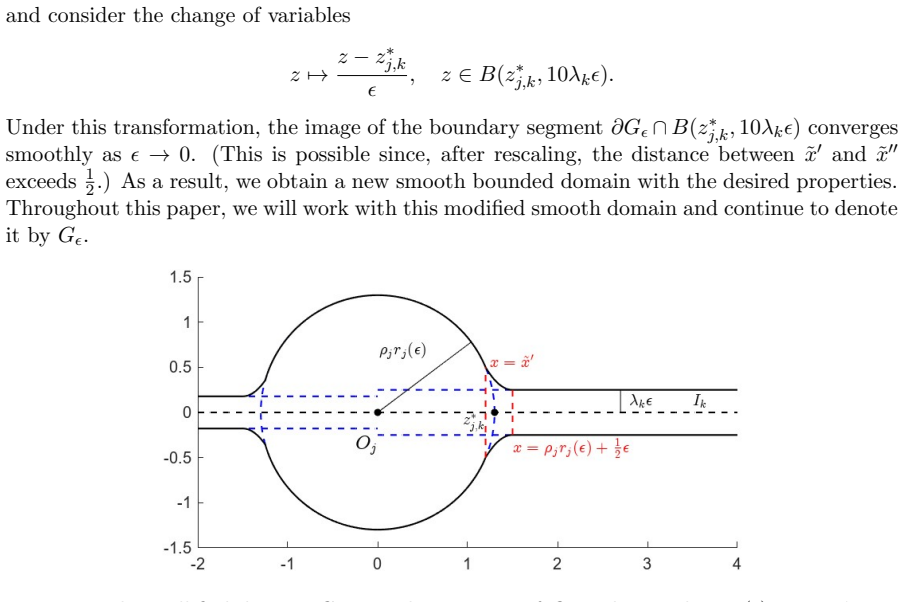
The machinery is a three-region decomposition of each vertex neighborhood: the ball B(O_j,ρ_j r_j), the short neck pieces near the junction, and the long cylinders along the edges. The proof solves the exit problem from the ball to a distant level set C_{ε,j}(δ) by matching one-dimensional solutions in the neck and cylinder with uniform-continuity statements (Lemmas 3.6 and 3.7) obtained from a uniform mixing condition for a discretized process that converges to its quasi-stationary distribution. The exit-place estimate fixes the probabilities p_{j,k}; the expected-exit-time estimate fixes the delay parameter α_j; and the vanishing of the moment-generating function of the exit time, imported
What would settle it
For a three-edge star in the plane with unequal edge widths λ_k and with r(ε) chosen so that r(ε)^2/ε → ∞, simulate reflected Brownian motion in the tube and measure first exit from the vertex ball to the neck boundary C_{ε,j}(δ). If the scaled exit time σ_{ε,δ}/(ρ^2 r(ε)^2 V_2/(Σ_k λ_k ε V_1) δ) is not asymptotically exponential with mean 1, uniformly in the starting point, or if the exit probabilities after δ→0 do not equal λ_k/Σ_l λ_l, then Theorem 8.2 fails.
Extended reading notes
Core claim
The central claim is Theorem 8.2: for every f in the domain of the limiting generator and every λ>0, the resolvent identity sup_z |E_z ∫_0^∞ e^{-λt}(λ f(Π^ε Z^ε_t) − Lbar f(Π^ε Z^ε_t)) dt − f(Π^ε z)| → 0 holds uniformly. This identifies every weak limit of the projected reflected Brownian motion Π^ε(Z^ε(·)) with the unique Markov diffusion on Γ whose generator is f'' on the edges and whose vertex gluing conditions are: sum_k p_{j,k} f'(O_j)=0 for small balls; sum_k p_{j,k} f'(O_j)=α_j f''(O_j) for intermediate balls; and f''(O_j)=0 for large balls. The probabilities are p_{j,k}=λ_k^{d-1}/Σ_l λ_l^{d-1}, and the delay parameter is α_j=ρ_j^d V_d/(Σ_l λ_l^{d-1} V_{d-1}). The classification of a
Load-bearing premise
The load-bearing premise is that the reflected Brownian motion mixes completely inside each vertex ball before it escapes through a neck, uniformly in the tube width, so that exit times and exit probabilities are asymptotically independent of where in the junction the particle starts.
Editorial extensions
If this is right
- Diffusive transport in narrow tubes can be replaced, in the limit, by a one-dimensional graph diffusion whose vertex conditions are read directly from the tube's edge widths λ_k ε and vertex-ball radii ρ_j r_j(ε).
- For small vertex balls the vertex behaves like a skew junction: a particle chooses incident edge k with probability λ_k^{d-1}/Σ_l λ_l^{d-1}; for intermediate balls the same probabilities are kept but each vertex visit carries the average delay α_j.
- For large vertex balls the vertex becomes absorbing, and the exit time from the vertex neighborhood into the tube is asymptotically exponential with explicit rate (ρ_j^d r_j^d V_d/(Σ_k λ_k^{d-1} ε^{d-1} V_{d-1}) δ)^{-1}.
- The narrow-escape estimates themselves — expected exit time, exit place, and exponential law — are uniform in the starting point, so they are usable beyond the convergence theorem as statements about bottleneck domains.
- The convergence holds uniformly with respect to the initial condition and covers all three scaling regimes in one theorem, so no separate boundary-layer treatment of vertices is needed.
Reading between the lines
- Because the only geometry-specific step is the unit-ball narrow-escape estimate behind Lemma 4.1, replacing spherical vertex neighborhoods by other smooth domains should preserve the theorem once multi-window escape asymptotics for those domains are known.
- One could test the sticky-junction prediction numerically by measuring mean occupation time near a vertex as a function of δ and comparing its limit to α_j; the paper's formula predicts a linear offset in δ.
- The dimensionless ratio r_j^d/ε^{d-1} resembles a capacity ratio, ball volume over total neck cross-section, suggesting that the same classification should govern analogous problems in higher dimensions and in discrete random-walk models of networks.
- The exponential-law result for large balls implies that the escape activity at a vertex is asymptotically Poisson; composing several such vertices would yield a network-level Markov chain with exponentially distributed vertex holding times, an extension the paper does not develop.
Editorial analysis
A structured set of objections, weighed in public.
Referee Report
Summary. The paper studies reflected Brownian motion in a narrow tube G_ε built around a finite metric graph in R^2 or R^3, with edge neighborhoods of width λ_k ε and vertex neighborhoods of radius ρ_j r_j(ε). The main result, Theorem 8.2, proves the resolvent/weak convergence of the projected process Π^ε(Z^ε(·)) to a diffusion on the graph whose generator is f'' on edges and whose vertex gluing conditions depend on the scaling limit of r_j(ε)^d / ε^{d-1}: skew/Neumann conditions for small balls, sticky-type conditions with a finite parameter α_j for intermediate balls, and the condition f''(O_j)=0 for large balls. The proof combines narrow-escape estimates (expected exit time, exit place, second moments), uniform mixing of a discretized chain via a Dobrushin-type quasi-stationary argument, an asymptotic exponential law in the large-ball regime, and a martingale problem argument in the spirit of Freidlin–Wentzell. The paper also develops rigorous narrow-escape results in multi-bottleneck domains that are of independent interest.
Significance. If correct, the paper resolves Conjecture 2.4 of Freidlin with explicit geometric formulas for the gluing constants: p_{j,k}=λ_k^{d-1}/Σ_l λ_l^{d-1} for small/intermediate vertices and α_j=ρ_j^d V_d/Σ_k λ_k^{d-1} V_{d-1} in the intermediate case, with α_j=1 in the large-ball case. It also supplies a rigorous treatment of the multi-bottleneck narrow escape problem, including an asymptotic exponential law. Among the paper's concrete strengths are the flux-balance derivation of the exit-place asymptotics in Section 3.1, the explicit uniform QSD convergence theorem (Theorem 5.2), and the fact that the gluing constants are derived rather than fitted. I also checked the internal dependency structure: Lemma 4.4 relies on Remark 3.8 rather than on Lemma 3.6, and the proof of Lemma 3.7 does not use Lemma 3.2, so I do not see a circularity in the main chain. The main caveat is not internal consistency but the reliance on imported, partly unpublished results for the large-ball regime.
major comments (3)
- [Section 7, Theorem 7.1] Theorem 7.1 is the engine for the large-ball regime: it is used to prove the asymptotic exponential law (7.8) and the moment-generating estimate (7.9), and (7.9) is then used in Section 8 to obtain the crucial bound (8.6) that controls the large-vertex contribution I_3 and yields the f''(O_j)=0 gluing condition. However, Theorem 7.1 is not proved in the manuscript; it is stated as 'closely parallel[ing] [19, Lemma 6.8]', with the proof 'along the same lines'. The cited [19] is an unpublished arXiv preprint, and Theorem 7.1 contains an additional parameter δ' not present in the original lemma. Since the large-ball part of Conjecture 2.4 depends on this result, a citation is not sufficient. Please include a full proof of Theorem 7.1 (including the δ'-uniform version) or replace it with a published theorem with exactly these hypotheses and proof of the present application.
- [Section 4.1.1, Lemma 4.1] The multi-window unit-ball narrow escape estimate is delegated to 'solving the algebraic system in [10, Section 5.3]' with the remark that verification is straightforward. Lemma 4.1 is load-bearing: it enters Lemma 4.2 and Lemma 4.3, hence Lemma 3.5, and through the QSD argument also Lemmas 3.6 and 3.7. The paper should either provide the stated multi-window bound with proof in the appendix or quote a precise theorem from [10] covering exactly this configuration of several escape windows of comparable small radius. As written, the proof of a key a priori estimate is not self-contained.
- [Section 8, proof of (8.6)] The bound (8.6) for the large-vertex contribution is derived by iterating E_z e^{-λσ_{L,n}} ≤ (max_{j∈L} sup E_{z'} e^{-λσ_{ε,δ}})^n and then using (7.9) to make the ratio <1/2 for small ε. This is mathematically sound once (7.9) is available, but the proof should make explicit that δ is chosen smaller than half the minimum edge length of the graph; otherwise the assertion 'if z ∈ ∪_{j∈L} C_{ε,j}(ρ_j r_j(ε)+3ε), then σ_{L,0}=σ_{ε,δ}' can fail when neighborhoods of two large vertices overlap. This is a minor fix, but it clarifies the limiting order ε→0, δ→0 in the argument.
minor comments (4)
- [Section 3.2, Eq. (3.18)] The symbol α(0) appears without definition; it should be α (or α_j) with the limit lim_ε α(ε) indicated. This would also connect more clearly to α_j(ε) in (3.2).
- [Section 7, Eq. (7.1)] The definition e(ε,δ') = ρ^d r(ε)^d V_d / (Σ_k λ_k^{d-1} ε^{d-1} V_{d-1}) δ' is written in a way that can be misread as δ' dividing the whole fraction. Writing e(ε,δ') = α(ε)δ' with α(ε) from (3.2) would improve readability.
- [Section 8, proof of Theorem 8.2] In the decomposition I_1+I_2+I_3, the notation o_{ε,δ}(1) is used before the limiting convention is fully re-stated. The proof works because the convention is lim_δ lim_ε, but a sentence at the start of the proof reminding the reader of this order would help.
- [General notation] The list of domains in Appendix D is very useful. It would be even more helpful to mark which domains are fixed relative to δ and which are rescaled in ε, since many estimates depend on this distinction.
Circularity Check
No significant circularity: the gluing constants are derived from geometric flux balance and invariant-measure calculations, and the convergence proof verifies the resolvent identity with these derived constants rather than assuming them.
full rationale
The paper's central derivation is acyclic. In Lemma 3.1, the exit-place probabilities p_{j,k} = lambda_k^{d-1}/sum_l lambda_l^{d-1} are obtained from the invariant-measure flux balance (3.4)-(3.8) and the uniform continuity Lemma 3.6, not assumed as an input. In Lemma 3.2, the mean exit time is derived from the PDE for v_{epsilon,delta} and the neck ODE (3.14)-(3.16), yielding the geometric constant alpha_j = rho_j^d V_d/(sum lambda_l^{d-1} V_{d-1}). These same derived constants are then substituted into the gluing conditions (8.2)-(8.3) in the proof of Theorem 8.2; the resolvent identity (8.4) is verified by showing that the vertex contribution equals delta*(sum p_{j,k} f' - alpha_j ar L f) + o(delta), which vanishes by the gluing condition. There is no fitted parameter renamed as a prediction, and no self-citation chain: the cited results [10] and [19] are by other authors and are used as external estimates/theorems, not as the paper's own conclusions. The reliance on [19, Lemma 6.8] for the large-ball exponential law is an external dependency and thus a potential completeness or correctness concern, but it is not circularity under the stated criteria. No circular step could be exhibited with a specific equation reducing to itself by construction.
Assumptions & free parameters
assumptions (5)
- domain assumption The tube domain G_epsilon is the union of epsilon-thick neighborhoods of edges and r_j(epsilon)-balls at vertices, with cusps mollified so the boundary is smooth uniformly in epsilon.
- domain assumption Each vertex belongs to one of three regimes: r_j(epsilon)^d/epsilon^{d-1} tends to 0, to a positive finite constant, or to infinity; additionally epsilon << r_j(epsilon) throughout.
- standard math Existence and uniqueness of the graph diffusion with gluing conditions (2.5), quoted as Theorem 2.3 from [15, Theorem 3.1].
- domain assumption The unit-ball narrow escape bounds of [10], including a multi-window version, are valid as used in Lemma 4.1 with all escape radii of the same order.
- domain assumption Theorem 7.1, the continuous analogue of the Poisson limit theorem adapted from [19, Lemma 6.8] with an added parameter, is valid as stated.
Cite this review
Pith. "Pith review of Asymptotic analysis on narrow tubes: narrow escape problems and diffusion processes." pith.science (2026). https://pith.science/paper/L57MFEZ7
@misc{pith2026250815060,
  author       = {Pith},
  title        = {Pith review of: Asymptotic analysis on narrow tubes: narrow escape problems and diffusion processes},
  year         = {2026},
  howpublished = {\url{https://pith.science/paper/L57MFEZ7}},
  note         = {Machine review of arXiv:2508.15060}
}
abstract
This paper investigates a diffusion process in a narrow tubular domain with reflecting boundary conditions, where the geometry serves as a singular perturbation of an underlying graph in $\mathbb{R}^2$ or $\mathbb{R}^3$. The construction incorporates distinct scaling regimes in the neighborhoods of the graph's vertices and edges. We show that, in the limit, the projected process converges weakly to a diffusion process on the graph, with gluing conditions at the vertices that depend on the relative scales of the neighborhoods. Our analysis relies on a detailed understanding of the narrow escape problem in domains with bottlenecks. In particular, we rigorously derive the asymptotic behavior of the expected escape time, establish the asymptotic exponential distribution of escape times and obtain exit place estimates, results that may be of independent interest.
Figures


Figures from the paper (1 more)

Forward citations
Cited by 2 Pith papers
-
A spectral approach to the narrow escape problem in two-dimensional domains
A quasimode expansion in powers of 1/|ln epsilon| yields rigorous asymptotics for the mean exit time and per-window exit probabilities of reflected Brownian motion in a 2D domain with small boundary holes.
-
The narrow escape problem in arbitrary dimension
For small holes in a smooth domain of any dimension, mean escape time scales with the sum of hole 'capacities' r_k^{d-2} and exit probabilities are the relative capacities.
Reference graph
Works this paper leans on
-
[19]
I. Imtiyas, L. Koralov, Metastable distributions of semi-Markov processes , arXiv:2411.04795
-
[10]
X. Chen, A. Friedman, Asymptotic analysis for the narrow escape problem , SIAM Journal on Mathematical Analysis 43 (2011), pp. 2542-2563
work page 2011
-
[1]
S. Albeverio, S. Kusuoka, Diffusion processes in thin tubes and their limits on graphs , Annals of Probability 40 (2012), pp. 2131-2167
work page 2012
- [2]
-
[3]
R. F. Bass, P. Hsu, Some potential theory for reflecting Brownian motion in H¨ older and Lipschitz domains , Annals of Probability 19 (1991), pp. 486-508
work page 1991
-
[4]
G. Berkolaiko, P. Kuchment, Introduction to quantum graphs, American Mathe- matical Society, 2013
work page 2013
-
[5]
Fully nonlinear elliptic PDEs in thin domains with oblique boundary condition
I. Birindelli, A. Briani, H. Ishii, Fully nonlinear elliptic PDEs in thin domains with oblique boundary condition, arXiv:2410.23925
-
[6]
S. Bonaccorsi, M. D’Ovidio, Sticky Brownian motion on star graphs , Fractional Calculus and Applied Analysis 27 (2024), pp. 2859-2891
work page 2024
Show all 32 references
-
[7]
Burdzy, Z
K. Burdzy, Z. Q. Chen, D. E. Marshall, Traps for reflected Brownian motion , Mathema- tische Zeitschrift 252 (2006), pp. 103-132
2006
-
[8]
Caginalp, X
C. Caginalp, X. Chen, Analytical and numerical results for an escape problem, Archive for Rational Mechanics and Analysis 203 (2011), pp. 329-342
2011
-
[9]
Champagnat, D
N. Champagnat, D. Villemonais, Exponential convergence to quasi-stationary distribution and Q-process, Probability Theory and Related Fields 164 (2016), pp. 243-283
2016
-
[11]
Cerrai, M
S. Cerrai, M. I. Freidlin, SPDEs on narrow domains and on graphs: an asymptotic result , Annales de l’Institut Henri Poincar´ e 53 (2017), pp. 865-899
2017
-
[12]
Exner, O
P. Exner, O. Post, Convergence of spectra of graph-like thin manifolds , Journal of Geom- etry and Physics 54 (2005), pp. 77-115
2005
-
[13]
Feller, Diffusion processes in one dimension , Transactions of the American Mathe- matical Society 77 (1954), pp
W. Feller, Diffusion processes in one dimension , Transactions of the American Mathe- matical Society 77 (1954), pp. 1-31
1954
-
[14]
M. I. Freidlin, Markov processes and differential equations: asymptotic prob- lems, Birkh¨ auser Basel, 1996
1996
-
[15]
M. I. Freidlin, A. D. Wentzell, Diffusion processes on graphs and the averaging principle , Annals of Probability 21 (1993), pp. 2215-2245
1993
-
[16]
Gilbarg, N
D. Gilbarg, N. S. Trudinger, Elliptic partial differential equations of second order, Springer Berlin, Second Edition, 2001. 63
2001
-
[17]
Holcman, Z
D. Holcman, Z. Schuss, Diffusion laws in dendritic spines , Journal of Mathematical Neu- roscience 1 (2011), pp. 1-14
2011
-
[18]
Holcman, Z
D. Holcman, Z. Schuss, The narrow escape problem, SIAM Review 56 (2014), pp. 213-257
2014
-
[20]
Itˆ o, H
K. Itˆ o, H. P. McKean,Diffusion processes and their sample paths, Springer Berlin, 1996
1996
-
[21]
R. Z. Khaminskii, Ergodic properties of recurrent diffusion processes and stabilization of the solution to the Cauchy problem for parabolic equations , Theory of Probability and Its Application 5 (1960), pp. 179-196
1960
-
[22]
S. G. Krantz, H. R. Parks, The geometry of domains in space, Birkh¨ auser Boston, 1999
1999
-
[23]
Lelievre, M
T. Lelievre, M. Rachid, G. Stoltz, A spectral approach to the narrow escape problem in the disk , arXiv:2401.06903
-
[24]
X. Li, H. Lee, Y. Wang, Asymptotic analysis of the narrow escape problem in dendritic spine shaped domain: three dimensions , Journal of Physics A: Mathematical and Theo- retical 50 (2017) 325203
2017
-
[25]
Loper, Uniform ergodicity for Brownian motion in a bounded convex set , Journal of Theoretical Probability 33 (2020) , pp.22-35
J. Loper, Uniform ergodicity for Brownian motion in a bounded convex set , Journal of Theoretical Probability 33 (2020) , pp.22-35
2020
-
[26]
Louca, On the narrow escape problem , Lecture Notes
S. Louca, On the narrow escape problem , Lecture Notes
-
[27]
Paquin-Lefebvre, K
F. Paquin-Lefebvre, K. Basnayake, D. Holcman, Narrow escape in composite domains forming heterogeneous networks, Physica D: Nonlinear Phenomena 454 (2023) 133837
2023
-
[28]
Post, Spectral analysis on graph-like spaces, Springer Berlin, 2012
O. Post, Spectral analysis on graph-like spaces, Springer Berlin, 2012
2012
-
[29]
Raugel, Dynamics of partial differential equations on thin domains, Dy- namical systems
G. Raugel, Dynamics of partial differential equations on thin domains, Dy- namical systems. Lectures given at the 2nd session of the Centro Internazionale Matem- atico Estivo (CIME) held in Montecatini Terme, Italy, June 13-22, 1994
1994
-
[30]
Salins, K
M. Salins, K. Spiliopoulos, Markov process with spatial delay: path space characterization, occupation time and properties, Stochastics and Dynamics 17 (2017) 1750042
2017
-
[31]
Schuss, Brownian dynamics at boundaries and interfaces, Springer New York, 2013
Z. Schuss, Brownian dynamics at boundaries and interfaces, Springer New York, 2013
2013
-
[32]
D. W. Stroock, S. R. S. Varadhan, Multidimensional diffusion processes, Springer Berlin, 2006. 64
2006
Reviewed August 5, 2026 · model on record in the stance chip above.
Discussion (0). Sign in to comment.