Characterizations of bipartite and Eulerian partial duals of orientable hypermaps
Pith reviewed 2026-06-30 05:29 UTC · model grok-4.3
The pith
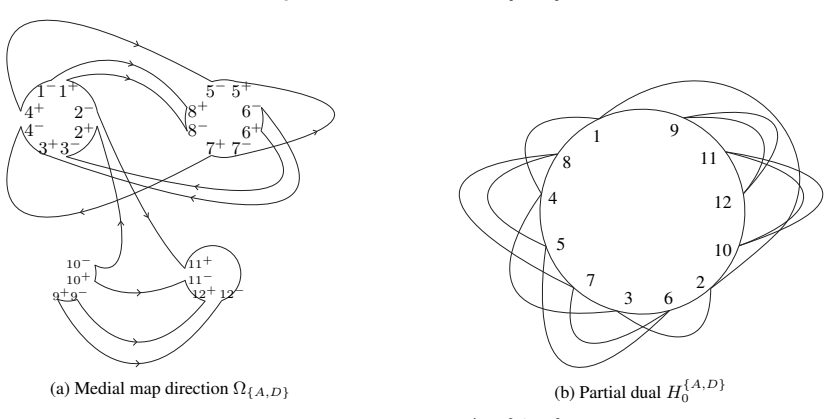
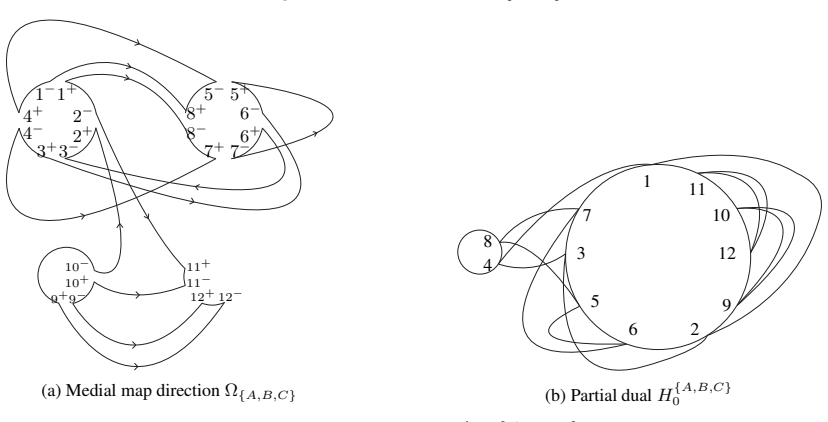
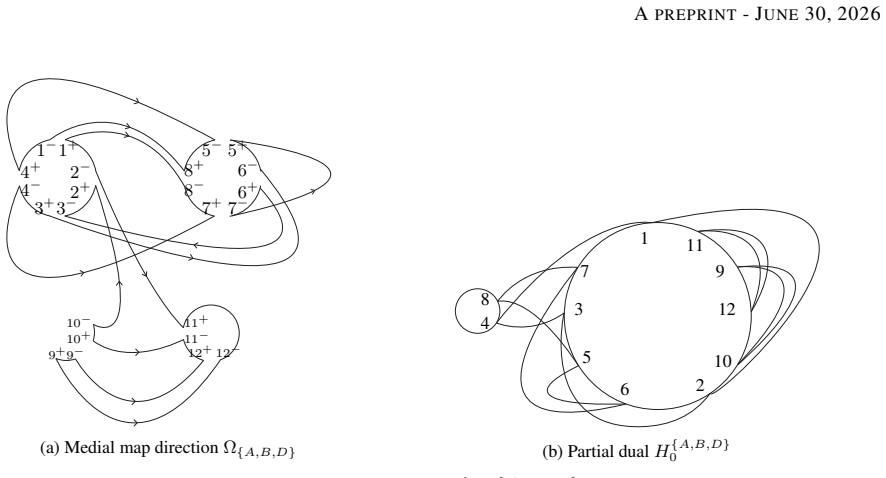
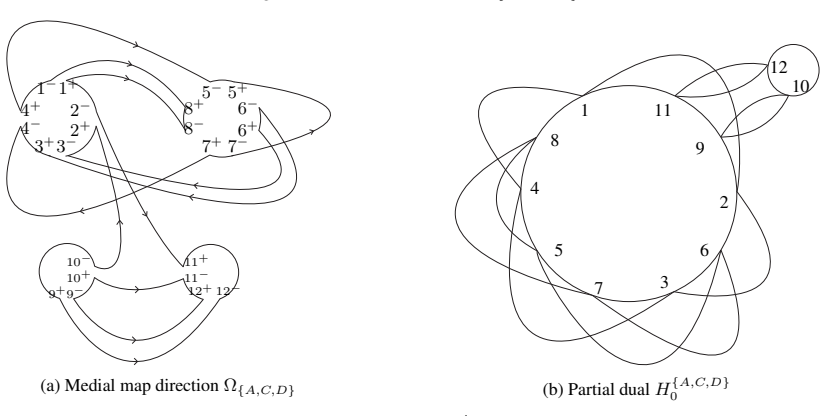
Partial duals of orientable hypermaps are Eulerian exactly when their hyperedges match a crossing-total direction on the medial map, and bipartite when they match an all-crossing direction.
A machine-rendered reading of the paper's core claim, the machinery that carries it, and where it could break.
Core claim
For an orientable hypermap H the partial dual H^{E'} is Eulerian if and only if there exists a crossing-total direction Ω of the medial map M(H) such that E' = D(Ω) ∪ T' for some T' ⊆ T(Ω), and H^{E'} is bipartite if and only if there exists an all-crossing direction Φ such that E' = C(Φ). The proof rests on rewriting partial duality explicitly and on the bijection between the circles of the smoothing state S_{E'} and the vertices of H^{E'}, which makes the Eulerian property equivalent to all state circles having even length.
What carries the argument
The bijection between the state circles of the black/white smoothing state S_{E'} and the vertices of the partial dual H^{E'}, which converts the Eulerian condition into the requirement that every circle has even length.
If this is right
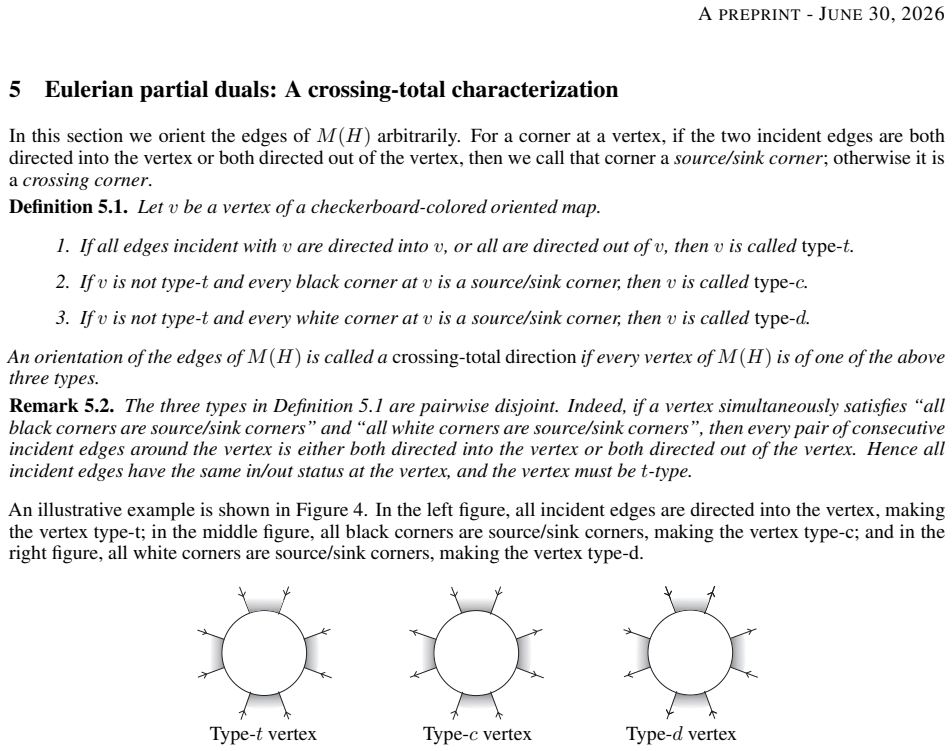
- The Eulerian property holds precisely for those subsets that can be obtained by taking all d-type hyperedges of some crossing-total direction together with an arbitrary subset of its t-type hyperedges.
- The bipartite property holds precisely for those subsets that coincide exactly with the c-type hyperedges of some all-crossing direction.
- If any partial dual is bipartite then every hyperedge of the original hypermap must have even length.
- Partial duality preserves the support and length of every hyperedge while reversing the alpha-cycles that correspond to the chosen hyperedges.
Where Pith is reading between the lines
- The direction characterizations may allow verification of Eulerian or bipartite properties by searching over directions on the medial map instead of enumerating all possible subsets.
- The even-length obstruction for bipartiteness suggests that hypermaps containing an odd-length hyperedge admit no bipartite partial dual at all.
- The same smoothing-state technique could be tested on other hereditary properties such as Hamiltonicity or planarity of partial duals.
Load-bearing premise
The state circles of the smoothing state S_{E'} stand in one-to-one correspondence with the vertices of the partial dual H^{E'}.
What would settle it
An explicit hyperedge subset E' for which the constructed partial dual H^{E'} is Eulerian yet no crossing-total direction Ω satisfies E' = D(Ω) ∪ T' with T' ⊆ T(Ω), or a subset where the lengths of the state circles fail to match the degrees at the corresponding vertices.
Figures
read the original abstract
We first rewrite the Chmutov and Vignes-Tourneret's three-permutation formula as an explicit hyperedge-partial-duality formula in the two-permutation model, and show that in this model partial duality acts exactly by preserving the support and length of every hyperedge while reversing the $\alpha$-cycles corresponding to the selected hyperedges. Next, using the Cori and Hetyei's construction of the medial map, we define for each hyperedge subset $E'\subseteq E(H)$ a black/white smoothing state $S_{E'}$, and prove rigorously that the state circles of $S_{E'}$ are in bijection with the vertices of the partial dual $H^{E'}$. Consequently, $H^{E'}$ is Eulerian if and only if every state circle has even length. On this basis we prove the following two main theorems: \[ \begin{aligned} H^{E'}\text{ is Eulerian} &\Longleftrightarrow \exists\text{ a crossing-total direction $\Omega$ of }M(H) \\ &\hspace{3.35em}\text{such that } E'=D(\Omega)\cup T',\quad T'\subseteq T(\Omega), \end{aligned} \] \[ \begin{aligned} H^{E'}\text{ is bipartite} &\Longleftrightarrow \exists\text{ an all-crossing direction $\Phi$ of }M(H) \\ &\hspace{3.35em}\text{such that } E'=C(\Phi). \end{aligned} \] Here $D(\Omega)$, $T(\Omega)$ and $C(\Phi)$ denote, respectively, the sets of all $d$-type, $t$-type and $c$-type hyperedges. Unlike the ribbon-graph case, the hypermap setting exhibits a genuine new obstruction: if some hyperedge-partial dual is bipartite, then every hyperedge of the original hypermap must have even length.
Editorial analysis
A structured set of objections, weighed in public.
Referee Report
Summary. The paper rewrites the Chmutov-Vignes-Tourneret three-permutation formula for partial duality of orientable hypermaps in the two-permutation model, showing that partial duality preserves hyperedge support and length while reversing the corresponding α-cycles. Using the Cori-Hetyei medial map construction, it defines a black/white smoothing state S_{E'} for each hyperedge subset E' and proves a bijection between the state circles of S_{E'} and the vertices of the partial dual H^{E'}. This yields that H^{E'} is Eulerian precisely when all state circles have even length. The main theorems then characterize Eulerian partial duals via the existence of a crossing-total direction Ω on M(H) with E' = D(Ω) ∪ T' (T' ⊆ T(Ω)) and bipartite partial duals via an all-crossing direction Φ with E' = C(Φ). A corollary states that bipartiteness of any partial dual forces every hyperedge of the original hypermap to have even length.
Significance. If the bijection holds, the work supplies explicit combinatorial characterizations of Eulerian and bipartite partial duals for hypermaps that extend the ribbon-graph case, using only directions on the medial map. The explicit two-permutation rewriting, the parameter-free nature of the direction conditions, and the new obstruction (even hyperedge lengths required for bipartiteness) are concrete strengths. The constructions avoid circularity and support direct verification.
minor comments (2)
- The abstract states the two main theorems as displayed equations without assigning them numbers or labels, which makes later cross-references in the body text less convenient.
- The notation for the sets D(Ω), T(Ω), and C(Φ) is introduced only in the abstract; a short reminder of their definitions in the introduction or §2 would improve readability for readers who consult the theorems first.
Simulated Author's Rebuttal
We thank the referee for the positive assessment of the manuscript, the accurate summary of our results on the two-permutation rewriting, the medial-map bijection, and the direction-based characterizations, as well as the note that the even-hyperedge-length obstruction is a genuine new feature relative to the ribbon-graph case. The recommendation for minor revision is noted; however, the report contains no specific major comments requiring response.
Circularity Check
No significant circularity
full rationale
The derivation begins with an explicit rewrite of an external three-permutation formula into the two-permutation model, followed by a direct definition of the black/white smoothing state S_{E'} from the medial map. A bijection between state circles and vertices of H^{E'} is asserted as proven, converting the Eulerian condition into an even-length condition on circles. The two main characterizations are then stated as equivalences derived from this bijection and the definitions of crossing-total and all-crossing directions. No equation reduces to a fitted parameter renamed as prediction, no self-citation supplies a load-bearing uniqueness theorem, and no ansatz is smuggled in. The argument is self-contained combinatorial construction.
Axiom & Free-Parameter Ledger
axioms (2)
- domain assumption The two-permutation model faithfully represents orientable hypermaps and partial duality acts by preserving hyperedge support/length while reversing α-cycles.
- domain assumption Cori-Hetyei medial map construction yields a well-defined black/white smoothing state S_{E'} for each hyperedge subset.
Reference graph
Works this paper leans on
-
[1]
Bipartite-unifo rm hypermaps on the sphere
Breda d’Azevedo, A., Duarte, R., 2007. Bipartite-unifo rm hypermaps on the sphere. Electronic Journal of Combinatorics 14, R5
2007
-
[2]
Chmutov, S., Vignes-Tourneret, F., 2022. Partial duali ty of hypermaps. Arnold Mathematical Journal 8, 445–468. doi:10.1007/s40598-021-00194-8
-
[3]
Un code pour les graphes planaires et ses a pplications
Cori, R., 1975. Un code pour les graphes planaires et ses a pplications. volume 27 of Astérisque. Société Mathématique de France, Paris
1975
-
[4]
A Whitney polynomial for hype rmaps
Cori, R., Hetyei, G., 2025. A Whitney polynomial for hype rmaps. Advances in Applied Mathematics 171, 102951. doi: 10.1016/j.aam.2025.102951
-
[5]
Characterization s of bipartite and Eulerian partial duals of ribbon graphs
Deng, Q., Jin, X., Metsidik, M., 2020. Characterization s of bipartite and Eulerian partial duals of ribbon graphs. Discrete Mathematics 343, 111637. doi: 10.1016/j.disc.2019.111637
-
[6]
Graphs on Surf aces: Dualities, Polynomials, and Knots
Ellis-Monaghan, J.A., Moffatt, I., 2013. Graphs on Surf aces: Dualities, Polynomials, and Knots. Springer, New Y ork. doi:10.1007/978-1-4614-6971-1
-
[7]
Solutio problematis ad geometriam situ s pertinentis
Euler, L., 1741. Solutio problematis ad geometriam situ s pertinentis. Commentarii Academiae Scientiarum Petropolitanae 8, 128–140
-
[8]
Topological Graph Theo ry
Gross, J.L., Tucker, T.W ., 1987. Topological Graph Theo ry. Wiley, New Y ork
1987
-
[9]
Bipartite partial duals and circuits in medial graphs
Huggett, S., Moffatt, I., 2013. Bipartite partial duals and circuits in medial graphs. Combinatorica 33, 231–252. doi:10.1007/s00493-013-2850-0
-
[10]
Theory of maps on orie ntable surfaces
Jones, G.A., Singerman, D., 1978. Theory of maps on orie ntable surfaces. Proceedings of the London Mathe- matical Society s3-37, 273–307. doi: 10.1112/plms/s3-37.2.273
-
[11]
Graphs on Surfaces an d Their Applications
Lando, S.K., Zvonkin, A.K., 2004. Graphs on Surfaces an d Their Applications. Springer, Berlin. doi:10.1007/978-3-540-38361-1
-
[12]
Eulerian partial duals of p lane graphs
Metsidik, M., Jin, X., 2018. Eulerian partial duals of p lane graphs. Journal of Graph Theory 87, 509–515
2018
-
[13]
Hypermaps versus bipartite maps
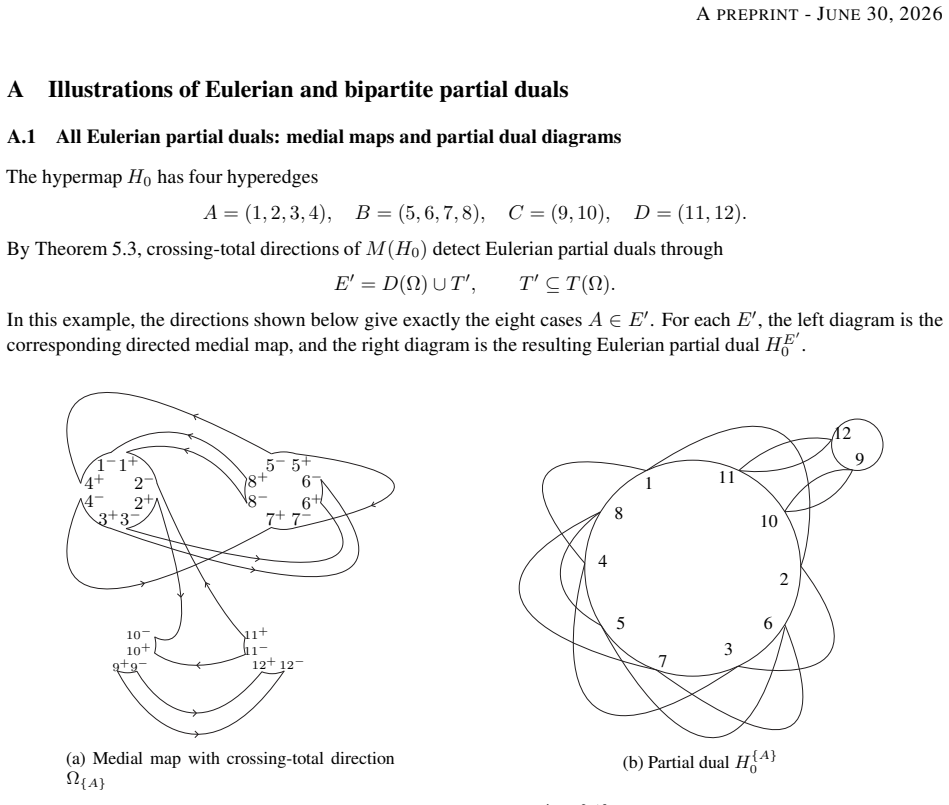
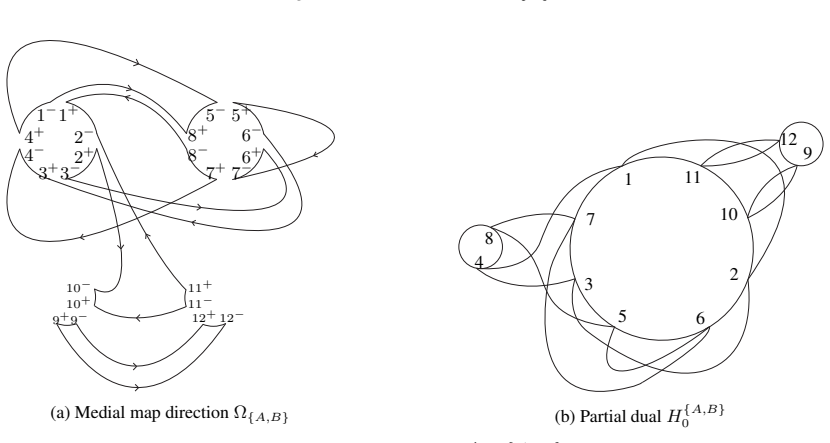
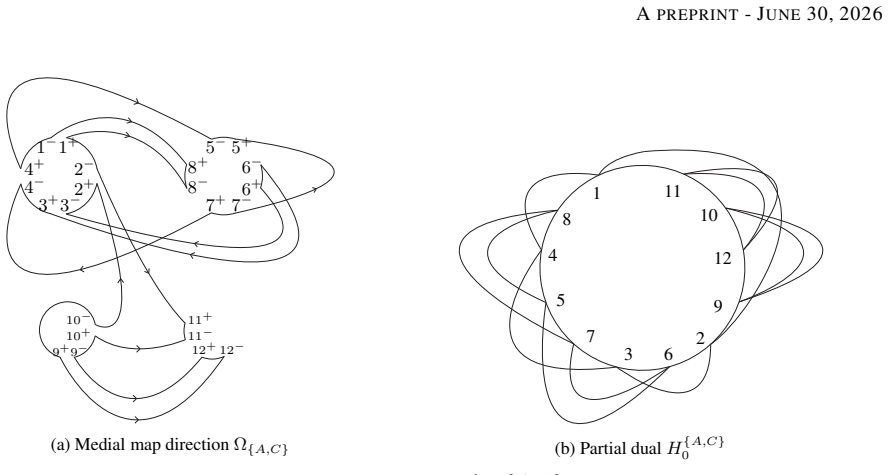
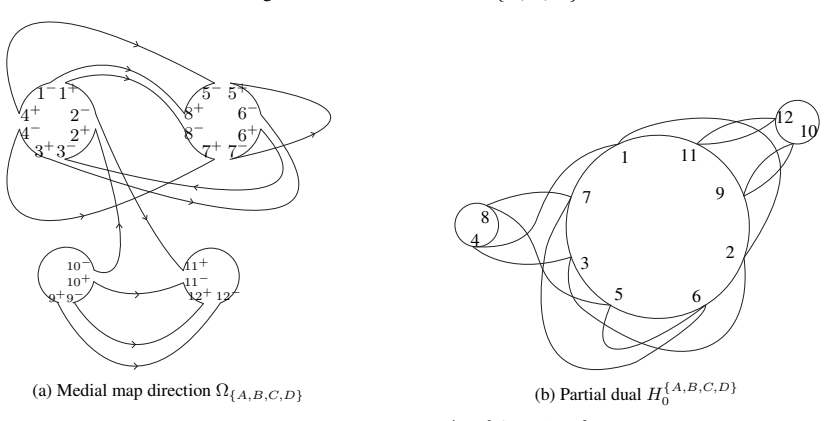
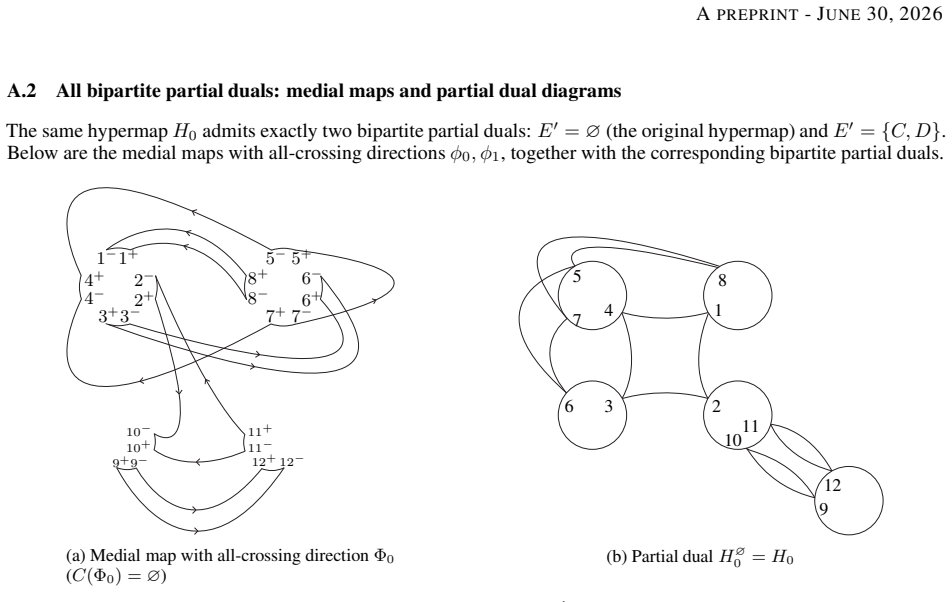
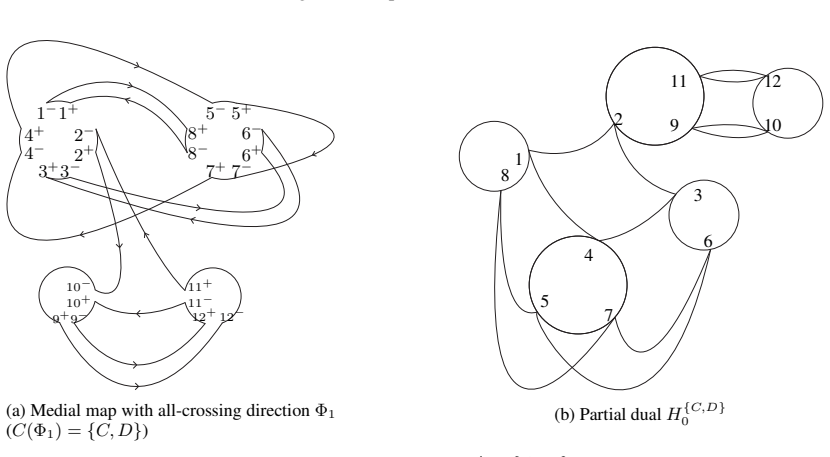
Walsh, T.R.S., 1975. Hypermaps versus bipartite maps. Journal of Combinatorial Theory, Series B 18, 155–163. doi:10.1016/0095-8956(75)90042-8. 15 A PREPRINT - J UNE 30, 2026 A Illustrations of Eulerian and bipartite partial duals A.1 All Eulerian partial duals: medial maps and partial dual diagrams The hypermap H0 has four hyperedges A = (1, 2, 3, 4), B =...
discussion (0)
Sign in with ORCID, Apple, or X to comment. Anyone can read and Pith papers without signing in.