Hybrid renormalization in lattice calculation of baryon LCDAs
Pith reviewed 2026-06-26 18:40 UTC · model grok-4.3
The pith
A hybrid renormalization scheme removes linear divergences from lattice matrix elements of baryon quasi-distribution amplitudes.
A machine-rendered reading of the paper's core claim, the machinery that carries it, and where it could break.
Core claim
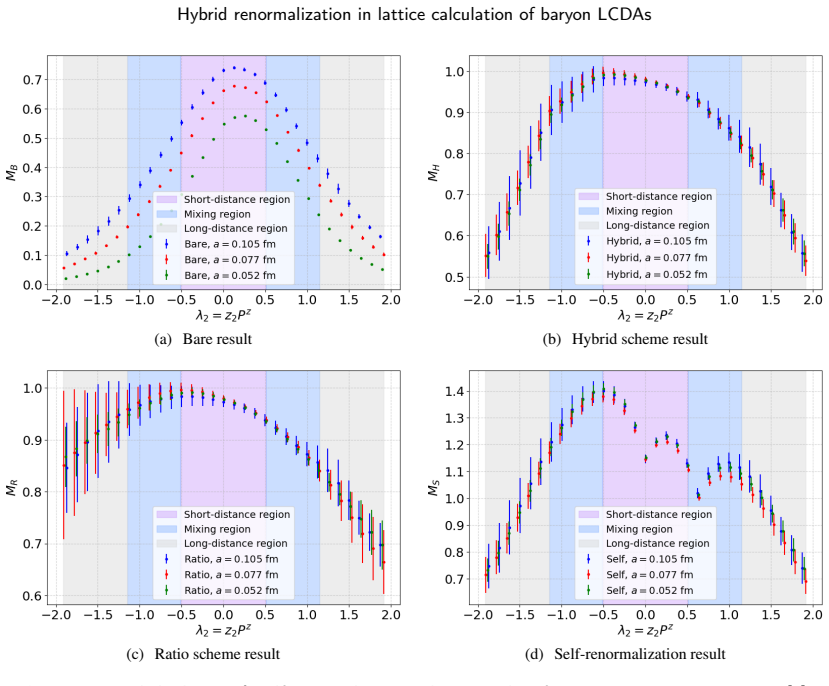
The hybrid renormalization scheme removes linear divergences in lattice matrix elements for octet baryons and yields smooth, self-consistent quasi-distribution amplitudes at lattice spacings of 0.052, 0.077, and 0.105 fm on Nf=2+1 ensembles with stout-smeared clover fermions.
What carries the argument
The hybrid renormalization scheme, which cancels linear divergences in the lattice matrix elements used to define quasi-distribution amplitudes.
If this is right
- Reliable determinations of quasi-DAs become available for octet baryons.
- Quasi-DAs are smooth and self-consistent across the three lattice spacings.
- The results supply a solid foundation for LaMET-based extractions of baryon LCDAs.
- Continuum-limit and physical-pion-mass extractions can now proceed from these quasi-DAs.
Where Pith is reading between the lines
- The same hybrid scheme may generalize to other baryon species or to meson LCDAs if the divergence structure is comparable.
- Once continuum results exist, direct comparisons with phenomenological extractions of baryon LCDAs from experimental data become feasible.
- The approach could shorten the path to precision lattice inputs for baryon structure observables that enter high-energy processes.
Load-bearing premise
The hybrid renormalization scheme is assumed to correctly cancel all linear divergences without introducing new uncontrolled systematics or distorting the quasi-DAs at the three lattice spacings employed.
What would settle it
Quasi-DAs that remain rough or fail to agree across the three spacings when the same hybrid scheme is reapplied, or that show large discrepancies with an independent renormalization method.
Figures
read the original abstract
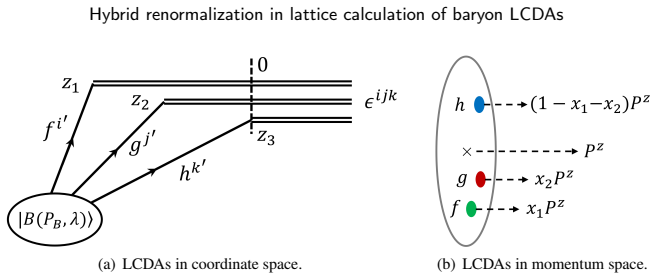
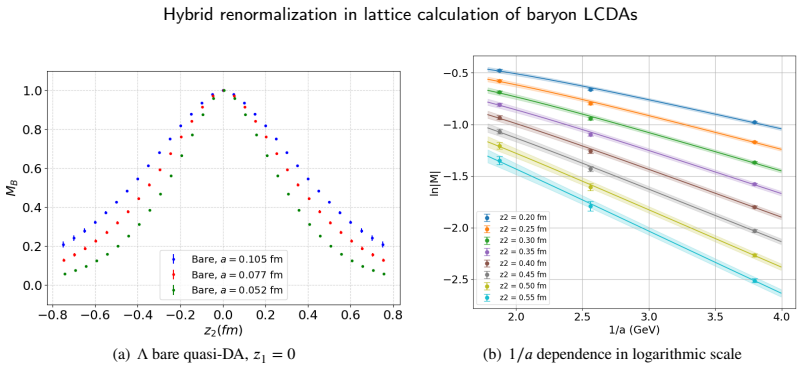
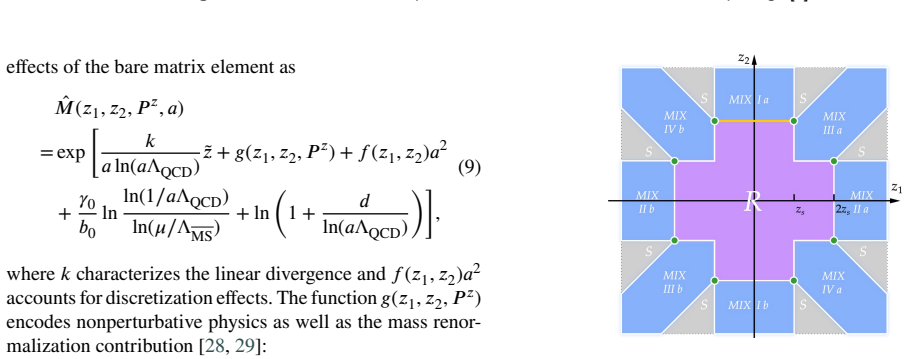
At the 2025 International Conference on the Structure of Baryons (Baryons 2025), I presented our recent progress in lattice calculations of baryon light-cone distribution amplitudes (LCDAs). In Ref.[1], we implemented a novel hybrid renormalization scheme for octet baryons, leading to reliable determinations of quasi-distribution amplitudes (quasi-DAs). The calculations were performed on $N_f=2+1$ ensembles with stout-smeared clover fermions and a Symanzik-improved gauge action at three lattice spacings, $a = 0.052,0.077,0.105$ fm. The hybrid renormalization removes linear divergences in lattice matrix elements and yields smooth, self-consistent quasi-DAs, providing a solid foundation for LaMET-based extractions of baryon LCDAs. Results at the continuum limit and physical pion mass will be reported in the near future.
Editorial analysis
A structured set of objections, weighed in public.
Referee Report
Summary. The manuscript reports progress on lattice calculations of baryon light-cone distribution amplitudes (LCDAs) for octet baryons. It describes the implementation of a novel hybrid renormalization scheme on Nf=2+1 ensembles with stout-smeared clover fermions and Symanzik-improved gauge action at three lattice spacings (a=0.052, 0.077, 0.105 fm). The central claim is that this scheme removes linear divergences from lattice matrix elements and produces smooth, self-consistent quasi-distribution amplitudes (quasi-DAs), providing a foundation for future LaMET-based extractions at the continuum limit and physical pion mass.
Significance. If validated with explicit results, a hybrid renormalization scheme that systematically removes linear divergences without introducing new uncontrolled systematics would represent a useful technical step toward reliable lattice determinations of baryon LCDAs via LaMET. However, the manuscript provides no supporting data, equations, or validation, so no assessment of significance is possible.
major comments (1)
- The entire manuscript is a high-level conference abstract with no operator definitions, renormalization factors, fitting procedures, numerical matrix elements, error analysis, or validation plots at the three lattice spacings. This absence makes it impossible to verify the claim that the hybrid scheme removes linear divergences and yields smooth quasi-DAs (Abstract).
Simulated Author's Rebuttal
We thank the referee for reviewing the manuscript. The submission is a brief conference report summarizing progress presented at Baryons 2025 rather than a full technical paper. We respond to the major comment below.
read point-by-point responses
-
Referee: The entire manuscript is a high-level conference abstract with no operator definitions, renormalization factors, fitting procedures, numerical matrix elements, error analysis, or validation plots at the three lattice spacings. This absence makes it impossible to verify the claim that the hybrid scheme removes linear divergences and yields smooth quasi-DAs (Abstract).
Authors: We agree that the manuscript, as written, is a concise conference abstract and does not contain operator definitions, renormalization factors, fitting procedures, numerical matrix elements, error analysis, or validation plots. This is by design for the conference format, which limits length and emphasizes the overall approach and outlook. The hybrid renormalization scheme and resulting quasi-DAs are described at a summary level, with the supporting technical details and data reserved for a separate, forthcoming publication. Consequently, independent verification of the specific claims cannot be performed from the current text alone. revision: no
Circularity Check
No significant circularity
full rationale
The supplied text is a short conference progress report that asserts implementation of a hybrid renormalization scheme on specific lattice ensembles and references prior work in Ref.[1] for the scheme itself. No equations, operator definitions, renormalization factors, fitting procedures, or derivation steps are presented that could reduce a claimed prediction or result to its own inputs by construction. The self-citation is not load-bearing for any mathematical claim within this document, and the central statements remain descriptive rather than deductive. This is the most common honest finding for high-level method summaries without internal derivations.
Axiom & Free-Parameter Ledger
Reference graph
Works this paper leans on
-
[1]
H.Bai,etal.(LatticePartonCollaboration(LPC)), Hybridrenormal- izationfordistributionamplitudeofalightbaryoninlargemomentum effective theory, Phys. Rev. D 112 (2025) 114515
2025
-
[2]
Aaij, et al
R. Aaij, et al. (LHCb), Observation of charge–parity symmetry breaking in baryon decays, Nature 643 (2025) 1223–1228
2025
-
[3]
V. L. Chernyak, A. R. Zhitnitsky, Asymptotic Behavior of Exclusive Processes in QCD, Phys. Rept. 112 (1984) 173
1984
-
[4]
V. L. Chernyak, A. A. Ogloblin, I. R. Zhitnitsky, Wave Functions of Octet Baryons, Yad. Fiz. 48 (1988) 1410–1422
1988
-
[5]
V. M. Braun, S. E. Derkachov, G. P. Korchemsky, A. N. Manashov, Baryon distribution amplitudes in QCD, Nucl. Phys. B 553 (1999) 355–426
1999
-
[6]
Braun, R
V. Braun, R. J. Fries, N. Mahnke, E. Stein, Higher twist distribution amplitudes of the nucleon in QCD, Nucl. Phys. B 589 (2000) 381–
2000
-
[7]
[Erratum: Nucl.Phys.B 607, 433–433 (2001)]
2001
-
[8]
P. Wein, A. Schäfer, Model-independent calculation of SU(3) 𝑓 violation in baryon octet light-cone distribution amplitudes, JHEP 05 (2015) 073
2015
-
[9]
G. S. Bali, et al., Light-cone distribution amplitudes of the baryon octet, JHEP 02 (2016) 070
2016
-
[10]
G.S.Bali,etal.(RQCD), Light-conedistributionamplitudesofoctet baryons from lattice QCD, Eur. Phys. J. A 55 (2019) 116
2019
-
[11]
G.S.Bali,V.M.Braun,S.Bürger,M.Göckeler,M.Gruber,F.Kaiser, B.A.Kniehl,O.L.Veretin,P.Wein(RQCD), Updateddetermination oflight-conedistributionamplitudesofoctetbaryonsinlatticeQCD, Phys. Rev. D 111 (2025) 094517
2025
-
[12]
Ji, Parton Physics on a Euclidean Lattice, Phys
X. Ji, Parton Physics on a Euclidean Lattice, Phys. Rev. Lett. 110 (2013) 262002
2013
-
[13]
China Phys
X.Ji, PartonPhysicsfromLarge-MomentumEffectiveFieldTheory, Sci. China Phys. Mech. Astron. 57 (2014) 1407–1412
2014
-
[14]
Hua, M.-H
J. Hua, M.-H. Chu, P. Sun, W. Wang, J. Xu, Y.-B. Yang, J.-H. Zhang, Q.-A. Zhang (Lattice Parton), Distribution Amplitudes of K* and𝜙 at the Physical Pion Mass from Lattice QCD, Phys. Rev. Lett. 127 (2021) 062002
2021
-
[15]
J.Hua,etal.(LatticeParton), PionandKaonDistributionAmplitudes from Lattice QCD, Phys. Rev. Lett. 129 (2022) 132001
2022
-
[16]
Han, et al
X.-Y. Han, et al. (Lattice Parton), Calculation of heavy meson light- cone distribution amplitudes from lattice QCD, Phys. Rev. D 111 (2025) 034503
2025
-
[17]
Chu, et al
M.-H. Chu, et al. (Lattice Parton), Light cone distribution amplitude fortheΛbaryonfromlatticeQCD, Phys.Rev.D111(2025)034510
2025
-
[18]
C. Han, W. Wang, J. Zeng, J.-L. Zhang, Lightcone and quasi distribution amplitudes for light octet and decuplet baryons, JHEP 07 (2024) 019
2024
-
[19]
Z.-F. Deng, C. Han, W. Wang, J. Zeng, J.-L. Zhang, Light-cone distributionamplitudesofalightbaryoninlarge-momentumeffective theory, JHEP 07 (2023) 191
2023
-
[20]
Zeng, Light-Cone Distribution Amplitudes of Light Baryons in Large-momentum Effective Theory, PoS QCHSC24 (2025) 097
J. Zeng, Light-Cone Distribution Amplitudes of Light Baryons in Large-momentum Effective Theory, PoS QCHSC24 (2025) 097
2025
-
[21]
Y.-J. Shi, J. Zeng, Factorization formula connecting theΛ𝑏 LCDA in QCD and boosted HQET, JHEP 05 (2026) 212
2026
-
[22]
Hu, et al
Z.-C. Hu, et al. (CLQCD), Quark masses and low-energy constants inthecontinuumfromthetadpole-improvedcloverensembles, Phys. Rev. D 109 (2024) 054507
2024
-
[23]
Zhang, A
R. Zhang, A. V. Grebe, D. C. Hackett, M. L. Wagman, Y. Zhao, Kinematically enhanced interpolating operators for boosted hadrons, Phys. Rev. D 112 (2025) L051502
2025
-
[24]
G. S. Bali, B. Lang, B. U. Musch, A. Schäfer, Novel quark smearing for hadrons with high momenta in lattice QCD, Phys. Rev. D 93 (2016) 094515. M.-H. Zhang:Preprint submitted to ElsevierPage 4 of 5 Hybrid renormalization in lattice calculation of baryon LCDAs
2016
-
[25]
Hasenfratz, F
A. Hasenfratz, F. Knechtli, Flavor symmetry and the static potential with hypercubic blocking, Phys. Rev. D 64 (2001) 034504
2001
-
[26]
T. A. DeGrand, A. Hasenfratz, T. G. Kovacs, Improving the chiral properties of lattice fermions, Phys. Rev. D 67 (2003) 054501
2003
-
[27]
W. I. Jay, E. T. Neil, Bayesian model averaging for analysis of lattice field theory results, Phys. Rev. D 103 (2021) 114502
2021
-
[28]
Huo, et al
Y.-K. Huo, et al. (Lattice Parton (LPC)), Self-renormalization of quasi-light-front correlators on the lattice, Nucl. Phys. B 969 (2021) 115443
2021
-
[29]
Ji, Matching perturbative and nonperturbative physics with power accuracy in heavy quark effective theory (1995)
X.-D. Ji, Matching perturbative and nonperturbative physics with power accuracy in heavy quark effective theory (1995)
1995
-
[30]
R.Zhang,J.Holligan,X.Ji,Y.Su, Leadingpoweraccuracyinlattice calculationsofpartondistributions, Phys.Lett.B844(2023)138081
2023
-
[31]
C. Han, Y. Su, W. Wang, J.-L. Zhang, Hybrid renormalization for quasi distribution amplitudes of a light baryon, JHEP 12 (2023) 044
2023
-
[32]
X.Ji,Y.Liu,A.Schäfer,W.Wang,Y.-B.Yang,J.-H.Zhang,Y.Zhao, A Hybrid Renormalization Scheme for Quasi Light-Front Correla- tionsinLarge-MomentumEffectiveTheory,Nucl.Phys.B964(2021) 115311
2021
-
[33]
M.-H. Zhang, Hybrid Renormalization for Baryon Distribution Amplitudes from Lattice QCD in LaMET, in: 26th International Symposium on Spin Physics, 2026.arXiv:2604.12419
Pith/arXiv arXiv 2026
-
[34]
J.-l.Zhang,M.-H.Zhang, Hybridrenormalizationwithgradientflow for baryon quasidistribution amplitudes, Phys. Rev. D 113 (2026) 014501. M.-H. Zhang:Preprint submitted to ElsevierPage 5 of 5
2026
discussion (0)
Sign in with ORCID, Apple, or X to comment. Anyone can read and Pith papers without signing in.