Bandwidth Is Not Enough: "Hidden" Outlier Noise and Its Mitigation
Pith reviewed 2026-05-25 00:52 UTC · model grok-4.3
The pith
Outlier interference hidden in signals can be mitigated in real time by intermittently nonlinear filters that observe excess band.
A machine-rendered reading of the paper's core claim, the machinery that carries it, and where it could break.
Core claim
Outlier interference (including that caused by nonlinear signal distortions, e.g. clipping) can be efficiently mitigated in real-time using intermittently nonlinear filters. Depending on the interference nature and composition, improvements in the quality of the signal of interest achieved by such filtering will vary from 'no harm' to substantial. The excess-band observation of outlier noise enables its efficient in-band mitigation, and the approach works even for challenging waveforms such as broadband chirps and high-crest-factor OFDM signals that severely obscure low-amplitude outlier noise.
What carries the argument
Intermittently nonlinear filters that use excess-band observations to separate and suppress outlier noise while leaving the in-band signal of interest intact.
If this is right
- Real-time mitigation is possible for both wide-band and narrow-band outlier noise using complementary filter arrangements.
- The same structures can be realized in effectively analog digital implementations.
- Channel capacity can increase when the mitigation is applied to interference from clipping or impulsive sources.
- Performance gains hold across radar, sonar, and spread-spectrum signals that use chirps.
Where Pith is reading between the lines
- The approach may reduce reliance on wider bandwidth allocations when the dominant impairment is outlier noise rather than thermal noise.
- Hardware platforms built for these filters could serve as testbeds for other non-Gaussian noise problems in sensor arrays.
- The method suggests a general separation principle that could be tested on recorded field data from existing communication links.
Load-bearing premise
The outlier characteristics of interference remain observable and separable via excess-band measurements even when the signal waveform itself severely obscures low-amplitude outlier noise.
What would settle it
A controlled test on a broadband chirp or high-crest-factor OFDM waveform in which excess-band measurements show no separable outlier component and the intermittently nonlinear filter produces no measurable improvement in output SNR or error rate.
Figures




read the original abstract
In addition to ever-present thermal noise, communication and sensor systems can contain significant amounts of interference with outlier (e.g. impulsive) characteristics. Such outlier interference (including that caused by nonlinear signal distortions, e.g. clipping) can be efficiently mitigated in real-time using intermittently nonlinear filters. Depending on the interference nature and composition, improvements in the quality of the signal of interest achieved by such filtering will vary from "no harm" to substantial. In this tutorial, we explain in detail why the underlying outlier nature of interference often remains obscured, discussing the many challenges and misconceptions associated with state-of-art analog and/or digital nonlinear mitigation techniques, especially when addressing complex practical interference scenarios. We then focus on the methodology and tools for real-time outlier noise mitigation, demonstrating how the "excess band" observation of outlier noise enables its efficient in-band mitigation. We introduce the basic real-time nonlinear components that are used for outlier noise filtering and provide examples of their implementation. We further describe complementary nonlinear filtering arrangements for wide- and narrow-band outlier noise reduction, providing illustrations of their performance and the effect on channel capacity. Finally, we outline "effectively analog" digital implementations of these filtering structures, discuss their broader applications, and comment on the ongoing development of the platform for their demonstration and testing. To emphasize the effectiveness and versatility of this approach, in our examples we use particularly challenging waveforms that severely obscure low-amplitude outlier noise, such as broadband chirp signals (e.g. used in radar, sonar, and spread-spectrum communications) and "bursty," high crest factor signals (e.g. OFDM).
Editorial analysis
A structured set of objections, weighed in public.
Referee Report
Summary. The manuscript is a tutorial claiming that outlier (impulsive) interference—including that arising from nonlinear distortions such as clipping—remains hidden in conventional observations but can be efficiently mitigated in real time by intermittently nonlinear filters that exploit excess-band observations for in-band reconstruction. It asserts that the resulting quality improvements for the signal of interest range from “no harm” to substantial, even when the signal of interest consists of broadband chirps or high-crest-factor OFDM waveforms that themselves obscure low-amplitude outliers, and it supplies implementation examples, complementary wide-/narrow-band arrangements, and capacity illustrations.
Significance. If the excess-band separability and real-time reconstruction steps hold for the cited waveform classes, the approach would supply a bandwidth-efficient, implementable alternative to conventional linear or purely digital nonlinear mitigation, with direct relevance to radar, sonar, and spread-spectrum links. The tutorial format, emphasis on “effectively analog” digital realizations, and explicit performance illustrations on challenging signals constitute concrete strengths.
major comments (1)
- [Abstract (and the methodology section that introduces excess-band observation)] The central claim that excess-band observations remain informative for intermittently nonlinear filtering even when the signal of interest produces large self-peaks (broadband chirps, high-CFR OFDM) is load-bearing, yet the manuscript provides no explicit analysis or detector design that distinguishes interference-induced outliers from signal-induced excursions; without such handling the filter risks either passing residual interference or attenuating legitimate signal components, undermining the “no harm to substantial improvement” guarantee.
minor comments (2)
- Notation for the basic nonlinear components (e.g., the intermittently nonlinear operators) should be introduced with explicit block diagrams or pseudocode before the wide-/narrow-band arrangement figures are presented.
- The capacity illustrations would benefit from explicit statement of the SNR and interference-to-signal ratios used, together with the number of Monte-Carlo realizations underlying each curve.
Simulated Author's Rebuttal
We thank the referee for their constructive review and for highlighting a key aspect of the central claim. We respond to the major comment below.
read point-by-point responses
-
Referee: [Abstract (and the methodology section that introduces excess-band observation)] The central claim that excess-band observations remain informative for intermittently nonlinear filtering even when the signal of interest produces large self-peaks (broadband chirps, high-CFR OFDM) is load-bearing, yet the manuscript provides no explicit analysis or detector design that distinguishes interference-induced outliers from signal-induced excursions; without such handling the filter risks either passing residual interference or attenuating legitimate signal components, undermining the “no harm to substantial improvement” guarantee.
Authors: The manuscript's methodology section explains that intermittently nonlinear filters are activated by excess-band observations, where the signal of interest (including broadband chirps and high-CFR OFDM) does not produce the same outlier signatures as impulsive interference; the excess band thereby supplies the separability needed for in-band reconstruction. The tutorial supplies concrete performance illustrations on precisely these challenging waveforms, showing outcomes ranging from no harm to substantial improvement and thereby indicating that legitimate signal excursions are not attenuated. We agree, however, that an expanded discussion of the detection threshold and reconstruction logic in the excess band would make the distinction more explicit. We will add this clarification to the methodology section in revision. revision: partial
Circularity Check
No circularity: tutorial description with no load-bearing derivations or self-referential fits
full rationale
The paper is a tutorial-style exposition of intermittently nonlinear filtering for outlier noise mitigation via excess-band observations. No equations, parameter fits, predictions, or uniqueness theorems appear in the abstract or described content. Central claims rest on explanatory methodology and waveform examples rather than any chain that reduces outputs to inputs by definition, self-citation, or renaming. The reader's assessment of score 1.0 aligns with absence of detectable circular steps under the enumerated patterns.
Axiom & Free-Parameter Ledger
Reference graph
Works this paper leans on
-
[1]
General filtering effects: For example, as illustrated in Fig. 1, apparent outliers in a signal can disappear and reappear due to various filtering effects, including fading and multipath, as the signal propagates through media and/or the signal processing chain, and such filtering can make apparent outliers wax and wane. In the analog domain, such filtering ...
-
[2]
“Outliers” vs “outlier noise” ambiguity: Even when the wideband noise itself contains clearly identifiable outliers, the noise outliers would not necessarily be observable as outliers in the signal+noise mixture. That would be the case, e.g., when the typical amplitude of the noise outliers is not significantly larger than that of the signal of interest. In...
-
[3]
Insufficient observation bandwidth: Once outlier noise becomes apparent, additional reduction in bandwidth typically makes it less evident. Fig. 3 illustrates the basic mechanism of outlier noise “disappearance” with the reduction in observation bandwidth. First note that a band-limited signal will not be affected by the change in the bandwidth of a filter,...
-
[4]
Spectral ambiguity: Neither power spectral densities (PSDs) nor their short-time versions (e.g. spectrograms) allow us to reliably identify outliers, as signals with very distinct temporal and/or amplitude structures can have identical spectra. Fig. 4 provides an emblematic example of such spectral ambiguity, depicting an impulse and a chirp signals with ...
-
[5]
histograms) are also highly ambiguous as an outlier- detection tool
Ambiguity of amplitude densities: Amplitude distributions (e.g. histograms) are also highly ambiguous as an outlier- detection tool. Although a super-Gaussian (heavy-tailed) amplitude distribution normally indicates presence of outliers, it does not necessarily reveal presence or absence of outlier noise in a signal+noise mixture. For example, two identic...
-
[6]
Wide range of powers across spectrum: Further, the outlier noise can be obscured by strong non-outlier signals, such as the thermal noise and/or adjacent channel interference, or by the signal of interest itself. More important, a wide range of powers across a wideband spectrum allows a signal containing outlier noise to have any type of amplitude distrib...
-
[7]
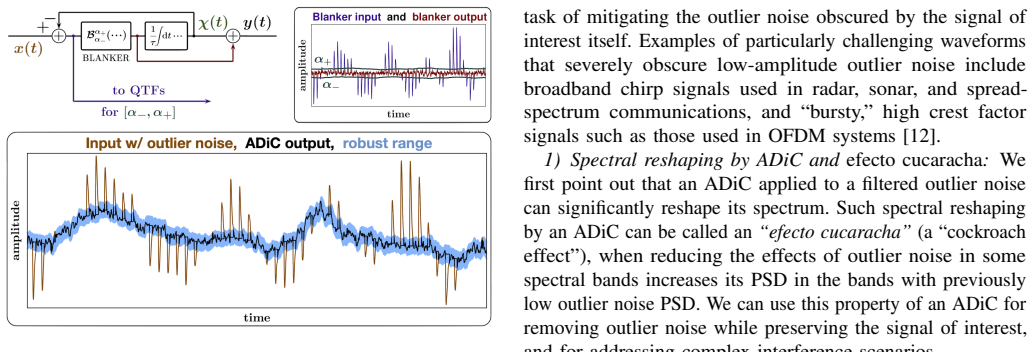
ADiC as main building block: Fig. 6 illustrates the basic concept of an Analog Differential Clipper (ADiC) for wideband outlier noise removal while preserving the signal of interest and the wideband non-outlier noise. First, we establish a robust range that excludes noise outliers while including the signal of interest. Then, we replace the outlier values...
-
[8]
7 shows a Quantile Tracking Filter (QTF) introduced in [2], [7] and described in detail in [4]
QTFs for robust range: Fig. 7 shows a Quantile Tracking Filter (QTF) introduced in [2], [7] and described in detail in [4]. Given the input y(t), the output Qq(t) of a QTF approximates (“tracks”) the q-th quantile of y(t) obtained in a moving time window. (See [8], [9] for discussion of quantiles of continuous signals.) Then various linear combinations of...
-
[9]
the arithmetic mean of the QTF outputs for the 1st and the 3rd quartiles)
Basic ADiC structure: In the basic ADiC structure the range is constructed as a range between Tukey’s fences, and the mid-range is the arithmetic mean of these QTF fences (i.e. the arithmetic mean of the QTF outputs for the 1st and the 3rd quartiles)
-
[10]
Much better way: Feedback-based ADiC: Fig. 8 presents a feedback-based ADiC variant that has a number of practical advantages and is well suited for mitigation of hidden outlier noise [1]. As the diagram in the upper left of the figure shows, the ADiC output y(t) can be described as y(t) =χ(t) +τ ˙χ(t) ˙χ(t) = 1 τBα+ α− (x(t)−χ(t)) , (2) where x(t) i...
-
[11]
Spectral reshaping by ADiC and efecto cucaracha: We first point out that an ADiC applied to a filtered outlier noise can significantly reshape its spectrum. Such spectral reshaping by an ADiC can be called an “efecto cucaracha” (a “cockroach effect”), when reducing the effects of outlier noise in some spectral bands increases its PSD in the bands with previo...
-
[12]
CAF: Removing outlier noise while preserving signal of interest: For example, Fig. 9 illustrates the use of a Complementary ADiC Filtering (CAF) arrangement employed for mitigation of wideband outlier noise affecting a linear chirp signal. In Fig. 9, the output I of the wideband front-end filter consists of the chirp signal of interest x(t) and the wideban...
-
[13]
CAF vs linear: Effect on channel capacity: We then outline the simulation setup for quantification of the improvements in signal quality provided by the CAF mitigation of outlier noise in comparison with linear filtering, and illustrate the relative increases in the baseband SNRs and in the channel 5 Figure 9. Complementary ADiC filtering (CAF) for removing ...
-
[14]
No harm” (default) CAF configurations: In all these simulations, a “default
“No harm” (default) CAF configurations: In all these simulations, a “default” set of CAF parameters was used, with the “no harm” constraint such that nonlinear filtering does not degrade the resulting signal quality, as compared with the linear filtering, for any signal+noise mixtures. Thus, while providing resistance to outlier noise, in the absence of such...
-
[15]
Digital: Where to get bandwidth?: However, efficient mitigation of wideband outlier noise requires availability of a sufficiently broad excess band, and thus the respectively high ADC sampling rate. In addition, the sampling rate may need to be further increased so that analog differentiation can be replaced by its accurate finite-difference approximation, t...
-
[16]
default” set of CINF parameters satisfies the “no harm
Addressing complex interference scenarios: Although it is perhaps unrealistic to require that any “default” set of CINF parameters satisfies the “no harm” constraint while improving the signal quality for all conceivable interference conditions, this constraint can always be met, for any particular interference scenario, in an ADiC-based filtering. For exam...
-
[17]
Practical configurations: CAF for chirp signals and OFDM: To emphasize the effectiveness and versatility of the CINF approach, we provide a detailed discussion of its practical application to particularly challenging waveforms that severely obscure low-amplitude outlier noise, such as broadband chirp signals (e.g. used in radar, sonar, and spread-spectrum ...
-
[18]
CAF for clipping distortions: Further, we demonstrate the use of CAF for mitigation of clipping distortions as a particular type of outlier interference
-
[19]
Designing development & testing platform: Fig. 11 shows an early prototype of an ADiC development and demonstration board that uses the “effectively analog” implementation approach outlined above. This board employs the 1-bit isolated 2nd order ∆Σ modulator AD7403, implements ADiC-based filtering in FPGA using National Instruments’ (NI’s) reconfigurable I/O...
-
[20]
Hidden outlier noise and its mitigation,
A. V . Nikitin and R. L. Davidchack, “Hidden outlier noise and its mitigation,” IEEE Access, vol. 7, 2019
work page 2019
-
[21]
Analog-domain mitigation of outlier noise in the process of analog-to-digital conversion,
——, “Analog-domain mitigation of outlier noise in the process of analog-to-digital conversion,” in Proc. IEEE Int. Conf. Commun. 2018 (ICC 2018), Kansas City, MO, 20-24 May 2018
work page 2018
-
[22]
Method and apparatus for mitigation of outlier noise,
A. V . Nikitin, “Method and apparatus for mitigation of outlier noise,” Patent, US 10,263,635 (Apr. 16, 2019)
work page 2019
-
[23]
Method and apparatus for nonlinear filtering and for mitigation of interference,
A. V . Nikitin, “Method and apparatus for nonlinear filtering and for mitigation of interference,” US patent applications 16/265,363 (Feb. 1,
- [24]
-
[25]
A. V . Nikitin, M. Epard, J. B. Lancaster, R. L. Lutes, and E. A. Shumaker, “Impulsive interference in communication channels and its mitigation by SPART and other nonlinear filters,” EURASIP J. Adv. Signal Process. , vol. 2012, no. 79, 2012
work page 2012
-
[26]
Pulse pileup effects in counting detectors,
A. V . Nikitin, “Pulse pileup effects in counting detectors,” PhD thesis, University of Kansas, Lawrence, 1998, OCLC Control No. 41141343
work page 1998
-
[27]
A. V . Nikitin and R. L. Davidchack, “Nonlinear rank-based analog loop filters in delta-sigma analog-to-digital converters for mitigation of technogenic interference,” in Proc. IEEE Military Commun. Conf. 2017 (MILCOM 2017), Baltimore, MD, 23-25 Oct. 2017
work page 2017
-
[28]
Signal analysis through analog representation,
——, “Signal analysis through analog representation,” Proc. R. Soc. Lond. A , vol. 459, no. 2033, pp. 1171–1192, 2003
work page 2033
-
[29]
Adaptive approximation of feedback rank filters for continuous signals,
——, “Adaptive approximation of feedback rank filters for continuous signals,” Signal Processing, vol. 84, no. 4, pp. 805–811, 2004. 8
work page 2004
-
[30]
J. W. Tukey, Exploratory Data Analysis . Addison-Wesley, 1977
work page 1977
-
[31]
The influence curve and its role in robust estimation,
F. R. Hampel, “The influence curve and its role in robust estimation,” J. Am. Stat. Assoc. , vol. 69, no. 346, pp. 383–393, 1974
work page 1974
-
[32]
Complementary Intermittently Nonlinear Filtering for Mitigation of Hidden Outlier Interference
A. V . Nikitin and R. L. Davidchack, “Complementary intermittently nonlinear filtering for mitigation of hidden outlier interference,” preprint, http://arxiv.org/abs/1906.01456, 2019. 9
work page internal anchor Pith review Pith/arXiv arXiv 1906
discussion (0)
Sign in with ORCID, Apple, or X to comment. Anyone can read and Pith papers without signing in.