REVIEW 5 major objections 6 minor 6 references
Mapping the Hubbard model to the t-J model using ground state unitary transformations
T0 review · 5 major / 6 minor · reviewed 2026-08-14 · deepseek-v4-flash
Pith's one-line read This paper shows that a unitary transformation optimized from the Hubbard ground state maps the Hamiltonian into effective spin and t-J models, reproducing $J = 4t^2/U$ exchange at half-filling and approximating low-energy levels when…
desk verdict A legitimate new numerical method for deriving effective models, with a clean half-filling check; the doped t-J case is not yet supported and the paper needs major revision. read the letter →
The pith
A machine-rendered reading of the paper's core claim, the machinery that carries it, and where it could break.
The reading
What carries the argument
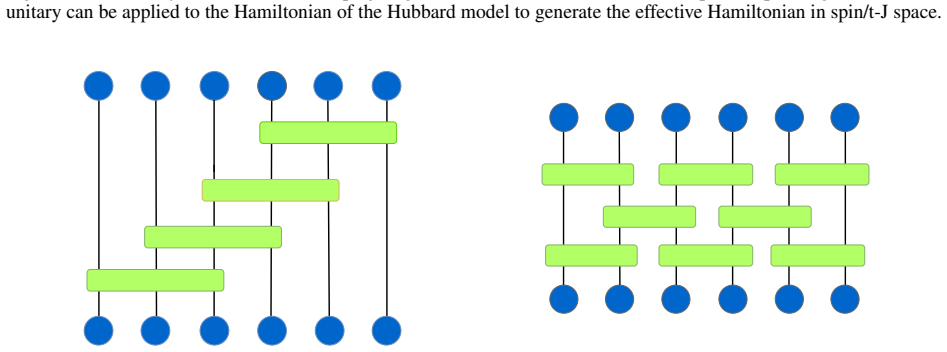
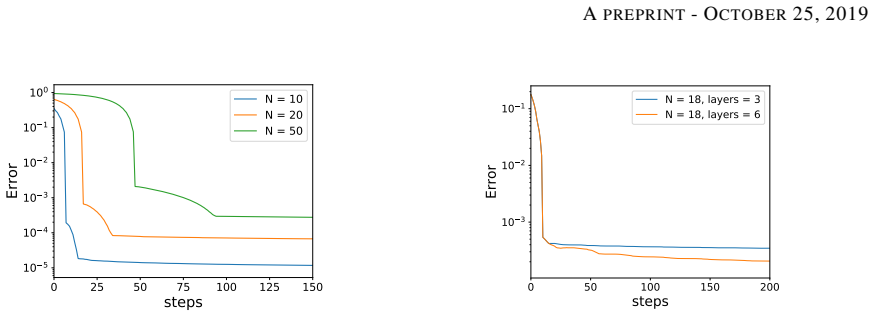
The load-bearing object is a unitary built from layers of local unitary gates, arranged either in a sequential sweep across neighboring sites (DMRG-like gates) or in a hierarchical coarse-graining network (MERA-like gates). The gates are optimized to maximize the overlap between the Hubbard ground state and its projection into the no-double-occupancy subspace, equivalently minimizing the loss given by one minus that overlap. The Hamiltonian is represented as a matrix product operator, so applying the same unitary gives an effective Hamiltonian in tensor-network form. The optimization's accuracy is monitored by convergence of the overlap error with system size and with number of gate layers.
What would settle it
Take a small doped Hubbard cluster (for example $N=6$, $P=4$), build the unitary from the ground-state overlap, apply it to the full Hamiltonian, and compare the first several excitation energies with an exact diagonalization of the original Hubbard model; if the discrepancies do not shrink as the matrix-product-operator cutoff is lowered, the mapping is not a faithful low-energy model.
Extended reading notes
Core claim
The central discovery is that a single unitary, derived purely from ground-state overlap, carries the Hubbard Hamiltonian into an effective model of the same type perturbation theory produces. In the half-filled case the fitted exchange coupling follows $J = 4t^2/U$ over a range of $U$. In the doped case, effective-model eigenvalues track the exact Hubbard levels for the small system studied, but the author also finds that the effective matrix product operator needs large bond dimension and that high-order terms remain sizable, so a short effective Hamiltonian is hard to obtain.
Load-bearing premise
The method assumes that a unitary fixed by the ground state alone, without input from any excited state, also maps the Hamiltonian correctly on the whole low-energy subspace.
Editorial extensions
If this is right
- At half-filling, the numerical unitary gives an effective spin Hamiltonian whose exchange coupling tracks $J=4t^2/U$, so the method reproduces the Heisenberg limit without classifying perturbation orders.
- For doped clusters, the same construction yields a t-J-like effective model whose low-lying levels match the exact Hubbard spectrum on the systems tested.
- The doped mapping is more demanding: useful accuracy requires a smaller cutoff and a larger matrix-product-operator bond dimension, and a few low-order terms do not suffice.
- The convergence behavior with system size and gate layers gives a numerical handle for judging whether a proposed effective model is trustworthy.
Reading between the lines
- A natural extension would be to optimize the unitary using several low-energy states rather than only the ground state; this would likely improve the doped case and could be checked by comparing more energy levels.
- The doped-case difficulty suggests that, away from half-filling, the number of relevant high-order terms grows with doping, so the low-energy description may not localize into a few short-range operators on larger systems.
- The same ground-state-derived unitary construction could be tried for multiband Hubbard or Kondo-lattice models where perturbation theory is uncontrolled, but the ground-state-only caveat would still apply.
Signed reviews
Editorial analysis
A structured set of objections, weighed in public.
Referee Report
Summary. This paper proposes a numerical method to construct effective low-energy Hamiltonians for the Hubbard model. The method optimizes a gate-based unitary transformation that maps the Hubbard ground state onto its projection into the no-double-occupancy sector (spin space at half-filling, t-J space when doped), then applies the same unitary to the Hubbard Hamiltonian to obtain an effective Hamiltonian represented as an MPO. At half-filling, the exchange coupling extracted from the effective Hamiltonian is compared with the perturbative result J = 4t^2/U. For a doped system with N=6 and P=4, low-energy levels of the effective model are compared with the exact Hubbard spectrum as a function of U.
Significance. If the method is made fully reproducible and its key assumption is verified, it would offer a non-perturbative numerical route to effective low-energy models of strongly correlated systems, complementing perturbation theory. The half-filling consistency check in Figure 4 is a clean, parameter-free comparison against the leading-order result, and the paper is candid about the difficulties in the doped case. However, the paper as written does not establish the central claim that the optimized unitary transforms the entire low-energy subspace correctly, and the numerical details are too under-specified to allow reproduction.
major comments (5)
- [Section 2] The loss function is ambiguous: the expression '1 - <psi(0)|psi>' is not meaningful unless both states are normalized, and the projected state is not normalized as defined; the paper also does not specify how the unitary gates are parameterized, initialized, or updated, which prevents reproduction of the method and is load-bearing for the central claim.
- [Sections 2 and 5] The paper assumes that a unitary optimized using only the ground state also transforms the full Hamiltonian into an effective model for the low-energy subspace, but this assumption is not checked; the doped results in Section 5, including 'much worse' accuracy, large MPO bond dimensions, and the importance of high-order terms, indicate that the assumption may already be violated in the doped case.
- [Section 5, Figure 5] The comparison between the effective model and the Hubbard model in the doped case is only qualitative; no numerical error metric is reported, so the claim that the effective model successfully reproduces the low-energy levels is not quantified and cannot be properly assessed.
- [Section 3, Figure 3] The convergence plot shows that the error at a fixed number of steps increases with system size, and for N=50 the error appears to saturate near 10^-1, which is inconsistent with the statement that three-site DMRG-like gates 'can reach very high accuracy'; the paper should quantify the achieved accuracy and discuss the scaling behavior.
- [Eq. (1)] The Hubbard Hamiltonian is miswritten: the hopping term uses the same site index for both creation and annihilation operators, and the interaction term is written as a sum over bonds rather than an on-site term; this makes the central definition ambiguous even if it is only a typographical error.
minor comments (6)
- [Section 3] The MERA disentanglers are attributed to reference [4], which is the DMRG review by Schollwoeck; the correct citation is [5] (Vidal).
- [Section 4] The Heisenberg-model mapping is cited to reference [5], but the appropriate reference is [6] (Cleveland and Medina).
- [Eq. (2)] The spin-spin interaction should be written as S_i · S_j; the dot product is missing.
- [Abstract] 'Matrix product state(MPO)' should read 'matrix product operator (MPO)'.
- [Throughout] There are several typos and formatting issues, for example 'change the of the doubly-occupied sites' in the text after Eq. (3) and 'excited statesexcited states' in Section 5.
- [References] The reference list omits journal and volume information for several entries, including [5] and [6].
Circularity Check
No significant circularity: the effective-model coefficients are validated against external perturbation theory and exact spectra, not encoded in the ground-state optimization.
full rationale
The paper's derivation chain is not circular. The unitary is obtained by optimizing the fidelity between the Hubbard ground state and its projection into the no-double-occupancy sector (Sec. 2), but the effective Hamiltonian is then obtained by applying this unitary to the full Hamiltonian and comparing the resulting low-energy quantities against external benchmarks: (i) at half-filling, the extracted J is compared with perturbation theory J=4t^2/U (Fig. 4), and (ii) for doping, the low-lying levels of the effective model are compared with exact Hubbard levels (Fig. 5). Neither comparison is an input to the optimization. The only quantity that is matched by construction is the ground-state energy, which the paper itself labels 'ground state(targeted)' in Fig. 5; the excited-state comparison, which is the nontrivial content, is not forced by the optimization. The paper also honestly reports that the doped case is much less accurate and requires large MPO bond dimensions (Sec. 5), which is a limitation but not a circular step. There are no load-bearing self-citations: references are to standard DMRG/MERA literature and to independent perturbation-theory work. The Heisenberg and t-J operator forms are assumed as ansatze rather than derived, but that is a modeling choice, not a circular reduction, because the coefficients are fitted from the transformed Hamiltonian and then validated externally.
Assumptions & free parameters
free parameters (3)
- MPO cutoff =
10^-3 (doped case)
- number of gate layers =
3 to 6 (MERA-like)
- gate structure =
3-site DMRG-like vs MERA-like
assumptions (5)
- domain assumption The Hubbard model is the standard single-band Hamiltonian with on-site U, despite the typo in Eq. (1).
- domain assumption The low-energy subspace at strong coupling consists of states with no double occupancy.
- ad hoc to paper A low-depth unitary with the chosen gate structure can represent the exact disentangling transformation.
- domain assumption The same unitary that maps the ground state also maps the Hamiltonian to a valid low-energy effective Hamiltonian.
- domain assumption The effective Hamiltonian has the form of Eq. (2) (Heisenberg) or Eq. (4) (t-J expansion).
Cite this review
Pith. "Pith review of Mapping the Hubbard model to the t-J model using ground state unitary transformations." pith.science (2026). https://pith.science/paper/LAHIMB22
@misc{pith2026190803979,
  author       = {Pith},
  title        = {Pith review of: Mapping the Hubbard model to the t-J model using ground state unitary transformations},
  year         = {2026},
  howpublished = {\url{https://pith.science/paper/LAHIMB22}},
  note         = {Machine review of arXiv:1908.03979}
}
read the original abstract
The effective low-energy models of the Hubbard model are usually derived from perturbation theory. Here we derive the effective model of the Hubbard model in spin space and t-J space using a unitary transformation from numerical optimization. We represent the Hamiltonian as Matrix product state(MPO) and represent the unitary transformation using gates according to tensor network methods. We obtain this unitary transformation by optimizing the unitary transformation between the ground state of the Hubbard model and the projection of the Hubbard model ground state into spin space and t-J space. The unitary transformation we get from numerical optimization yields effective models that are in line with perturbation theories. This numerical optimization method starting from ground state provides another approach to analyze effective low-energy models of strongly correlated electron systems.
Figures

Figures from the paper (3 more)


Reference graph
Works this paper leans on
-
[1]
K. A. Chao, J. Spalek, A. M. Oles Canonical perturbation expansion of the Hubbard model In Phys. RevB. 18.3453 4 A PREPRINT - OCTOBER 25, 2019
work page 2019
-
[2]
L. L. Foldy and S. A. Wouthuysen , Phys. Rev. 78, 29 (1950)
work page 1950
-
[3]
A. L. Chernyshev, D. Galanakis, P. Phillips, A. V . Rozhkov, and A.-M. S. Tremblay Higher order corrections to effective low-energy theories for strongly correlated electron systems. Phys. RevB. 70, 235111 , 2004
work page 2004
-
[4]
Ulrich Schollwoeck The density-matrix renormalization group arXiv:cond-mat/0409292
-
[5]
Vidal A class of quantum many-body states that can be efficiently simulated arXiv:quant-ph/0610099
G. Vidal A class of quantum many-body states that can be efficiently simulated arXiv:quant-ph/0610099
-
[6]
Cleveland and Rodrigo Medina A
Charles L. Cleveland and Rodrigo Medina A. Obtaining a Heisenberg Hamiltonian from the Hubbard model American Journal of Physics 44, 44 (1976) . 5
work page 1976
Reviewed August 14, 2026 · model on record in the stance chip above.
Discussion (0). Continue with ORCID to comment.