REVIEW 2 major objections 4 minor 32 references
On the weak and strong Lefschetz properties for initial ideals of determinantal ideals with respect to diagonal monomial orders
T0 review · 2 major / 4 minor · reviewed 2026-08-07 · deepseek-v4-flash
Pith's one-line read For $t=\min\{m,n\}$, the initial ideal ring $R/\mathrm{in}(I_t)$ has the strong Lefschetz property; for smaller $t$, explicit matrix-size thresholds force the weak Lefschetz property to fail.
desk verdict The central Betti-number lemma is false as stated, and the paper's WLP-failure proof collapses; the SLP result for maximal minors may still survive repair, but the current manuscript is not publishable. read the letter →
The pith
A machine-rendered reading of the paper's core claim, the machinery that carries it, and where it could break.
The reading
What carries the argument
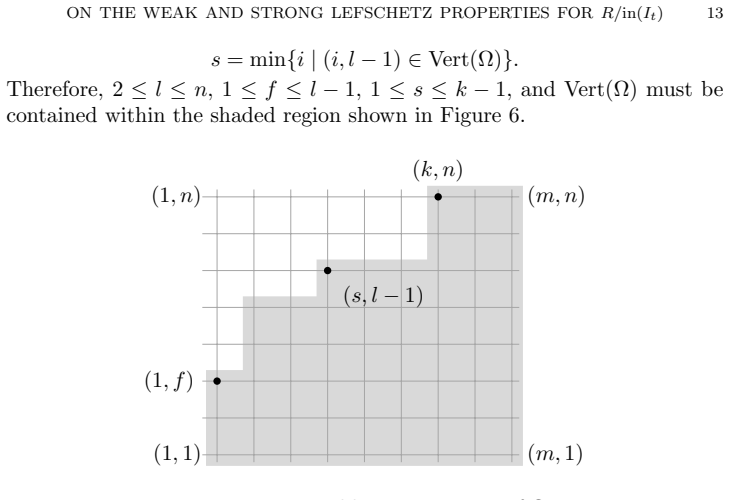
The machinery is simplicial. Because the $t$-minors form a Gröbner basis under a diagonal monomial order, $\mathrm{in}(I_t)$ is a square-free monomial ideal, and its Stanley–Reisner complex $\Delta(t,m,n)$ has facets described as families of nonintersecting monotone paths in the $m\times n$ grid. The paper restricts $\Delta(t,m,n)$ to specially chosen vertex sets $V_a(t,m,n)$ of size $h+t-1$, giving subcomplexes $\Omega_a(t,m,n)$. Hochster's formula converts the Betti number $\beta_{h,h+t-1}$ into a sum of reduced homology groups of these restrictions, and Lemma 3.7 uses an induction on $t$ with links and a Cohen–Macaulayness argument to show each contributes at least one unit of $\tilde{H}_{t-2}$. The Lefschetz conclusion then comes from two counting mechanisms: Lemma 2.1 converts the nonzero homology into a non-injectivity statement, and Lemma 4.4's Hilbert-function inequality converts the same numerical setup into non-surjectivity.
What would settle it
Run the supplied computer algebra code (or an independent computation) for a small non-maximal case such as $t=3$, $m=n=5$ or $t=4$, $m=n=6$ and check whether $\beta_{h,h+t-1}(R/\mathrm{in}(I_t))\ge t$ holds; a value below $t$ would refute Theorem 1.2. A direct combinatorial test is to search the complex $\Delta(t,m,n)$ for a set of $t-1$ vertices of $\Gamma$ that is not a face; the smallest such failure would identify exactly where Lemma 3.7 breaks. Independently computing the reduced homology $\tilde{H}_{t-2}(\Omega_a(t,m,n);K)$ for all $a$ would either confirm the lower bound or expose the missing homology.
Extended reading notes
Core claim
The central claim is that the graded Betti number $\beta_{h,h+t-1}(R/\mathrm{in}(I_t))$ is at least $t$ for every $2\le t\le\min\{m,n\}$ with $t<\max\{m,n\}$, where $h=(m-t+1)(n-t+1)$ is the height of $\mathrm{in}(I_t)$. A nonzero entry in this Betti position means the Artinian reduction of $R/\mathrm{in}(I_t)$ has a socle element in degree $t-1$, and Lemma 2.1 turns that into the statement that multiplication by any linear form fails to be injective. Lemma 4.4 shows that when $F_t(m,n)=\binom{h+t-2}{t}-\binom{m}{t}\binom{n}{t}\ge 0$, the Hilbert function in degree $t$ is at most the Hilbert function in degree $t-1$, so the same multiplication map also fails to be surjective; together these force the weak Lefschetz property to fail. The thresholds in the Main Theorem are exactly the ranges where this Hilbert-function inequality holds, with one boundary pair checked by computer. In the complementary maximal-minor case the initial ideal has a $t$-linear resolution and its Artinian reduction is isomorphic to $K[Y_1,\ldots,Y_h]/(Y_1,\ldots,Y_h)^t$, a ring with the strong Lefschetz property, which proves the SLP for $R/\mathrm{in}(I_t)$.
Load-bearing premise
In the proof of Lemma 3.7 the paper asserts, with a reference to Remark 2.10, that every set of $t-1$ vertices of the deleted complex $\Gamma$ is a face; this amounts to claiming that the path complex is a matroid complex of rank $t-1$, a nontrivial combinatorial fact that is neither proved nor cited. If that fact fails, the shellability step and the Cohen–Macaulay conclusion for the $(t-2)$-skeleton collapse, and with them the Betti number lower bound $\beta_{h,h+t-1}\ge t$ and the WLP failure thresholds.
Editorial extensions
If this is right
- For square matrices with $m=n\ge t+2$, the ring $R/I_t$ has the strong Lefschetz property while its square-free initial ideal $R/\mathrm{in}(I_t)$ fails the weak Lefschetz property, giving a negative answer to the open question about preservation under square-free Gröbner degenerations.
- For $t=3$, $m=4$, $n=5$, $R/\mathrm{in}(I_3)$ has the weak Lefschetz property but fails the strong one, while $R/I_3$ has the strong Lefschetz property, so the failure can occur one level up.
- For $t=3$, $m=4$, $n=6$, $R/\mathrm{in}(I_3)$ fails the weak Lefschetz property while $R/I_3$ has the strong Lefschetz property, extending the counterexample to rectangles.
- For $t=2$ the threshold $mn\ge 16$ is sharp: computer calculations show $R/\mathrm{in}(I_2)$ has the strong Lefschetz property for all $mn\le 15$, and similarly $t=3$ has SLP for $m=n=4$ and WLP-without-SLP at $(4,5)$ and $(5,4)$.
- If the equality $\mathrm{gin}(\mathrm{in}(I_t))=\mathrm{gin}(I_t)$ holds for $t=m-1=n-1$, then the bound in the Main Theorem is sharp for every $t$, as the paper raises in its closing question.
Reading between the lines
- The unproved matroidal assertion in Lemma 3.7 — that every $t-1$ vertices of the deleted complex $\Gamma$ form a face — suggests that the real combinatorial core of the Betti lower bound is a matroid structure on the nonintersecting-path complex; a direct proof of that matroid property would place Theorem 1.2 on independent footing and could yield exact Betti numbers rather than the lower bound $t
- The thresholds depend only on $mn$, not on the individual dimensions $m$ and $n$; a natural testable extension is whether WLP failure in the non-maximal case is exactly characterized by the same numerical condition $F_t(m,n)\ge 0$, or whether additional small exceptional rectangles behave differently.
- The same two-step mechanism — a nonzero top Betti number blocking injectivity plus a Hilbert-function gap blocking surjectivity — is portable to other families of ideals whose initial ideals have a nonintersecting-path description, such as ladder determinantal ideals, where the path complexes are replaced by higher-dimensional analogues.
- The contrast with the known sphere result for a different monomial order suggests that among square-free Gröbner degenerations the choice of monomial order controls Lefschetz behavior; comparing initial ideals under diagonal versus other orders might give a sharper criterion for when WLP is preserved.
Editorial analysis
A structured set of objections, weighed in public.
Referee Report
Summary. The paper studies the weak and strong Lefschetz properties for the Stanley–Reisner ring R/in(I_t), where I_t is the ideal of t-minors of an m×n matrix of indeterminates and in(I_t) is taken with respect to a diagonal monomial order. The main theorem claims that R/in(I_t) has the SLP when t=min{m,n}, and that R/in(I_t) fails the WLP for t<min{m,n} under the stated numerical conditions. The proof strategy is to bound a graded Betti number via Hochster's formula using a family of subcomplexes Ω_a(t,m,n), then to convert the Betti-number lower bound into failure of injectivity of multiplication by a linear form, while comparing Hilbert functions to obtain failure of surjectivity. The SLP case for maximal minors is approached through the linear resolution of in(I_t) and a cited characterization of ideals with linear resolutions.
Significance. If the main theorem is correct, the paper provides a substantial family of square-free Gröbner degenerations where Lefschetz properties fail, giving counterexamples to a question of Murai. The paper is largely self-contained, uses standard tools (Hochster's formula, the Wiebe–Murai transfer principle, Conca–Varbaro regularity, and Adiprasito's SLP theorem for spheres), and supplies Macaulay2 code for verification. There are no fitted parameters or circular reductions. However, two load-bearing arguments are not established as written: the key combinatorial assertion in Lemma 3.7 is false, and the cited equivalence in Proposition 4.2 is stated without the hypotheses needed to make it true. These gaps affect both the WLP-failure direction and the SLP direction of the main theorem.
major comments (2)
- [Section 4, Proposition 4.2] The claim that 'Remark 2.10 implies that, for each t−1 vertices v1,...,v_{t−1} of Γ, the set {v1,...,v_{t−1}} is a face of Γ' is false. For t=3, m=n=4, a=0, we have V_0(3,4,4)={(1,1),(1,2),(2,1),(2,2),(3,3),(4,4)} and F={(4,4)}, so (1,2) and (2,1) are vertices of Γ=Ω_0(3,4,4)\{(4,4)}. A face of Δ(3,4,4) must be contained in a family of nonintersecting paths from (1,4),(2,4) to (4,1),(4,2). Any path from (2,4) to (4,2) has all second coordinates at least 2, hence cannot contain (2,1); therefore {(1,2),(2,1)} is not a face of Γ. Consequently Γ^{≤t−2} is not the (t−2)-skeleton of a simplex, and the shellability/Cohen–Macaulay argument proving ~H_{t−3}(Γ)=0 collapses. Since Lemma 3.7 is the only route given to Theorem 1.2, and since Theorem 1.2 is used in Lemma 4.4, the WLP-failure part of the Main Theorem is not proved as written.
- [Section 4, Proposition 4.2] The assertion that [26, Theorem 3.2] gives an equivalence 'J has a t-linear resolution if and only if HF(J,t)=binom(h+t−1,t)' is not valid under the hypotheses stated in the paper. For example, J=(x^2,y^2)⊂K[x,y] has a 2-linear resolution, and K[x,y]/J is Artinian and Cohen–Macaulay, but HF(J,2)=2 while binom(3,2)=3. Thus the forward direction used in the proof is false without additional hypotheses. The conclusion J=(Y_1,...,Y_h)_t, which is essential for the SLP argument for maximal minors, therefore does not follow from the cited theorem as stated. The author should either give the precise hypotheses of the cited result and verify them, or supply a different proof of the structure of the Artinian reduction.
minor comments (4)
- [Definition 2.6] The word 'filed' should be 'field'.
- [Lemma 3.7] Even if the face claim were true, the citation to Remark 2.10 would be incomplete: Remark 2.10 only describes the facets of Δ(t,m,n) and does not directly assert that arbitrary sets of t−1 vertices lie in a common face, so the inference needs a separate proof.
- [Section 5] The Macaulay2 code is useful and reproducible, but the printed code has formatting and line-break issues that make it difficult to verify directly from the PDF; the GitHub link is therefore important and should be prominently referenced.
- [Remark 4.5] The use of Rubey–Stump's result in [27] is qualified by a footnote explaining that the proof was not formally published; this qualification should be stated in the main text as well, since the SLP of R/I_t depends on it.
Circularity Check
No significant circularity: the derivation relies on standard external results and explicit combinatorial and Hilbert-function arguments, with no fitted input renamed as prediction.
full rationale
The paper does not exhibit any of the enumerated circularity patterns. Its main results are derived from standard external tools (Hochster's formula, Wiebe–Murai transfer, Conca–Varbaro regularity/Cohen–Macaulay results, Narasimhan's Gröbner basis theorem, Bruns–Conca linear-resolution facts, and Adiprasito's SLP theorem for simplicial spheres), and none of these citations are self-citations of the author. There are no fitted constants, no parameters calibrated to a subset of data and then presented as predictions, and no model output that is equivalent to its input by construction. The Betti-number argument in Section 3 is an internal induction based on Lemma 2.15 and Lemma 3.7; the latter's disputed combinatorial assertion is a matter of mathematical correctness, not of circularity, since it is not obtained by assuming the conclusion. Proposition 4.2 and Theorem 4.3 similarly reduce to standard ring-theoretic equivalences and explicit inequalities plus Macaulay2 verifications. The manuscript itself even includes a limitation note that the Rubey–Stump proof was not formally published, which is transparency about external support rather than a circular reliance. Therefore no circular step can be quoted, and the appropriate finding is an honest non-finding with score 0.
Assumptions & free parameters
assumptions (5)
- standard math Narasimhan's theorem: the t-minors form a Groebner basis of I_t with respect to any diagonal monomial order, so in(I_t) is square-free.
- standard math Hochster's formula computing graded Betti numbers of Stanley-Reisner ideals from reduced homology of restrictions.
- domain assumption For each t-1 vertices v_1,...,v_{t-1} of Gamma, the set {v_1,...,v_{t-1}} is a face of Gamma (equivalently, Delta(t,m,n) has a matroid complex of rank t-1).
- standard math Conca-Varbaro's result that square-free initial ideals preserve regularity and Cohen-Macaulayness.
- domain assumption Soll-Welker conjecture, proved by Rubey-Stump, that certain monomial order initial ideals define simplicial spheres; Adiprasito's theorem that Stanley-Reisner rings of simplicial spheres have SLP.
Cite this review
Pith. "Pith review of On the weak and strong Lefschetz properties for initial ideals of determinantal ideals with respect to diagonal monomial orders." pith.science (2026). https://pith.science/paper/LBA6EYNQ
@misc{pith2026250605193,
  author       = {Pith},
  title        = {Pith review of: On the weak and strong Lefschetz properties for initial ideals of determinantal ideals with respect to diagonal monomial orders},
  year         = {2026},
  howpublished = {\url{https://pith.science/paper/LBA6EYNQ}},
  note         = {Machine review of arXiv:2506.05193}
}
abstract
We study the weak and strong Lefschetz properties for $R/\mathrm{in}(I_t)$, where $I_t$ is the ideal of a polynomial ring $R$ generated by the $t$-minors of an $m\times n$ matrix of indeterminates, and $\mathrm{in}(I_t)$ denotes the initial ideal of $I_t$ with respect to a diagonal monomial order. We show that when $I_t$ is generated by maximal minors (that is, $t=\mathrm{min}\{m,n\}$), the ring $R/\mathrm{in}(I_t)$ has the strong Lefschetz property for all $m$, $n$. In contrast, for $t<\mathrm{min}\{m,n\}$, we provide a bound such that $R/\mathrm{in}(I_t)$ fails to satisfy the weak Lefschetz property whenever the product $mn$ exceeds this bound. As an application, we present counterexamples that provide a negative answer to a question posed by Murai regarding the preservation of Lefschetz properties under square-free Gr\"obner degenerations.
Figures


Figures from the paper (4 more)



Reference graph
Works this paper leans on
-
[1]
Combinatorial lefschetz theorems beyond positivity, 2018
Karim Adiprasito. Combinatorial lefschetz theorems beyond positivity, 2018. arXiv: 1812.10454
arXiv 2018
-
[2]
Anisotropy, biased pairings, and the lefschetz property for pseudomanifolds and cycles, 2021
Karim Adiprasito, Stavros Argyrios Papadakis, and Vasiliki Petrotou. Anisotropy, biased pairings, and the lefschetz property for pseudomanifolds and cycles, 2021. arXiv: 2101.07245
arXiv 2021
-
[3]
Louis J. Billera and Carl W. Lee. A proof of the sufficiency of mcmullen’s conditions for f-vectors of simplicial convex polytopes. Journal of Combinatorial Theory, Series A, 31(3):237–255, 1981
work page 1981
-
[4]
Anders Bj¨ orner and Michelle L. Wachs. Shellable nonpure complexes and posets i. Transactions of the American Mathematical Society , 348(4):1299–1327, April 1996
work page 1996
-
[5]
Gr¨ obner bases and determinantal ideals
Winfried Bruns and Aldo Conca. Gr¨ obner bases and determinantal ideals. In J¨ urgen Herzog and Victor Vuletescu, editors, Commutative Algebra, Singularities and Com- puter Algebra, pages 9–66, Dordrecht, 2003. Springer Netherlands
work page 2003
-
[6]
Products of borel fixed ideals of maximal minors
Winfried Bruns and Aldo Conca. Products of borel fixed ideals of maximal minors. Advances in Applied Mathematics , 91:1–23, 2017
work page 2017
-
[7]
Determinants, Gr¨ obner Bases and Cohomology
Winfried Bruns, Aldo Conca, Claudiu Raicu, and Matteo Varbaro. Determinants, Gr¨ obner Bases and Cohomology. Springer Monographs in Mathematics. Springer Cham, 1 edition, 2022
work page 2022
-
[8]
Cambridge Studies in Advanced Mathematics
Winfried Bruns and J¨ urgen Herzog.Cambridge University Press . Cambridge Studies in Advanced Mathematics. Springer Cham, 2 edition, 1993
work page 1993
Show all 32 references
-
[9]
Guccione, and Juan J
Leandro Caniglia, Jorge A. Guccione, and Juan J. Guccione. Ideals of generic minors. Communications in Algebra, 18(8):2633–2640, 1990
1990
-
[10]
On short graded algebras
Maria Pia Cavaliere, Maria Evelina Rossi, and Giuseppe Valla. On short graded algebras. In Winfried Bruns and Aron Simis, editors, Commutative Algebra , pages 21–31, Berlin, Heidelberg, 1990. Springer Berlin Heidelberg
1990
-
[11]
Reduction numbers and initial ideals
Aldo Conca. Reduction numbers and initial ideals. Proceedings of the American Math- ematical Society, 131(4):1015–1020, June 2002
2002
-
[12]
Square-free gr¨ obner degenerations
Aldo Conca and Matteo Varbaro. Square-free gr¨ obner degenerations. Inventiones mathematicae, 221:713–730, 09 2020
2020
-
[13]
Grayson and Michael E
Daniel R. Grayson and Michael E. Stillman. Macaulay2, a software system for research in algebraic geometry. Available at http://www2.macaulay2.com
-
[14]
Graduate Texts in Mathematics
J¨ urgen Herzog and Takayuki Hibi.Monomial Ideals. Graduate Texts in Mathematics. Springer London, London, 1 edition, 2011
2011
-
[15]
Cohen-macaulay rings, combinatorics, and simplicial complexes
Melvin Hochster. Cohen-macaulay rings, combinatorics, and simplicial complexes. In Bernard R. McDonald and Robert A. Morris, editors, Ring theory II: Proceedings of the second Oklahoma conference, Lecture notes in pure and applied mathematics, 26, pages 171–223, New York, 1977...
1977
-
[16]
The Theory and Applications of Harmonic Inte- grals
William Vallance Douglas Hodge. The Theory and Applications of Harmonic Inte- grals. Cambridge mathematical library. Cambridge University Press, 1989
1989
-
[17]
L’analysis situs et la g´ eom´ etrie alg´ ebrique
Solomon Lefschetz. L’analysis situs et la g´ eom´ etrie alg´ ebrique. Gauthier-Villars et cie, 1924
1924
-
[18]
Some properties of enumeration in the theory of modular systems
Francis Sowerby Macaulay. Some properties of enumeration in the theory of modular systems. Proceedings of the London Mathematical Society , 26:531–555, 1927
1927
-
[19]
McMullen
P. McMullen. The numbers of faces of simplicial polytopes. Israel Journal of Mathe- matics, 9(4):559–570, 1971
1971
-
[20]
Combinatorial Commutative Algebra
Ezra Miller and Bernd Sturmfels. Combinatorial Commutative Algebra . Graduate Texts in Mathematics. Springer New York, New York, NY, 1 edition, 2005
2005
-
[21]
James R. Munkres. Elements of Algebraic Topology. Addison Wesley Publishing Com- pany, 1984
1984
-
[22]
Algebraic shifting of strongly edge decomposable spheres
Satoshi Murai. Algebraic shifting of strongly edge decomposable spheres. Journal of Combinatorial Theory, Series A , 117(1):1–16, 2010. 30 HONGMIAO YU
2010
-
[23]
The irreducibility of ladder determinantal varieties
Himanee Narasimhan. The irreducibility of ladder determinantal varieties. Journal of Algebra, 102(1):162–185, 1986
1986
-
[24]
The characteristic 2 anisotropicity of simplicial spheres, 2018
Stavros Argyrios Papadakis and Vasiliki Petrotou. The characteristic 2 anisotropicity of simplicial spheres, 2018. arXiv:2012.09815
2018 arXiv
-
[25]
Cohen-macaulay quotients of polynomial rings
Gerald Allen Reisner. Cohen-macaulay quotients of polynomial rings. Advances in Mathematics, 21(1):30–49, 1976
1976
-
[26]
Villarreal
Carlos Renteria and Rafael H. Villarreal. Koszul homology of cohen-macaulay rings with linear resolutions. Proceedings of the American Mathematical Society, 115(1):51– 58, 1992
1992
-
[27]
Crossings and nestings in set partitions of clas- sical types, 2009
Martin Rubey and Christian Stump. Crossings and nestings in set partitions of clas- sical types, 2009. arXiv:0904.1097
2009 arXiv
-
[28]
Type-b generalized triangulations and determinantal ideals
Daniel Soll and Volkmar Welker. Type-b generalized triangulations and determinantal ideals. Discrete Mathematics, 309(9):2782–2797, 2009
2009
-
[29]
Richard P. Stanley. The number of faces of a simplicial convex polytope. Advances in Mathematics, 35(3):236–238, 1980
1980
-
[30]
Gr¨ obner bases and stanley decompositions of determinantal rings
Bernd Sturmfels. Gr¨ obner bases and stanley decompositions of determinantal rings. Mathematische Zeitschrift , 205:137–144, September 1990
1990
-
[31]
g-elements of matroid complexes
Ed Swartz. g-elements of matroid complexes. Journal of Combinatorial Theory, Series B, 88(2):369–375, 2003
2003
-
[32]
The lefschetz property for componentwise linear ideals and gotzmann ideals
Attila Wiebe. The lefschetz property for componentwise linear ideals and gotzmann ideals. Communications in Algebra, 32(12):4601–4611, 2004. Vietnam Institute for Advanced Study in Mathematics, Hanoi, Vietnam Email address : hongmiaoyu@hotmail.com
2004
Reviewed August 7, 2026 · model on record in the stance chip above.
Discussion (0). Sign in to comment.