REVIEW 2 major objections 6 minor 27 references
GPU-Accelerated Polygonal Signed Distance Functions for Real-Time Collision Avoidance
T0 review · 2 major / 6 minor · reviewed 2026-07-11 · grok-4.5
Pith's one-line read A GPU signed-distance function for polygons keeps exact robot-obstacle geometry while the MPC quadratic program stays fixed-size no matter how many obstacles appear.
desk verdict Solid systems paper: geometry-exact edge SDF + fixed-size QP via GPU/CPU split; usable now, scope limited to convex static polygons. read the letter →
The pith
A machine-rendered reading of the paper's core claim, the machinery that carries it, and where it could break.
The reading
What carries the argument
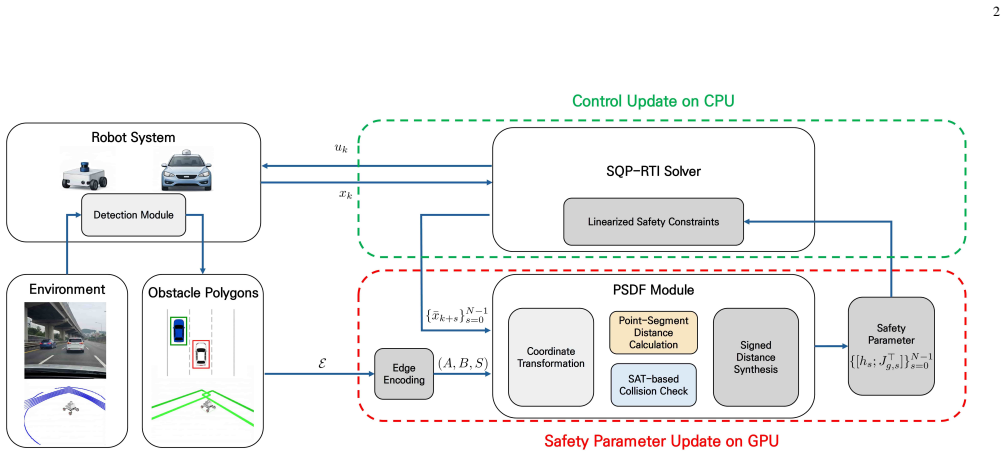
Polygonal Signed Distance Function (PSDF): a weight-free pipeline of robot-local edge transforms, branch-free point-to-segment distances, SAT-based soft-min penetration, and min-reduction that returns signed distances and state gradients for any batch of poses against a padded edge tensor.
What would settle it
In a dense static polygonal scene with a convex robot footprint, measure whether per-step solve time remains essentially constant as obstacle edge count grows while the robot still tracks a tight reference without collision; if either the QP dimension grows with edges or clearance is lost under the reported linearizations, the central claim fails.
Extended reading notes
Core claim
A geometry-exact polygonal signed-distance oracle can be written as a fully tensorized, branch-free GPU pipeline whose outputs linearize into stage-wise safety constraints for SQP-RTI model predictive control; the resulting QP size and sparsity are independent of obstacle feature count, so environment complexity is confined to the parallel collision-oracle workload while the optimizer remains a fixed, sparse real-time problem.
Load-bearing premise
The robot footprint and every obstacle must be convex (or already split into convex pieces) and the obstacle edge set is treated as fixed for the whole prediction horizon.
Editorial analysis
A structured set of objections, weighed in public.
Referee Report
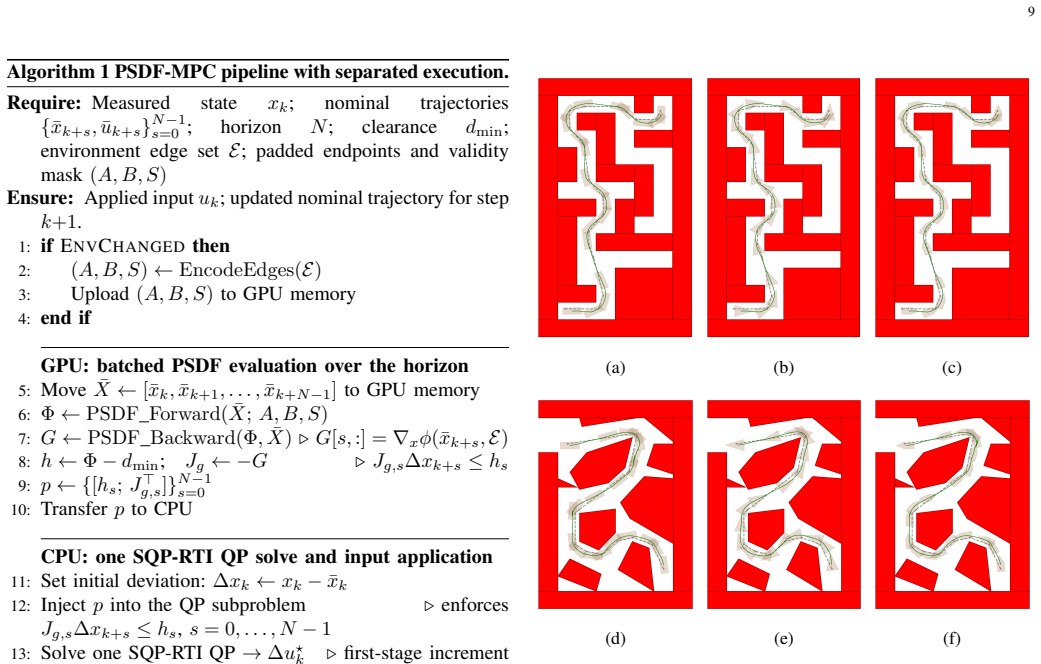
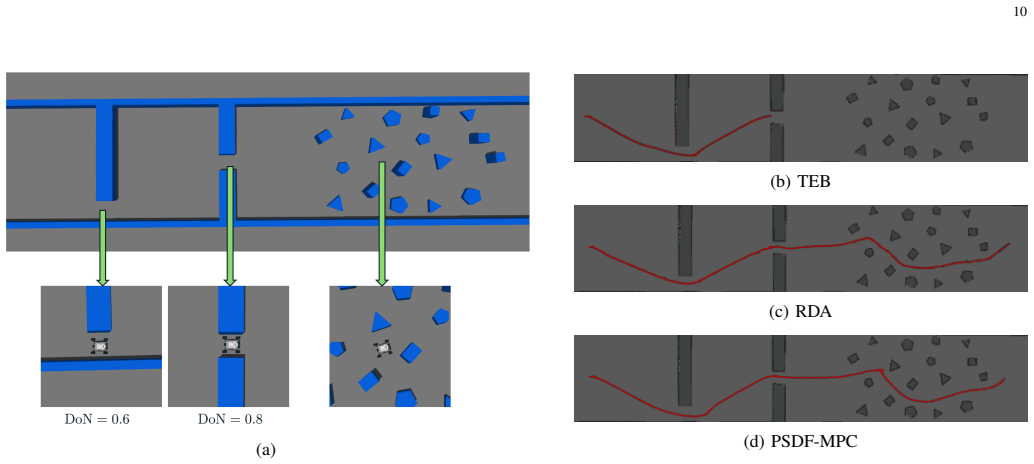
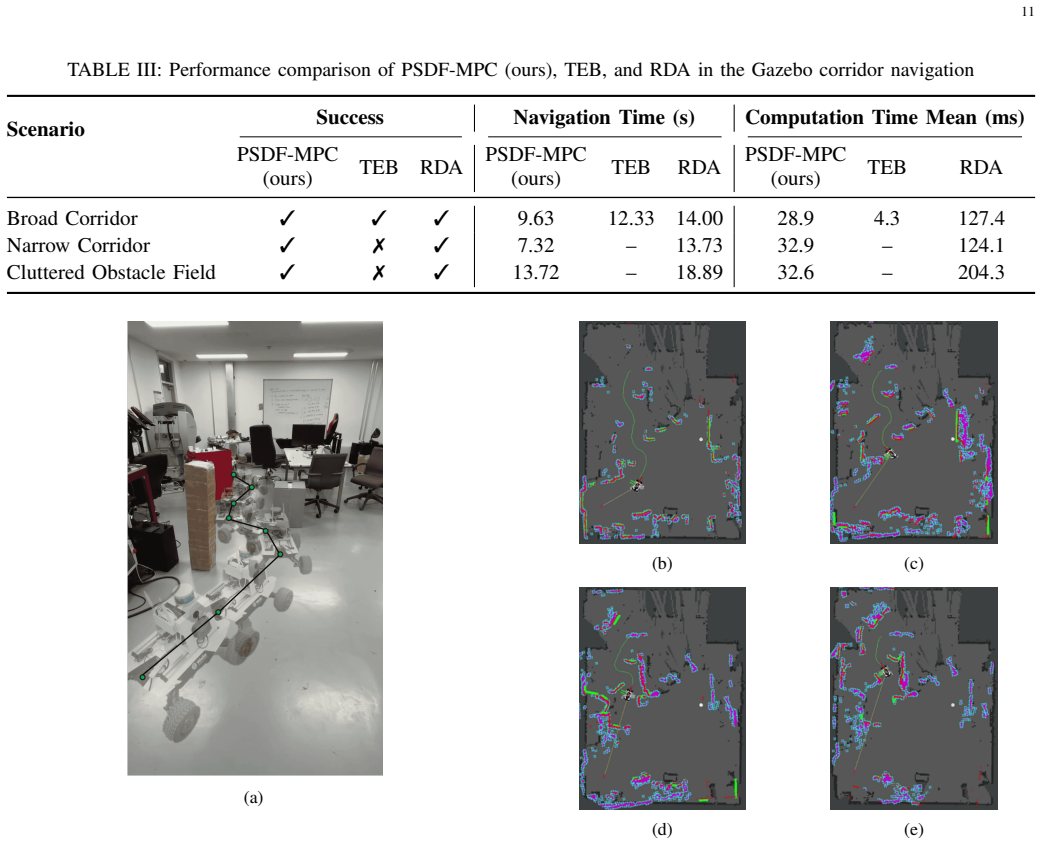
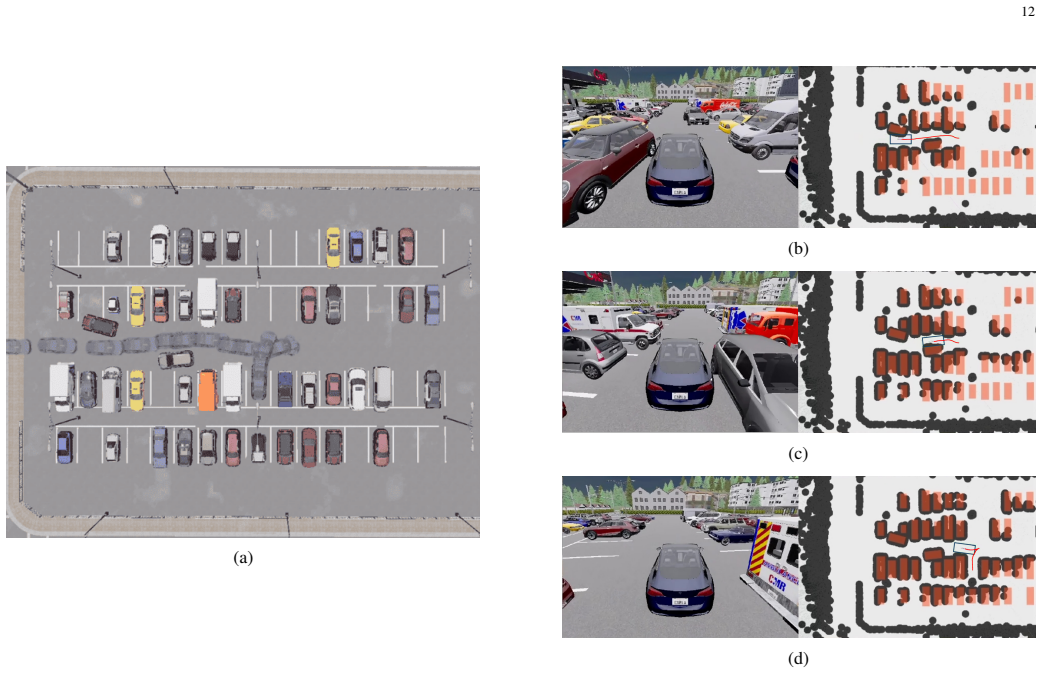
Summary. The paper proposes the Polygonal Signed Distance Function (PSDF), a branch-free, tensorized, GPU-executable signed-distance oracle between a convex polygonal robot footprint and obstacle boundary edges, together with its embedding into SQP-RTI model predictive control (PSDF-MPC). The architecture evaluates batched PSDF values and state gradients on the GPU and injects stage-wise affine safety linearizations into a CPU-side sparse QP whose size depends only on (n_x, n_u, N), not on obstacle feature count. Micro-benchmarks (Table I) compare query latency against GJK+EPA and NPField; closed-loop results in 2D mazes, Gazebo corridors, CARLA parking, and a Jetson+LiDAR Scout Mini deployment (Tables II–III, Figs. 2–5) report real-time feasibility and competitive success/navigation times versus OBCA, DCBF, TEB, and RDA under the paper’s convex, static-horizon setting.
Significance. If the reported scaling and closed-loop behavior hold, the work offers a practical systems-level answer to a recurring bottleneck in optimization-based local planning: geometry-exact polygonal collision constraints without dual variables or obstacle-dependent QP growth. The CPU/GPU separation (Sec. V, Alg. 1) is a clear engineering contribution, and the public ROS/PyTorch release strengthens reproducibility. The evaluation spans micro-benchmarks, multiple simulators, and onboard LiDAR deployment, which is stronger evidence than many related MPC-collision papers. Scope is appropriately limited to convex (or pre-decomposed) polygons and static edge sets over the horizon; within that scope the result is useful for dense planar navigation and parking-style maneuvers.
major comments (2)
- [Abstract; Sec. IV-C, Eq. (31); Sec. IV-D] Abstract and Contribution 1 call PSDF “geometry-exact,” but Sec. IV-C Eq. (31) replaces the hard min penetration depth with a log-sum-exp soft-min controlled by η. Separation distances from the point-to-segment stage are exact for convex polygons; penetration is intentionally smoothed. The exactness claim should be qualified in the abstract, contributions, and Sec. IV-D (e.g., exact when separated; smooth surrogate when penetrating), and the sensitivity of closed-loop behavior to η should be stated or briefly ablated so readers know the approximation is not load-bearing for the reported timings.
- [Sec. VI-D; Fig. 4; Table III] Sec. VI-D and Fig. 4 present real-robot deployment only qualitatively (trajectory and top-down views). Table III quantifies success, navigation time, and mean computation time only in Gazebo. Given the paper’s claim of “real-world navigation experiments” and onboard Jetson execution, at least mean per-step optimization time and a success/failure summary on the physical platform (even without TEB/RDA on-robot) are needed to support the deployability claim at the same standard as the simulation tables.
minor comments (6)
- [Assumption 1; Sec. V-B; Note to Practitioners] Assumption 1 and Sec. V-B correctly state convexity and static-horizon edge sets; the Note to Practitioners and Conclusion already flag dynamic obstacles and perception noise. A short explicit failure-mode paragraph (e.g., incomplete line fits, nonconvex leftovers after decomposition) would help practitioners without changing scope.
- [Sec. IV-D, Eq. (32)] Eq. (32) uses a hard separated_i switch. Values match at contact if d_sep and δ both approach zero, but gradients can jump. A one-sentence note on how the tensorized mask is implemented and that SQP-RTI re-linearizes every cycle would clarify nondifferentiability at the contact boundary.
- [Sec. VI-B; Table I] Table I compares GPU PSDF/NPField to CPU GJK+EPA. The text already notes the platform difference; stating explicitly that GJK+EPA is a sequential CPU baseline (not a GPU-optimized competitor) would prevent misreading of the large-M, large-B gap.
- [Fig. 1; Sec. V-A] Fig. 1 caption and Alg. 1 refer to stage-wise parameters {[h_s; J_g,s^T]}; notation for J_g is introduced later in Eqs. (39)–(40). Align symbol order so the figure is self-contained.
- [Introduction; front matter] Minor typography: “an collision oracle” (p. 1), “the authors are with the School…” affiliation line breaks, and occasional missing spaces before citations. A pass for grammar and IEEE style would help.
- [Sec. II-B; Ref. [11]] Related work cites OBCA, duality-CBF, RDA, NeuPAN, and SDF-NMPC appropriately. A brief contrast with recent GPU-accelerated OBCA (ref. [11]) on whether dual variables still grow with features would sharpen the QP-size-independence claim.
Circularity Check
No significant circularity: PSDF is a constructive geometric pipeline and PSDF-MPC is an engineering integration evaluated against external baselines.
full rationale
The paper’s load-bearing chain is constructive, not predictive. PSDF is defined from first-order geometric primitives (branch-free point-to-segment distances, SAT projections, soft-min penetration, min over obstacles; Sec. IV, Eqs. 17–33) and implemented as a weight-free tensor graph; nothing in that definition is fitted to the navigation outcomes later reported. Embedding into SQP-RTI (Sec. V, Alg. 1) uses standard local linearization of the safety constraint and a CPU/GPU split so QP size depends only on (nx, nu, N); that architectural claim is checked by microbenchmarks (Table I vs GJK+EPA and NPField) and closed-loop timings against independent baselines (OBCA, DCBF, TEB, RDA; Tables II–III), not by re-labeling fitted parameters as predictions. Free knobs (N, d_min, soft-min η) are controller settings, not claimed discoveries. Self-citations are limited to tooling (SQP-RTI, RealTime L4CasADi) and prior NMPC context; none supply a uniqueness theorem or ansatz that forces the central result. Scope assumptions (convex footprints/obstacles, static edges over the horizon) are stated as limits, not smuggled conclusions. No step reduces a claimed prediction to its own inputs by construction.
Assumptions & free parameters
free parameters (4)
- prediction horizon N =
15
- safety margin d_min =
0.01 m
- soft-min smoothing η
- padding bounds M-bar, m-bar
assumptions (4)
- domain assumption Robot footprint and every obstacle are convex bounded polygons (or pre-decomposed into convex pieces); distance checks are applied componentwise.
- domain assumption Environment edge set is static over the entire MPC prediction horizon.
- domain assumption First-order Taylor linearization of the PSDF safety constraint around the nominal trajectory yields a sufficiently accurate local model for one SQP-RTI step.
- standard math Standard SQP-RTI convergence and real-time iteration theory apply to the resulting sparse QP.
invented entities (1)
-
Polygonal Signed Distance Function (PSDF)
independent evidence
Cite this review
Pith. "Pith review of GPU-Accelerated Polygonal Signed Distance Functions for Real-Time Collision Avoidance." pith.science (2026). https://pith.science/paper/LBSHHWF2
@misc{pith2026260704310,
  author       = {Pith},
  title        = {Pith review of: GPU-Accelerated Polygonal Signed Distance Functions for Real-Time Collision Avoidance},
  year         = {2026},
  howpublished = {\url{https://pith.science/paper/LBSHHWF2}},
  note         = {Machine review of arXiv:2607.04310}
}
read the original abstract
Optimization-based local planning and control require high-rate collision-avoidance constraint evaluation over a prediction horizon. In obstacle-dense environments, where feasible space is limited and the constraints become increasingly complex, the computational workload often dominates the control-cycle runtime. The resulting bottleneck motivates collision-avoidance constraints that combine computational efficiency with geometric fidelity. The proposed Polygonal Signed Distance Function (PSDF) is a geometry-exact signed distance function between a convex polygonal robot footprint and obstacles represented by their boundary edges. It is implemented as a weight-free, branch-free tensorized geometric pipeline enabling batched GPU execution and automatic differentiation. The PSDF is embedded into model predictive control by locally linearizing the stage-wise safety constraints within a sequential quadratic programming-based real-time iteration scheme, yielding the PSDF-embedded model predictive controller (PSDF-MPC). The design separates CPU/GPU computation so that the GPU evaluates batched PSDF values and gradients while the CPU solves a sparse quadratic program whose dimension is determined by system dimensions and horizon length, not by obstacle features. Microbenchmarks show that PSDF scales favorably against signed-distance query baselines. Closed-loop simulated and real-world navigation experiments, including comparisons with optimization-based baselines, demonstrate that PSDF-MPC maintains real-time feasibility and robust collision avoidance in dense polygonal environments.
Figures
Figures from the paper (2 more)
Reference graph
Works this paper leans on
-
[1]
Nonaffine helicopter control design and implementation based on a robust explicit nonlinear model predictive control,
J. Seo, S. Lee, J. Lee, and J. Choi, “Nonaffine helicopter control design and implementation based on a robust explicit nonlinear model predictive control,”IEEE Transactions on Control Systems Technology, vol. 30, no. 2, pp. 811–818, 2021
2021
-
[2]
A linear time algorithm for computing exact euclidean distance transforms of binary images in arbitrary dimensions,
C. R. Maurer, R. Qi, and V . Raghavan, “A linear time algorithm for computing exact euclidean distance transforms of binary images in arbitrary dimensions,”IEEE Transactions on Pattern Analysis and Machine Intelligence, vol. 25, no. 2, pp. 265–270, 2003
2003
-
[3]
Distance transforms of sampled functions,
P. F. Felzenszwalb and D. P. Huttenlocher, “Distance transforms of sampled functions,”Theory of computing, vol. 8, no. 1, pp. 415–428, 2012
2012
-
[4]
V oxblox: Incremental 3d euclidean signed distance fields for on-board mav planning,
H. Oleynikova, Z. Taylor, M. Fehr, R. Siegwart, and J. Nieto, “V oxblox: Incremental 3d euclidean signed distance fields for on-board mav planning,” in2017 IEEE/RSJ International Conference on Intelligent Robots and Systems (IROS). IEEE, 2017, pp. 1366–1373
2017
-
[5]
Fiesta: Fast incremental euclidean distance fields for online motion planning of aerial robots,
L. Han, F. Gao, B. Zhou, and S. Shen, “Fiesta: Fast incremental euclidean distance fields for online motion planning of aerial robots,” in2019 IEEE/RSJ International Conference on Intelligent Robots and Systems (IROS). IEEE, 2019, pp. 4423–4430
2019
-
[6]
Autonomous parking using optimization-based collision avoidance,
X. Zhang, A. Liniger, A. Sakai, and F. Borrelli, “Autonomous parking using optimization-based collision avoidance,” in2018 IEEE Conference on Decision and Control (CDC). IEEE, 2018, pp. 4327–4332
2018
-
[7]
Optimization-based collision avoidance,
X. Zhang, A. Liniger, and F. Borrelli, “Optimization-based collision avoidance,”IEEE Transactions on Control Systems Technology, vol. 29, no. 3, pp. 972–983, 2020
2020
-
[8]
Duality-based convex optimization for real-time obstacle avoidance between polytopes with control barrier functions,
A. Thirugnanam, J. Zeng, and K. Sreenath, “Duality-based convex optimization for real-time obstacle avoidance between polytopes with control barrier functions,” in2022 American Control Conference (ACC). IEEE, 2022, pp. 2239–2246
2022
Show all 27 references
-
[9]
Safety-critical control and planning for obstacle avoidance be- tween polytopes with control barrier functions,
——, “Safety-critical control and planning for obstacle avoidance be- tween polytopes with control barrier functions,” in2022 International Conference on Robotics and Automation (ICRA). IEEE, 2022, pp. 286– 292
2022
-
[10]
Rda: An accelerated collision free motion planner for autonomous navigation in cluttered environments,
R. Han, S. Wang, S. Wang, Z. Zhang, Q. Zhang, Y . C. Eldar, Q. Hao, and J. Pan, “Rda: An accelerated collision free motion planner for autonomous navigation in cluttered environments,”IEEE Robotics and Automation Letters, vol. 8, no. 3, pp. 1715–1722, 2023
2023
-
[11]
Gpu-accelerated optimization- based collision avoidance,
Z. Wu, Z. Wang, and H. Zhang, “Gpu-accelerated optimization- based collision avoidance,” in2024 IEEE International Conference on Robotics and Automation (ICRA). IEEE, 2024, pp. 7561–7567
2024
-
[12]
Sequential quadratic programming,
P. T. Boggs and J. W. Tolle, “Sequential quadratic programming,”Acta numerica, vol. 4, pp. 1–51, 1995
1995
-
[13]
A real-time iteration scheme for nonlinear optimization in optimal feedback control,
M. Diehl, H. G. Bock, and J. P. Schl ¨oder, “A real-time iteration scheme for nonlinear optimization in optimal feedback control,”SIAM Journal on control and optimization, vol. 43, no. 5, pp. 1714–1736, 2005
2005
-
[14]
Integrated online trajec- tory planning and optimization in distinctive topologies,
C. R ¨osmann, F. Hoffmann, and T. Bertram, “Integrated online trajec- tory planning and optimization in distinctive topologies,”Robotics and Autonomous Systems, vol. 88, pp. 142–153, 2017
2017
-
[15]
Nonlinear model predictive control for wheeled mobile robot in dynamic environment,
C.-H. Hsieh and J.-S. Liu, “Nonlinear model predictive control for wheeled mobile robot in dynamic environment,” in2012 IEEE/ASME international conference on advanced intelligent mechatronics (AIM). IEEE, 2012, pp. 363–368
2012
-
[16]
Autonomous vehicle con- trol: A nonconvex approach for obstacle avoidance,
U. Rosolia, S. De Bruyne, and A. G. Alleyne, “Autonomous vehicle con- trol: A nonconvex approach for obstacle avoidance,”IEEE Transactions on Control Systems Technology, vol. 25, no. 2, pp. 469–484, 2016
2016
-
[17]
Finding locally optimal, collision-free trajectories with sequential con- vex optimization
J. Schulman, J. Ho, A. X. Lee, I. Awwal, H. Bradlow, and P. Abbeel, “Finding locally optimal, collision-free trajectories with sequential con- vex optimization.” inRobotics: science and systems, vol. 9, no. 1. Berlin, Germany, 2013, pp. 1–10
2013
-
[18]
A fast procedure for computing the distance between complex objects in three-dimensional space,
E. G. Gilbert, D. W. Johnson, and S. S. Keerthi, “A fast procedure for computing the distance between complex objects in three-dimensional space,”IEEE Journal on Robotics and Automation, vol. 4, no. 2, pp. 193–203, 2002
2002
-
[19]
Proximity queries and penetration depth compu- tation on 3d game objects,
G. Van Den Bergen, “Proximity queries and penetration depth compu- tation on 3d game objects,” inGame developers conference, vol. 170, 2001, p. 209
2001
-
[20]
Reachability-based trajectory design via exact formulation of implicit neural signed distance functions,
J. Michaux, Q. Chen, C. E. Adu, J. Liu, and R. Vasudevan, “Reachability-based trajectory design via exact formulation of implicit neural signed distance functions,”arXiv preprint arXiv:2403.12280, 2024
2024 arXiv
-
[21]
Neural nmpc through signed distance field encoding for collision avoidance,
M. Jacquet, M. Harms, and K. Alexis, “Neural nmpc through signed distance field encoding for collision avoidance,”The International Journal of Robotics Research, p. 02783649251401223, 2025
2025
-
[22]
Neupan: Direct point robot navigation with end- to-end model-based learning,
R. Han, S. Wang, S. Wang, Z. Zhang, J. Chen, S. Lin, C. Li, C. Xu, Y . C. Eldar, Q. Haoet al., “Neupan: Direct point robot navigation with end- to-end model-based learning,”IEEE Transactions on Robotics, 2025
2025
-
[23]
Neural potential field for obstacle-aware local motion planning,
M. Alhaddad, K. Mironov, A. Staroverov, and A. Panov, “Neural potential field for obstacle-aware local motion planning,” in2024 IEEE International Conference on Robotics and Automation (ICRA). IEEE, 2024, pp. 9313–9320
2024
-
[24]
Learning for casadi: Data-driven models in numerical optimization,
T. Salzmann, J. Arrizabalaga, J. Andersson, M. Pavone, and M. Ryll, “Learning for casadi: Data-driven models in numerical optimization,” in6th Annual Learning for Dynamics & Control Conference. PMLR, 2024, pp. 541–553
2024
-
[25]
Real-time neural mpc: Deep learning model predictive control for quadrotors and agile robotic platforms,
T. Salzmann, E. Kaufmann, J. Arrizabalaga, M. Pavone, D. Scaramuzza, and M. Ryll, “Real-time neural mpc: Deep learning model predictive control for quadrotors and agile robotic platforms,”IEEE Robotics and Automation Letters, vol. 8, no. 4, pp. 2397–2404, 2023
2023
-
[26]
Carla: An open urban driving simulator,
A. Dosovitskiy, G. Ros, F. Codevilla, A. Lopez, and V . Koltun, “Carla: An open urban driving simulator,” inConference on robot learning. PMLR, 2017, pp. 1–16
2017
-
[27]
Practical search techniques in path planning for autonomous driving,
D. Dolgov, S. Thrun, M. Montemerlo, and J. Diebel, “Practical search techniques in path planning for autonomous driving,”ann arbor, vol. 1001, no. 48105, pp. 18–80, 2008
2008
Reviewed July 11, 2026 · model on record in the stance chip above.
Discussion (0). Sign in to comment.