REVIEW 3 major objections 5 minor 2 cited by
On the initial conditions of the $\nu$HDM cosmological model
T0 review · 3 major / 5 minor · reviewed 2026-08-06 · deepseek-v4-flash
Pith's one-line read A Bayesian fit of the MOND-based $\nu$HDM model to Planck CMB data gives $H_0\approx56$ km/s/Mpc, $\Omega_m\approx0.5$, and new initial conditions for MOND simulations.
desk verdict Honest first Bayesian fit of νHDM to Planck, but the ΛCDM-calibrated likelihood makes 'opt-νHDM' provisional, and the model is strongly disfavored by its own objective function. read the letter →
The pith
A machine-rendered reading of the paper's core claim, the machinery that carries it, and where it could break.
The reading
What carries the argument
The load-bearing machinery is the Bayesian posterior sampling of the $\nu$HDM parameter set ($\omega_{\nu}$, $h$, $\tau$, $n_s$, $\ln(10^{10} A_s)$, $A_{Pl}$) against the Planck likelihood, using a modified Einstein-Boltzmann solver in which the cold dark matter density is held near zero and the energy budget is carried by baryons and a massive sterile neutrino. The central output is the converged posterior and its mean values, from which the CMB power spectrum, the matter power spectrum, and the transfer function at redshift $z=199$ are recomputed. The 'excess of power' in the absolute transfer function at $k<1\,h\,\mathrm{Mpc}^{-1}$ is the feature that is expected to change structure formation relative to the previous Wittenburg et al. (2023) initial conditions.
What would settle it
Run the same fit with a model-consistent Planck likelihood in which the five correction processes (non-integrated and integrated Sachs-Wolfe, Sunyaev-Zeldovich, weak lensing, and possible early foregrounds) are recomputed for the $\nu$HDM background and for MOND structure growth: if the best-fit parameters move significantly away from $H_0 \approx 56$ km/s/Mpc and $\Omega_m \approx 0.5$, the opt-$\nu$HDM initial conditions are an artifact of $\Lambda$CDM-calibrated data. A shorter check is to run a MOND hydrodynamical simulation from the proposed transfer function and compare the predicted galaxy mass function and massive-cluster abundance against the weak-lensing cluster catalog used by Wittenburg et al. (2023).
Extended reading notes
Core claim
The central claim is that a fully converged Bayesian fit of the $\nu$HDM model to the Planck 2018 CMB temperature power spectrum defines a distinct 'opt-$\nu$HDM' cosmology: $H_0 = 55.64 \pm 0.32$ km/s/Mpc, $\Omega_m \approx 0.495$, $\omega_{\nu} = 0.1307 \pm 0.001$, $n_s = 0.872 \pm 0.0037$, $\tau \approx 0.0375$, and a sterile neutrino rest mass of about 12.2 eV/$c^2$, with the cold-dark-matter density held at a numerical floor. The fitted CMB spectrum reproduces the observed peak positions and amplitudes more closely than the manually tuned Wittenburg et al. (2023) model, and the paper argues that its matter power spectrum and transfer function at $z=199$ should therefore replace the older initial conditions in MOND hydrodynamical calculations. The transfer function is plotted in absolute value and shows an excess of power at $k<1\,h\,\mathrm{Mpc}^{-1}$, which the authors expect to enhance structure formation and possibly relieve the late emergence of the cosmic web seen in earlier $\nu$HDM simulations.
Load-bearing premise
The Planck likelihood used to constrain the $\nu$HDM model is computed with foreground, lensing, integrated Sachs-Wolfe, and Sunyaev-Zeldovich corrections that assume a $\Lambda$CDM universe, so the fitted parameters inherit the very model the paper is trying to test; the authors state this explicitly.
Editorial extensions
If this is right
- Future MOND hydrodynamical simulations should be seeded with the opt-$\nu$HDM matter power spectrum and transfer function of Figs. 4 and 5 rather than the hand-tuned Wittenburg et al. (2023) initial conditions.
- The increased sterile neutrino mass ($\approx 12.2$–$13$ eV) shortens the free-streaming length relative to the 11 eV case, so neutrinos cluster on larger scales and halo neutrino fractions must be recomputed.
- The low $H_0 \approx 56$ km/s/Mpc gives an older universe ($t_0 \approx 14.9$ Gyr), which the authors point out is consistent with some recent stellar-age bounds and with explaining the local $H_0$ tension by a giant void.
- Later reionization ($z \approx 5.9$) lengthens the dark ages, so JWST-era observations of galaxies at $z=10$–$20$ will provide a direct test of whether this cosmology forms bound objects early enough.
- Because the Planck likelihood corrections assume $\Lambda$CDM, the fitted parameters are only a first step; a self-consistent $\nu$HDM fit requires recalculating the five foreground/lensing/ISW/SZ corrections and repeating the analysis until the parameters stabilize.
Reading between the lines
- Editorial inference: the reported statistical uncertainties on $H_0$ and $\Omega_m$ are conditional on the $\Lambda$CDM-calibrated Planck likelihood, so a MOND-consistent likelihood could shift the best-fit values by more than the quoted error bars; the model comparison should not yet be read as a fair test.
- Editorial inference: a direct way to stress-test the fit is to free the baryon density $\omega_b$ and widen the $\omega_{\nu}$ prior, since the current fit fixes $\omega_b$ and confines $\omega_{\nu}$ to $[0.1,0.15]$; if the posterior then moves, the claimed 12.2 eV mass and the 6-parameter setup are not robust.
- Editorial inference: plotting $|T(k)|$ hides the sign of perturbation modes; the opt-$\nu$HDM initial conditions imply a specific pattern of overdense modes turning into underdensities (and vice versa) in the neutrino fluid, which is checkable directly in the initial velocity fields of a simulation built from these spectra.
- Editorial inference: should the iterative CMB re-analysis converge and keep $H_0$ near 56, the model predicts a universe older than about 14 Gyr, making very old stellar populations in the local Universe a genuine falsifiable demographic prediction rather than a tension.
Editorial analysis
A structured set of objections, weighed in public.
Referee Report
Summary. This paper performs a Bayesian fit of the νHDM cosmological model—ΛCDM-like expansion with baryons plus a ~12 eV thermal sterile neutrino replacing CDM, and MOND for small-scale dynamics—to the Planck 2018 CMB angular power spectrum, using CosmoSIS with the mgcamb module. The authors obtain a 'best-fit' (posterior mean) cosmology with H0≈55.6 km/s/Mpc, Ωm≈0.5, ων=0.1307, and ns≈0.872, and they present the resulting matter power spectrum and transfer function as the initial conditions for future MOND hydrodynamical simulations. The paper explicitly acknowledges that the Planck likelihood it uses is calibrated within ΛCDM for foregrounds and for ISW, SZ, and lensing corrections, and frames the work as a first step in an iterative procedure.
Significance. If the fitted parameters and derived power spectra are taken at face value, the paper delivers a concrete, reproducible prescription for the initial conditions of νHDM simulations, which would directly update the hand-tuned ICs used in Wittenburg et al. (2023). The authors are commendably candid: the abstract and Section 5.5 clearly state that the assumed Planck initial conditions are only valid for ΛCDM, and the paper openly labels the exercise as a first iteration. The numerical pipeline (CosmoSIS plus mgcamb) is standard and the derived transfer functions are falsifiable inputs for simulation codes such as MUSIC and Phantom of RAMSES. These strengths are real. However, the headline claim of an 'optimized' fit is not yet supported because the objective function is a ΛCDM-calibrated likelihood, and the same data overwhelmingly disfavor the model on the authors' own likelihood comparison.
major comments (3)
- [§5.5 and Abstract] The central claim that opt-νHDM constitutes an 'optimized fit' to the Planck data is load-bearing and is not yet established. As the paper itself states, the Planck likelihood incorporates corrections for the non-integrated Sachs-Wolfe effect, the integrated Sachs-Wolfe effect, the Sunyaev-Zeldovich effect, weak lensing, and unmodeled foregrounds, all computed under ΛCDM structure growth. In νHDM with MOND, late-time growth differs substantially, so the likelihood used as the objective function is not the likelihood of the model being tested. The resulting parameter values H0≈55.6, Ωm≈0.5, and ων≈0.1307 are therefore the mode of a ΛCDM-calibrated likelihood, not of the true νHDM likelihood. The paper needs either to quantify the resulting bias (e.g., by a mock-based test or by recomputing the largest corrections in a MOND-compatible framework) or to explicitly rename the result as 'the best fit under ΛCDM-calibrated Planck assumptions' throughout, including the abstract and the name 'opt-νHDM'.
- [Table 1] The likelihood comparison in Table 1 is presented without statistical interpretation. The reported values give Δ(-2 ln L) = 768 between ΛCDM (-826) and opt-νHDM (-1210) with the same number of free parameters (six), which corresponds to a decisive rejection of the νHDM model by the Planck data at any conventional significance threshold. The paper does not quantify this discrepancy, nor does it discuss how the 'optimized' label relates to a model that the same data disfavor so strongly. This omission is load-bearing because the derived initial conditions are meant to be used for simulations claiming to represent the νHDM scenario; if the model is effectively ruled out by the CMB, the value of those ICs as a physical prediction is questionable. At minimum, the paper should report the Δχ² or an approximate p-value and discuss the implication.
- [§5.2 and Fig. 5] Section 5.2 interprets the 'excess of power' in the opt-νHDM transfer function as a distinct evolution scenario that might help solve the late-time emergence of the cosmic web in νHDM. This interpretive claim is premature because the transfer function is computed from parameters fitted to the same CMB data with a ΛCDM-calibrated likelihood; the excess is thus a consequence of the fitting assumptions, not an independent prediction of the νHDM model. The paper should either temper this statement or provide a demonstration that the excess is robust to the model-inconsistency of the likelihood.
minor comments (5)
- [Abstract and §5.1] The abstract quotes H0≈56 and Ωm0≈0.5, while Section 5.1 gives H0=55.64±0.32 and Ωm≈0.49; the rounding should be made consistent.
- [Table 2 and Table 4] The text states that the 'best-fit values of the posterior' are used to reevaluate the CMB, but Table 4 reports posterior means; please clarify which quantity is used for the power spectra and transfer functions.
- [Figure 2] The x-axis of the convergence plot is not labeled; please specify whether it shows step number, sample index, or something else, and report a convergence diagnostic such as Gelman-Rubin R̂.
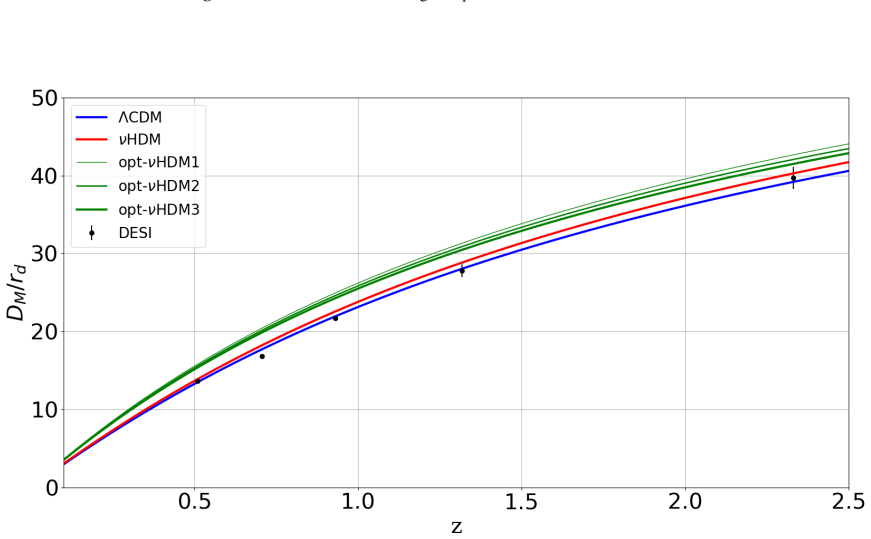
- [§5.3] The three ad hoc values of the sound horizon (rd = 130.05, 145.05, 160.05 Mpc) are introduced without any physical justification; please state the reasoning for this ansatz and whether any of these values is compatible with the model's background expansion.
- [Throughout] There are several typographical and stylistic errors, including 'enlighten' instead of 'shed light on' and the L ATEX template header in the compiled PDF; a thorough proofread is needed.
Circularity Check
No significant circularity: the best-fit parameters and derived transfer functions are fit outputs from external Planck data, not equations that reduce to their own inputs.
full rationale
The paper's central claim is a Bayesian best fit of the νHDM cosmological model to the Planck CMB power spectrum using CosmoSIS. The reported quantities (H0 ≈ 55.6 km/s/Mpc, Ωm ≈ 0.5, ων ≈ 0.1307, ns ≈ 0.872) are fit outputs from an external likelihood, not derivations from the model's own outputs. The matter power spectrum and transfer function of Section 5.2 are model outputs computed from those fitted parameters; they are not used as inputs to the fit, so the 'excess of power' is a consequence of the fitted model rather than a prediction that is forced by construction. The paper explicitly acknowledges that the Planck foreground, lensing, ISW, and SZ corrections assume a ΛCDM universe (Section 5.5) and warns that the 'Planck-derived CMB power spectrum might not be a valid constraint for non-ΛCDM models'; this is an honest model-consistency limitation, not a circular reduction. Self-citations to Wittenburg et al. (2023) and Haslbauer et al. (2020a) provide prior simulation context and are not load-bearing for the likelihood calculation, which uses external Planck data and the CosmoSIS mgcamb module. The comparisons to Pantheon+ and DESI are independent external checks. No equation-level or definitional circularity can be exhibited, so the appropriate finding is no significant circularity.
Assumptions & free parameters
free parameters (6)
- ων = Ων h² (sterile neutrino density) =
0.1307 ± 0.001 (posterior mean)
- h (H0 / 100) =
0.5564 ± 0.0032
- ns (scalar spectral index) =
0.872 ± 0.0037
- τ (optical depth to reionization) =
0.0375 ± 0.0069
- ln(10^10 As) =
2.987 ± 0.015
- APl (Planck calibration) =
1.0 ± 0.0025
assumptions (5)
- domain assumption FLRW metric, adiabatic inflationary perturbations, and the Big Bang history apply to νHDM.
- ad hoc to paper MOND does not modify the background expansion, CMB anisotropies, or linear perturbation growth at high redshift.
- ad hoc to paper The Planck 2018 CMB likelihood, including foreground and lensing corrections calibrated within ΛCDM, is applicable to νHDM.
- domain assumption The mgcamb Boltzmann solver correctly evolves linear perturbations for the νHDM model.
- domain assumption Fixed fiducial values for baryon density, curvature, helium fraction, and Neff are correct for νHDM.
invented entities (1)
-
11-13 eV sterile neutrino (νs), a hypothetical thermal relic replacing CDM in νHDM
Cite this review
Pith. "Pith review of On the initial conditions of the $\nu$HDM cosmological model." pith.science (2026). https://pith.science/paper/LD67JTAK
@misc{pith2026250619196,
  author       = {Pith},
  title        = {Pith review of: On the initial conditions of the $\nu$HDM cosmological model},
  year         = {2026},
  howpublished = {\url{https://pith.science/paper/LD67JTAK}},
  note         = {Machine review of arXiv:2506.19196}
}
abstract
The $\nu$HDM is the only cosmological model based on Milgromian Dynamics (MOND) with available structure formation simulations. While MOND accounts for galaxies, with a priori predictions for spirals and ellipticals, a light sterile neutrino of 11 eV can assist in recovering scaling relations on the galaxy-cluster scales. In order to perform MONDian cosmological simulations in this theoretical approach, initial conditions derived from a fit to the angular power spectrum of Cosmic Microwave Background (CMB) fluctuations are required. In this work, we employ CosmoSIS to perform a Bayesian study of the $\nu$HDM model. Using the best-fit values of the posterior, the CMB power spectrum is reevaluated. The excess of power in the transfer function implies a distinct evolution scenario, which can be used further as an input for a set of hydro-dynamical calculations. The resulting values H0 $\approx$ 56 km/s/Mpc and ${\Omega}_{m_{0}} \approx 0.5$ are far from agreement with respect to the best fit ones in the canonical Cold Dark Matter model, but may be significant in MONDian cosmology. The assumed Planck CMB initial conditions are only valid for the $\Lambda$CDM cosmology. This work constitutes a first step in an iterative procedure needed to disentangle the model dependence of the derived initial density and velocity fields.
Figures


Figures from the paper (4 more)


Forward citations
Cited by 2 Pith papers
-
Baryonic mass budgets in the central regions of the Bullet Cluster and their consistency with strong lensing in MOND
MOND strong-lensing masses in the Bullet Cluster’s three BCG cores lie between lower and upper IGIMF baryonic mass estimates from JWST photometry.
-
Tsallis-Cirto Hubble parameter: Explaining DESI data and High redshift Supermassive Black Hole
The paper tunes a non-comoving-fluid Hubble parameter to the CMB angular scale, then uses the same curve to claim consistency with DESI/CC data and enough time for high-redshift black holes to grow.
Reference graph
Works this paper leans on
-
[1]
Abbott T. M. C., et al., 2022, @doi [Phys. Rev. D] 10.1103/PhysRevD.105.043512 , 105, 043512
-
[2]
Adame A. G., et al., 2025, @doi [ ] 10.1088/1475-7516/2025/02/021 , https://ui.adsabs.harvard.edu/abs/2025JCAP...02..021A 2025, 021
-
[3]
Aker M., et al., 2019, @doi [Phys. Rev. Lett.] 10.1103/PhysRevLett.123.221802 , 123, 221802
-
[4]
Aker M., et al., 2022a, @doi [Nature Physics] 10.1038/s41567-021-01463-1 , 18, 160
-
[5]
Aker M., et al., 2022b, @doi [Phys. Rev. D] 10.1103/PhysRevD.105.072004 , 105, 072004
-
[6]
Aker M., et al., 2024, @doi [arXiv e-prints] 10.48550/arXiv.2406.13516 , https://ui.adsabs.harvard.edu/abs/2024arXiv240613516A p. arXiv:2406.13516
-
[7]
Almaz \'a n H., et al., 2023, @doi [Nature] 10.1038/s41586-022-05568-2 , 613, 257
-
[11]
W., Diaferio A., Famaey B., van der Heyden K
Angus G. W., Diaferio A., Famaey B., van der Heyden K. J., 2013, @doi [Monthly Notices of the Royal Astronomical Society] 10.1093/mnras/stt1564 , 436, 202
Show all 94 references
-
[12]
Asencio E., Banik I., Kroupa P., 2021, @doi [ ] 10.1093/mnras/staa3441 , https://ui.adsabs.harvard.edu/abs/2021MNRAS.500.5249A 500, 5249
2021 doi
-
[13]
Asencio E., Banik I., Kroupa P., 2023, @doi [ ] 10.3847/1538-4357/ace62a , https://ui.adsabs.harvard.edu/abs/2023ApJ...954..162A 954, 162
2023 doi
-
[14]
arXiv:2410.00804
Banik I., Samaras N., 2024, @doi [arXiv e-prints] 10.48550/arXiv.2410.00804 , https://ui.adsabs.harvard.edu/abs/2024arXiv241000804B p. arXiv:2410.00804
2024 doi
- [15]
-
[16]
R., Efstathiou G., Silk J., 1980, @doi [ ] 10.1103/PhysRevLett.45.1980 , https://ui.adsabs.harvard.edu/abs/1980PhRvL..45.1980B 45, 1980
Bond J. R., Efstathiou G., Silk J., 1980, @doi [ ] 10.1103/PhysRevLett.45.1980 , https://ui.adsabs.harvard.edu/abs/1980PhRvL..45.1980B 45, 1980
1980 doi
-
[17]
Brout D., et al., 2022, @doi [ ] 10.3847/1538-4357/ac8e04 , https://ui.adsabs.harvard.edu/abs/2022ApJ...938..110B 938, 110
2022 doi
-
[18]
K., Loewenstein M., Randall S
Bulbul E., Markevitch M., Foster A., Smith R. K., Loewenstein M., Randall S. W., 2014, @doi [The Astrophysical Journal] 10.1088/0004-637X/789/1/13 , 789, 13
2014 doi
-
[19]
Calabrese E., Slosar A. c. v., Melchiorri A., Smoot G. F., Zahn O., 2008, @doi [Phys. Rev. D] 10.1103/PhysRevD.77.123531 , 77, 123531
2008 doi
- [20]
-
[21]
Cimatti A., Moresco M., 2023, @doi [ ] 10.3847/1538-4357/ace439 , https://ui.adsabs.harvard.edu/abs/2023ApJ...953..149C 953, 149
2023 doi
-
[22]
M., 1996, @doi [ ] 10.1086/176788 , https://ui.adsabs.harvard.edu/abs/1996ApJ...458....1C 458, 1
Colombi S., Dodelson S., Widrow L. M., 1996, @doi [ ] 10.1086/176788 , https://ui.adsabs.harvard.edu/abs/1996ApJ...458....1C 458, 1
1996 doi
-
[23]
Curtis-Lake E., et al., 2023, @doi [Nature Astronomy] 10.1038/s41550-023-01918-w , https://ui.adsabs.harvard.edu/abs/2023NatAs...7..622C 7, 622
2023 doi
- [24]
-
[25]
Di Valentino E., Melchiorri A., Silk J., 2021, @doi [ ] 10.3847/2041-8213/abe1c4 , https://ui.adsabs.harvard.edu/abs/2021ApJ...908L...9D 908, L9
2021 doi
-
[26]
Dodelson S., Vesterinen M., 2009, @doi [Phys. Rev. Lett.] 10.1103/PhysRevLett.103.171301 , 103, 171301
2009 doi
-
[27]
M., 1994, @doi [Phys
Dodelson S., Widrow L. M., 1994, @doi [Phys. Rev. Lett.] 10.1103/PhysRevLett.72.17 , 72, 17
1994 doi
-
[28]
Dunkley J., et al., 2009, @doi [ ] 10.1088/0067-0049/180/2/306 , https://ui.adsabs.harvard.edu/abs/2009ApJS..180..306D 180, 306
2009 doi
-
[29]
S., 2012, @doi [Living Reviews in Relativity] 10.12942/lrr-2012-10 , https://ui.adsabs.harvard.edu/abs/2012LRR....15...10F 15, 10
Famaey B., McGaugh S. S., 2012, @doi [Living Reviews in Relativity] 10.12942/lrr-2012-10 , https://ui.adsabs.harvard.edu/abs/2012LRR....15...10F 15, 10
2012 doi
-
[30]
E., 1984, @doi [ ] 10.1086/162569 , https://ui.adsabs.harvard.edu/abs/1984ApJ...286....3F 286, 3
Felten J. E., 1984, @doi [ ] 10.1086/162569 , https://ui.adsabs.harvard.edu/abs/1984ApJ...286....3F 286, 3
1984 doi
-
[31]
de Salas P., Pisanti O., Consiglio R., 2022, @doi [Computer Physics Communications] 10.1016/j.cpc.2021.108205 , https://ui.adsabs.harvard.edu/abs/2022CoPhC.27108205G 271, 108205
Gariazzo S., F. de Salas P., Pisanti O., Consiglio R., 2022, @doi [Computer Physics Communications] 10.1016/j.cpc.2021.108205 , https://ui.adsabs.harvard.edu/abs/2022CoPhC.27108205G 271, 108205
2022
-
[32]
Gjergo E., Kroupa P., 2025, @doi [Nuclear Physics B] 10.1016/j.nuclphysb.2025.116931 , https://ui.adsabs.harvard.edu/abs/2025NuPhB101716931G 1017, 116931
2025
-
[33]
M., Barbosa D., Liddle A
Griffiths L. M., Barbosa D., Liddle A. R., 1999, @doi [ ] 10.1046/j.1365-8711.1999.02777.x , https://ui.adsabs.harvard.edu/abs/1999MNRAS.308..854G 308, 854
1999
-
[34]
Hahn O., Abel T., 2011, @doi [ ] 10.1111/j.1365-2966.2011.18820.x , https://ui.adsabs.harvard.edu/abs/2011MNRAS.415.2101H 415, 2101
2011
-
[36]
R., 1970b, @doi [ ] 10.1103/PhysRevD.1.2726 , https://ui.adsabs.harvard.edu/abs/1970PhRvD...1.2726H 1, 2726
Harrison E. R., 1970b, @doi [ ] 10.1103/PhysRevD.1.2726 , https://ui.adsabs.harvard.edu/abs/1970PhRvD...1.2726H 1, 2726
-
[38]
Haslbauer M., Banik I., Kroupa P., 2020a, @doi [Monthly Notices of the Royal Astronomical Society] 10.1093/mnras/staa2348 , 499, 2845
-
[39]
H., Haghi H., 2022, @doi [The Astrophysical Journal Letters] 10.3847/2041-8213/ac9a50 , 939, L31
Haslbauer M., Kroupa P., Zonoozi A. H., Haghi H., 2022, @doi [The Astrophysical Journal Letters] 10.3847/2041-8213/ac9a50 , 939, L31
2022 doi
-
[40]
Haslbauer M., Kroupa P., Jerabkova T., 2023, @doi [ ] 10.1093/mnras/stad1986 , https://ui.adsabs.harvard.edu/abs/2023MNRAS.524.3252H 524, 3252
2023 doi
-
[41]
Jansen H., et al., 2024, @doi [ ] 10.1051/0004-6361/202347833 , https://ui.adsabs.harvard.edu/abs/2024A&A...683A.240J 683, A240
2024 doi
-
[42]
Javanmardi B., Kroupa P., 2017, @doi [ ] 10.1051/0004-6361/201629408 , https://ui.adsabs.harvard.edu/abs/2017A&A...597A.120J 597, A120
2017 doi
-
[43]
Javanmardi B., Porciani C., Kroupa P., Pflamm-Altenburg J., 2015, @doi [ ] 10.1088/0004-637X/810/1/47 , https://ui.adsabs.harvard.edu/abs/2015ApJ...810...47J 810, 47
2015 doi
-
[44]
J., Starkman G
Jones J., Copi C. J., Starkman G. D., Akrami Y., 2023, @doi [arXiv e-prints] 10.48550/arXiv.2310.12859 , https://ui.adsabs.harvard.edu/abs/2023arXiv231012859J p. arXiv:2310.12859
2023 doi
-
[45]
Kashlinsky A., Atrio-Barandela F., Kocevski D., Ebeling H., 2008, @doi [The Astrophysical Journal] 10.1086/592947 , 686, L49
2008 doi
-
[46]
W., 2013, @doi [The Astrophysical Journal] 10.1088/0004-637X/772/1/10 , 772, 10
Katz H., McGaugh S., Teuben P., Angus G. W., 2013, @doi [The Astrophysical Journal] 10.1088/0004-637X/772/1/10 , 772, 10
2013 doi
-
[47]
C., Barger A
Keenan R. C., Barger A. J., Cowie L. L., 2013, @doi [The Astrophysical Journal] 10.1088/0004-637X/775/1/62 , 775, 62
2013 doi
-
[48]
S., 1995, @doi [ ] 10.1103/PhysRevD.52.R1739 , https://ui.adsabs.harvard.edu/abs/1995PhRvD..52.1739K 52, R1739
Kosowsky A., Turner M. S., 1995, @doi [ ] 10.1103/PhysRevD.52.R1739 , https://ui.adsabs.harvard.edu/abs/1995PhRvD..52.1739K 52, R1739
1995 doi
- [49]
-
[50]
König J., Merle A., Totzauer M., 2016, @doi [Journal of Cosmology and Astroparticle Physics] 10.1088/1475-7516/2016/11/038 , 2016, 038
2016 doi
-
[51]
Langacker P., 1989, Comments Nucl. Part. Phys., 19, 1
1989
-
[52]
Lewis A., Challinor A., Lasenby A., 2000, @doi [The Astrophysical Journal] 10.1086/309179 , 538, 473
2000 doi
-
[53]
Li P., Lelli F., McGaugh S., Schombert J., 2018, @doi [ ] 10.1051/0004-6361/201732547 , https://ui.adsabs.harvard.edu/abs/2018A&A...615A...3L 615, A3
2018 doi
-
[54]
J., Le Fevre O., Hammer F., Crampton D., 1996, @doi [ ] 10.1086/309975 , https://ui.adsabs.harvard.edu/abs/1996ApJ...460L...1L 460, L1
Lilly S. J., Le Fevre O., Hammer F., Crampton D., 1996, @doi [ ] 10.1086/309975 , https://ui.adsabs.harvard.edu/abs/1996ApJ...460L...1L 460, L1
1996 doi
-
[55]
Llinares C., Knebe A., Zhao H., 2008, @doi [Monthly Notices of the Royal Astronomical Society] 10.1111/j.1365-2966.2008.13961.x , 391, 1778
2008
-
[56]
L \"u ghausen F., Famaey B., Kroupa P., 2015, @doi [Canadian Journal of Physics] 10.1139/cjp-2014-0168 , https://ui.adsabs.harvard.edu/abs/2015CaJPh..93..232L 93, 232
2015 doi
-
[57]
C., Dickinson M
Madau P., Ferguson H. C., Dickinson M. E., Giavalisco M., Steidel C. C., Fruchter A., 1996, @doi [ ] 10.1093/mnras/283.4.1388 , https://ui.adsabs.harvard.edu/abs/1996MNRAS.283.1388M 283, 1388
1996 doi
-
[58]
Maki Z., Nakagawa M., Sakata S., 1962, @doi [Progress of Theoretical Physics] 10.1143/PTP.28.870 , 28, 870
1962 doi
-
[59]
Mangano G., Miele G., Pastor S., Peloso M., 2002, @doi [Physics Letters B] https://doi.org/10.1016/S0370-2693(02)01622-2 , 534, 8
2002 doi
-
[60]
Mazurenko S., Banik I., Kroupa P., Haslbauer M., 2024, @doi [ ] 10.1093/mnras/stad3357 , https://ui.adsabs.harvard.edu/abs/2024MNRAS.527.4388M 527, 4388
2024 doi
-
[61]
Mazurenko S., Banik I., Kroupa P., 2025, @doi [ ] 10.1093/mnras/stae2758 , https://ui.adsabs.harvard.edu/abs/2025MNRAS.536.3232M 536, 3232
2025 doi
- [62]
-
[63]
Menanteau F., et al., 2012, @doi [The Astrophysical Journal] 10.1088/0004-637X/748/1/7 , 748, 7
2012 doi
- [64]
-
[65]
T., Reiprich T
Migkas K., Pacaud F., Schellenberger G., Erler J., Nguyen-Dang N. T., Reiprich T. H., Ramos-Ceja M. E., Lovisari L., 2021, @doi [ ] 10.1051/0004-6361/202140296 , https://ui.adsabs.harvard.edu/abs/2021A&A...649A.151M 649, A151
2021 doi
-
[66]
Milgrom M., 1999, @doi [Physics Letters A] 10.1016/S0375-9601(99)00077-8 , https://ui.adsabs.harvard.edu/abs/1999PhLA..253..273M 253, 273
1999 doi
-
[67]
Milgrom M., 2010, @doi [ ] 10.1111/j.1365-2966.2009.16184.x , https://ui.adsabs.harvard.edu/abs/2010MNRAS.403..886M 403, 886
2010
-
[68]
Mistele T., McGaugh S., Lelli F., Schombert J., Li P., 2024, @doi [ ] 10.3847/2041-8213/ad54b0 , https://ui.adsabs.harvard.edu/abs/2024ApJ...969L...3M 969, L3
2024 doi
-
[69]
Murgia R., Merle A., Viel M., Totzauer M., Schneider A., 2017, @doi [ ] 10.1088/1475-7516/2017/11/046 , https://ui.adsabs.harvard.edu/abs/2017JCAP...11..046M 2017, 046
2017 doi
- [70]
-
[71]
Peebles P. J. E., Yu J. T., 1970, @doi [ ] 10.1086/150713 , https://ui.adsabs.harvard.edu/abs/1970ApJ...162..815P 162, 815
1970 doi
-
[72]
Planck Collaboration et al., 2014, @doi [ ] 10.1051/0004-6361/201321591 , https://ui.adsabs.harvard.edu/abs/2014A&A...571A..16P 571, A16
2014 doi
-
[73]
Planck Collaboration et al., 2016a, @doi [ ] 10.1051/0004-6361/201525830 , https://ui.adsabs.harvard.edu/abs/2016A&A...594A..13P 594, A13
-
[74]
Planck Collaboration et al., 2016b, @doi [ ] 10.1051/0004-6361/201526681 , https://ui.adsabs.harvard.edu/abs/2016A&A...594A..16P 594, A16
-
[75]
Planck Collaboration et al., 2020a, @doi [ ] 10.1051/0004-6361/201833880 , https://ui.adsabs.harvard.edu/abs/2020A&A...641A...1P 641, A1
-
[76]
Planck Collaboration et al., 2020b, @doi [ ] 10.1051/0004-6361/201936386 , https://ui.adsabs.harvard.edu/abs/2020A&A...641A...5P 641, A5
-
[77]
Planck Collaboration et al., 2020c, @doi [ ] 10.1051/0004-6361/201833910 , https://ui.adsabs.harvard.edu/abs/2020A&A...641A...6P 641, A6
-
[78]
Pontecorvo B., 1958, Zhur. Eksptl'. i Teoret. Fiz., Vol: 34
1958
-
[79]
G., et al., 2011, @doi [ ] 10.1088/0004-637X/730/2/119 , https://ui.adsabs.harvard.edu/abs/2011ApJ...730..119R 730, 119
Riess A. G., et al., 2011, @doi [ ] 10.1088/0004-637X/730/2/119 , https://ui.adsabs.harvard.edu/abs/2011ApJ...730..119R 730, 119
2011 doi
-
[80]
G., et al., 2022, @doi [ ] 10.3847/2041-8213/ac5c5b , https://ui.adsabs.harvard.edu/abs/2022ApJ...934L...7R 934, L7
Riess A. G., et al., 2022, @doi [ ] 10.3847/2041-8213/ac5c5b , https://ui.adsabs.harvard.edu/abs/2022ApJ...934L...7R 934, L7
2022 doi
-
[81]
J., Diaferio A., Kurtz M
Rines K., Geller M. J., Diaferio A., Kurtz M. J., 2013, @doi [The Astrophysical Journal] 10.1088/0004-637X/767/1/15 , 767, 15
2013 doi
-
[82]
H., 1994, , https://ui.adsabs.harvard.edu/abs/1994A&A...284L..31S 284, L31
Sanders R. H., 1994, , https://ui.adsabs.harvard.edu/abs/1994A&A...284L..31S 284, L31
1994
-
[83]
H., 1998, @doi [ ] 10.1046/j.1365-8711.1998.01459.x , https://ui.adsabs.harvard.edu/abs/1998MNRAS.296.1009S 296, 1009
Sanders R. H., 1998, @doi [ ] 10.1046/j.1365-8711.1998.01459.x , https://ui.adsabs.harvard.edu/abs/1998MNRAS.296.1009S 296, 1009
1998
-
[84]
H., 1999, @doi [ ] 10.1086/311865 , https://ui.adsabs.harvard.edu/abs/1999ApJ...512L..23S 512, L23
Sanders R. H., 1999, @doi [ ] 10.1086/311865 , https://ui.adsabs.harvard.edu/abs/1999ApJ...512L..23S 512, L23
1999 doi
-
[85]
H., 2003, @doi [ ] 10.1046/j.1365-8711.2003.06596.x , https://ui.adsabs.harvard.edu/abs/2003MNRAS.342..901S 342, 901
Sanders R. H., 2003, @doi [ ] 10.1046/j.1365-8711.2003.06596.x , https://ui.adsabs.harvard.edu/abs/2003MNRAS.342..901S 342, 901
2003
-
[86]
J., Copi C
Schwarz D. J., Copi C. J., Huterer D., Starkman G. D., 2016, @doi [Classical and Quantum Gravity] 10.1088/0264-9381/33/18/184001 , 33, 184001
2016 doi
-
[87]
Scolnic D., et al., 2022, @doi [ ] 10.3847/1538-4357/ac8b7a , https://ui.adsabs.harvard.edu/abs/2022ApJ...938..113S 938, 113
2022 doi
-
[88]
Skordis C., Z o s \' s nik T., 2021, @doi [Phys. Rev. Lett.] 10.1103/PhysRevLett.127.161302 , 127, 161302
2021 doi
-
[89]
Skordis C., Zlosnik T., 2022, @doi [ ] 10.1103/PhysRevD.106.104041 , https://ui.adsabs.harvard.edu/abs/2022PhRvD.106j4041S 106, 104041
2022 doi
-
[90]
N., et al., 2003, @doi [ ] 10.1086/377226 , https://ui.adsabs.harvard.edu/abs/2003ApJS..148..175S 148, 175
Spergel D. N., et al., 2003, @doi [ ] 10.1086/377226 , https://ui.adsabs.harvard.edu/abs/2003ApJS..148..175S 148, 175
2003 doi
-
[91]
E., 1979, @doi [Phys
Tremaine S., Gunn J. E., 1979, @doi [Phys. Rev. Lett.] 10.1103/PhysRevLett.42.407 , 42, 407
1979 doi
-
[92]
Tristram M., et al., 2024, @doi [ ] 10.1051/0004-6361/202348015 , https://ui.adsabs.harvard.edu/abs/2024A&A...682A..37T 682, A37
2024 doi
-
[93]
D., Bolton J
Viel M., Becker G. D., Bolton J. S., Haehnelt M. G., 2013, @doi [Phys. Rev. D] 10.1103/PhysRevD.88.043502 , 88, 043502
2013 doi
-
[94]
Wang J., et al., 2022, @doi [The Astrophysical Journal] 10.3847/1538-4357/ac8986 , 936, 161
2022 doi
-
[95]
Watkins R., et al., 2023, @doi [ ] 10.1093/mnras/stad1984 , https://ui.adsabs.harvard.edu/abs/2023MNRAS.524.1885W 524, 1885
2023 doi
-
[96]
Wittenburg N., Kroupa P., Banik I., Candlish G., Samaras N., 2023, @doi [ ] 10.1093/mnras/stad1371 , https://ui.adsabs.harvard.edu/abs/2023MNRAS.523..453W 523, 453
2023 doi
-
[97]
G., et al., 2000, @doi [ ] 10.1086/301513 , https://ui.adsabs.harvard.edu/abs/2000AJ....120.1579Y 120, 1579
York D. G., et al., 2000, @doi [ ] 10.1086/301513 , https://ui.adsabs.harvard.edu/abs/2000AJ....120.1579Y 120, 1579
2000 doi
-
[99]
B., 1972b, @doi [Monthly Notices of the Royal Astronomical Society] 10.1093/mnras/160.1.1P , 160, 1P
Zeldovich Y. B., 1972b, @doi [Monthly Notices of the Royal Astronomical Society] 10.1093/mnras/160.1.1P , 160, 1P
-
[100]
Zuntz J., et al., 2015, @doi [Astronomy and Computing] 10.1016/j.ascom.2015.05.005 , https://ui.adsabs.harvard.edu/abs/2015A&C....12...45Z 12, 45
2015 doi
Reviewed August 6, 2026 · model on record in the stance chip above.
Discussion (0). Sign in to comment.