REVIEW 4 major objections 6 minor 74 references
Terahertz prototype for air pollutants detection
T0 review · 4 major / 6 minor · reviewed 2026-08-07 · deepseek-v4-flash
Pith's one-line read A portable terahertz spectrometer can fingerprint dichloromethane and chloroform and quantify them in gas mixtures, the authors report.
desk verdict New THz spectra and a portable prototype are real, but the chloroform fingerprint sits below the instrument resolution and the in-field partial pressures are implausible; the paper deserves review but needs major revision. read the letter →
The pith
A machine-rendered reading of the paper's core claim, the machinery that carries it, and where it could break.
The reading
What carries the argument
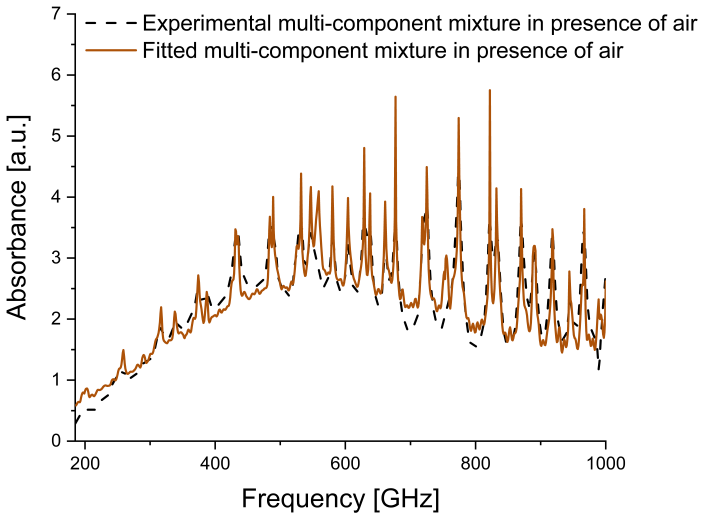
The load-bearing objects are the 1.10 m brass gas cell with Teflon windows, the THz-TDS system with a usable band to about 5.5 THz, and the multiple-absorbers fitting model: the retrieved absorbance is $\sum_i \alpha_i(\nu) x_i$, where $\alpha_i$ are the pure compounds' molecular absorption coefficients and $x_i$ the fitted partial pressures. The spectroscopic assignment rests on literature rotational constants and a rigid-rotator simulation with centrifugal distortion, using band-envelope calculations. The data processing uses a 200 ps time window (5 GHz native resolution), zero-padding to a 1 GHz grid, and a Savitzky-Golay filter.
What would settle it
Record a pure chloroform spectrum with a THz continuous-wave or other spectrometer whose true resolution is 1 GHz or better and check whether the pattern of lines spaced about 6 GHz with roughly 3 GHz widths reproduces; if it does not, the fingerprint and the mixture retrievals built on it are not established. A simpler check is to simulate a 6 GHz-spaced doublet with 3 GHz widths, convolve it with a 5 GHz instrument function, and see whether the doublet disappears.
Extended reading notes
Core claim
The central claim is that THz-TDS with the described portable gas cell yields new, usable rotational fingerprints: dichloromethane shows a Q-branch progression spaced by about 57 GHz and chloroform an R-branch progression spaced by about 6 GHz, both matching a rigid-rotator model with centrifugal corrections. The paper further claims that a multi-component gas mixture's absorbance is a linear combination of the pure compounds' absorption coefficients and that fitting this combination gives partial pressures in good agreement with gauge readings in the laboratory and plausible values after remote aspiration. This establishes, in the authors' view, that the prototype plus the multiple-absorbers fitting approach can simultaneously identify and quantify single components in the atmosphere.
Load-bearing premise
The claimed chloroform fingerprint relies on the system being able to distinguish absorption lines spaced about 6 GHz apart, yet the measurement's raw resolution is only 5 GHz, and the numerical zero-padding that turns it into a 1 GHz grid cannot add real detail.
Editorial extensions
If this is right
- If the fingerprints are real, dichloromethane and chloroform can be monitored remotely at THz frequencies rather than only by established chemical or infrared methods.
- The linear mixing model makes quantification of multi-component air possible from a single broadband measurement.
- The 5 m suction test suggests the portable unit could sample ambient air away from the instrument, including from a vehicle or drone.
- Extending the spectral library to more very short-lived substances would let the same apparatus target other ozone-depleting halocarbons.
- A higher-resolution THz-CW upgrade, which the authors mention, would remove the current 5 GHz resolution ceiling.
Reading between the lines
- Because zero-padding does not add true resolution, the roughly 6 GHz-spaced chloroform lines sit at or below the native 5 GHz resolution; a high-resolution re-measurement might reveal a different line shape or spacing than reported.
- The linear-additivity assumption will break down as partial pressures rise and collisional broadening or inter-molecular interactions become significant; the reported agreement holds at the specific pressures of this test.
- The detection limit expressed as evaporated liquid volume is specific to the 1.10 m cell; translating it to ambient concentration units would require knowing the cell volume and dilution ratio, which the paper does not fully specify.
- The in-field retrieved pressures are tens of mbar, far above real atmospheric trace-gas concentrations, so the prototype's practical sensitivity to ambient VSLS at environmental levels is untested, though the aspiration configuration is demonstrated.
Editorial analysis
A structured set of objections, weighed in public.
Referee Report
Summary. The paper reports a portable terahertz time-domain spectroscopy (THz-TDS) prototype with a gas cell, used to measure pure dichloromethane (DCM) and chloroform, to compare their spectra with rotational simulations, and to retrieve partial pressures in four-component gas mixtures in both a laboratory configuration and an in-field configuration with a 5 m aspiration pipe. The central claims are that this is the first broad-THz characterization of these two VSLS pollutants and that the prototype, combined with a multiple-absorbers fitting model, can simultaneously identify and quantify individual components in the atmosphere.
Significance. If the claims were established, the work would be a useful step toward portable THz-based environmental monitoring of halogenated VSLS and VOCs. Credit is due for the DCM result: the 57 GHz Q-branch spacing is well above the 5 GHz resolution and is supported by the time-domain period of about 17 ps. The laboratory mixture fit also reproduces the gauge pressures to within roughly 10%, and the 5 m remote-sampling demonstration is a practical engineering contribution. However, the paper does not provide machine-checked proofs, reproducible code, or an independent validation dataset; the main limitation is the spectral-resolution analysis for chloroform, which is load-bearing for both the first-characterization claim and the mixture quantification.
major comments (4)
- [§4.3 and §2.1 (Fig. 3)] Section 4.3 states that the 200 ps time window corresponds to a 5 GHz resolution and that zero-padding is applied to obtain a 1 GHz grid. Section 2.1 and Figure 3 interpret chloroform features spaced every about 6 GHz with a FWHM of about 3 GHz. Zero-padding is interpolation and cannot create spectral structure below the native 5 GHz resolution, and a reported FWHM of 3 GHz is narrower than the instrument resolution unless a deconvolution or line-narrowing procedure is explicitly applied. The chloroform fingerprint, the 'first characterization' claim, and the Eq. (4) mixture retrievals that include chloroform are therefore not established as presented.
- [§4.3 and Figs. 2, 4] Section 4.3 states that the higher-order centrifugal coefficients 'have been found through a fit on the experimental data.' Because the simulations in Figures 2 and 4 use parameters adjusted to the same experimental spectra, the agreement is a consistency check rather than an independent theoretical confirmation. The abstract and Section 2.1 should soften the wording 'theoretical confirmation' or demonstrate that the fitted coefficients are consistent with literature values and that the predicted line positions do not depend on the specific experimental realization.
- [Abstract and §1] The claim of 'the first time in literature over a broad THz range' characterization of DCM and chloroform is difficult to reconcile with the cited references, particularly Ref. [52] on the far-infrared spectrum of methylene chloride and Ref. [56] on the rotational spectrum of chloroform, both of which cover THz-range frequencies. The authors should either explicitly compare their spectra with these earlier datasets and state what is genuinely new, or qualify the novelty claim to specify the measurement technique and spectral range.
- [§4.3, Savitzky-Golay filter] The sentence 'applying a Savitzky-Golay (S-G) filter with a quadratic polynomial order of 55 points' is ambiguous and potentially problematic. If the filter frame length is 55 points on the zero-padded 1 GHz grid, the smoothing window spans roughly 55 GHz, which would suppress any 6 GHz structure; if 'order' means polynomial degree 55, that is not a quadratic polynomial. The exact filter parameters and their effect on the reported 3 GHz FWHM and 6 GHz spacing must be specified and quantified.
minor comments (6)
- [Keywords] The keywords field begins with a stray comma: 'Keywords: , terahertz' should be cleaned to a proper keyword list.
- [§2.2] There are typographical spacing errors such as 'in-fieldconditions' and 'pChlorof orm' that should be corrected.
- [§4.3] The text refers to the 'Lamber-Beer law'; the standard spelling is 'Lambert-Beer law'.
- [§2.2] The phrase 'groundbreaking advancement' is promotional and unsupported; a neutral statement of the demonstrated capability would be more appropriate.
- [§3] The stated limit of detection of 'about 0.5 microliters' is not accompanied by a calibration curve, measurement uncertainty, or a definition of the detection criterion; either provide the supporting analysis or remove the quantitative claim.
- [Table 1] The retrieved partial pressures in Table 1 are reported without uncertainties, making it difficult to assess whether the discrepancies with the gauge pressures are statistically significant.
Circularity Check
Theoretical 'confirmation' of the new spectra is partly fitted to the same experimental data; the core measured spectra and mixture quantification remain independent.
-
fitted input called prediction
[Section 4.3, 'Measurement protocol and data analysis', simulations paragraph (after Eq. 4); see also Figs. 2 and 4]
"The simulations have been performed following three main references. The centrifugally distorted rotational levels have been calculated, up to sextic terms in the rotational quantum numbers [72]. The higher-order centrifugal coefficients have been found through a fit on the experimental data, and their order of magnitude is consistent with the scaling reported in previous research works [72, 73]."
The paper presents Figs. 2 and 4 as 'theoretical confirmation' and 'good agreement' for the newly measured dichloromethane and chloroform spectra. However, the simulation's higher-order centrifugal-distortion coefficients were obtained by fitting the experimental data themselves. The agreement therefore partially reduces to reproducing the input data; it is not an independent first-principles prediction and cannot independently validate the line assignments or the claimed first characterization. The measured spectra remain independent evidence, but the 'theoretical confirmation' is weaker than presented.
full rationale
The core measurements are not circular: the pure-gas THz-TDS spectra and the mixture spectra are independent acquisitions, and the mixture quantification in Eq. (4) is a standard weighted-linear-combination calibration against the same instrument's separately measured pure spectra. In the laboratory configuration, the retrieved partial pressures are checked against independent pressure-gauge readings (Table 1), so that retrieval has external validation. The in-field retrieved pressures lack an independent ground-truth comparison, but that is a validation limitation rather than a circularity reduction. The frequency-resolution concern about the 200 ps window, 5 GHz resolution, and zero-padding to 1 GHz is a measurement-validity risk, not a circularity pattern: zero-padding cannot create real resolution, but this does not amount to the paper defining its output in terms of its input. The one genuine circular element is the 'theoretical confirmation': the centrifugal-distortion coefficients used in the simulations are fitted to the experimental data, so the claimed agreement in Figs. 2 and 4 is partly self-consistent by construction. This affects a supporting claim, not the central spectral-database or mixture-detection claims, so the overall circularity score is moderate.
Assumptions & free parameters
free parameters (2)
- Centrifugal distortion coefficients for dichloromethane and chloroform (up to sextic terms) =
Not reported; fitted to experimental THz spectra
- Savitzky-Golay filter window size =
55 points with a quadratic polynomial
assumptions (6)
- standard math Beer-Lambert law and ideal gas law relate absorbance, concentration, pressure, and path length (Eqs. 1-3).
- domain assumption Rigid-rotator model with centrifugal corrections up to sextic terms describes the rotational spectra of dichloromethane and chloroform.
- domain assumption Gerhard-Dennison theory gives rotational band envelopes at finite temperature.
- domain assumption Gaseous mixture components do not interact, so total absorbance is a weighted linear combination of pure-component spectra (Eq. 4).
- domain assumption Absorbance scales linearly with partial pressure down to ambient in-field concentrations, with negligible pressure broadening at the system's 5 GHz resolution.
- domain assumption The spectrum of non-polluted ambient air is a valid reference that cancels water-vapor lines.
Cite this review
Pith. "Pith review of Terahertz prototype for air pollutants detection." pith.science (2026). https://pith.science/paper/LDGZWSDB
@misc{pith2026250523956,
  author       = {Pith},
  title        = {Pith review of: Terahertz prototype for air pollutants detection},
  year         = {2026},
  howpublished = {\url{https://pith.science/paper/LDGZWSDB}},
  note         = {Machine review of arXiv:2505.23956}
}
read the original abstract
In this work, we propose a prototype set-up exploiting terahertz time-domain spectroscopy (THz-TDS) to investigate gaseous compounds. The system is portable and allows to perform remote measurements. We used the prototype to characterise for the first time in literature over a broad THz range, pure dichloromethane and chloroform, two pollutants known as very short-lived substances (VSLS) that strongly contribute to ozone depletion. The THz range allows selectively detecting their absorption lines related to the rotational molecular motion for which we also present the theoretical confirmation. Then, we investigate the optical response of a multi-component mixture achieved with the two aforementioned chlorine-based compounds mixed with two widely distributed volatile pollutants (acetone and methanol). For these first measurements, we developed the set-up specifically for laboratory condition in which the substances are directly injected into the gas-cell circuit. Finally, we modified the prototype to ensure that the ambient atmosphere is drawn directly into the gas cell via a long pipe and a suction system opportunely developed. The analysis of the mixtures in both laboratory and in-field conditions demonstrates that the prototype together with the approach employed in this work can simultaneously identify and quantify single components in the atmosphere. The results obtained open up new possibilities for the development and applications of an efficient portable THz-based sensor for the remote detection of multi-component environmental contaminants.
Figures


Figures from the paper (4 more)



Reference graph
Works this paper leans on
-
[52]
F. Tullini, G. Nivellini, M. Carlotti, B. Carli, The far-infrared spectrum of methylene chloride, Journal of Molecular Spectroscopy 138 (2) (1989) 355–374
work page 1989
-
[56]
J. H. Carpenter, P. J. Seo, D. H. Whiffen, The rotational spectrum of chloroform in its ground and excited vibrational states, Journal of molecular spectroscopy 170 (1) (1995) 215–227
work page 1995
-
[1]
P. K. Sekhar, K. Subramaniyam, Detection of harmful benzene, toluene, ethylbenzene, xylenes (btex) vapors using electrochemical gas sensors, ECS Electrochemistry Letters 3 (2) (2014) B1
work page 2014
- [2]
-
[3]
J. R. F. Foronda, L. G. Aryaswara, G. N. C. Santos, S. N. Raghu, M. A. Muflikhun, Broad-class volatile organic compounds (vocs) detection via polyaniline/zinc oxide (pani/zno) composite materials as gas sensor ap- plication, Heliyon 9 (2) (2023)
work page 2023
-
[4]
M. Shooshtari, S. Vollebregt, Y. Vaseghi, M. Rajati, S. Pahlavan, The sensitivity enhancement of tio2-based vocs sensor decorated by gold at room temperature, Nanotechnology 34 (25) (2023) 255501
work page 2023
-
[5]
P. Hajivand, J. C. Jansen, E. Pardo, D. Armentano, T. F. Mastropietro, A. Azadmehr, Application of metal-organic frameworks for sensing of vocs and other volatile biomarkers, Coordination Chemistry Reviews 501 (2024) 215558
work page 2024
-
[6]
A. Abdelraheem, M. Abdel-Rahim, D. Hamad, A. M. Abd-Elnaiem, Physical characterizations and methane gas–sensing of alxzn1-xo nanoparticles, Applied Surface Science 619 (2023) 156729
work page 2023
Show all 74 references
-
[7]
M. T. Rahman, R. R. Khan, Y. Tian, H. Ibrahim, L. Dong, High-sensitivity and room-temperature nitrous oxide sensor using au nanoparticles-decorated mos 2, IEEE Sensors Journal (2023)
2023
-
[8]
X. Wu, R. Tao, T. Zhang, X. Liu, J. Wang, Z. Zhang, X. Zhao, P. Yang, Biomedical applications of terahertz spectra in clinical and molecular pathology of human glioma, Spectrochimica Acta Part A: Molecular and Biomolecular Spectroscopy 285 (2023) 121933. 18
2023
-
[9]
Hossaini, M
R. Hossaini, M. Chipperfield, S. Montzka, A. Leeson, S. Dhomse, J. Pyle, The increasing threat to stratospheric ozone from dichloromethane, nat. commun., 8, 15962 (2017)
2017
-
[10]
Hossaini, E
R. Hossaini, E. Atlas, S. S. Dhomse, M. P. Chipperfield, P. F. Bernath, A. M. Fernando, J. M¨ uhle, A. A. Leeson, S. A. Montzka, W. Feng, et al., Recent trends in stratospheric chlorine from very short-lived substances, Journal of Geophysical Research: Atmospheres 124 (4) (201...
2019
-
[11]
Laube, A
J. Laube, A. Engel, H. B¨ onisch, T. M¨ obius, D. Worton, W. Sturges, K. Grunow, U. Schmidt, Contribution of very short-lived organic sub- stances to stratospheric chlorine and bromine in the tropics–a case study, Atmospheric Chemistry and Physics 8 (23) (2008) 7325–7334
2008
-
[12]
Fuhlbr¨ ugge, B
S. Fuhlbr¨ ugge, B. Quack, S. Tegtmeier, E. Atlas, H. Hepach, Q. Shi, S. Raimund, K. Kr¨ uger, The contribution of oceanic halocarbons to ma- rine and free tropospheric air over the tropical west pacific, Atmospheric Chemistry and Physics 16 (12) (2016) 7569–7585
2016
-
[13]
Ziska, B
F. Ziska, B. Quack, S. Tegtmeier, I. Stemmler, K. Kruger, Future emis- sions of marine halogenated very-short lived substances under climate change, Journal of Atmospheric Chemistry 74 (2017) 245–260
2017
-
[14]
Y. Jia, S. Tegtmeier, E. Atlas, B. Quack, How marine emissions of bromoform impact the remote atmosphere, Atmospheric chemistry and physics 19 (17) (2019) 11089–11103
2019
-
[15]
J. Maas, Y. Jia, B. Quack, J. V. Durgadoo, A. Biastoch, S. Tegtmeier, Simulations of anthropogenic bromoform indicate high emissions at the coast of east asia, Atmospheric Chemistry and Physics Discussions 2020 (2020) 1–31
2020
-
[16]
Tegtmeier, E
S. Tegtmeier, E. Atlas, B. Quack, F. Ziska, K. Kr¨ uger, Variability and past long-term changes of brominated very short-lived substances at the tropical tropopause, Atmospheric chemistry and physics 20 (11) (2020) 7103–7123
2020
-
[17]
Dekant, P
W. Dekant, P. Jean, J. Arts, Evaluation of the carcinogenicity of dichloromethane in rats, mice, hamsters and humans, Regulatory Toxi- cology and Pharmacology 120 (2021) 104858. 19
2021
-
[18]
T. Rice, M. Chowdhury, M. Mansha, M. Hella, I. Wilke, M. Oehlschlaeger, Halogenated hydrocarbon gas sensing by rotational absorption spectroscopy in the 220–330 ghz frequency range, Applied Physics B 127 (8) (2021) 123
2021
-
[19]
A. Butz, D. Considine, M. Dorf, L. Froidevaux, L. Kovalenko, N. Livesey, R. Nassar, C. Sioris, D. Weisenstein, Scientific assessment of ozone de- pletion: 2006, chapter 2-halogenated very short-lived substances, Tech. rep., World Meteorological Organization, Geneva, Switzerland (2007)
2007
-
[20]
Sekar, G
A. Sekar, G. K. Varghese, M. R. Varma, Chloroform—an emerging pol- lutant in the air, in: New Trends in Emerging Environmental Contami- nants, Springer, 2021, pp. 101–129
2021
-
[21]
H. Deng, T. Pan, Y. Zhang, L. Wang, Q. Wu, J. Ma, W. Shan, H. He, Adsorptive removal of toluene and dichloromethane from humid exhaust on mfi, bea and fau zeolites: An experimental and theoretical study, Chemical Engineering Journal 394 (2020) 124986
2020
-
[22]
McCulloch, Chloroform in the environment: occurrence, sources, sinks and effects, Chemosphere 50 (10) (2003) 1291–1308
A. McCulloch, Chloroform in the environment: occurrence, sources, sinks and effects, Chemosphere 50 (10) (2003) 1291–1308
2003
-
[23]
Shestakova, M
M. Shestakova, M. Sillanp¨ a¨ a, Removal of dichloromethane from ground and wastewater: A review, Chemosphere 93 (7) (2013) 1258–1267
2013
-
[24]
P. M. Schlosser, A. S. Bale, C. F. Gibbons, A. Wilkins, G. S. Cooper, Human health effects of dichloromethane: key findings and scientific issues, Environmental health perspectives 123 (2) (2015) 114–119
2015
-
[25]
Trudinger, D
C. Trudinger, D. Etheridge, G. Sturrock, P. Fraser, P. Krummel, A. McCulloch, Atmospheric histories of halocarbons from analysis of antarctic firn air: Methyl bromide, methyl chloride, chloroform, and dichloromethane, Journal of Geophysical Research: Atmospheres 109 (D22) (2004)
2004
-
[26]
Worton, W
D. Worton, W. Sturges, J. Schwander, R. Mulvaney, J.-M. Barnola, J. Chappellaz, 20th century trends and budget implications of chloro- form and related tri-and dihalomethanes inferred from firn air, Atmo- spheric Chemistry and Physics 6 (10) (2006) 2847–2863. 20
2006
-
[27]
Tekawade, T
A. Tekawade, T. E. Rice, M. A. Oehlschlaeger, M. W. Mansha, K. Wu, M. M. Hella, I. Wilke, Towards realization of quantitative atmospheric and industrial gas sensing using thz wave electronics, Applied Physics B 124 (2018) 1–7
2018
-
[28]
X. Zhan, Y. Liu, Z. Chen, J. Luo, S. Yang, X. Yang, Revolutionary approaches for cancer diagnosis by terahertz-based spectroscopy and imaging, Talanta (2023) 124483
2023
-
[29]
Chernomyrdin, D
N. Chernomyrdin, D. Il’enkova, V. Zhelnov, A. Alekseeva, A. Gavdush, G. Musina, P. Nikitin, A. Kucheryavenko, I. Dolganova, I. Spektor, et al., Quantitative polarization-sensitive super-resolution solid immer- sion microscopy reveals biological tissues’ birefringence in the te...
2023
-
[30]
S. Yang, L. Ding, S. Wang, C. Du, L. Feng, H. Qiu, C. Zhang, J. Wu, K. Fan, B. Jin, et al., Studying oral tissue via real-time high-resolution terahertz spectroscopic imaging, Physical Review Applied 19 (3) (2023) 034033
2023
-
[31]
Gezimati, G
M. Gezimati, G. Singh, Advances in terahertz technology for cancer detection applications, Optical and Quantum Electronics 55 (2) (2023) 151
2023
-
[32]
Nourinovin, M
S. Nourinovin, M. M. Rahman, S. J. Park, H. Hamid, M. P. Philpott, A. Alomainy, Terahertz dielectric characterisation of three-dimensional organotypic treated basal cell carcinoma and corresponding double de- bye model, IEEE Transactions on Terahertz Science and Technology (2023)
2023
-
[33]
Ikari, Y
T. Ikari, Y. Sasaki, C. Otani, 275–305 ghz fm-cw radar 3d imaging for walk-through security body scanner, in: Photonics, Vol. 10, MDPI, 2023, p. 343
2023
-
[34]
P. N. Kumar, M. Nagaraju, K. Arjun, A. Razdan, A. Chaudhary, Com- parative study of real-time terahertz imaging of concealed metallic ob- jects, drug, wood and tnt explosive in transmission/reflection modes using uncooled microbolometer and ultrafast pulsed terahertz imaging s...
2023
-
[35]
Singh, U
K. Singh, U. Aalam, A. Mishra, N. Dixit, A. Bandyopadhyay, A. Sen- gupta, Spectroscopic and imaging considerations of thz-tds and ulf- raman techniques towards practical security applications, Optics Ex- press 32 (2) (2024) 1314–1324
2024
-
[36]
E. M. Witko, T. M. Korter, Terahertz spectroscopy of the explosive tag- gant 2, 3-dimethyl-2, 3-dinitrobutane, The Journal of Physical Chem- istry A 116 (25) (2012) 6879–6884
2012
-
[37]
E. M. Kleist, C. L. Koch Dandolo, J.-P. Guillet, P. Mounaix, T. M. Korter, Terahertz spectroscopy and quantum mechanical simulations of crystalline copper-containing historical pigments, The Journal of Phys- ical Chemistry A 123 (6) (2019) 1225–1232
2019
-
[38]
E. M. Kleist, T. M. Korter, Quantitative analysis of minium and vermil- ion mixtures using low-frequency vibrational spectroscopy, Analytical chemistry 92 (1) (2019) 1211–1218
2019
-
[39]
Moffa, C
C. Moffa, C. Merola, E. Chiadroni, L. Giuliani, A. Curcio, L. Palumbo, A. C. Felici, M. Petrarca, Pigments, minerals, and copper-corrosion products: Terahertz continuous wave (thz-cw) spectroscopic characteri- zation of antlerite and atacamite, Journal of Cultural Heritage 66 ...
2024
-
[40]
Fukunaga, Nondestructive evaluation of lined paintings by thz pulsed time-domain imaging, Heritage 6 (4) (2023) 3448–3460
K. Fukunaga, Nondestructive evaluation of lined paintings by thz pulsed time-domain imaging, Heritage 6 (4) (2023) 3448–3460
2023
-
[41]
Fukunaga, Y
K. Fukunaga, Y. Ueno, C. Watanabe, A. Yanagida, S. Wakiya, Nonde- structive observation of multilayered paintings on a single canvas by thz time-domain imaging and x-ray fluorescence elemental mapping, Journal of Infrared, Millimeter, and Terahertz Waves (2024) 1–17
2024
-
[42]
Moffa, A
C. Moffa, A. Curcio, C. Merola, M. Migliorati, L. Palumbo, A. C. Felici, M. Petrarca, Discrimination of natural and synthetic forms of azurite: an innovative approach based on high-resolution terahertz continuous wave (thz-cw) spectroscopy for cultural heritage., Dyes and Pigm...
2024
-
[43]
Dinovitser, D
A. Dinovitser, D. G. Valchev, D. Abbott, Terahertz time-domain spec- troscopy of edible oils, Royal Society open science 4 (6) (2017) 170275. 22
2017
-
[44]
T. Chen, L. Ma, Z. Tang, L. X. Yu, Identification of coumarin-based food additives using terahertz spectroscopy combined with manifold learning and improved support vector machine, Journal of Food Science 87 (3) (2022) 1108–1118
2022
-
[45]
Rawson, S
A. Rawson, S. C. K, Recent advances in terahertz time-domain spec- troscopy and imaging techniques for automation in agriculture and food sector, Food Analytical Methods (2022) 1–29
2022
-
[46]
H. Lin, W. Withayachumnankul, B. Fischer, S. Mickan, D. Abbott, Gas recognition with terahertz time-domain spectroscopy and spectral catalog: a preliminary study, in: Terahertz Photonics, Vol. 6840, SPIE, 2008, pp. 205–213
2008
-
[47]
V. L. Vaks, V. A. Anfertev, V. Y. Balakirev, S. A. Basov, E. G. Domracheva, A. V. Illyuk, P. V. Kupriyanov, S. I. Pripolzin, M. B. Chernyaeva, High resolution terahertz spectroscopy for analytical appli- cations, Physics-Uspekhi 63 (7) (2020) 708
2020
-
[48]
Naftaly, Terahertz metrology, Artech House, 2015
M. Naftaly, Terahertz metrology, Artech House, 2015
2015
-
[49]
T. E. Rice, M. A. Z. Chowdhury, M. W. Mansha, M. M. Hella, I. Wilke, M. A. Oehlschlaeger, Voc gas sensing via microelectronics-based absorp- tion spectroscopy at 220–330 ghz, Applied Physics B 126 (2020) 1–12
2020
-
[50]
Bigourd, A
D. Bigourd, A. Cuisset, F. Hindle, S. Matton, E. Fertein, R. Bocquet, G. Mouret, Detection and quantification of multiple molecular species in mainstream cigarette smoke by continuous-wave terahertz spectroscopy, Optics letters 31 (15) (2006) 2356–2358
2006
-
[51]
Z. Li, N. Rothbart, X. Deng, H. Geng, X. Zheng, P. Neumaier, H.- W. H¨ ubers, Qualitative and quantitative analysis of terahertz gas-phase spectroscopy using independent component analysis, Chemometrics and Intelligent Laboratory Systems 206 (2020) 104129
2020
-
[53]
Cooke, P
S. Cooke, P. Ohring, et al., Decoding pure rotational molecular spectra for asymmetric molecules, Journal of Spectroscopy 2013 (2013). 23
2013
-
[54]
Brown, Fine structure formation in the electronic spectra of larger molecules, Journal of Molecular Spectroscopy 31 (1-13) (1969) 118–128
J. Brown, Fine structure formation in the electronic spectra of larger molecules, Journal of Molecular Spectroscopy 31 (1-13) (1969) 118–128
1969
-
[55]
D. G. Burkhard, D. M. Dennison, Rotation spectrum of methyl alcohol, Journal of Molecular Spectroscopy 3 (1-6) (1959) 299–334
1959
-
[57]
Galstyan, A
V. Galstyan, A. D’Arco, M. Di Fabrizio, N. Poli, S. Lupi, E. Comini, Detection of volatile organic compounds: From chemical gas sensors to terahertz spectroscopy, Reviews in Analytical Chemistry 40 (1) (2021) 33–57
2021
-
[58]
R. M. Smith, M. A. Arnold, Selectivity of terahertz gas-phase spec- troscopy, Analytical chemistry 87 (21) (2015) 10679–10683
2015
-
[59]
D. J. Tyree, P. Huntington, J. Holt, A. L. Ross, R. Schueler, D. T. Petkie, S. S. Kim, C. C. Grigsby, C. Neese, I. R. Medvedev, Terahertz spectroscopic molecular sensor for rapid and highly specific quantitative analytical gas sensing, ACS sensors 7 (12) (2022) 3730–3740
2022
-
[60]
Cheville, D
R. Cheville, D. Grischkowsky, Far-infrared terahertz time-domain spec- troscopy of flames, Optics letters 20 (15) (1995) 1646–1648
1995
-
[61]
Cheville, D
R. Cheville, D. Grischkowsky, Far-infrared foreign and self-broadened rotational linewidths of high-temperature water vapor, JOSA B 16 (2) (1999) 317–322
1999
-
[62]
Matton, F
S. Matton, F. Rohart, R. Bocquet, G. Mouret, D. Bigourd, A. Cuis- set, F. Hindle, Terahertz spectroscopy applied to the measurement of strengths and self-broadening coefficients for high-j lines of ocs, Journal of molecular spectroscopy 239 (2) (2006) 182–189
2006
-
[63]
Bigourd, A
D. Bigourd, A. Cuisset, F. Hindle, S. Matton, R. Bocquet, G. Mouret, F. Cazier, D. Dewaele, H. Nouali, Multiple component analysis of cigarette smoke using thz spectroscopy, comparison with standard chem- ical analytical methods, Applied Physics B 86 (2007) 579–586. 24
2007
-
[64]
Cazzoli, C
G. Cazzoli, C. Puzzarini, G. Buffa, O. Tarrini, Pressure-broadening of water lines in the thz frequency region: Improvements and confirma- tions for spectroscopic databases.: Part i, Journal of Quantitative Spec- troscopy and Radiative Transfer 109 (17-18) (2008) 2820–2831
2008
-
[65]
Cazzoli, C
G. Cazzoli, C. Puzzarini, G. Buffa, O. Tarrini, Pressure-broadening of water lines in the thz frequency region: Improvements and confirma- tions for spectroscopic databases. part ii, Journal of Quantitative Spec- troscopy and Radiative Transfer 110 (9-10) (2009) 609–618
2009
-
[66]
Svelto, D
O. Svelto, D. C. Hanna, et al., Principles of lasers, Vol. 1, Springer, 2010
2010
-
[67]
Y. Ren, J. Hovenier, R. Higgins, J. Gao, T. Klapwijk, S. Shi, A. Bell, B. Klein, B. Williams, S. Kumar, et al., Terahertz heterodyne spectrom- eter using a quantum cascade laser, Applied Physics Letters 97 (16) (2010)
2010
-
[68]
G. C. Walker, J. W. Bowen, J. Labaune, J.-B. Jackson, S. Hadjilou- cas, J. Roberts, G. Mourou, M. Menu, Terahertz deconvolution, Optics express 20 (25) (2012) 27230–27241
2012
-
[69]
Withayachumnankul, M
W. Withayachumnankul, M. Naftaly, Fundamentals of measurement in terahertz time-domain spectroscopy, Journal of Infrared, Millimeter, and Terahertz Waves 35 (2014) 610–637
2014
-
[70]
H. Liu, Z. Zhang, Y. Yang, T. Chen, C. Zhang, Identification terahertz spectra for the dyestuffs based on principal component analysis and savitzky-golay filter, Optik 172 (2018) 668–673
2018
-
[71]
W. Qiu, X. Wang, D. Ma, J. Qiu, W. Lu, A recurrent neural network for adaptive filtering in terahertz time-domain spectroscopy, Infrared Physics & Technology (2024) 105256
2024
-
[72]
Martin, J.-P
J. Martin, J.-P. Fran¸ cois, R. Gijbels, The rotational partition function of the symmetric top and the effect of k doubling thereon, Chemical physics letters 187 (4) (1991) 375–386
1991
-
[73]
J. K. Watson, Determination of centrifugal distortion coefficients of asymmetric-top molecules. iii. sextic coefficients, The Journal of Chem- ical Physics 48 (10) (1968) 4517–4524. 25
1968
-
[74]
Agritech
S. L. Gerhard, D. M. Dennison, The envelopes of infrared absorption bands, Physical Review 43 (3) (1933) 197. Acknowledgements This work was carried out thanks to ”PRIN 2022: TREX a prototype of a portable and remotely controlled platform based on THz technology to mea- sure t...
1933
Reviewed August 7, 2026 · model on record in the stance chip above.
Discussion (0). Continue with ORCID to comment.