Ultrafast many-body dynamics of dense Rydberg gases and ultracold plasma
Pith reviewed 2026-05-21 20:50 UTC · model grok-4.3
The pith
Charge imbalance drives the decay of dense Rydberg gases into ultracold plasmas.
A machine-rendered reading of the paper's core claim, the machinery that carries it, and where it could break.
Core claim
After a femtosecond laser pulse excites a 87Rb Bose-Einstein condensate, wavelength tuning across the ionization threshold creates either free-electron-dominated conditions that evolve into an ultracold plasma or Rydberg-state-dominated conditions that produce a dense Rydberg gas. The broad bandwidth allows excitation densities beyond the Rydberg blockade. Molecular dynamics simulations that model electrons individually, incorporating collisional ionization and recombination, reproduce the measured distributions of free, bound, and plasma electrons. Charge imbalance between ions and electrons is the primary mechanism driving the dense Rydberg gas to decay into an ultracold plasma.
What carries the argument
Molecular dynamics simulations treating electrons as individual particles with explicit collisional ionization and recombination, compared against measured electron kinetic energies to isolate charge imbalance as the decay driver.
If this is right
- Tuning the femtosecond laser wavelength controls whether the system starts as free electrons or Rydberg states.
- The large pulse bandwidth enables Rydberg excitation densities that exceed the limit set by narrow-linewidth blockade.
- Including collisional ionization and recombination in simulations yields accurate final distributions of free, bound, and plasma electrons.
- Charge imbalance is the dominant process converting a dense Rydberg gas into an ultracold plasma.
Where Pith is reading between the lines
- The same imbalance mechanism may govern mixed bound-free dynamics in other ultracold atomic or molecular gases.
- Time-resolved imaging of ion and electron densities could directly track the growth of imbalance during decay.
- The wavelength-control approach could be extended to test how pulse duration or intensity alters the balance between Rydberg and plasma pathways.
Load-bearing premise
The molecular dynamics simulations accurately represent the experimental dynamics without significant unaccounted effects from the ultrafast excitation or other many-body interactions.
What would settle it
A direct measurement showing persistent Rydberg populations without plasma formation when initial charge neutrality is enforced, or a large mismatch between simulated and observed electron distributions when recombination is removed from the model.
Figures


read the original abstract
Understanding Coulomb driven many-body dynamics in ultracold atomic systems far from equilibrium remains an open challenge, particularly when ultrafast excitation channels create competing pathways toward Rydberg gases or ultracold plasmas. Here, we investigate the many-body dynamics in a $^{87}$Rb Bose-Einstein condensate after exposure to a single femtosecond laser pulse. By tuning the laser wavelength across the two-photon ionization threshold, we can control the initial state that is either dominated by free electrons and leads to an ultracold plasma or dominated by electrons in excited states which leads to a dense Rydberg gas. The large bandwidth enables overcoming the Rydberg blockade that limits the excitation density for narrow-linewidth lasers. We directly measure the kinetic energy of the released electrons and compare the final distribution of free, bound and plasma electrons to molecular dynamics simulations where the electrons are modeled as individual particles including collisional ionization and recombination processes. We find very good agreement between the simulated electron distribution and the experimental observation. We identify charge imbalance as main driver for the decay of a dense Rydberg gas into an ultracold plasma.
Editorial analysis
A structured set of objections, weighed in public.
Referee Report
Summary. The manuscript examines ultrafast many-body dynamics in a 87Rb Bose-Einstein condensate following excitation by a single femtosecond laser pulse. By tuning the laser wavelength across the two-photon ionization threshold, the initial state is controlled to favor either free electrons leading to an ultracold plasma or bound electrons leading to a dense Rydberg gas. The large bandwidth overcomes the Rydberg blockade. Electron kinetic energies are measured experimentally and compared to molecular dynamics simulations treating electrons as classical particles with collisional ionization and recombination. Good agreement is reported, and charge imbalance is identified as the primary driver for the decay of the dense Rydberg gas into an ultracold plasma.
Significance. If the central claim holds, the work provides insight into competing pathways in far-from-equilibrium ultracold Coulomb systems and demonstrates control via broadband excitation. The direct experimental-simulation comparison of electron distributions is a positive feature, as is the parameter-free modeling of collisional processes. Confirmation of charge imbalance as the dominant mechanism would clarify plasma formation dynamics in Rydberg gases.
major comments (1)
- [Abstract] Abstract: The claim that charge imbalance is the main driver for the decay of the dense Rydberg gas into an ultracold plasma is based on agreement between measured electron kinetic-energy distributions and MD simulations. However, no control simulations are described in which net charge is forced to zero (e.g., by enforcing local neutrality or adding compensating ions) while holding density, collisional rates, and other parameters fixed. Without such a test, the attribution remains an inference rather than a demonstrated necessity, as the observed agreement could be consistent with multiple mechanisms including the collisional ionization/recombination processes themselves.
minor comments (1)
- The abstract states 'very good agreement' between experiment and simulation but does not specify quantitative metrics (e.g., chi-squared values, overlap integrals, or error bars on the distributions). Including such measures in the main text would allow readers to assess the degree of agreement more precisely.
Simulated Author's Rebuttal
We thank the referee for the careful reading of our manuscript and the constructive comment. We address the point below and will incorporate additional analysis in the revised version to strengthen the attribution of charge imbalance.
read point-by-point responses
-
Referee: [Abstract] Abstract: The claim that charge imbalance is the main driver for the decay of the dense Rydberg gas into an ultracold plasma is based on agreement between measured electron kinetic-energy distributions and MD simulations. However, no control simulations are described in which net charge is forced to zero (e.g., by enforcing local neutrality or adding compensating ions) while holding density, collisional rates, and other parameters fixed. Without such a test, the attribution remains an inference rather than a demonstrated necessity, as the observed agreement could be consistent with multiple mechanisms including the collisional ionization/recombination processes themselves.
Authors: We thank the referee for this observation. Our molecular dynamics simulations begin from an initially neutral collection of Rydberg atoms (bound electrons, zero free electrons) and allow charge imbalance to develop self-consistently through electron escape and collisional ionization. The resulting electron kinetic-energy distributions match the experimental measurements. We agree, however, that an explicit control test with enforced zero net charge would make the necessity of imbalance clearer. In the revised manuscript we will add such simulations, for example by introducing a uniform compensating background charge while keeping density and collisional rates unchanged, and will compare the resulting electron distributions to both the original runs and the data. These results will be presented in the main text or a supplementary figure, and the abstract wording will be adjusted to reflect the additional evidence. revision: yes
Circularity Check
No significant circularity; claim follows from independent simulation-experiment comparison
full rationale
The paper's identification of charge imbalance as the main driver is obtained by tuning the laser across the ionization threshold to prepare either plasma or Rydberg-dominated initial states, directly measuring released electron kinetic energies, and comparing the resulting free/bound/plasma electron distributions to separate molecular dynamics simulations that treat electrons as classical particles with explicit collisional ionization and recombination. This match is presented as external validation rather than a quantity fitted to the target observable and then relabeled as a prediction. No equations reduce the final attribution to a self-definition, no load-bearing uniqueness theorem is imported from overlapping prior work, and no ansatz is smuggled via self-citation. The derivation chain therefore remains self-contained against the stated experimental and numerical benchmarks.
Axiom & Free-Parameter Ledger
axioms (1)
- standard math Standard atomic physics models for Rydberg excitation and ionization thresholds apply to the femtosecond pulse interaction.
Lean theorems connected to this paper
-
IndisputableMonolith/Foundation/RealityFromDistinction.leanreality_from_one_distinction unclear?
unclearRelation between the paper passage and the cited Recognition theorem.
We identify charge imbalance as main driver for the decay of a dense Rydberg gas into an ultracold plasma.
-
IndisputableMonolith/Cost/FunctionalEquation.leanwashburn_uniqueness_aczel unclear?
unclearRelation between the paper passage and the cited Recognition theorem.
molecular dynamics simulations where the electrons are modeled as individual particles including collisional ionization and recombination processes
What do these tags mean?
- matches
- The paper's claim is directly supported by a theorem in the formal canon.
- supports
- The theorem supports part of the paper's argument, but the paper may add assumptions or extra steps.
- extends
- The paper goes beyond the formal theorem; the theorem is a base layer rather than the whole result.
- uses
- The paper appears to rely on the theorem as machinery.
- contradicts
- The paper's claim conflicts with a theorem or certificate in the canon.
- unclear
- Pith found a possible connection, but the passage is too broad, indirect, or ambiguous to say the theorem truly supports the claim.
Reference graph
Works this paper leans on
-
[1]
Ultracold atoms We use dispensers to generate a dilute 87Rb vapor in a glass cell. The atoms are first collected in a 2D magneto- optical trap (MOT) to improve the loading of our 3D MOT separated by a differential pumping stage. A short gray molasses phase after the 3D MOT allows us to reach temperatures on the order of a fewµK. After laser cooling, we lo...
-
[2]
Femtosecond laser pulses We use a commercially available ytterbium doped potassium-gadolinium tungstate (Yb:KGW) solid-state laser system to generate the femtosecond laser pulses via Kerr-lens mode-locking and chirped-pulse amplification (CPA) in a regenerative amplifier (RA). The pulses with a pulse duration of 300 fs FWHM, a fundamental wave- length of ...
-
[3]
Experimental parameters All measurements discussed are performed with either a BEC with a peak density ofρ BEC = 1.6×10 20 m−3 at pulse peak intensities ofI 0,BEC = 2.5(2)×10 13 W/cm2 or a dilute thermal cloud with a peak density ofρ th = 2.8×10 17 m−3 at pulse peak intensities ofI 0,th = 3.9(2)× 1013 W/cm2
-
[4]
Electric field configuration and CPT simulations We employ finite element method (FEM) simulations of the static electric fields within a 3D computer-aided design (CAD) geometry of the fully equipped science chamber. We use the electrostatics module of the COM- SOL Multiphysics ® [68] software to calculate the fields (Fig. 5) and the charged particle trac...
-
[5]
Rydberg detection Atoms in bound states including Rydberg atoms are detected by recording the photoelectrons after ionization via a 10µs pulse atλ Ry,PI = 1064 nm at an intensity of I≈7×10 7 W/cm2. We assume that the applied pulse ionizes most of the Rydberg atoms created by the femtosecond laser pulse, since the Rydberg electron signal saturates with inc...
-
[6]
Electron counting Since the detector images recorded in the experiment usually show a distribution of a few hundred overlapping single electron signals, blob analysis is not feasible to determine the number of detected electrons. Instead we use the following expression to get an estimate for the number of electronsN e from the summed up pixel counts Nc ac...
-
[7]
Short-range cutoff for Coulomb interaction To avoid the divergence at small distances we imple- ment the Coulomb force with a short-range cutoff: 10 FC = ( 1 4πϵ0 q1q2 r2 , r > R 0 1 4πϵ0 q1q2 R2 0 , r≤R 0 (B1) Here,ϵ 0 is the vacuum permittivity,q 1 andq 2 are the charges of the interacting particles,rdenotes the dis- tance between these particles andR 0...
-
[8]
Ion distribution /uni000001c6/uni00000003/uni0000037e/uni00000452/uni00000175/uni0000037f /uni000003ee /uni000003ed /uni000003ec/uni000003ed/uni000003ee /uni000001c7/uni00000003/uni0000037e/uni00000452/uni00000175/uni0000037f /uni000003ed /uni000003ec/uni000003ed /uni000001cc/uni00000003/uni0000037e/uni00000452/uni00000175/uni0000037f /uni000003f0 /uni000...
-
[9]
Electron distribution At high densities and low electron excess energies, elec- trons and ions can not be randomly distributed since the Coulomb energy between an electron and the nearest ion neighbor can be higher than the excess energy. Instead, we generate the electrons and ions pairwise and take the initial binding energy of the electron to its paired...
-
[10]
The electron energy was set to the corresponding s-state according to App
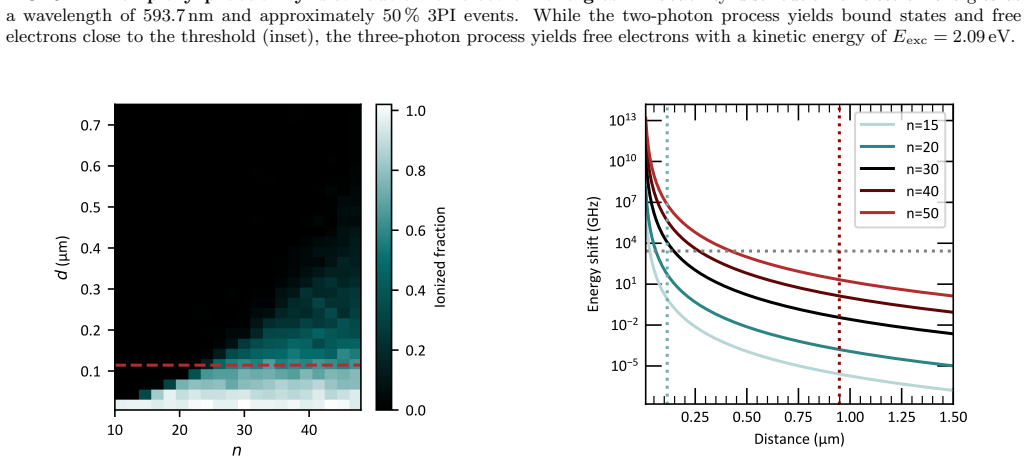
Penning ionization To estimate the stability of Rydberg atoms in our sim- ulations, we performed simulations of two atoms placed at a varying distancedand varying main quantum num- bern. The electron energy was set to the corresponding s-state according to App. B 3. For large distances both atoms remain stable. For smaller distances or highern, one of the...
-
[11]
Rydberg blockade The Rydberg blockade prevents excitation of adjacent atoms into Rydberg states if the distance is smaller than the blockade radius. This prevents the creation of dense Rydberg gases with the common approach using narrow- bandwidth continuous wave lasers. The blockade radius is the distance, where the shift due to the van-der-Waals- intera...
-
[12]
P. B. Corkum and F. Krausz, Attosecond science, Nat. Phys.3, 381 (2007)
work page 2007
-
[13]
C. Ott, A. Kaldun, L. Argenti, P. Raith, K. Meyer, M. Laux, Y. Zhang, A. Bl¨ attermann, S. Hagstotz, T. Ding, R. Heck, J. Madro˜ nero, F. Mart´ ın, and T. Pfeifer, Reconstruction and control of a time- dependent two-electron wave packet, Nature516, 374 (2014)
work page 2014
-
[14]
J. Itatani, J. Levesque, D. Zeidler, H. Niikura, H. P´ epin, J. C. Kieffer, P. B. Corkum, and D. M. Villeneuve, Tomo- graphic imaging of molecular orbitals, Nature432, 867 (2004)
work page 2004
-
[15]
F. Calegari, D. Ayuso, A. Trabattoni, L. Belshaw, S. D. Camillis, S. Anumula, F. Frassetto, L. Poletto, A. Pala- cios, P. Decleva, J. B. Greenwood, F. Mart´ ın, and M. Nisoli, Ultrafast electron dynamics in phenylalanine initiated by attosecond pulses, Science346, 336 (2014)
work page 2014
-
[16]
A. Rudenko, L. Inhester, K. Hanasaki, X. Li, S. J. Ro- batjazi, B. Erk, R. Boll, K. Toyota, Y. Hao, O. Ven- drell, C. Bomme, E. Savelyev, B. Rudek, L. Foucar, S. H. Southworth, C. S. Lehmann, B. Kraessig, T. Marchenko, M. Simon, K. Ueda, K. R. Ferguson, M. Bucher, T. Gorkhover, S. Carron, R. Alonso-Mori, J. E. Koglin, J. Correa, G. J. Williams, S. Boutet,...
work page 2017
-
[17]
T. Fennel, K.-H. Meiwes-Broer, J. Tiggesb¨ aumker, P.- G. Reinhard, P. M. Dinh, and E. Suraud, Laser-driven nonlinear cluster dynamics, Rev. Mod. Phys.82, 1793 (2010)
work page 2010
-
[18]
K. F. MacDonald, Z. L. S´ amson, M. I. Stockman, and N. I. Zheludev, Ultrafast active plasmonics, Nat. Photon. 3, 55 (2009)
work page 2009
-
[19]
F. Siek, S. Neb, P. Bartz, M. Hensen, C. Str¨ uber, S. Fiechter, M. Torrent-Sucarrat, V. M. Silkin, E. E. Krasovskii, N. M. Kabachnik, S. Fritzsche, R. D. Mui˜ no, P. M. Echenique, A. K. Kazansky, N. M¨ uller, W. Pfeiffer, and U. Heinzmann, Angular momentum–induced delays in solid-state photoemission enhanced by intra-atomic in- teractions, Science357, 12...
work page 2017
-
[20]
E. J. Sie, C. M. Nyby, C. D. Pemmaraju, S. J. Park, X. Shen, J. Yang, M. C. Hoffmann, B. K. Ofori-Okai, R. Li, A. H. Reid, S. Weathersby, E. Mannebach, N. Finney, D. Rhodes, D. Chenet, A. Antony, L. Bali- cas, J. Hone, T. P. Devereaux, T. F. Heinz, X. Wang, and A. M. Lindenberg, An ultrafast symmetry switch in a Weyl semimetal, Nature565, 61 (2019)
work page 2019
-
[21]
H. A. Hafez, S. Kovalev, J.-C. Deinert, Z. Mics, B. Green, N. Awari, M. Chen, S. Germanskiy, U. Lehn- ert, J. Teichert, Z. Wang, K.-J. Tielrooij, Z. Liu, Z. Chen, A. Narita, K. M¨ ullen, M. Bonn, M. Gensch, and D. Turchinovich, Extremely efficient terahertz high- harmonic generation in graphene by hot Dirac fermions, Nature561, 507 (2018)
work page 2018
-
[22]
S. Ghimire and D. A. Reis, High-harmonic generation from solids, Nat. Phys.15, 10 (2019)
work page 2019
-
[23]
W. Becker and H. R. and, Many-electron strong-field physics, Contemp. Phys.49, 199 (2008)
work page 2008
-
[24]
S. Pabst and R. Santra, Strong-field many-body physics and the giant enhancement in the high-harmonic spec- trum of xenon, Phys. Rev. Lett.111, 233005 (2013)
work page 2013
-
[25]
R. E. F. Silva, I. V. Blinov, A. N. Rubtsov, O. Smirnova, and M. Ivanov, High-harmonic spectroscopy of ultra- fast many-body dynamics in strongly correlated systems, Nat. Photon.12, 266 (2018)
work page 2018
-
[26]
E. Goulielmakis and T. Brabec, High harmonic genera- tion in condensed matter, Nat. Photon.16, 411 (2022)
work page 2022
-
[27]
S. Ichimaru, Strongly coupled plasmas: high-density clas- sical plasmas and degenerate electron liquids, Rev. Mod. Phys.54, 1017 (1982)
work page 1982
-
[28]
M. S. Murillo, Strongly coupled plasma physics and high energy-density matter, Phys. Plasmas11, 2964 (2004)
work page 2004
-
[29]
H. M. V. Horn, Dense astrophysical plasmas, Science 252, 384 (1991)
work page 1991
-
[30]
R. T. Sprenkle, L. G. Silvestri, M. S. Murillo, and S. D. Bergeson, Temperature relaxation in strongly-coupled bi- nary ionic mixtures, Nat. Commun.13, 15 (2022)
work page 2022
-
[31]
J. J. Bekx, S.-K. Son, B. Ziaja, and R. Santra, Electronic- structure calculations for nonisothermal warm dense matter, Phys. Rev. Res.2, 033061 (2020)
work page 2020
-
[32]
S. L. Gilbert, J. J. Bollinger, and D. J. Wineland, Shell- structure phase of magnetically confined strongly coupled plasmas, Phys. Rev. Lett.60, 2022 (1988)
work page 2022
-
[33]
T. C. Killian, S. Kulin, S. D. Bergeson, L. A. Orozco, C. Orzel, and S. L. Rolston, Creation of an ultracold neutral plasma, Phys. Rev. Lett.83, 4776 (1999)
work page 1999
-
[34]
T. C. Killian, Ultracold neutral plasmas, Science316, 705 (2007)
work page 2007
-
[35]
D. Gericke and M. Murillo, Disorder-induced heating of ultracold plasmas, Contrib. Plasma Phys.43, 298 (2003)
work page 2003
-
[36]
T. Killian, T. Pattard, T. Pohl, and J. Rost, Ultracold neutral plasmas, Phys. Rep.449, 77 (2007)
work page 2007
-
[37]
T. K. Langin, G. M. Gorman, and T. C. Killian, Laser cooling of ions in a neutral plasma, Science363, 61 (2019)
work page 2019
-
[38]
G. M. Gorman, M. K. Warrens, S. J. Bradshaw, and T. C. Killian, Magnetic confinement of an ultracold neu- tral plasma, Phys. Rev. Lett.126, 085002 (2021)
work page 2021
-
[39]
M. S. Murillo, Using Fermi statistics to create strongly coupled ion plasmas in atom traps, Phys. Rev. Lett.87, 115003 (2001)
work page 2001
-
[40]
G. Bannasch, T. C. Killian, and T. Pohl, Strongly cou- pled plasmas via Rydberg blockade of cold atoms, Phys. Rev. Lett.110, 253003 (2013)
work page 2013
-
[41]
D. Murphy and B. M. Sparkes, Disorder-induced heat- ing of ultracold neutral plasmas created from atoms in partially filled optical lattices, Phys. Rev. E94, 021201 (2016)
work page 2016
-
[42]
J. B. Balewski, A. T. Krupp, A. Gaj, D. Peter, H. P. B¨ uchler, R. L¨ ow, S. Hofferberth, and T. Pfau, Coupling a single electron to a Bose-Einstein condensate, Nature 502, 664 (2013)
work page 2013
-
[43]
V. Bendkowsky, B. Butscher, J. Nipper, J. P. Shaffer, R. L¨ ow, and T. Pfau, Observation of ultralong-range Ry- dberg molecules, Nature458, 1005 (2009). 13
work page 2009
-
[44]
D. Barredo, S. de L´ es´ eleuc, V. Lienhard, T. Lahaye, and A. Browaeys, An atom-by-atom assembler of defect-free arbitrary two-dimensional atomic arrays, Science354, 1021 (2016)
work page 2016
- [45]
-
[46]
A. Browaeys and T. Lahaye, Many-body physics with individually controlled Rydberg atoms, Nat. Phys.16, 132 (2020)
work page 2020
-
[47]
Y. Chew, T. Tomita, T. P. Mahesh, S. Sugawa, S. de L´ es´ eleuc, and K. Ohmori, Ultrafast energy ex- change between two single Rydberg atoms on a nanosec- ond timescale, Nat. Photon.16, 724 (2022)
work page 2022
- [48]
-
[49]
A. Ga¨ etan, Y. Miroshnychenko, T. Wilk, A. Chotia, M. Viteau, D. Comparat, P. Pillet, A. Browaeys, and P. Grangier, Observation of collective excitation of two individual atoms in the Rydberg blockade regime, Nat. Phys.5, 115 (2009)
work page 2009
- [50]
-
[51]
J. A. Yeazell, M. Mallalieu, and C. R. Stroud, Observa- tion of the collapse and revival of a Rydberg electronic wave packet, Phys. Rev. Lett.64, 2007 (1990)
work page 2007
-
[52]
J. L. Krause, K. J. Schafer, M. Ben-Nun, and K. R. Wil- son, Creating and detecting shaped Rydberg wave pack- ets, Phys. Rev. Lett.79, 4978 (1997)
work page 1997
- [53]
- [54]
-
[55]
M. Mizoguchi, Y. Zhang, M. Kunimi, A. Tanaka, S. Takeda, N. Takei, V. Bharti, K. Koyasu, T. Kishi- moto, D. Jaksch, A. Glaetzle, M. Kiffner, G. Masella, G. Pupillo, M. Weidem¨ uller, and K. Ohmori, Ultrafast creation of overlapping Rydberg electrons in an atomic BEC and Mott-insulator lattice, Phys. Rev. Lett.124, 253201 (2020)
work page 2020
-
[56]
G. Vitrant, J. M. Raimond, M. Gross, and S. Haroche, Rydberg to plasma evolution in a dense gas of very ex- cited atoms, J. Phys. B: At. Mol. Opt. Phys.15, L49 (1982)
work page 1982
-
[57]
G. W. Foltz, E. J. Beiting, T. H. Jeys, K. A. Smith, F. B. Dunning, and R. F. Stebbings, State changing in Na(nd)-electron collisions, Phys. Rev. A25, 187 (1982)
work page 1982
-
[58]
S. K. Dutta, D. Feldbaum, A. Walz-Flannigan, J. R. Guest, and G. Raithel, High-angular-momentum states in cold Rydberg gases, Phys. Rev. Lett.86, 3993 (2001)
work page 2001
-
[59]
A. Walz-Flannigan, J. R. Guest, J.-H. Choi, and G. Raithel, Cold-Rydberg-gas dynamics, Phys. Rev. A 69, 063405 (2004)
work page 2004
-
[60]
N. Vanhaecke, D. Comparat, D. A. Tate, and P. Pillet, Ionization of Rydberg atoms embedded in an ultracold plasma, Phys. Rev. A71, 013416 (2005)
work page 2005
-
[61]
F. Robicheaux, M. M. Goforth, and M. A. Phillips, Sim- ulations of prompt many-body ionization in a frozen Ry- dberg gas, Phys. Rev. A90, 022712 (2014)
work page 2014
-
[62]
M. Kiffner, D. Ceresoli, W. Li, and D. Jaksch, Quantum mechanical calculation of Rydberg–Rydberg autoioniza- tion rates, J. Phys. B: At. Mol. Opt. Phys.49, 204004 (2016)
work page 2016
-
[63]
M. P. Robinson, B. L. Tolra, M. W. Noel, T. F. Gal- lagher, and P. Pillet, Spontaneous evolution of Rydberg atoms into an ultracold plasma, Phys. Rev. Lett.85, 4466 (2000)
work page 2000
-
[64]
T. F. Gallagher, P. Pillet, M. P. Robinson, B. Laburthe- Tolra, and M. W. Noel, Back and forth between Rydberg atoms and ultracold plasmas, J. Opt. Soc. Am. B20, 1091 (2003)
work page 2003
-
[65]
T. Pohl, T. Pattard, and J. M. Rost, Plasma formation from ultracold Rydberg gases, Phys. Rev. A68, 010703 (2003)
work page 2003
-
[66]
L. G. Silvestri, L. J. Stanek, G. Dharuman, Y. Choi, and M. S. Murillo, Sarkas: A fast pure-python molec- ular dynamics suite for plasma physics, Comput. Phys. Commun.272, 108245 (2022)
work page 2022
-
[67]
C. Veit, N. Zuber, O. A. Herrera-Sancho, V. S. V. Ana- suri, T. Schmid, F. Meinert, R. L¨ ow, and T. Pfau, Pulsed ion microscope to probe quantum gases, Phys. Rev. X11, 011036 (2021)
work page 2021
-
[68]
M. Stecker, H. Schefzyk, J. Fort´ agh, and A. G¨ unther, A high resolution ion microscope for cold atoms, New J. Phys.19, 043020 (2017)
work page 2017
-
[69]
M. Wollenhaupt, M. Krug, J. K¨ ohler, T. Bayer, C. Sarpe- Tudoran, and T. Baumert, Three-dimensional tomo- graphic reconstruction of ultrashort free electron wave packets, App. Phys. B95, 647 (2009)
work page 2009
-
[70]
P. Hockett, M. Wollenhaupt, C. Lux, and T. Baumert, Complete photoionization experiments via ultrafast co- herent control with polarization multiplexing, Phys. Rev. Lett.112, 223001 (2014)
work page 2014
-
[71]
D. K¨ ohnke, T. Bayer, and M. Wollenhaupt, Shaped free- electron vortices, Phys. Rev. A110, 053109 (2024)
work page 2024
-
[72]
S. Larimian, S. Erattupuzha, C. Lemell, S. Yoshida, S. Nagele, R. Maurer, A. Baltuˇ ska, J. Burgd¨ orfer, M. Kit- zler, and X. Xie, Coincidence spectroscopy of high-lying Rydberg states produced in strong laser fields, Phys. Rev. A94, 033401 (2016)
work page 2016
-
[73]
B. Vaucher, S. J. Thwaite, and D. Jaksch, Ultralarge Ry- dberg dimers in optical lattices, Phys. Rev. A78, 043415 (2008)
work page 2008
-
[74]
T. P. Mahesh, T. Matsubara, Y. T. Chew, T. Tomita, S. de L´ es´ eleuc, and K. Ohmori, Generation of 480 nm picosecond pulses for ultrafast excitation of Rydberg atoms, Opt. Lett.50, 403 (2025)
work page 2025
-
[75]
A. Y. Kuntsevich, Y. V. Tupikov, V. M. Pudalov, and I. S. Burmistrov, Strongly correlated two-dimensional plasma explored from entropy measurements, Nat. Com- mun.6, 7298 (2015)
work page 2015
-
[76]
A. Punnoose and A. M. Finkel’stein, Metal-insulator transition in disordered two-dimensional electron sys- tems, Science310, 289 (2005)
work page 2005
-
[77]
A. M. Kaufman and K.-K. Ni, Quantum science with optical tweezer arrays of ultracold atoms and molecules, Nat. Phys.17, 1324 (2021)
work page 2021
-
[78]
D. Barredo, V. Lienhard, S. de L´ es´ eleuc, T. Lahaye, and 14 A. Browaeys, Synthetic three-dimensional atomic struc- tures assembled atom by atom, Nature561, 79 (2018)
work page 2018
-
[79]
COMSOL AB, Stockholm, Sweden,COMSOL Multiphysics® v. 5.4. www.comsol.com(2018)
work page 2018
-
[80]
R. Cardman, J. L. MacLennan, S. E. Anderson, Y. J. Chen, and G. Raithel, Photoionization of Rydberg atoms in optical lattices, New J. Phys.23, 063074 (2021)
work page 2021
discussion (0)
Sign in with ORCID, Apple, or X to comment. Anyone can read and Pith papers without signing in.