REVIEW 3 major objections 4 minor 86 references
Introducing a Harmonic Balance Navier-Stokes Finite Element Solver to Accelerate Cardiovascular Simulations
T0 review · 3 major / 4 minor · reviewed 2026-08-12 · deepseek-v4-flash
Pith's one-line read A harmonic balance finite element solver claims to compute time-periodic cardiovascular flows 10 to 100 times faster than conventional time-stepping, with under 5 percent velocity error at 19 modes.
desk verdict Useful practical contribution with a flawed derivation of the harmonic balance equations; the numerical evidence is solid and the flaw is fixable, so it deserves review. read the letter →
The pith
A machine-rendered reading of the paper's core claim, the machinery that carries it, and where it could break.
The reading
What carries the argument
The central object is the harmonic balance form of the Navier-Stokes equations, obtained by writing the frequency-domain equations with unknowns organized as discrete Fourier coefficient vectors and applying the inverse discrete Fourier transform matrix $E^{-1}$. The load-bearing algebraic objects are the time-coupling matrix $H = E^{-1}\Omega E$, a skew-symmetric zero-diagonal matrix coupling all $N$ time points that is applied via fast Fourier transforms, and the diagonal matrices $U_j = \operatorname{diag}(u_j)$ for the convective term. The paper's cost scaling depends on the claim that the discrete Fourier transform diagonalizes the convective coupling, leaving a diagonal $U_j$; this is what allows the tangent matrix to split into a pointwise block $P$ plus an FFT-applied coupling block $C$, and it is what makes the residual and tangent computations approximately $O(N\log N)$ rather than $O(N^2)$. The stabilized weak form uses Galerkin/least-squares with a stabilization parameter $\tau$ chosen to recover the steady-state form and to keep the method consistent as the equivalent time step vanishes.
What would settle it
Compute $E^{-1}A_iE$ for a nonzero velocity field with $M \geq 3$ and inspect the off-diagonal entries; if any are nonzero, the claimed diagonalization behind the $O(N\log N)$ cost is not exact. A stronger test is to run the harmonic balance solver with the full convection coupling matrix $A_i$, without the diagonalizing step, and compare residuals and converged solutions against the diagonal version on a case with $N \geq 19$; equal results would show the omitted couplings are negligible, while different results would identify the error introduced by the diagonalization.
Extended reading notes
Core claim
The paper's central claim is that the harmonic balance form of the incompressible Navier-Stokes equations, discretized with a Galerkin/least-squares stabilized finite element method, is an accurate and much faster replacement for conventional time-stepping in physiologically stable, time-periodic blood flows. The authors represent velocity, pressure, and boundary data as $N$ equally spaced time points per cardiac cycle, obtained from a truncated discrete Fourier series, and solve one coupled system containing all time points. The time-coupling matrix $H = E^{-1}\Omega E$, where $\Omega$ contains the imaginary angular frequencies and $E$ is the discrete Fourier transform matrix, is multiplied using fast Fourier transforms, giving an approximately $O(N\log N)$ cost instead of the $O(N^2)$ cost of their earlier frequency-domain solver. In the three test cases, the harmonic balance solver matched the time-stepping solver's velocity field within roughly 5 percent at $N = 19$ and produced speedups from 30-fold to 40-fold for the largest $N$, with the paper reporting a 10-to-100-fold speedup across all cases. The paper also finds that the truncation error of the inlet boundary condition predicts the overall solution error at low Reynolds number, and that the harmonic balance solution acts as a built-in filter for noisy clinical inflow data.
Load-bearing premise
The derivation of the harmonic balance equations from the frequency-domain equations in Section 2.1 assumes that the discrete Fourier transform diagonalizes the convective coupling matrix $A_i$, i.e. $E^{-1}A_iE = \operatorname{diag}(u_i)$, but $A_i$ is not circulant because of its zero top-right and bottom-left corners, so this diagonalization does not hold in general.
Editorial extensions
If this is right
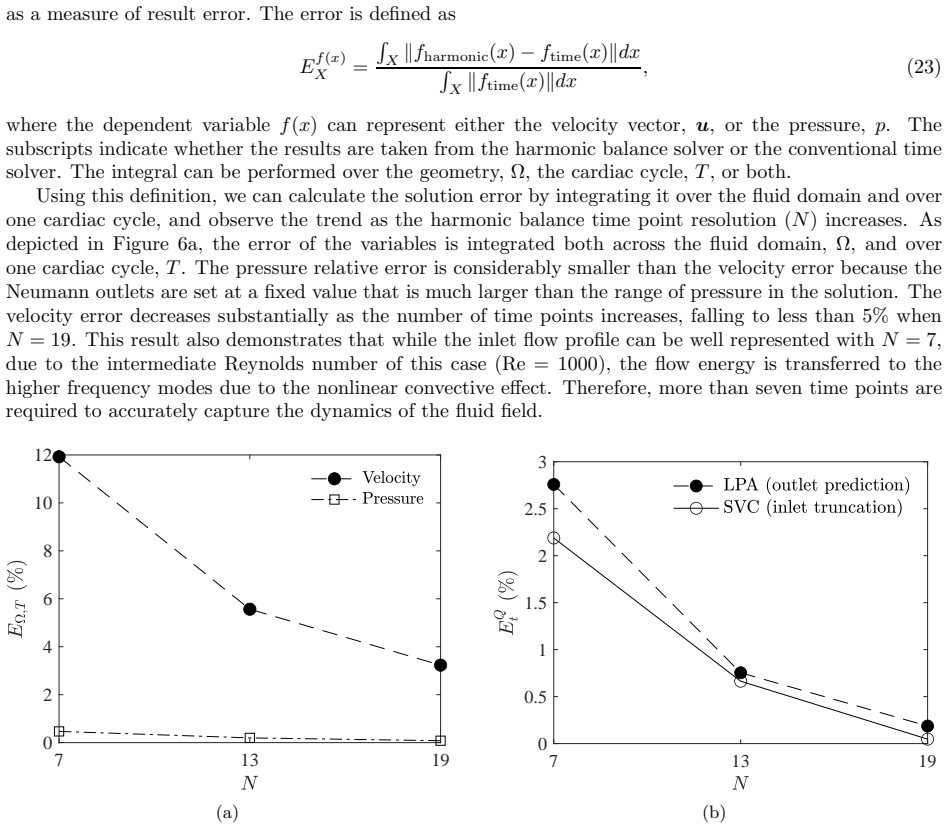
- For flows whose boundary conditions are well represented by 19 modes, the harmonic balance solver matches conventional time-stepping within about 5 percent velocity error, and within 3 percent for outlet flow rates even at $N = 7$ to $N = 13$.
- The approximately linear cost scaling removes the quadratic scaling that limited the earlier frequency-domain approach, making large mode counts practical.
- Speedups of 30 to 40 times at the largest $N$ tested mean a 30-hour coronary simulation can be completed in roughly 30 minutes with similar accuracy.
- Memory overhead stays modest, about 2.4 times the time-stepping solver at $N = 25$, because most memory is occupied by sparse matrices and connectivity rather than unknowns.
- Because the equations are presented as a direct transform of the frequency equations, the method can be adapted into an existing stabilized finite element Navier-Stokes code structure with relatively small changes.
Reading between the lines
- Editorial inference: the claimed diagonalization $E^{-1}A_iE = \operatorname{diag}(u_i)$ in Section 2.1 is not generally true because $A_i$ has zero top-right and bottom-left corners and is not circulant; if off-diagonal couplings remain, the linear-cost scaling and the direct-transform claim would need to be revisited, although the numerical results could still hold if those couplings are small i
- Editorial inference: the same harmonic balance machinery could apply to other periodic physiological flows, such as respiratory airflow, where the period is known and Reynolds numbers are comparable; the paper mentions this but does not test it.
- Editorial inference: the built-in spectral truncation could be used deliberately as a denoising step for clinical inflow waveforms, trading a controlled truncation error for robustness against measurement noise.
Editorial analysis
A structured set of objections, weighed in public.
Referee Report
Summary. The paper presents a stabilized finite element solver for the incompressible Navier-Stokes equations in harmonic balance form, targeting time-periodic cardiovascular flows. The unknowns at N uniformly spaced instants in the cardiac cycle are solved simultaneously; the time-derivative coupling is implemented through an FFT, and matrix splitting is used to make the cost scale roughly linearly with N. The solver is validated on three patient-specific geometries (Glenn pulmonary flow, cerebral arteries, left main coronary artery) by comparing velocity, pressure, and outlet flow rates against a conventional GLS time-stepping solver on the same meshes. Reported speedups range from about 10 to 100 times, with integrated velocity errors below 5% when N is sufficiently large (N >= 19 in the cases shown), and memory overhead of about 2.4x at N = 25. The authors conclude that the solver is viable for low-to-intermediate Reynolds number periodic flows.
Significance. The numerical contribution is potentially valuable: it addresses a practical bottleneck in patient-specific cardiovascular simulation, demonstrates near-linear cost scaling through FFT-based time coupling, and reports careful comparisons on three clinically relevant geometries using the same meshes, stabilization framework, and hardware for both solvers. The accuracy assessment is benchmarked against an independent time-stepping solver rather than being self-referential, which is a genuine strength. However, the theoretical derivation connecting the frequency-domain formulation to the harmonic balance form contains an invalid algebraic step, and the manuscript overstates the equivalence between Eq. (4) and Eq. (7). The empirical results may survive a corrected derivation, but the formulation's mathematical foundation and its anti-aliasing claims need to be revised before the paper is fully sound.
major comments (3)
- [Section 2.1, Eqs. (4)-(7)] The derivation of Eq. (7) from Eq. (4) implicitly asserts that E^{-1} A_i E = diag(u_i) for the convective coupling matrix. This assertion is false. The matrix A_i defined after Eq. (4) is a truncated Toeplitz matrix with zero entries at its top-right and bottom-left corners, enforced by the condition |j-k| < M to 'eliminate aliasing'; it is not a circulant matrix, and the DFT diagonalizes only circulant matrices. The pointwise product U_j \partial u_i / \partial x_j in Eq. (7) corresponds to a circular convolution that wraps contributions from modes |m| >= M back into the resolved band, so Eq. (7) does not inherit the anti-aliasing property claimed for Eq. (4). Remark 1 correctly observes that Eq. (7) can be derived from Eq. (1) as a spectral collocation method, but that alternative derivation does not establish equivalence with Eq. (4) and does not justify the claim that aliasing is eliminated. Because the paper's central methodological premise is that Eq. (7) is a direct transform of the anti-aliased frequency equations, this step must be corrected or the method must be explicitly reframed as a collocation formulation.
- [Section 2.1, Eqs. (3)-(5)] There is an indexing inconsistency in the transform definitions. The vector u*_i in Eq. (3) is ordered by mode index -M+1, ..., M-1, whereas the DFT matrix defined in Eq. (5), E(j,k) = (1/N)e^{-2\pi i j k/N} with j,k = 0, ..., N-1, orders its rows by DFT frequency 0, ..., N-1. As written, the equality u*_i = E u_i does not hold for the stated ordering, and H = E^{-1} \Omega E is not the time-derivative matrix for the stated unknowns unless an intermediate permutation is introduced. The implementation may use a standard FFT ordering internally, but the manuscript's formulation is not self-consistent without explicitly specifying this permutation.
- [Section 3, speedup comparisons] The central speedup claims (10 to 100 times faster) are measured against a conventional time-stepping solver that was run for four cardiac cycles, but no cycle-to-cycle convergence metric is reported. If the time-stepping reference had not reached the time-periodic state to within the reported 5% error levels, the speedup could be inflated and the error integrals would not have a converged reference. Please add a periodic-convergence diagnostic for the time solver, such as the change in velocity or pressure norms between successive cardiac cycles, or state explicitly the criterion used to consider the reference solution converged.
minor comments (4)
- [Figure 8 caption] The caption reads 'R V A, left vertebral artery'; it should read 'right vertebral artery'.
- [Section 2.2, Remark 4] The claim that the equivalent time step 2\pi/(N\omega) is 'large enough' to omit the (1/\Delta t)^2 term from the stabilization parameter should be quantified; for N = 25 the equivalent time step is not obviously large compared with the convective time scale, and reporting the element Womersley number for each case would make the claim checkable.
- [Abstract and Section 1] The terminology is inconsistent: the paper refers to the 'harmonic balanced method' and the 'harmonics-balance Navier-Stokes equations' in places; the standard term 'harmonic balance' should be used consistently.
- [Data availability] The data availability statement says results are available on request; depositing the meshes, boundary conditions, and scripts in a permanent repository would improve reproducibility.
Circularity Check
No significant circularity: the accuracy and speed claims are benchmarked against an independent conventional time-stepping solver, and the reused prior-work components are not the target claims.
full rationale
The paper's central claims are empirical: the harmonic balance solver is compared with a conventional time-stepping GLS solver on the same meshes and physiological cases, and the reported speedups (10-100x) and velocity errors (~5% for sufficiently large N) are measured outputs rather than quantities defined by the solver's inputs. The inlet boundary conditions are Fourier-truncated versions of the same waveforms used by the conventional solver, but the comparison quantities, such as outlet flow rates and spatial-temporal field errors, are genuine predictions not fitted to the conventional results. The paper does reuse the authors' earlier frequency-domain stabilization, time-spectral formulation, and pseudo-time-stepping scheme [31], but these are methodological building blocks; the validation against an independent time-marching solver does not depend on accepting those prior papers as ground truth. The questionable step E^{-1} A_i E = diag(u_i) between Eqs. (5) and (7), given that A_i is not circulant due to its anti-aliasing zero corners, is a mathematical correctness concern about the derivation, not a case where a prediction reduces to an input by construction. No fitted parameter is renamed as a prediction, no load-bearing claim rests solely on a self-citation, and no uniqueness or ansatz is smuggled in through the authors' own prior work. Therefore no significant circularity is found.
Assumptions & free parameters
free parameters (5)
- Pseudo time step size Δt̃ =
5e-3 (Glenn), 2e-2 (cerebral), 5e-3 (coronary)
- Backflow stabilization coefficient β =
0.2
- Stabilization constant C_I =
3
- GMRES tolerance =
0.03
- Newton residual reduction =
1e-3
assumptions (4)
- domain assumption The flow is time-periodic with a known fundamental frequency ω = 2π/T, and the solution consists only of integer multiples of ω.
- domain assumption Blood is incompressible and Newtonian, and vessel walls are rigid.
- ad hoc to paper E^{-1} A_i E = diag(u_i) for the truncated convolution matrix A_i.
- domain assumption The GLS stabilization with the pointwise τ_n (Eq. 10) is stable and convergent for the harmonic balance Navier-Stokes equations.
Cite this review
Pith. "Pith review of Introducing a Harmonic Balance Navier-Stokes Finite Element Solver to Accelerate Cardiovascular Simulations." pith.science (2026). https://pith.science/paper/LDR5N77W
@misc{pith2026241114315,
  author       = {Pith},
  title        = {Pith review of: Introducing a Harmonic Balance Navier-Stokes Finite Element Solver to Accelerate Cardiovascular Simulations},
  year         = {2026},
  howpublished = {\url{https://pith.science/paper/LDR5N77W}},
  note         = {Machine review of arXiv:2411.14315}
}
read the original abstract
The adoption of cardiovascular simulations for diagnosis and surgical planning on a patient-specific basis requires the development of faster methods than the existing state-of-the-art techniques. To address this need, we leverage the periodic nature of these flows to accurately capture their time-dependence using spectral discretization. Owing to the reduced size of the discrete problem, the resulting approach, known as the harmonic balance method, significantly lowers the solution cost when compared against the conventional time marching methods. This study describes a stabilized finite element implementation of the harmonic balanced method that targets the simulation of physically-stable time-periodic flows. That stabilized method is based on the Galerkin/least-squares formulation that permits stable solution in convection-dominant flows and convenient use of the same interpolation functions for velocity and pressure. We test this solver against its equivalent time marching method using three common physiological cases where blood flow is modeled in a Glenn operation, a cerebral artery, and a left main coronary artery. Using the conventional time marching solver, simulating these cases takes more than ten hours. That cost is reduced by up to two orders of magnitude when the proposed harmonic balance solver is utilized, where a solution is produced in approximately 30 minutes. We show that that solution is in excellent agreement with the conventional solvers when the number of modes is sufficiently large to accurately represent the imposed boundary conditions.
Figures


Figures from the paper (17 more)






Reference graph
Works this paper leans on
-
[1]
F inite element modeling of three- dimensional pulsatile flow in the abdominal aorta: relevance to ather osclerosis
Charles A Taylor, Thomas JR Hughes, and Christopher K Zarins. F inite element modeling of three- dimensional pulsatile flow in the abdominal aorta: relevance to ather osclerosis. Annals of biomedical engineering, 26:975–987, 1998
1998
-
[2]
A coupled momentum method for modeling blood flow in three-d imensional deformable arteries
C Alberto Figueroa, Irene E Vignon-Clementel, Kenneth E Jansen , Thomas JR Hughes, and Charles A Taylor. A coupled momentum method for modeling blood flow in three-d imensional deformable arteries. Computer methods in applied mechanics and engineering , 195(41-43):5685–5706, 2006
2006
-
[3]
A modu lar numerical method for implicit 0d/3d coupling in cardiovascular finite element simulations
Mahdi Esmaily Moghadam, Irene E Vignon-Clementel, Richard Figliola , Alison L Marsden, Modeling of Congenital Hearts Alliance (MOCHA) Investigators, et al. A modu lar numerical method for implicit 0d/3d coupling in cardiovascular finite element simulations. Journal of Computational Physics , 244:63– 79, 2013
2013
-
[4]
Com- putational fluid dynamics modelling in cardiovascular medicine
Paul D Morris, Andrew Narracott, Hendrik von Tengg-Kobligk, D aniel Alejandro Silva Soto, Sarah Hsiao, Angela Lungu, Paul Evans, Neil W Bressloff, Patricia V Lawfor d, D Rodney Hose, et al. Com- putational fluid dynamics modelling in cardiovascular medicine. Heart, 102(1):18–28, 2016
2016
-
[5]
An image-based modeling framework for patient-specific computational hemodynamics
Luca Antiga, Marina Piccinelli, Lorenzo Botti, Bogdan Ene-Iordac he, Andrea Remuzzi, and David A Steinman. An image-based modeling framework for patient-specific computational hemodynamics. Med- ical & biological engineering & computing , 46:1097–1112, 2008
2008
-
[6]
Patient- specific modeling of blood flow and pressure in human coronary arter ies
Hyun Jin Kim, IE Vignon-Clementel, JS Coogan, CA Figueroa, KE Jan sen, and CA Taylor. Patient- specific modeling of blood flow and pressure in human coronary arter ies. Annals of biomedical engineer- ing, 38:3195–3209, 2010
2010
-
[7]
Bongjae Chung and Juan Raul Cebral. Cfd for evaluation and tre atment planning of aneurysms: review of proposed clinical uses and their challenges. Annals of biomedical engineering , 43:122–138, 2015
work page 2015
-
[8]
Comp utational modeling of cardiac hemodynamics: current status and future outlook
Rajat Mittal, Jung Hee Seo, Vijay Vedula, Young J Choi, Hang Liu, H Howie Huang, Saurabh Jain, Laurent Younes, Theodore Abraham, and Richard T George. Comp utational modeling of cardiac hemodynamics: current status and future outlook. Journal of Computational Physics , 305:1065–1082, 2016
work page 2016
Show all 86 references
-
[9]
Patient-s pecific surgical planning and hemo- dynamic computational fluid dynamics optimization through free-fo rm haptic anatomy editing tool (surgem)
Kerem Pekkan, Brian Whited, Kirk Kanter, Shiva Sharma, Diane De Zelicourt, Kartik Sundareswaran, David Frakes, Jarek Rossignac, and Ajit P Yoganathan. Patient-s pecific surgical planning and hemo- dynamic computational fluid dynamics optimization through free-fo rm haptic anatom...
2008
-
[10]
Simulations reveal adverse hemodynamics in patients with multiple systemic to pulmonary shunts
Mahdi Esmaily-Moghadam, Bari Murtuza, Tain-Yen Hsia, and Alis on Marsden. Simulations reveal adverse hemodynamics in patients with multiple systemic to pulmonary shunts. Journal of biomechanical engineering, 137(3):031001, 2015. 24
2015
-
[11]
Image-based flow simulations of pre-and post-left atrial appendage closure in the lef t atrium
Dongjie Jia, Byunghwan Jeon, Hyung-Bok Park, Hyuk-Jae Cha ng, and Lucy T Zhang. Image-based flow simulations of pre-and post-left atrial appendage closure in the lef t atrium. Cardiovascular Engineering and Technology, 10:225–241, 2019
2019
-
[12]
Vigno n-Clementel, Tain-Yen Hsia, Ali- son L
Mahdi Esmaily Moghadam, Francesco Migliavacca, Irene E. Vigno n-Clementel, Tain-Yen Hsia, Ali- son L. Marsden, and Modeling of Congenital Hearts Alliance (MOCHA) Investigators. Optimization of Shunt Placement for the Norwood Surgery Using Multi-Domain Modelin g. Journal of Bio...
2012
-
[13]
Optimization in cardiovascular modeling
Alison L Marsden. Optimization in cardiovascular modeling. Annual review of fluid mechanics , 46:519– 546, 2014
2014
-
[14]
Characterization of the ejector pump performance for the assisted bidirectional glenn procedure
Dongjie Jia and Mahdi Esmaily. Characterization of the ejector pump performance for the assisted bidirectional glenn procedure. Fluids, 7(1):31, 2022
2022
-
[15]
Fontan surgical planning: previous a ccomplishments, current challenges, and future directions
Phillip M Trusty, Timothy C Slesnick, Zhenglun Alan Wei, Jarek Rossig nac, Kirk R Kanter, Mark A Fogel, and Ajit P Yoganathan. Fontan surgical planning: previous a ccomplishments, current challenges, and future directions. Journal of cardiovascular translational research , 11:...
2018
-
[16]
An efficient assisted bidirectional glenn design with lowered superior vena cava pressure for stage-o ne single ventricle patients
Dongjie Jia, Matthew Peroni, Tigran Khalapyan, and Mahdi Esma ily. An efficient assisted bidirectional glenn design with lowered superior vena cava pressure for stage-o ne single ventricle patients. Journal of Biomechanical Engineering, 143(7):071008, 2021
2021
-
[17]
Computation al fluid dynamics applied to cardiac computed tomography for noninvasive quantification of fr actional flow reserve: scientific basis
Charles A Taylor, Timothy A Fonte, and James K Min. Computation al fluid dynamics applied to cardiac computed tomography for noninvasive quantification of fr actional flow reserve: scientific basis. Journal of the American College of Cardiology , 61(22):2233–2241, 2013
2013
-
[18]
“virtual”(computed) fractional flow reserve: current challenge s and limitations
Paul D Morris, Frans N van de Vosse, Patricia V Lawford, D Rodn ey Hose, and Julian P Gunn. “virtual”(computed) fractional flow reserve: current challenge s and limitations. JACC: Cardiovascular Interventions, 8(8):1009–1017, 2015
2015
-
[19]
Comparison of coronary computed tomography angiography , fractional flow reserve, and perfusion imaging for ischemia diagnosis
Roel S Driessen, Ibrahim Danad, Wijnand J Stuijfzand, Pieter G Raijmakers, Stefan P Schumacher, Pepijn A Van Diemen, Jonathon A Leipsic, Juhani Knuuti, S Richard Un derwood, Peter M van de Ven, et al. Comparison of coronary computed tomography angiography , fractional flow rese...
2019
-
[20]
Predicting the physiologic al effect of revascularization in se- rially diseased coronary arteries: clinical validation of a novel ct cor onary angiography–based technique
Bhavik N Modi, Sethuraman Sankaran, Hyun Jin Kim, Howard Ellis, C ampbell Rogers, Charles A Taylor, Ronak Rajani, and Divaka Perera. Predicting the physiologic al effect of revascularization in se- rially diseased coronary arteries: clinical validation of a novel ct cor onary a...
2019
-
[21]
A closed-loop lumped parameter comput ational model for human cardio- vascular system
Fuyou Liang and Hao Liu. A closed-loop lumped parameter comput ational model for human cardio- vascular system. JSME International Journal Series C Mechanical Systems, Ma chine Elements and Manufacturing, 48(4):484–493, 2005
2005
-
[22]
A sim ple, versatile valve model for use in lumped parameter and one-dimensional cardiovascular models
JP Mynard, MR Davidson, DJ Penny, and JJ2946553 Smolich. A sim ple, versatile valve model for use in lumped parameter and one-dimensional cardiovascular models. International Journal for Numerical Methods in Biomedical Engineering , 28(6-7):626–641, 2012
2012
-
[23]
Reduced order mod- els for transstenotic pressure drop in the coronary arteries
Mehran Mirramezani, Scott L Diamond, Harold I Litt, and Shawn C Shadden. Reduced order mod- els for transstenotic pressure drop in the coronary arteries. Journal of biomechanical engineering , 141(3):031005, 2019
2019
-
[24]
Automated generat ion of 0d and 1d reduced-order models of patient-specific blood flow
Martin R Pfaller, Jonathan Pham, Aekaansh Verma, Luca Pegolo tti, Nathan M Wilson, David W Parker, Weiguang Yang, and Alison L Marsden. Automated generat ion of 0d and 1d reduced-order models of patient-specific blood flow. International journal for numerical methods in biomedic...
2022
-
[25]
Coro- nary ct angiography–derived fractional flow reserve: machine lea rning algorithm versus computational fluid dynamics modeling
Christian Tesche, Carlo N De Cecco, Stefan Baumann, Matthias Renker, Tindal W McLaurin, Taylor M Duguay, Richard R Bayer 2nd, Daniel H Steinberg, Katharine L Gran t, Christian Canstein, et al. Coro- nary ct angiography–derived fractional flow reserve: machine lea rning algorith...
2018
-
[26]
Prediction of 3d cardiovascular hemodynamics before and after coronary artery bypass surgery via deep learning
Gaoyang Li, Haoran Wang, Mingzi Zhang, Simon Tupin, Aike Qiao, Y oujun Liu, Makoto Ohta, and Hitomi Anzai. Prediction of 3d cardiovascular hemodynamics before and after coronary artery bypass surgery via deep learning. Communications biology, 4(1):99, 2021
2021
-
[27]
Beyond cfd: Emerging methodologies for predictive simulation in cardiovascular health and d isease
Erica L Schwarz, Luca Pegolotti, Martin R Pfaller, and Alison L Mar sden. Beyond cfd: Emerging methodologies for predictive simulation in cardiovascular health and d isease. Biophysics Reviews, 4(1), 2023
2023
-
[28]
A s calable spectral stokes solver for sim- ulation of time-periodic flows in complex geometries
Chenwei Meng, Anirban Bhattacharjee, and Mahdi Esmaily. A s calable spectral stokes solver for sim- ulation of time-periodic flows in complex geometries. Journal of Computational Physics , 445:110601, 2021
2021
-
[29]
A stabilized formulation for the solu tion of the incompressible unsteady stokes equations in the frequency domain
Mahdi Esmaily and Dongjie Jia. A stabilized formulation for the solu tion of the incompressible unsteady stokes equations in the frequency domain. Journal of Computational Physics , 473:111736, 2023
2023
-
[30]
An augmented streamline upwind/p etrov-galerkin method for the time-spectral convection-diffusion equation
Mahdi Esmaily and Dongjie Jia. An augmented streamline upwind/p etrov-galerkin method for the time-spectral convection-diffusion equation. Journal of Computational Physics , 520:113484, 2025
2025
-
[31]
A new stabilized time-spectral finit e element solver for fast simulation of blood flow
Mahdi Esmaily and Dongjie Jia. A new stabilized time-spectral finit e element solver for fast simulation of blood flow. Computer Methods in Applied Mechanics and Engineering , 425:116939, 2024
2024
-
[32]
Finite-element-based computation al methods for cardiovascular fluid- structure interaction
FN Van de Vosse, J De Hart, CHGA Van Oijen, D Bessems, TWM Gun ther, A Segal, BJBM Wolters, JMA Stijnen, and FPT Baaijens. Finite-element-based computation al methods for cardiovascular fluid- structure interaction. Journal of engineering mathematics , 47:335–368, 2003
2003
-
[33]
Computational fluid– structure interaction: methods and application to a total cavopu lmonary connection
Yuri Bazilevs, M-C Hsu, David J Benson, Sethu Sankaran, and A lison L Marsden. Computational fluid– structure interaction: methods and application to a total cavopu lmonary connection. Computational Mechanics, 45:77–89, 2009
2009
-
[34]
Geometric multiscale modeling of the cardiovascular system, between theory and practice
Alfio Quarteroni, Alessandro Veneziani, and Christian Vergara. Geometric multiscale modeling of the cardiovascular system, between theory and practice. Computer Methods in Applied Mechanics and Engineering, 302:193–252, 2016
2016
-
[35]
Im- mersogeometric cardiovascular fluid–structure interaction analy sis with divergence-conforming b-splines
David Kamensky, Ming-Chen Hsu, Yue Yu, John A Evans, Michael S Sacks, and Thomas JR Hughes. Im- mersogeometric cardiovascular fluid–structure interaction analy sis with divergence-conforming b-splines. Computer methods in applied mechanics and engineering , 314:408–472, 2017
2017
-
[36]
Rouphael
Tony J. Rouphael. Chapter 4 - system nonlinearity. In Tony J. R ouphael, editor, Wireless Receiver Architectures and Design , pages 179–261. Academic Press, Boston, 2014
2014
-
[37]
Xuechuan Wang, Xiaokui Yue, Honghua Dai, Haoyang Feng, and Satya N. Atluri. Chapter 2 - harmonic balance method and time domain collocation method. In Xuechuan Wan g, Xiaokui Yue, Honghua Dai, Haoyang Feng, and Satya N. Atluri, editors, Computational Methods for Nonlinear Dyna...
2023
-
[38]
Suarez, S
A. Suarez, S. Sancho, and F. Ramirez. Chapter 3 - nonlinear an alysis and design of oscillator circuits. In Antonio Raffo and Giovanni Crupi, editors, Microwave Wireless Communications , pages 65–133. Academic Press, 2016
2016
-
[39]
Accelera tion of convergence to a periodic steady state in turbomachinery flows
Matthew McMullen, Antony Jameson, and Juan Alonso. Accelera tion of convergence to a periodic steady state in turbomachinery flows. In 39th aerospace sciences meeting and exhibit , page 152, 2001
2001
-
[40]
Application of a non-lin ear frequency domain solver to the euler and navier-stokes equations
Antony Jameson, J Alonso, and M McMullen. Application of a non-lin ear frequency domain solver to the euler and navier-stokes equations. In 40th AIAA aerospace sciences meeting & exhibit , page 120, 2002. 26
2002
-
[41]
Three-dimensional unsteady multi-stage turbomachinery simu lations using the harmonic balance technique
Arathi Gopinath, Edwin van der Weide, Juan Alonso, Antony Jam eson, Kivanc Ekici, and Kenneth Hall. Three-dimensional unsteady multi-stage turbomachinery simu lations using the harmonic balance technique. In 45th AIAA Aerospace Sciences Meeting and Exhibit , page 892, 2007
2007
-
[42]
A time-do main harmonic balance method for rotor/stator interactions
Frederic Sicot, Guillaume Dufour, and Nicolas Gourdain. A time-do main harmonic balance method for rotor/stator interactions. J. Turbomach., 134(1):011001, 2012
2012
-
[43]
H armonic balance methods applied to computational fluid dynamics problems
Kenneth C Hall, Kivanc Ekici, Jeffrey P Thomas, and Earl H Dowell. H armonic balance methods applied to computational fluid dynamics problems. International Journal of Computational Fluid Dynamics , 27(2):52–67, 2013
2013
-
[44]
Comparison of p arallel time-periodic Navier-Stokes solvers
Peter Arbenz, Daniel Hupp, and Dominik Obrist. Comparison of p arallel time-periodic Navier-Stokes solvers. In International Conference on Parallel Processing and Appli ed Mathematics , pages 57–67. Springer, 2017
2017
-
[45]
A parallel Navier –Stokes solver using spectral dis- cretisation in time
Daniel Hupp, Peter Arbenz, and Dominik Obrist. A parallel Navier –Stokes solver using spectral dis- cretisation in time. International journal of computational fluid dynamics , 30(7-10):489–494, 2016
2016
-
[46]
In International Conference on Medical Image Computing and Co mputer-Assisted Intervention, pages 486–494
Taha Sabri Koltukluo˘ glu, Gregor Cvijeti´ c, and Ralf Hiptmair.Harmonic balance techniques in cardiovas- cular fluid mechanics. In International Conference on Medical Image Computing and Co mputer-Assisted Intervention, pages 486–494. Springer, 2019
2019
-
[47]
Computation o f unsteady nonlinear flows in cascades using a harmonic balance technique
Kenneth C Hall, Jeffrey P Thomas, and William S Clark. Computation o f unsteady nonlinear flows in cascades using a harmonic balance technique. AIAA journal , 40(5):879–886, 2002
2002
-
[48]
Vignon-Clementel, C.A
I.E. Vignon-Clementel, C.A. Figueroa, K.E. Jansen, and C.A. Taylo r. Outflow boundary conditions for three-dimensional simulations of non-periodic blood flow and pre ssure fields in deformable arteries. Computer Methods in Biomechanics and Biomedical Engineeri ng, 13(5):625–640, 2010
2010
-
[49]
Bazilevs, J.R
Y. Bazilevs, J.R. Gohean, T.J.R. Hughes, R.D. Moser, and Y. Zhan g. Patient-specific isogeometric fluid- structure interaction analysis of thoracic aortic blood flow due to im plantation of the Jarvik 2000 left ventricular assist device. Computer Methods in Applied Mechanics and ...
2000
-
[50]
Fundamentals of engineering numerical analysis
Parviz Moin. Fundamentals of engineering numerical analysis . Cambridge University Press, 2010
2010
-
[51]
Recent progress in the development and un derstanding of SUPG methods with special reference to the compressible Euler and Navier-Stokes eq uations
Thomas JR Hughes. Recent progress in the development and un derstanding of SUPG methods with special reference to the compressible Euler and Navier-Stokes eq uations. International journal for numerical methods in fluids , 7(11):1261–1275, 1987
1987
-
[52]
Stabilization of incompressibility and convection th rough orthogonal sub-scales in finite element methods
Ramon Codina. Stabilization of incompressibility and convection th rough orthogonal sub-scales in finite element methods. Computer methods in applied mechanics and engineering , 190(13-14):1579–1599, 2000
2000
-
[53]
Stabilized methods for compressible flows
Thomas JR Hughes, Guglielmo Scovazzi, and Tayfun E Tezduyar. Stabilized methods for compressible flows. Journal of Scientific Computing , 43:343–368, 2010
2010
-
[54]
A multidimentional upwind scheme with no cros swind diffusion
Thomas JR Hughes. A multidimentional upwind scheme with no cros swind diffusion. Finite element methods for convection dominated flows, AMD 34 , 1979
1979
-
[55]
Streamline upwind/P etrov-Galerkin formulations for convection dominated flows with particular emphasis on the incompre ssible Navier-Stokes equations
Alexander N Brooks and Thomas JR Hughes. Streamline upwind/P etrov-Galerkin formulations for convection dominated flows with particular emphasis on the incompre ssible Navier-Stokes equations. Computer methods in applied mechanics and engineering , 32(1-3):199–259, 1982
1982
-
[56]
Finite element stabilization parameters computed from element matrices and vectors
Tayfun E Tezduyar and Yasuo Osawa. Finite element stabilization parameters computed from element matrices and vectors. Computer Methods in Applied Mechanics and Engineering , 190(3-4):411–430, 2000
2000
-
[57]
Improving stability of stabilized and multiscale formulations in flow simulations at sm all time steps
M-C Hsu, Yuri Bazilevs, Victor M Calo, Tayfun E Tezduyar, and T JR2581346 Hughes. Improving stability of stabilized and multiscale formulations in flow simulations at sm all time steps. Computer Methods in Applied Mechanics and Engineering , 199(13-16):828–840, 2010. 27
2010
-
[58]
Stab ilization and discontinuity-capturing pa- rameters for space–time flow computations with finite element and is ogeometric discretizations
Kenji Takizawa, Tayfun E Tezduyar, and Yuto Otoguro. Stab ilization and discontinuity-capturing pa- rameters for space–time flow computations with finite element and is ogeometric discretizations. Com- putational Mechanics, 62:1169–1186, 2018
2018
-
[59]
Photogrammetry-based computational fluid dynamics
Xuguang Wang, Monu Jaiswal, Ashton M Corpuz, Shashwot Paud el, Aditya Balu, Adarsh Krishna- murthy, Jinhui Yan, and Ming-Chen Hsu. Photogrammetry-based computational fluid dynamics. Com- puter Methods in Applied Mechanics and Engineering , 417:116311, 2023
2023
-
[60]
A new finite element formulat ion for computational fluid dynamics: III
Thomas JR Hughes and Michel Mallet. A new finite element formulat ion for computational fluid dynamics: III. the generalized streamline operator for multidimens ional advective-diffusive systems. Computer methods in applied mechanics and engineering , 58(3):305–328, 1986
1986
-
[61]
A new fin ite element formulation for compu- tational fluid dynamics: X
Farzin Shakib, Thomas JR Hughes, and Zdenˇ ek Johan. A new fin ite element formulation for compu- tational fluid dynamics: X. the compressible Euler and Navier-Stoke s equations. Computer Methods in Applied Mechanics and Engineering , 89(1-3):141–219, 1991
1991
-
[62]
Variational multiscale residual-based turbulence modeling for large eddy simulation of incom- pressible flows
Yuri Bazilevs, Victor M Calo, John A Cottrell, Thomas JR Hughes, Alessandro Reali, and G23614751169 Scovazzi. Variational multiscale residual-based turbulence modeling for large eddy simulation of incom- pressible flows. Computer methods in applied mechanics and engineering , 1...
2007
-
[63]
The role of continuity in residual-based variational multiscale modeling of turbulence
I Akkerman, Y Bazilevs, VM Calo, TJR Hughes, and S Hulshoff. The role of continuity in residual-based variational multiscale modeling of turbulence. Computational Mechanics, 41:371–378, 2008
2008
-
[64]
A time-consistent stabilized finite e lement method for fluids with applications to hemodynamics
Dongjie Jia and Mahdi Esmaily. A time-consistent stabilized finite e lement method for fluids with applications to hemodynamics. Scientific Reports , 13(1):19120, 2023
2023
-
[65]
The design and implementat ion of fftw3
Matteo Frigo and Steven G Johnson. The design and implementat ion of fftw3. Proceedings of the IEEE, 93(2):216–231, 2005
2005
-
[66]
A generalized-α method for integrat- ing the filtered Navier–Stokes equations with a stabilized finite elemen t method
Kenneth E Jansen, Christian H Whiting, and Gregory M Hulbert. A generalized-α method for integrat- ing the filtered Navier–Stokes equations with a stabilized finite elemen t method. Computer methods in applied mechanics and engineering , 190(3-4):305–319, 2000
2000
-
[67]
A compar- ison of outlet boundary treatments for prevention of backflow div ergence with relevance to blood flow simulations
Mahdi Esmaily, Yuri Bazilevs, Tain-Yen Hsia, Irene Vignon-Cleme ntel, and Alison Marsden. A compar- ison of outlet boundary treatments for prevention of backflow div ergence with relevance to blood flow simulations. Computational Mechanics, 48(3):277–291, 2011
2011
-
[68]
A new preconditioning technique for implicitly coupled multidomain simulations with applications to hemodyn amics
Mahdi Esmaily-Moghadam, Yuri Bazilevs, and Alison L Marsden. A new preconditioning technique for implicitly coupled multidomain simulations with applications to hemodyn amics. Computational Mechanics, 52:1141–1152, 2013
2013
-
[69]
Gmres: A generalized minimal r esidual algorithm for solving nonsymmetric linear systems
Youcef Saad and Martin H Schultz. Gmres: A generalized minimal r esidual algorithm for solving nonsymmetric linear systems. SIAM Journal on scientific and statistical computing , 7(3):856–869, 1986
1986
-
[70]
A bi-partitioned iterative algorithm for solving linear systems arising from incompressible flow problems
Mahdi Esmaily-Moghadam, Yuri Bazilevs, and Alison L Marsden. A bi-partitioned iterative algorithm for solving linear systems arising from incompressible flow problems. Computer Methods in Applied Mechanics and Engineering , 286:40–62, 2015
2015
-
[71]
Variability of computational fluid dynamics solutions for pressure and flow in a g iant aneurysm: the asme 2012 summer bioengineering conference cfd challenge
David A Steinman, Yiemeng Hoi, Paul Fahy, Liam Morris, Michael T W alsh, Nicolas Aristokleous, Andreas S Anayiotos, Yannis Papaharilaou, Amirhossein Arzani, Sha wn C Shadden, et al. Variability of computational fluid dynamics solutions for pressure and flow in a g iant aneurysm:...
2012
-
[72]
The assisted bidirectional glenn: a n ovel surgical approach for first-stage single-ventricle heart palliation
Mahdi Esmaily-Moghadam, Tain-Yen Hsia, Alison L Marsden, Mode ling of Congenital Hearts Alliance (MOCHA) Investigators, et al. The assisted bidirectional glenn: a n ovel surgical approach for first-stage single-ventricle heart palliation. The Journal of thoracic and cardiovascu...
2015
-
[73]
Lo w entropy data mapping for sparse iterative linear solvers
Mahdi Esmaily-Moghadam, Yuri Bazilevs, and Alison Marsden. Lo w entropy data mapping for sparse iterative linear solvers. In Proceedings of the conference on extreme science and engine ering discovery environment: gateway to discovery , pages 1–4, 2013
2013
-
[74]
I mpact of data distribution on the par- allel performance of iterative linear solvers with emphasis on cfd of in compressible flows
M Esmaily-Moghadam, Yuri Bazilevs, and AL3294994 Marsden. I mpact of data distribution on the par- allel performance of iterative linear solvers with emphasis on cfd of in compressible flows. Computational Mechanics, 55:93–103, 2015
2015
-
[75]
MeTis: Unstructured Graph Pa rtitioning and Sparse Matrix Order- ing System, Version 4.0
George Karypis and Vipin Kumar. MeTis: Unstructured Graph Pa rtitioning and Sparse Matrix Order- ing System, Version 4.0. http://www.cs.umn.edu/~metis, 2009
2009
-
[76]
The vascular m odel repository: a pub- lic resource of medical imaging data and blood flow simulation results
Nathan M Wilson, Ana K Ortiz, and Allison B Johnson. The vascular m odel repository: a pub- lic resource of medical imaging data and blood flow simulation results. Journal of medical devices , 7(4):040923, 2013
2013
-
[77]
Troianowski, C
G. Troianowski, C. A. Taylor, J. A. Feinstein, and I. E. Vignon-C lementel. Three-Dimensional Simula- tions in Glenn Patients: Clinically Based Boundary Conditions, Hemodyn amic Results and Sensitivity to Input Data. Journal of Biomechanical Engineering , 133(11):111006, 12 2011
2011
-
[78]
Effect of accessory pulmonary blood flow on survival after the bidirectional glenn procedure
Richard D Mainwaring, John J Lamberti, Karen Uzark, Robert L S picer, Mark W Cocalis, and John W Moore. Effect of accessory pulmonary blood flow on survival after the bidirectional glenn procedure. Circulation, 100(suppl 2):II–151, 1999
1999
-
[79]
Usefulness of the bidirectional glenn procedure as staged recon- struction for the functional single ventricle
Ara K Pridjian, Alan M Mendelsohn, Flavian M Lupinetti, Robert H Be ekman III, Macdonald Dick II, Gerald Serwer, and Edward L Bove. Usefulness of the bidirectional glenn procedure as staged recon- struction for the functional single ventricle. The American journal of cardiolog...
1993
-
[80]
Abnormal distribution of pulmonary blood flow aft er the glenn shunt or fontan procedure: risk of development of arteriovenous fistulae
ALAIN Cloutier, JUDITH M Ash, JEFFREY F Smallhorn, WG Williams, GA Trusler, RD Rowe, and M Rabinovitch. Abnormal distribution of pulmonary blood flow aft er the glenn shunt or fontan procedure: risk of development of arteriovenous fistulae. Circulation, 72(3):471–479, 1985
1985
-
[81]
Central pulmonary artery growth pat terns after the bidirectional glenn procedure
Alan M Mendelsohn, Edward L Bove, Flavian M Lupinetti, Dennis C Cr owley, Thomas R Lloyd, and Robert H Beekman III. Central pulmonary artery growth pat terns after the bidirectional glenn procedure. The Journal of thoracic and cardiovascular surgery , 107(5):1284–1290, 1994
1994
-
[82]
Fluid mechanics of mixing in the vertebrobasilar system: comparison of sim ulation and mri
Matthew D Bockman, Akash P Kansagra, Shawn C Shadden, Eric C Wong, and Alison L Marsden. Fluid mechanics of mixing in the vertebrobasilar system: comparison of sim ulation and mri. Cardiovascular Engineering and Technology, 3:450–461, 2012
2012
-
[83]
Coronary a rtery disease: from mechanism to clinical practice
Chunli Shao, Jingjia Wang, Jian Tian, and Yi-da Tang. Coronary a rtery disease: from mechanism to clinical practice. Coronary Artery Disease: Therapeutics and Drug Discovery , pages 1–36, 2020
2020
-
[84]
Pathophysiology of coronary artery disease
Peter Libby and Pierre Theroux. Pathophysiology of coronary artery disease. Circulation, 111(25):3481– 3488, 2005
2005
-
[85]
Berne and M.N
R.M. Berne and M.N. Levy. Cardiovascular Physiology. Mosby physiology monograph series. Mosby, 2001
2001
-
[86]
Patient-specific three-dimensional simulation of ldl accumulation in a human left coron ary artery in its healthy and atherosclerotic states
Ufuk Olgac, Dimos Poulikakos, Stefan C Saur, Hatem Alkadhi, and Vartan Kurtcuoglu. Patient-specific three-dimensional simulation of ldl accumulation in a human left coron ary artery in its healthy and atherosclerotic states. American Journal of Physiology-Heart and Circulatory ...
2009
Reviewed August 12, 2026 · model on record in the stance chip above.
Discussion (0). Continue with ORCID to comment.