REVIEW 3 major objections 5 minor 53 references
Chaos induced breakdown of Bose-Hubbard modeling
T0 review · 3 major / 5 minor · reviewed 2026-08-14 · deepseek-v4-flash
Pith's one-line read The Bose-Hubbard approximation fails because far-detuned excited modes turn near-separatrix motion chaotic, not because the interaction bridges the band gap; the same mechanism reproduces breakdowns seen in exact double-well simulations.
desk verdict A coherent and well-illustrated mechanism attributing BHM breakdown to separatrix chaos, with the main caveat that the reproduction of MCTDHB data relies on fitted auxiliary-mode parameters rather than a parameter-free calculation. read the letter →
The pith
A machine-rendered reading of the paper's core claim, the machinery that carries it, and where it could break.
The reading
What carries the argument
The object that carries the argument is the $2+1$-mode Hamiltonian: a two-site Bose-Hubbard dimer with hopping $K$ and interaction $U$, plus a single detuned bosonic mode with frequency $\Omega$, coupling $\kappa$, and the same on-site interaction strength $U$. It is meant to emulate the lowest Bloch band plus the first excited band of a double well, with the total particle number $N$ conserved. The isolated dimer is integrable and has a pendulum phase space with a separatrix; the detuned mode acts as a perturbation that, through the Melnikov-Arnold mechanism, destroys the separatrix and creates higher-order resonances. The paper's quantitative tools are Poincaré sections, the deviation measure $d(E,\Omega)$ comparing two-mode and three-mode population imbalance, eigenstate participation numbers, and semiclassical truncated-Wigner clouds, all of which locate the breakdown in the chaotic layer.
What would settle it
If exact many-body simulations of a double well with a realistic excited band are run for initial states launched precisely on the separatrix, and the population imbalance stays close to the two-mode result or the excited-band population shows no enhancement there, then the single-mode chaotic mechanism is not the whole story.
Extended reading notes
Core claim
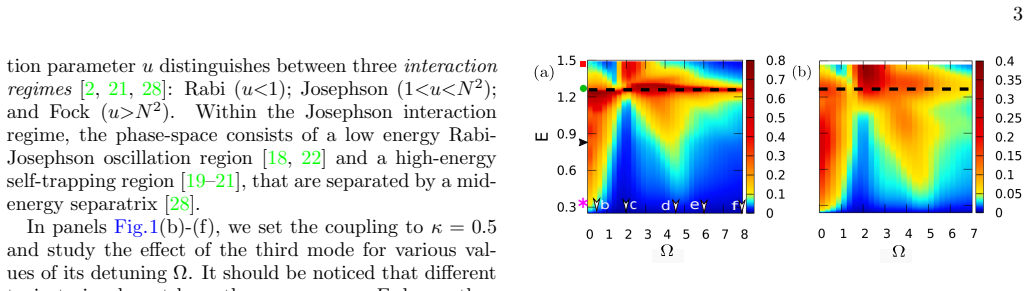
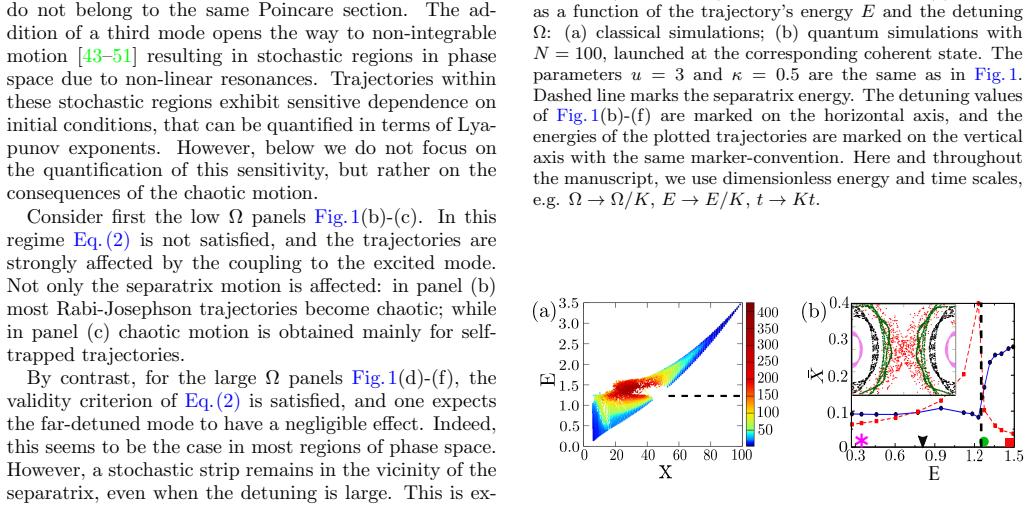
The central discovery is that chaos, not energetic resonance, is the source of Bose-Hubbard breakdown under far-detuned conditions. In the Josephson regime the isolated two-mode dimer has a pendulum-like phase space divided by a separatrix; adding one bosonic mode at detuning $\Omega$ with coupling $\kappa$ converts that separatrix into a stochastic strip through nonlinear resonance, formally identical to the Melnikov-Arnold analysis of the stochastic pump. Quantum spectra confirm the classical picture: eigenstates near the separatrix energy have large participation numbers, indicating strong mixing with the excited orbital, and the time-averaged occupation of that orbital is enhanced exactly in the chaotic regions. The observable consequences are a drop in single-particle purity and the growth of entanglement entropy between the dimer and the extra mode, while the deviation between the two-mode and three-mode population imbalance peaks at the separatrix even for large $\Omega$. The same minimal model quantitatively reproduces the breakdown and thermalization seen in earlier exact numerical studies, including cases with strong interactions.
Load-bearing premise
The load-bearing premise is that one detuned bosonic mode with constant frequency and coupling faithfully represents the entire excited Bloch band of the real double well, so that separatrix chaos in this minimal model is the actual cause of the breakdown seen in the exact simulations.
Editorial extensions
If this is right
- The standard validity condition $u \ll \Omega/K$ is necessary but not sufficient: far-detuned excited modes can still break the two-mode description for initial conditions at or near the separatrix.
- Breakdown appears as fragmentation and entanglement: single-particle purity falls below $1/2$ and dimer-entropy rises precisely in the chaotic regions, so apparent decoherence can arise from internal chaos rather than an external environment.
- Because semiclassical propagation of a Gaussian cloud reproduces the quantum breakdown, the mechanism is essentially classical and should be captured by truncated-Wigner methods.
- The reproduction of the earlier exact simulations, including thermalization of a self-trapped state at strong interaction, indicates that the mechanism extends beyond the weak-interaction validity regime to full chaotic ergodization.
Reading between the lines
- If the single-mode emulation transfers to real lattices, Bose-Hubbard validity should be stated per trajectory rather than per parameter set; initial states whose wavepacket straddles the separatrix are the first to fail.
- A testable extension: in a double-well experiment, prepare nearly identical condensates at energies just below and just above the separatrix and measure excited-band occupation or single-particle purity; the paper predicts a sharp peak in deviation only for the near-separatrix preparation.
- The many-body enhancement suggests a revised validity condition expressed as the width of the stochastic layer relative to the quantum uncertainty of the initial state, rather than the bare detuning $\Omega/K$.
- The same reasoning may apply to any truncated model of a nonlinear many-body system whose classical phase space has separatrices, not only to bosonic lattices.
Signed reviews
Editorial analysis
A structured set of objections, weighed in public.
Referee Report
Summary. The paper studies the breakdown of the two-mode Bose-Hubbard model (BHM) for a bosonic double well when a third, far-detuned bosonic mode is included. Using classical Poincaré sections, quantum spectra, and semiclassical propagation, the authors show that the auxiliary mode creates a stochastic layer near the separatrix of the dimer phase space, producing deviations from two-mode BHM dynamics, enhanced occupation of the excited mode, and entanglement generation even when the standard validity condition u << Omega/K is nominally satisfied. The authors identify the mechanism with the Melnikov-Arnold/stochastic-pump scenario, propose a many-body enhancement of chaos, and compare their 2+1-mode model with the MCTDHB results of Ref. [35].
Significance. If the mechanism is correct, the paper offers a concrete dynamical explanation for a previously unexplained numerical breakdown of the BHM and challenges the sufficiency of band-gap-based validity criteria: near-separatrix motion may be chaotic even for far-detuned modes. The numerical evidence is substantial and clearly presented: Fig. 1 shows persistent stochastic strips at large detuning, Fig. 2 connects large deviation d to chaotic regions, and Figs. 3 and 4 relate chaos to enhanced third-mode occupation, eigenstate mixing, and entanglement entropy. The equations of motion, initial-state construction, and semiclassical protocol are all specified. The main weakness is that the reproduction of Ref. [35] is not parameter-free, and the Melnikov-Arnold connection is asserted rather than derived, so the explanatory claim is stronger than what is demonstrated.
major comments (3)
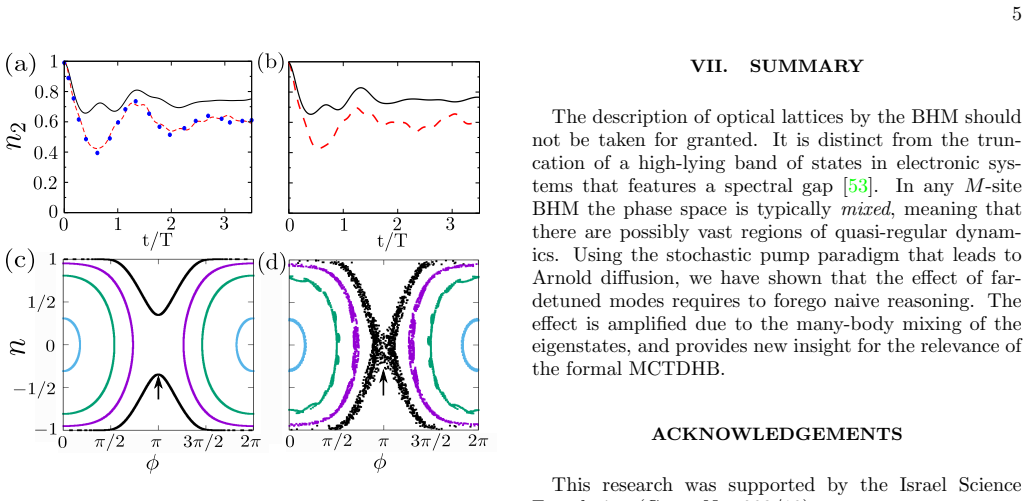
- [Appendix C, Fig. 6] The claim that the model 'precisely reproduces' the MCTDHB results of Ref. [35] relies on fitted parameters: Omega = 5 in all panels and kappa = 0.65 or 0.75, as stated in the Fig. 6 caption. Appendix A only defines Omega and kappa as matrix elements for one excited orbital; it does not compute them for the actual trap used in Ref. [35], nor does it show that a single mode with constant coupling and detuning captures the full excited Bloch band. With two free parameters available, the agreement in Fig. 6 is a consistency check rather than an independent verification of the chaos mechanism. Please either derive Omega and kappa from the physical double-well potential, or explicitly present the comparison as an effective fit and temper the abstract and Sec. VI accordingly. Note also that with u about 2 and Omega/K = 5, the reproduced cases correspond to u/(Omega/K) about 0.43, so they are not deep in the u << Omega/K regime.
- [Sec. III B and abstract] The abstract states that the mechanism is 'formally identical' to the Melnikov-Arnold analysis of the stochastic pump model, and Sec. III B invokes this analogy, but no Melnikov-type calculation is presented: there is no separatrix map, no Melnikov integral, and no prediction for the stochastic-layer width as a function of Omega, kappa, and u. The evidence consists of Poincaré sections. If the formal claim is to be maintained, the authors should provide the reduction or at least a leading-order estimate; otherwise the wording should be weakened to a heuristic analogy.
- [Sec. VII] The summary asserts that 'in any M-site BHM' the phase space is typically mixed and the chaos mechanism applies, but all calculations in the paper are for M = 2 with a single auxiliary mode. No argument is given that the near-separatrix resonance structure survives in longer chains or that the effective single-mode reduction remains valid for a lattice. The conclusions should either be restricted to the double-well/dimer case or supported by explicit evidence for M > 2.
minor comments (5)
- [Sec. II B] There is a typo: 'explaiend' should be 'explained'.
- [Sec. IV] The word 'reminisencet' should be 'reminiscent'.
- [Sec. V B] The word 'separtrix' should be 'separatrix'.
- [Eq. (4)] Please clarify whether T = 2pi is a fixed averaging window or the period of the unperturbed dimer orbit, since near the separatrix the period diverges and the deviation measure may depend on this choice.
- [Appendix C] The MCTDHB data points appear to be digitized from figures of Ref. [35]; please state this explicitly and note the associated digitization uncertainty.
Circularity Check
The core near-separatrix chaos mechanism is self-contained, but the claimed reproduction of Ref. [35] is a tuned fit (Ω=5, κ=0.65/0.75), not an independent prediction.
-
fitted input called prediction
[Sec. VI and Fig. 6 caption (Appendix C)]
"The parameters used in our model are Ω = 5 in all panels, κ = 0.65 in a,b and 0.75 in c,d. ... Our simple model clearly reproduces the results of the MCTDHB model (blue circles) to great accuracy."
The paper presents the agreement with the MCTDHB data of Ref. [35] as evidence that BHM breakdown can be attributed to separatrix chaos from a far-detuned mode. However, the comparison uses Ω and κ as adjustable inputs, chosen separately for the two regimes (κ=0.65 for a,b and κ=0.75 for c,d). Appendix A only defines Ω and κ in terms of excited-orbital matrix elements; it does not compute them for the double-well potential used in Ref. [35]. With these free parameters tuned per case, the agreement shows the model can be fitted to the data, rather than providing a parameter-free prediction that would independently confirm the proposed mechanism. The attribution of the observed breakdown to the model's chaos is therefore partly a restatement of the fitted comparison, not an independent test.
full rationale
The central mechanical claim — that a far-detuned auxiliary mode leaves most dimer trajectories integrable but converts the near-separatrix region into a chaotic strip, causing BHM breakdown even when the standard validity condition holds — is established by the paper's own numerical solution of Eq. (3) and does not depend on the MCTDHB data. That part is self-contained and not circular. The paper also draws on the known Melnikov-Arnold/stochastic-pump paradigm from Chirikov, not on a self-citation chain. The only significant circularity-like issue is the reproduction of Ref. [35]: the model parameters Ω and κ are hand-picked (Ω=5; κ=0.65 or 0.75 depending on the panel) rather than derived from the actual double-well potential, so the observed agreement is a fit rather than an independent prediction. Because the general mechanism retains independent content and the fitted comparison concerns the attribution of the specific prior numerical observations, the appropriate score is moderate, not severe.
Assumptions & free parameters
free parameters (2)
- Omega (auxiliary mode detuning) =
5 in reproduction of Ref. [35]; 0.5, 2, 4.5, 6, 7 in Fig. 1
- kappa (auxiliary mode coupling) =
0.65 and 0.75 in Fig. 6; 0.5 in Figs. 1-4; 40 in Fig. 8
assumptions (4)
- domain assumption The two-mode BHM has an integrable phase space with a separatrix for the Josephson regime (u between 1 and N^2).
- domain assumption The mean-field (Gross-Pitaevskii) classical dynamics correctly captures the relevant chaos and quantum-classical correspondence for large N.
- ad hoc to paper The effect of the whole excited Bloch band can be represented by a single auxiliary mode with constant Omega and kappa (Eq. 3).
- domain assumption The Melnikov-Arnold procedure for the stochastic pump model applies to this three-mode system (Sec. III B).
Cite this review
Pith. "Pith review of Chaos induced breakdown of Bose-Hubbard modeling." pith.science (2026). https://pith.science/paper/LDUTTPTN
@misc{pith2026190801987,
  author       = {Pith},
  title        = {Pith review of: Chaos induced breakdown of Bose-Hubbard modeling},
  year         = {2026},
  howpublished = {\url{https://pith.science/paper/LDUTTPTN}},
  note         = {Machine review of arXiv:1908.01987}
}
read the original abstract
We show that the Bose-Hubbard approximation fails due to the emergence of chaos, even when excited modes are far detuned and the standard validity condition is satisfied. This is formally identical to the Melnikov-Arnold analysis of the stochastic pump model. Previous numerical observations of Bose-Hubbard breakdown are precisely reproduced by our simple model and can be attributed to many body enhancement of chaos.
Figures

Figures from the paper (4 more)



Reference graph
Works this paper leans on
-
[35]
K. Sakmann, A. I. Streltsov, O. E. Alon and L. S. Ceder- baum, Phys. Rev. Lett. 103, 220601 (2009)
work page 2009
-
[1]
M. P. A. Fisher, P. B. Weichman, G. Grinstein, and D. S. Fisher, Phys. Rev. B 40, 546 (1989)
1989
- [2]
-
[3]
J. Hubbard, Proc. R. Soc. Lond. Ser. A Math. Phys. Eng. Sci., 276, 238 (1963)
work page 1963
- [4]
-
[5]
Bloch, Nat
I. Bloch, Nat. Phys. 1, 23 (2005)
2005
-
[6]
K. V. Krutitsky, Phys. Rep. 607, 1 (2016)
work page 2016
- [7]
Show all 53 references
-
[8]
Orzel, A
C. Orzel, A. K. Tuchman, M. L. Fenselau, M. Yasuda, M. A. Kasevich, Science 291, 2386 (2001)
2001
-
[9]
Greiner, O
M. Greiner, O. Mandel, T. Esslinger, T. W. H¨ ansch, I. Bloch, Nature 415, 39 (2002)
2002
-
[10]
Greiner, O
M. Greiner, O. Mandel, T. W. H¨ ansch, I. Bloch, Nature 419, 51 (2002)
2002
-
[11]
S. Will, T. Best, U. Schneider, L. Hackerm¨ uller, D. S. R. L¨ uhmann, and I. Bloch, Nature465, 197 (2010)
2010
-
[12]
Lewenstein, A
M. Lewenstein, A. Sanpera, V. Ahufinger, B. Damski, A. Sen(De), and U. Sen, Adv. Phys., 56, 243 (2007)
2007
-
[13]
Bloch, J
I. Bloch, J. Dalibard, and S. Nascimbene, Nat. Phys. 8, 267 (2012). 8
2012
-
[14]
H. J. Lipkin, N. Meshkov, and A. J. Glick, Nucl. Phys. 62, 188 (1965); N. Meshkov, A. J. Glick, and H. J. Lipkin, Nucl. Phys. 62, 199 (1965); A. J. Glick, H. J. Lipkin, and N. Meshkov, Nucl. Phys. 62, 211 (1965)
1965
-
[15]
G.-B. Jo, Y. Shin, S. Will, T. A. Pasquini, M. Saba, W. Ketterle, D. E. Pritchard, M. Vengalattore and M. Prentiss, Phys. Rev. Lett. 98, 030407 (2007)
2007
-
[16]
Esteve, C
J. Esteve, C. Gross, A. Weller, S. Giovanazzi, and M. K. Oberthaler, Nature 455, 1216 (2008)
2008
-
[17]
M. F. Riedel, P.l B¨ ohi, Yun Li, T. W. H¨ ansch, A. Sinatra, and P. Treutlein Nature 464, 1170 (2010)
2010
-
[18]
G. J. Milburn, J. Corney, E. M. Wright, and D. F. Walls Phys. Rev. A 55, 4318 (1997)
1997
-
[19]
Smerzi, S
A. Smerzi, S. Fantoni, S. Giovanazzi, and S. R. Shenoy, Phys. Rev. Lett. 79, 4950 (1997)
1997
-
[20]
Albiez, R
M. Albiez, R. Gati, J. F¨ olling, S. Hunsmann, M. Cris- tiani, and M. K. Oberthaler Phys. Rev. Lett. 95, 010402 (2005)
2005
-
[21]
Gati, M.K
R. Gati, M.K. Oberthaler, J. Phys. B 40, 61(R) (2007)
2007
-
[22]
S. Levy, E. Lahoud, I. Shomroni, and J. Steinhauer, Na- ture 449, 579 (2007)
2007
-
[23]
Vardi and J
A. Vardi and J. R. Anglin, Phys. Rev. Lett. 86, 568 (2001)
2001
-
[24]
J. R. Anglin and A. Vardi, Phys. Rev. A 64, 013605 (2001)
2001
-
[25]
Khodorkovsky, G
Y. Khodorkovsky, G. Kurizki, and A. Vardi, Phys. Rev. Lett. 100, 220403 (2008)
2008
-
[26]
Boukobza, M
E. Boukobza, M. Chuchem, D. Cohen and A. Vardi, Phys. Rev. Lett. 102, 180403 (2009)
2009
-
[27]
Boukobza, M
E. Boukobza, M. G. Moore, D. Cohen, and A. Vardi, Phys. Rev. Lett. 104, 240402 (2010)
2010
-
[28]
Chuchem, K
M. Chuchem, K. Smith-Mannschott, M. Hiller, T. Kot- tos, A. Vardi, and D. Cohen, Phys. Rev. A, 82, 053617 (2010)
2010
-
[29]
K. C. Wright, R. B. Blakestad, C. J. Lobb, W. D. Phillips, and G. K. Campbell, Phys. Rev. Lett. 110, 025302 (2013)
2013
-
[30]
Eckel, J
S. Eckel, J. G. Lee, F. Jendrzejewski, N. Murray, C. W. Clark, C. J. Lobb, W. D. Phillips, M. Edwards, and G. K. Campbell, Nature 506, 200 (2014)
2014
-
[31]
Fialko, M.-C
O. Fialko, M.-C. Delattre, J. Brand, and A. R. Kolovsky, Phys. Rev. Lett. 108, 250402 (2012)
2012
-
[32]
Arwas and D
G. Arwas and D. Cohen,, New J. Phys. 18, 015007 (2016)
2016
-
[33]
Arwas and D
G. Arwas and D. Cohen, Phys. Rev. B 95, 054505 (2017)
2017
-
[34]
Geva Arwas, Doron Cohen, Frank Hekking, and Anna Minguzzi, Phys. Rev. A 96, 063616 (2017)
2017
-
[36]
Ananikian and T
D. Ananikian and T. Bergeman, Phys. Rev. A 73, 013604 (2006)
2006
-
[37]
Trujillo-Martinez, A
M. Trujillo-Martinez, A. Posazhennikova, and J. Kroha, Phys. Rev. Lett. 103, 105302 (2009)
2009
-
[38]
L. J. LeBlanc, A. B. Bardon, J. McKeever, M. H. T. Extavour, D. Jervis, J. H. Thywissen, F. Piazza, and A. Smerzi, Phys. Rev. Lett. 106, 025302 (2011)
2011
-
[39]
Sof´ ıa Mart´ ınez-Garaot, Giulio Pettini, and Michele Mod- ugno, Phys. Rev. A 98, 043624 (2018)
2018
-
[40]
D. M. Jezek, P. Capuzzi, and H. M. Cataldo, Phys. Rev. A 87, 053625 (2013)
2013
-
[41]
Boris. V. Chirikov, Phys. Rep. 52, 263 (1979)
1979
-
[42]
H.Q. Zhou, J. Links, R.H. McKenzie, and X.W. Guan, J. Phys. A 36, L113 (2003)
2003
-
[43]
Trimborn, D
F. Trimborn, D. Witthaut, and H. J. Korsch, Phys. Rev. A 79, 013608 (2009)
2009
-
[44]
Hiller, T
M. Hiller, T. Kottos, and T. Geisel, Phys. Rev. A 79, 023621 (2009)
2009
-
[45]
Bin Liu, Li-Bin Fu, Shi-Ping Yang, and Jie Liu, Phys. Rev. A 75, 033601 (2007)
2007
-
[46]
Mossmann and C
S. Mossmann and C. Jung, Phys. Rev. A 74, 033601 (2006)
2006
-
[47]
Buonsante, R
P. Buonsante, R. Franzosi, and V. Penna, Phys. Rev. Lett. 90, 050404 (2003)
2003
-
[48]
Vardi, J
I Tikhonenkov, A. Vardi, J. R. Anglin, and D. Cohen, Phys. Rev. Lett. 110, 050401 (2013)
2013
-
[49]
Polls and B
A Gallem, M Guilleumas, J Martorell, R Mayol, A. Polls and B. Juli´ a-Daz, New J. Phys.17, 073014 (2015)
2015
-
[50]
A. Dey, D. Cohen, and A. Vardi, Phys. Rev. Lett. 121, 250405 (2018)
2018
-
[51]
B¨ urkle, A
R. B¨ urkle, A. Vardi, D. Cohen, and J. R. Anglin, Phys. Rev. Lett. 123, 114101 (2019)
2019
-
[52]
V. V. Flambaum, Phys. Scr. 1993, 198 (1993)
1993
-
[53]
Dobrzyniecki and T
Even few-particle systems impose severe limitations, see J. Dobrzyniecki and T. Sowi´ nski, Eur. Phys. J. D70, 83 (2016)
2016
Reviewed August 14, 2026 · model on record in the stance chip above.
Discussion (0). Continue with ORCID to comment.