REVIEW 3 major objections 5 minor 45 references
Near-real-time ship grounding damage assessment using Bayesian networks
T0 review · 3 major / 5 minor · reviewed 2026-08-07 · deepseek-v4-flash
Pith's one-line read This paper claims that a Bayesian network can turn post-grounding observations into near-real-time posterior distributions for damage width, penetration, and location, and that model-plus-observation evidence can make underwater…
desk verdict A genuinely novel BN framework for post-grounding damage extent estimation, with one real validation and one self-consistency check that leaves the inspection-replacement claim under-supported. read the letter →
The pith
A machine-rendered reading of the paper's core claim, the machinery that carries it, and where it could break.
The reading
What carries the argument
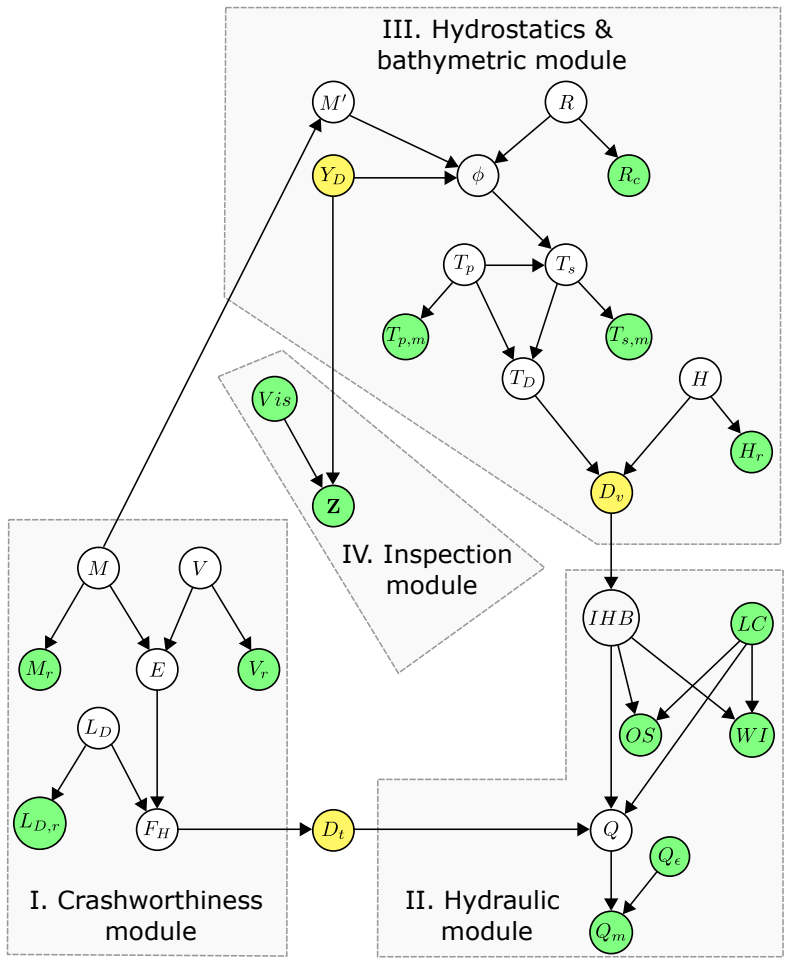
The central object is a hybrid Bayesian network, a directed acyclic graph of discrete and discretized continuous random variables connected by conditional probability tables and conditional densities. It carries the argument because it formalizes the causal chain from ship speed, mass, and damage length to grounding force, from damage area to flow rate, from stranding equilibrium to penetration depth, and from true damage to inspection reports; the clustering algorithm of Lauritzen and Spiegelhalter performs exact inference after discretization. The load-bearing numerical identities are Eq. (5) for the horizontal grounding force, Eq. (7) rearranging the Cerup-Simonsen formula to solve for $D_t$, Eqs. (11) and (12) for flow rates through an opening of area $A=l_D D_t$, and Eq. (21) $D_v \approx T_D - H$ for vertical penetration.
What would settle it
Use the model on a real grounding for which the hull is later dry-docked and the breach geometry measured; feed only the on-board evidence the network is designed for, then check whether the posterior 90% credible intervals for $D_t$, $D_v$, and $Y_D$ contain the measured values, because systematic misses, or a shift when the true multi-segment damage length replaces the reported one, would falsify the near-real-time claim.
Extended reading notes
Core claim
The paper's central claim is that the damage geometry after a hard grounding can be described by three random variables, the transverse center $Y_D$, the transverse extent $D_t$, and the vertical penetration $D_v$, and that a Bayesian network assembled from four modules yields their joint posterior in near real time. The crashworthiness module connects ship mass $M$ and impact speed $V$ to a horizontal grounding force $F_H = 0.5(M+M_a)V^2/L_D$ with a lognormal error, then maps $F_H$ through the Cerup-Simonsen formula to $D_t$. The hydraulic module uses Bernoulli-type relations $Q = C_d A \sqrt{2gh_w}$ for water ingress and the analogous oil-outflow expression, with $A = l_D D_t$, so measured flow rates constrain the damage area. The hydrostatic and bathymetric module obtains $Y_D$ from moment equilibrium $R Y_D = (W'-R)\,GM\tan\phi$ and the penetration from $D_v \approx T_D - H$, the draft at the rock minus water depth. An inspection module adds diver observations with visibility-dependent error. The result is a posterior distribution over $Y_D$, $D_t$, and $D_v$ that tightens as evidence is entered.
Load-bearing premise
The load-bearing premise is that the longitudinal damage length is known to within a 5 m error, so both the force formula and the damage area can be computed with $L_D$ and $A = l_D D_t$; if a real grounding's damage length is unknown or split across segments, the posterior width estimates will be biased and overconfident.
Editorial extensions
If this is right
- Post-grounding decisions can be made with a quantified posterior distribution over damage geometry rather than a conservative point estimate, feeding directly into residual hull-girder strength calculations.
- Combining the crashworthiness and hydraulic modules with on-board observations can produce damage-width estimates as informative as a diver inspection, so inspections become optional when conditions make them unsafe.
- The network can be updated piecewise as evidence arrives, so an early estimate from speed and displacement can be refined by measured flooding rate, drafts, bathymetry, and any inspection report.
- The sensitivity analysis shows inspection quality controls how much a diver report contributes, with a poor-visibility inspection adding little beyond the physics-based modules.
- The same structure is ready to be extended to dynamic Bayesian networks for time-varying flooding, multiple rock contacts, and three-dimensional damage extent.
Reading between the lines
- Left implicit is that the same network could be coupled to a Smith-based residual strength solver to output a failure probability, not just a damage geometry.
- The 5 m damage-length error is the assumption most worth stress-testing next: a real grounding can tear a multi-segment opening, and treating length as known would make the width posterior overconfident.
- A dry-dock comparison, running the model on a real grounding and then laser-scanning the actual hull breach, would be a direct field test of whether the posterior intervals contain the true damage.
- The perfect-detection assumption for water ingress and oil spill could be relaxed with a noisy-sensor conditional probability table, reflecting tank soundings taken in heavy weather.
Editorial analysis
A structured set of objections, weighed in public.
Referee Report
Summary. The paper proposes a Bayesian network (BN) for near-real-time probabilistic assessment of bottom damage extent and location after a hard grounding of an oil tanker. The damage is described by the transverse center location YD, transverse extent Dt, and vertical penetration Dv. The BN integrates four information modules: a crashworthiness module based on energy and empirical grounding-force formulas; a hydraulic module for water-ingress and oil-outflow rates; a hydrostatics and bathymetry module that uses draft, ground reaction, and water depth; and an underwater-inspection module. The crashworthiness module is validated against the 1975 single-hull tanker grounding off Singapore, reproducing the reported 6--10 m damage width with a posterior mean of 8.6 m. The full network is then demonstrated on two hypothetical double-hull VLCC grounding scenarios, where the posterior distributions are shown to tighten and peak near assumed 'true' damage values as evidence is added. The paper concludes that combining crashworthiness and hydraulic models with onboard observations can even replace costly underwater inspections.
Significance. If the claims are supported, the work would fill a practical gap: existing rapid damage-assessment tools are deterministic and conservative, while the proposed BN gives probabilistic, updateable damage estimates from heterogeneous evidence. Explicit strengths are the external anchor of the crashworthiness module against a real accident, the transparent causal model structure, and the systematic treatment of measurement errors in several evidence channels. However, the full-network demonstration does not yet provide independent verification, and the treatment of damage length is a load-bearing simplification. The practical significance is therefore real but contingent on addressing these issues.
major comments (3)
- [Section 5.2, Table 9 and Figures 15-16] The verification of the full BN is circular. The 'true' values are assumed by introducing small perturbations to the same input parameters that generate the evidence, and the inspection outcomes are slight deviations from those same true values. The posterior distributions peaking around the assumed true values is therefore a check of internal consistency, not an independent verification of the model. This is load-bearing because the Abstract and Section 7 use this case study to support the claim that monitoring can replace underwater inspections. I recommend re-running the demonstration with independent evidence generation, for example by holding out one module's evidence (e.g., the inspection) and checking posterior calibration, by generating the 'true' damage from an independent high-fidelity simulation, or by using historical accidents with complete damage records.
- [Section 2.2, Section 4.3.3 (Eq. 10), Section 4.4.2] The treatment of longitudinal damage length is a load-bearing assumption that is not calibrated or stress-tested. Section 2.2 states that longitudinal variables are known with limited uncertainty, and Eq. 10 assumes a reporting error with sigma_epsilon_l = 5 m, but this value is not calibrated against accident data. The damage length enters the crashworthiness module through Eq. 5 (stopping length LD) and the hydraulic module through A = lD * Dt. Combining Eqs. 5 and 7 gives Dt proportional to (1/LD)^(1/0.83), so a 20% error in LD shifts the modal Dt by roughly 30%. A biased report, such as one that identifies only one damaged tank or fails to recognize multi-segment damage (a limitation acknowledged in Section 6), would systematically bias the posterior of Dt and Dv. Case Study II cannot expose this bias because the evidence is generated from the same assumed LD. I recommend widening and calibrating the uncertainty on LD, or at minimum adding a sensitivity study that perturbs LD and introduces a reporting bias, and reporting the resulting posterior changes for Dt and Dv.
- [Abstract, Section 5.2.2, Section 6, Section 7] The conclusion that combining crashworthiness and hydraulic modules 'can even replace costly underwater inspections' is stronger than what the evidence supports. The sensitivity study in Section 5.2.2 compares information sources only under the same likelihood assumptions and does not quantify decision-relevant metrics such as coverage, calibration, or expected loss. Section 6 properly cautions that only partial validation is possible and that the model should initially complement existing approaches, but the Abstract and Section 7 do not carry this caveat. The authors should either soften the 'replace inspections' claim or add a calibration/validation study that directly tests the posterior's frequentist coverage under realistic evidence errors.
minor comments (5)
- [Section 3.2] The discretization of continuous variables is acknowledged to introduce error, but no convergence or sensitivity analysis with respect to discretization resolution is reported; a short study on the effect of interval size on the posterior of Dt and Dv would strengthen the paper.
- [Section 4.4.3, Eq. (13)] The central-difference expression in Eq. (13) is confusing as written; expressing the volume rate directly in terms of the level measurement h(t) and its derivative would improve readability.
- [Table 7] The 'Empirical' distribution for damage length LD is not defined; the IMO histogram underlying Figure 4b should be described or at least cited precisely.
- [Figures 15-17] The paper would benefit from reporting quantitative summaries (posterior means, standard deviations, and credible intervals) alongside the histograms, particularly for the sensitivity study in Figure 17 where 'equally good' is asserted visually.
- [Throughout] There are numerous formatting artifacts and missing spaces (e.g., 'Inapost-grounding', 'isdetermined', 'heeling angel' in Section 4.5.1) that should be corrected before publication.
Circularity Check
No significant circularity: the BN's modules are anchored by external empirical formulas and the synthetic case study is a closed-loop consistency check, not a circular derivation.
full rationale
The derivation chain is not circular. The crashworthiness module rests on the external empirical formula of Cerup-Simonsen et al. (2009) (Eqs. 5-7), which was calibrated with FEA and validated against real groundings, independent of this paper's fitted values. The validation in Case Study I uses the reported 1975 Singapore grounding and recovers a damage width mean of 8.6 m within the reported 6-10 m range; this is an external anchor. The hydraulic and inspection modules use Bernoulli (Eqs. 11-12) and measurement-error models (Eqs. 23-24) that are standard and independent. The full-network Case Study II is explicitly a synthetic verification: 'The "true" values were assumed by introducing small perturbations to the input parameters of the modules,' and the evidence 'was created' from those same modules. The posterior peaking near the true values is therefore a self-consistency check of the BN implementation and likelihood specification, not an empirical validation. The paper acknowledges this: 'only partial validation of the model is possible at present.' No parameter is fitted to a subset of data and then predicted back; no load-bearing self-citation is used; and no uniqueness claim is imported from the authors' prior work. The uncalibrated 5 m sigma for the damage-length report (Eq. 10) is a model-uncertainty and correctness concern, not circularity.
Assumptions & free parameters
free parameters (10)
- Reported damage length error sigma_epsilon_l (Eq. 10) =
5 m
- Grounding force multiplicative error COV delta_epsilon_fh (Eq. 5) =
0.10
- Discharge coefficient Cd (Eqs. 11-12) =
N(0.625, 0.02)
- Flow rate measurement error COV delta_epsilon_q (Eq. 14) =
0.10 good, 0.30 poor
- Water depth reporting error sigma_epsilon_h (Eq. 22) =
0.75 m
- Draft measurement error sigma_epsilon_tp/s (Eqs. 17-18) =
0.25 m
- Ground reaction estimation error COV delta_epsilon_r (Eq. 19) =
0.10
- Inspection extent error COV delta_epsilon_d (Eq. 23) =
0.10 good, 0.30 poor visibility
- Inspection location error sigma_epsilon_y (Eq. 24) =
1 m good, 2 m poor visibility
- Impact speed prior Beta(alpha=5, beta=2) =
Beta(5,2)
assumptions (7)
- domain assumption Kinetic energy of the ship before grounding is totally dissipated by the destruction of the bottom structure (Eq. 5).
- domain assumption The damage opening is rectangular and the outer and inner shell damaged widths are equal (Section 2.3).
- domain assumption Longitudinal damage extent and location are known with limited uncertainty (Section 2.2).
- domain assumption Single rock grounding, hard grounding, powered ship (Section 2.3).
- ad hoc to paper The assumed error distributions and COVs for all evidence variables are correct (Sections 4.3.1-4.6).
- standard math Bernoulli's principle and the tank-level hydraulic equations (Eqs. 11-12) govern inflow and outflow.
- standard math Bayes' rule and the BN factorization (Eq. 1) hold.
Cite this review
Pith. "Pith review of Near-real-time ship grounding damage assessment using Bayesian networks." pith.science (2026). https://pith.science/paper/LDZ64TUV
@misc{pith2026250606493,
  author       = {Pith},
  title        = {Pith review of: Near-real-time ship grounding damage assessment using Bayesian networks},
  year         = {2026},
  howpublished = {\url{https://pith.science/paper/LDZ64TUV}},
  note         = {Machine review of arXiv:2506.06493}
}
read the original abstract
In a post-grounding event, the rapid assessment of hull girder residual strength is crucial for making informed decisions, such as determining whether the vessel can safely reach the closest yard. One of the primary challenges in this assessment is the uncertainty in the estimation of the extent of structural damage. Although classification societies have developed rapid response damage assessment tools, primarily relying on 2D Smith-based models, these tools are based on deterministic methods and conservative estimates of damage extent. To enhance this assessment, we propose a probabilistic framework for rapid grounding damage assessment of ship structures using Bayesian networks (BNs). The proposed BN model integrates multiple information sources, including underwater inspection results, hydrostatic and bathymetric data, crashworthiness models, and hydraulic models for flooding and oil spill monitoring. By systematically incorporating these parameters and their associated uncertainties within a causal framework, the BN allows for dynamic updates as new evidence emerges during an incident. Two case studies demonstrate the effectiveness of this methodology, highlighting its potential as a practical decision support tool to improve operational safety during grounding events. The results indicate that combining models with on-site observations can even replace costly underwater inspections.
Figures


Figures from the paper (14 more)




Reference graph
Works this paper leans on
-
[1]
Simulation of ship grounding damage using the finite element method
AbuBakar, A., Dow, R., 2013. Simulation of ship grounding damage using the finite element method. International Journal of Solids and Structures 50, 623–636
work page 2013
-
[2]
On the resistance of tanker bottom structures during stranding
Alsos, H.S., Amdahl, J., 2007. On the resistance of tanker bottom structures during stranding. Marine Structures 20, 218–237
work page 2007
-
[3]
Application of Bayesian network in the maritime industry: Comprehensive literature review
Animah, I., 2024. Application of Bayesian network in the maritime industry: Comprehensive literature review. Ocean Engineering 302, 117610. BayesFusion, 2024. GeNIe Modeler. URL:https://www.bayesfusion.com/ genie
work page 2024
-
[4]
Probabilistic assessment of damaged survivability of passenger ships in case of grounding or contact
Bulian, G., Cardinale, M., Dafermos, G., Lindroth, D., Ruponen, P., Zara- phonitis, G., 2020. Probabilistic assessment of damaged survivability of passenger ships in case of grounding or contact. Ocean Engineering 218, 107396. Bužančić Primorac, B., Parunov, J., Guedes Soares, C., 2020. Structural reli- ability analysis of ship hulls accounting for collis...
work page 2020
-
[5]
Cerup-Simonsen, B., Törnqvist, R., Lützen, M., 2009. A simplified grounding damage prediction method and its application in modern damage stability requirements. Marine Structures 22, 62–83. ClassNK, 2014. Investigation report on structural safety of large container ships. Class NK, Tokyo. 37 Dalheim, Ø.Ø., Steen, S., 2021. Uncertainty in the real-time es...
work page 2009
-
[6]
Dean, M.S., 2016. Salvage operations. Springer Handbook of Ocean Engi- neering , 985–1066. DNV, 2025. Emergency Response Service. URL:https: //www.dnv.com/maritime/ship-classification-services/ emergency-response-service
work page 2016
-
[7]
Statistical analysis of ship accidents and review of safety level
Eliopoulou, E., Papanikolaou, A., Voulgarellis, M., 2016. Statistical analysis of ship accidents and review of safety level. Safety Science 85, 282–292
work page 2016
-
[8]
Survivability and reliability of damaged ships after collision and grounding
Fang, C., Das, P.K., 2005. Survivability and reliability of damaged ships after collision and grounding. Ocean Engineering 32, 293–307
work page 2005
Show all 45 references
-
[9]
Bayesian networks as a decision support tool in marine applications
Friis-Hansen, A., 2000. Bayesian networks as a decision support tool in marine applications. Ph.D. thesis. Department of Naval Architecture and Offshore Engineering, Technical University of Denmark
2000
-
[10]
A simplified method to predict grounding damage of double bottom tankers
Heinvee, M., Tabri, K., 2015. A simplified method to predict grounding damage of double bottom tankers. Marine Structures 43, 22–43
2015
-
[11]
Rapid assessment of ship grounding over large contact surfaces
Hong, L., Amdahl, J., 2012. Rapid assessment of ship grounding over large contact surfaces. Ships and Offshore Structures 7, 5–19. IACS, 2024. Common Structural Rules for Bulk Carriers and Oil Tankers. International Association of Classification Societies, London, UK. IHO, 202...
2012
-
[12]
Bayesian Networks and Decision Graphs
Jensen, F.V., Nielsen, T.D., 2007. Bayesian Networks and Decision Graphs. Springer. 38
2007
-
[13]
Towards a probabilistic model for estimation of grounding accidents in fluctuating backwater zone of the Three Gorges Reservoir
Jiang, D., Wu, B., Cheng, Z., Xue, J., Van Gelder, P., 2021. Towards a probabilistic model for estimation of grounding accidents in fluctuating backwater zone of the Three Gorges Reservoir. Reliability Engineering & System Safety 205, 107239
2021
-
[14]
Jiang, X., Yu, H., Kaminski, M.L., 2014. Assessment of residual ultimate hull girder strength of damaged ships, in: International Conference on Off- shore Mechanics and Arctic Engineering, American Society of Mechanical Engineers. p. V04AT02A011. Joško Parunov, S.R., Ćorak, M....
2014
-
[15]
A practical diagram to determine the residual longitudinal strength of grounded ship in northern sea route
Kim, D.K., Kim, H.B., Park, D.H., Hairil, M., Paik, J.K., 2020. A practical diagram to determine the residual longitudinal strength of grounded ship in northern sea route. Ships and Offshore Structures 15, 683–700
2020
-
[16]
FEM approach to the simulation of collision and ground- ing damage
Kitamura, O., 2002. FEM approach to the simulation of collision and ground- ing damage. Marine Structures 15, 403–428
2002
-
[17]
Hydraulic modelling of oil spill through submerged orifices in damaged ship hulls
Kollo, M., Laanearu, J., Tabri, K., 2017. Hydraulic modelling of oil spill through submerged orifices in damaged ship hulls. Ocean Engineering 130, 385–397
2017
-
[18]
Numerical simulation of actual collision and grounding accidents, in: International conference on collision and grounding of ships (ICCGS)
Kuroiwa, T., 1996. Numerical simulation of actual collision and grounding accidents, in: International conference on collision and grounding of ships (ICCGS)
1996
-
[19]
Local computations with prob- abilities on graphical structures and their application to expert systems
Lauritzen, S.L., Spiegelhalter, D.J., 1988. Local computations with prob- abilities on graphical structures and their application to expert systems. Journal of the Royal Statistical Society: Series B (Methodological) 50, 157–194
1988
-
[20]
Lee, A., VanDerHorn, E., Wang, G., 2012. Residual strength analysis for rapid response damage assessment (RRDA) of steel ship structures, in: International Conference on Offshore Mechanics and Arctic Engineering, American Society of Mechanical Engineers. pp. 491–502
2012
-
[21]
Principles of Naval Architecture: Stability and Strength
Lewis, E.V., 1988. Principles of Naval Architecture: Stability and Strength. SNAME 1, 316. 39
1988
-
[22]
A comparison of numerical methods for damage index based residual ultimate limit state assessment of grounded ship hulls
Li, S., Kim, D.K., 2022. A comparison of numerical methods for damage index based residual ultimate limit state assessment of grounded ship hulls. Thin-Walled Structures 172, 108854
2022
-
[23]
Structural risk analysis model of damaged membrane LNG carriers after grounding based on Bayesian belief networks
Li, X., Tang, W., 2019. Structural risk analysis model of damaged membrane LNG carriers after grounding based on Bayesian belief networks. Ocean Engineering 171, 332–344
2019
-
[24]
Numerical assessment of the structural crashworthiness of corroded ship hulls in stranding
Liu, B., Garbatov, Y., Zhu, L., Soares, C.G., 2018. Numerical assessment of the structural crashworthiness of corroded ship hulls in stranding. Ocean Engineering 170, 276–285
2018
-
[25]
Analysis of structural crashworthiness of double-hull ships in collision and grounding
Liu, B., Villavicencio, R., Pedersen, P.T., Soares, C.G., 2021. Analysis of structural crashworthiness of double-hull ships in collision and grounding. Marine Structures 76, 102898
2021
-
[26]
Towards an evidence-based probabilistic risk model for ship-grounding accidents
Mazaheri, A., Montewka, J., Kujala, P., 2016. Towards an evidence-based probabilistic risk model for ship-grounding accidents. Safety Science 86, 195–210
2016
-
[27]
Dynamic Bayesian networks: representation, inference and learning
Murphy, K.P., 2002. Dynamic Bayesian networks: representation, inference and learning. University of California, Berkeley
2002
-
[28]
Understanding ship- grounding events
Nguyen, T.H., Amdahl, J., Leira, B.J., Garrè, L., 2011. Understanding ship- grounding events. Marine Structures 24, 551–569
2011
-
[29]
A new method for assessing the safety of ships damaged by grounding
Paik, J., Kim, D., Park, D., Kim, H., Kim, M., 2012. A new method for assessing the safety of ships damaged by grounding. International Journal of Maritime Engineering 154
2012
-
[30]
Probabilistic reasoning in intelligent systems: Networks of plausible inference
Pearl, J., Shafer, G., 1995. Probabilistic reasoning in intelligent systems: Networks of plausible inference. Synthese-Dordrecht 104, 161. 40
1995
-
[31]
Effect of ship structure and size on grounding and collision damage distributions
Pedersen, P., Zhang, S., 2000. Effect of ship structure and size on grounding and collision damage distributions. Ocean Engineering 27, 1161–1179
2000
-
[32]
A fast simulation tool for ship grounding damage analysis
Pineau, J.P., Conti, F., Le Sourne, H., Looten, T., 2022. A fast simulation tool for ship grounding damage analysis. Ocean Engineering 262, 112248
2022
-
[33]
Simulation of the behavior of a ship hull under grounding: Effect of applied element size on structural crashworthiness
Prabowo, A.R., Putranto, T., Sohn, J.M., 2019. Simulation of the behavior of a ship hull under grounding: Effect of applied element size on structural crashworthiness. Journal of Marine Science and Engineering 7, 270
2019
-
[34]
Committee V.1: Accidental Limit States, in: Proceedings of the 21st International Ship and Offshore Struc- tures Congress, Vancouver, Canada
Walters, C., Wang, D., Yu, Z., 2022. Committee V.1: Accidental Limit States, in: Proceedings of the 21st International Ship and Offshore Struc- tures Congress, Vancouver, Canada
2022
-
[35]
A method for breach assessment onboard a damaged passenger ship
Ruponen, P., Pulkkinen, A., Laaksonen, J., 2017. A method for breach assessment onboard a damaged passenger ship. Applied Ocean Research 64, 236–248
2017
-
[36]
Survey on grounding inci- dents: Statistical analysis and risk assessment
Samuelides, M., Ventikos, N., Gemelos, I., 2009. Survey on grounding inci- dents: Statistical analysis and risk assessment. Ships and Offshore Struc- tures 4, 55–68
2009
-
[37]
Sergejeva, M., Laanearu, J., Tabri, K., 2017. On parameterization of emul- sification and heat exchange in the hydraulic modelling of oil spill from a damaged tanker in winter conditions, in: Progress in the Analysis and Design of Marine Structures. CRC Press, pp. 43–50
2017
-
[38]
Hydraulic modelling of sub- merged oil spill including tanker hydrostatic overpressure
Sergejeva, M., Laarnearu, J., Tabri, K., 2013. Hydraulic modelling of sub- merged oil spill including tanker hydrostatic overpressure. Analysis and Design of Marine Structures 209
2013
-
[39]
An online platform for rapid oil outflow assessment from grounded tankers for pollution response
Tabri, K., Heinvee, M., Laanearu, J., Kollo, M., Goerlandt, F., 2018. An online platform for rapid oil outflow assessment from grounded tankers for pollution response. Marine Pollution Bulletin 135, 963–976
2018
-
[40]
A novel method for the proba- bilistic assessment of ship grounding damages and their impact on damage stability
Taimuri, G., Ruponen, P., Hirdaris, S., 2023. A novel method for the proba- bilistic assessment of ship grounding damages and their impact on damage stability. Structural Safety 100, 102281. 41
2023
-
[41]
Analytical prediction of oil spill from grounded cargo tankers, in: International Con- ference on Offshore Mechanics and Arctic Engineering, pp
Tavakoli, M.T., Amdahl, J., Ashrafian, A., Leira, B.J., 2008. Analytical prediction of oil spill from grounded cargo tankers, in: International Con- ference on Offshore Mechanics and Arctic Engineering, pp. 911–920
2008
-
[42]
Hazard identification and scenario selec- tion of ship grounding accidents
Youssef, S.A.M., Paik, J.K., 2018. Hazard identification and scenario selec- tion of ship grounding accidents. Ocean Engineering 153, 242–255
2018
-
[43]
A method for the direct assessment of ship colli- sion damage and flooding risk in real conditions
Zhang, M., Conti, F., Le Sourne, H., Vassalos, D., Kujala, P., Lindroth, D., Hirdaris, S., 2021. A method for the direct assessment of ship colli- sion damage and flooding risk in real conditions. Ocean Engineering 237, 109605
2021
-
[44]
Plate tearing and bottom damage in ship grounding
Zhang, S., 2002. Plate tearing and bottom damage in ship grounding. Marine Structures 15, 101–117
2002
-
[45]
Statistics and damage assessment of ship grounding
Zhu, L., James, P., Zhang, S., 2002. Statistics and damage assessment of ship grounding. Marine Structures 15, 515–530. 42
2002
Reviewed August 7, 2026 · model on record in the stance chip above.
Discussion (0). Sign in to comment.