Controllable excitation of vector Akhmediev breather patterns
Pith reviewed 2026-06-26 12:40 UTC · model grok-4.3
The pith
An eigenvector-based perturbation scheme selectively excites a chosen vector Akhmediev breather by seeding the corresponding modulation instability branch in the Manakov system.
A machine-rendered reading of the paper's core claim, the machinery that carries it, and where it could break.
Core claim
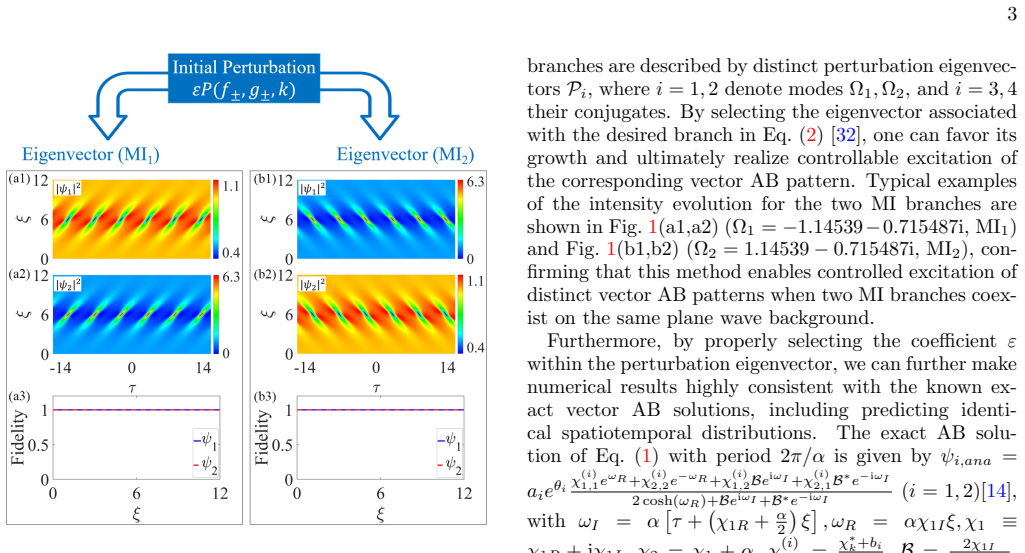
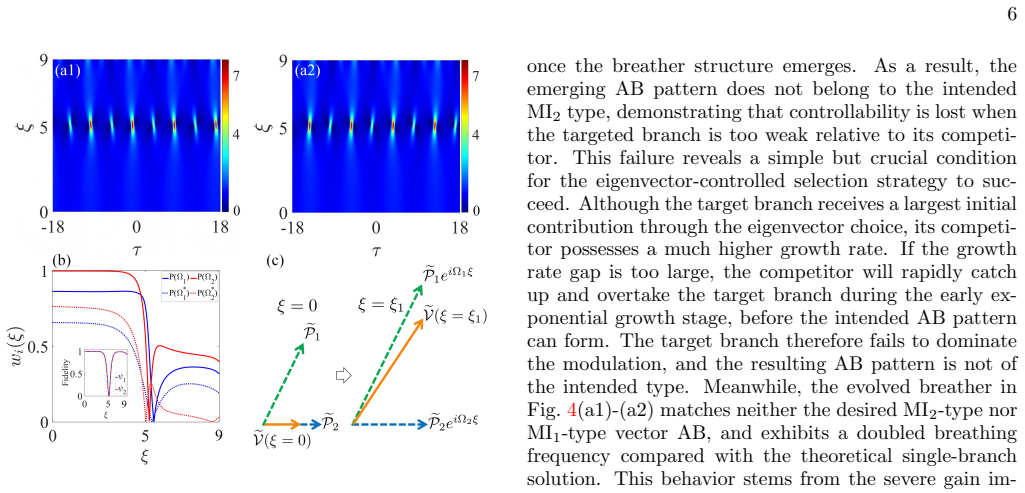
The central claim is that an eigenvector-based initial perturbation scheme, formed by adding Fourier modes whose amplitudes follow the perturbation eigenvector of a chosen modulation instability branch to a plane wave background, produces controllable high-fidelity excitation of any desired vector Akhmediev breather. The mechanism is that the seeded eigenvector, together with the non-Hermitian coupling of the linearized dynamics, causes the targeted unstable mode to dominate the early evolution and thereby dictate the breather type throughout the nonlinear stage; the method works in gain-balanced regimes provided the selected branch possesses a sufficient gain advantage.
What carries the argument
eigenvector-based initial perturbation scheme that constructs the initial condition as a plane wave plus Fourier modes whose coefficients follow the perturbation eigenvector of a selected MI branch
Load-bearing premise
The non-Hermitian coupling in the linearized modulation instability dynamics makes the seeded unstable mode dominate the early linear stage and thereby fix the breather type for the rest of the evolution.
What would settle it
A numerical simulation that applies the eigenvector-based initial condition yet produces a breather whose shape deviates substantially from the exact target solution during the nonlinear stage would falsify the dominance claim.
Figures
read the original abstract
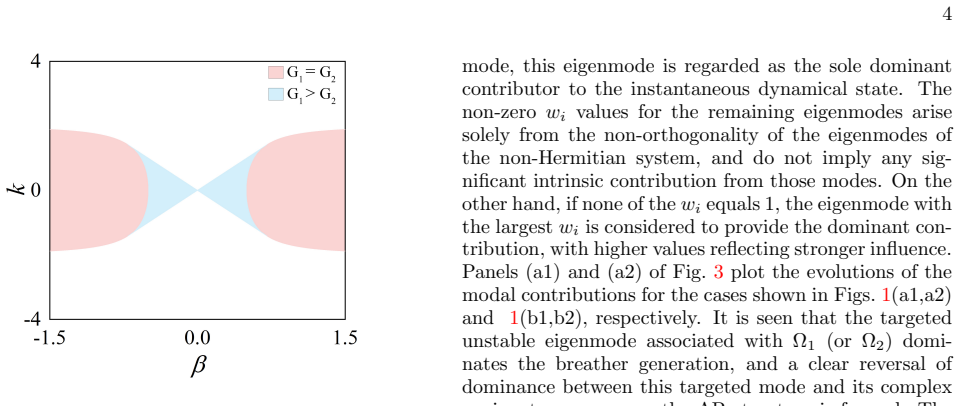
In the focusing Manakov system, multiple modulation instability (MI) branches coexist on the same plane wave background, so the usual weak periodic modulation cannot selectively excite a single vector Akhmediev breather (AB). Here we propose an eigenvector-based initial perturbation scheme that constructs the initial condition as a plane wave plus Fourier modes whose coefficients follow the perturbation eigenvector of a selected MI branch, enabling controllable high-fidelity excitation of desired vector ABs. Numerical simulations show near-100\% fidelity with the exact AB solution. The underlying mechanism is eigenvector-controlled mode selection. The initial seeding of the target MI branch through the chosen eigenvector, together with the non-Hermitian coupling inherent in the linearized MI dynamics, ensures that the targeted unstable mode dominates the early linear stage and thereby dictates the breather type. This eigenvector-based control succeeds in gain-balanced regimes and when the targeted branch has a sufficient gain advantage. The proposed method provides a simple and robust framework for controllable generation of vector ABs over a broad parameter range, highlighting the key role of eigenvector selectivity in multi-component nonlinear systems.
Editorial analysis
A structured set of objections, weighed in public.
Referee Report
Summary. The paper proposes an eigenvector-based initial perturbation scheme for the focusing Manakov system that constructs initial data as a plane wave plus Fourier modes whose amplitudes and phases are taken from the eigenvector of a chosen modulation-instability branch. This seeding is claimed to enable selective, high-fidelity excitation of a single target vector Akhmediev breather even when multiple MI branches coexist on the same background. Direct numerical simulations are reported to recover the exact breather solution with near-100% fidelity; the mechanism is attributed to eigenvector-controlled mode selection together with non-Hermitian coupling that lets the seeded unstable mode dominate the early linear stage.
Significance. If the reported fidelity is reproducible across the stated parameter ranges, the work supplies a parameter-free, eigenvector-driven protocol for controllable generation of vector breathers. It extends standard linear stability analysis of the Manakov system without introducing fitted parameters or circular derivations, and the numerical verification is presented as direct comparison with the exact analytic solution. Such a method could be useful for designing initial conditions in optics or hydrodynamics experiments where selective breather excitation is desired.
minor comments (3)
- The abstract states 'near-100% fidelity' but the manuscript should explicitly define the quantitative measure (e.g., L2-norm error, overlap integral, or pointwise deviation) and report the maximum error over the full evolution interval and across the parameter sets shown in the figures.
- Section describing the numerical scheme should state the integrator, spatial discretization, domain size, and grid resolution used to obtain the reported fidelity; without these details the reproducibility of the 'near-100%' claim cannot be assessed.
- The statement that the method 'succeeds in gain-balanced regimes' would benefit from an explicit table or figure panel that lists the gain values of the competing branches and the resulting fidelity for each case.
Simulated Author's Rebuttal
We thank the referee for the positive assessment of the manuscript and the recommendation of minor revision. The report contains no major comments requiring point-by-point response.
Circularity Check
No significant circularity identified
full rationale
The paper's proposed eigenvector-based initial perturbation scheme is constructed directly from the standard linear stability (MI) analysis of the Manakov system, with the non-Hermitian coupling invoked as the mechanism for mode dominance. No derivation step reduces by construction to a fitted input, self-definition, or self-citation chain; the numerical fidelity checks are presented as independent verification against the exact AB solution. The argument remains self-contained against external benchmarks of linear stability theory.
Axiom & Free-Parameter Ledger
axioms (1)
- standard math Linearized modulation instability analysis of the Manakov system yields eigenvectors usable for constructing selective initial perturbations.
Reference graph
Works this paper leans on
-
[1]
This phenomenon also originates from the non-Hermitian nature of the linearized MI sys- tem
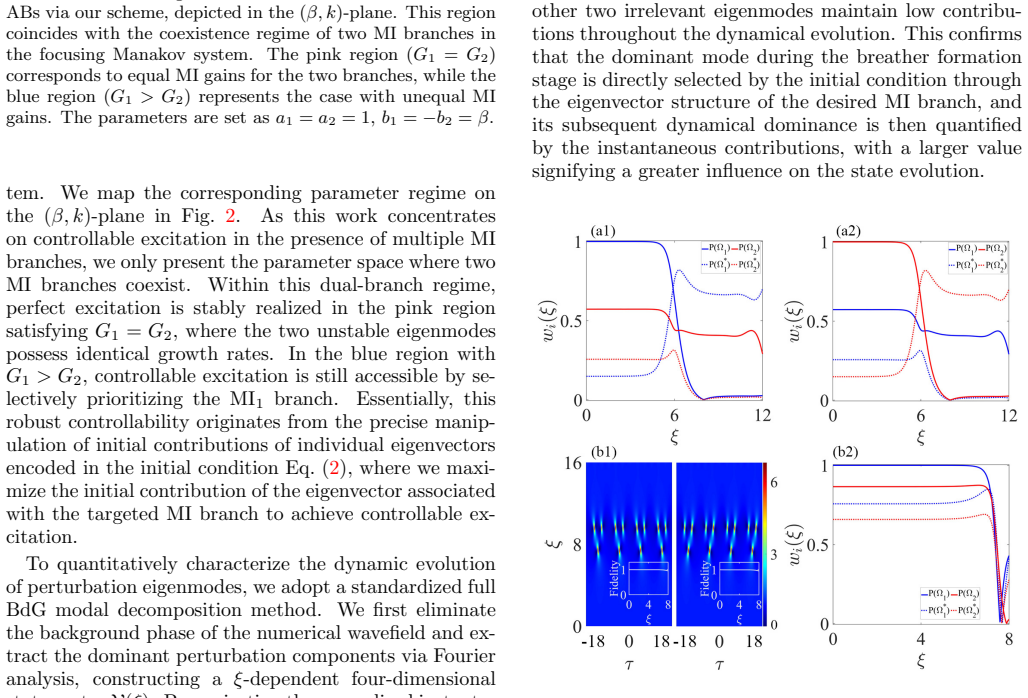
exhibit non-zero contributions in the modal decomposition. This phenomenon also originates from the non-Hermitian nature of the linearized MI sys- tem. The BdG operatorKgoverning linearized perturba- tions is non-Hermitian, and its eigenbasis does not obey conventional Hermitian orthogonal conditions [31, 38]. This intrinsic property causes the instantane...
-
[2]
Tianchi Talent
and cannot diffuse into other eigenmodes Ω 2 and Ω ∗ 2 (or Ω1 and Ω ∗ 1). The energy exchange between these two dominant modes di- rectly produces the periodic compression and recovery of the breather intensity, thereby guaranteeing the high pu- rity, stability, and controllability of the generated vector ABs. The above analysis establishes that the AB pa...
-
[3]
N. N. Akhmediev and V. I. Korneev, Modulation insta- bility and periodic solutions of the nonlinear Schr¨ odinger equation, Theor. Math. Phys.69, 1089-1093 (1986)
1986
-
[4]
Hammani, B
K. Hammani, B. Wetzel, B. Kibler, J. Fatome, C. Finot, G. Millot, N. Akhmediev, and J. M. Dudley, Spectral dy- namics of modulation instability described using Akhme- diev breather theory, Opt. Lett.36, 2140-2142 (2011)
2011
-
[5]
Erkintalo, G
M. Erkintalo, G. Genty, B. Wetzel, and J. M. Dudley, Akhmediev breather evolution in optical fiber for realistic initial conditions, Phys. Lett. A375, 2029-2034 (2011)
2029
-
[6]
J. M. Dudley, G. Genty, F. Dias, B. Kibler, and N. Akhmediev, Modulation instability, Akhmediev Breathers and continuous wave supercontinuum gener- ation, Opt. Express17, 21497-21508 (2009)
2009
-
[7]
Frisquet, B
B. Frisquet, B. Kibler, G. Millot, Collision of Akhmediev Breathers in Nonlinear Fiber Optics, Phys. Rev. X3, 041032 (2013)
2013
-
[8]
Kibler, J
B. Kibler, J. Fatome, C. Finot, G. Millot, F. Dias, G. Genty, N. Akhmediev, J. M. Dudley, The Peregrine soli- ton in nonlinear fibre optics, Nat. Phys.6, 790-795 (2010)
2010
-
[9]
K Hammani, B Kibler, C Finot, P Morin, J Fatome, J. M. Dudley, and G. Millot, Peregrine soliton generation and breakup in standard telecommunications fiber, Opt. Lett.36, 112-114 (2011)
2011
-
[10]
G. Yang, L. Li, and S. Jia, Peregrine rogue waves in- duced by the interaction between a continuous wave and a soliton, Phys. Rev. E85, 046608 (2012)
2012
-
[11]
J. M. Dudley, F. Dias, M. Erkintalo, and G. Genty, In- stabilities, breathers and rogue waves in optics, Nature Photon8, 755-764 (2014)
2014
-
[12]
Chabchoub, N
A. Chabchoub, N. P. Hoffmann, and N. Akhmediev, Ob- servation of rogue wave holes in a water wave tank, J Geophys Res-Oceans117, 00J02 (2012)
2012
-
[13]
M. G. Forest, D. W. McLaughlin, D. J. Muraki, O. C. Wright, Nonfocusing instabilities in coupled, integrable nonlinear Schr¨ odinger PDEs, J. Nonlinear Sci.10, 291- 331 (2000)
2000
-
[14]
Baronio, M
F. Baronio, M. Conforti, A. Degasperis, S. Lombardo, M. Onorato, S. Wabnitz, Vector rogue waves and baseband modulation instability in the defocusing regime, Phys. Rev. Lett.113, 034101 (2014)
2014
-
[15]
Baronio, S
F. Baronio, S. Chen, P. Grelu, S. Wabnitz, M. Conforti, Baseband modulation instability as the origin of rogue waves, Phys. Rev. A91, 033804 (2015)
2015
-
[16]
Ling, L.-C
L. Ling, L.-C. Zhao, Modulational instability and ho- moclinic orbit solutions in vector nonlinear Schr¨ odinger equation, Commun. Nonlinear Sci. Numer. Simulat.72, 449-471 (2019)
2019
-
[17]
Ling, L.-C
L. Ling, L.-C. Zhao, Z.-Y. Yang, and B. Guo, Generation mechanisms of fundamental rogue wave spatial-temporal structure, Phys. Rev. E96, 022211 (2017)
2017
-
[18]
Y.-H. Qin, L. Ling, and L.-C. Zhao, Optical rogue-wave patterns in coupled defocusing systems, Phys. Rev. A 108, 023519 (2023)
2023
-
[19]
Liu, S.-C
C. Liu, S.-C. Chen, N, Akhmediev, Fundamental and second-order superregular breathers in vector fields, Phys. Rev. Lett.132, 027201 (2024)
2024
-
[20]
Liu, S.-C
C. Liu, S.-C. Chen, X. Yao, N. Akhmediev, Modulation Instability and Non-Degenerate Akhmediev Breathers of Manakov Equations, Chin. Phys. Lett.39, 094201 (2022)
2022
-
[21]
S.-C. Chen, C. Liu, X. Yao, L.-C. Zhao, and N. Akhmediev, Extreme spectral asymmetry of Akhmediev breathers and Fermi-Pasta-Ulam recurrence in a Man- akov system, Phys. Rev. E104, 024215 (2021)
2021
-
[22]
S. V. Manakov, On the theory of two-dimensional sta- tionary self-focusing of electromagnetic waves, Sov. Phys. JETP38, 248 (1974)
1974
-
[23]
G. P. Agrawal,Nonlinear Fiber Optics(Academic Press, New York, 2013)
2013
-
[24]
C. R. Menyuk, Pulse propagation in an elliptically bire- fringent Kerr medium, IEEE J. Quantum Electron.25, 2674-2682 (1989)
1989
-
[25]
S. Chen, F. Baronio, J. M. Soto-Crespo, P. Grelu, and D. Mihalache, Versatile rogue waves in scalar, vector, and multidimensional nonlinear systems, J. Phys. A: Math. Theor.50, 463001 2017
2017
-
[26]
Baronio, A
F. Baronio, A. Degasperis, M. Conforti, and S. Wabnitz, Solutions of the Vector Nonlinear Schr¨ odinger Equations: Evidence for Deterministic Rogue Waves, Phys. Rev. Lett.109, 044102 (2012)
2012
-
[27]
Baronio, B
F. Baronio, B. Frisquet, S. Chen, G. Millot, S. Wabnitz, and B. Kibler, Observation of a group of dark rogue waves in a telecommunication optical fiber, Phys. Rev. A97, 013852 (2018)
2018
-
[28]
P. G. Kevrekidis, D. J. Frantzeskakis, and R. Carretero-Gonz´ alez,Emergent Nonlinear Phenomena in Bose-Einstein Condensates: Theory and Experiment (Springer, Berlin, 2008). 8
2008
-
[29]
Becker, S
C. Becker, S. Stellmer, P. Soltan-Panahi, S. D¨ orscher, M. Baumert, E.-M. Richter, J. Kronj¨ ager, K. Bongs, and K. Sengstock, Oscillations and interactions of dark and dark-bright solitons in Bose-Einstein condensates, Nat. Phys.4, 496 (2008)
2008
-
[30]
Lannig, C.-M
S. Lannig, C.-M. Schmied, M. Pr¨ ufer, P. Kunkel, R. Strohmaier, H. Strobel, T. Gasenzer, P. G. Kevrekidis, and M. K. Oberthaler, Collisions of Three-Component Vector Solitons in Bose-Einstein Condensates, Phys. Rev. Lett.125, 170401 (2020)
2020
-
[31]
N. V. Priya, M. Senthilvelan, and M. Lakshmanan, Akhmediev breathers, Ma solitons, and general breathers from rogue waves: A case study in the Manakov system, Phys. Rev. E88, 022918 (2013)
2013
-
[32]
Bogolubov, On the thoery of superfludity, J
N. Bogolubov, On the thoery of superfludity, J. Phys. 11, 23-32 (1947); P. G. de Gennes, Supercondutivity of metals and alloys (New York: W.A. Benjamin, 1966)
1947
-
[33]
Moiseyev,Non-Hermitian Quantum Mechanics(Cam- bridge University Press, 2011)
N. Moiseyev,Non-Hermitian Quantum Mechanics(Cam- bridge University Press, 2011)
2011
-
[34]
Qin, L.-C
Y.-H. Qin, L.-C. Zhao, Z.-Y. Yang, and W.-L. Yang, Sev- eral localized waves induced by linear interference be- tween a nonlinear plane wave and bright solitons, Chaos 28, 013111 (2018)
2018
-
[35]
Zhao and L
L.-C. Zhao and L. Ling, Quantitative relations between modulational instability and several well-known nonlin- ear excitations, J. Opt. Soc. Am. B33, 850 (2016)
2016
-
[36]
Fermi, J
E. Fermi, J. Pasta, and S. Ulam, Los Alamos Report No. LA-1940, 1955; reprinted in E. Fermi, Collected Papers, edited by E. Segr´ e (University of Chicago Press, Chicago, IL, 1965), Vol. II, p. 978
1940
-
[37]
Devine, A
N. Devine, A. Ankiewicz, G. Genty, J. M. Dudley, and N. Akhmediev, Recurrence phase shift in Fermi-Pasta-Ulam nonlinear dynamics, Phys. Lett. A375, 4158 (2011)
2011
-
[38]
Mussot, A
A. Mussot, A. Kudlinski, M. Droques, P. Szriftgiser, and N. Akhmediev, Fermi-Pasta-Ulam Recurrence in Nonlin- ear Fiber Optics: The Role of Reversible and Irreversible Losses, Phys. Rev. X4, 011054 (2014)
2014
-
[39]
C. Bao, J. A. Jaramillo-Villegas, Y. Xuan, D. E. Leaird, M. Qi, and A. M. Weiner, Observation of Fermi-Pasta- Ulam Recurrence Induced by Breather Solitons in an Optical Microresonator, Phys. Rev. Lett.117, 163901 (2016)
2016
-
[40]
Kaiser, C
R. Kaiser, C. Westbrook, and F. David, eds., Coherent Atomic Matter Waves, Les Houches Session LXXII (EDP Sciences, Springer, Les Ulis, Berlin, 2001), Vol. 72
2001
-
[41]
Erkintalo, K
M. Erkintalo, K. Hammani, B. Kibler, C. Finot, N. Akhmediev, J. M. Dudley, and G. Genty, Higher-Order Modulation Instability in Nonlinear Fiber Optics, Phys. Rev. Lett.107, 253901 (2011)
2011
discussion (0)
Sign in with ORCID, Apple, or X to comment. Anyone can read and Pith papers without signing in.