REVIEW 1 major objections 4 minor 25 references
Latency and Liquidity Risk
T0 review · 1 major / 4 minor · reviewed 2026-08-14 · deepseek-v4-flash
Pith's one-line read Optimal discretion to walk the book is characterized by a forward-backward SDE driven by random measures, and the paper proves existence, uniqueness, and global optimality of the solution.
desk verdict New FBSDE characterization of latency-optimal price limits, but the global optimality proof is invalid; deserves review with major revision. read the letter →
The pith
A machine-rendered reading of the paper's core claim, the machinery that carries it, and where it could break.
The reading
What carries the argument
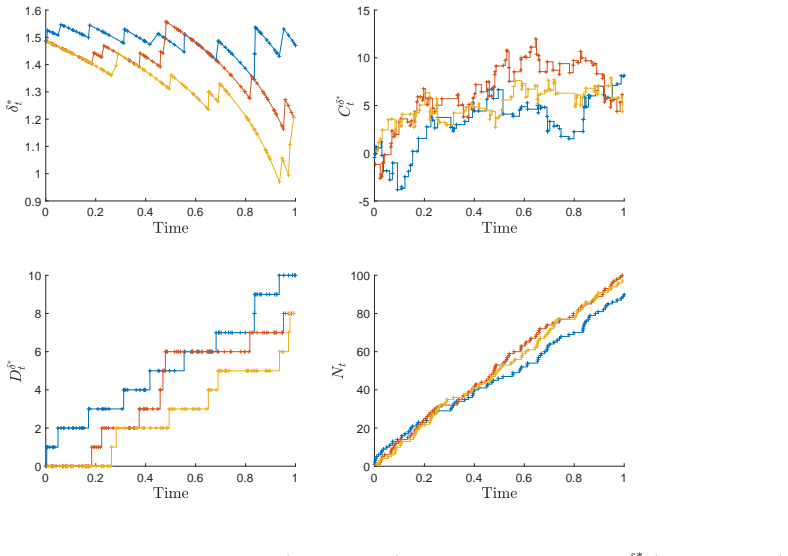
The machinery is a marked point process $N = \{(T_n, Z_n)\}$ whose compensator has intensity $\lambda$ and mark distribution $\varphi$; a fill occurs when the book shock $z$ does not exceed the chosen discretion $\delta$, so the controlled cost and miss processes are $C_t^\delta = \int_0^t\int_{\mathbb{R}} z \hat{G}(\delta_s - z)\,p(dz,ds)$ and $D_t^\delta = \int_0^t\int_{\mathbb{R}} G(\delta_s - z)\,p(dz,ds)$. Taking Gateaux derivatives of $J$ leads to the optimality equation $\delta^*_t = 2\gamma \mathbb{E}_{t-}[D_T^{\delta^*}] + \gamma + \alpha$, which is recast as a new class of random-measure-driven FBSDE; existence and uniqueness are obtained by fixed-point arguments (contraction for the backward part, Borel-Cantelli for the forward part, and a joint contraction for the full system), and under a Markovian intensity assumption the control is characterized by a partial integro-differential equation for $h(t,D,\lambda)$.
What would settle it
Compute the second Gateaux derivative (21a)-(21b) at $\delta^*$ for a smooth mark density $\varphi$ and high-frequency perturbations $\nu_t = w_t = \sin(n t)$ with large $n$ and sufficiently large $\gamma$; if the bilinear form is negative, $\delta^*$ is not a local minimum, contradicting Theorem 5. Alternatively, run the paper's 10,000-simulation design with a miss penalty $\gamma$ above the range tested and compare the empirical $J$ of $\delta^*$ against a nearby constant-discretion policy: a lower $J$ for the constant policy would falsify global optimality.
Extended reading notes
Core claim
The central claim is that for a performance criterion $J(\delta) = \mathbb{E}[C_T^\delta + \alpha D_T^\delta + \gamma (D_T^\delta)^2]$, the optimal discretion $\delta^*$ satisfies $\delta^*_t = 2\gamma \mathbb{E}_{t-}[D_T^{\delta^*}] + \gamma + \alpha$ (Equation 12), where $D$ is the count of missed trades. The authors prove existence and uniqueness of the solution to this FBSDE, prove that any global minimum of $J$ coincides with $\delta^*$, and for $\gamma=0$ obtain the explicit fixed-discretion rule $\delta^* = \alpha$. Numerically, they show the quadratic-penalty strategy achieves a given fill-probability target at lower expected cost than the fixed-discretion strategy.
Load-bearing premise
The proof that the candidate $\delta^*$ is a local minimum assumes the second Gateaux derivative of $J$ is nonnegative in every admissible direction, and this is asserted rather than proved; with large quadratic miss penalty and oscillatory perturbations the bilinear form can be negative, so the local and global optimality of $\delta^*$ is not fully established.
Editorial extensions
If this is right
- A trader with estimates of her order-arrival intensity and the shock distribution can compute the optimal discretion path with no simulation in the $\gamma=0$ case and with a numerical PIDE solve otherwise.
- The optimal discretion increases with accumulated misses when $\gamma>0$, so the strategy automatically opens the book after a string of unfilled orders and tightens it after fills.
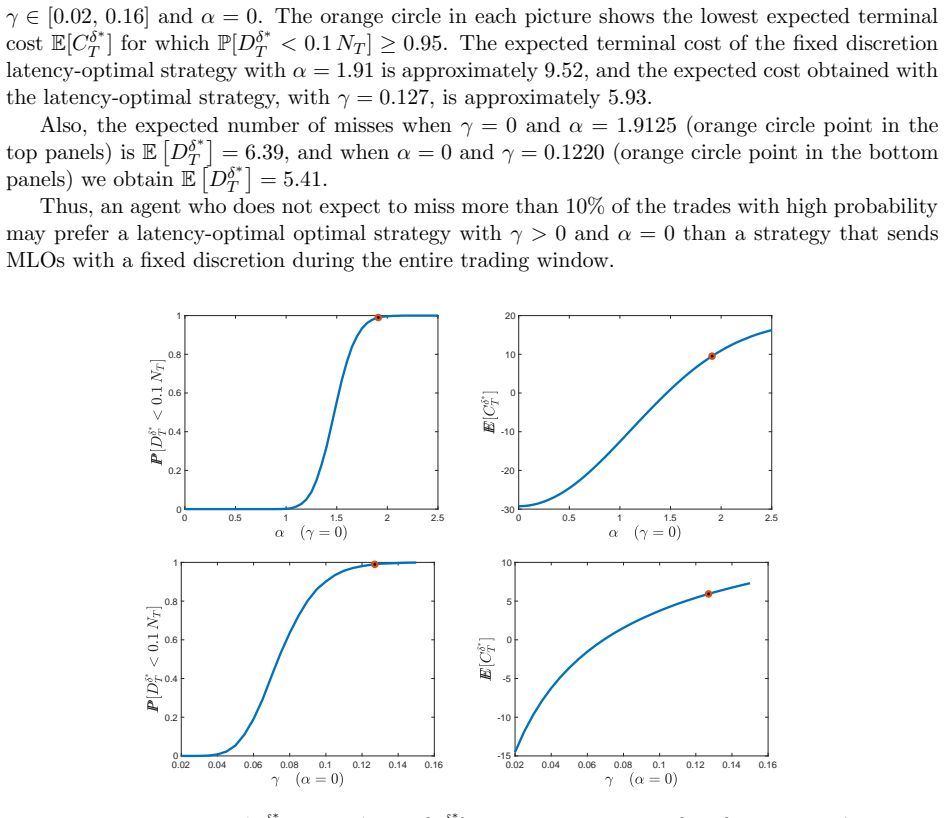
- Under the calibrated parameters, a quadratic-penalty strategy reaches a 95% probability of missing fewer than 10% of attempts at lower expected cost (about 5.93) than the best fixed-discretion strategy (about 9.52).
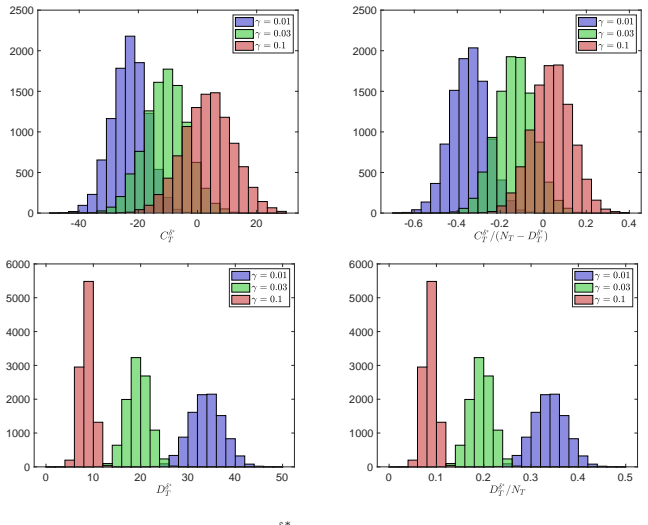
- At the cost-neutral parameter $\gamma \approx 0.0693$, the expected cost of filled trades is zero while the miss rate is about 10.5%, giving a default parameter choice for a trader without a miss penalty.
- The same framework gives a foreign-exchange market maker under last look a rule for how much adverse price movement to tolerate before rejecting an incoming order.
Reading between the lines
- The paper leaves open whether the second-order condition actually holds globally; a direct verification for high-frequency perturbations would either close the proof or restrict the admissible set.
- Because $\delta^*$ is a càglàd sub-martingale, the optimal rule resembles a state-dependent control limit, which suggests a connection to optimal stopping or barrier policies for order execution.
- A testable extension is to estimate $\varphi_t$ nonparametrically from limit-order-book snapshots and compare realized fill probabilities and costs of $\delta^*$ versus fixed discretion on out-of-sample data.
- The FBSDE formulation suggests that similar latency problems, such as queue position, partial fills, or multiple venues, would produce FBSDEs of the same form and could be solved with the same variational machinery.
Signed reviews
Editorial analysis
A structured set of objections, weighed in public.
Referee Report
Summary. The paper models the latency faced by a liquidity taker who sends marketable limit orders (MLOs) to a moving limit order book. The interaction is described by a marked point process, and the agent chooses a predictable 'discretion' δ that determines how far the MLO may walk the book. The performance criterion penalizes expected walking costs, a linear penalty α on missed trades, and a quadratic penalty γ on missed trades. Using Gateaux derivatives, the authors derive a first-order condition characterizing a candidate optimal discretion δ* as the solution of the FBSDE δ*_t = 2γ E_{t-}[D^{δ*}_T] + γ + α (Eq. (12)). They prove existence and uniqueness of this FBSDE under a contraction condition, claim that δ* is the global minimizer of the performance criterion, and implement the strategy numerically via a PIDE for the value function.
Significance. If the optimality claim were rigorously established, the paper would provide a useful, explicit framework for latency-aware execution: the γ=0 case gives a closed-form constant discretion, and the γ>0 case gives a tractable FBSDE/PIDE characterization. The modelling choices are clear and the FBSDE formulation is genuinely new to the execution literature. The paper also makes falsifiable numerical predictions about fill ratios and walking costs. However, the central proof that δ* is the global optimum is not valid, and the numerical experiments lie outside the proven uniqueness regime. The framework is promising, but the overclaim that δ* is the argmin is currently unsupported.
major comments (1)
- [§2.3 and §4, Theorem 6] The contraction estimate in Theorem 4 undercounts the Lipschitz constant. From the two bounds displayed after Eq. (20), the coefficient on ||U−X|| in the sum is k λ̄ T (1+2γ), not k λ̄ T max{1,2γ}², and the coefficient on ||V−Y|| is 2γ(1+2γ)kλ̄T. The contraction condition should therefore involve (1+2γ)max{1,2γ} k λ̄ T < 1. Moreover, the numerical experiments in §5 use λ=100, T=1, and a normal mark distribution for which k≈0.4, so kTλ̄≈40; even the paper's stated condition is violated by two orders of magnitude. The numerical section thus lies outside the proven existence and uniqueness regime.
minor comments (4)
- [§4, Lemma 3] Lemma 3 assumes a finite bound ar N on the number of trade attempts that is not part of Assumption 1; the lemma should either be restricted to models with N_T≤ar N or proved without such a bound. The final display of the proof also uses an undefined symbol ar{z}, which appears to be a typo for α.
- [§3, Theorem 3] Theorem 3 states uniqueness of the fixed point of Θ, but its proof only establishes convergence of the Picard iterates to a fixed point; a separate uniqueness argument is needed.
- [§5, Theorem 7] The assertion that existence and uniqueness of the PIDE follow from a comparison principle is not backed by a stated or proved comparison theorem for this nonlinear, nonlocal equation. Since the numerical strategy is obtained by solving this PIDE, this gap should be addressed or the PIDE solution should be presented as a heuristic approximation.
- [Throughout] There are several typographical issues, including 'Lipchitz' for 'Lipschitz' in Assumption 1 and Theorem 4, and the phrase 'almost everywhere in T×Ω' in Theorem 1 should be specified with respect to the product measure dA⊗dP.
Circularity Check
No significant circularity: the optimal discretion is derived from an explicit performance criterion and characterized by a fixed-point FBSDE, with no fitted-input recycling or load-bearing self-citation.
full rationale
The paper's central derivation is self-contained. The latency-optimal strategy is obtained by minimizing the explicitly stated performance criterion J(δ) = E[C^δ_T + α D^δ_T + γ (D^δ_T)^2] over admissible predictable discretion processes. The Gateaux derivative is computed from the model primitives (the marked point process compensator φ_t(dz)dA_t), and setting it to zero yields the fixed-point characterization δ*_t = 2γ E_{t-}[D^{δ*}_T] + γ + α (Equation 12). This is a legitimate optimality condition, not a quantity fitted to data and then relabeled as a prediction; α and γ are user-chosen penalty parameters. Existence and uniqueness of the FBSDE are established by contraction arguments that do not presuppose the target result. The numerical section solves the PIDE for h for chosen parameter values and compares against a fixed-discretion baseline; no calibrated parameter is recycled as an output. The only self-citations (Cartea and Sánchez-Betancourt 2018 for the zero-discretion naive strategy; Casgrain and Jaimungal 2018 for related variational problems) are used for context or comparison, not as the justification of the optimality claim. The reviewer's concern that Theorem 6's global-optimality proof is invalid is a mathematical-correctness issue, not circularity: even if the contradiction argument is defective, the derivation does not assume its own conclusion. No step in the paper reduces by construction to its inputs, so the circularity score is 0.
Assumptions & free parameters
free parameters (4)
- Linear miss penalty α =
0 in most examples; 1.91 in the fixed-discretion comparison
- Quadratic miss penalty γ =
0.01 to 0.16 in the numerical examples
- Shock mark distribution =
Z ~ N(0.2, 1), iid across jumps
- Arrival intensity λ =
λ = 100, or M = 100 with ε = 0.1 in the pinned-rate section
assumptions (5)
- domain assumption The marked point process has bounded stochastic intensity λ ≤ λbar and mark CDF Φ uniformly Lipschitz with constant k.
- ad hoc to paper The contraction condition k T λbar (max{1, 2γ})^2 < 1 holds.
- domain assumption The stochastic intensity λ is Markov and has zero quadratic covariation with the miss process D.
- ad hoc to paper There is a finite bound Nbar on the number of trade attempts.
- standard math Standard stochastic calculus for marked point processes and the Banach fixed point theorem.
Cite this review
Pith. "Pith review of Latency and Liquidity Risk." pith.science (2026). https://pith.science/paper/LFRMLAMN
@misc{pith2026190803281,
  author       = {Pith},
  title        = {Pith review of: Latency and Liquidity Risk},
  year         = {2026},
  howpublished = {\url{https://pith.science/paper/LFRMLAMN}},
  note         = {Machine review of arXiv:1908.03281}
}
read the original abstract
Latency (i.e., time delay) in electronic markets affects the efficacy of liquidity taking strategies. During the time liquidity takers process information and send marketable limit orders (MLOs) to the exchange, the limit order book (LOB) might undergo updates, so there is no guarantee that MLOs are filled. We develop a latency-optimal trading strategy that improves the marksmanship of liquidity takers. The interaction between the LOB and MLOs is modelled as a marked point process. Each MLO specifies a price limit so the order can receive worse prices and quantities than those the liquidity taker targets if the updates in the LOB are against the interest of the trader. In our model, the liquidity taker balances the tradeoff between missing trades and the costs of walking the book. We employ techniques of variational analysis to obtain the optimal price limit of each MLO the agent sends. The price limit of a MLO is characterized as the solution to a new class of forward-backward stochastic differential equations (FBSDEs) driven by random measures. We prove the existence and uniqueness of the solution to the FBSDE and numerically solve it to illustrate the performance of the latency-optimal strategies.
Figures


Figures from the paper (4 more)


Reference graph
Works this paper leans on
-
[1]
Almgren, R. (2012). Optimal trading with stochastic liquidity and volatility. SIAM Journal on Financial Mathematics , 3(1):163--181
work page 2012
-
[2]
Antonelli, F. (1993). Backward-forward stochastic differential equations. The Annals of Applied Probability , 3(3):777--793
work page 1993
-
[3]
Bandini, E. (2016). Probabilistic representation of HJB equations for optimal control of jump processes, BSDE s and related stochastic calculus. PhD Thesis
work page 2016
-
[4]
Barger, W. and Lorig, M. (2019). Optimal liquidation under stochastic price impact. International Journal of Theoretical and Applied Finance , 22(02):1850059
work page 2019
-
[5]
Cartea, \'A ., Jaimungal, S., and Walton, J. (2018). Foreign exchange markets with L ast L ook. Mathematics and Financial Economics (forthcoming)
work page 2018
-
[6]
Cartea, \'A . and S \'a nchez-Betancourt, L. (2018). The shadow price of latency: Improving intraday fill ratios in foreign exchange markets. Available at SSRN 3190961
work page 2018
-
[7]
Mean-Field Games with Differing Beliefs for Algorithmic Trading
Casgrain, P. and Jaimungal, S. (2018a). Mean-field games with differing beliefs for algorithmic trading. arXiv preprint arXiv:1810.06101
work page Pith review arXiv 2018
-
[8]
Casgrain, P. and Jaimungal, S. (2018b). Mean-field games with partial information for algorithmic trading. arXiv preprint arXiv:1803.04094
arXiv 2018
Show all 25 references
-
[9]
Cohen, S. N. and Elliott, R. J. (2015). Stochastic calculus and applications , volume 2. Springer
2015
-
[10]
Conforti, G. (2016). Bridges of M arkov counting processes: quantitative estimates. Electronic Communications in Probability , 21
2016
-
[11]
and Fuhrman, M
Confortola, F. and Fuhrman, M. (2013). Backward stochastic differential equations and optimal control of marked point processes. SIAM Journal on Control and Optimization , 51(5):3592--3623
2013
-
[12]
Confortola, F., Fuhrman, M., and Jacod, J. (2016). Backward stochastic differential equation driven by a marked point process: An elementary approach with an application to optimal control. The Annals of Applied Probability , 26(3):1743--1773
2016
-
[13]
and Epstein, L
Duffie, D. and Epstein, L. G. (1992). Stochastic differential utility. Econometrica: Journal of the Econometric Society , pages 353--394
1992
-
[14]
and Wang, Y
Gao, X. and Wang, Y. (2018). Electronic market making and latency. arXiv preprint arXiv:1806.05849
2018 arXiv
-
[15]
Gu \'e ant, O. (2016). The financial mathematics of market liquidity: From optimal execution to market making , volume 33. CRC Press
2016
-
[16]
Hoyle, E. (2010). Information-based models for finance and insurance. PhD Thesis
2010
-
[17]
Jeanblanc, M., Yor, M., and Chesney, M. (2009). Mathematical methods for financial markets . Springer Science & Business Media
2009
-
[18]
Jianming, X. (2000). Backward stochastic differential equation with random measures. Acta Mathematicae Applicatae Sinica , 16(3):225--234
2000
-
[19]
and Laruelle, S
Lehalle, C.-A. and Laruelle, S. (2013). Market Microstructure in Practice . World Scientific
2013
-
[20]
and Mounjid, O
Lehalle, C.-A. and Mounjid, O. (2017). Limit order strategic placement with adverse selection risk and the role of latency. Market Microstructure and Liquidity , 03(01):1750009
2017
-
[21]
Moallemi, C. C. and Sa\^ g lam, M. (2013). The cost of latency in high-frequency trading. Operations Research , 61(5):1070--1086
2013
-
[22]
Oomen, R. (2017). Last L ook. Quantitative Finance , 17:1057--1070
2017
-
[23]
and Wu, Z
Peng, S. and Wu, Z. (1999). Fully coupled forward-backward stochastic differential equations and applications to optimal control. SIAM Journal on Control and Optimization , 37(3):825--843
1999
-
[24]
and Waeber, R
Stoikov, S. and Waeber, R. (2016). Reducing transaction costs with low-latency trading algorithms. Quantitative Finance , 16(9):1445--1451
2016
-
[25]
Zhen, W. (1999). Forward-backward stochastic differential equations with brownian motion and poisson process. Acta Mathematicae Applicatae Sinica , 15(4):433--443
1999
Reviewed August 14, 2026 · model on record in the stance chip above.
Discussion (0). Continue with ORCID to comment.