REVIEW 4 major objections 5 minor 36 references
Four-wave Mixing of Topological Edge Plasmons in Graphene Metasurfaces
T0 review · 4 major / 5 minor · reviewed 2026-08-14 · deepseek-v4-flash
Pith's one-line read This paper claims that four-wave mixing of topological edge plasmons in a graphene nanohole metasurface can produce net signal gain with pump power below 10 nW, via an effective nonlinear coefficient around 10^13 W^-1 m^-1.
desk verdict The genuinely new piece is simulated phase-matched FWM of topological edge plasmons in graphene with a giant effective gamma and net gain at sub-10 nW pump, but the headline numbers rest on material parameters that are not yet established at 13 THz and 10 T. read the letter →
The pith
A machine-rendered reading of the paper's core claim, the machinery that carries it, and where it could break.
The reading
What carries the argument
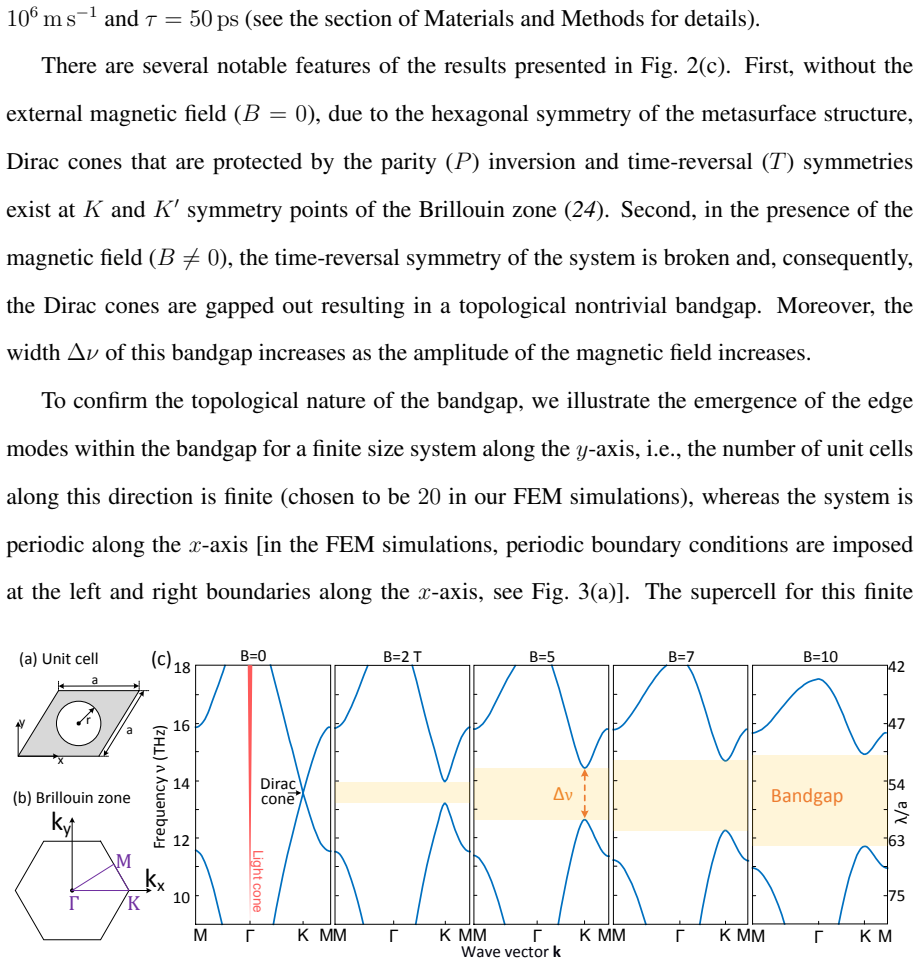
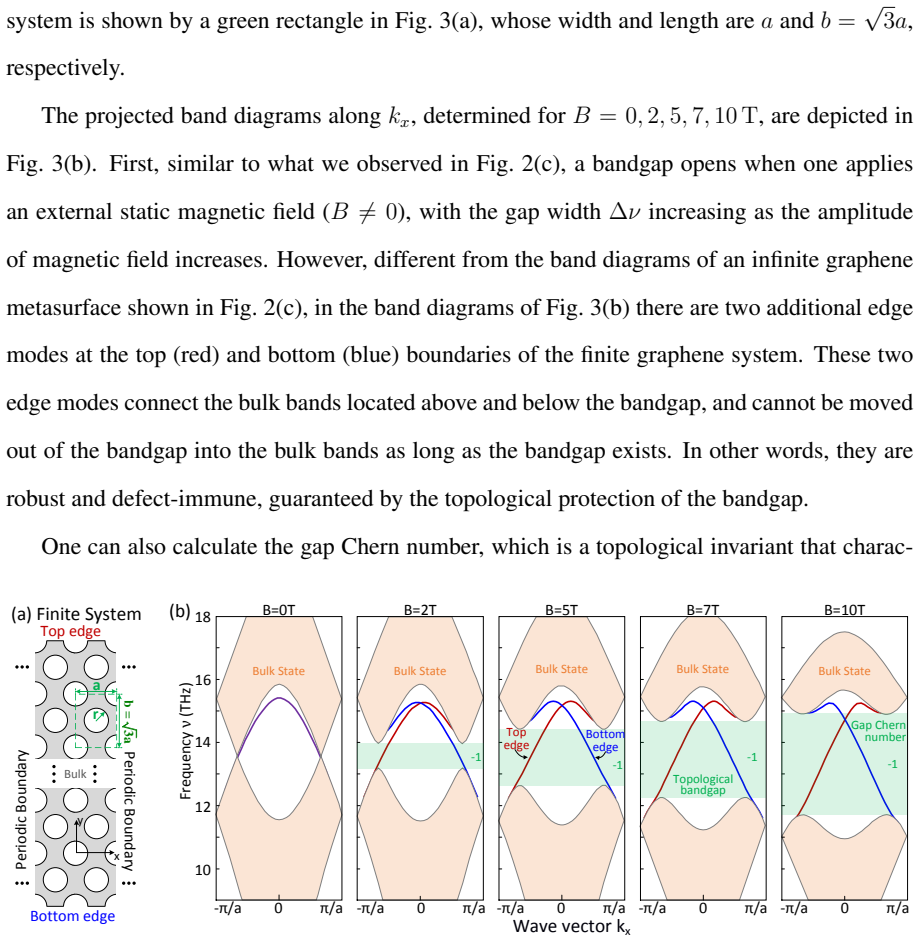
The central object is a graphene metasurface—a hexagonal lattice of nanoholes etched in a graphene sheet—placed in a perpendicular static magnetic field. The magnetic field breaks time-reversal symmetry and opens a topological bandgap with gap Chern number -1, guaranteeing one chiral, backscattering-immune edge plasmon at each boundary. The FWM process is degenerate: two pump photons at frequency νp convert into signal and idler edge plasmons at νs and νi with 2νp = νs + νi. Phase matching is expressed by the normalized wave-vector mismatch Δκ = a(2kp − ks − ki); because a single edge mode exists at each frequency, the mismatch has a large near-zero domain. The nonlinearity is implemented through three coupled surface currents proportional to χ^(3) = 5×$10^{-10}$ $m^{2}$/$V^{2}$, and the loss enters through the plasmon lifetime τ in the graphene conductivities. The machinery combines full-wave finite-element simulations and a coupled-mode theory that gives γ_FWM ≈ 2.4×$10^{13}$ $W^{-1}$ $m^{-1}$.
What would settle it
Launch a ~13 THz pump along the edge of a graphene nanohole metasurface in a 10 T field, seed a signal at 13.72 THz, and monitor idler generation at 12.62 THz over tens of micrometers. Net signal growth at pump power below 10 nW with plasmon lifetime near 2.5 ps would confirm the claim; monotone decay of the signal would refute it. A simpler check: measure the third-order susceptibility of magnetized graphene near 13 THz and see whether it reaches 5×$10^{-10}$ $m^{2}$/$V^{2}$.
Extended reading notes
Core claim
The central claim is that degenerate four-wave mixing between topological edge plasmons in a graphene nanohole metasurface under a static magnetic field can be phase-matched and loss-overcompensated, yielding net gain at terahertz frequencies with pump powers below 10 nW and an effective nonlinear coefficient of order $10^{13}$ $W^{-1}$ $m^{-1}$ (1.1×$10^{13}$ in the abstract, 2.4×$10^{13}$ from coupled-mode theory in the main text). The claim rests on three ingredients: the magnetic field opens a topological bandgap with a single unidirectional edge mode per edge, so phase matching is automatic; the edge-mode field localization enhances the already large third-order susceptibility of magnetized graphene; and plasmon lifetimes at or above 2.5 ps let nonlinear gain outpace absorption. The paper further claims this is the first plasmonic system to achieve net FWM gain without embedded gain media.
Load-bearing premise
The net-gain result stands on two quantitative inputs: graphene's third-order susceptibility in a 10 T field being as large as 5×$10^{-10}$ $m^{2}$/$V^{2}$, and the edge-plasmon lifetime reaching at least 2.5 ps (the authors use up to 50 ps); if either is too optimistic in a real device, the predicted gain turns into loss.
Editorial extensions
If this is right
- Nanowatt-level parametric amplification would make on-chip terahertz amplifiers and wavelength converters practical, since the pump power is orders below what silicon photonic waveguides require.
- Because the gain occurs in topologically protected edge modes, the amplifier should keep working in the presence of fabrication defects and sharp bends, unlike ordinary nonlinear waveguides.
- The same design could be driven as a spontaneous FWM source, generating correlated signal-idler photon pairs in a topologically protected mode, which is a route toward robust quantum light sources.
- The paper's phase-matching argument implies that no careful dispersion engineering is required for FWM in these edge modes, since each frequency supports only one mode in the bandgap.
Reading between the lines
- Editorial inference: The gain threshold τ ≥ 2.5 ps could be lowered by operating at higher magnetic field or by heterostructuring graphene on substrates that push lifetimes beyond 50 ps, which would make the device more tolerant to fabrication-induced loss.
- Editorial inference: The single-mode phase-matching property is not specific to graphene; any 2D material that supports topologically gapped edge plasmons and has a strong third-order response could reproduce the effect, so the result may map onto other material platforms.
- Editorial inference: The paper's coupled-mode theory assumes a uniform χ^(3); spatially patterned doping or superlattice modulation could be used to engineer the edge-mode dispersion and widen the phase-matched frequency window beyond the few-THz domain shown.
Signed reviews
Editorial analysis
A structured set of objections, weighed in public.
Referee Report
Summary. This paper studies degenerate four-wave mixing (FWM) of topologically protected edge plasmons in a graphene nanohole metasurface under a static magnetic field. The authors use finite-element-method (FEM) band-structure calculations to show that a topological bandgap opens at B > 0, that edge modes exist in the gap with unidirectional propagation and a gap Chern number of -1, and that a nearly phase-matched FWM process can be found within the gap. They report an effective waveguide nonlinearity coefficient of about 1.1e13 W^-1 m^-1 in the abstract and 2.4e13 W^-1 m^-1 in the main text, and they claim net signal gain for FWM of edge plasmons for plasmon lifetimes tau greater than about 2.5 ps, with pump power below 10 nW.
Significance. The qualitative framework is attractive and the computational study is careful. The topological characterization is explicit, the phase-matching analysis exploits the unique dispersion of edge modes, and the full-wave FEM results agree with the coupled-mode theory. If the quantitative claims could be substantiated, the result would be important: a passive, deeply subwavelength platform for topological nonlinear frequency conversion at nanowatt pump powers would be of wide interest. The main weaknesses are that the net-gain prediction hinges on a fixed chi^(3) value from a theoretical Landau-level calculation and on a 50 ps lifetime from a low-frequency edge-magnetoplasmon experiment, neither of which is established at the 13 THz operating frequencies, and that the pump-power and gamma values in the abstract are not fully reproduced in the main text.
major comments (4)
- [Materials and Methods, Eqs. (4)-(6)] The nonlinear surface currents in Eqs. (4)-(6) use a single scalar chi^(3)=5e-10 m^2 V^-2 taken from Ref. (23) at all three frequencies (12.62, 13.17, 13.72 THz). Ref. (23) reports a giant third-order response of magnetized graphene at particular Landau-level resonances; the paper does not establish that this value is valid at these THz frequencies and at B=10 T. Because the FWM gain is proportional to chi^(3), a factor-of-two reduction in chi^(3) would push the net-gain threshold above tau=2.5 ps, and a factor-of-three reduction would require tau on the order of 5-10 ps. Please provide the frequency-dependent chi^(3) from the microscopic model (or an experimental value) at the pump, signal, and idler frequencies, and show where the adopted value sits relative to that response.
- [Results, Fig. 6 and surrounding text] The threshold tau >~ 2.5 ps for net gain is supported by the assertion in the text that an external magnetic field can increase the plasmon lifetime to 50 ps, citing Ref. (31). However, Ref. (31) is a low-frequency edge-magnetoplasmon measurement, not a 13 THz magneto-plasmon measurement in a nanohole metasurface, and the text itself notes that typical graphene plasmon lifetimes are 0.1-1 ps and about 3 ps on hBN. Moreover, the loss scan in Fig. 6 varies tau alone while keeping chi^(3) fixed, even though in a resonant material both quantities are controlled by the same scattering and dissipation physics. A self-consistent treatment, or at least a sensitivity study in which chi^(3) and tau are varied together, is needed before the net-gain claim can be considered supported.
- [Abstract; Results, 'Nonlinear interaction of edge states'] The abstract reports gamma about 1.1e13 W^-1 m^-1, whereas the main text reports gamma_FWM = 2.4e13 W^-1 m^-1 for the same FWM process. If these are different quantities (for example, an effective waveguide nonlinearity versus a FWM coefficient), both should be defined and their relation shown; otherwise the inconsistency undermines the headline number. In the same context, the abstract's 'pump power of less than 10 nW' is not justified in the main text, which gives only the input field amplitudes (|Ep| = 2e4 V/m, |Es| = 4e2 V/m); the conversion from field amplitude to mode power and the resulting 10 nW value should be reported.
- [Results, Fig. 6] The term 'net gain' is not defined quantitatively. For tau >~ 2.5 ps the signal power grows monotonically, but the idler shows a more complex behavior: it initially grows and then, for tau <~ 2.5 ps, decays. Please specify whether 'net gain' refers to the output/input power ratio of the signal, a local gain coefficient, or the FWM conversion efficiency, and state the corresponding value at the threshold and at tau=50 ps. The threshold will also depend on the pump power, so the tau threshold and the 10 nW pump power should be reported together.
minor comments (5)
- [Fig. 4(c) caption] The caption contains 'nu_b = 13.17 THz THz'; the repeated 'THz' should be removed and the frequency label should be nu_p rather than nu_b for the edge mode.
- [Fig. 5(d) caption] The caption contains 'pase matched'; this should be 'phase-matched'.
- [Results, 'Nonlinear interaction of edge states'] The statement that this is 'the largest nonlinear FWM coefficient reported to date' should be supported by a quantitative comparison with previously reported values, not only with silicon nanowires.
- [Conclusion] The conclusion states that losses are 'rigorously taken into account' by a single relaxation time tau; this wording overstates the Drude-like loss model used in Eqs. (2)-(3).
- [Materials and Methods, Eqs. (4)-(6)] The definition of the effective graphene thickness heff = 0.3 nm and its role in converting chi^(3) to the surface conductivity in Eqs. (4)-(6) should be justified or referenced explicitly.
Circularity Check
No circular derivation: the nonlinear coefficient and net-gain threshold are computed from externally cited material parameters, not fitted to the predicted outputs.
full rationale
The derivation chain is self-contained and non-circular. The linear band structures are computed from the Kubo conductivities in Eqs. (2)-(3), with tau=50 ps as an input. The nonlinear interaction is implemented through surface currents Eqs. (4)-(6), whose third-order surface conductivity is defined from the externally cited chi^(3)=5e-10 m^2 V^-2 of Yao and Belyanin (ref. 23). The effective FWM coefficient gamma and the signal/idler growth curves are derived from the computed mode fields via coupled-mode theory; no parameter is fit to the simulated power curves to make the claimed amplification appear. The net-gain condition tau > 2.5 ps follows from comparing the derived FWM gain with the independently varied loss rate, so it is not a tautology. The agreement between CMT and full-wave simulations is an internal consistency check, since both rely on the same nonlinear surface conductivity model, but that does not make the central result circular. There is a self-citation (ref. 34) but it is a general review and is not load-bearing. The main vulnerabilities are material-parameter risks: the unvalidated value of chi^(3) at 13 THz and 10 T, the use of tau up to 50 ps, and the abstract/main-text discrepancy in gamma (1.1e13 versus 2.4e13 W^-1 m^-1). Those are correctness concerns, not circularity. No enumerated circularity pattern is present, and no step reduces, by definition or by self-citation, to its own inputs.
Assumptions & free parameters
free parameters (5)
- Unit cell geometry (a=400 nm, r=120 nm) =
a = 400 nm, r = 120 nm
- Fermi energy E_F =
0.2 eV
- Relaxation time tau =
50 ps (lossless); threshold tau > 2.5 ps
- Magnetic field B =
10 T
- Third-order susceptibility chi^(3) =
5e-10 m^2 V^-2
assumptions (7)
- domain assumption Maxwell's equations solved by FEM correctly describe the linear response of the gyrotropic graphene conductivity tensor.
- domain assumption The Kubo formalism at room temperature and terahertz frequencies gives the longitudinal and Hall conductivities in Eqs. 2-3.
- domain assumption The topological bandgap has gap Chern number -1 and exactly one edge mode per edge, as computed in Fig. 3(b).
- domain assumption The nonlinearity is described by a scalar third-order surface conductivity -i eps0 omega heff chi^(3), with chi^(3) from ref 23, and the FWM current terms in Eqs. 4-6 are correct.
- standard math Energy conservation 2 nu_p = nu_s + nu_i holds and phase matching is characterized by Delta kappa = a(2 k_p - k_s - k_i).
- domain assumption The coupled-mode theory in the supplementary materials is a valid reduced description of the full-wave nonlinear interaction.
- domain assumption Plasmon lifetimes can reach 50 ps in magnetized graphene at the operating temperature, or at least the loss threshold tau > 2.5 ps is achievable.
Cite this review
Pith. "Pith review of Four-wave Mixing of Topological Edge Plasmons in Graphene Metasurfaces." pith.science (2026). https://pith.science/paper/LFTCKJLF
@misc{pith2026190805477,
  author       = {Pith},
  title        = {Pith review of: Four-wave Mixing of Topological Edge Plasmons in Graphene Metasurfaces},
  year         = {2026},
  howpublished = {\url{https://pith.science/paper/LFTCKJLF}},
  note         = {Machine review of arXiv:1908.05477}
}
read the original abstract
We study topologically-protected four-wave mixing (FWM) interactions in a plasmonic metasurface consisting of a periodic array of nanoholes in a graphene sheet, which exhibits a wide topological bandgap at terahertz frequencies upon the breaking of time-reversal symmetry by a static magnetic field. We demonstrate that due to the significant nonlinearity enhancement and large lifetime of graphene plasmons in specific configurations, a net gain of FWM interaction of plasmonic edge states within the topological bandgap can be achieved with pump power of less than 10 nW. In particular, we find that the effective waveguide nonlinearity coefficient is about 1.1x10^13 1/(Wm), i.e., more than ten orders of magnitude larger than that of commonly used, highly nonlinear silicon photonic nanowires. These findings could pave a new way for developing ultra-low-power-consumption, highly-integrated and robust active photonic systems at deep-subwavelength scale for applications in quantum communications and information processing.
Figures

Figures from the paper (3 more)


Reference graph
Works this paper leans on
-
[1]
F. D. M. Haldane, S. Raghu, Possible realization of directional optical waveguides in pho- tonic crystals with broken time-reversal symmetry. Phys. Rev. Lett.100, 013904 (2008)
work page 2008
- [2]
-
[3]
Z. Wang, Y . Chong, J. D. Joannopoulos, M. Soljacic, Observation of unidirectional backscattering-immune topological electromagnetic states. Nature 461, 772-775 (2009)
work page 2009
-
[4]
L. Lu, J. D. Joannopoulos, M. Soljacic, Topological photonics. Nat. Photonics 8, 821 (2014)
work page 2014
-
[5]
L. Lu, J. D. Joannopoulos, M. Soljacic, Topological states in photonic systems. Nat. Phys. 12, 626 (2016)
work page 2016
-
[6]
A. B. Khanikaev, G. Shvets, Two-dimensional topological photonics. Nat. Photonics 11, 763 (2017). 16
work page 2017
-
[7]
C. Liu, W. Gao, B. Yang, S. Zhang, Disorder-induced topological state transition in pho- tonic metamaterials. Phys. Rev. Lett. 119, 183901 (2017)
work page 2017
- [8]
Show all 36 references
-
[9]
Z. Wang, Y . D. Chong, J. D. Joannopoulos, M. Soljacic, Reflection-free one-way edge modes in a gyromagnetic photonic crystal. Phys. Rev. Lett. 100, 013905 (2008)
2008
-
[10]
Y . Yang, Y . Poo, R. X. Wu, Y . Gu, P. Chen, Experimental demonstration of one-way slow wave in waveguide involving gyromagnetic photonic crystals. Appl. Phys. Lett. 102, 231113 (2013)
2013
-
[11]
Mittal, J
S. Mittal, J. Fan, S. Faez, A. Migdall, J. M. Taylor, M. Hafezi, Topologically robust trans- port of photons in a synthetic gauge field. Phys. Rev. Lett. 113, 087403 (2014)
2014
-
[12]
D. D. Solnyshkov, O. Bleu, G. Malpuech, Topological optical isolator based on polariton graphene. Appl. Phys. Lett. 112, 031106 (2018)
2018
-
[13]
C. He, X. L. Chen, M. H. Lu, X. F. Li, W. W. Wan, X. S. Qian, R. C. Yin, Y . F. Chen, Tunable one-way cross-waveguide splitter based on gyromagnetic photonic crystal. Appl. Phys. Lett. 96, 111111 (2010)
2010
-
[14]
Hafezi, S
M. Hafezi, S. Mittal, J. Fan, A. Migdall, J. M. Taylor, Imaging topological edge states in silicon photonics. Nat. Photon. 7, 1001-1005 (2013)
2013
-
[15]
Cheng, C
X. Cheng, C. Jouvaud, X. Ni, S. H. Mousavi, A. Z. Genack, A. B. Khanikaev, Robust re- configurable electromagnetic pathways within a photonic topological insulator. Nat. Mater. 15, 542-548 (2016). 17
2016
-
[16]
X. Zang, C. Jiang, Edge mode in nonreciprocal photonic crystal waveguide: manipulat- ing the unidirectional electromagnetic pulse dynamically. J. Opt. Soc. Am. B 28, 554-557 (2011)
2011
-
[17]
J. X. Fu, R. J. Liu, Z. Y . Li, Robust one-way modes in gyromagnetic photonic crystal waveguides with different interfaces. Appl. Phys. Lett. 97, 041112 (2010)
2010
-
[18]
J. X. Fu, J. Lian, R. J. Liu, L. Gan, Z. Y . Li, Unidirectional channel-drop filter by one-way gyromagnetic photonic crystal waveguides. Appl. Phys. Lett. 98, 211104 (2011)
2011
-
[19]
W. Qiu, Z. Wang, M. Soljacic, Broadband circulators based on directional coupling of one- way waveguides. Opt. Express 19, 22248-22257 (2011)
2011
-
[20]
Bahari, A
B. Bahari, A. Ndao, F.Vallini, A. El Amili, Y . Fainman, B. Kante, Nonreciprocal lasing in topological cavities of arbitrary geometries. Science 358, 636-640 (2017)
2017
-
[21]
St-Jean, V
P. St-Jean, V . Goblot, E. Galopin, A. Lemaitre, T. Ozawa, L. Le Gratiet, I. Sagnes, J. Bloch, A. Amo, Lasing in topological edge states of a one-dimensional lattice. Nat. Photon. 11, 651-656 (2017)
2017
-
[22]
Mittal, E
S. Mittal, E. A. Goldschmidt, M. Hafezi, A topological source of quantum light. Nature 561, 502-506 (2018)
2018
-
[23]
X. Yao, A. Belyanin, Giant optical nonlinearity of graphene in a strong magnetic field. Phys. Rev. Lett. 108, 255503 (2012)
2012
-
[24]
D. Jin, T. Christensen, M. Soljacic, N. X. Fang, L. Lu, X. Zhang, Infrared topological plasmons in graphene. Phys. Rev. Lett. 118, 245301 (2017)
2017
-
[25]
D. Pan, R. Yu, H. Xu, F. J. G. de Abajo, Topologically protected Dirac plasmons in a graphene superlattice. Nat. Commun. 8, 1243 (2017). 18
2017
-
[26]
Lavdas, N
S. Lavdas, N. C. Panoiu, Theory of pulsed four-wave mixing in one-dimensional silicon photonic crystal slab waveguides. Phys. Rev. B93, 115435 (2016)
2016
-
[27]
M. P. Nielsen, X. Shi, P. Dichtl, S. A. Maier, R. F. Oulton, Giant nonlinear response at a plasmonic nanofocus drives efficient four-wave mixing. Science, 358, 1179 (2017)
2017
-
[28]
T. Low, P. Avouris, Graphene plasmonics for terahertz to mid-infrared applications. ACS Nano, 8, 1086 (2014)
2014
-
[29]
C. R. Dean, A. F. Young, I. Meric, C. Lee, L. Wang, S. Sorgenfrei, K. Watanabe, T. Taniguchi, P. Kim, K. L. Shepard, J. Hone, Boron Nitride substrates for high-quality graphene electronics. Nat. Nanotechnol. 5, 722 (2010)
2010
-
[30]
H. Yan, Z. Li, X. Li, W. Zhu, P. Avouris, F. Xia, Infrared spectroscopy of tunable Dirac terahertz mMagneto-plasmons in graphene. Nano Lett. 12, 3766 (2012)
2012
-
[31]
Petkovic, F
I. Petkovic, F. I. B. Williams, K. Bennaceur, F. Portier, P. Roche, D. C. Glattli, Carrier drift velocity and edge magnetoplasmons in graphene. Phys. Rev. Lett. 110, 016801 (2013)
2013
-
[32]
Crassee, J
I. Crassee, J. Levallois, A. L. Walter, M. Ostler, A. Bostwick, E. Rotenberg, T. Seyller, D. Van Der Marel, A. B. Kuzmenko, Giant Faraday rotation in single-and multilayer graphene. Nat. Phys. 7, 48 (2011)
2011
-
[33]
Ferreira, N
A. Ferreira, N. M. R. Peres, A. C. Neto, Confined magneto-optical waves in graphene. Phys. Rev. B 85, 205426 (2012)
2012
-
[34]
J. W. You, S. R. Bongu, Q. Bao, N. C. Panoiu. Nonlinear optical properties and applications of 2D materials: theoretical and experimental aspects. Nanophotonics 8, 63 (2019)
2019
-
[35]
Dressel, G
M. Dressel, G. Gruner, Electrodynamics of solids. Cambridge,U.K.: Cambridge Univ. Press, 2002. 19
2002
-
[36]
B. E. A. Saleh, M. C. Teich, Fundamentals of Photonics (Wiley Series in Pure and Applied Optics). (Wiley-Blackwell; 2Rev Ed edition 2007). Acknowledgments Funding: This work was supported by European Research Council (ERC), Grant Agreement no. ERC-2014-CoG-648328. Contribution...
2007
Reviewed August 14, 2026 · model on record in the stance chip above.
Discussion (0). Continue with ORCID to comment.