REVIEW 4 major objections 5 minor 38 references
Modeling Uncertainty: From Simulink to Stochastic Hybrid Automata
T0 review · 4 major / 5 minor · reviewed 2026-08-15 · deepseek-v4-flash
Pith's one-line read The paper claims that stochastic Simulink subsystems can be transformed into stochastic hybrid automata, enabling formal quantitative analysis of safety and performance under uncertainty.
desk verdict A useful, well-scoped extension of Simulink-to-SHA transformation, but the missing semantics-preservation proof leaves the central formal claim only conditionally supported. read the letter →
The pith
A machine-rendered reading of the paper's core claim, the machinery that carries it, and where it could break.
The reading
What carries the argument
The central object is the HAwK, a hybrid automaton with stochastic kernels: delay kernels sample the expiration time of each random clock, and reset kernels stochastically reassign continuous variables at discrete steps. On top of this, the paper defines HAwKsync templates, which add sending and receiving labels and separate input from output variables, so each Simulink subsystem becomes a small automaton. The load-bearing templates are the stochastic timer (a location where the output decreases at rate $-1$ and a self-loop resamples the output from the configured distribution) and the stochastic switch (two random clocks, one per input, whose expiration decides which input is passed to the output). The lifted parallel-composition rules combine templates: for synchronized edges the delay kernel comes from the sending edge and the reset kernels from all involved edges are merged, which is well-defined because each template owns its output variables. This machinery is what lets a composed SHA inherit both the continuous dynamics and the probabilistic behavior of the original Simulink model.
What would settle it
Feed the same distribution parameters to the stochastic timer block in Simulink and to the corresponding HAwK template, run both with the same input for many repetitions, and compare the empirical distribution of expiration times: the Simulink falling-edge re-trigger and the template's immediate self-loop resampling should produce identical timer-value traces if the semantics match. A more direct test is to run the automatic transformation end-to-end without the hand-optimizations described in the evaluation and check whether the confidence intervals for the energy-unit property $P(\lozenge\, total \geq 16000)$ still overlap those from Simulink, since that is the property where the current results only partially overlap.
Extended reading notes
Core claim
The paper's central claim is that the stochastic Simulink subsystems it defines have exact formal counterparts as HAwK templates, and that composing these templates with the lifted parallel-composition rules yields a monolithic stochastic hybrid automaton whose quantitative behavior matches the Simulink model. The paper presents templates for a stochastic timer, a stochastic switch, stochastic sampling, stochastic noise, and discrete and continuous aging, including variants with and without explicit repair signals. The delay and reset kernels of HAwK encode the random expiration times and the stochastic reassignments of variables, respectively. The evaluation compares statistical model checking on the automaton with simulation of the original Simulink models for a temperature control system with sensor loss and an energy measurement unit with stochastic switching. For most properties the confidence intervals from the automaton lie within those from Simulink simulation, with much smaller computational cost, and the paper concludes that this enables formal reasoning about safety and performance under uncertainty.
Load-bearing premise
The load-bearing premise is that each SHA template faithfully formalizes the semantics of its Simulink subsystem, especially the stochastic timer's immediate self-loop resampling and the stochastic switch's two-timer edge delays, and the paper gives no equivalence proof to back that premise.
Editorial extensions
If this is right
- If the templates are faithful, safety properties such as 'the temperature never drops below 20' can be checked on the SHA with statistical model checking, and the resulting probability estimates transfer to the Simulink model.
- Engineers can use the parameterizable subsystem library to inject aging, noise, sensor loss, or stochastic switching into existing Simulink models and still obtain formal, quantitative guarantees, instead of relying on the idealized model.
- Because the SHA analysis ran in about 0.3 seconds versus 30 minutes for the temperature case and 12 minutes for the energy case, the approach makes it practical to run far more samples and obtain tighter confidence intervals.
- The same composed SHA is not limited to statistical model checking; it is also a candidate for reachability analysis, so the paper's transformation opens the door to analysis techniques beyond simulation.
Reading between the lines
- If the template semantics are later proved or validated, the same template pattern could be extended to other stochastic Simulink constructs such as Poisson arrivals, discrete random walks, or correlated noise, turning the library into a general uncertainty modeling language.
- The evaluation's hand-optimized automata suggest that the automatic composition may currently produce larger or less efficient models; an automated end-to-end pipeline with equivalence checking would be needed before industrial deployment.
- The rare-event property where the confidence intervals only partially overlap indicates that very small probabilities may be sensitive to the sampling tick or scheduler choice; rare-event simulation techniques could be combined with the SHA to sharpen those estimates.
- A direct comparison between statistical model checking and a reachability analysis on the same SHA would test whether the stochastic guarantees extend beyond the SMC setting the paper evaluates.
Signed reviews
Editorial analysis
A structured set of objections, weighed in public.
Referee Report
Summary. The paper presents an approach for modeling uncertainties in Simulink by providing a library of stochastic subsystems (Stochastic Timer, Switching, Sampling, Noise, Discrete Aging, Continuous Aging) and formalizing them as stochastic hybrid automata (SHA). The authors extend a previously proposed Simulink-to-SHA transformation by lifting the parallel composition rules from LHACsync to HAwKsync and by giving SHA templates, called HAwK templates, for each stochastic subsystem. The approach is intended to enable quantitative analysis, such as statistical model checking, of Simulink models under uncertainty. The evaluation applies the resulting automata to two case studies, a temperature control system with sensor loss and an energy measurement unit with stochastic switching, comparing confidence intervals obtained from the modes statistical model checker with confidence intervals computed from Simulink simulation.
Significance. If the transformation rules are correct, the paper addresses a real and practically important gap: bringing stochastic uncertainties in Simulink models into a formal framework that supports quantitative verification. The proposed subsystem library is well motivated, the paper includes concrete HAwK templates for each subsystem, and the two case studies demonstrate a significant runtime advantage for the SHA-based analysis. The authors provide an artifact with models and scripts, which is a definite strength. The main limitation is that the central formalization claim is currently not substantiated: no correctness statement or proof links the semantics of the stochastic Simulink subsystems to the HAwK templates, and the empirical evaluation uses hand-optimized automata rather than the automatic transformation output. One quantitative result in Table 1 is also inconsistent with the accompanying text. These issues affect the load-bearing claim that quantitative results on the SHA transfer back to the original Simulink models.
major comments (4)
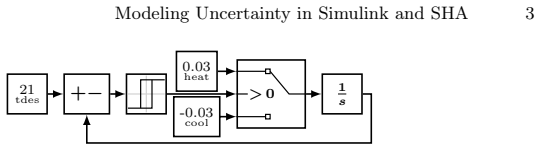
- [Sec. 4.2, Figs. 6-8] The paper states that the SHA templates 'formalize' the stochastic Simulink subsystems, but it gives no equivalence statement or proof. For instance, the stochastic timer template in Fig. 6a replaces the Simulink falling-edge re-trigger with an immediate self-loop resampling, and the stochastic switch template in Fig. 6b collapses two interacting timers into edge delays. It is not shown that the stochastic process induced by the HAwK is equivalent to the stochastic process induced by the corresponding masked Simulink subsystem, in either a distributional or a trace-based sense. This is load-bearing for the abstract's claim that the approach 'allows us to formally argue about safety and performance under uncertainty', because results obtained on the SHA can be transferred to the Simulink model only if the transformation is semantics-preserving. Please provide a precise correctness theorem (e.g., equivalence of reachability probabilities or of the induced stochastic processes) and its proof, or a clearly stated set of assumptions under which the templates are exact, together with a proof under those assumptions.
- [Sec. 5, Tables 1-2] The evaluation does not exercise the proposed transformation. The text says that the HAwKs shown in Figs. 10 and 12 have been hand-optimized to eliminate redundant or unused variables, locations and edges, so the confidence intervals in Tables 1 and 2 validate only those hand-built automata, not the automatic transformation rules of Sec. 4. Furthermore, Table 1 contradicts the accompanying sentence that all modes CIs lie within the Simulink CIs: for P(◇ tmp ≤ 20), modes reports [0.0497, 0.05885] while Simulink reports [0.0652, 0.0795], and the two intervals are disjoint. This is precisely the kind of discrepancy that would signal a semantic mismatch between the SHA and the Simulink model, and the paper does not discuss it. Please either run the unoptimized automatic transformation in the evaluation, or give a semantics-preservation argument for the applied optimizations, and in either case address the non-overlapping interval in Table 1.
- [Sec. 4.2, Fig. 6b] In the stochastic switch template, the expiration time of the clock that is currently inactive is sampled at the initial state or at the previous switch and then frozen, because the inactive random clock has rate 0. In the Simulink subsystem of Fig. 3b, the expiration time of the other timer is sampled anew at the instant the active timer expires. For the constant, state-independent distributions U(low,high) and N≥0 considered in the paper, the two mechanisms yield the same dwell-time distribution, but this equivalence is neither stated nor proved, and it fails if the delay kernels are made state-dependent, which the HAwK definition (Def. 2) allows. Please state explicitly that the templates are intended only for state-independent delay distributions and give the distributional equivalence argument, or modify the template so that resampling occurs at the correct state.
- [Appendix A.3, Definitions 5-6] The lifted composition rules for HAwKsync do not specify how the label of the resulting synchronized edge is chosen, nor how the random clock of a receiving edge is eliminated. In a HAwK, delay kernels are indexed by labels and each label has exactly one random clock; after synchronizing edges with different delay kernels, the receiving edge's clock must be handled consistently, and labels must be renamed so that the guard-disjointness condition for equal labels is preserved. Without this detail, the composed object is not unambiguously a HAwK, and the claim in Sec. 4.1 of a seamless integration into the existing transformation is not fully substantiated. The rules should be completed and, preferably, accompanied by a correctness argument for the composition itself.
minor comments (5)
- [Appendix A.3, Definition 4] The sentence 'Init assigns a pair of initial state and condition to each location l in Loc for each v in Varoutput' appears to mean that Init assigns the pair to each location, not to each variable; please rephrase.
- [Appendix A.3, Definition 6] Item 5 uses the undefined symbols Lsync,i and Lcomp; these should likely be Synci and Acomp, respectively.
- [Sec. 4.1] For synchronized edges, the text says the delay kernel from the sending edge is assigned to the new edge, but it does not state what happens to the delay kernels of the receiving edges; please clarify whether they are discarded and why this is correct.
- [Fig. 7b and Sec. 4.2] The text describing the stochastic noise template refers to edges e0-e3 while the figure appears to use e1-e3 inconsistently; please align the figure and the text.
- [Sec. 5, Tables 1-2] Please report the number of modes runs for the energy measurement case study as well, and state the seeds and schedulers used for both case studies, so that the experiments are fully reproducible.
Circularity Check
No significant circularity: the SHA templates are proposed formalizations and the modes-vs-Simulink comparison is a consistency check, not a fitted prediction.
full rationale
The paper's derivation chain runs from stochastic Simulink subsystems (Sec. 3) to HAwK templates (Sec. 4.2) and lifted composition rules (Sec. 4.1), then to SMC results with modes (Sec. 5). None of the target quantities, i.e., the safety and performance probabilities in Tables 1 and 2, are used to define the templates or their kernels; the distributions are taken from the subsystem masks and stated explicitly, e.g., 'The delay kernel is defined as Ψe0(σ)∼Dist1, Ψe1(σ)∼Dist2' for the stochastic switch. The CI comparison is an external consistency check against independent Simulink simulation, not a fit of parameters to data. The paper does rely on the authors' own earlier transformation [8] and DHA semantics [34,35], but these are prior formal definitions with stated assumptions that do not include the present case-study probabilities, so this is ordinary incremental self-citation rather than a load-bearing circular chain. The main weaknesses are validation gaps, not circularity: Sec. 5 states that the analyzed HAwKs are hand-optimized ('we have applied some optimizations to eliminate redundant or unused variables, locations and edges'), and Sec. 4.2 provides no equivalence proof between templates and Simulink subsystems (the stochastic switch template, Fig. 6b, initializes both clocks at zero and does not resample the inactive timer exactly as described in Sec. 3). An unproven or even incorrect template would be a correctness problem, not a tautology, so no circular step is exhibited and the score is 0.
Assumptions & free parameters
assumptions (4)
- domain assumption The informal semantics of Simulink blocks (integrator, relay, random number generator, triggered subsystems) are as implemented by MathWorks and are correctly captured by the proposed SHA templates.
- standard math The HAwK/DHA formalism and its semantics from Willemsen et al. [34,35] are correct and applicable.
- ad hoc to paper The lifted parallel composition rules for HAwKsync (Appendix A.3, Def. 5-6) preserve the behavior of the composed stochastic templates.
- ad hoc to paper The hand-optimized HAwK used in the evaluation (Figs. 10 and 12) are faithful instantiations of the automated transformation applied to the corresponding Simulink models.
invented entities (2)
-
HAwKsync
-
Stochastic Simulink subsystems (Timer, Switching, Sampling, Noise, Discrete Aging, Continuous Aging)
Cite this review
Pith. "Pith review of Modeling Uncertainty: From Simulink to Stochastic Hybrid Automata." pith.science (2026). https://pith.science/paper/LGU74S4Z
@misc{pith2026250614581,
  author       = {Pith},
  title        = {Pith review of: Modeling Uncertainty: From Simulink to Stochastic Hybrid Automata},
  year         = {2026},
  howpublished = {\url{https://pith.science/paper/LGU74S4Z}},
  note         = {Machine review of arXiv:2506.14581}
}
read the original abstract
Simulink is widely used in industrial design processes to model increasingly complex embedded control systems. Thus, their formal analysis is highly desirable. However, this comes with two major challenges: First, Simulink models often provide an idealized view of real-life systems and omit uncertainties such as, aging, sensor noise or failures. Second, the semantics of Simulink is only informally defined. In this paper, we present an approach to formally analyze safety and performance of embedded control systems modeled in Simulink in the presence of uncertainty. To achieve this, we 1) model different types of uncertainties as stochastic Simulink subsystems and 2) extend an existing formalization of the Simulink semantics based on stochastic hybrid automata (SHA) by providing transformation rules for the stochastic subsystems. Our approach gives us access to established quantitative analysis techniques, like statistical model checking and reachability analysis. We demonstrate the applicability of our approach by analyzing safety and performance in the presence of uncertainty for two smaller case studies.
Figures


Figures from the paper (12 more)


Reference graph
Works this paper leans on
-
[1]
In: Bridging the Gap Between AI and Reality
Adelt, J., Bruch, S., Herber, P., Niehage, M., Remke, A.: Shielded Learning for Resilience and Performance Based on Statistical Model Checking in Simulink. In: Bridging the Gap Between AI and Reality. pp. 94–118. Springer Nature (2024). https://doi.org/10.1007/978-3-031-46002-9_6
-
[2]
Adelt, J., Liebrenz, T., Herber, P.: Formal Verification of Intelligent Hybrid Sys- tems that are modeled with Simulink and the Reinforcement Learning Toolbox. In: Formal Methods. LNCS, vol. 13047, pp. 349–366. Springer (2021). https: //doi.org/10.1007/978-3-030-90870-6_19
-
[3]
Theoretical Computer Science 138, 3–34 (1995)
Alur, R., Courcoubetis, C., Halbwachs, N., Henzinger, T., Ho, P.H., Nicollin, X., Olivero, A., Sifakis, J., Yovine, S.: The algorithmic analysis of hybrid sys- tems. Theoretical Computer Science 138, 3–34 (1995). https://doi.org/10.1016/ 0304-3975(94)00202-T Modeling Uncertainty in Simulink and SHA 23
work page 1995
-
[4]
Alur, R., Courcoubetis, C., Henzinger, T.A., Ho, P.H.: Hybrid automata: An algo- rithmic approach to the specification and verification of hybrid systems. In: Hybrid systems, pp. 209–229. Springer (1993). https://doi.org/10.1007/3-540-57318-6_30
-
[5]
International Journal on Software Tools for Technology Transfer21(1), 87–104 (2019)
Bak, S., Beg, O.A., Bogomolov, S., Johnson, T.T., Nguyen, L.V., Schilling, C.: Hybrid automata: from verification to implementation. International Journal on Software Tools for Technology Transfer21(1), 87–104 (2019)
work page 2019
-
[6]
Bertrand,N.,Bouyer,P.,Brihaye,T.,Menet,Q.,Baier,C.,Grösser,M.,Jurdzinski, M.: Stochastic Timed Automata. Logical Methods in Comp. Science10 (2014). https://doi.org/10.2168/LMCS-10(4:6)2014
-
[7]
In: Leveraging Applications of Formal Methods, Verification and Validation
Blohm, P., Fränzle, M., Herber, P., Kröger, P., Remke, A.: Towards probabilis- tic contracts for intelligent cyber-physical systems. In: Leveraging Applications of Formal Methods, Verification and Validation. Specification and Verification. pp. 26–47. Springer (2025). https://doi.org/10.1007/978-3-031-75380-0_3
-
[8]
Blohm,P.,Herber,P.,Remke,A.:Towardsquantitativeanalysisofsimulinkmodels using stochastic hybrid automata. In: Integrated Formal Methods. pp. 172–193. Springer (2025). https://doi.org/10.1007/978-3-031-76554-4_10
Show all 38 references
-
[9]
In: 24th Int
Budde, C.E., D’Argenio, P.R., Hartmanns, A., Sedwards, S.: A statistical model checker for nondeterminism and rare events. In: 24th Int. Conference on Tools and Algorithms for the Construction and Analysis of Systems. LNCS, vol. 10806, pp. 340–358. Springer (2018). https://doi...
2018 doi
- [10]
-
[11]
In: Provably Correct Systems, pp
Chen, M., Han, X., Tang, T., Wang, S., Yang, M., Zhan, N., Zhao, H., Zou, L.: MARS: A toolchain for modelling, analysis and verification of hybrid systems. In: Provably Correct Systems, pp. 39–58. Springer (2017). https://doi.org/10.1007/ 978-3-319-48628-4_3
2017
-
[13]
Energies 11, 306 (2018)
Chiacchio, F., Famoso, F., D’Urso, D., Brusca, S., Aizpurua, J.I., Cedola, L.: Dy- namic performance evaluation of photovoltaic power plant by stochastic hybrid fault tree automaton model. Energies 11, 306 (2018). https://doi.org/10.3390/ en11020306
2018
-
[14]
In: IEEE Trans
Chutinan, A., Krogh, B.H.: Computational techniques for hybrid system verifica- tion. In: IEEE Trans. on Automatic Control. vol. 48(1), pp. 64–75. IEEE (2003). https://doi.org/10.1109/TAC.2002.806655
2003
-
[15]
International Journal on Software Tools for Technology Transfer17(4), 397–415 (2015)
David, A., Larsen, K.G., Legay, A., Mikučionis, M., Poulsen, D.B.: Uppaal smc tutorial. International Journal on Software Tools for Technology Transfer17(4), 397–415 (2015). https://doi.org/10.1007/s10009-014-0361-y
2015 doi
-
[16]
Delicaris, J., Remke, A., Ábrahám, E., Schupp, S., Stübbe, J.: Maximizing reach- ability probabilities in rectangular automata with random events. Sci. Comput. Program. 240, 103213 (2025). https://doi.org/10.1016/J.SCICO.2024.103213
2025
-
[17]
In: 17th Int
Delicaris, J., Schupp, S., Ábrahám, E., Remke, A.: Maximizing reachability prob- abilities in rectangular automata with random clocks. In: 17th Int. Symposium on Theoretical Aspects of Software Engineering. LNCS, vol. 13931, pp. 164–182. Springer (2023). https://doi.org/10.100...
2023 doi
-
[18]
In: 16th Int
Delicaris, J., Stübbe, J., Schupp, S., Remke, A.: Realyst: A C++ tool for optimiz- ing reachability probabilities in stochastic hybrid systems. In: 16th Int. Conf. on 24 P. Blohm et al. Performance Evaluation Methodologies and Tools. vol. 539, pp. 170–182. Springer (2023). htt...
2023 doi
-
[19]
In: International Symposium on Formal Methods
Filipovikj, P., Mahmud, N., Marinescu, R., Seceleanu, C., Ljungkrantz, O., Lönn, H.: Simulink to uppaal statistical model checker: Analyzing automotive industrial systems. In: International Symposium on Formal Methods. pp. 748–756. Springer (2016). https://doi.org/10.1007/978-...
2016 doi
-
[20]
In: Proceedings of the 16th Int
Frehse, G., Kateja, R., Le Guernic, C.: Flowpipe approximation and clustering in space-time. In: Proceedings of the 16th Int. Conf. on Hybrid Systems: Computation and Control. p. 203–212. ACM (2013). https://doi.org/10.1145/2461328.2461361
2013
-
[21]
Fulton, N., Mitsch, S., Quesel, J.D., Völp, M., Platzer, A.: KeYmaera X: An axiomatic tactical theorem prover for hybrid systems. In: Int. Conference on Automated Deduction. LNCS, vol. 9195, pp. 527–538. Springer (2015). https: //doi.org/10.1007/978-3-319-21401-6_36
2015 doi
-
[22]
In: Verification of digital and hybrid systems, pp
Henzinger, T.A.: The theory of hybrid automata. In: Verification of digital and hybrid systems, pp. 265–292. Springer (2000). https://doi.org/10.1007/ 978-3-642-59615-5_13
2000
-
[23]
Henzinger,T.A.,Kopke,P.W.,Puri,A.,Varaiya,P.:What’sdecidableabouthybrid automata? Journal of computer and system sciences57(1), 94–124 (1998)
1998
-
[24]
London (2014)
Klenke, A.: Probability Theory: A Comprehensive Course. London (2014). https: //doi.org/10.1007/978-1-4471-5361-0{_}1
2014 doi
-
[25]
Kuriakose, R.B., Vermaak, H.J.: Customized mixed model stochastic assembly line modelling using simulink. Int. Journal of Simulation Systems Science & Technology 20(1), 61–69 (2019). https://doi.org/10.5013/IJSSST.a.20.S1.06
2019 doi
-
[26]
In: Formal Techniques for Safety-Critical Systems: 4th In- ternational Workshop
Legay, A., Traonouez, L.M.: Statistical model checking of simulink models with Plasma Lab. In: Formal Techniques for Safety-Critical Systems: 4th In- ternational Workshop. pp. 259–264. Springer (2016). https://doi.org/10.1007/ 978-3-319-29510-7_15
2016
-
[27]
Liebrenz, T., Herber, P., Glesner, S.: Deductive verification of hybrid control systems modeled in Simulink with KeYmaera X. In: Int. Conference on For- mal Engineering Methods. LNCS, vol. 11232, pp. 89–105. Springer (2018). https: //doi.org/10.1007/978-3-030-02450-5_6
2018 doi
-
[28]
Liebrenz, T., Herber, P., Glesner, S.: A service-oriented approach for decomposing and verifying hybrid system models. In: Int. Conference on Formal Aspects of Component Software. LNCS, vol. 12018, pp. 127–146. Springer (2019). https:// doi.org/10.1007/978-3-030-40914-2_7
2019 doi
-
[29]
European Journal of Control16(6), 583–594 (2010)
Lygeros, J., Prandini, M.: Stochastic Hybrid Systems: A Powerful Framework for Complex, Large Scale Applications. European Journal of Control16(6), 583–594 (2010). https://doi.org/10.3166/ejc.16.583-594
2010 doi
-
[30]
Minopoli, S., Frehse, G.: SL2SX translator: from Simulink to SpaceEx models. In: Int. Conf. on Hybrid Systems: Computation and Control. pp. 93–98. ACM (2016). https://doi.org/10.1145/2883817.2883826
2016
-
[31]
Journal of Automated Reasoning 41(2), 143–189 (2008)
Platzer, A.: Differential dynamic logic for hybrid systems. Journal of Automated Reasoning 41(2), 143–189 (2008). https://doi.org/10.1007/s10817-008-9103-8
2008 doi
-
[32]
ACM Trans- actions on Modeling and Computer Simulation33(4) (2023)
da Silva, C., Schupp, S., Remke, A.: Optimizing reachability probabilities for a re- stricted class of stochastic hybrid automata via flowpipe-construction. ACM Trans- actions on Modeling and Computer Simulation33(4) (2023). https://doi.org/10. 1145/3607197
2023
-
[33]
https://de.mathworks.com/products/simulink.html
The MathWorks: Simulink. https://de.mathworks.com/products/simulink.html
-
[34]
In: Quantitative Evaluation of Systems - 20th Modeling Uncertainty in Simulink and SHA 25 Int
Willemsen, L., Remke, A., Ábrahám, E.: Comparing two approaches to include stochasticity in hybrid automata. In: Quantitative Evaluation of Systems - 20th Modeling Uncertainty in Simulink and SHA 25 Int. Conf. pp. 238–254. Lecture Notes in Computer Science, Springer (2023). ht...
2023 doi
-
[35]
In: Principles of Verification: Cycling the Probabilistic Landscape : Essays Dedicated to Joost-Pieter Katoen on the Occasion of His 60th Birthday, Part III
Willemsen, L., Remke, A., Ábrahám, E.: (de-)composed and more: Eager and lazy specifications (camels) for stochastic hybrid systems. In: Principles of Verification: Cycling the Probabilistic Landscape : Essays Dedicated to Joost-Pieter Katoen on the Occasion of His 60th Birthd...
2025
-
[36]
Journal of the American Statistical Association 22(158), 209–212 (1927)
Wilson, E.: Probable inference, the law of succession, and statistical inference. Journal of the American Statistical Association 22(158), 209–212 (1927). https: //doi.org/10.2307/2276774
1927 doi
-
[37]
Zou, L., Zhan, N., Wang, S., Fränzle, M.: Formal Verification of Simulink/Stateflow Diagrams. In: Int. Symposium on Automated Technology for Verification and Analysis. pp. 464–481. LNCS, Springer (2015). https://doi.org/10.1007/ 978-3-319-47016-0
2015
-
[38]
In: Proceedings of the 15th ACM Int
Zuliani, P., Baier, C., Clarke, E.M.: Rare-event verification for stochastic hybrid systems. In: Proceedings of the 15th ACM Int. Conf. on Hybrid Systems: Com- putation and Control. p. 217–226. ACM (2012). https://doi.org/10.1145/2185632. 2185665
2012 doi
-
[39]
Formal Methods in System Design pp
Zuliani, P., Platzer, A., Clarke, E.M.: Bayesian statistical model checking with application to stateflow/simulink verification. Formal Methods in System Design pp. 338–367 (2013). https://doi.org/10.1007/s10703-013-0195-3
2013 doi
Reviewed August 15, 2026 · model on record in the stance chip above.
Discussion (0). Continue with ORCID to comment.