A hybrid IFENN solver for generalizable modeling of phase-field fracture initiation and propagation
Pith reviewed 2026-06-26 01:47 UTC · model grok-4.3
The pith
The IFENN hybrid couples a FEM solver to neural networks that approximate the phase-field equation, enabling fracture predictions on unseen geometries after one training run on a benchmark shape.
A machine-rendered reading of the paper's core claim, the machinery that carries it, and where it could break.
Core claim
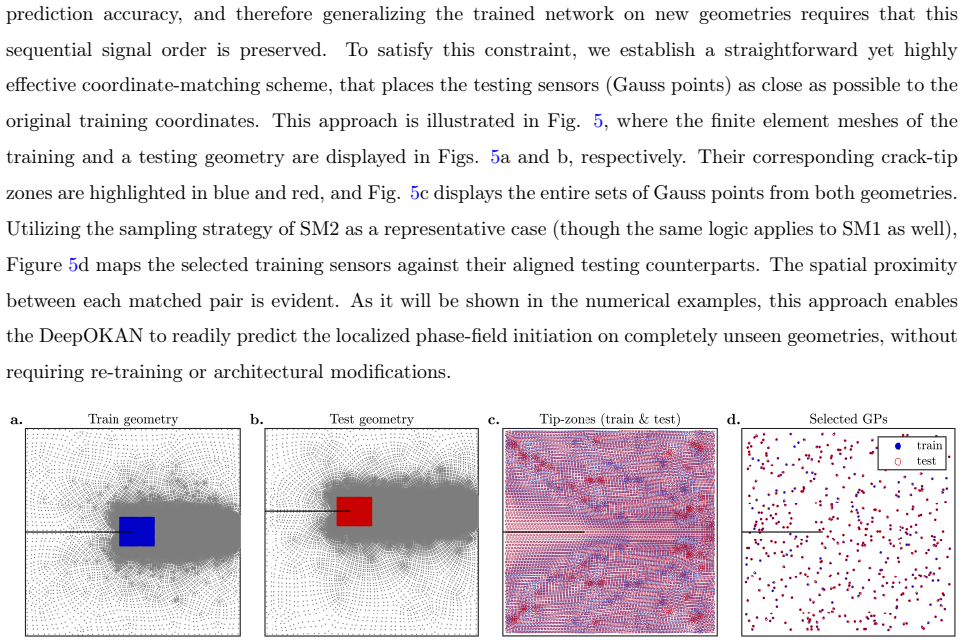
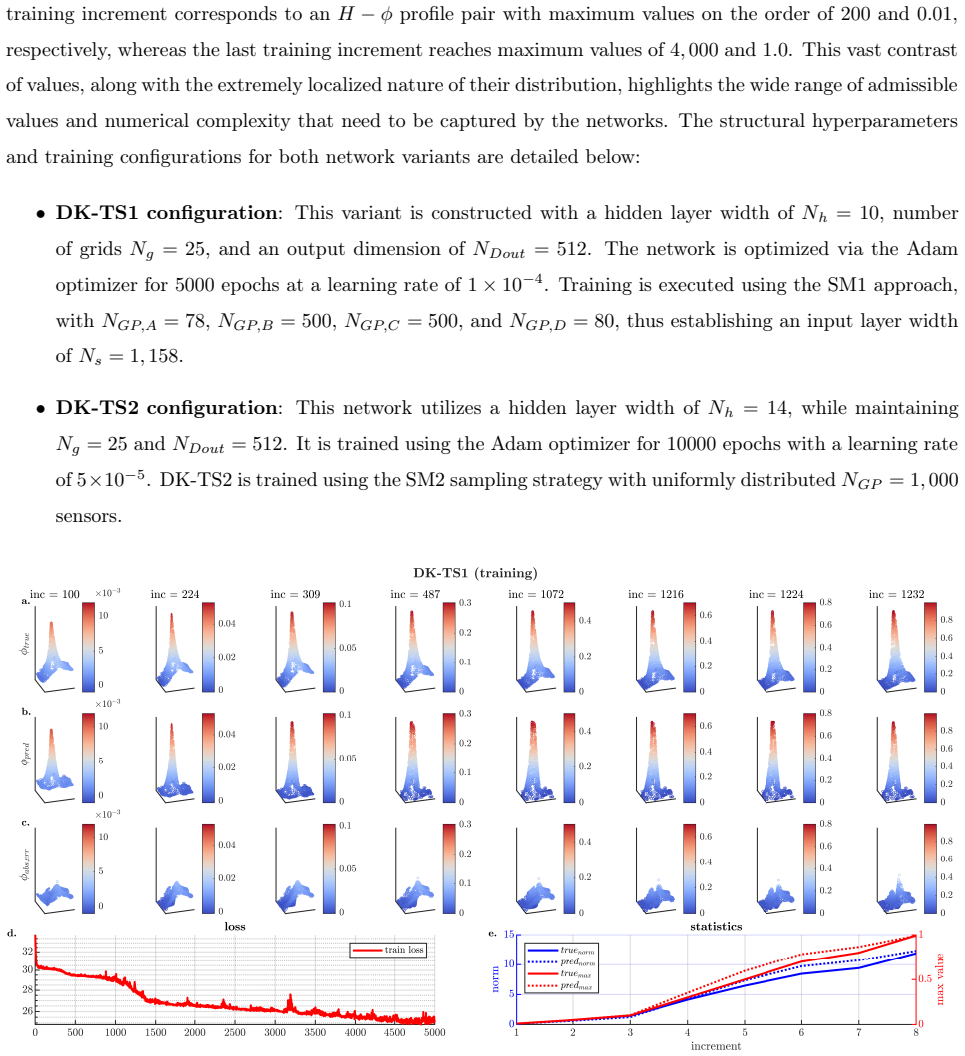
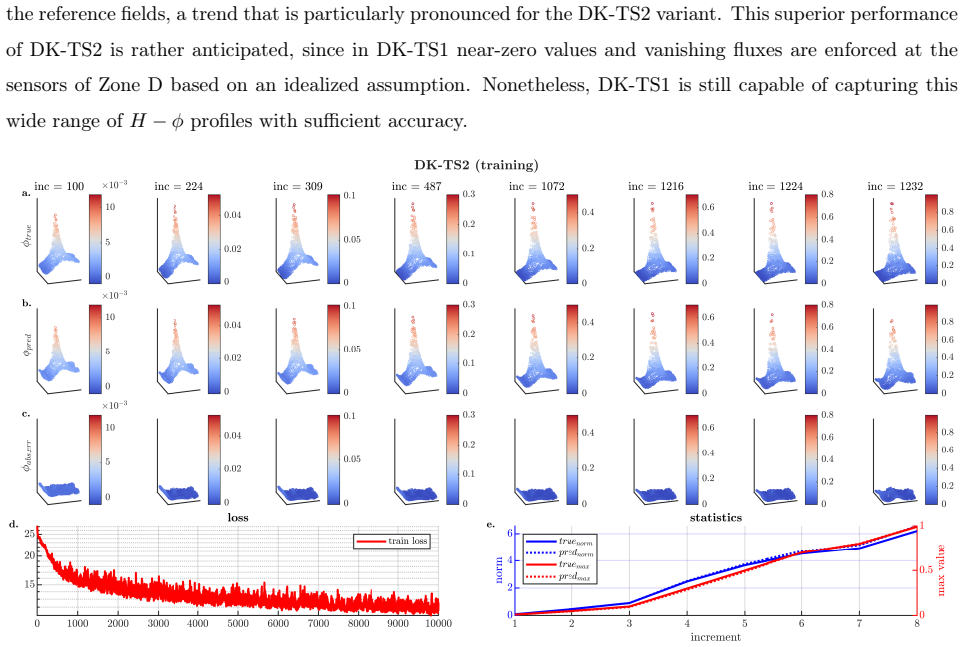
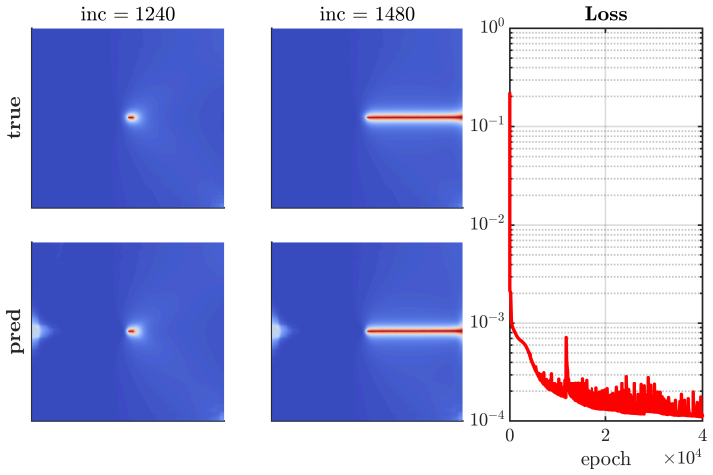
The IFENN framework tightly couples a standard finite element solver for mechanical equilibrium with a pre-trained neural network that approximates the phase-field diffusion equation; a DeepOKAN network is used for the initiation stage and a CNN for the propagation stage, both trained physics-informed on one benchmark geometry with few increments and limited Gauss points sampled from the fracture process zone, then applied to both the training geometry and arbitrary unseen geometries.
What carries the argument
The Integrated Finite Element Neural Network (IFENN) hybrid scheme, which pairs a conventional FEM solver for equilibrium with a neural network surrogate for the phase-field equation.
If this is right
- The method models both crack initiation and subsequent propagation within a single framework.
- Training cost drops sharply because only a small number of increments and Gauss points from the fracture zone are required.
- The same trained networks produce usable results on both the original benchmark and previously unseen geometries.
- Artificial boundary conditions allow the networks to extrapolate near-zero phase-field values far from the crack tip.
Where Pith is reading between the lines
- Engineering workflows that repeatedly analyze fracture in families of similar parts could replace many full simulations with a single training step plus fast inference.
- The same hybrid coupling pattern could be tested on other coupled-field problems such as diffusion-reaction systems or thermo-mechanical problems.
- Systematic checks on geometries whose topology differs markedly from the training shape would reveal the practical limits of the claimed generalizability.
Load-bearing premise
A neural network trained exclusively on one benchmark geometry with artificial boundary conditions will produce accurate phase-field predictions on arbitrary unseen geometries without retraining or accumulating large errors.
What would settle it
A side-by-side comparison on a new geometry with a different topology, measuring whether the hybrid solver's predicted phase-field values and crack paths deviate substantially from a full finite-element reference solution.
Figures
read the original abstract
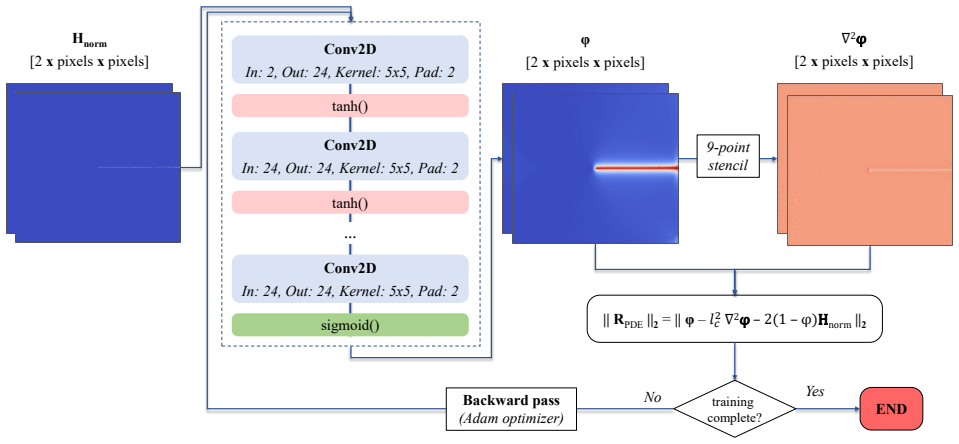
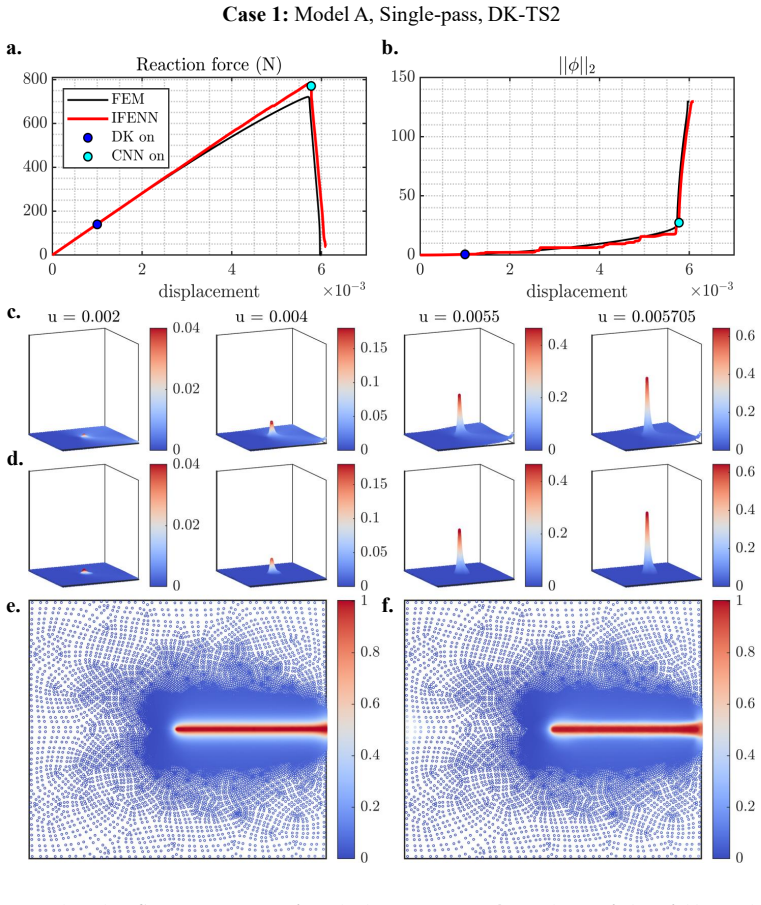
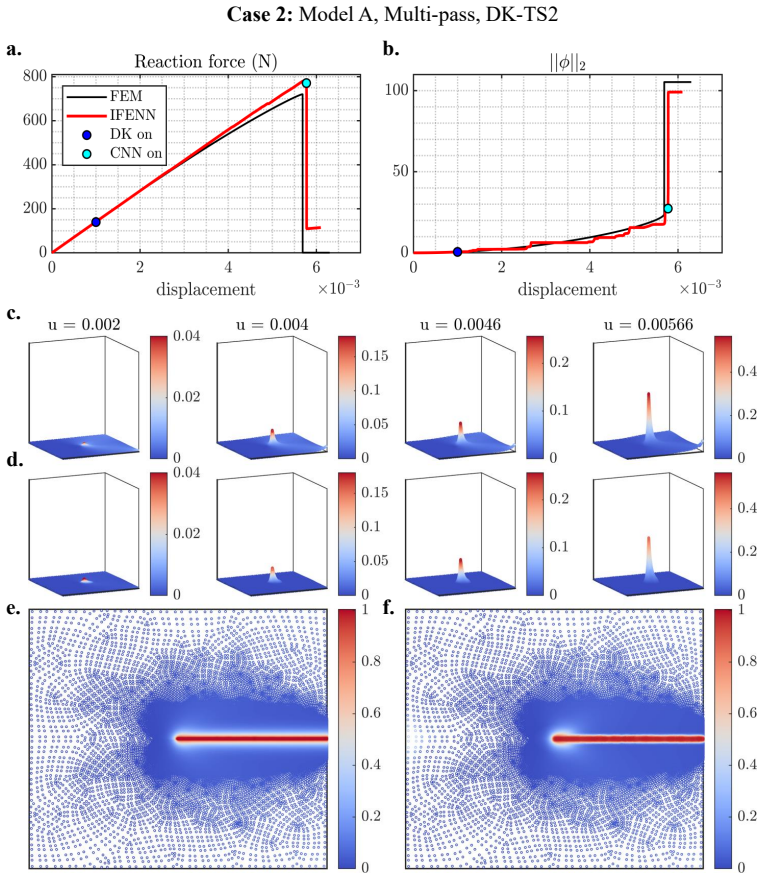
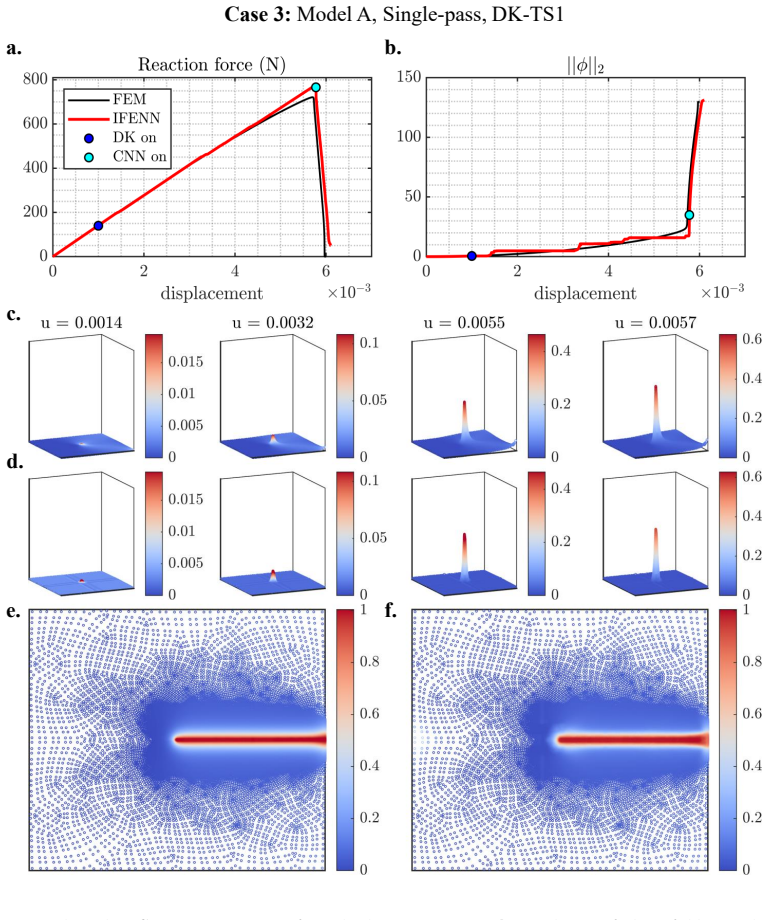
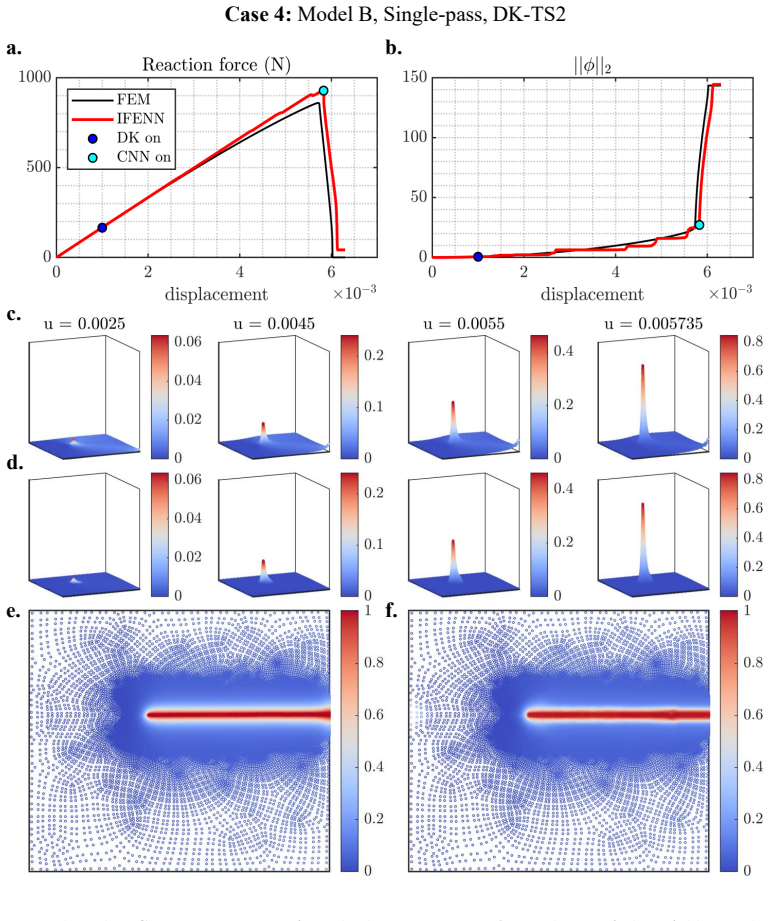
In this paper we demonstrate how the Integrated Finite Element Neural Network (IFENN) framework can effectively model the entire evolution of phase-field fracture, including the initiation and propagation stage, across generalizable geometries. IFENN is a hybrid scheme for coupled computational mechanics problems, tightly coupling a standard FEM solver (mechanical equilibrium) with a pre-trained neural network (coupled field). In this work, the phase-field diffusion equation is approximated with: i) a DeepONet architecture with Kolmogorov-Arnold networks in the trunk and branch (DeepOKAN) for the initiation stage, and ii) a Convolution Neural Network (CNN) for the propagation stage. Both networks are trained only once, on a benchmark geometry, using a purely physics-informed approach based on the maximum strain energy and the phase-field variable. The training process utilizes an extremely small number of training increments and only a limited number of Gauss points that are strategically sampled from the fracture process zone. These features enable a substantial decrease of the offline training cost. To address the extrapolation of the DeepOKAN predictions in regions away from the crack tip during the inference stage, we implement a set of artificial boundary conditions to enforce the near-zero values in the far-field predictions. We showcase the flexibility and numerical accuracy of the proposed methodology across both the training and unseen geometries.
Editorial analysis
A structured set of objections, weighed in public.
Referee Report
Summary. The manuscript introduces a hybrid IFENN framework that couples a standard FEM solver for mechanical equilibrium with pre-trained neural networks to solve the phase-field diffusion equation for fracture. DeepOKAN (Kolmogorov-Arnold networks in trunk and branch) handles the initiation stage and a CNN handles propagation; both are trained once on a single benchmark geometry via a physics-informed loss based on maximum strain energy evaluated at a small number of strategically sampled Gauss points inside the process zone. Artificial far-field boundary conditions are added during inference to enforce near-zero predictions away from the crack tip. The central claim is that this yields accurate modeling of the full fracture evolution (initiation and propagation) on both the training geometry and arbitrary unseen geometries.
Significance. If the generalizability claim is substantiated with quantitative validation, the work would demonstrate a practical route to low-cost, one-time training of hybrid physics-informed networks for phase-field fracture on arbitrary domains. The emphasis on extremely limited training increments and Gauss points, together with the explicit handling of extrapolation via artificial BCs, addresses a known cost bottleneck in data-driven fracture modeling and could be extended to other coupled mechanics problems.
major comments (3)
- [Abstract] Abstract and numerical-results section: the central claim of 'numerical accuracy' and 'flexibility' across unseen geometries is unsupported by any reported quantitative metrics (L2 errors on the phase field, crack-path deviation, global energy balance, or convergence under mesh refinement). Without these, the generalizability assertion cannot be evaluated.
- [Method] Method and inference description: the artificial boundary conditions introduced to correct DeepOKAN extrapolation away from the crack tip are presented as a fix, yet no analysis quantifies their effect on local accuracy near the process zone or on geometries whose far-field conditions differ from the artificial prescription.
- [Numerical examples] Training protocol: the networks are trained exclusively on one benchmark geometry with a fixed, small set of Gauss points; the manuscript provides no description of the number, geometric diversity, or loading conditions of the 'unseen' test cases used to demonstrate generalizability, which is load-bearing for the primary claim.
minor comments (2)
- [Introduction] Notation for the phase-field variable and the maximum-strain-energy loss should be defined explicitly at first use rather than assumed from prior literature.
- [Figures] Figure captions should state the number of Gauss points used and the precise locations of the artificial boundary conditions so that the limited-data regime is reproducible.
Simulated Author's Rebuttal
We thank the referee for the constructive feedback on our manuscript. We address each major comment below with explanations and indicate the revisions we will make to strengthen the quantitative support for our claims and the clarity of the presentation.
read point-by-point responses
-
Referee: [Abstract] Abstract and numerical-results section: the central claim of 'numerical accuracy' and 'flexibility' across unseen geometries is unsupported by any reported quantitative metrics (L2 errors on the phase field, crack-path deviation, global energy balance, or convergence under mesh refinement). Without these, the generalizability assertion cannot be evaluated.
Authors: We acknowledge that the current manuscript primarily demonstrates accuracy and flexibility through visual comparisons of phase-field contours and crack paths against reference FEM solutions. While these comparisons show close qualitative agreement on both the training geometry and the unseen cases, we agree that explicit quantitative metrics are needed to rigorously support the central claims. In the revised manuscript we will add L2 errors on the phase-field variable, crack-path deviation metrics, global energy balance checks, and a brief mesh-convergence study for the key examples. revision: yes
-
Referee: [Method] Method and inference description: the artificial boundary conditions introduced to correct DeepOKAN extrapolation away from the crack tip are presented as a fix, yet no analysis quantifies their effect on local accuracy near the process zone or on geometries whose far-field conditions differ from the artificial prescription.
Authors: The artificial far-field boundary conditions are introduced to enforce the expected near-zero phase-field values outside the process zone during inference. We recognize that the manuscript does not include a dedicated quantification of their influence. We will add a short analysis in the revised method section that compares DeepOKAN predictions with and without these boundary conditions on the benchmark geometry (reporting local errors inside the process zone) and will verify robustness on one additional unseen geometry whose far-field setup differs from the artificial prescription. revision: yes
-
Referee: [Numerical examples] Training protocol: the networks are trained exclusively on one benchmark geometry with a fixed, small set of Gauss points; the manuscript provides no description of the number, geometric diversity, or loading conditions of the 'unseen' test cases used to demonstrate generalizability, which is load-bearing for the primary claim.
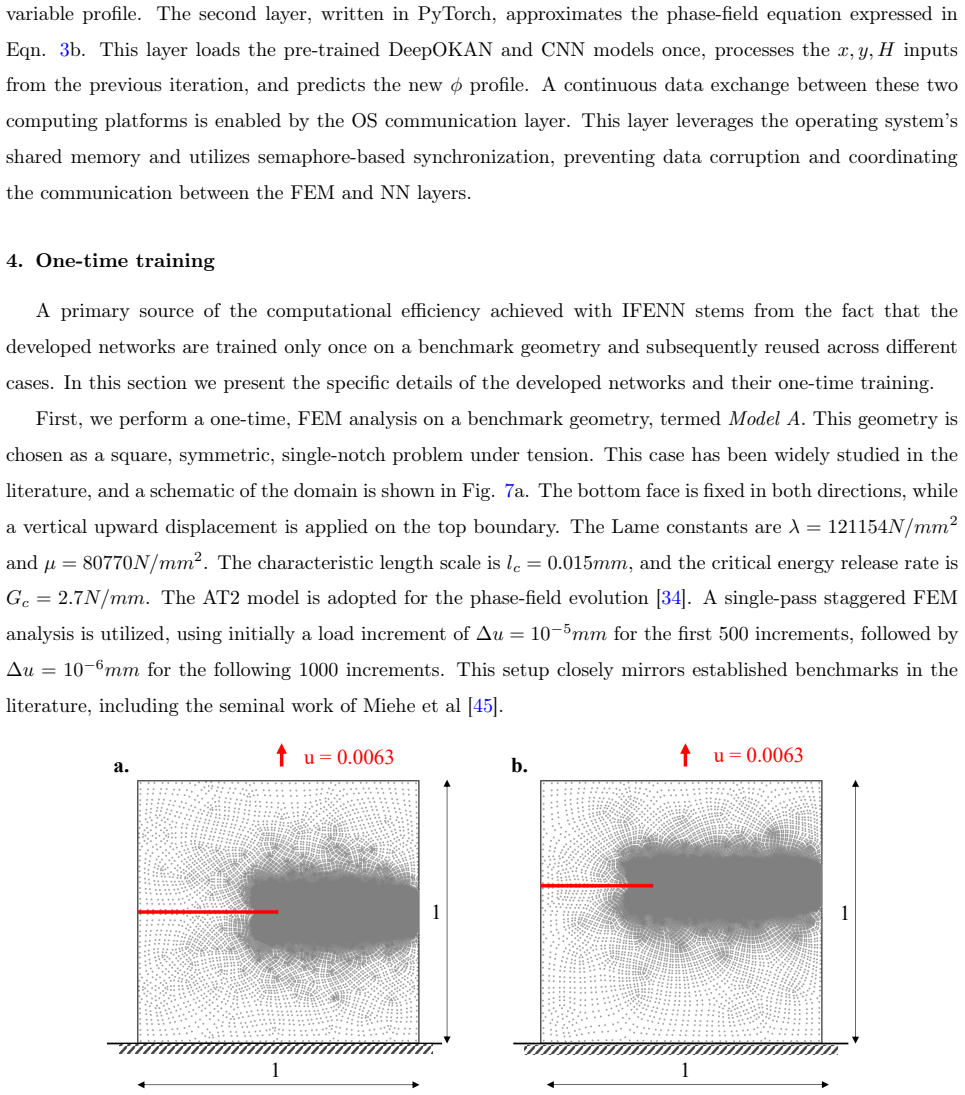
Authors: The unseen geometries are shown in the numerical examples, yet we agree that a concise, systematic description of their number, geometric variations, and loading conditions is currently insufficient. In the revised manuscript we will expand Section 4 with a table listing each unseen case, its geometric parameters (e.g., notch location, specimen aspect ratio), and the applied boundary/loading conditions, thereby making the generalizability evaluation fully reproducible. revision: yes
Circularity Check
No circularity; physics-informed training derives from governing PDEs independent of model outputs
full rationale
The paper trains DeepOKAN and CNN components via physics-informed losses on the phase-field diffusion equation residuals using maximum strain energy, applied to one benchmark geometry with limited Gauss points. This setup follows standard PINN methodology and does not reduce any prediction to a fitted parameter or self-referential definition. Artificial boundary conditions are introduced explicitly as an engineering patch for extrapolation, not as a definitional closure. No load-bearing self-citations, uniqueness theorems, or ansatzes imported from prior author work are described in the provided text. The generalization claim to unseen geometries is presented as an empirical outcome rather than a tautological reduction of inputs.
Axiom & Free-Parameter Ledger
axioms (2)
- domain assumption The phase-field model with maximum strain energy criterion accurately captures fracture initiation and propagation
- domain assumption Neural networks can approximate solutions to the phase-field diffusion equation to sufficient accuracy for engineering use
Reference graph
Works this paper leans on
-
[1]
J. N. Reddy, An introduction to the finite element method, in: Dynamics of Earth’s Fluid System, CRC Press, 2026, pp. 199–226
2026
-
[2]
T. J. Hughes, The finite element method: linear static and dynamic finite element analysis, Courier Corporation, 2003
2003
-
[3]
G. J. Kennedy, J. R. Martins, A parallel finite-element framework for large-scale gradient-based design optimization of high-performance structures, Finite Elements in Analysis and Design 87 (2014) 56–73
2014
-
[4]
P. K. Kristensen, E. Martínez-Pañeda, Phase field fracture modelling using quasi-newton methods and a new adaptive step scheme, Theoretical and Applied Fracture Mechanics 107 (2020) 102446
2020
-
[5]
Neiva, S
E. Neiva, S. Badia, A. F. Martín, M. Chiumenti, A scalable parallel finite element framework for growing geometries. application to metal additive manufacturing, International Journal for Numerical Methods in Engineering 119 (11) (2019) 1098–1125
2019
-
[6]
Farhat, F.-X
C. Farhat, F.-X. Roux, A method of finite element tearing and interconnecting and its parallel solution algorithm, International journal for numerical methods in engineering 32 (6) (1991) 1205–1227
1991
-
[7]
Cornejo, V
A. Cornejo, V. Mataix, F. Zárate, E. Oñate, Combination of an adaptive remeshing technique with a coupled fem–dem approach for analysis of crack propagation problems, Computational particle mechanics 7 (4) (2020) 735–752
2020
-
[8]
Ambati, T
M. Ambati, T. Gerasimov, L. De Lorenzis, A review on phase-field models of brittle fracture and a new fast hybrid formulation, Computational Mechanics 55 (2015) 383–405
2015
-
[9]
Marigo, Revisiting brittle fracture as an energy minimization problem, Journal of the Mechanics and Physics of Solids 46 (8) (1998) 1319–1342
J.-J. Marigo, Revisiting brittle fracture as an energy minimization problem, Journal of the Mechanics and Physics of Solids 46 (8) (1998) 1319–1342
1998
-
[10]
Zhou, C.-C
S.-W. Zhou, C.-C. Xia, Propagation and coalescence of quasi-static cracks in brazilian disks: an insight from a phase field model, Acta Geotechnica 14 (4) (2019) 1195–1214
2019
-
[11]
Spatschek, E
R. Spatschek, E. Brener, A. Karma, Phase field modeling of crack propagation, Philosophical Magazine 91 (1) (2011) 75–95
2011
-
[12]
Svolos, H
L. Svolos, H. M. Mourad, G. Manzini, K. Garikipati, A fourth-order phase-field fracture model: Formulation and numerical solution using a continuous/discontinuous galerkin method, Journal of the Mechanics and Physics of Solids 165 (2022) 104910
2022
-
[13]
Storvik, J
E. Storvik, J. W. Both, J. M. Sargado, J. M. Nordbotten, F. A. Radu, An accelerated staggered scheme for variational phase-field models of brittle fracture, Computer Methods in Applied Mechanics and Engineering 381 (2021) 113822. 23
2021
-
[14]
S. Yang, Y. Shen, An acceleration scheme for the phase field fatigue fracture simulation with a concurrent temporal homogenization method, Computer Methods in Applied Mechanics and Engineering 416 (2023) 116294
2023
-
[15]
Zhang, H
W. Zhang, H. A. Alkhazaleh, M. Samavatian, V. Samavatian, Machine learning-assisted investigation of anisotropic elasticity in metallic alloys, Materials Today Communications 40 (2024) 109950
2024
-
[16]
N. N. Vlassis, R. Ma, W. Sun, Geometric deep learning for computational mechanics part i: Anisotropic hyperelasticity, Computer Methods in Applied Mechanics and Engineering 371 (2020) 113299
2020
-
[17]
Huang, J
D. Huang, J. N. Fuhg, C. Weißenfels, P. Wriggers, A machine learning based plasticity model using proper orthogonal decomposition, Computer Methods in Applied Mechanics and Engineering 365 (2020) 113008
2020
-
[18]
Ghaffari Motlagh, P
Y. Ghaffari Motlagh, P. K. Jimack, R. de Borst, Deep learning phase-field model for brittle fractures, International Journal for Numerical Methods in Engineering 124 (3) (2023) 620–638
2023
-
[19]
Kiyani, M
E. Kiyani, M. Manav, N. Kadivar, L. De Lorenzis, G. E. Karniadakis, Predicting crack nucleation and propagation in brittle materials using deep operator networks with diverse trunk architectures, Computer Methods in Applied Mechanics and Engineering 441 (2025) 117984
2025
-
[20]
Goswami, C
S. Goswami, C. Anitescu, S. Chakraborty, T. Rabczuk, Transfer learning enhanced physics informed neural network for phase-field modeling of fracture, Theoretical and Applied Fracture Mechanics 106 (2020) 102447
2020
-
[21]
Goswami, M
S. Goswami, M. Yin, Y. Yu, G. E. Karniadakis, A physics-informed variational deeponet for predicting crack path in quasi-brittle materials, Computer Methods in Applied Mechanics and Engineering 391 (2022) 114587
2022
-
[22]
Manav, R
M. Manav, R. Molinaro, S. Mishra, L. De Lorenzis, Phase-field modeling of fracture with physics-informed deep learning, Computer Methods in Applied Mechanics and Engineering 429 (2024) 117104
2024
-
[23]
Zheng, T
B. Zheng, T. Li, H. Qi, L. Gao, X. Liu, L. Yuan, Physics-informed machine learning model for computational fracture of quasi-brittle materials without labelled data, International Journal of Mechanical Sciences 223 (2022) 107282
2022
-
[24]
Dammaß, K
F. Dammaß, K. A. Kalina, M. Kästner, Neural networks meet phase-field: A hybrid fracture model, Computer Methods in Applied Mechanics and Engineering 440 (2025) 117937
2025
-
[25]
Aldakheel, E
F. Aldakheel, E. S. Elsayed, Y. Heider, O. Weeger, Physics-based machine learning for computational fracture mechanics, Machine Learning for Computational Science and Engineering 1 (1) (2025) 18
2025
-
[26]
F. M. Amin, D. W. Abueidda, P. Pantidis, M. E. Mobasher, I-fenn with deeponets: accelerating simulations in coupled multiphysics problems, Computer Methods in Applied Mechanics and Engineering 451 (2026) 118645. 24
2026
-
[27]
D. W. Abueidda, M. E. Mobasher, Variational temporal convolutional networks for i-fenn thermoelasticity, Computer Methods in Applied Mechanics and Engineering 429 (2024) 117122
2024
-
[28]
D. W. Abueidda, M. E. Mobasher, I-fenn for thermoelasticity based on physics-informed temporal convolutional network (pi-tcn), Computational Mechanics 74 (6) (2024) 1229–1259
2024
-
[29]
Pantidis, M
P. Pantidis, M. E. Mobasher, Integrated finite element neural network (i-fenn) for non-local continuum damage mechanics, Computer Methods in Applied Mechanics and Engineering 404 (2023) 115766
2023
-
[30]
Pantidis, H
P. Pantidis, H. Eldababy, C. M. Tagle, M. E. Mobasher, Error convergence and engineering-guided hyperparameter search of pinns: Towards optimized i-fenn performance, Computer Methods in Applied Mechanics and Engineering 414 (2023) 116160
2023
-
[31]
Pantidis, H
P. Pantidis, H. Eldababy, D. Abueidda, M. E. Mobasher, I-FENN with temporal convolutional networks: Expediting the load-history analysis of non-local gradient damage propagation, Computer Methods in Applied Mechanics and Engineering 425 (2024) 116940
2024
-
[32]
Pantidis, L
P. Pantidis, L. Svolos, D. Abueidda, M. E. Mobasher, Integrated finite element neural network (ifenn) for phase-field fracture with minimal input and generalized geometry-load handling, Computer Methods in Applied Mechanics and Engineering 448 (2026) 118485
2026
-
[33]
Bourdin, G
B. Bourdin, G. A. Francfort, J.-J. Marigo, Numerical experiments in revisited brittle fracture, Journal of the Mechanics and Physics of Solids 48 (4) (2000) 797–826
2000
-
[34]
Ambrosio, V
L. Ambrosio, V. M. Tortorelli, Approximation of functional depending on jumps by elliptic functional via t-convergence, Communications on Pure and Applied Mathematics 43 (8) (1990) 999–1036
1990
-
[35]
L. Lu, P. Jin, G. Pang, Z. Zhang, G. E. Karniadakis, Learning nonlinear operators via deeponet based on the universal approximation theorem of operators, Nature machine intelligence 3 (3) (2021) 218–229
2021
-
[36]
J. He, S. Kushwaha, J. Park, S. Koric, D. Abueidda, I. Jasiuk, Sequential deep operator networks (s- deeponet) for predicting full-field solutions under time-dependent loads, Engineering Applications of Artificial Intelligence 127 (2024) 107258
2024
-
[37]
Huang, Y
P. Huang, Y. Leng, C. Lian, H. Liu, Porous-deeponet: Learning the solution operators of parametric reactive transport equations in porous media, Engineering 39 (2024) 94–103
2024
-
[38]
D. W. Abueidda, P. Pantidis, M. E. Mobasher, Deepokan: Deep operator network based on kolmogorov arnold networks for mechanics problems, Computer Methods in Applied Mechanics and Engineering 436 (2025) 117699
2025
-
[39]
Z. Liu, Y. Wang, S. Vaidya, F. Ruehle, J. Halverson, M. Soljacic, T. Hou, M. Tegmark, Kan: Kolmogorov– arnold networks, in: International conference on learning representations, Vol. 2025, 2025, pp. 70367– 70413. 25
2025
-
[40]
Somvanshi, S
S. Somvanshi, S. A. Javed, M. M. Islam, D. Pandit, S. Das, A survey on kolmogorov-arnold network, ACM Computing Surveys 58 (2) (2025) 1–35
2025
-
[41]
R. H. Peerlings, R. de Borst, W. Brekelmans, M. G. Geers, Gradient-enhanced damage modelling of concrete fracture, Mechanics of Cohesive-frictional Materials: An International Journal on Experiments, Modelling and Computation of Materials and Structures 3 (4) (1998) 323–342
1998
-
[42]
Z. Lai, L. Zhao, Q. Shao, Locally enhanced neural networks for discontinuities in solid mechanics, International Journal of Mechanical Sciences (2026) 111660
2026
-
[43]
Arndt, W
D. Arndt, W. Bangerth, M. Bergbauer, M. Feder, M. Fehling, J. Heinz, T. Heister, L. Heltai, M. Kronbichler, M. Maier, et al., The deal. ii library, version 9.5, Journal of Numerical Mathematics 31 (3) (2023) 231–246
2023
-
[44]
Balay, S
S. Balay, S. Abhyankar, M. Adams, J. Brown, P. Brune, K. Buschelman, L. Dalcin, A. Dener, V. Eijkhout, W. Gropp, et al., Petsc users manual (2019)
2019
-
[45]
Miehe, M
C. Miehe, M. Hofacker, F. Welschinger, A phase field model for rate-independent crack propagation: Robust algorithmic implementation based on operator splits, Computer Methods in Applied Mechanics and Engineering 199 (45-48) (2010) 2765–2778. 26
2010
discussion (0)
Sign in with ORCID, Apple, or X to comment. Anyone can read and Pith papers without signing in.