REVIEW 4 major objections 3 minor 20 references
Path Dynamics in a Deployed Path-Aware Network: A Measurement Study of SCIONLab
T0 review · 4 major / 3 minor · reviewed 2026-08-05 · deepseek-v4-flash
Pith's one-line read Four weeks of SCIONLab measurements show that path availability churns constantly, with average path lifetimes as short as 8.6 hours, so multipath protocols cannot assume stable or symmetric paths.
desk verdict A sincere, data-releasing measurement study of SCIONLab path dynamics whose headline lifetime numbers are weakened by 30-minute sampling and a single-region vantage, but worth a revision. read the letter →
The pith
A machine-rendered reading of the paper's core claim, the machinery that carries it, and where it could break.
The reading
What carries the argument
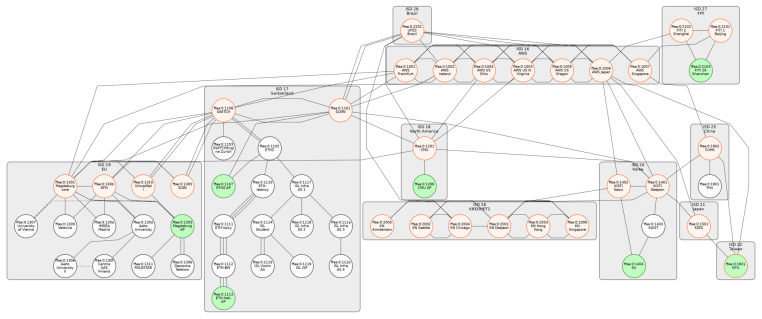
The load-bearing mechanism is SCION's control-plane beaconing: beacon servers generate Path Construction Beacons (PCBs) that propagate through ASes toward ISD cores, and each path segment has a finite lifetime and must be refreshed. This continuous create-and-expire cycle makes the discovered path set dynamic. The measurement machinery is a Python-based suite that runs every 30 minutes on three SCIONLab ASes: pathdiscover enumerates paths, comparer logs appearance and disappearance events, prober samples up to 15 paths per destination for latency and loss, mp-prober runs three simultaneous ping sessions to capture concurrency effects, and bandwidth tests measure throughput in both directions
What would settle it
Run the same measurement suite with the three ASes hosted in different cloud regions or on physical hardware, and check whether average path lifetimes stay near 8.6 hours, whether path discrepancy persists, and whether upstream loss at 100 Mbps still exceeds 30%. Alternatively, log PCB generation and expiry timestamps from SCIONLab's beacon servers and correlate them with the observed path-add and path-remove events; if lifetimes do not track beacon refresh cycles, the 30-minute polling interval or the VPN overlay is the real cause.
Extended reading notes
Core claim
The paper establishes empirically that SCIONLab's path environment has three properties that contradict common multipath assumptions. First, SCION's beaconing creates constant control-plane churn: for one destination, 301 change events over 1281 comparisons added 1254 paths and removed 1259, giving an average path lifetime of about 8.6 hours. Second, path availability is asymmetric between endpoints—path discrepancy—because each AS independently filters which path segments it accepts and advertises (one vantage point saw 20 paths to a peer while the peer saw 18 back). Third, using multiple paths concurrently degrades per-path RTT, jitter, and loss, yet raises aggregate throughput beyond any
Load-bearing premise
The three measurement ASes, although attached to different SCION attachment points, all run as virtual machines in the same Google Cloud region (us-central1-a) and reach SCIONLab through VPN overlays, so the observed churn, asymmetry, and packet loss are assumed to reflect SCION's own dynamics rather than artifacts of that co-location and the underlying tunnels.
Editorial extensions
If this is right
- MPQUIC and similar protocols cannot treat the discovered path set as static; they need low-overhead continuous path probing and validation, with rapid failover when a path vanishes.
- Path asymmetry (path discrepancy) means forward-path RTT cannot be assumed to time reverse-path acknowledgements; schedulers and congestion control must measure each direction independently.
- A two-tier scheduling strategy is indicated: reserve one high-quality path for latency-sensitive traffic and spread bulk transfers across the remaining paths to capture aggregate throughput while accepting per-path degradation.
- Path stability should become a primary path-selection metric, likely more important than latency or bandwidth for deadline-sensitive flows.
- The reported upstream bandwidth bottleneck (up to 34.6% packet loss at 100 Mbps) implies that high-speed bulk-transfer systems must explicitly measure directional capacity rather than assuming symmetric links.
Reading between the lines
- If the observed churn stems from SCION's beacon refresh cycles rather than testbed artifacts, production SCION deployments with tuned beacon intervals could exhibit lower churn; the 8.6-hour figure is a lower bound for well-provisioned networks, not a universal SCION constant.
- The co-location of all three measurement ASes in one cloud region may actually suppress data-plane instability, so real geographically distributed SCION deployments could show even more pronounced performance divergence between paths than reported here.
- A direct testable extension: run the same suite with 5- or 10-minute polling intervals to determine whether average path lifetimes are an artifact of 30-minute sampling (i.e., whether paths actually live shorter but get missed by coarse polling).
- Path discrepancy quantified at the control plane likely understates data-plane asymmetry; combining showpaths with bidirectional active probing could yield an 'asymmetry budget' useful for protocol design.
Editorial analysis
A structured set of objections, weighed in public.
Referee Report
Summary. The paper presents a four-week longitudinal measurement study of the SCIONLab testbed using three SCIONLab ASes hosted on Google Cloud VMs in us-central1-a but attached to ISDs 19, 17, and 18. Every 30 minutes the authors enumerate available SCION paths, track path additions/removals, probe per-path RTT, jitter, loss, and bandwidth, and compare single-path versus multipath behavior. The central findings are that SCIONLab paths are highly dynamic (for one destination, 301 change events over 1281 comparisons, with average path lifetime 8.6 hours; for another, 161 events and 15.7 hours), that path availability can be asymmetric ("path discrepancy", e.g., 20 paths in one direction vs. 18 in the other), and that concurrent multipath use raises aggregate throughput but degrades per-path latency, jitter, and loss. The paper concludes that protocols like MPQUIC must explicitly handle churn and asymmetry. The manuscript is transparent about its limitations and ships a public measurement suite.
Significance. If the results hold, this is one of the first longitudinal empirical characterizations of path dynamics in a deployed path-aware network, and the public release of the measurement suite is a concrete reproducibility asset. The qualitative finding that SCIONLab's path set is churny is plausible and useful for multipath protocol design. However, the quantitative lifetime estimates are threatened by the 30-minute sampling cadence, the path-discrepancy phenomenon rests on a single uncontrolled comparison, and the multipath trade-off lacks statistical support. These are load-bearing issues for the paper's headline contributions; they can likely be addressed by reanalysis or by substantially narrowing the claims, so the work is suitable for major revision.
major comments (4)
- [§3.1–3.2 and §4.1] The 8.6 h and 15.7 h average path lifetimes are computed from path sets sampled every 30 minutes by the cron-driven comparer. This interval censoring means any path appearing and disappearing between consecutive samples is never observed, so the lifetime estimates are biased upward and cannot be interpreted as true control-plane path lifetimes. The paper does not report the formula used to map added/removed events to lifetimes, nor a sensitivity analysis with respect to the polling interval, nor a comparison with SCION's segment expiry/beaconing timers. Given that change events occur in the majority of intervals (Figure 3), the quantitative headline (8.6 h) is not robust as stated. The authors should either present lifetimes as lower bounds, add an interval-sensitivity analysis, or qualify the claim to explicitly acknowledge the censoring.
- [§4.5] Path discrepancy is introduced based on a single observation: 'AS-3 could discover 20 viable paths to AS-2, while AS-2 could only find 18 paths.' No simultaneity check, no repeated samples, no distribution over time, and no statistical test is provided. The statement that this 'is not a transient failure' is therefore unsupported. For a claimed phenomenon, the authors should quantify the asymmetry across all intervals and endpoints, report how often and for how long such count imbalances persist, and test whether the difference is beyond sampling noise. As written, the contribution rests on an anecdote.
- [§4.4 and Figure 8] The single-path vs. multipath comparison uses medians of SP−MP differences, but no confidence intervals, sample sizes, or significance tests are reported. The comparison involves a small path set (up to three paths) and does not state whether endpoint or testbed load was controlled. The central trade-off claim—'concurrent usage degrades per-path latency'—could be an artifact of measurement load or random variation. Please report paired distributions with confidence intervals and a significance test, or downgrade the claim to an observation rather than a general design implication.
- [§3.1 and §5] All three measurement VMs were hosted in the same Google Cloud region (us-central1-a). The paper describes the ASes as 'geographically diverse' based on their ISD attachment, but this does not make the underlying physical paths diverse. Consequently, the data-plane results (RTT, loss, bandwidth, and the multipath trade-off) may reflect the shared cloud/VPN infrastructure rather than SCION path diversity. The limitation is acknowledged in §5, but the abstract and Section 4 present the findings as general SCIONLab characteristics. The performance-related claims should be re-framed as specific to this co-located setup, or supplemented with measurements from genuinely diverse vantage points.
minor comments (3)
- [§4.1] The relationship between 1281 comparisons and the stated measurement period (July 16–August 11, 30-minute intervals) is unclear; 26 days at 48 intervals/day gives ~1248 intervals. Clarify the exact interval count and how time periods with missing data are treated.
- [References] Several references lack complete bibliographic information: [5] has only an access URL, [13] is a presentation without a DOI or indexed venue, [17] appears to be an unpublished report, and [20] lacks a version or access date. Please complete these entries.
- [Figure 4] The lifetime histogram is described only qualitatively. Report the bin width and the fraction of paths whose lifetime falls below the 30-minute sampling interval, since that directly bears on the censoring concern.
Circularity Check
No significant circularity: the paper is an observational measurement study whose claims are summary statistics of recorded data, with no fitted parameters or load-bearing self-citations.
full rationale
This is a measurement study, not a derivation. The central claims—path churn counts, average path lifetimes (8.6 h and 15.7 h), RTT/loss/throughput values, and the single-path vs multipath comparison—are computed directly from measurements taken by the described tools (showpaths, comparer, prober, mp-prober, bw tests). There is no equation fitted to a target value and no parameter tuned to reproduce a claimed result. The average path lifetime is a summary statistic of observed add/remove events, not a quantity defined in terms of the paper's conclusions. The most plausible circularity-adjacent concern is the 30-minute polling interval used for path discovery (Section 3.1), which could censor short-lived paths and bias the lifetime estimate; this is a measurement-validity limitation, explicitly acknowledged in the Limitations paragraph (Section 5), not a circular reduction. The paper's self-reference is limited to its own public GitHub repository [20] for data/scripts, which is not load-bearing for the scientific claims. Citations to prior SCION work are external background, not the authors' own prior results invoked as a uniqueness theorem or hidden ansatz. No self-definitional step, fitted-input-called-prediction, or renaming-known-result pattern is present. Accordingly, the circularity burden is not met and the score is 0.
Assumptions & free parameters
assumptions (4)
- domain assumption SCION control-plane beaconing creates path segments with finite lifetimes, so path sets are inherently dynamic.
- domain assumption The set of paths returned by 'scion showpaths' at 30-minute intervals accurately represents the paths available to end hosts and their continuity.
- ad hoc to paper Co-locating all three measurement VMs in the same Google Cloud region does not systematically confound the SCION path churn and asymmetry measurements.
- domain assumption Path counts observed by two ASes are comparable for detecting asymmetry.
invented entities (1)
-
path discrepancy
Cite this review
Pith. "Pith review of Path Dynamics in a Deployed Path-Aware Network: A Measurement Study of SCIONLab." pith.science (2026). https://pith.science/paper/LHMX66SA
@misc{pith2026250904695,
  author       = {Pith},
  title        = {Pith review of: Path Dynamics in a Deployed Path-Aware Network: A Measurement Study of SCIONLab},
  year         = {2026},
  howpublished = {\url{https://pith.science/paper/LHMX66SA}},
  note         = {Machine review of arXiv:2509.04695}
}
read the original abstract
Path-aware networks promise enhanced performance and resilience through multipath transport, but a lack of empirical data on their real-world dynamics hinders the design of effective protocols. This paper presents a longitudinal measurement study of the SCION architecture on the global SCIONLab testbed, characterizing the path stability, diversity, and performance crucial for protocols like Multipath QUIC (MPQUIC). Our measurements reveal a dynamic environment, with significant control-plane churn and short path lifetimes in parts of the testbed. We identify and characterize path discrepancy, a phenomenon where routing policies create asymmetric path availability between endpoints. Furthermore, we observe a performance trade-off where concurrent multipath transmissions can improve aggregate throughput but may degrade the latency and reliability of individual paths. These findings demonstrate that protocols such as MPQUIC should explicitly account for high churn and path asymmetry, challenging common assumptions in multipath protocol design.
Figures


Figures from the paper (5 more)


Reference graph
Works this paper leans on
-
[1]
Is Crunching Public Data the Right Approach to Detect BGP Hijacks?
A. Giaconia, M. Tran, L. Vanbever, S. Vissicchio, Is crunching pub- lic data the right approach to detect bgp hijacks?, arXiv preprint arXiv:2507.20434 (2025)
work page Pith review arXiv 2025
- [2]
-
[3]
D. D. Clark, Designing an internet, MIT Press, 2018
work page 2018
-
[4]
X. Zhang, H.-C. Hsiao, G. Hasker, H. Chan, A. Perrig, D. G. Andersen, Scion: Scalability, control, and isolation on next-generation networks, in: 2011 IEEE Symposium on Security and Privacy, IEEE, 2011, pp. 212–227. 17
work page 2011
-
[5]
A. S. AG, Secure, resilient, and controlled connectivity with scion, https://www.anapaya.net/, accessed: 2025-08-11 (2025)
work page 2025
-
[6]
A. Ford, C. Raiciu, M. J. Handley, O. Bonaventure, C. Paasch, TCP Extensions for Multipath Operation with Multiple Addresses, RFC 8684 (Mar. 2020).doi:10.17487/RFC8684. URLhttps://www.rfc-editor.org/info/rfc8684
-
[7]
Q. De Coninck, O. Bonaventure, Multipath quic: Design and evalua- tion, in: Proceedings of the 13th international conference on emerging networking experiments and technologies, 2017, pp. 160–166
work page 2017
-
[8]
Y. Liu, Y. Ma, Q. D. Coninck, O. Bonaventure, C. Huitema, M. Kühlewind, Multipath Extension for QUIC, Internet-Draft draft- ietf-quic-multipath-15, Internet Engineering Task Force, work in Progress (Jul. 2025). URLhttps://datatracker.ietf.org/doc/ draft-ietf-quic-multipath/15/
work page 2025
Show all 20 references
-
[9]
Krähenbühl, S
C. Krähenbühl, S. Tabaeiaghdaei, S. Scherrer, M. Frei, A. Perrig, Glids: A global latency information dissemination system, arXiv preprint arXiv:2405.04319 (2024)
2024 arXiv
-
[10]
Krähenbühl, S
C. Krähenbühl, S. Tabaeiaghdaei, C. Gloor, J. Kwon, A. Perrig, D. Hausheer, D. Roos, Deployment and scalability of an inter-domain multi-path routing infrastructure, in: Proceedings of the 17th Interna- tional Conference on emerging Networking EXperiments and Technolo- gies, 2...
2021
-
[11]
J. Kwon, J. A. García-Pardo, M. Legner, F. Wirz, M. Frei, D. Hausheer, A. Perrig, Scionlab: A next-generation internet testbed, in: 2020 IEEE 28th International Conference on Network Protocols (ICNP), IEEE, 2020, pp. 1–12
2020
-
[12]
Chuat, M
L. Chuat, M. Legner, D. Basin, D. Hausheer, S. Hitz, P. Müller, A. Per- rig, The complete guide to scion, Information Security and Cryptogra- phy (2022)
2022
-
[13]
van Rijswijk-Deij, C
L. van Rijswijk-Deij, C. de Laat, SCION Performance Testbed Evalua- tion, SC23 INDIS Presentation, accessed: 2025-07-23 (2023). 18 URLhttps://delaat.net/sc/sc23/indis/S4-4-sc23_presenter_ leo.pdf
2025
-
[14]
Battipaglia, L
A. Battipaglia, L. Boldrini, R. Koning, P. Grosso, Evaluation of scion for user-driven path control: A usability study, in: Proceedings of the SC’23 Workshops of The International Conference on High Performance Computing, Network, Storage, and Analysis, 2023, pp. 785–794
2023
-
[15]
van Veen, H
A. van Veen, H. Vranken, R. Koning, C. Schutijser, E. Poll, Achieving application-level requirement-based path selection within scion (2024)
2024
-
[16]
J.Gessner, Leveragingapplicationlayerpath-awarenesswithscion, Mas- ter’s thesis, ETH Zurich (2021)
2021
-
[17]
Koole, M
K. Koole, M. Pawlus, A comparative analysis of routing policies in bgp and scion (2023)
2023
-
[18]
T. John, A. Perrig, D. Hausheer, Dmtp: Deadline-aware multipath transport protocol, in: 2023 IFIP Networking Conference (IFIP Net- working), IEEE, 2023, pp. 1–9
2023
-
[19]
Gartner, J.-P
M. Gartner, J.-P. Smith, M. Frei, F. Wirz, C. Neukom, D. Hausheer, A. Perrig, Hercules: High-speed bulk-transfer over scion, in: 2023 IFIP Networking Conference (IFIP Networking), IEEE, 2023, pp. 1–9
2023
-
[20]
Herschbacha, D
L. Herschbacha, D. Rossi, S. Keshvadi, mpquic-on-scion-ipc,https: //github.com/Keshvadi/mpquic-on-scion-ipc(2025). 19
2025
Reviewed August 5, 2026 · model on record in the stance chip above.
Discussion (0). Sign in to comment.