REVIEW 3 major objections 5 minor 109 references
The Concordance of Weak Lensing and Escape Velocity Mass Estimates for Galaxy Clusters
T0 review · 3 major / 5 minor · reviewed 2026-08-06 · deepseek-v4-flash
Pith's one-line read Galaxy cluster masses inferred from escape velocities now agree with weak-lensing masses to within 0.02 dex, ending a decade of apparent disagreement.
desk verdict A plausible resolution of the caustic–WL discrepancy, but the escape-mass suppression model needs hydro validation before I'd treat the concordance as established. read the letter →
The pith
A machine-rendered reading of the paper's core claim, the machinery that carries it, and where it could break.
The reading
What carries the argument
The load-bearing object is the suppression function $Z_v$, the factor by which the true three-dimensional escape velocity profile is pulled inward when the phase-space is sparsely sampled. The paper models the distribution of $Z_v$ as a skew-normal whose location, scale, and skewness depend on the projected tracer count $N$, mass, and redshift, calibrated on analytic spherical phase-spaces and validated against a gravity-only N-body simulation; the observed edge is taken as the maximum absolute line-of-sight velocity in five radial bins, and the cluster mass is recovered by an MCMC comparison of the bin edges to the suppressed theoretical escape profile built from a Dehnen potential in a flat $\Lambda$CDM cosmology.
What would settle it
Run the same escape-mass pipeline on mock cluster phase-spaces drawn from a cosmological hydrodynamical simulation with baryonic feedback and realistic survey selection: if the recovered masses differ from the true halo masses by more than about 0.05 dex in the mean, or if re-applying a hydro-calibrated $Z_v$ to the 46 real clusters pushes the lensing bias outside $0.02 \pm 0.02$ dex, the concordance would be exposed as a calibration artifact rather than a physical agreement.
Extended reading notes
Core claim
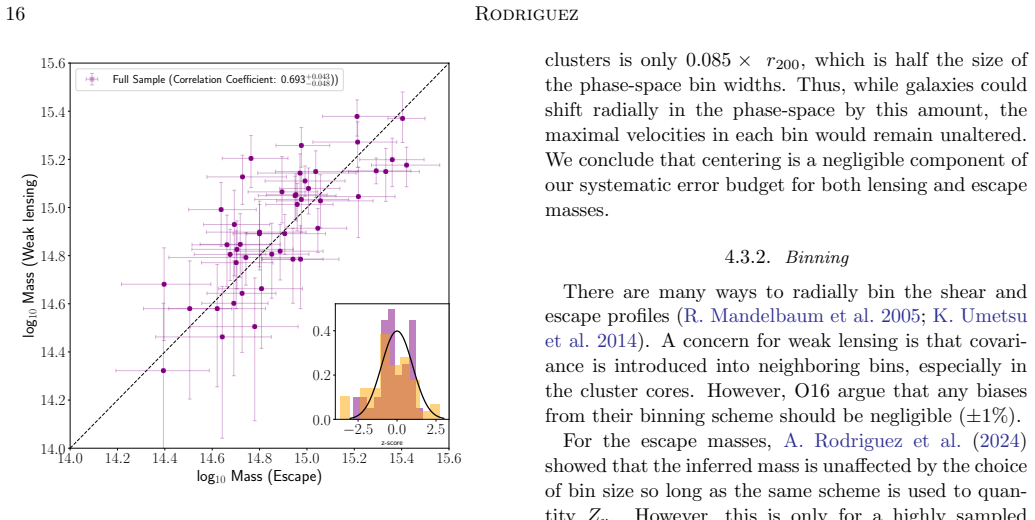
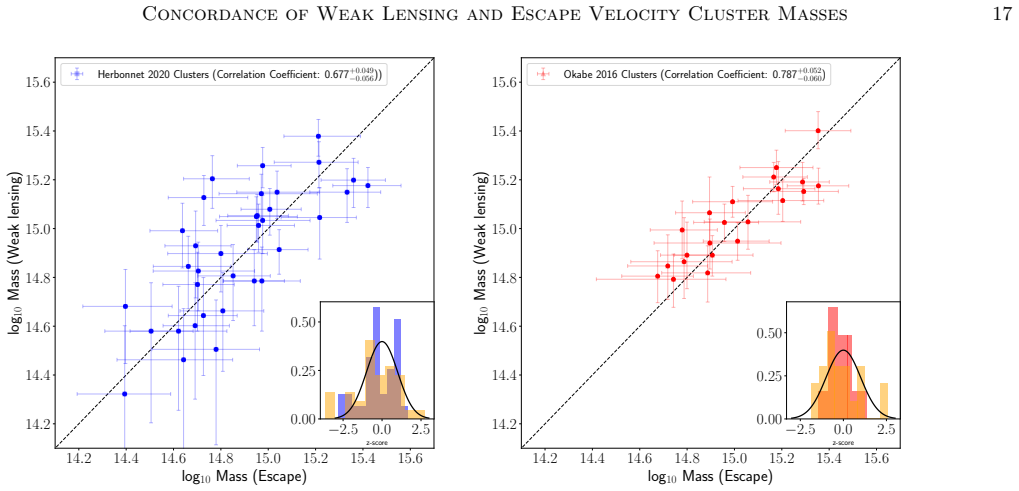
The central discovery is that galaxy cluster masses measured from projected radius–velocity phase-space data, via the down-sampled escape velocity profile corrected by a skew-normal suppression function $Z_v$, are statistically indistinguishable from weak lensing masses. For 46 clusters at $0.05 \le z \le 0.3$ spanning $14.4 \le \log_{10} M/M_\odot \le 15.4$, the mean logarithmic bias is $0.02 \pm 0.02$ dex, the scatter is $0.17$ dex, and the correlation is $0.679^{+0.046}_{-0.049}$; the scatter is fully consistent with the sum of individual measurement errors, so no additional intrinsic scatter is required. This contrasts with the same comparison made with caustic-inferred masses, which shows a correlation consistent with zero and a $0.25 \pm 0.05$ dex bias.
Load-bearing premise
The suppression function $Z_v$, calibrated on analytic spherical model clusters and validated only against gravity-only N-body halos, is assumed to correct the observed escape edge in real clusters that contain baryonic feedback, substructure, and interlopers without additional bias; a few-percent error in $Z_v$ would shift escape masses enough to make the reported lensing concordance spurious.
Editorial extensions
If this is right
- If the concordance is real, phase-space escape masses can be used as an independent check on weak lensing systematics at the ~0.1 dex level without relying on hydrodynamical simulations.
- The skew-normal treatment of the suppression function is essential: ignoring its skewness biases inferred masses low by about 0.1 dex, so future escape-velocity work must include it.
- Because the escape edge depends on cosmology through $qH^2$, the same data can in principle constrain the late-universe expansion rate and acceleration, with $H_0$ uncertainty currently the dominant systematic in escape masses.
- Concordance holds for clusters with evidence of disturbed dynamical states as well as relaxed ones, implying the method is not limited to equilibrium systems.
- The bias between lensing and escape masses shifts with the assumed cosmology, meaning the technique is sensitive enough to distinguish competing $H_0$ values in a larger sample.
Reading between the lines
- A hydrodynamical test of $Z_v$ would settle the main residual worry: if baryonic feedback redistributes galaxies in phase-space, the suppression calibration could shift and the reported bias could be hiding a cancellation between errors.
- The same framework could be extended to lower-mass groups or higher-redshift clusters, where the strong $N$ dependence of $Z_v$ predicts that sampling sparsity, not internal dynamics, will dominate the error budget.
- If the escape technique constrains $qH^2$ as the paper suggests, combining it with independent $H_0$ probes could provide a purely dynamical cross-check of the current Hubble tension.
- A stacked or ensemble application of the method, rather than per-cluster mass estimates, might sharpen the cosmological constraint from the same 46 clusters.
Editorial analysis
A structured set of objections, weighed in public.
Referee Report
Summary. This paper presents a revised comparison between escape-velocity masses and weak-lensing masses for 46 galaxy clusters at 0.05<z<0.3. The authors model the observed down-sampled escape edge with a skew-normal suppression function Z_v calibrated on AGAMA phase-spaces of spherical potentials, and they validate the mass-inference pipeline on Millennium N-body halos, finding unbiased recovery. Applied to clusters drawn from Herbonnet et al. (2020), Okabe & Smith (2016), and AS1063, the method yields a mean bias of 0.02±0.02 dex, a scatter of 0.17 dex, and a correlation of 0.679^{+0.046}_{-0.049} with weak-lensing masses, with no additional intrinsic scatter required. The authors contrast this with the prior caustic-based comparison, which showed negligible correlation and a 0.25 dex bias, and they provide a detailed discussion of systematic uncertainties.
Significance. If the result is correct, it is significant: it would demonstrate that a carefully modeled escape-edge technique yields cluster masses statistically consistent with independent weak-lensing measurements, overturning the previously reported lack of correlation and establishing escape masses as a viable independent mass probe with potential cosmological applications. The paper's strengths include the explicit treatment of the skewness of the suppression distribution, the end-to-end validation on Millennium halos with a range of dynamical states, the outlier analysis, and a clear systematics budget. However, the central claim is not yet fully secured: the suppression function Z_v is calibrated on gravity-only simulations and the paper explicitly does not test it against hydrodynamical simulations, so a few-percent model bias could shift the escape masses by an amount comparable to the quoted zero bias. The result is therefore promising but conditional on additional validation.
major comments (3)
- [§4.3.9 and Eqs. (5)–(10)] The suppression function Z_v, which the paper identifies as the primary systematic of the escape technique, is calibrated on AGAMA phase-spaces of isolated spherical potentials and validated only against gravity-only Millennium halos. The paper explicitly does not test Z_v against hydrodynamical simulations, and the order-of-magnitude energy argument (~10^60 erg to displace a single galaxy) does not bound the effect of lower-energy processes such as tidal stripping, harassment, or orbital redistribution, which can change which galaxies populate the phase-space edge at fixed N without requiring AGN displacement of a single galaxy. Because M200 scales roughly as v_esc^2 r, a 2–3% bias in the suppressed edge translates to ~0.05–0.1 dex in mass, comparable to the quoted bias of 0.02±0.02 dex. I recommend testing Z_v on a hydrodynamical simulation (e.g., IllustrisTNG or the Three Hundred project) or otherwise providing a quantitative demonstration that baryonic processes do not bias the edge population.
- [§4.2 and §3.5.3] The escape masses are not fully independent of the weak-lensing masses because the weak-lensing M200 is used to define the initial r200 that sets the radial binning and the phase-space count N entering Z_v. The AGAMA test in §3.5.3 shows the induced correlation is weak, and the Millennium test with 0.6 dex mass errors gives zero bias, which is reassuring. However, in the real sample, the weak-lensing masses are themselves the comparison quantity, and if those masses carry a correlated bias (e.g., from orientation or photometric-redshift systematics), part of that bias could propagate into the escape masses through the N-dependent suppression. The quoted 0.01 dex binning systematic in §4.3.2 does not obviously include this correlated component. I ask the authors to either propagate the full weak-lensing uncertainty through the escape-mass pipeline in a joint analysis or demonstrate with a realistic mock that the covariance is negligible at the 0.01 dex level.
- [§4.2 and Figure 8] The claim that the 0.17 dex observed scatter requires no additional intrinsic component rests on z-score histograms in which the escape-mass errors appear consistent with σ=1 but the weak-lensing errors have σ≈1.4. Underestimated lensing errors directly weaken the inference about intrinsic scatter. The conclusion should be tested with a joint likelihood that includes both error sets and a free intrinsic-scatter parameter, with a posterior on that parameter, rather than by comparing z-score widths informally.
minor comments (5)
- [Abstract and Table 3] The abstract states the sample spans 0.05≤z≤0.3, but Table 3 includes AS1063 at z=0.345; the redshift range should be updated or the sample definition made consistent.
- [§4.2] The 'chance of observing this correlation due to random chance' (1.25% and 32.09%) is not defined; please specify the null model and whether the p-value comes from a permutation test or from the Monte Carlo realizations under a null hypothesis.
- [§4.3.9] The statement that non-uniform sampling variations up to 30% have no effect on the measured velocity dispersion is cited from A. Rodriguez et al. (2024); since the present work concerns the phase-space edge rather than the velocity dispersion, please clarify whether this test also applies to the edge measurement and Z_v.
- [§3.1 and §5] There are several typos: 'quantity' should be 'quantify' in §3.1, 'Herbonett' should be 'Herbonnet' in §5, and 'affect' should be 'effect' in §4.3.1; the manuscript also references 'Figure A' in §3.1 instead of 'Figure A1'.
- [§4.3.7] In the sentence discussing the Hubble constant, '±3 km−1s' should be '±3 km s^−1'.
Circularity Check
No significant circularity: the escape-mass pipeline is calibrated on AGAMA, validated on an external N-body simulation, and the only weak-lensing input (initial r200 for binning) is explicitly tested for insensitivity.
full rationale
The paper's derivation chain is self-contained at the level required by the circularity rubric. The suppression model Z_v (Eqs. 5, 7, 10) is calibrated from AGAMA analytic phase-spaces (§3.1) and then tested against the external Millennium N-body simulation (§3.2, §3.5), where it recovers input M200 with zero bias (B = 0.0 ± 0.01) and no excess scatter. The weak-lensing masses enter the escape pipeline only through the initial r200 that sets the radial binning and phase-space count N (§4.2). The authors explicitly identify this dependence, test it in §3.5.3 by scattering input masses by up to 200%, find the induced correlation weak (R = 0.46 but sub-percent effect on Z_v), and further check that varying the prior range from 1 to 4σ_WL does not change the final bias. This is an acknowledged, quantified systematic rather than an equation-level reduction of M_esc to M_WL. The comparison itself uses external weak-lensing catalogs (H20, O16) and external simulation benchmarks; prior same-group work (Halenka et al. 2022; Rodriguez et al. 2024) is cited for the method, but the present paper recalibrates and validates the model rather than importing the result by citation alone. The absence of a hydrodynamical test of Z_v is a legitimate modeling/correctness concern, not a circularity: the model is not fitted to the 46 clusters, and no claim in the paper reduces by construction to its inputs.
Assumptions & free parameters
free parameters (5)
- Suppression model parameters (xi, omega, alpha) as functions of N, M200, z =
Stored in look-up table; slopes and intercepts fitted in AGAMA simulations
- Shifting-gapper velocity gap (600 km/s) and galaxies per bin (20) =
600 km/s, 20 galaxies/bin
- Velocity anisotropy beta in AGAMA (0.25) =
0.25
- Mass-concentration relation (Duffy et al. 2008) =
c(M,z) from Duffy 2008
- Cosmology (Omega_m=0.3, H0=70) =
Omega_m=0.3, H0=70 km/s/Mpc
assumptions (5)
- domain assumption The effective potential in an accelerating universe is given by equation 1, following Nandra et al. 2012.
- domain assumption The extrema of the phase-space tracer velocities are bounded by the escape surface.
- standard math The Dehnen potential parametrization (equation 6) is an adequate model for the cluster potential.
- domain assumption The monotonicity of the edge profile is enforced in the measurement.
- domain assumption The Millennium simulation (gravity-only, with semi-analytic galaxies) is representative of real clusters for validating the suppression model.
Cite this review
Pith. "Pith review of The Concordance of Weak Lensing and Escape Velocity Mass Estimates for Galaxy Clusters." pith.science (2026). https://pith.science/paper/LHWI5REQ
@misc{pith2026250720938,
  author       = {Pith},
  title        = {Pith review of: The Concordance of Weak Lensing and Escape Velocity Mass Estimates for Galaxy Clusters},
  year         = {2026},
  howpublished = {\url{https://pith.science/paper/LHWI5REQ}},
  note         = {Machine review of arXiv:2507.20938}
}
abstract
In the $\Lambda$CDM paradigm, the masses of the galaxy clusters inferred using background galaxies via weak-lensing shear should agree with the masses measured using the galaxy projected radius-velocity phase-space data via the escape velocity profile. However, prior work indicates that the correlation between caustic-inferred escape masses and weak lensing masses is statistically consistent with zero. Based on recent advancements in the measurement of the escape edge and its physical interpretation, we conduct a revised comparison between these two independent mass inference techniques for 46 galaxy clusters between $0.05 \le z \le 0.3$ and over an order of magnitude in mass, $14.4 \le {\rm log}_{10} M/M_{\odot} \le 15.4$. We find excellent agreement, with a correlation ($0.679^{+0.046}_{-0.049}$), and a mean relative difference between the two mass measurements consistent with zero (0.02 $\pm$ 0.02 dex). The observed scatter between these direct mass estimates is 0.17 dex and is consistent with the reported individual mass errors, suggesting that there is no need for an additional intrinsic component. We discuss the important practical consequences of these results, focusing on the systematic uncertainties inherent to each technique, and their implications for cosmology.
Figures


Figures from the paper (6 more)


Reference graph
Works this paper leans on
-
[1]
, " * write output.state after.block = add.period write newline
ENTRY address archivePrefix author booktitle chapter doi edition editor eprint howpublished institution journal key month number organization pages publisher school series title misctitle type volume year version url label extra.label sort.label short.list INTEGERS output.state before.all mid.sentence after.sentence after.block FUNCTION init.state.consts ...
-
[2]
write newline
" write newline "" before.all 'output.state := FUNCTION format.url url empty "" new.block "" url * "" * if FUNCTION format.eprint eprint empty "" archivePrefix empty "" archivePrefix "arXiv" = new.block " " eprint * " " * new.block " " eprint * " " * if if if FUNCTION format.doi doi empty "" " " doi * " " * if FUNCTION format.pid doi empty eprint empty ur...
-
[3]
@esa ( ) , n @biblabelnum##1 ##1
\@ifclassloaded aguplus natbib The aguplus class already includes natbib coding, so you should not add it explicitly Type <Return> for now, but then later remove the command natbib from the document \@ifclassloaded nlinproc natbib The nlinproc class already includes natbib coding, so you should not add it explicitly Type <Return> for now, but then later r...
-
[4]
@stdbsttrue NAT@ctr \@lbibitem[ NAT@ctr ] \@lbibitem[#1]#2 \@extra@b@citeb \@ifundefined br@#2\@extra@b@citeb \@namedef br@#2 \@nameuse br@#2\@extra@b@citeb \@ifundefined b@#2\@extra@b@citeb @num @parse #2 [ @natanchorstart #2\@extra@b@citeb \@biblabel @num @natanchorend] @ifcmd#1()()\@nil #2 @lbibitem\@undefined @lbibitem\@lbibitem \@lbibitem[#1]#2 @lbib...
-
[5]
@open @close @open @close and [1] URL: #1 \@ifundefined chapter * \@mkboth \@ifundefined NAT@sectionbib * \@mkboth * \@mkboth\@gobbletwo \@ifclassloaded amsart * \@ifclassloaded amsbook * \@ifundefined bib@heading @heading NAT@ctr thebibliography [1] @ \@biblabel NAT@ctr \@bibsetup #1 NAT@ctr 0 @openbib .11em \@plus.33em \@minus.07em 4000 4000 `\.=1000 \@...
-
[6]
1997, title Segregations in clusters of galaxies, arXiv, 10.48550/ARXIV.ASTRO-PH/9709268
Adami, C., Biviano, A., & Mazure, A. 1997, title Segregations in clusters of galaxies, arXiv, 10.48550/ARXIV.ASTRO-PH/9709268
-
[7]
Aguilar , L. A. 2008, in A Pan-Chromatic View of Clusters of Galaxies and the Large-Scale Structure, ed. M. Plionis , O. L \'o pez-Cruz , & D. Hughes , Vol. 740, 24, 10.1007/978-1-4020-6941-3_3
-
[8]
E., von der Linden, A., Kelly, P
Applegate, D. E., von der Linden, A., Kelly, P. L., et al. 2014, title Weighing the Giants – III. Methods and measurements of accurate galaxy cluster weak-lensing masses, Monthly Notices of the Royal Astronomical Society, 439, 48–72, 10.1093/mnras/stt2129
Show all 109 references
-
[9]
E., Mantz , A., Allen , S
Applegate , D. E., Mantz , A., Allen , S. W., et al. 2016, title Cosmology and astrophysics from relaxed galaxy clusters - IV. Robustly calibrating hydrostatic masses with weak lensing , , 457, 1522, 10.1093/mnras/stw005
2016 doi
-
[10]
2009, title Statistical applications of the multivariate skew-normal distribution , arXiv e-prints, arXiv:0911.2093, 10.48550/arXiv.0911.2093
Azzalini , A., & Capitanio , A. 2009, title Statistical applications of the multivariate skew-normal distribution , arXiv e-prints, arXiv:0911.2093, 10.48550/arXiv.0911.2093
-
[11]
M., McCarthy , I
Bah \'e , Y. M., McCarthy , I. G., & King , L. J. 2012, title Mock weak lensing analysis of simulated galaxy clusters: bias and scatter in mass and concentration , , 421, 1073, 10.1111/j.1365-2966.2011.20364.x
2012
-
[12]
2007, title Internal dynamics of the radio halo cluster Abell 773: a multiwavelength analysis, Astronomy & Astrophysics, 467, 37–48, 10.1051/0004-6361:20066511
Barrena, R., Boschin, W., Girardi, M., & Spolaor, M. 2007, title Internal dynamics of the radio halo cluster Abell 773: a multiwavelength analysis, Astronomy & Astrophysics, 467, 37–48, 10.1051/0004-6361:20066511
2007 doi
-
[13]
2016, title Velocity segregation effects in galaxy clusters at 0.4 z 1.5 , , 595, A73, 10.1051/0004-6361/201629012
Barsanti , S., Girardi , M., Biviano , A., et al. 2016, title Velocity segregation effects in galaxy clusters at 0.4 z 1.5 , , 595, A73, 10.1051/0004-6361/201629012
2016 doi
-
[14]
B., Zengo , K., Ruel , J., et al
Bayliss , M. B., Zengo , K., Ruel , J., et al. 2017, title Velocity Segregation and Systematic Biases In Velocity Dispersion Estimates with the SPT-GMOS Spectroscopic Survey , , 837, 88, 10.3847/1538-4357/aa607c
2017 doi
-
[15]
R., & Kravtsov, A
Becker, M. R., & Kravtsov, A. V. 2011, title ON THE ACCURACY OF WEAK-LENSING CLUSTER MASS RECONSTRUCTIONS, The Astrophysical Journal, 740, 25, 10.1088/0004-637x/740/1/25
2011 doi
-
[16]
S., Loeb, A., & Wechsler, R
Behroozi, P. S., Loeb, A., & Wechsler, R. H. 2013, title Unbound particles in dark matter halos, Journal of Cosmology and Astroparticle Physics, 2013, 019, 10.1088/1475-7516/2013/06/019
2013 doi
-
[17]
2008, Galactic Dynamics: Second Edition
Binney , J., & Tremaine , S. 2008, Galactic Dynamics: Second Edition
2008
-
[18]
1992, title Velocity Segregation in Galaxy Clusters , , 396, 35, 10.1086/171695
Biviano , A., Girardi , M., Giuricin , G., Mardirossian , F., & Mezzetti , M. 1992, title Velocity Segregation in Galaxy Clusters , , 396, 35, 10.1086/171695
1992 doi
-
[19]
S., Schlegel, D
Bolton, A. S., Schlegel, D. J., Aubourg, E., et al. 2012, title SPECTRAL CLASSIFICATION AND REDSHIFT MEASUREMENT FOR THE SDSS-III BARYON OSCILLATION SPECTROSCOPIC SURVEY, The Astronomical Journal, 144, 144, 10.1088/0004-6256/144/5/144
2012 doi
-
[20]
2022, title The Pantheon+ Analysis: Cosmological Constraints , , 938, 110, 10.3847/1538-4357/ac8e04
Brout , D., Scolnic , D., Popovic , B., et al. 2022, title The Pantheon+ Analysis: Cosmological Constraints , , 938, 110, 10.3847/1538-4357/ac8e04
2022 doi
-
[21]
L., & Kempner, J
Chatzikos, M., Sarazin, C. L., & Kempner, J. C. 2006, title ChandraObservation of Abell 2065: An Unequal Mass Merger? The Astrophysical Journal, 643, 751–763, 10.1086/503276
2006 doi
-
[22]
O., Scaife, A
Clarke, A. O., Scaife, A. M. M., Shimwell, T., et al. 2019, title Signatures from a merging galaxy cluster and its AGN population: LOFAR observations of Abell 1682, Astronomy & Astrophysics, 627, A176, 10.1051/0004-6361/201935584
2019 doi
-
[23]
Coenda , V., Rios , M. d. l., Muriel , H., et al. 2022, title Reconstructing orbits of galaxies in extreme regions (ROGER) - II: reliability of projected phase-space in our understanding of galaxy populations , , 510, 1934, 10.1093/mnras/stab3551
2022 doi
-
[24]
A., Alamo-Mart \' nez , K
Coziol , R., Andernach , H., Caretta , C. A., Alamo-Mart \' nez , K. A., & Tago , E. 2009, title The Dynamical State of Brightest Cluster Galaxies and The Formation of Clusters , , 137, 4795, 10.1088/0004-6256/137/6/4795
2009 doi
-
[25]
2022, title THE THREE HUNDRED project: The GIZMO-SIMBA run , , 514, 977, 10.1093/mnras/stac1402
Cui , W., Dave , R., Knebe , A., et al. 2022, title THE THREE HUNDRED project: The GIZMO-SIMBA run , , 514, 977, 10.1093/mnras/stac1402
2022 doi
-
[26]
D'Agostino, R., & Pearson, E. S. 1973, title Tests for Departure from Normality. Empirical Results for the Distributions of b2 and (b1) , Biometrika, 60, 613. http://www.jstor.org/stable/2335012
1973
-
[27]
F., Caldwell , R
Daniel , S. F., Caldwell , R. R., Cooray , A., Serra , P., & Melchiorri , A. 2009, title Multiparameter investigation of gravitational slip , , 80, 023532, 10.1103/PhysRevD.80.023532
2009 doi
-
[28]
1993, title A Family of Potential-Density Pairs for Spherical Galaxies and Bulges , , 265, 250, 10.1093/mnras/265.1.250
Dehnen , W. 1993, title A Family of Potential-Density Pairs for Spherical Galaxies and Bulges , , 265, 250, 10.1093/mnras/265.1.250
1993 doi
- [29]
-
[30]
1999, title Mass estimation in the outer regions of galaxy clusters , , 309, 610, 10.1046/j.1365-8711.1999.02864.x
Diaferio , A. 1999, title Mass estimation in the outer regions of galaxy clusters , , 309, 610, 10.1046/j.1365-8711.1999.02864.x
1999
-
[31]
Diaferio, A., & Geller, M. J. 1997, title Infall Regions of Galaxy Clusters, The Astrophysical Journal, 481, 633–643, 10.1086/304075
1997 doi
-
[32]
J., & Rines , K
Diaferio , A., Geller , M. J., & Rines , K. J. 2005, title Caustic and Weak-Lensing Estimators of Galaxy Cluster Masses , , 628, L97, 10.1086/432880
2005 doi
-
[33]
F., et al
Drabent , A., Hoeft , M., Pizzo , R. F., et al. 2015, title Diffuse radio emission in the complex merging galaxy cluster Abell2069 , , 575, A8, 10.1051/0004-6361/201424828
2015 doi
-
[34]
R., Schaye, J., Kay, S
Duffy, A. R., Schaye, J., Kay, S. T., & Vecchia, C. D. 2008, title Dark matter halo concentrations in the i Wilkinson Microwave Anisotropy Probe /i year 5 cosmology, Monthly Notices of the Royal Astronomical Society: Letters, 390, L64, 10.1111/j.1745-3933.2008.00537.x
2008
-
[35]
A., & Macci \` o , A
Dutton, A. A., & Macci \` o , A. V. 2014, title Cold dark matter haloes in the Planck era: evolution of structural parameters for Einasto and NFW profiles, Monthly Notices of the Royal Astronomical Society, 441, 3359, 10.1093/mnras/stu742
2014 doi
-
[36]
2024, title Euclid preparation
Euclid Collaboration , Giocoli , C., Meneghetti , M., et al. 2024, title Euclid preparation. XXXII. Evaluating the weak-lensing cluster mass biases using the Three Hundred Project hydrodynamical simulations , , 681, A67, 10.1051/0004-6361/202346058
2024 doi
-
[37]
2005, title Hectospec, the MMT’s 300 Optical Fiber‐Fed Spectrograph, Publications of the Astronomical Society of the Pacific, 117, 1411–1434, 10.1086/497385
Fabricant, D., Fata, R., Roll, J., et al. 2005, title Hectospec, the MMT’s 300 Optical Fiber‐Fed Spectrograph, Publications of the Astronomical Society of the Pacific, 117, 1411–1434, 10.1086/497385
2005 doi
-
[38]
1996, title The Observational Distribution of Internal Velocity Dispersions in Nearby Galaxy Clusters , , 473, 670, 10.1086/178180
Fadda , D., Girardi , M., Giuricin , G., Mardirossian , F., & Mezzetti , M. 1996, title The Observational Distribution of Internal Velocity Dispersions in Nearby Galaxy Clusters , , 473, 670, 10.1086/178180
1996 doi
-
[39]
W., Lang , D., & Goodman , J
Foreman-Mackey , D., Hogg , D. W., Lang , D., & Goodman , J. 2013, title emcee: The MCMC Hammer , , 125, 306, 10.1086/670067
2013 doi
-
[40]
J., Diaferio , A., Rines , K
Geller , M. J., Diaferio , A., Rines , K. J., & Serra , A. L. 2013, title Measuring the Mass Distribution in Galaxy Clusters , , 764, 58, 10.1088/0004-637X/764/1/58
2013 doi
-
[41]
Gifford, D., Kern, N., & Miller, C. J. 2017, title STACKING CAUSTIC MASSES FROM GALAXY CLUSTERS , The Astrophysical Journal, 834, 204, 10.3847/1538-4357/834/2/204
2017 doi
-
[42]
2013, title A SYSTEMATIC ANALYSIS OF CAUSTIC METHODS FOR GALAXY CLUSTER MASSES , The Astrophysical Journal, 773, 116, 10.1088/0004-637x/773/2/116
Gifford, D., Miller, C., & Kern, N. 2013, title A SYSTEMATIC ANALYSIS OF CAUSTIC METHODS FOR GALAXY CLUSTER MASSES , The Astrophysical Journal, 773, 116, 10.1088/0004-637x/773/2/116
2013 doi
-
[43]
Gifford , D., & Miller , C. J. 2013, title Velocity Anisotropy and Shape Bias in the Caustic Technique , , 768, L32, 10.1088/2041-8205/768/2/L32
2013 doi
-
[44]
1996, in Astronomical Society of the Pacific Conference Series, Vol
Girardi , M., Fadda , D., Giuricin , G., et al. 1996, in Astronomical Society of the Pacific Conference Series, Vol. 94, Mapping, Measuring, and Modelling the Universe, ed. P. Coles , V. Martinez , & M.-J. Pons-Borderia , 221
1996
-
[45]
Gnedin , O. Y. 2003, title Dynamical Evolution of Galaxies in Clusters , , 589, 752, 10.1086/374774
2003 doi
-
[46]
L., Valkonen , L
G \'o mez , P. L., Valkonen , L. E., Romer , A. K., et al. 2012, title Optical and X-Ray Observations of the Merging Cluster AS1063 , , 144, 79, 10.1088/0004-6256/144/3/79
2012 doi
-
[47]
2013, title Weak lensing analysis of RXC-J2248.7−4431 , Monthly Notices of the Royal Astronomical Society, 432, 1455, 10.1093/mnras/stt566
Gruen, D., Brimioulle, F., Seitz, S., et al. 2013, title Weak lensing analysis of RXC-J2248.7−4431 , Monthly Notices of the Royal Astronomical Society, 432, 1455, 10.1093/mnras/stt566
2013 doi
-
[48]
E., et al
Guo , Q., White , S., Angulo , R. E., et al. 2013, title Galaxy formation in WMAP1 and WMAP7 cosmologies , , 428, 1351, 10.1093/mnras/sts115
2013 doi
-
[49]
2014, title The VIMOS Public Extragalactic Redshift Survey (VIPERS)
Guzzo , L., Scodeggio , M., Garilli , B., et al. 2014, title The VIMOS Public Extragalactic Redshift Survey (VIPERS). An unprecedented view of galaxies and large-scale structure at 0.5 < z < 1.2 , , 566, A108, 10.1051/0004-6361/201321489
2014 doi
-
[50]
2024, title Reconsidering the dynamical states of galaxy clusters using PCA and UMAP , , 532, 1031, 10.1093/mnras/stae1566
Haggar , R., De Luca , F., De Petris , M., et al. 2024, title Reconsidering the dynamical states of galaxy clusters using PCA and UMAP , , 532, 1031, 10.1093/mnras/stae1566
2024 doi
-
[51]
J., & Vansickle , P
Halenka , V., Miller , C. J., & Vansickle , P. 2022, title Quantifying the Projected Suppression of Cluster Escape Velocity Profiles , , 926, 126, 10.3847/1538-4357/ac4786
2022 doi
-
[52]
2020, title CCCP and MENeaCS: (updated) weak-lensing masses for 100 galaxy clusters , Monthly Notices of the Royal Astronomical Society, 497, 4684, 10.1093/mnras/staa2303
Herbonnet, R., Sifón, C., Hoekstra, H., et al. 2020, title CCCP and MENeaCS: (updated) weak-lensing masses for 100 galaxy clusters , Monthly Notices of the Royal Astronomical Society, 497, 4684, 10.1093/mnras/staa2303
2020 doi
-
[53]
Herbonnet, R., Crawford, A., Avestruz, C., et al. 2022, title Brightest cluster galaxies trace weak lensing mass bias and halo triaxiality in the three hundred project, Monthly Notices of the Royal Astronomical Society, 513, 2178–2193, 10.1093/mnras/stac997
2022 doi
-
[54]
2015, title The Canadian Cluster Comparison Project: detailed study of systematics and updated weak lensing masses , , 449, 685, 10.1093/mnras/stv275
Hoekstra , H., Herbonnet , R., Muzzin , A., et al. 2015, title The Canadian Cluster Comparison Project: detailed study of systematics and updated weak lensing masses , , 449, 685, 10.1093/mnras/stv275
2015 doi
-
[55]
W., Bovy, J., & Lang, D
Hogg, D. W., Bovy, J., & Lang, D. 2010, title Data analysis recipes: Fitting a model to data, 1008.4686
2010 arXiv
-
[56]
T., Kravtsov, A
Lau, E. T., Kravtsov, A. V., & Nagai, D. 2009, title RESIDUAL GAS MOTIONS IN THE INTRACLUSTER MEDIUM AND BIAS IN HYDROSTATIC MEASUREMENTS OF MASS PROFILES OF CLUSTERS, The Astrophysical Journal, 705, 1129–1138, 10.1088/0004-637x/705/2/1129
2009 doi
-
[57]
2011, title Euclid Definition Study Report, 1110.3193
Laureijs, R., Amiaux, J., Arduini, S., et al. 2011, title Euclid Definition Study Report, 1110.3193
2011 arXiv
-
[58]
2003, in Society of Photo-Optical Instrumentation Engineers (SPIE) Conference Series, Vol
Le F \`e vre , O., Saisse , M., Mancini , D., et al. 2003, in Society of Photo-Optical Instrumentation Engineers (SPIE) Conference Series, Vol. 4841, Instrument Design and Performance for Optical/Infrared Ground-based Telescopes, ed. M. Iye & A. F. M. Moorwood , 1670--1681, 10...
2003 doi
-
[59]
J., et al
Lee, W., Cha, S., Jee, M. J., et al. 2023, title Weak-lensing Mass Bias in Merging Galaxy Clusters, The Astrophysical Journal, 945, 71, 10.3847/1538-4357/acb76b
2023 doi
-
[60]
2012, title Profiles of Dark Matter Velocity Anisotropy in Simulated Clusters , , 752, 141, 10.1088/0004-637X/752/2/141
Lemze , D., Wagner , R., Rephaeli , Y., et al. 2012, title Profiles of Dark Matter Velocity Anisotropy in Simulated Clusters , , 752, 141, 10.1088/0004-637X/752/2/141
2012 doi
-
[61]
2013, title Joint Analysis of Cluster Observations
Mahdavi , A., Hoekstra , H., Babul , A., et al. 2013, title Joint Analysis of Cluster Observations. II. Chandra/XMM-Newton X-Ray and Weak Lensing Scaling Relations for a Sample of 50 Rich Clusters of Galaxies , , 767, 116, 10.1088/0004-637X/767/2/116
2013 doi
-
[62]
M., Kriss , G
Malumuth , E. M., Kriss , G. A., Dixon , W. V. D., Ferguson , H. C., & Ritchie , C. 1992, title Dynamics of Clusters of Galaxies with Central Dominant Galaxies. I. Galaxy Redshifts , , 104, 495, 10.1086/116250
1992 doi
-
[63]
M., Seljak, U., et al
Mandelbaum, R., Hirata, C. M., Seljak, U., et al. 2005, title Systematic errors in weak lensing: application to SDSS galaxy-galaxy weak lensing, Monthly Notices of the Royal Astronomical Society, 361, 1287–1322, 10.1111/j.1365-2966.2005.09282.x
2005
-
[64]
2001, title Merger Shocks in Galaxy Clusters A665 and A2163 and Their Relation to Radio Halos, The Astrophysical Journal, 563, 95–102, 10.1086/323831
Markevitch, M., & Vikhlinin, A. 2001, title Merger Shocks in Galaxy Clusters A665 and A2163 and Their Relation to Radio Halos, The Astrophysical Journal, 563, 95–102, 10.1086/323831
2001 doi
-
[65]
2014, title Major Cluster Mergers and the Location of the Brightest Cluster Galaxy , , 786, 79, 10.1088/0004-637X/786/2/79
Martel , H., Robichaud , F., & Barai , P. 2014, title Major Cluster Mergers and the Location of the Brightest Cluster Galaxy , , 786, 79, 10.1088/0004-637X/786/2/79
2014 doi
-
[66]
I., Crane , J., et al
Mateo , M., Bailey , J. I., Crane , J., et al. 2012, in Society of Photo-Optical Instrumentation Engineers (SPIE) Conference Series, Vol. 8446, Ground-based and Airborne Instrumentation for Astronomy IV, ed. I. S. McLean , S. K. Ramsay , & H. Takami , 84464Y, 10.1117/12.926448
2012 doi
-
[67]
L., Bourdin , H., et al
Maurogordato , S., Sauvageot , J. L., Bourdin , H., et al. 2011, title Merging history of three bimodal clusters , , 525, A79, 10.1051/0004-6361/201014415
2011 doi
-
[68]
2021, title CLASH-VLT: Abell -0.5ex 1063
Mercurio , A., Rosati , P., Biviano , A., et al. 2021, title CLASH-VLT: Abell -0.5ex 1063. Cluster assembly history and spectroscopic catalogue , arXiv e-prints, arXiv:2109.03305. 2109.03305
2021 arXiv
-
[69]
2015, title CLASH: The Concentration-Mass Relation of Galaxy Clusters , , 806, 4, 10.1088/0004-637X/806/1/4
Merten , J., Meneghetti , M., Postman , M., et al. 2015, title CLASH: The Concentration-Mass Relation of Galaxy Clusters , , 806, 4, 10.1088/0004-637X/806/1/4
2015 doi
-
[70]
J., Stark, A., Gifford, D., & Kern, N
Miller, C. J., Stark, A., Gifford, D., & Kern, N. 2016, title INFERRING GRAVITATIONAL POTENTIALS FROM MASS DENSITIES IN CLUSTER-SIZED HALOS, The Astrophysical Journal, 822, 41, 10.3847/0004-637x/822/1/41
2016 doi
-
[71]
S., Machado, R
Monteiro-Oliveira, R., Cypriano, E. S., Machado, R. E. G., et al. 2016, title The merger history of the complex cluster Abell 1758: a combined weak lensing and spectroscopic view, Monthly Notices of the Royal Astronomical Society, 466, 2614–2632, 10.1093/mnras/stw3238
2016 doi
-
[72]
C., Ribeiro, A
Monteiro-Oliveira, R., Soja, A. C., Ribeiro, A. L. B., et al. 2020, title Probing Saraswati’s heart: evaluating the dynamical state of the massive galaxy cluster A2631 through a comprehensive weak-lensing and dynamical analysis, Monthly Notices of the Royal Astronomical Societ...
2020 doi
-
[73]
V., & Vikhlinin , A
Nagai , D., Kravtsov , A. V., & Vikhlinin , A. 2007, title Effects of Galaxy Formation on Thermodynamics of the Intracluster Medium , , 668, 1, 10.1086/521328
2007 doi
-
[74]
N., & Hobson, M
Nandra, R., Lasenby, A. N., & Hobson, M. P. 2012, title The effect of a massive object on an expanding universe, Monthly Notices of the Royal Astronomical Society, 422, 2931–2944, 10.1111/j.1365-2966.2012.20618.x
2012
-
[75]
F., Frenk , C
Navarro , J. F., Frenk , C. S., & White , S. D. M. 1997, title A Universal Density Profile from Hierarchical Clustering , , 490, 493, 10.1086/304888
1997 doi
-
[76]
2021, title The IllustrisTNG Simulations: Public Data Release, 1812.05609
Nelson, D., Springel, V., Pillepich, A., et al. 2021, title The IllustrisTNG Simulations: Public Data Release, 1812.05609
2021 arXiv
-
[77]
T., & Nagai, D
Nelson, K., Lau, E. T., & Nagai, D. 2014, title HYDRODYNAMIC SIMULATION OF NON-THERMAL PRESSURE PROFILES OF GALAXY CLUSTERS, The Astrophysical Journal, 792, 25, 10.1088/0004-637x/792/1/25
2014 doi
-
[78]
R., & Hill , J
Oegerle , W. R., & Hill , J. M. 2001, title Dynamics of cD Clusters of Galaxies. IV. Conclusion of a Survey of 25 Abell Clusters , , 122, 2858, 10.1086/323536
2001 doi
-
[79]
Okabe, N., & Smith, G. P. 2016, title LoCuSS: weak-lensing mass calibration of galaxy clusters, Monthly Notices of the Royal Astronomical Society, 461, 3794–3821, 10.1093/mnras/stw1539
2016 doi
-
[80]
Okabe, N., & Umetsu, K. 2008, title Subaru Weak Lensing Study of Seven Merging Clusters: Distributions of Mass and Baryons, Publications of the Astronomical Society of Japan, 60, 345–375, 10.1093/pasj/60.2.345
2008 doi
-
[81]
J., Kenyon , S
Pizzardo , M., Geller , M. J., Kenyon , S. J., Damjanov , I., & Diaferio , A. 2023, title An IllustrisTNG view of the caustic technique for galaxy cluster mass estimation , , 675, A56, 10.1051/0004-6361/202346545
2023 doi
-
[82]
2020, title Planck 2018 results
Planck Collaboration , Aghanim , N., Akrami , Y., et al. 2020, title Planck 2018 results. VI. Cosmological parameters , , 641, A6, 10.1051/0004-6361/201833910
2020 doi
-
[83]
2006, title Systematics in the X-ray cluster mass estimators , , 369, 2013, 10.1111/j.1365-2966.2006.10466.x
Rasia , E., Ettori , S., Moscardini , L., et al. 2006, title Systematics in the X-ray cluster mass estimators , , 369, 2013, 10.1111/j.1365-2966.2006.10466.x
2006
-
[84]
2017, title Phase-space Analysis in the Group and Cluster Environment: Time Since Infall and Tidal Mass Loss , , 843, 128, 10.3847/1538-4357/aa6d6c
Rhee , J., Smith , R., Choi , H., et al. 2017, title Phase-space Analysis in the Group and Cluster Environment: Time Since Infall and Tidal Mass Loss , , 843, 128, 10.3847/1538-4357/aa6d6c
2017 doi
-
[85]
J., Diaferio , A., & Kurtz , M
Rines , K., Geller , M. J., Diaferio , A., & Kurtz , M. J. 2013, title Measuring the Ultimate Halo Mass of Galaxy Clusters: Redshifts and Mass Profiles from the Hectospec Cluster Survey (HeCS) , , 767, 15, 10.1088/0004-637X/767/1/15
2013 doi
-
[86]
J., Geller, M
Rines, K. J., Geller, M. J., Diaferio, A., & Hwang, H. S. 2016, title HeCS-SZ: THE HECTOSPEC SURVEY OF SUNYAEV–ZELDOVICH-SELECTED CLUSTERS, The Astrophysical Journal, 819, 63, 10.3847/0004-637x/819/1/63
2016 doi
-
[87]
2017, title What does the Bullet Cluster tell us about self-interacting dark matter? , , 465, 569, 10.1093/mnras/stw2670
Robertson , A., Massey , R., & Eke , V. 2017, title What does the Bullet Cluster tell us about self-interacting dark matter? , , 465, 569, 10.1093/mnras/stw2670
2017 doi
-
[88]
J., Halenka , V., & Kremin , A
Rodriguez , A., Miller , C. J., Halenka , V., & Kremin , A. 2024, title Escape Velocity Mass of A1063 , , 968, 35, 10.3847/1538-4357/ad3de3
2024 doi
-
[89]
J., Bazin , G., & Dolag , K
Saro , A., Mohr , J. J., Bazin , G., & Dolag , K. 2013, title Toward Unbiased Galaxy Cluster Masses from Line-of-sight Velocity Dispersions , , 772, 47, 10.1088/0004-637X/772/1/47
2013 doi
-
[90]
, Biviano, A
Sartoris, B. , Biviano, A. , Rosati, P. , et al. 2020, title CLASH-VLT: a full dynamical reconstruction of the mass profile of Abell S1063 from 1 kpc out to the virial radius, A&A, 637, A34, 10.1051/0004-6361/202037521
2020 doi
-
[91]
P., et al
Schrabback , T., Applegate , D., Dietrich , J. P., et al. 2018, title Cluster mass calibration at high redshift: HST weak lensing analysis of 13 distant galaxy clusters from the South Pole Telescope Sunyaev-Zel'dovich Survey , , 474, 2635, 10.1093/mnras/stx2666
2018 doi
-
[92]
L., Diaferio , A., Murante , G., & Borgani , S
Serra , A. L., Diaferio , A., Murante , G., & Borgani , S. 2011, title Measuring the escape velocity and mass profiles of galaxy clusters beyond their virial radius , , 412, 800, 10.1111/j.1365-2966.2010.17946.x
2011
-
[93]
Simet, M., McClintock, T., Mandelbaum, R., et al. 2016, title Weak lensing measurement of the mass–richness relation of SDSS redMaPPer clusters, Monthly Notices of the Royal Astronomical Society, 466, 3103–3118, 10.1093/mnras/stw3250
2016 doi
-
[94]
Springel , V., & Farrar , G. R. 2007, title The speed of the `bullet' in the merging galaxy cluster 1E0657-56 , , 380, 911, 10.1111/j.1365-2966.2007.12159.x
2007
-
[95]
Springel , V., White , S. D. M., Jenkins , A., et al. 2005, title Simulations of the formation, evolution and clustering of galaxies and quasars , , 435, 629, 10.1038/nature03597
2005 doi
-
[96]
J., & Gifford , D
Stark , A., Miller , C. J., & Gifford , D. 2016 a , title On Escaping a Galaxy Cluster in an Accelerating Universe , , 830, 109, 10.3847/0004-637X/830/2/109
2016 doi
-
[97]
J., & Halenka, V
Stark, A., Miller, C. J., & Halenka, V. 2019, title Deriving Galaxy Cluster Velocity Anisotropy Profiles from a Joint Analysis of Dynamical and Weak Lensing Data, The Astrophysical Journal, 874, 33, 10.3847/1538-4357/ab06fa
2019 doi
-
[98]
J., & Huterer, D
Stark, A., Miller, C. J., & Huterer, D. 2017, title Cosmology with galaxy cluster phase spaces, Phys. Rev. D, 96, 023543, 10.1103/PhysRevD.96.023543
2017 doi
-
[99]
J., Kern , N., et al
Stark , A., Miller , C. J., Kern , N., et al. 2016 b , title Probing theories of gravity with phase space-inferred potentials of galaxy clusters , , 93, 084036, 10.1103/PhysRevD.93.084036
2016 doi
-
[100]
Umetsu, K., Pizzardo, M., Diaferio, A., & Geller, M. J. 2025, title Cluster Lensing Mass Inversion (CLUMI+): Combining Dynamics and Weak Lensing around Galaxy Clusters, 2505.04694
2025 arXiv
-
[101]
2014, title CLASH: WEAK-LENSING SHEAR-AND-MAGNIFICATION ANALYSIS OF 20 GALAXY CLUSTERS, The Astrophysical Journal, 795, 163, 10.1088/0004-637x/795/2/163
Umetsu, K., Medezinski, E., Nonino, M., et al. 2014, title CLASH: WEAK-LENSING SHEAR-AND-MAGNIFICATION ANALYSIS OF 20 GALAXY CLUSTERS, The Astrophysical Journal, 795, 163, 10.1088/0004-637x/795/2/163
2014 doi
-
[102]
2019, title AGAMA: action-based galaxy modelling architecture , , 482, 1525, 10.1093/mnras/sty2672
Vasiliev , E. 2019, title AGAMA: action-based galaxy modelling architecture , , 482, 1525, 10.1093/mnras/sty2672
2019 doi
-
[103]
2009, title Turbulent motions and shocks waves in galaxy clusters simulated with adaptive mesh refinement , , 504, 33, 10.1051/0004-6361/200912535
Vazza , F., Brunetti , G., Kritsuk , A., et al. 2009, title Turbulent motions and shocks waves in galaxy clusters simulated with adaptive mesh refinement , , 504, 33, 10.1051/0004-6361/200912535
2009 doi
-
[104]
D., Ulmer, M
Wang, Q. D., Ulmer, M. P., & Lavery, R. J. 1997, title Butcher & Oemler cluster A 2111: a head-on merger at z = 0.23, Monthly Notices of the Royal Astronomical Society, 288, 702–714, 10.1093/mnras/288.3.702
1997 doi
-
[105]
R., Hornstrup , A., Molendi , S., et al
Wik , D. R., Hornstrup , A., Molendi , S., et al. 2014, title NuSTAR Observations of the Bullet Cluster: Constraints on Inverse Compton Emission , , 792, 48, 10.1088/0004-637X/792/1/48
2014 doi
-
[106]
D., & Blanton , E
Wing , J. D., & Blanton , E. L. 2013, title An Examination of the Optical Substructure of Galaxy Clusters Hosting Radio Sources , , 767, 102, 10.1088/0004-637X/767/2/102
2013 doi
-
[107]
S., & Han , J
Yuan , Z. S., & Han , J. L. 2020, title Dynamical state for 964 galaxy clusters from Chandra X-ray images , , 497, 5485, 10.1093/mnras/staa2363
2020 doi
-
[108]
S., Han, J
Yuan, Z. S., Han, J. L., & Wen, Z. L. 2022, title Dynamical state of galaxy clusters evaluated from X-ray images, Monthly Notices of the Royal Astronomical Society, 513, 3013–3021, 10.1093/mnras/stac1037
2022 doi
-
[109]
L., et al
Zhang , Y., Jeltema , T., Hollowood , D. L., et al. 2019, title Dark Energy Surveyed Year 1 results: calibration of cluster mis-centring in the redMaPPer catalogues , , 487, 2578, 10.1093/mnras/stz1361
2019 doi
Reviewed August 6, 2026 · model on record in the stance chip above.
Discussion (0). Sign in to comment.