REVIEW 2 major objections 4 minor 63 references
Chern and $Z_{2}$ topological insulating phases in perovskite-derived $4d$ and $5d$ oxide buckled honeycomb lattices
T0 review · 2 major / 4 minor · reviewed 2026-08-14 · deepseek-v4-flash
Pith's one-line read Perovskite-derived oxide honeycomb bilayers with 4d and 5d cations are predicted to be Chern insulators in their ferromagnetic phases and Z2 topological insulators in nonmagnetic phases, with quantized edge conduction.
desk verdict Solid DFT topological-prediction paper with an honest U-sensitivity section; the Pt Chern phase is the fragile centerpiece and all predicted phases are metastable. read the letter →
The pith
A machine-rendered reading of the paper's core claim, the machinery that carries it, and where it could break.
The reading
What carries the argument
The load-bearing object is the buckled honeycomb lattice formed by two triangular layers of corner-sharing XO6 octahedra in the perovskite (111) orientation, which preserves P321 symmetry (a trigonal space group that keeps the two transition-metal sublattices equivalent). Spin-orbit coupling acts on the t2g-derived bands near the Fermi level and induces a band inversion between majority and minority spin bands around the K point, opening a topological gap. The machinery used to certify the phases is the combination of GGA+U band structures, maximally localized Wannier functions for computing Berry curvature and anomalous Hall conductivity, Wilson-loop Wannier charge centers for Z2 indices, and iterative Green's-function edge-state calculations. The Hubbard U parameter is an active ingredient, not just a correction: for Pt it controls the band-inversion mechanism and therefore the sign and magnitude of the Chern number.
What would settle it
Grow a ferromagnetic (LaPtO3)2/(LaAlO3)4(111) film and measure the anomalous Hall conductivity: the prediction requires a quantized plateau at $e^{2}$/h for C = 1, not a trivial or opposite-sign response. Alternatively, an independent determination of the effective Hubbard U for Pt 5d states in this superlattice that falls outside 1.0-2.0 eV would falsify the C = 1 phase.
Extended reading notes
Core claim
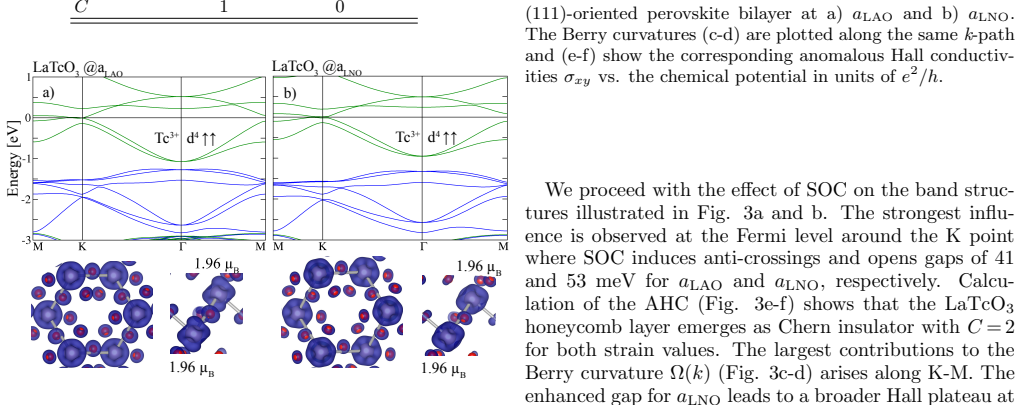
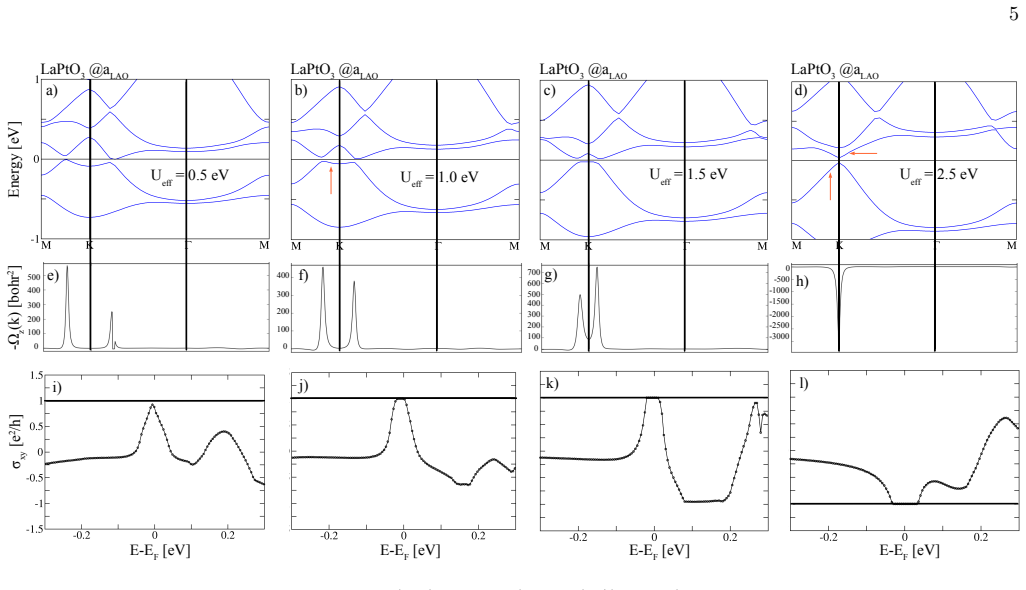
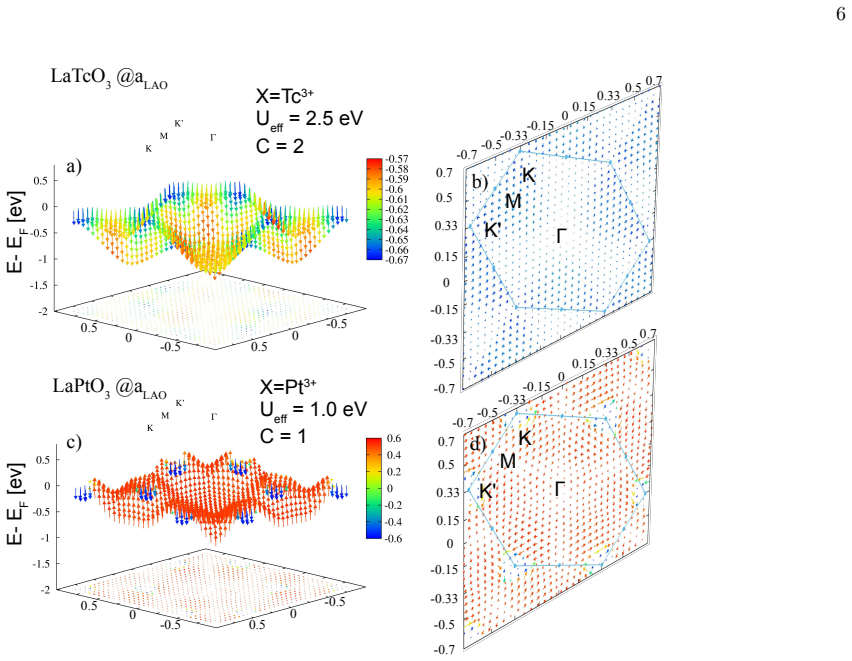
The central discovery is that the buckled honeycomb arrangement of corner-sharing XO6 octahedra in (LaXO3)2/(LaAlO3)4(111) supports two classes of topological insulating states. For X = Tc and Pt, spin-orbit coupling opens band gaps of 41 and 38 meV in the metastable ferromagnetic phase, and Berry curvature calculations give Chern numbers C = 2 and C = 1; the associated anomalous Hall conductivity is quantized in units of $e^{2}$/h and edge-state calculations show one (Pt) or two (Tc) chiral edge modes. For X = Mo and W in nonmagnetic phases, the systems are Z2 topological insulators with nontrivial Z2 = 1 and helical edge states, with gaps of 26 and 60 meV. The paper also shows that tensile strain stabilizes the Tc Chern phase, while for Pd and Pt strain instead triggers a site disproportionation that turns the systems into trivial Mott insulators. For Pt, the Chern number depends sensitively on the Hubbard U parameter, changing sign from +1 to -1 when U_eff exceeds 2.0 eV.
Load-bearing premise
The load-bearing premise is that the effective Hubbard U chosen for the 5d electrons is realistic; the Pt Chern phase exists only for U_eff between 1 and 2 eV, and the Chern number reverses sign for larger values, while no independent calibration of U for this superlattice is provided.
Editorial extensions
If this is right
- If synthesized in the predicted ferromagnetic state, (LaTcO3)2/(LaAlO3)4(111) would show a quantized anomalous Hall conductance of 2e^2/h with two chiral edge channels.
- A ferromagnetic (LaPtO3)2/(LaAlO3)4(111) film with U_eff in the 1-2 eV range would show a quantized Hall conductance of e^2/h with a single chiral edge mode.
- Nonmagnetic (LaMoO3)2/(LaAlO3)4(111) and (LaWO3)2/(LaAlO3)4(111) would be Z2 topological insulators, exhibiting helical edge states with gaps of 26 and 60 meV.
- Tensile strain is a control knob for the Tc Chern phase, strengthening its gap, but destroys the Pd/Pt Chern phases by inducing site disproportionation.
- The predicted phases extend topological-insulator physics from s/p electron systems to correlated 4d/5d oxide heterostructures, where narrow d-bands offer larger gaps.
Reading between the lines
- An implicit consequence is that the Pt system may be a correlation-tuned topological switch: if U_eff can be varied experimentally, for example by strain or chemical pressure, the Chern number could flip between +1 and -1, changing the direction of the chiral edge current.
- The sign reversal of the Tc Chern number between perovskite and corundum structures suggests that the connectivity of the octahedral network controls the band topology, so comparing other d-electron counts across these two honeycomb oxide families could map out which are topological.
- A testable extension would be to engineer the metastable ferromagnetic state through epitaxial strain or doping rather than relying on the antiferromagnetic ground state, since the paper identifies the ferromagnetic phase as the one hosting the Chern gap.
- The antiferromagnetic ground states themselves might host different, possibly axion-like, topological phases, but the paper does not address this.
Signed reviews
Editorial analysis
A structured set of objections, weighed in public.
Referee Report
Summary. The manuscript uses GGA+U+SOC density functional theory to study (LaXO3)2/(LaAlO3)4(111) superlattices for X = Tc, Pd, Pt, Mo, and W. It reports that metastable ferromagnetic phases of LaTcO3 and LaPtO3 emerge as Chern insulators with C = 2 and C = 1, with band gaps of 41 and 38 meV at the LaAlO3 lattice constant, supported by Berry curvature, anomalous Hall conductivity, and edge-state calculations. It also reports that tensile strain induces site disproportionation and trivial insulating behavior for Pd and Pt, and that nonmagnetic Mo and W phases are Z2 topological insulators with gaps of 26 and 60 meV, supported by Wannier charge center evolution and edge states.
Significance. If the predictions hold, the work extends oxide-heterostructure topology into 4d/5d perovskite-derived honeycomb bilayers and proposes concrete platforms for quantized anomalous Hall and quantum spin Hall responses. A clear strength is the internal consistency of the topological calculations: Chern numbers obtained from Berry curvature and anomalous Hall conductivity agree with the number of chiral edge states, and the Z2 index for Mo is computed via Wilson loops. The explicit study of the Hubbard-U dependence is also valuable, since it identifies the parameter sensitivity rather than hiding it. The main limitation is that the strongest new prediction, the Pt C = 1 phase, is confined to an uncalibrated Hubbard-U window, so the practical significance is conditional on the realism of that parameter range.
major comments (2)
- [III C and Fig. 5] The central C = 1 Chern-insulator claim for (LaPtO3)2/(LaAlO3)4(111) depends on a narrow, uncalibrated Hubbard-U window: the quantized plateau is absent at Ueff = 0.5 eV and the Chern number reverses to C = -1 at Ueff >= 2.5 eV. The only stated justification for excluding the latter regime is the sentence "for 5d systems U values beyond 2.0 eV appear to be too high to describe correctly the electronic properties." This is an assertion rather than a calibration. Because the topological invariant itself changes sign across a shift of only about 0.5 eV, I ask the authors to provide an independent estimate of Ueff for Pt in this environment (for example, constrained RPA or comparison with photoemission spectra of related 5d oxides) or to present the C = 1 result as explicitly conditional on the chosen parameter window.
- [III E and Table II] The Z2 topological-insulator prediction for Mo and W is made for nonmagnetic configurations that are higher in energy than the AFM ground state by 2.0 eV and 0.4 eV per u.c., respectively. The manuscript does not discuss how these nonmagnetic states might be stabilized, nor whether the AFM ground states are themselves topologically nontrivial. This is directly relevant to the realizability of the predicted quantum spin Hall effect and should be addressed explicitly, for example by identifying possible strain, doping, or substrate conditions that could favor the nonmagnetic state, or by softening the claim to a conditional metastable-phase prediction.
minor comments (4)
- [III C] The text states that the C = 1 phase exists for "1.0 < Ueff < 2.0 eV," but Fig. 5 shows that Ueff = 1.0 eV is already Chern insulating; please make the interval notation consistent, e.g., 1.0 <= Ueff <= 2.0 eV.
- [II and III C] The methods paragraph gives U = 1-2 eV for Pt and W, while the Pt sweep in Fig. 5 extends to Ueff = 2.5 eV; please clarify how U and J are combined and which Ueff values correspond to the results in Tables I and II.
- [III E and Fig. 10] The Wilson-loop Wannier charge center data in Fig. 10 are shown for X = Mo only, yet Table II lists Z2 = 1 for W as well; please show the corresponding WCC or parity calculation for W, or state explicitly that the same method was used.
- [III B] In Table I, the FM-AFM energy difference for Tc at aLNO is listed as a dash, although the text says the CI phase is further stabilized under tensile strain; please clarify whether the dash means the AFM state was not computed and whether the statement refers to gap magnitude or magnetic-state energetics.
Circularity Check
No significant circularity: the Chern/Z2 invariants are computed outputs of the DFT+U Hamiltonian, not inputs or fitted targets.
full rationale
The paper's central predictions are the Chern numbers C=2 and C=1 for ferromagnetic Tc and Pt honeycomb bilayers and Z2=1 for nonmagnetic Mo and W. These are obtained by constructing maximally localized Wannier functions from the converged GGA+U+SOC Hamiltonian and computing Berry curvature, anomalous Hall conductivity, Wannier charge centers, and edge states. No equation in the paper defines the topological invariant in terms of a fitted parameter, and no parameter is fitted so as to force a particular Chern number. The Hubbard U dependence is reported explicitly: for Pt the C=1 phase occurs only for 1.0<Ueff<2.0 eV, with sign reversal at Ueff>=2.5 eV, and the authors state their physical judgment that U beyond 2.0 eV is too high for 5d systems. That is a parameter-sensitivity caveat, not a circular reduction; the claim is conditional on the chosen U window and is openly presented as such. Self-citations to the authors' prior corundum work [24,27-29] are used for motivation, comparison, and methodological continuity, but the perovskite-derived calculations are carried out independently and even show differences from the corundum case (e.g., sign reversal of C for Tc). No uniqueness theorem or ansatz is imported from prior self-cited work to force the present conclusion. The metastable ferromagnetic nature of the Tc/Pt Chern-insulating solutions is also disclosed rather than hidden. Thus the derivation chain is self-contained with respect to the claimed invariants, and the reported fragility under U is a robustness concern, not circularity.
Assumptions & free parameters
free parameters (2)
- Effective Hubbard U (Ueff = U - J) for 4d/5d cations =
2.5 eV for Tc/Pd/Mo; Pt scanned 0.5-2.5 eV, C=1 phase at 1.0-2.0 eV; W at 1.0 eV; J=0.5 eV
- U = 8 eV for empty La 4f states =
8 eV
assumptions (4)
- domain assumption The chosen GGA+U functional with the listed U and J values correctly describes correlated 4d/5d electrons and spin-orbit coupling in these oxides.
- domain assumption The metastable ferromagnetic states of LaTcO3 and LaPtO3 are well-defined and relevant despite being 1.0 and 1.1 eV per cell above the antiferromagnetic ground states.
- domain assumption Time-reversal and inversion symmetries are present in the nonmagnetic phases of Mo and W, validating the Fu-Kane parity and Wilson loop Z2 calculations.
- standard math Wannier interpolation and the iterative Green's function edge-state method faithfully represent the DFT band topology.
Cite this review
Pith. "Pith review of Chern and $Z_{2}$ topological insulating phases in perovskite-derived $4d$ and $5d$ oxide buckled honeycomb lattices." pith.science (2026). https://pith.science/paper/LIB537JG
@misc{pith2026190802835,
  author       = {Pith},
  title        = {Pith review of: Chern and $Z_2$ topological insulating phases in perovskite-derived $4d$ and $5d$ oxide buckled honeycomb lattices},
  year         = {2026},
  howpublished = {\url{https://pith.science/paper/LIB537JG}},
  note         = {Machine review of arXiv:1908.02835}
}
abstract
Based on density functional theory calculations including a Coulomb repulsion parameter $U$, we explore the topological properties of (La$X$O$_3$)$_2$/(LaAlO$_3$)$_4$(111) with $X=$ $4d$ and $5d$ cations. The metastable ferromagnetic phases of LaTcO$_3$ and LaPtO$_3$ preserve P321 symmetry and emerge as Chern insulators (CI) with $C$=2 and 1 and band gaps of 41 and 38 meV at the lateral lattice constant of LaAlO$_3$, respectively. Berry curvatures, spin textures as well as edge states provide additional insight into the nature of the CI states. While for $X$=Tc the CI phase is further stabilized under tensile strain, for $X$=Pd and Pt a site disproportionation takes place when increasing the lateral lattice constant from $a_{\rm LAO}$ to $a_{\rm LNO}$. The CI phase of $X$=Pt shows a strong dependence on the Hubbard $U$ parameter with sign reversal for higher values associated with the change of band gap opening mechanism. Parallels to the previously studied ($X_2$O$_3$)$_1$/(Al$_2$O$_3$)$_5$(0001) honeycomb corundum layers are discussed. Additionally, non-magnetic systems with $X$=Mo and W are identified as potential candidates for $Z_2$ topological insulators at $a_{\rm LAO}$ with band gaps of 26 and 60 meV, respectively. The computed edge states and $Z_{2}$ invariants underpin the non-trivial topological properties.
Figures


Figures from the paper (7 more)




Reference graph
Works this paper leans on
-
[1]
Furthermore, we explore the effect of strain on the stability of the CI state, as well as the dependence on the Coulomb repulsion parameter U and compare to the corundum-type systems. Last but not least, we con- centrate on TI cases where time reversal and inversion symmetry are preserved and identify the non-magnetic phases of X = Mo, W in (LaXO3)2/(LaAlO...
work page 2000
-
[2]
H. Weng, R. Yu, X. Hu, X. Dai and Z. Fang, Adv. Phys. 64, 227 (2015)
work page 2015
-
[3]
Y. Ren, Z. Qiao, and Q. Niu, Rep. Prog. Phys.79, 066501 (2016)
work page 2016
-
[4]
D. J. Thouless, M. Kohmoto, M. P. Nightingale, and M. den Nijs, Phys. Rev. Lett. 49, 405 (1982)
1982
-
[5]
C. L. Kane and E. J. Mele, Phys. Rev. Lett. 95, 226801 (2005)
2005
-
[6]
B. A. Bernevig and S. C. Zhang, Phys. Rev. Lett. 96, 106802 (2006)
work page 2006
-
[7]
B. A. Bernevig, T. L. Hughes, and S. C. Zhang, Science 314, 5806 (2006)
work page 2006
-
[8]
M. K¨ onig, S. Wiedmann, C. Br¨ une, A. Roth, H. Buh- mann, L. W. Molenkamp, X. L. Qi, and S. C. Zhang, Science 318, 5851 (2007)
work page 2007
Show all 63 references
-
[9]
F. D . M. Haldane, Phys. Rev. Lett. 61, 2015 (1988)
1988
-
[10]
Liu, X.-L
C.-X. Liu, X.-L. Qi, X. Dai, Z. Fang and S.-C. Zhang, Phys. Rev. Lett. 101, 146802 (2008)
2008
-
[11]
R. Yu, W. Zhang, H.-J. Zhang, S.-C. Zhang, X. Dai and Z. Fang, Science 329, 61 (2010)
2010
-
[12]
C. Fang, M. J. Gilbert and B. A. Bernevig, Phys. Rev. Lett. 112, 046801 (2014)
2014
-
[13]
Zhang, C
H. Zhang, C. Lazo, S. Bl¨ ugel, S. Heinze and Y. Mokrousov, Phys. Rev. Lett. 108, 056802 (2012)
2012
-
[14]
M. Zhou, Z. Liu, W. Ming, Z. Wang and F. Liu, Phys. Rev. Lett. 113, 236802 (2014)
2014
-
[15]
Xian-Lei Sheng and B. K. Nikolic, Phys. Rev. B 95, 201402(R) (2017)
2017
-
[16]
Zhang, J
H. Zhang, J. Wang, G. Xu, Y. Xu and S.-C. Zhang, Phys. Rev. Lett. 112, 096804 (2014)
2014
-
[17]
K. F. Garrity and D. Vanderbilt, Phys. Rev. B 90, 121103(R) (2014)
2014
-
[18]
Huang, Z
H. Huang, Z. Liu, H. Zhang, W. Duan and D. Vanderbilt, Phys. Rev. B 92, 161115(R) (2015)
2015
-
[19]
T. Cai, X. Li, F. Wang, S. Ju, J. Feng and C.-D. Gong, Nano Lett. 15, 6434 (2015)
2015
-
[20]
J. L. Lado, D. Guterding, P. Barone, R. Valenti, and V. Pardo, Phys. Rev. B 94, 235111 (2016)
2016
-
[21]
Fiete and A
G.A. Fiete and A. R¨ uegg, J. Appl. Phys. 117, 172602 (2015)
2015
-
[22]
D. Xiao, W. Zhu, Y. Ran, N. Nagaosa and S. Okamoto, Nature Commun. 2, 596 (2011)
2011
-
[23]
J. L. Lado, V. Pardo, and D. Baldomir, Phys. Rev. B 88, 155119 (2013)
2013
-
[24]
Okamoto, W
S. Okamoto, W. Zhu, Y. Nomura, R. Arita, D. Xiao, and N. Nagaosa, Phys. Rev. B. 89, 195121 (2014)
2014
-
[25]
Doennig, S
D. Doennig, S. Baidya, W. E. Pickett and R. Pentcheva, Phys. Rev. B. 93, 165145 (2016)
2016
-
[26]
Wrobel, B
F. Wrobel, B. Geisler, Y. Wang, G. Christiani, G. Logvenov, M. Bluschke, E. Schierle, P. A. van Aken, B. Keimer, R. Pentcheva, and E. Benckiser, Phys. Rev. Ma- terials 2, 035001 (2018)
2018
-
[27]
A. D. Caviglia, R. Scherwitzl, P. Popovich, W. Hu, H. Bromberger, R. Singla, M. Mitrano, M. C. Hoffmann, S. Kaiser, P. Zubko, S. Gariglio, J.-M. Triscone, M. F¨ orst and A. Cavalleri, Phys. Rev. Lett. 108, 136801 (2012)
2012
-
[28]
H. Guo, S. Gangopadhyay, O. K¨ oksal, R. Pentcheva and W. E. Pickett, npj Quantum Materials 2, 4 (2017)
2017
-
[29]
K¨ oksal, S
O. K¨ oksal, S. Baidya, and R. Pentcheva, Phys. Rev. B 97, 035126 (2018)
2018
-
[30]
K¨ oksal and R
O. K¨ oksal and R. Pentcheva, J. Phys. Chem. Solids, cor- rected Proof, https://doi.org/10.1016/j.jpcs.2018.01.049 (2018)
2018 doi
-
[31]
Kresse and D
G. Kresse and D. Joubert, Phys. Rev. B. 59, 1758 (1999)
1999
-
[32]
Kresse and J
G. Kresse and J. Furthm¨ uller, Phys. Rev. B 54, 11169 (1996). 9
1996
-
[33]
J. P. Perdew, K. Burke, and M. Ernzerhof, Phys. Rev. Lett. 77, 3865 (1996)
1996
-
[34]
S. L. Dudarev, G. A. Botton, S. Y. Savrasov, C. J. Humphreys and A. P. Sutton, Phys. Rev. B 57, 1505 (1998)
1998
-
[35]
A. A. Mostofi, J. R. Yates, Y.-S. Lee, I. Souza, D. Van- derbilt and N. Marzari, Comput. Phys. Commun. 178, 685 (2008)
2008
-
[36]
Avdeev, G
M. Avdeev, G. J. Thorogood, M. L. Carter, B. J. Kennedy, J. Ting, D. J. Singh, and K. S. Wallwork, J. Am. Chem. Soc. 133 (6), pp 16541657 (2011)
2011
-
[37]
E. E. Rodriguez, F. Poineau, A. Llobet, B. J. Kennedy, M. Avdeev, G. J. Thorogood, M. L. Carter, R. Seshadri, D. J. Singh, and A. K. Cheetham, Phys. Rev. Lett. 106, 067201 (2011)
2011
-
[38]
Franchini, T
C. Franchini, T. Archer, Jiangjang He, Xing-Qiu Chen, A. Filipetti, and S. Sanvito, Phys. Rev. B 83, 220402(R) (2011)
2011
-
[39]
Mravlje, M
J. Mravlje, M. Aichhorn, and A. Georges, Phys. Rev. Lett. 108, 197202 (2012)
2012
-
[40]
Borisov, S
V. Borisov, S. Ostanin, and I. Mertig, Phys. Chem. Chem. Phys. 17, 12812 (2015)
2015
-
[41]
H. Park, A. J. Millis, and C. A. Marianetti Phys. Rev. Lett. 109, 156402 (2012)
2012
-
[42]
Johnston, A
S. Johnston, A. Mukherjee, I. Elfimov, M. Berciu, and G. A. Sawatzky, Phys. Rev. Lett. 112, 106404 (2014)
2014
-
[43]
A. V. Boris et al., Science 332, 937 (2011)
2011
-
[44]
J. W. Freeland, J. Liu, M. Kareev, B. Gray, J. W. Kim, P. Ryan, R. Pentcheva, and J. Chakhalian, Europhys. Lett. 96, 57004 (2011)
2011
-
[45]
Blanca-Romero and R
A. Blanca-Romero and R. Pentcheva, Phys. Rev. B 84, 195450 (2011)
2011
-
[46]
Geisler, R
B. Geisler, R. Pentcheva, Phys. Rev. Materials 2, 055403 (2018)
2018
-
[47]
R¨ uegg and G
A. R¨ uegg and G. A. Fiete, Phys. Rev. B 84, 201103 (2011)
2011
-
[48]
K.-Y. Yang, W. Zhu, D. Xiao, S. Okamoto, Z. Wang, and Y. Ran, Phys. Rev. B 84, 201104(R) (2011)
2011
-
[49]
Doennig, W
D. Doennig, W. E. Pickett and R. Pentcheva, Phys. Rev. B 89, 121110 (2014)
2014
-
[50]
S. J. Kim, S. Lemaux, G. Demazeau, J. Y. Kim, and J. H. Choy, J. Am. Chem. Soc. 123, 10413 (2001)
2001
-
[51]
S. J. Kim, S. Lemaux, G. Demazeau, J. Y. Kim, and J. H. Choy, J. Mater. Chem 12, 995 (2002)
2002
-
[52]
Q. Wu, S. Zhang, H. Song, M. Troyer and A. A. Soluyanov, Comput. Phys. Commun. 224, 405 (2018)
2018
-
[53]
Wolfram, S
T. Wolfram, S. Ellialtioglu, Cambridge University Press, Cambridge (2006)
2006
-
[54]
Michalsky, A
R. Michalsky, A. Steinfeld, Catalysis Today 286, 124-130 (2017)
2017
-
[55]
Fu and C
L. Fu and C. L. Kane, Phys. Rev. B 76, 045302 (2007)
2007
-
[56]
M. P. L. Sancho, J. M. L. Sancho and J. Rubio, J. Phys. F 14, 1205-1215 (1984)
1984
-
[57]
M. P. L. Sancho, J. M. L. Sancho and J. Rubio, J. Phys. F 15, 851-858 (1985)
1985
-
[58]
Wilson, Phys
K. Wilson, Phys. Rev. D 10, 2445-2459 (1974)
1974
-
[59]
R. Yu, X. L. Qi, A. Bernevig, Z. Fang, and X. Dai, Phys. Rev. B 84, 75119 (2011)
2011
-
[60]
Middey, D
S. Middey, D. Meyers, M. Kareev, E. J. Moon, B. A. Gray, X. Liu, J. W. Freeland, and J. Chakhalian , Appl. Phys. Lett. 101, 261602 (2012)
2012
-
[61]
Gibert, P
M. Gibert, P. Zubko, R. Scherwitzl, and J.-M. Triscone, Nat. Mater. 11, 195 (2012)
2012
-
[62]
Middey, D
S. Middey, D. Meyers, D. Doennig, M. Kareev, X. Liu, Y. Cao, Z. Yang, J. Shi, L. Gu, P. J. Ryan, R. Pentcheva, J. W. Freeland, and J. Chakhalian , Phys. Rev. Lett. 116, 056801 (2016)
2016
-
[63]
Hepting, R
M. Hepting, R. J. Green, Z. Zhong, M. Bluschke, Y. E. Suyolcu, S. Macke, A. Frano, S. Catalano, M. Gibert, R. Sutarto, F. He, G. Cristiani, G. Logvenov, Y. Wang, P. A. van Aken, P. Hansmann, M. Le Tacon, J.-M. Triscone, G. A. Sawatzky, B. Keimer and E. Benckiser, Nature Physic...
2018
Reviewed August 14, 2026 · model on record in the stance chip above.
Discussion (0). Continue with ORCID to comment.