Lagrangian Submanifolds with Legendrian Boundary in the Unit Ball
Pith reviewed 2026-06-25 22:35 UTC · model grok-4.3
The pith
Any compact exact Lagrangian self-similar submanifold with connected Legendrian boundary in the unit ball must be an equatorial n-disk.
A machine-rendered reading of the paper's core claim, the machinery that carries it, and where it could break.
Core claim
Any compact exact Lagrangian self-similar submanifold with connected Legendrian boundary in the unit ball must be an equatorial n-disk. The same conclusion holds without the exactness assumption provided the cosine of the contact angle has constant sign; this covers in particular the case of Legendrian free boundary. The proof employs the Liouville form and boundary unique continuation for differential forms.
What carries the argument
The Liouville form on the ball combined with boundary unique continuation applied to differential forms, which forces the submanifold to be flat under the self-similarity and boundary conditions.
If this is right
- The result includes minimal Lagrangian submanifolds as the special case where the self-similar factor vanishes.
- Prior two-dimensional minimal rigidity theorems now hold in all dimensions.
- The Legendrian boundary condition alone is sufficient for rigidity, without requiring an additional capillary condition.
- Non-disk Lagrangian self-similar submanifolds with Legendrian boundary exist only if the boundary fails to be connected or if the sign condition on the contact angle is violated.
Where Pith is reading between the lines
- The unique continuation technique on the Liouville form may extend to rigidity questions for Lagrangians in other Kähler manifolds with boundary.
- One could investigate whether the connectedness assumption on the boundary can be relaxed while preserving the conclusion.
- The examples constructed with capillary boundary suggest that capillary conditions allow more flexibility than pure Legendrian ones.
- Similar rigidity might hold for other geometric flows or solitons in symplectic geometry.
Load-bearing premise
The Legendrian boundary must be connected and the submanifold must satisfy either exactness or a fixed sign condition on the cosine of the contact angle.
What would settle it
The existence of a compact exact Lagrangian self-similar submanifold in the unit ball, with connected Legendrian boundary, that is not an equatorial disk would disprove the main theorem.
Figures
read the original abstract
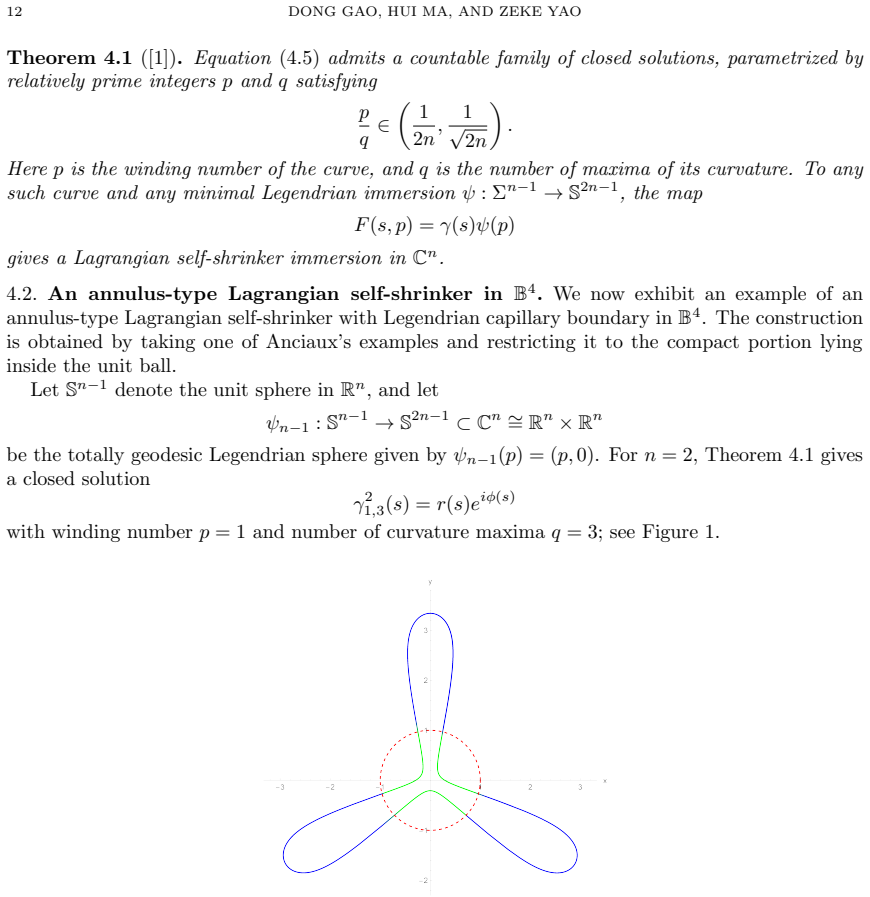
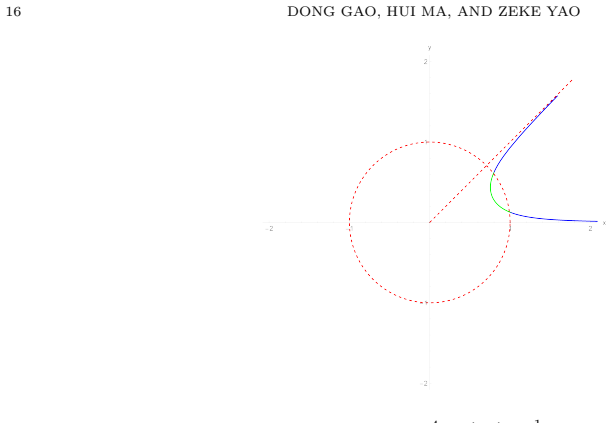
We study compact Lagrangian submanifolds in the unit ball $\mathbb B^{2n}\subset\mathbb C^n$ with Legendrian boundary. We prove that any compact exact Lagrangian self-similar submanifold with connected Legendrian boundary must be an equatorial $n$-disk. The same rigidity holds, without exactness, for Legendrian boundary under a fixed sign assumption on the cosine of the contact angle; in particular, it holds for Legendrian free boundary. These results extend the two dimensional minimal rigidity theorems of Li-Wang-Weng and Luo-Sun to higher dimensions and to the Lagrangian self-similar setting, which includes the minimal case. Notably, the Legendrian capillary condition in Li-Wang-Weng's theorem is weakened to the Legendrian boundary condition. Our proof uses the Liouville form and boundary unique continuation for differential forms, rather than holomorphic differential techniques. Finally, we construct non-disk-type Lagrangian self-similar examples with Legendrian capillary boundary.
Editorial analysis
A structured set of objections, weighed in public.
Referee Report
Summary. The paper proves a rigidity result stating that any compact exact Lagrangian self-similar submanifold with connected Legendrian boundary in the unit ball B^{2n} ⊂ C^n must be an equatorial n-disk. The same conclusion holds without the exactness assumption provided there is a fixed sign condition on the cosine of the contact angle (including the free boundary case). The argument relies on the Liouville form together with boundary unique continuation for differential forms, presented as an alternative to holomorphic differential methods. The results extend 2D minimal rigidity theorems to higher dimensions and the self-similar setting. The manuscript also constructs non-disk Lagrangian self-similar examples with Legendrian capillary boundary.
Significance. If the central claims hold, the work supplies a new technical route to rigidity statements in Lagrangian geometry that avoids holomorphic differentials and applies directly to self-similar submanifolds. The explicit weakening of the capillary condition to a plain Legendrian boundary, together with the counterexamples for the capillary case, sharpens the understanding of which boundary conditions force rigidity. The method is described as using standard tools (Liouville form and unique continuation), which, if correctly implemented, would constitute a clean contribution.
minor comments (2)
- [Abstract] Abstract: the statements of the two main theorems are clear, but the abstract does not indicate the range of dimensions n for which the results hold or whether n=1 is included; adding this would improve precision.
- [Abstract] Abstract: references to the 2D theorems of Li-Wang-Weng and Luo-Sun are given by name only; full bibliographic details should appear at first mention in the introduction.
Simulated Author's Rebuttal
We thank the referee for their report and for recognizing the potential significance of our alternative approach to rigidity results via the Liouville form and boundary unique continuation. The referee's recommendation is listed as uncertain, but no specific major comments or technical objections were provided in the report. We therefore offer a brief overall response below and note that we are happy to address any further points the referee may wish to raise.
Circularity Check
No significant circularity; derivation self-contained
full rationale
The paper proves a rigidity result for compact exact Lagrangian self-similar submanifolds with connected Legendrian boundary using the Liouville form and boundary unique continuation for differential forms. This is an independent analytic argument extending prior 2D results (Li-Wang-Weng, Luo-Sun) via a different method, without fitted parameters, self-definitional reductions, or load-bearing self-citations. Assumptions (exactness or fixed-sign contact angle, connected boundary) are stated explicitly and the counterexamples for the capillary case are constructed separately. No step reduces to its inputs by construction.
Axiom & Free-Parameter Ledger
axioms (2)
- standard math Standard properties of the Liouville form on the unit ball and its restriction to Lagrangian submanifolds
- standard math Boundary unique continuation for differential forms
Reference graph
Works this paper leans on
-
[1]
Anciaux, Construction of Lagrangian self-similar solutions to the mean curvature flow inC n,Geom
H. Anciaux, Construction of Lagrangian self-similar solutions to the mean curvature flow inC n,Geom. Dedicata 120(2006), 37–48
2006
-
[2]
Cappell, D
S. Cappell, D. DeTurck, H. Gluck and E. Y. Miller, Cohomology of harmonic forms on Riemannian manifolds with boundary,Forum Math.18(2006), no. 6, 923–931
2006
-
[3]
Castro and A
I. Castro and A. M. Lerma, The Clifford torus as a self-shrinker for the Lagrangian mean curvature flow,Int. Math. Res. Not. IMRN2014(2014), 1515–1527
2014
-
[4]
Castro and F
I. Castro and F. Urbano, On a minimal Lagrangian submanifold ofC n foliated by spheres,Michigan Math. J. 46(1999), 71–82
1999
-
[5]
A. Chau, J. Chen and Y. Yuan, Rigidity of entire self-shrinking solutions to curvature flows,J. Reine Angew. Math.664(2012), 229–239
2012
-
[6]
Cheng, H
Q.-M. Cheng, H. Hori and G. Wei, Complete Lagrangian self-shrinkers inR 4,Math. Z.301(2022), 3417–3468
2022
-
[7]
Ding and Y
Q. Ding and Y. L. Xin, The rigidity theorems for Lagrangian self-shrinkers,J. Reine Angew. Math.692(2014), 109–123. LAGRANGIAN SUBMANIFOLDS WITH LEGENDRIAN BOUNDARY 19
2014
-
[8]
Fraser and R
A. Fraser and R. Schoen, Uniqueness theorems for free boundary minimal disks in space forms,Int. Math. Res. Not. IMRN2015(2015), 8268–8274
2015
-
[9]
Gerner, A unique continuation theorem for exterior differential forms on Riemannian manifolds with bound- ary,Differential Geom
W. Gerner, A unique continuation theorem for exterior differential forms on Riemannian manifolds with bound- ary,Differential Geom. Appl.103(2026), Paper No. 102358
2026
-
[10]
Harvey and H
R. Harvey and H. B. Lawson, Jr., Calibrated geometries,Acta Math.148(1982), 47–157
1982
-
[11]
Joyce, Y.-I
D. Joyce, Y.-I. Lee and M.-P. Tsui, Self-similar solutions and translating solitons for Lagrangian mean curvature flow,J. Differential Geom.84(2010), 127–161
2010
-
[12]
Lee and M.-T
Y.-I. Lee and M.-T. Wang, Hamiltonian stationary shrinkers and expanders for Lagrangian mean curvature flows,J. Differential Geom.83(2009), 27–42
2009
-
[13]
Lee and M.-T
Y.-I. Lee and M.-T. Wang, Hamiltonian stationary cones and self-similar solutions in higher dimension,Trans. Amer. Math. Soc.362(2010), 1491–1503
2010
-
[14]
Li and X
H. Li and X. Wang, New characterizations of the Clifford torus as a Lagrangian self-shrinker,J. Geom. Anal. 27(2017), 1393–1412
2017
-
[15]
M. M. C. Li, Free boundary minimal surfaces in the unit ball: recent advances and open questions, inProceedings of the International Consortium of Chinese Mathematicians 2017, Int. Press, Boston, MA, 2020, pp. 401–435
2017
-
[16]
M. Li, G. Wang and L. Weng, Lagrangian surfaces with Legendrian boundary,Sci. China Math.64(2021), 1589–1598
2021
-
[17]
Z. Li, R. Wang and G. Wei, The rigidity theorem for complete Lagrangian self-shrinkers,J. Geom. Anal.35 (2025), Paper No. 69
2025
-
[18]
J. D. Lotay and A. Neves, Uniqueness of Lagrangian self-expanders,Geom. Topol.17(2013), no. 5, 2689–2729
2013
-
[19]
Luo and L
Y. Luo and L. Sun, Rigidity theorems for minimal Lagrangian surfaces with Legendrian capillary boundary, Adv. Math.393(2021), Paper No. 108124
2021
-
[20]
Neves, Recent progress on singularities of Lagrangian mean curvature flow, inSurveys in Geometric Analysis and Relativity, Adv
A. Neves, Recent progress on singularities of Lagrangian mean curvature flow, inSurveys in Geometric Analysis and Relativity, Adv. Lect. Math. (ALM), vol. 20, Int. Press, Somerville, MA, 2011, pp. 413–438
2011
-
[21]
J. C. C. Nitsche, Stationary partitioning of convex bodies,Arch. Ration. Mech. Anal.89(1985), 1–19
1985
-
[22]
Ros and F
A. Ros and F. Urbano, Lagrangian submanifolds ofC n with conformal Maslov form and the Whitney sphere, J. Math. Soc. Japan50(1998), 203–226
1998
-
[23]
Schoen and J
R. Schoen and J. Wolfson, Minimizing area among Lagrangian surfaces: the mapping problem,J. Differential Geom.58(2001), 1–86. D. Gao, School of Science, Beijing University of Civil Engineering and Architecture, Beijing 102616, P.R. China Email address:gaodong@bucea.edu.cn H. Ma, Department of Mathematical Sciences, Tsinghua University, Beijing, 100084, P....
2001
discussion (0)
Sign in with ORCID, Apple, or X to comment. Anyone can read and Pith papers without signing in.