REVIEW 4 major objections 5 minor 8 references
Mediation Analysis for Sparse and Irregularly Spaced Longitudinal Outcomes with Application to the MrOS Sleep Study
T0 review · 4 major / 5 minor · reviewed 2026-08-07 · deepseek-v4-flash
Pith's one-line read A permutation test plus a three-component mixture FDR controls mediation discoveries in sparse longitudinal outcomes and identifies five lipid mediators linking sleep-wake timing to cognitive decline.
desk verdict Genuinely new combination of high-dimensional mediation with sparse irregular longitudinal outcomes, but the FDR control claim is unverified and the permutation test targets a different null. read the letter →
The pith
A machine-rendered reading of the paper's core claim, the machinery that carries it, and where it could break.
The reading
What carries the argument
The load-bearing object is the three-component mixture FDR estimator for the overall mediation p-value. Each mediator's overall p-value is $P_k = \max(P_{\alpha_k}, P_{\beta_k(t)})$, so under the composite null ($\alpha_k = 0$ or $\beta_k(t) = 0$) it falls into one of three components; the FDR numerator is $\hat{\pi}_{01}\lambda + \hat{\pi}_{10}\lambda + \hat{\pi}_{00}\lambda^2$, and the threshold is the largest $\lambda$ with estimated FDR below the target. The other half of the machinery is the permutation test for $\beta_k(t)$: the outcome is projected onto a B-spline basis, the model is fit by weighted least squares with an estimated within-subject correlation matrix, and the mediator's importance is scored by the F-statistic comparing weighted residual sums of squares with and without the mediator. This test is what supplies a valid $P_{\beta_k(t)}$ under sparse and irregular sampling, and the mixture formula is what converts 476 candidate p-values into a controlled discovery set.
What would settle it
Simulate null data with no true mediation but with shared subject-level random effects that couple the mediator and outcome equations, so $P_{\alpha_k}$ and $P_{\beta_k(t)}$ are dependent, and run the proposed permutation and mixture-FDR procedure with growing $p$; if the empirical FDR exceeds the target level as $p$ grows, the independence assumption behind Theorem 1 is violated.
Extended reading notes
Core claim
On its own terms, the paper's central discovery is that high-dimensional mediation testing can be made to work when the outcome is a sparse, irregularly sampled longitudinal process. For each candidate mediator $k$, the exposure-to-mediator effect $\alpha_k$ is tested by ordinary least squares, and the mediator-to-outcome time-varying effect $\beta_k(t)$ is tested by permuting the mediator values and comparing weighted residual sums of squares from a B-spline expansion of the marginal model; the overall mediation p-value is $P_k = \max(P_{\alpha_k}, P_{\beta_k(t)})$. Under the null, $P_k$ is modeled as a three-component mixture, and the estimated FDR at threshold $\lambda$ is $(\hat{\pi}_{01}\lambda + \hat{\pi}_{10}\lambda + \hat{\pi}_{00}\lambda^2) / (\max\{1, R(\lambda)\}/p)$. Theorem 1 states that, for a correctly specified time-varying model with asymptotically independent $P_{\alpha_k}$ and $P_{\beta_k(t)}$, sufficiently many permutations, and $p$ growing at most polynomially in the number of basis functions, the estimated FDR controls the target level asymptotically: $\limsup_{p\to\infty} \widehat{\mathrm{FDR}}(\lambda) \le b$. Applied at FDR 0.05 to 476 lipid mediators in 490 older men, the procedure consistently selects five metabolites—3-hydroxymyristate, 3-hydroxylaurate, tetradecadienoate (14:2), dodecadienoate (12:2), and 3-hydroxyoctanoyl-carnitine—as mediators linking acrophase (the time of daily peak activity) to cognitive decline, while the pointwise function-on-scalar regression comparator identifies none.
Load-bearing premise
The FDR guarantee rests on the assumption that, for each mediator, the p-value for the exposure-to-mediator effect and the p-value for the time-varying mediator-to-outcome effect are asymptotically independent; the paper states this in Theorem 1 but gives no proof or sensitivity analysis for it.
Editorial extensions
If this is right
- If the FDR control holds, the same spline-plus-permutation pipeline can be used for any scalar exposure, high-dimensional mediator panel, and sparse longitudinal outcome, not just cognition and lipids.
- The MrOS finding implies that fatty-acid and acylcarnitine metabolism deserves closer study as a pathway from rest-activity rhythm disruption to cognitive decline in older men.
- The permutation test for time-varying coefficients is itself portable and can be used to test functional predictors in longitudinal regression outside the mediation setting.
- Because the five mediators are selected consistently across all four user-specified correlation structures at FDR 0.05, the authors show the discovery does not depend on the chosen covariance model, although the larger set at FDR 0.10 does vary with it.
Reading between the lines
- One testable extension is to check robustness of the MrOS list to the stated independence assumption: generate null data with shared subject-level random effects that induce dependence between $\hat{\alpha}_k$ and the permutation statistic for $\beta_k(t)$, and compare the empirical FDR with the nominal level.
- The procedure could be adapted to other actigraphy summary measures, such as amplitude or relative amplitude, since the mediation model itself is exposure-agnostic.
- If the five lipids replicate in an independent cohort, the estimated time-varying indirect effects shown in the paper could be used to identify the follow-up window in which the lipid pathway matters most for cognitive decline.
Signed reviews
Editorial analysis
A structured set of objections, weighed in public.
Referee Report
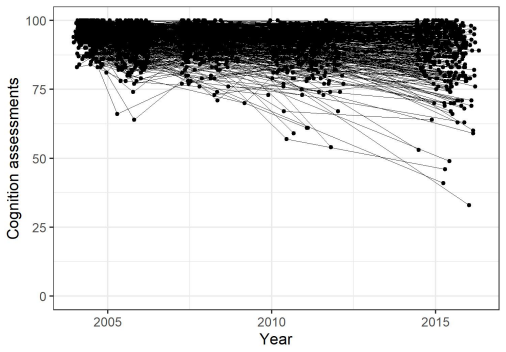
Summary. The manuscript proposes a mediation analysis method for scalar exposures, high-dimensional mediators, and sparse, irregularly spaced longitudinal outcomes. The exposure-to-mediator effects are tested with OLS p-values, and the mediator-to-outcome time-varying effects are tested with a permutation test applied to a marginal functional regression model. The two p-values are combined through the HDMT JS-mixture procedure, with a theorem claiming asymptotic control of the estimated FDR. The method is evaluated in simulations under four correlation structures and three sampling designs, and applied to the MrOS Sleep Study to identify lipid metabolites mediating the association between acrophase and cognitive decline, with five metabolites consistently selected.
Significance. If the central FDR-control claim is valid, the paper would fill a genuine gap: high-dimensional mediation analysis with functional or longitudinal outcomes that are measured sparsely and irregularly. The application to a real cohort with 476 lipid metabolites is timely and substantively interesting, and the idea of combining a permutation test with the HDMT mixture FDR is a sensible starting point. The paper also gives explicit credit to existing work on functional regression and high-dimensional mediation. However, the central theoretical guarantee is currently unverified: the theorem relies on an unproved independence assumption and on a supplement that is not available, and the simulation study does not report empirical FDR. These issues are load-bearing for the paper's main claim.
major comments (4)
- [Section 4.1, Eq. (5) vs. Eq. (2)] The permutation p-value P_βk(t) is computed from the marginal model (5), which omits all other mediators, whereas the null H0 in Eq. (4) is stated in terms of β_k(t) from the full model (2). When mediators are correlated—as in the simulation's Σ_ϵ = 0.1^{|k1−k2|} and in the MrOS lipid panel—the marginal coefficient β_k^*(t) can be nonzero even when the full-model β_k(t) is zero. The paper provides no theorem showing that marginal and full-model coefficients coincide, nor any simulation demonstrating FDR control under this mismatch. This is a direct threat to the validity of the screening procedure for the stated mediation null.
- [Theorem 1, Section 4.1] Theorem 1 assumes that P_αk and P_βk(t) are asymptotically independent for each k, but this assumption is asserted without proof, reference, or sensitivity analysis. The proof is said to be in Section S1 of a supplementary file that is not available to the reader. Moreover, the theorem only bounds the estimated quantity FDR-hat(λ), not the true FDR, so even if the theorem is correct it does not establish control of the actual false discovery rate. The authors should either provide the proof and a justification of independence, or add simulation evidence on empirical FDR under correlated mediators.
- [Section 5.3–5.4] No simulation result reports an empirical FDR or false-positive count for the proposed screening procedure. Section 5.4 reports screening frequencies for the true mediators only, and Section 5.3 reports power for one mediator. Without a direct report of FDR or type I error, the paper's central claim of false discovery control is not supported by the numerical study. I request an explicit FDR table or figure under the null and under the full simulation design.
- [Section 5.5 and Table 1] The mediation effect estimation is evaluated only under oracle knowledge of the true mediators: the text states that 'the first p0 = 4 mediators were correctly identified in each simulation replicate.' This does not reflect the actual pipeline, where screening errors propagate into the estimation of direct and indirect effects. Furthermore, within each case in Table 1, the reported bias and standard deviation are identical across Scenarios 1, 2, and 3, which is surprising given that the sampling design changes the number of repeated measurements per subject; this needs clarification or correction.
minor comments (5)
- [Section 2] The phrase '5 consequtive 24-hour periods' contains a typo; it should be 'consecutive.'
- [Section 4.1, Eq. (4)] The definition of the overall p-value P_k = max(P_αk, P_βk(t)) should be reconciled with the three-component mixture decomposition; the authors should state explicitly how the mixture proportions are identifiable under the asymptotic independence assumption.
- [Section 4.1] The notation is inconsistent: the text uses bλb for the threshold and then writes FDR-hat(λ); please define all symbols clearly and use a uniform notation for the estimated FDR and the threshold.
- [Section 4.1] The condition that 'p is bounded by a polynomial function of L_n' in Theorem 1 is vague; since the theorem takes p → ∞, the relationship between p and L_n should be specified.
- [Section 4.1] The proof of Theorem 1 is deferred to a supplementary file that is not included with the arXiv version; for a journal submission, the supplement should be made available to reviewers.
Circularity Check
No significant circularity: the estimation, testing, and application chain is self-contained, and the only self-citations are contextual.
full rationale
The paper's derivation is a standard chain: structural equations (1) and (2) define the mediation parameters; these are estimated by OLS/WLS; P_alpha_k is a Wald-type p-value from equation (1), and P_beta_k(t) is a permutation p-value from the marginal time-varying model (5). The overall p-value P_k = max(P_alpha_k, P_beta_k(t)) is then fed into the external JS-mixture FDR procedure of Dai et al. (2022), not into a procedure invented to reproduce the paper's own conclusions. Theorem 1 claims asymptotic FDR control under explicit conditions (correctly specified model, asymptotic independence of the two component p-values, assumptions S1.1-S1.8), so the claim is conditional on stated assumptions rather than being true by construction. Whether those assumptions hold, and whether the marginal model (5) tests the same null as the full model (2), are statistical validity questions, not circularity: the test statistic would remain meaningful even if the FDR bound is not proven. Simulation studies generate data from known alpha_k and beta_k(t), so screening frequencies and estimation errors are evaluated against ground truth rather than against the fitting procedure's own targets. The MrOS application applies the fitted threshold to identify mediators; the five selected lipids are not quantities defined by the procedure itself. Self-citations (Xiao et al. 2022; Wang and Huang 2024) are contextual and not load-bearing for the FDR claim or for the MrOS conclusion. The proof of Theorem 1 is deferred to the supplementary file, but omission of a proof is not circularity. No equation in the paper is shown to reduce to its own inputs by construction, and no fitted parameter is renamed as a prediction.
Assumptions & free parameters
free parameters (3)
- Number of B-spline basis functions L_n =
Chosen by 10-fold CV over 1-8 interior knots, yielding L_n in {5,...,12}
- Within-subject correlation structure R_i(rho) =
One of Diagonal, AR(1), Uniform, or Power, depending on method variant
- Correlation parameter rho =
Estimated from residuals (Section S2)
assumptions (5)
- domain assumption Assumptions 3.1-3.4: no unmeasured confounding between exposure and mediator, exposure and outcome, mediator and outcome, and no exposure-induced confounding
- domain assumption Structural models (1) and (2) are correctly specified, including linear mediator models and the time-varying coefficient outcome model
- domain assumption The outcome process Y_i(t) is smooth and admits a truncated Karhunen-Loeve expansion with L_n basis functions
- ad hoc to paper P_alpha_k and P_beta_k(t) are asymptotically independent for each mediator k
- standard math Regularity conditions S1.1-S1.8 in the supplementary file
Cite this review
Pith. "Pith review of Mediation Analysis for Sparse and Irregularly Spaced Longitudinal Outcomes with Application to the MrOS Sleep Study." pith.science (2026). https://pith.science/paper/LIQZHLTI
@misc{pith2026250607953,
  author       = {Pith},
  title        = {Pith review of: Mediation Analysis for Sparse and Irregularly Spaced Longitudinal Outcomes with Application to the MrOS Sleep Study},
  year         = {2026},
  howpublished = {\url{https://pith.science/paper/LIQZHLTI}},
  note         = {Machine review of arXiv:2506.07953}
}
read the original abstract
Mediation analysis has become a widely used method for identifying the pathways through which an independent variable influences a dependent variable via intermediate mediators. However, limited research addresses the case where mediators are high-dimensional and the outcome is represented by sparse, irregularly spaced longitudinal data. To address these challenges, we propose a mediation analysis approach for scalar exposures, high-dimensional mediators, and sparse longitudinal outcomes. This approach effectively identifies significant mediators by addressing two key issues: (i) the underlying correlation structure within the sparse and irregular cognitive measurements, and (ii) adjusting mediation effects to handle the high-dimensional set of candidate mediators. In the MrOS Sleep study, our primary objective is to explore lipid pathways that may mediate the relationship between rest-activity rhythms and longitudinal cognitive decline in older men. Our findings suggest a potential mechanism involving rest-activity rhythms, lipid metabolites, and cognitive decline, and highlight significant mediators identified through multiple testing procedures.
Figures


Figures from the paper (3 more)


Reference graph
Works this paper leans on
-
[1]
Alecu, I. and Bennett, S. A. (2019), ‘Dysregulated lipid metabolism and its role inα- synucleinopathy in parkinson’s disease’,Frontiers in Neuroscience13,
work page 2019
-
[3]
Perera, C., Zhang, H., Zheng, Y., Hou, L., Qu, A., Zheng, C., Xie, K. and Liu, L. (2022), ‘Hima2: high-dimensional mediation analysis and its application in epigenome-wide dna methylation data’,BMC Bioinformatics23(1),
work page 2022
-
[39]
Functional Mediation Analysis with an Application to Functional Magnetic Resonance Imaging Data
Zhao, Y., Luo, X., Lindquist, M. and Caffo, B. (2018), ‘Functional mediation analysis with an application to functional magnetic resonance imaging data’,arXiv preprint arXiv:1805.06923. Zhao, Z., Chen, C., Adhikari, B. M., Hong, L. E., Kochunov, P. and Chen, S. (2023), ‘Mediation analysis for high-dimensional mediators and outcomes with an application to ...
work page Pith review arXiv 2018
-
[54]
Xu, Y. and Zhao, Y. (2025), ‘Mediation analysis with graph mediator’,Biostatistics 26(1), kxaf004. Zeng, S., Rosenbaum, S., Archie, E., Alberts, S. and Li, F. (2021), ‘Causal mediation analysis for sparse and irregular longitudinal data’,The Annals of Applied Statistics 15(2), 747–767. Zhang, H., Zheng, Y., Hou, L., Zheng, C. and Liu, L. (2021), ‘Mediatio...
work page 2025
-
[212]
Zhao, Y. (2024), ‘Mediation analysis with multiple exposures and multiple mediators’, Statistics in Medicine43(25), 4887–4898. Zhao, Y., Li, L. and Initiative, A. D. N. (2022), ‘Multimodal data integration via media- tion analysis with high-dimensional exposures and mediators’,Human Brain Mapping 43(8), 2519–2533. Zhao, Y., Lindquist, M. A. and Caffo, B. ...
work page 2024
-
[296]
Reiss, P. T., Huang, L. and Mennes, M. (2010), ‘Fast function-on-scalar regression with penalized basis expansions’,International Journal of Biostatistics6(1). 21 Reiss, P. T., Mennes, M., Petkova, E., Huang, L., Hoptman, M. J., Biswal, B. B., Colcombe, S. J., Zuo, X.-N. and Milham, M. P. (2011), ‘Extracting information from functional connectivity maps v...
work page 2010
-
[328]
Baron, R. M. and Kenny, D. A. (1986), ‘The moderator–mediator variable distinction in social psychological research: Conceptual, strategic, and statistical considerations’, Journal of Personality and Social Psychology51(6), 1173–1182. Bind, M.-A., Vanderweele, T., Coull, B. and Schwartz, J. (2016), ‘Causal mediation analysis for longitudinal data with exo...
work page 1986
-
[596]
20 Coffman, D. L., Dziak, J. J., Litson, K., Chakraborti, Y., Piper, M. E. and Li, R. (2023), ‘A causal approach to functional mediation analysis with application to a smoking cessation intervention’,Multivariate Behavioral Research58(5), 859–876. Dai, J. Y., Stanford, J. L. and LeBlanc, M. (2022), ‘A multiple-testing procedure for high-dimensional mediat...
work page 2023
Reviewed August 7, 2026 · model on record in the stance chip above.
Discussion (0). Continue with ORCID to comment.