REVIEW 4 major objections 5 minor 41 references
Pureformer-VC: Non-parallel Voice Conversion with Pure Stylized Transformer Blocks and Triplet Discriminative Training
T0 review · 4 major / 5 minor · reviewed 2026-08-07 · deepseek-v4-flash
Pith's one-line read Pureformer-VC claims a pure transformer encoder-decoder converts any utterance to any target timbre in one shot, without parallel data.
desk verdict A new architecture combination undermined by a training objective that never asks the decoder to produce the target timbre, plus mechanical errors in the loss equations; worth a serious referee, not acceptance as-is. read the letter →
The pith
A machine-rendered reading of the paper's core claim, the machinery that carries it, and where it could break.
The reading
What carries the argument
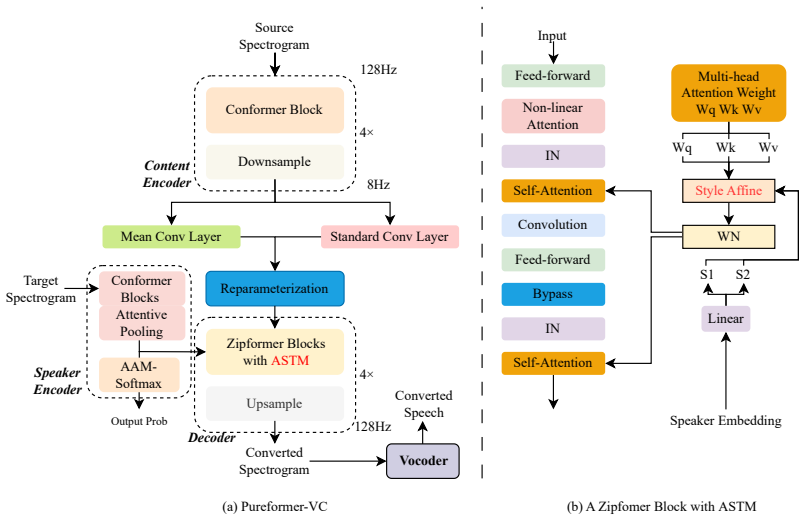
The central mechanism is the Attention Style Transfer Mechanism (ASTM) transplanted from Styleformer into Zipformer self-attention: target speaker embeddings are split and applied as affine modulations to the attention weight matrices (Wq, Wk, Wv, Wu), followed by weight normalization, so that style enters where content is mixed. Around that sit three supporting pieces: the VAE reparameterization in the content encoder to model content as a distribution, the triplet loss that pulls same-speaker embeddings together and pushes different-speaker embeddings apart with a margin, and the AAM-Softmax loss that sharpens speaker boundaries. Together these are meant to force the encoder to keep content and discard timbre, while the decoder re-injects timbre from the conditioning embedding.
What would settle it
Take a trained Pureformer-VC and convert an utterance twice, once with the true target embedding and once with a randomly permuted or zeroed embedding; if the two output spectrograms are nearly identical and the output speaker-verification similarity tracks the source rather than the target, the decoder is not using the conditioning and the disentanglement claim collapses. Equivalently, measure VSS of converted speech against target and source: if VSS(target) minus VSS(source) is not clearly positive, the style transfer mechanism is not doing the work.
Extended reading notes
Core claim
Pureformer-VC claims that a pure transformer encoder-decoder with variational decoupled training can perform high-quality one-shot, many-to-many voice conversion without parallel data. The content encoder uses Conformer blocks with instance normalization and average pooling to produce a VAE-style latent content representation; the decoder uses Zipformer blocks whose self-attention weights are modulated by target speaker embeddings through the Attention Style Transfer Mechanism; and the speaker encoder is trained with AAM-Softmax and triplet losses so that timbre embeddings become compact and separable. The reported result is that this combination outperforms earlier disentanglement-based VC models such as AdaIN-VC, AutoVC, VQMIVC, and MAIN-VC on mel-cepstral distortion, MOS, and voice similarity, while remaining slightly behind the strongest retrieval- and language-model-based systems RVC and GPT-SoVITS.
Load-bearing premise
The model assumes that reconstructing the anchor spectrogram while conditioning the decoder on embeddings from different speakers teaches the decoder to rely on the supplied timbre rather than to copy the source voice; if the reconstruction loss lets the decoder ignore the conditioning, the claimed style transfer fails.
Editorial extensions
If this is right
- On VCTK and AISHELL-3, Pureformer-VC beats the four classic encoder-decoder baselines on MCD, MOS, and VSS in both many-to-many and one-shot settings.
- Removing either the triplet loss or the AAM-Softmax loss lowers voice-similarity and fake-detection scores, indicating both losses contribute to timbre fidelity.
- The model performs cross-lingual conversion when trained on mixed English and Mandarin data, with lower scores than monolingual conversion, pointing to language-specific latent variables as a next step.
- A pure transformer backbone without the usual CNN-based style transfer modules is sufficient for non-parallel voice conversion.
Reading between the lines
- A stronger test of disentanglement would measure whether the converted speech's speaker embedding tracks the conditioning target embedding; if it tracks the source instead, the reported similarity gains do not come from the intended mechanism.
- The AAM-Softmax loss could make speaker embeddings too tightly clustered, potentially discarding fine-grained timbre; a softer conditional objective might preserve more voice detail.
- The same ASTM block could be tested for zero-shot transfer of other styles beyond timbre, such as emotion or prosody, since it modulates attention weights rather than just feature statistics.
- Combining this disentangled architecture with flow-matching or discrete speech units could be a direct route to closing the remaining gap to RVC and GPT-SoVITS without abandoning the design.
Editorial analysis
A structured set of objections, weighed in public.
Referee Report
Summary. The paper proposes Pureformer-VC, a non-parallel voice conversion system combining a Conformer-based content encoder, a Zipformer-based decoder with an Attention Style Transfer Mechanism (ASTM), and a speaker encoder trained with AAM-softmax and triplet losses. The model is trained with a VAE-style objective that reconstructs an anchor spectrogram from content and a second speaker embedding. Experiments on VCTK and AISHELL-3 compare many-to-many and one-shot conversion against six baselines, reporting MOS, VSS, and MCD, with ablations of the two discriminative losses.
Significance. If the architecture and objectives performed as claimed, the combination of Conformer and Zipformer blocks with ASTM and triplet discriminative training could be a useful empirical contribution to non-parallel voice conversion. Strengths of the submission include evaluation on two multi-speaker corpora, comparison against six baselines including recent systems, explicit ablation studies, t-SNE visualizations, and a public repository link. However, the central claims are not supported by the evidence as presented: the training objective contains apparent formula errors, the loss does not supervise target-timbre synthesis, and the headline comparison tables contradict the abstract's claim of significantly enhanced objective metrics.
major comments (4)
- [Section IV.C, Tables I and II] Tables I and II show that Pureformer-VC is worse than RVC and GPT-SoVITS on every reported metric in both datasets and both settings (for example, on VCTK many-to-many, MCD is 4.95 versus 4.75 and 4.70, MOS is 3.64 versus 3.70 and 3.70, and VSS is 3.56 versus 3.72 and 3.68). This directly contradicts the abstract's statement that the method achieves 'significantly enhancing objective metrics compared to existing approaches.' Section IV.C characterizes a 'slight performance gap,' but that caveat is absent from the abstract. The comparative claim must be revised or the experiments redone.
- [Section III.B, Eq. (6)] The KL-divergence term is written as 0.5 E[r_c + r_m^2 - log(r_m^2) - 1]. With the reparameterization r_c = r_m + e*r_s in Eq. (3), the correct KL term for a Gaussian posterior against a standard normal prior is 0.5 E[r_s^2 + r_m^2 - log(r_s^2) - 1]. As written, the objective uses the sampled latent r_c instead of the variance r_s^2 and takes the logarithm of the mean rather than the variance; therefore the model is not actually trained as a VAE in the stated sense.
- [Section III.E, Eq. (13)] Minimizing L_tri = E[nm(e_anc)*nm(e_pos)^t] - E[nm(e_anc)*nm(e_neg)^t] + delta encourages the anchor-positive cosine similarity to decrease and the anchor-negative similarity to increase under the standard convention that higher cosine similarity means greater similarity. This is the opposite of the intended triplet objective described in the text and is inconsistent with the claimed discriminative benefit of the loss. The sign or the definition of the similarity measure must be corrected and the experiments re-run.
- [Section III.F, Eq. (16) and Figure 2] The VAE loss reconstructs x_anc from y1 = G(x_anc, x_neg) and y2 = G(x_anc, x_pos); both terms penalize deviation from the anchor spectrogram. Since x_pos shares the anchor speaker, neither term requires the decoder to synthesize the non-anchor speaker's timbre. A decoder that ignores the supplied style embedding can minimize this objective by copying the anchor, and the VSS evaluation in Section IV.B measures similarity to the target speaker only, not to the source speaker. The paper should add a source-similarity measurement or otherwise demonstrate that the reported VSS gains arise from genuine style transfer rather than from anchor reconstruction.
minor comments (5)
- [Section III.C, Eq. (11)] The attention output uses wn(w_k)x' for both the key and value terms; given the earlier definition of w_v, the value term should likely be wn(w_v)x'. Please correct the typo or clarify the notation.
- [Section III.B and III.E] The notation r_s is described as a variance in the text but appears as a standard deviation in the reparameterization r_c = r_m + e*r_s. Please define r_s consistently and use r_s^2 in the KL term.
- [Section IV.A] The data-sampling description says one utterance is selected from one speaker and two utterances from another speaker, while Section III.E states that anchor and positive share the same timbre and only negative differs. These statements are inconsistent and should be reconciled.
- [Section IV.B] The MOS evaluation is based on only 10 source/target pairs and 5 participants, and no significance testing is reported; please provide additional details or temper the 'comparable subjective scores' claim.
- [Section IV.B] The text attributes VSS to Resemblyzer, but reference [41] is an ECAPA-TDNN paper; please cite the actual Resemblyzer implementation or clarify the relationship.
Circularity Check
No significant circularity: Pureformer-VC is an empirical systems paper whose claims are evaluated against external baselines and external metrics.
full rationale
Pureformer-VC is an empirical systems paper, not a derivation. Its central components—Conformer/Zipformer encoder-decoder, ASTM, triplet loss, and AAM-softmax loss—are architectural and loss-function choices evaluated against external baselines (AdaIN-VC, AutoVC, VQMIVC, MAIN-VC, RVC, GPT-SoVITS) with external metrics (human MOS, Resemblyzer VSS, MCD). No equation in the paper defines a predicted quantity in terms of fitted parameters such that the result is forced by construction. The VAE loss (Eqs. 4-6, 16) is a reconstruction objective, and reconstruction-based training is standard in AutoVC-style models; whether it fully enforces timbre transfer is a correctness or robustness concern, not a circularity. The triplet loss (Eq. 13) as written appears to have an inverted margin, and the abstract's 'significantly enhancing' claim is not fully supported by Tables I-II—these are substantive weaknesses, but they are not self-referential derivation steps. The only author-overlapping citation is ref. [32], which is used as related work on style transfer modules; the ASTM mechanism itself is cited to external prior work [33], and the reported results do not reduce to that citation. The HiFi-GAN vocoder pretraining on the same datasets could affect absolute quality, but it is external to the conversion mapping and does not force the reported comparative scores. Therefore no prediction reduces to its inputs by definition, and the circularity score is 0.
Assumptions & free parameters
free parameters (5)
- lambda_1 =
10
- lambda_2 =
range 1e-4 to 1
- lambda_3 =
1
- lambda_4 =
1
- delta =
0.3
assumptions (4)
- domain assumption Instance normalization in the content encoder removes speaker-specific information from the content representation.
- domain assumption The pre-trained HiFi-GAN vocoder can synthesize natural speech from the decoder's mel-spectrograms for any speaker in the training distribution.
- standard math The VAE reparameterization with a standard normal prior is a valid regularizer for learning a speaker-invariant content latent.
- domain assumption AAM-Softmax and triplet losses on the speaker encoder improve timbre discrimination without harming content disentanglement.
Cite this review
Pith. "Pith review of Pureformer-VC: Non-parallel Voice Conversion with Pure Stylized Transformer Blocks and Triplet Discriminative Training." pith.science (2026). https://pith.science/paper/LIRHM4KP
@misc{pith2026250608348,
  author       = {Pith},
  title        = {Pith review of: Pureformer-VC: Non-parallel Voice Conversion with Pure Stylized Transformer Blocks and Triplet Discriminative Training},
  year         = {2026},
  howpublished = {\url{https://pith.science/paper/LIRHM4KP}},
  note         = {Machine review of arXiv:2506.08348}
}
read the original abstract
As a foundational technology for intelligent human-computer interaction, voice conversion (VC) seeks to transform speech from any source timbre into any target timbre. Traditional voice conversion methods based on Generative Adversarial Networks (GANs) encounter significant challenges in precisely encoding diverse speech elements and effectively synthesising these elements into natural-sounding converted speech. To overcome these limitations, we introduce Pureformer-VC, an encoder-decoder framework that utilizes Conformer blocks to build a disentangled encoder and employs Zipformer blocks to create a style transfer decoder. We adopt a variational decoupled training approach to isolate speech components using a Variational Autoencoder (VAE), complemented by triplet discriminative training to enhance the speaker's discriminative capabilities. Furthermore, we incorporate the Attention Style Transfer Mechanism (ASTM) with Zipformer's shared weights to improve the style transfer performance in the decoder. We conducted experiments on two multi-speaker datasets. The experimental results demonstrate that the proposed model achieves comparable subjective evaluation scores while significantly enhancing objective metrics compared to existing approaches in many-to-many and many-to-one VC scenarios.
Figures


Reference graph
Works this paper leans on
-
[1]
V oice conversion based on maximum-likelihood estimation of spectral parameter trajectory,
T. Toda, A. W. Black, and K. Tokuda, “V oice conversion based on maximum-likelihood estimation of spectral parameter trajectory,”IEEE Transactions on Audio, Speech, and Language Processing, vol. 15, no. 8, pp. 2222–2235, 2007
work page 2007
-
[2]
V oice conver- sion using partial least squares regression,
E. Helander, T. Virtanen, J. Nurminen, and M. Gabbouj, “V oice conver- sion using partial least squares regression,”IEEE Transactions on Audio, Speech, and Language Processing, vol. 18, no. 5, pp. 912–921, 2010
work page 2010
-
[3]
One-shot voice conversion by vector quan- tization,
D.-Y . Wu and H.-y. Lee, “One-shot voice conversion by vector quan- tization,” inICASSP 2020-2020 IEEE International Conference on Acoustics, Speech and Signal Processing (ICASSP). IEEE, 2020, pp. 7734–7738
work page 2020
-
[4]
V oice conversion based on weighted frequency warping,
D. Erro, A. Moreno, and A. Bonafonte, “V oice conversion based on weighted frequency warping,”IEEE Transactions on Audio, Speech, and Language Processing, vol. 18, no. 5, pp. 922–931, 2009
work page 2009
-
[5]
Exemplar-based emotional voice conversion using non-negative matrix factorization,
R. Aihara, R. Ueda, T. Takiguchi, and Y . Ariki, “Exemplar-based emotional voice conversion using non-negative matrix factorization,” inSignal and Information Processing Association Annual Summit and Conference (APSIPA), 2014 Asia-Pacific. IEEE, 2014, pp. 1–7
work page 2014
-
[6]
CycleGAN-VC3: Examining and Improving CycleGAN-VCs for Mel-spectrogram Conversion
T. Kaneko, H. Kameoka, K. Tanaka, and N. Hojo, “Cyclegan-vc3: Ex- amining and improving cyclegan-vcs for mel-spectrogram conversion,” arXiv preprint arXiv:2010.11672, 2020
work page Pith review arXiv 2010
-
[7]
Maskcyclegan-vc: Learning non-parallel voice conversion with filling in frames,
——, “Maskcyclegan-vc: Learning non-parallel voice conversion with filling in frames,” inICASSP 2021-2021 IEEE International Conference on Acoustics, Speech and Signal Processing (ICASSP). IEEE, 2021, pp. 5919–5923
work page 2021
-
[8]
Stargan-vc: Non- parallel many-to-many voice conversion using star generative adversarial networks,
H. Kameoka, T. Kaneko, K. Tanaka, and N. Hojo, “Stargan-vc: Non- parallel many-to-many voice conversion using star generative adversarial networks,” in2018 IEEE Spoken Language Technology Workshop (SLT). IEEE, 2018, pp. 266–273
work page 2018
Show all 41 references
-
[9]
Stargan-vc2: Rethinking conditional methods for stargan-based voice conversion,
T. Kaneko, H. Kameoka, K. Tanaka, and N. Hojo, “Stargan-vc2: Rethinking conditional methods for stargan-based voice conversion,” arXiv preprint arXiv:1907.12279, 2019
1907 arXiv
-
[10]
Starganv2-vc: A diverse, unsuper- vised, non-parallel framework for natural-sounding voice conversion,
Y . A. Li, A. Zare, and N. Mesgarani, “Starganv2-vc: A diverse, unsuper- vised, non-parallel framework for natural-sounding voice conversion,” arXiv preprint arXiv:2107.10394, 2021
2021 arXiv
-
[11]
Towards low-resource stargan voice conversion using weight adaptive instance normalization,
M. Chen, Y . Shi, and T. Hain, “Towards low-resource stargan voice conversion using weight adaptive instance normalization,” inICASSP 2021-2021 IEEE International Conference on Acoustics, Speech and Signal Processing (ICASSP). IEEE, 2021, pp. 5949–5953
2021
-
[12]
Arbitrary style transfer in real-time with adaptive instance normalization,
X. Huang and S. Belongie, “Arbitrary style transfer in real-time with adaptive instance normalization,” inProceedings of the IEEE interna- tional conference on computer vision, 2017, pp. 1501–1510
2017
-
[13]
Analyzing and improving the image quality of stylegan,
T. Karras, S. Laine, M. Aittala, J. Hellsten, J. Lehtinen, and T. Aila, “Analyzing and improving the image quality of stylegan,” inProceedings of the IEEE/CVF conference on computer vision and pattern recognition, 2020, pp. 8110–8119
2020
-
[14]
A comparison of discrete and soft speech units for improved voice conversion,
B. Van Niekerk, M.-A. Carbonneau, J. Za ¨ıdi, M. Baas, H. Seut ´e, and H. Kamper, “A comparison of discrete and soft speech units for improved voice conversion,” inICASSP 2022-2022 IEEE International Conference on Acoustics, Speech and Signal Processing (ICASSP). IEEE, 2022, p...
2022
-
[15]
Yourtts: Towards zero-shot multi-speaker tts and zero-shot voice conversion for everyone,
E. Casanova, J. Weber, C. D. Shulby, A. C. Junior, E. G ¨olge, and M. A. Ponti, “Yourtts: Towards zero-shot multi-speaker tts and zero-shot voice conversion for everyone,” inInternational conference on machine learning. PMLR, 2022, pp. 2709–2720
2022
-
[16]
V oice conversion with just nearest neighbors,
M. Baas, B. van Niekerk, and H. Kamper, “V oice conversion with just nearest neighbors,”arXiv preprint arXiv:2305.18975, 2023
2023 arXiv
-
[17]
Unsupervised speech decomposition via triple information bottleneck,
K. Qian, Y . Zhang, S. Chang, M. Hasegawa-Johnson, and D. Cox, “Unsupervised speech decomposition via triple information bottleneck,” inInternational Conference on Machine Learning. PMLR, 2020, pp. 7836–7846
2020
-
[18]
Speech- split2. 0: Unsupervised speech disentanglement for voice conversion without tuning autoencoder bottlenecks,
C. H. Chan, K. Qian, Y . Zhang, and M. Hasegawa-Johnson, “Speech- split2. 0: Unsupervised speech disentanglement for voice conversion without tuning autoencoder bottlenecks,” inICASSP 2022-2022 IEEE International Conference on Acoustics, Speech and Signal Processing (ICASSP). ...
2022
-
[19]
One-shot voice conversion by separating speaker and content representations with instance normaliza- tion,
J.-c. Chou, C.-c. Yeh, and H.-y. Lee, “One-shot voice conversion by separating speaker and content representations with instance normaliza- tion,”arXiv preprint arXiv:1904.05742, 2019
1904 arXiv
-
[20]
Autovc: Zero-shot voice style transfer with only autoencoder loss,
K. Qian, Y . Zhang, S. Chang, X. Yang, and M. Hasegawa-Johnson, “Autovc: Zero-shot voice style transfer with only autoencoder loss,” in International Conference on Machine Learning. PMLR, 2019, pp. 5210–5219
2019
-
[21]
Conformer: Convolution-augmented transformer for speech recognition,
A. Gulati, J. Qin, C.-C. Chiu, N. Parmar, Y . Zhang, J. Yu, W. Han, S. Wang, Z. Zhang, Y . Wuet al., “Conformer: Convolution-augmented transformer for speech recognition,”arXiv preprint arXiv:2005.08100, 2020
2005 arXiv
-
[22]
Paraformer: Fast and accurate parallel transformer for non-autoregressive end-to-end speech recognition,
Z. Gao, S. Zhang, I. McLoughlin, and Z. Yan, “Paraformer: Fast and accurate parallel transformer for non-autoregressive end-to-end speech recognition,”arXiv preprint arXiv:2206.08317, 2022
2022 arXiv
-
[23]
Zipformer: A faster and better encoder for automatic speech recognition,
Z. Yao, L. Guo, X. Yang, W. Kang, F. Kuang, Y . Yang, Z. Jin, L. Lin, and D. Povey, “Zipformer: A faster and better encoder for automatic speech recognition,”arXiv preprint arXiv:2310.11230, 2023
2023 arXiv
-
[24]
Paraformer-v2: An improved non- autoregressive transformer for noise-robust speech recognition,
K. An, Z. Li, Z. Gao, and S. Zhang, “Paraformer-v2: An improved non- autoregressive transformer for noise-robust speech recognition,”arXiv preprint arXiv:2409.17746, 2024
2024 arXiv
-
[25]
Mfa-conformer: Multi-scale feature aggregation conformer for automatic speaker verification,
Y . Zhang, Z. Lv, H. Wu, S. Zhang, P. Hu, Z. Wu, H.-y. Lee, and H. Meng, “Mfa-conformer: Multi-scale feature aggregation conformer for automatic speaker verification,”arXiv preprint arXiv:2203.15249, 2022
2022 arXiv
-
[26]
Mfa: Tdnn with multi- scale frequency-channel attention for text-independent speaker verifi- cation with short utterances,
T. Liu, R. K. Das, K. A. Lee, and H. Li, “Mfa: Tdnn with multi- scale frequency-channel attention for text-independent speaker verifi- cation with short utterances,” inICASSP 2022-2022 IEEE international conference on acoustics, speech and signal processing (ICASSP). IEEE, 202...
2022
-
[27]
Se-conformer: Time-domain speech enhancement using conformer
E. Kim and H. Seo, “Se-conformer: Time-domain speech enhancement using conformer.” inInterspeech, 2021, pp. 2736–2740
2021
-
[28]
Cmgan: Conformer-based metric- gan for monaural speech enhancement,
S. Abdulatif, R. Cao, and B. Yang, “Cmgan: Conformer-based metric- gan for monaural speech enhancement,”IEEE/ACM Transactions on Audio, Speech, and Language Processing, 2024
2024
-
[29]
In defense of the triplet loss for person re-identification,
A. Hermans, L. Beyer, and B. Leibe, “In defense of the triplet loss for person re-identification,”arXiv preprint arXiv:1703.07737, 2017
2017 arXiv
-
[30]
Main-vc: Lightweight speech representation disentanglement for one-shot voice conversion,
P. Li, J. Wang, X. Zhang, Y . Zhang, J. Xiao, and N. Cheng, “Main-vc: Lightweight speech representation disentanglement for one-shot voice conversion,”arXiv preprint arXiv:2405.00930, 2024
2024 arXiv
-
[31]
knn-svc: Robust zero- shot singing voice conversion with additive synthesis and concatenation smoothness optimization,
K. Shao, K. Chen, M. Baas, and S. Dubnov, “knn-svc: Robust zero- shot singing voice conversion with additive synthesis and concatenation smoothness optimization,” inICASSP 2025-2025 IEEE International Conference on Acoustics, Speech and Signal Processing (ICASSP). IEEE, 2025, pp. 1–5
2025
-
[32]
A new spoken language teaching tech: Combining multi-attention and adain for one-shot cross language voice conversion,
D. Ke, W. Yao, R. Hu, L. Huang, Q. Luo, and W. Shu, “A new spoken language teaching tech: Combining multi-attention and adain for one-shot cross language voice conversion,” in2022 13th International Symposium on Chinese Spoken Language Processing (ISCSLP). IEEE, 2022, pp. 101–104
2022
-
[33]
Styleformer: Real-time arbitrary style transfer via parametric style composition,
X. Wu, Z. Hu, L. Sheng, and D. Xu, “Styleformer: Real-time arbitrary style transfer via parametric style composition,” inProceedings of the IEEE/CVF International Conference on Computer Vision, 2021, pp. 14 618–14 627
2021
-
[34]
Hifi-gan: Generative adversarial networks for efficient and high fidelity speech synthesis,
J. Kong, J. Kim, and J. Bae, “Hifi-gan: Generative adversarial networks for efficient and high fidelity speech synthesis,”Advances in neural information processing systems, vol. 33, pp. 17 022–17 033, 2020
2020
-
[35]
A batch normalized inference network keeps the kl vanishing away,
Q. Zhu, J. Su, W. Bi, X. Liu, X. Ma, X. Li, and D. Wu, “A batch normalized inference network keeps the kl vanishing away,”arXiv preprint arXiv:2004.12585, 2020
2004 arXiv
-
[36]
Weight normalization: A simple repa- rameterization to accelerate training of deep neural networks,
T. Salimans and D. P. Kingma, “Weight normalization: A simple repa- rameterization to accelerate training of deep neural networks,”Advances in neural information processing systems, vol. 29, 2016
2016
-
[37]
Vctk corpus: English multi- speaker corpus for cstr voice cloning,
C. Veaux, J. Yamagishi, and S. King, “Vctk corpus: English multi- speaker corpus for cstr voice cloning,”arXiv preprint arXiv:2012.11929 [cs.Speech], 2020
2012 arXiv
-
[38]
Aishell-3: A multi-speaker mandarin tts corpus and the baselines,
Y . Shi, H. Bu, X. Xu, S. Zhang, and M. Li, “Aishell-3: A multi-speaker mandarin tts corpus and the baselines,”arXiv preprint arXiv:2010.11567, 2020
2010 arXiv
-
[39]
Vqmivc: Vector quantization and mutual information-based unsuper- vised speech representation disentanglement for one-shot voice conver- sion,
D. Wang, L. Deng, Y . T. Yeung, X. Chen, X. Liu, and H. Meng, “Vqmivc: Vector quantization and mutual information-based unsuper- vised speech representation disentanglement for one-shot voice conver- sion,”arXiv preprint arXiv:2106.10132, 2021
2021 arXiv
-
[40]
Adam: A method for stochastic optimization,
D. P. Kingma and J. Ba, “Adam: A method for stochastic optimization,” arXiv preprint arXiv:1412.6980, 2014
2014 arXiv
-
[41]
Ecapa-tdnn: Em- phasized channel attention, propagation and aggregation in tdnn based speaker verification,
B. Desplanques, J. Thienpondt, and K. Demuynck, “Ecapa-tdnn: Em- phasized channel attention, propagation and aggregation in tdnn based speaker verification,”arXiv preprint arXiv:2005.07143, 2020
2005 arXiv
Reviewed August 7, 2026 · model on record in the stance chip above.
Discussion (0). Sign in to comment.