On the Complexity of Recurrence Evaluation
Pith reviewed 2026-06-28 15:59 UTC · model grok-4.3
The pith
Evaluating fixed recurrences on sequences is PSPACE-complete for unary offsets and EXP-complete for binary offsets.
A machine-rendered reading of the paper's core claim, the machinery that carries it, and where it could break.
Core claim
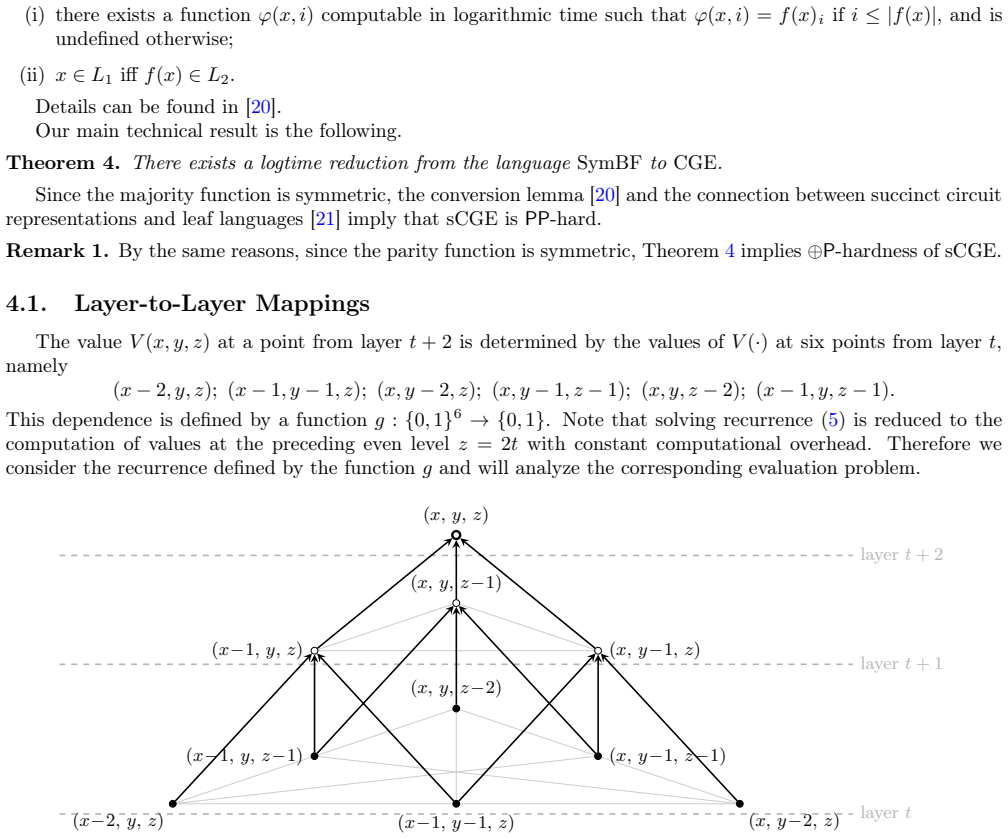
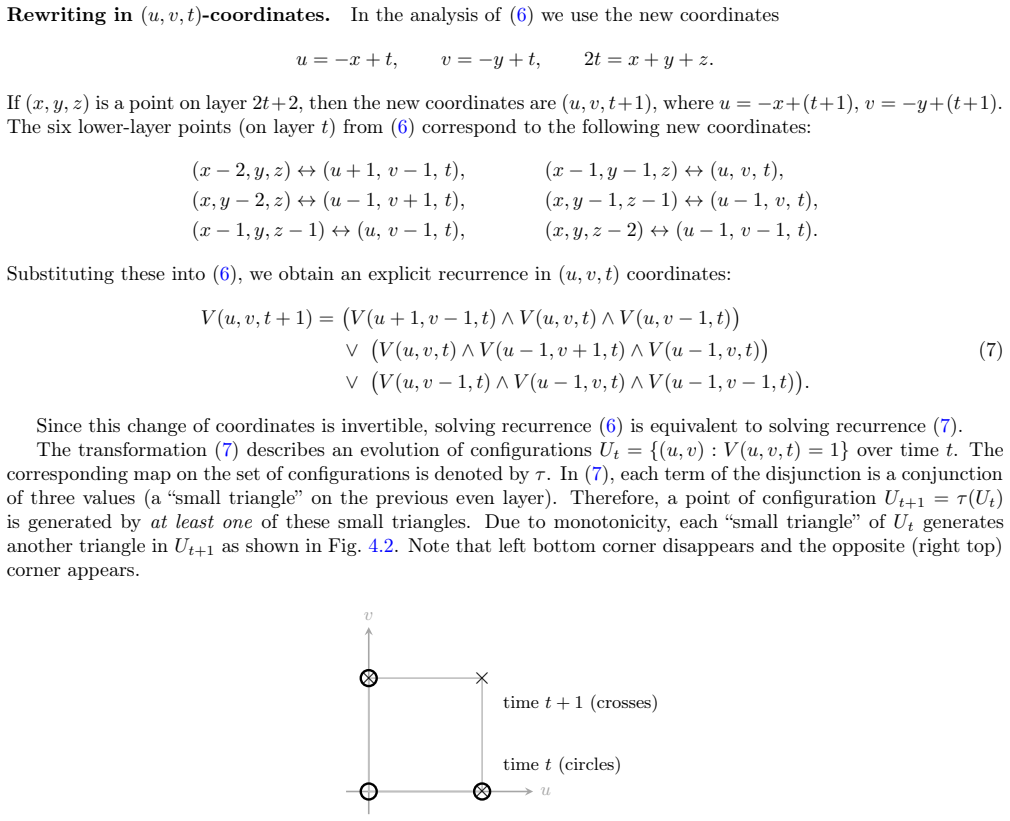
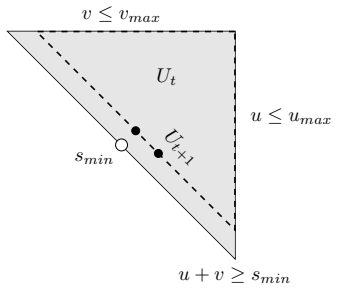
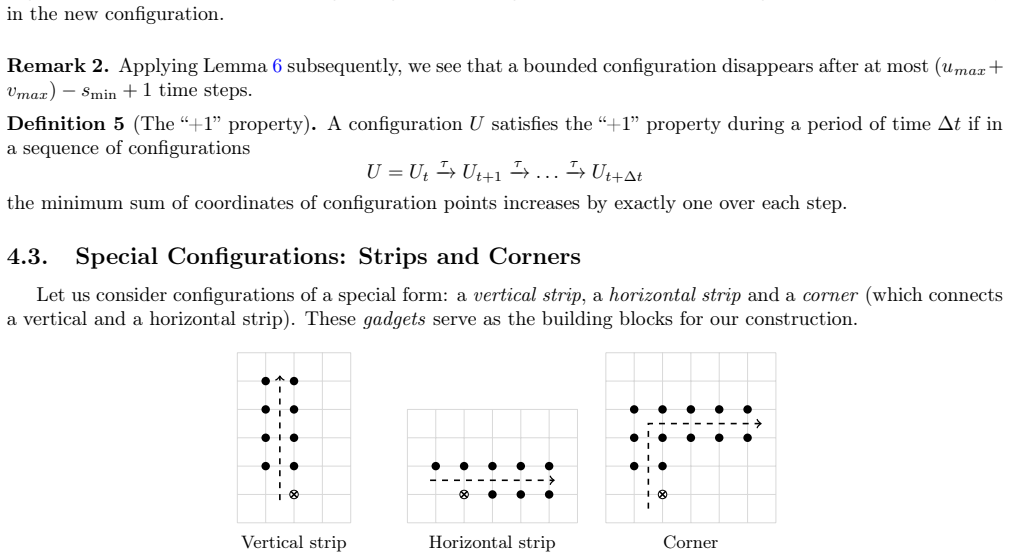
We show that the recurrence evaluation problem is PSPACE-complete when offsets are given in unary and EXP-complete when given in binary, for sequences with a fixed recurrence relation. Additionally, for recurrences defined by the NAND function on a 3-dimensional grid with coordinate offsets, the problem is PP-hard with arbitrary boundary conditions.
What carries the argument
The recurrence evaluation problem with a fixed finite-valued defining function and input-provided offsets or boundary conditions.
If this is right
- The problem remains hard for sequences when the recurrence is fixed.
- Binary encoding of offsets increases the complexity to EXP.
- PP-hardness holds for 3D NAND recurrences even with arbitrary boundaries.
- These connect to impartial games with normal and misère conditions generalized.
Where Pith is reading between the lines
- If true, similar hardness may apply to other fixed functions beyond NAND.
- The results suggest that grid-based recurrences capture game-theoretic hardness.
- Extensions could explore higher dimensions or different offset sets.
Load-bearing premise
The recurrence function is fixed and takes only finitely many values, while offsets and boundaries vary as input.
What would settle it
Discovery of a polynomial-space algorithm for the binary-offset case would contradict the EXP-completeness result.
Figures
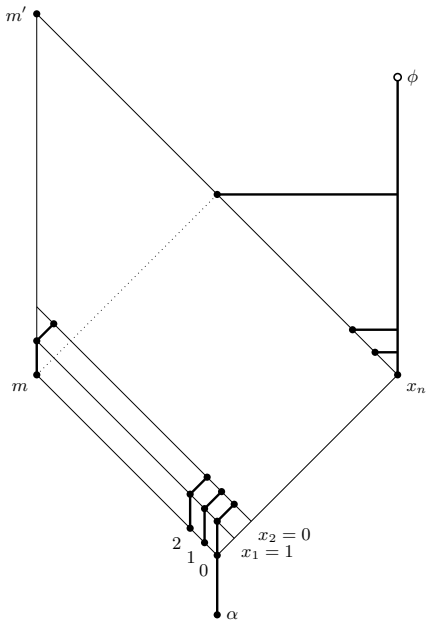
read the original abstract
In this paper, we study the complexity of the recurrence evaluation problem. We are interested in finitely valued recurrent functions. We present two results in this direction. First, we study the recurrence problem for sequences, assuming that a recurrence relation is defined by a fixed function, while the offsets are part of the input. Depending on the form of presentation (whether the offsets are given in unary or in binary), the problem is PSPACE-complete or EXP-complete. Second, we study recurrences defined by the NAND function. They are related to impartial games. We prove PP-hardness of the recurrence evaluation problem for a very simple 3-dimensional game, in which the offset vectors are coordinate vectors (1,0,0), (0,1,0) and (0,0,1) but the boundary conditions are arbitrary. In other words, we consider generalized winning conditions for the game extending the normal and the mis\`ere winning conditions.
Editorial analysis
A structured set of objections, weighed in public.
Referee Report
Summary. The paper studies the complexity of evaluating finitely valued recurrent functions. It claims two main results: (1) when a recurrence is defined by a fixed function and offsets are part of the input, the evaluation problem is PSPACE-complete if offsets are encoded in unary and EXP-complete if encoded in binary; (2) the evaluation problem for NAND-defined recurrences on a 3D grid with unit coordinate offsets (1,0,0), (0,1,0), (0,0,1) and arbitrary boundary conditions is PP-hard. The second result is framed in terms of generalized impartial games extending normal and misère play.
Significance. If the claims are substantiated with complete reductions and membership arguments, the results would give tight complexity classifications for recurrence evaluation, linking a simple dynamic-programming-style problem to PSPACE/EXP and a 3D grid game to PP. The explicit connection to impartial games and the use of fixed recurrence functions with variable offsets or boundaries are potentially useful for classifying other DP and game problems.
major comments (1)
- [Abstract] Abstract (second result): the PP-hardness claim for NAND recurrences on the 3D grid assumes arbitrary boundary conditions are supplied as part of the input while the recurrence function is fixed. When target coordinates are given in binary (to be consistent with the EXP-completeness case of the first result), an arbitrary boundary function on the three coordinate planes requires either an exponential-sized explicit table or a compact encoding (circuit/formula). The abstract supplies no indication of which encoding is used; without a polynomial-size encoding the input size becomes exponential in the coordinate values, which would invalidate both PP membership and standard poly-time reductions for hardness.
Simulated Author's Rebuttal
We thank the referee for the careful review and for highlighting the need for greater clarity in the abstract regarding the encoding of boundary conditions. We address the major comment below and will revise the manuscript to improve precision.
read point-by-point responses
-
Referee: [Abstract] Abstract (second result): the PP-hardness claim for NAND recurrences on the 3D grid assumes arbitrary boundary conditions are supplied as part of the input while the recurrence function is fixed. When target coordinates are given in binary (to be consistent with the EXP-completeness case of the first result), an arbitrary boundary function on the three coordinate planes requires either an exponential-sized explicit table or a compact encoding (circuit/formula). The abstract supplies no indication of which encoding is used; without a polynomial-size encoding the input size becomes exponential in the coordinate values, which would invalidate both PP membership and standard poly-time reductions for hardness.
Authors: We agree the abstract is insufficiently precise on this point. The full paper encodes the arbitrary boundary conditions via a compact polynomial-size circuit (or equivalent succinct representation) that, given any coordinate on the three boundary planes, outputs the boundary value. This ensures the overall input remains polynomial in the bit length of the target coordinates, supporting both PP membership (via the standard PP machine for evaluating the recurrence with the circuit oracle) and the correctness of the poly-time reductions used for PP-hardness. We will revise the abstract to state explicitly that boundaries are supplied via a compact encoding such as a circuit. revision: yes
Circularity Check
No circularity: hardness results rest on explicit reductions from standard problems
full rationale
The paper establishes PSPACE/EXP-completeness and PP-hardness via direct reductions from known complete problems (e.g., quantified Boolean formulas or impartial games) to recurrence evaluation with fixed NAND or other functions and variable offsets/boundaries. No equations, parameters, or self-citations are used to define the target complexity class in terms of itself; the input encoding of boundaries is part of the problem statement rather than a fitted quantity renamed as a prediction. The derivation chain is therefore independent of the claimed results.
Axiom & Free-Parameter Ledger
axioms (1)
- domain assumption Standard complexity classes (PSPACE, EXP, PP) and their closure properties under reductions are well-defined and distinct.
Reference graph
Works this paper leans on
-
[1]
AMS, 2003
Graham Everest, Poorten Alf van der, Igor Shparlinski, and Thomas Ward.Recurrence Sequences. AMS, 2003
2003
-
[2]
An Algorithm for Evaluation of Remote Terms in A Linear Recurrence Sequence
J. C. P. Miller and D. J. Spencer Brown. “An Algorithm for Evaluation of Remote Terms in A Linear Recurrence Sequence”. In:Comput. J.9.2 (1966), pp. 188–190
1966
-
[3]
An efficient formula for linear recurrences
C. M. Fiduccia. “An efficient formula for linear recurrences”. In:SIAM Journal on computing14.1 (1985), pp. 106–112
1985
-
[4]
Efficient computations in terms of linear recurrence sequences of any order
Dmitry I. Khomovsky. “Efficient computations in terms of linear recurrence sequences of any order”. In: Integers: Electronic Journal of Combinatorial Number Theory18 (2018), #A39
2018
-
[5]
A mathematical investigation of games of “take-away
Solomon W. Golomb. “A mathematical investigation of games of “take-away””. In:Journal of Combinatorial Theory1.4 (1966), pp. 443–458.issn: 0021-9800.doi:https://doi.org/10.1016/S0021-9800(66)80016-9. url:https://www.sciencedirect.com/science/article/pii/S0021980066800169
-
[6]
Unsolved Problems in Combinatorial Games
Richard K. Guy. “Unsolved Problems in Combinatorial Games”. In:Combinatorics Advances. Ed. by Charles J. Colbourn and Ebadollah S. Mahmoodian. Boston, MA: Springer US, 1995, pp. 161–179.isbn: 978-1-4613- 3554-2.doi:10.1007/978-1-4613-3554-2_10.url:https://doi.org/10.1007/978-1-4613-3554-2_10
work page doi:10.1007/978-1-4613-3554-2_10.url:https://doi.org/10.1007/978-1-4613-3554-2_10 1995
-
[7]
‘An equilibrium existence result for an economy with land’
Ingo Althöfer and Jörg Bültermann. “Superlinear period lengths in some subtraction games”. In:Theoretical Computer Science148.1 (1995), pp. 111–119.issn: 0304-3975.doi:https://doi.org/10.1016/0304- 3975(95)00019-S.url:https://www.sciencedirect.com/science/article/pii/030439759500019S
-
[8]
On the expansion of three-element subtraction sets
Nhan Bao Ho. “On the expansion of three-element subtraction sets”. In:Theoretical Computer Science582 (2015), pp. 35–47.issn: 0304-3975.doi:https://doi.org/10.1016/j.tcs.2015.03.025.url:https: //www.sciencedirect.com/science/article/pii/S0304397515002418
-
[9]
On the linearity of the periods of subtraction games
Shenxing Zhang. “On the linearity of the periods of subtraction games”. In:Theoretical Computer Science 985 (2024), p. 114350.issn: 0304-3975.doi:https://doi.org/10.1016/j.tcs.2023.114350.url: https://www.sciencedirect.com/science/article/pii/S0304397523006631
-
[10]
Superpolynomial period lengths of the winning positions in the subtraction game
István Miklós and Logan Post. “Superpolynomial period lengths of the winning positions in the subtraction game”. In:Int. J. Game Theory53.4 (2024), pp. 1275–1313.doi:10.1007/S00182-024-00911-5.url: https://doi.org/10.1007/s00182-024-00911-5
-
[11]
Urban Larsson and Johan Wästlund.From heaps of matches to the limits of computability. 2012. arXiv: 1202.0664 [cs.CC].url:https://arxiv.org/abs/1202.0664. 15
Pith/arXiv arXiv 2012
-
[12]
On Computational Hardness of Multidimensional Subtraction Games
Vladimir Gurvich and Mikhail Vyalyi. “On Computational Hardness of Multidimensional Subtraction Games”. In:Algorithms14.3 (2021).issn: 1999-4893.doi:10.3390/a14030071.url:https://www.mdpi.com/1999- 4893/14/3/71
work page doi:10.3390/a14030071.url:https://www.mdpi.com/1999- 2021
-
[13]
More about exact slow k-Nim
Nikolay Chikin, Vladimir Gurvich, Konstantin Knop, Michael S. Paterson, and Michael Vyalyi. “More about exact slow k-Nim”. In:Integers: Electronic Journal of Combinatorial Number Theory21 (2021), #G4
2021
-
[14]
On Remoteness Functions of Exact Slowk-NIM withk+ 1Piles
Vladimir Gurvich, Denis Martynov, Vladislav Maximchuk, and Michael Vyalyi. “On Remoteness Functions of Exact Slowk-NIM withk+ 1Piles”. In:Integers: Electronic Journal of Combinatorial Number Theory24 (2024), #G1
2024
-
[15]
doi: https://doi.org/10.1016/j
Urban Larsson, Indrajit Saha, and Makoto Yokoo. “Subtraction games in more than one dimension”. In: Theoretical Computer Science1016 (2024), p. 114775.issn: 0304-3975.doi:https://doi.org/10.1016/j. tcs.2024.114775.url:https://www.sciencedirect.com/science/article/pii/S030439752400392X
work page doi:10.1016/j 2024
-
[16]
Sipser.Introduction to the Theory of Computation
M. Sipser.Introduction to the Theory of Computation. Cengage Learning, 2012.isbn: 9781285401065.url: https://books.google.ru/books?id=1aMKAAAAQBAJ
2012
-
[17]
Arora and B
S. Arora and B. Barak.Computational Complexity: A Modern Approach. Cambridge University Press, 2006. isbn: 978-0-521-42426-4.url:https://theory.cs.princeton.edu/complexity/book.pdf
2006
-
[18]
Ding-Zhu Du and Ker-I Ko.Theory of Computational Complexity. 2nd ed. John Wiley & Sons, Inc., 2014. isbn: 9781118306086
2014
-
[19]
Ryan Williams and Seri Khoury.Functions With and Without Small Circuits. Sept. 2018.url:https: //people.csail.mit.edu/rrw/cs294-2018/fns-without-small2.pdf
2018
-
[20]
The Complexity of Algorithmic Problems on Succinct Instances
José L. Balcázar, Antoni Lozano, and Jacobo Torán. “The Complexity of Algorithmic Problems on Succinct Instances”. In:Computer Science. Springer, 1992, pp. 351–377.doi:10.1007/978-1-4615-3422-8_30
-
[21]
Succinct circuit representations and leaf language classes are basically the same concept
Bernd Borchert and Antoni Lozano. “Succinct circuit representations and leaf language classes are basically the same concept”. In:Information Processing Letters59.4 (1996), pp. 211–215.doi:10.1016/0020-0190(96) 00096-8. 16
discussion (0)
Sign in with ORCID, Apple, or X to comment. Anyone can read and Pith papers without signing in.