REVIEW 3 major objections 5 minor 53 references
Continuous phase transition between bosonic integer quantum Hall liquid and trivial insulator: evidences for deconfined quantum criticality
T0 review · 3 major / 5 minor · reviewed 2026-08-14 · deepseek-v4-flash
Pith's one-line read A bosonic integer quantum Hall state on a honeycomb lattice is shown to pass continuously into a trivial insulator under a periodic potential, with the critical point described by emergent QED3 with two Dirac flavors.
desk verdict A credible DMRG case for a continuous BIQH-to-Mott transition with c≈1, but the finite-width Ly=8 cylinder carries the whole quantitative load and the QED3 identification is underdetermined. read the letter →
The pith
A machine-rendered reading of the paper's core claim, the machinery that carries it, and where it could break.
The reading
What carries the argument
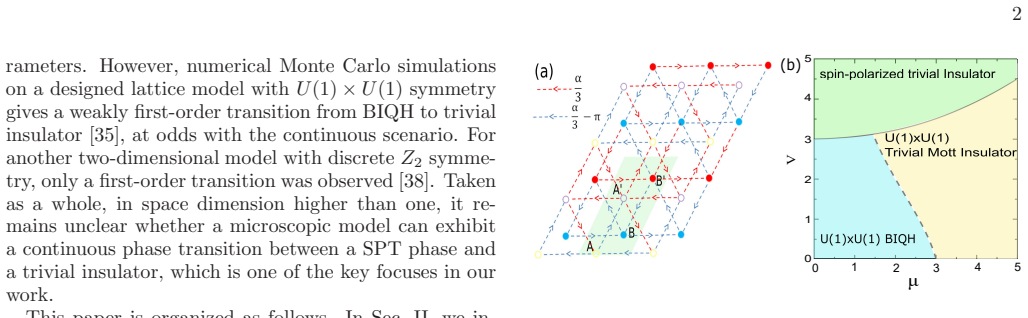
The argument rests on two pieces of machinery. The first is the topological $K$ matrix of the two-component bosonic system, a symmetric integer matrix whose inverse gives the Chern number matrix $C = K^{-1}$; through quantized charge pumping under flux insertion in DMRG, the BIQH phase is pinned to $C = \begin{pmatrix}0&1\\1&0\end{pmatrix}$, meaning the off-diagonal drag Hall conductance is unity. The second is the entanglement-scaling diagnostic at the critical point, built on the Calabrese--Cardy relation $S = (c/6)\log\xi$ between entanglement entropy and the infinite-DMRG correlation length $\xi$. The identification of the critical theory as $\mathrm{QED}_3$ with $N_f=2$ uses the fermionic parton construction of bosons: the two Dirac flavors are coupled to a noncompact $U(1)$ gauge field, and the gauge coupling removes the total charge mode, reducing the central charge to $c = N_f - 1 = 1$.
What would settle it
A converged DMRG calculation on wider cylinders ($L_y=12$ or larger) would settle the claim: if the correlation-length peak as a function of $\mu$ splits into two peaks (an intermediate phase) or sharpens into a jump, the continuous $\mathrm{QED}_3$ critical point is a finite-width artifact rather than a true two-dimensional transition.
Extended reading notes
Core claim
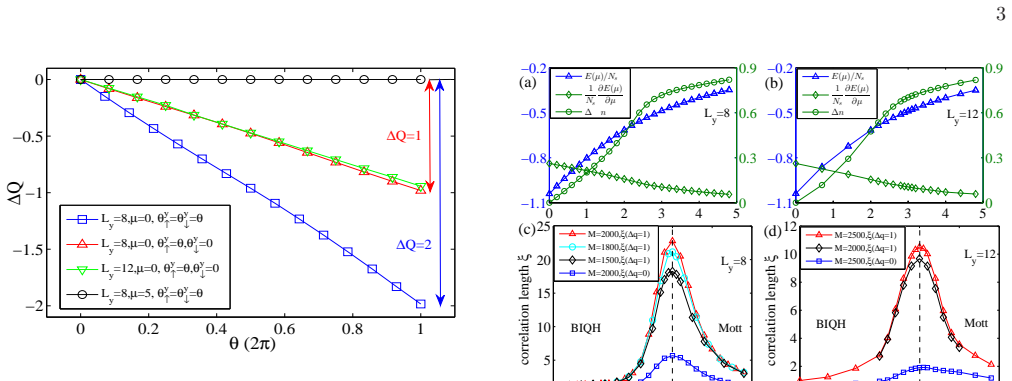
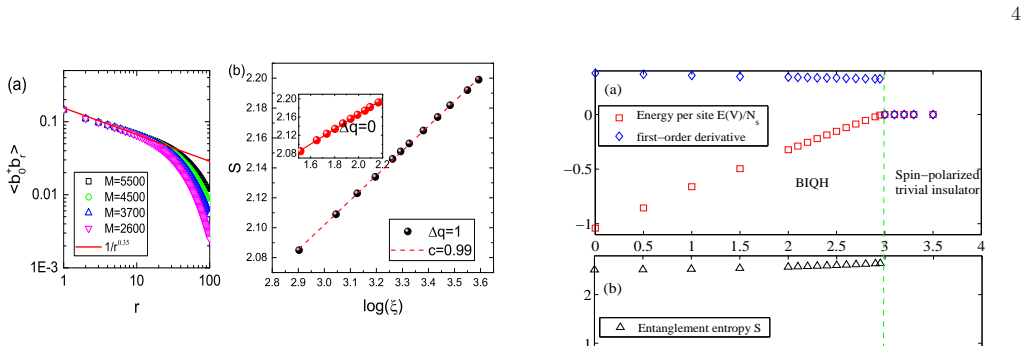
The central discovery is that the BIQH-to-trivial-insulator transition driven by the periodic potential $\mu$ is continuous and preserves all symmetries: the first derivative of the ground-state energy and the density imbalance evolve smoothly, with no level crossing in exact diagonalization and no discontinuity in DMRG. The correlation length reaches a bond-dimension-dependent peak at a unique critical point, and at that point the single-particle correlation function $\langle b_0^\dagger b_r\rangle$ decays algebraically while the entanglement entropy satisfies $S = (c/6)\log\xi$ with $c\simeq 1$. The authors argue that the value $c=1$, rather than $c=2$ for two free Dirac flavors, is the signature that the critical theory is massless $\mathrm{QED}_3$ with $N_f=2$ fermions coupled to a noncompact gauge field, which gaps out the total charge mode; this is a characteristic signature of deconfined quantum criticality. In contrast, the transition driven by the nearest-neighbor interaction $V$ is first-order and breaks the $U(1)\times U(1)$ protecting symmetry down to a global $U(1)$, which the authors interpret as natural because symmetric-protected phases cannot undergo a continuous transition when the protecting symmetry is lost.
Load-bearing premise
The load-bearing assumption is that an infinitely long cylinder only eight sites wide, with periodic boundary conditions in the transverse direction, faithfully represents the two-dimensional thermodynamic limit of the transition.
Editorial extensions
If this is right
- If the transition is truly continuous, this is a concrete two-dimensional lattice realization of deconfined quantum criticality between a symmetry-protected topological phase and a trivial insulator.
- The measured central charge $c\simeq 1$ at the critical point supports the emergent $\mathrm{QED}_3$ with $N_f=2$ description, implying the deconfined gauge field is the organizing principle of the criticality.
- The transition preserves the $U(1)\times U(1)$ symmetry, so no local order parameter changes; the phase transition is therefore Landau-forbidden in the sense of symmetry-breaking order.
- The first-order $V$-driven transition that breaks the protecting symmetry indicates that the order of the transition depends on whether the symmetry protecting the SPT phase is preserved.
- The algebraic decay of single-particle correlations at the critical point, $\langle b_0^\dagger b_r\rangle \sim r^{-\eta}$, provides a concrete signature that can be looked for in other candidate models.
Reading between the lines
- A natural extension is to compute the correlation-length exponent $\nu$ and the anomalous dimension $\eta$ at the $\mu$-driven critical point on larger cylinders; if the transition is genuinely $\mathrm{QED}_3$, these exponents should match the predictions for $N_f=2$ fermionic QED3, not the mean-field values.
- The same entanglement-scaling diagnostic—central charge $c=1$ for two Dirac flavors—could be transferred to other candidate deconfined critical points in bosonic or fermionic lattice models to distinguish emergent gauge-field criticality from free-fermion or conventional criticality.
- If the continuous transition survives in the two-dimensional limit, the periodic-potential strength $\mu$ becomes a tunable knob for studying the crossover between confined and deconfined gauge dynamics, and possibly for engineering interfaces between a bosonic SPT phase and a trivial Mott insulator.
- The result suggests that symmetry-preserving perturbations, unlike symmetry-breaking ones, may generically convert first-order SPT-to-trivial transitions into continuous ones in two dimensions, motivating similar searches in fermionic SPT systems with the same $U(1)\times U(1)$ symmetry.
Signed reviews
Editorial analysis
A structured set of objections, weighed in public.
Referee Report
Summary. This paper studies a hardcore-boson correlated-hopping model on the honeycomb lattice at half filling. Using exact diagonalization and infinite DMRG, the authors identify a bosonic integer quantum Hall (BIQH) phase through the Chern number matrix obtained from charge-pumping calculations, and then study transitions out of this phase. They claim that a staggered periodic chemical potential drives a continuous transition from the BIQH phase to a featureless trivial Mott insulator, with all local observables evolving smoothly, while a nearest-neighbor repulsion drives a first-order transition to a spin-polarized insulator. At the continuous critical point, the entanglement entropy versus correlation length gives a central charge c≃1, which they interpret as evidence for emergent QED3 with two flavors of Dirac fermions (c=Nf−1=1) and hence for deconfined quantum criticality between an SPT phase and a trivial insulator.
Significance. If the central claim is correct, the paper provides a rare two-dimensional microscopic example of deconfined quantum criticality involving a symmetry-protected topological phase, connecting to recent duality-based proposals and potentially stimulating further numerical and analytical work. The K-matrix identification via two independent charge-pumping protocols is clean, well documented, and does not rely on the critical-scaling analysis. The authors are also candid about the computational limitations of their DMRG calculations. The main weakness is that the quantitative evidence for the continuous transition and for the QED3 identification rests almost entirely on a single cylinder width (Ly=8) and on a small number of bond dimensions, with no width extrapolation; this limits the strength of the conclusions that can be drawn about the true two-dimensional limit.
major comments (3)
- [Sec. IV, Figs. 4(c),(d)] The claim of a continuous two-dimensional transition rests almost entirely on Ly=8 data. The text explicitly states that Ly=12 is "computationally difficult" and that the authors "focus our following discussions on a relatively small system width Ly=8 in our quasi-one-dimensional infinite cylinder," and Fig. 4(d) shows only two bond dimensions with a much weaker peak. No data for other widths and no extrapolation in 1/Ly or finite-entanglement scaling collapse are provided. The broad correlation-length peak in Fig. 4(c) with only M=1500, 1800, and 2000 does not by itself establish a diverging correlation length at a unique critical point. As a result, the observed continuous-looking behavior could be a quasi-one-dimensional finite-width effect, and the central claim that the BIQH-to-Mott transition is continuous in two dimensions is not secured. Please either add controlled Ly=6, 10, and 12 data with matched truncation errors or substantially soften the two-dimensional claim.
- [Sec. IV, Eq. (4), Fig. 5(b)] The identification of the critical theory as QED3 with two flavors of Dirac fermions is based on c≈1 from S=(c/6)logξ. This is not a unique diagnostic: any single gapless mode on the cylinder, for example the quasi-one-dimensional version of an ordinary bosonic critical point, would also give c=1, and the algebraic decay of ⟨b†b⟩ is the superfluid-type response generic to such states. The comparison with the predicted c=Nf−1=1 is therefore necessary but not sufficient. Additional discriminators are needed, such as extraction of critical exponents, the full low-energy spectrum, or the scaling of the topological/drag response across the critical point, to substantiate the emergent-gauge-field interpretation.
- [Sec. IV, Fig. 5] The S-versus-logξ scaling analysis is not described with enough detail to be reproducible or robust: the manuscript does not state the number of μ points used, the fitting window, or the uncertainty of the fitted slope, and "c≃1" is quoted without error bars. Because the correlation-length peak in Fig. 4(c) is broad, the choice of fitting window can materially shift the fitted central charge. Please provide the fit protocol, the number of points, and an error estimate for the extracted slope.
minor comments (5)
- [Sec. IV, Fig. 4] The value of the critical potential μc is not given anywhere; the black dashed line in Fig. 4 is not quantified. Please state μc and the criterion used to determine it, as this is needed for reproducibility and for any scaling analysis.
- [Sec. IV] The sentence describing ⟨b†ibj⟩ as "off-diagonal long range correlations" should read "quasi-long-range (algebraic) correlations," since the data show power-law rather than true long-range order.
- [Sec. IV, Fig. 5] The phrase "for different system sizes, the smooth behavior ... supports a continuous phase transition" overstates the evidence, since only Ly=8 and Ly=12 are shown and only one width is used for the critical scaling; consider rewording to "is consistent with."
- [Sec. II and Fig. 5] The text and abstract state that up to M=6500 states are kept, but all reported scaling results use M≤2500. Please clarify the maximum bond dimension actually used in each figure.
- [Eq. (1)] In the second hopping term of Eq. (1), the index k is not defined in the equation; it should be identified as the B-site index of the nearest-neighbor pair.
Circularity Check
No material circularity: the central claims are supported by independent numerical observables and external theoretical benchmarks, with self-citations only in methodological roles.
full rationale
The paper's derivation chain is not circular. The BIQH phase is identified by topological probes that are independent of the conclusion: charge pumping under inserted flux is a raw DMRG observable, and the resulting pumped charges (Delta Q=2 for both-component flux and Delta Q~1 for one-component flux) are compared with, not defined by, the expected Chern-number matrix C=K^{-1}=((0,1),(1,0)). The continuous-transition evidence consists of smooth first-order energy derivatives, smooth density imbalance, a correlation-length peak that grows with bond dimension, and algebraic single-particle correlations; none of these quantities is constructed from the QED3 claim. The central charge is extracted by fitting S=(c/6)log(xi) to DMRG data (Fig. 5b), giving c~1, and then compared with the external theoretical prediction c=Nf-1=1 for emergent QED3 with two fermion flavors, as computed in Ref. [53]; the fit is not defined in terms of that prediction. Self-citations (Refs. [14,46,47]) appear only as background for the model and for the charge-pumping method, and they do not carry the central claim. The quasi-1D Ly=8 limitation and the fact that c=1 could also be consistent with other single-mode critical theories are robustness and interpretation concerns, not circularity. No equation is equivalent to its input by construction, and no fitted parameter is renamed as a prediction.
Assumptions & free parameters
free parameters (2)
- effective central charge c =
about 1
- chiral flux alpha =
pi/2
assumptions (4)
- domain assumption The K-matrix classification and the relation C = K^{-1} apply to this two-component bosonic system, so measured charge pumping values uniquely identify the BIQH state.
- domain assumption The 1+1D CFT formula S = (c/6) log xi remains valid for extracting an effective central charge on a finite-width infinite cylinder at a 2D quantum critical point.
- domain assumption The transfer-matrix correlation length computed in infinite DMRG is a faithful proxy for the physical correlation length, and its broad peak marks the quantum critical point.
- domain assumption The parton-construction duality mapping this boson model to QED3 with two Dirac fermion flavors is correct for this transition.
Cite this review
Pith. "Pith review of Continuous phase transition between bosonic integer quantum Hall liquid and trivial insulator: evidences for deconfined quantum criticality." pith.science (2026). https://pith.science/paper/LJ4DYTLU
@misc{pith2026190802490,
  author       = {Pith},
  title        = {Pith review of: Continuous phase transition between bosonic integer quantum Hall liquid and trivial insulator: evidences for deconfined quantum criticality},
  year         = {2026},
  howpublished = {\url{https://pith.science/paper/LJ4DYTLU}},
  note         = {Machine review of arXiv:1908.02490}
}
abstract
The deconfined quantum critical point, a prototype Landau-forbidden transition, could exist in principle in the phase transitions involving symmetry protected topological phase, however, examples of such kinds of transition in physical systems are rare beyond one-dimensional systems. Here, using density-matrix renormalization group calculation, we unveil a bosonic integer quantum Hall phase in two-dimensional correlated honeycomb lattice, by full identification of its internal structure from the topological $\mathbf{K}$ matrix. Moreover we demonstrate that imbalanced periodic chemical potentials can destroy the bosonic integer quantum Hall state and drive it into a featureless trivial (Mott) insulator, where all physical observables evolve smoothly across the critical point. At the critical point the entanglement entropy reveals a characteristic scaling behavior, which is consistent with the critical field theory as an emergent QED$_3$ with two flavors of Dirac fermions.
Figures

Figures from the paper (1 more)
Reference graph
Works this paper leans on
- [1]
-
[2]
Wen, Rev
X.-G. Wen, Rev. Mod. Phys. 89, 041004 (2017)
2017
-
[3]
Senthil, Annual Review of Condensed Matter Physics 6, 299 (2015)
T. Senthil, Annual Review of Condensed Matter Physics 6, 299 (2015)
2015
-
[4]
C. L. Kane and E. J. Mele, Phys. Rev. Lett. 95, 146802 (2005)
2005
-
[5]
F. D. M. Haldane, Phys. Rev. Lett. 50, 1153 (1983). 6
work page 1983
-
[6]
Chen, Z.-C
X. Chen, Z.-C. Gu, Z.-X. Liu, and X.-G. Wen, Phys. Rev. B 87, 155114 (2013)
2013
- [7]
- [8]
Show all 53 references
-
[9]
Regnault and T
N. Regnault and T. Senthil, Phys. Rev. B 88, 161106(R) (2013)
2013
-
[10]
Wu and J
Y.-H. Wu and J. K. Jain, Phys. Rev. B 87, 245123 (2013)
2013
-
[11]
S. D. Geraedts and O. I. Motrunich, Ann. of Phys. 334, 288 (2013)
2013
-
[12]
Y.-C. He, S. Bhattacharjee, R. Moessner, and F. Poll- mann, Phys. Rev. Lett. 115, 116803 (2015)
2015
-
[13]
Sterdyniak, N
A. Sterdyniak, N. R. Cooper, and N. Regnault, Phys. Rev. Lett. 115, 116802 (2015)
2015
-
[14]
T.-S. Zeng, W. Zhu, and D. N. Sheng, Phys. Rev. B 93, 195121 (2016)
2016
-
[15]
Qi and S.-C
X.-L. Qi and S.-C. Zhang, Rev. Mod. Phys. 83, 1057 (2011)
2011
-
[16]
Lu and A
Y.-M. Lu and A. Vishwanath, Phys. Rev. B 86, 125119 (2012)
2012
-
[17]
Chen, Z.-C
X. Chen, Z.-C. Gu, Z.-X. Liu, and X.-G. Wen, Science 338, 1604 (2012)
2012
-
[18]
Vishwanath and T
A. Vishwanath and T. Senthil, Phys. Rev. X 3, 011016 (2013)
2013
-
[19]
Xu and T
C. Xu and T. Senthil, Phys. Rev. B 87, 174412 (2013)
2013
-
[20]
Schuch, D
N. Schuch, D. Perez-Garcia, and I. Cirac, Phys. Rev. B 84, 165139 (2011)
2011
-
[21]
Gu and X.-G
Z.-C. Gu and X.-G. Wen, Phys. Rev. B 80, 155131 (2009)
2009
-
[22]
Pollmann, A
F. Pollmann, A. M. Turner, E. Berg, and M. Oshikawa, Phys. Rev. B 81, 064439 (2010)
2010
-
[23]
Z.-X. Liu, M. Liu, and X.-G. Wen, Phys. Rev. B 84, 075135 (2011)
2011
-
[24]
den Nijs and K
M. den Nijs and K. Rommelse, Phys. Rev. B 40, 4709 (1989)
1989
-
[25]
X. Chen, F. Wang, Y.-M. Lu, and D.-H. Lee, Nucl. Phys. B 873, 248 (2013)
2013
-
[26]
L. Tsui, Y. Huang, H.-C. Jiang, and D.-H. Lee, Nucl. Phys. B 919, 470 (2017)
2017
-
[27]
Lahtinen and E
V. Lahtinen and E. Ardonne, Phys. Rev. Lett. 115, 237203 (2015)
2015
-
[28]
Verresen, R
R. Verresen, R. Moessner, and Frank Pollmann, Phys. Rev. B 96, 165124 (2017)
2017
-
[29]
Senthil, A
T. Senthil, A. Vishwanath, L. Balents, S. Sachdev, and M. P. A. Fisher, Science 303, 1490 (2004)
2004
-
[30]
Senthil, L
T. Senthil, L. Balents, S. Sachdev, A. Vishwanath, and M. P. A. Fisher, Phys. Rev. B 70, 144407 (2004)
2004
-
[31]
Karch and D
A. Karch and D. Tong, Phys. Rev. X 6, 031043 (2016)
2016
-
[32]
C. Wang, A. Nahum, M. A. Metlitski, C. Xu, and T. Senthil, Phys. Rev. X 7, 031051 (2017)
2017
-
[33]
Senthil, D
T. Senthil, D. T. Son, C. Wang, and C. Xu, Phys. Rep. 827, 1 (2019)
2019
-
[34]
Y. Q. Qin, Y.-Y. He, Y.-Z. You, Z.-Y. Lu, A. Sen, A. W. Sandvik, C. Xu, and Z. Y. Meng, Phys. Rev. X 7, 031052 (2017)
2017
-
[35]
Geraedts and Olexei I
S. Geraedts and Olexei I. Motrunich, Phys. Rev. B 96, 115137 (2017)
2017
-
[36]
Grover and A
T. Grover and A. Vishwanath, Phys. Rev. B 87, 045129 (2013)
2013
-
[37]
Lu and D.-H
Y.-M. Lu and D.-H. Lee, Phys. Rev. B 89, 195143 (2014)
2014
-
[38]
S. C. Morampudi, C. von Keyserlingk, and F. Pollmann, Phys. Rev. B 90, 035117 (2014)
2014
-
[39]
Fuji, Y.-C
Y. Fuji, Y.-C. He, S. Bhattacharjee, and F. Pollmann, Phys. Rev. B 93, 195143 (2016)
2016
-
[40]
S. R. White, Phys. Rev. Lett. 69, 2863 (1992)
1992
-
[41]
I. P. McCulloch, arxiv: 0804.2509
-
[42]
Cincio and G
L. Cincio and G. Vidal, Phys. Rev. Lett. 110, 067208 (2013)
2013
-
[43]
D. N. Sheng, L. Balents, and Z. Wang, Phys. Rev. Lett. 91, 116802 (2003)
2003
-
[44]
D. N. Sheng, Z.-Y. Weng, L. Sheng, and F. D. M. Hal- dane, Phys. Rev. Lett. 97, 036808 (2006)
2006
-
[45]
S. S. Gong, W. Zhu, and D. N. Sheng, Sci. Rep. 4, 6317 (2014)
2014
-
[46]
T.-S. Zeng, W. Zhu, and D. N. Sheng, Phys. Rev. B 95, 125134 (2017)
2017
-
[47]
Zeng and D
T.-S. Zeng and D. N. Sheng, Phys. Rev. B 97, 035151 (2018); T.-S. Zeng, D. N. Sheng, and W. Zhu, Phys. Rev. B 100, 075106 (2019)
2018
-
[48]
Wen and Y.-S
X.-G. Wen and Y.-S. Wu, Phys. Rev. Lett. 70, 1501 (1993)
1993
-
[49]
W. Chen, M. P. A. Fisher, and Y.-S. Wu, Phys. Rev. B 48, 13749 (1993)
1993
-
[50]
Kol and N
A. Kol and N. Read, Phys. Rev. B 48, 8890 (1993)
1993
-
[51]
J. Y. Lee, C. Wang, M. P. Zaletel, A. Vishwanath, and Y.-C. He, Phys. Rev. X 8, 031015 (2018)
2018
-
[52]
Calabrese and J
P. Calabrese and J. Cardy, J. Phys. A 42, 504005 (2009)
2009
-
[53]
S. D. Geraedts, M. P. Zaletel, R. S. K. Mong, M. A. Metlitski, A. Vishwanath, and O. I. Motrunich, Science 352, 197 (2016)
2016
Reviewed August 14, 2026 · model on record in the stance chip above.
Discussion (0). Continue with ORCID to comment.