Physics-guided residual Kalman learning for state-of-charge estimation of lithium iron phosphate batteries
Pith reviewed 2026-06-27 08:32 UTC · model grok-4.3
The pith
A hybrid filter merges an electrochemical model with a recurrent network to reduce SOC estimation error by 77 percent for LFP batteries.
A machine-rendered reading of the paper's core claim, the machinery that carries it, and where it could break.
Core claim
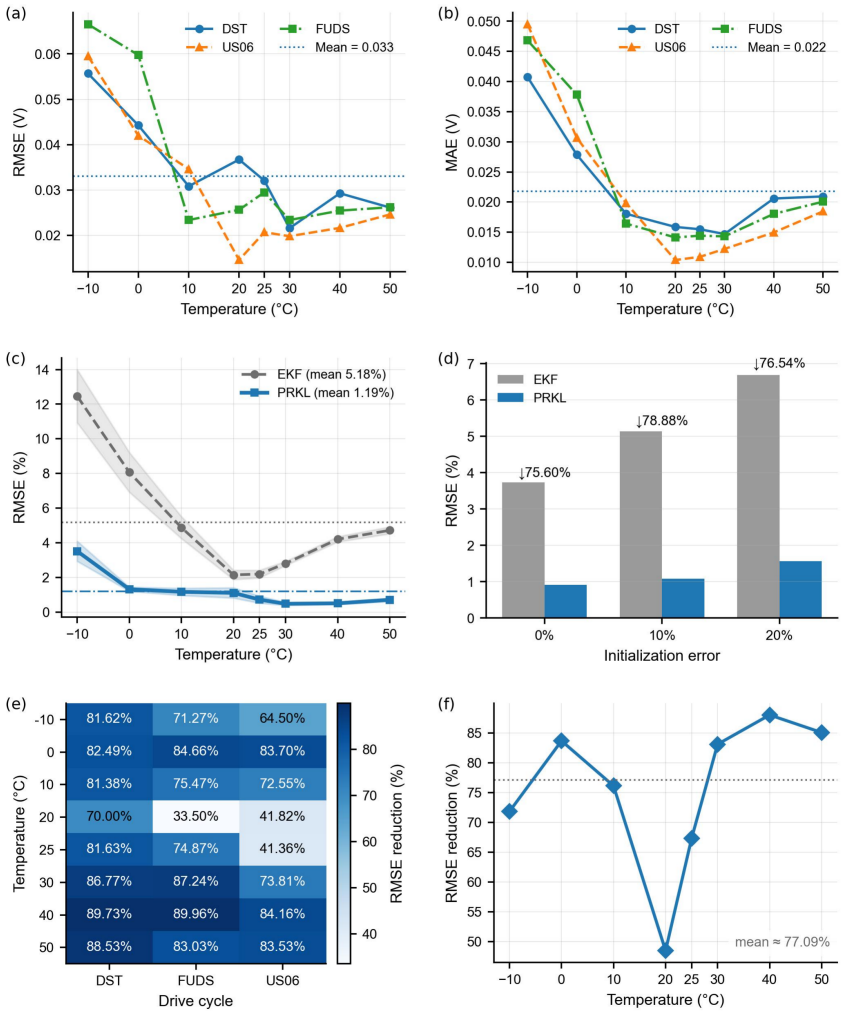
The central claim is that a gated recurrent unit residual learner, trained to compensate structured errors in a single-particle-model-based extended Kalman filter by using electrochemical states and measurement features, yields a global average RMSE of 1.19 percent for SOC estimation across the dataset, a 77 percent reduction relative to the physics-only EKF, while preserving recursive propagation and showing cross-profile robustness when trained on DST and FUDS cycles and tested on US06 within the same cell dataset.
What carries the argument
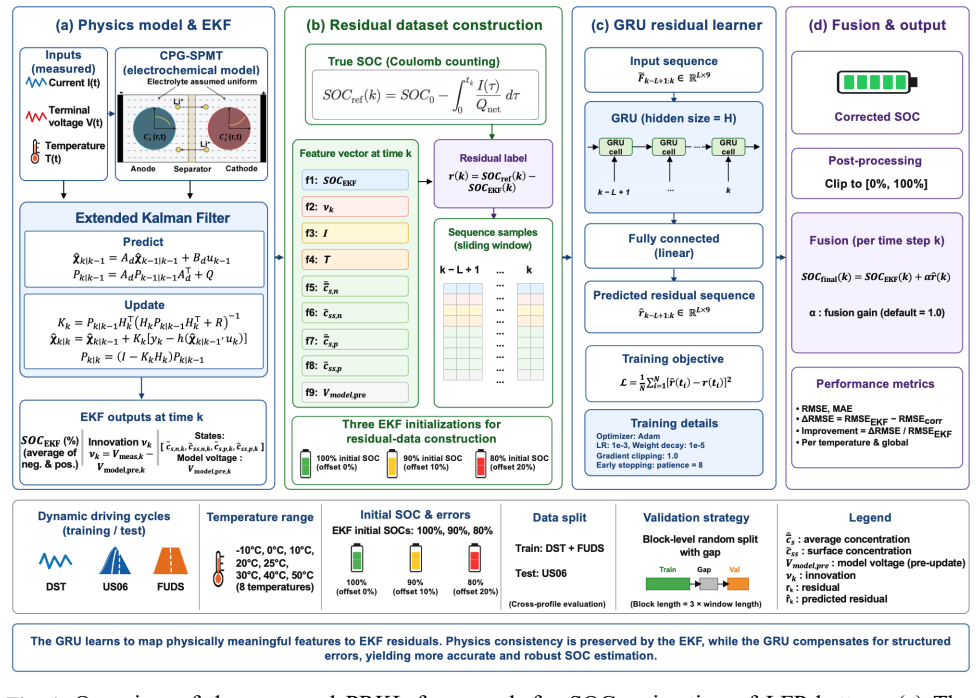
The physics-guided residual Kalman learning (PRKL) framework, in which the GRU residual learner receives electrochemical states from the EKF to correct its estimation errors while the EKF handles recursive physical state propagation.
If this is right
- The hybrid method maintains the recursive, real-time state propagation of the EKF while adding correction for temperature-dependent and initialization-sensitive mismatches.
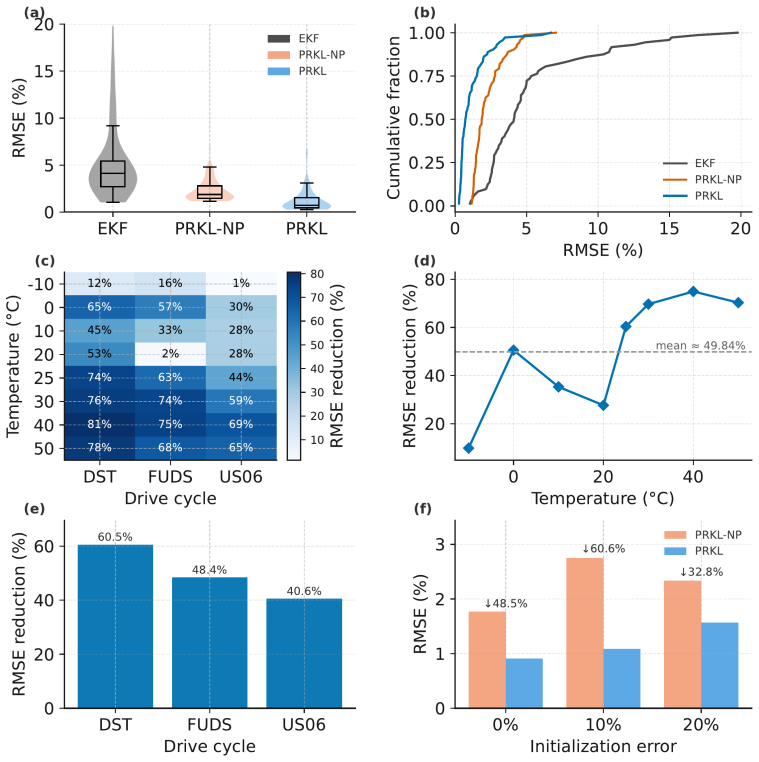
- Electrochemical state information from the single-particle model guides the residual learner to handle flat OCV-SOC characteristics effectively.
- Cross-profile testing shows that training on DST and FUDS cycles allows the framework to generalize to the US06 cycle within the studied dataset.
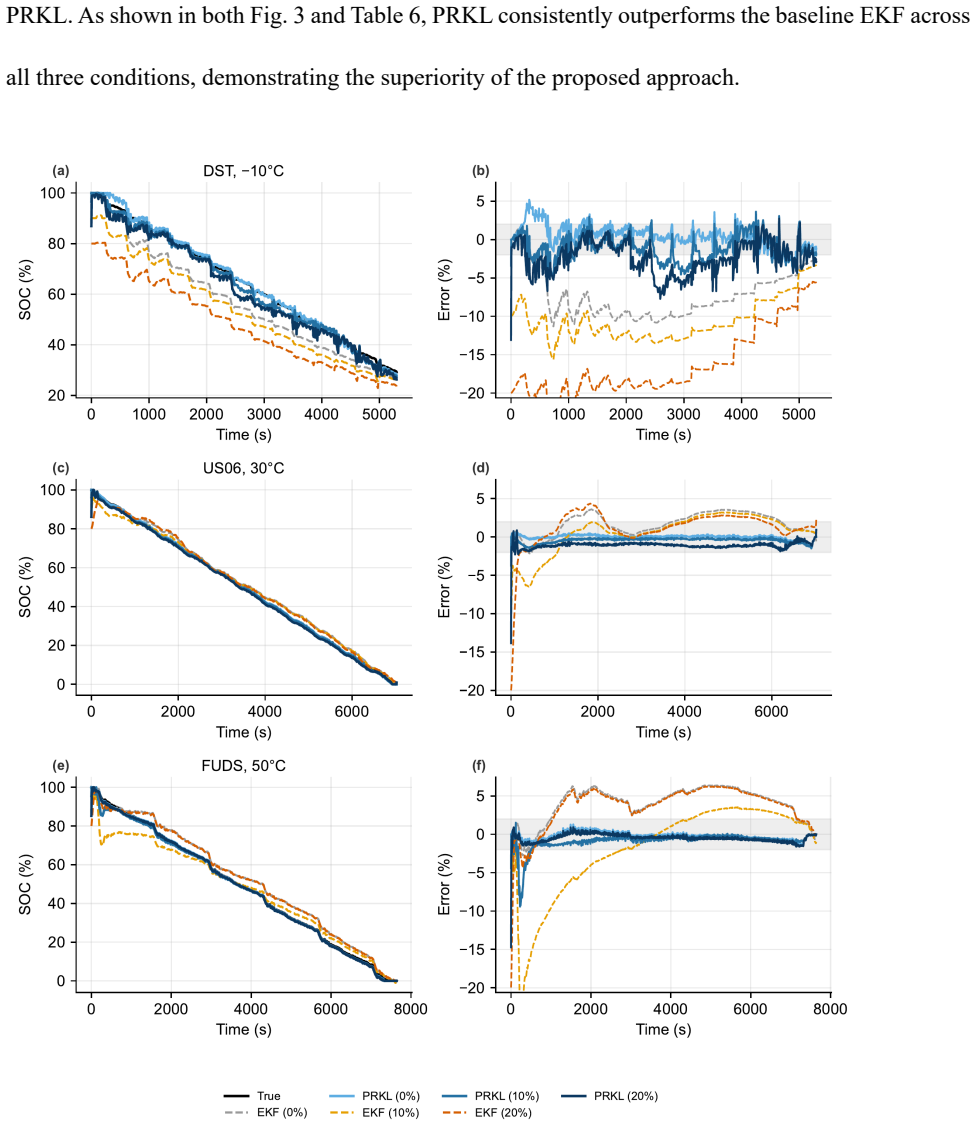
- The approach supports validation on initialization offsets up to 20 percent and temperatures from -10 to 50 degrees Celsius.
- Results provide a basis for extending to ageing-aware and embedded-platform implementations as stated in the paper.
Where Pith is reading between the lines
- The same residual-correction idea could be applied to other battery chemistries that exhibit flat voltage regions or strong temperature sensitivity.
- Embedding the physical states directly into the learner may reduce the volume of data needed compared with fully data-driven SOC estimators.
- If the GRU correction remains stable over long sequences, the method could lower the frequency of open-circuit voltage resets in battery management systems.
- Future tests on multi-cell packs would show whether cell-to-cell variation requires retraining the residual learner or only retuning the base EKF.
Load-bearing premise
The assumption that EKF errors remain structured enough for the GRU to learn and correct them reliably when generalizing from training cycles to an unseen test cycle within the same cell dataset without creating new instabilities.
What would settle it
Applying the trained PRKL model to data from a different LFP cell or an aged cell under the same temperature and cycle conditions and observing that the RMSE does not drop below the physics-only EKF level would falsify the central performance claim.
Figures
read the original abstract
Accurate state of charge (SOC) estimation of lithium iron phosphate (LFP) batteries remains challenging because of their flat open-circuit-voltage (OCV)-SOC characteristics, temperature-dependent dynamics, and sensitivity to initialization errors. Here, we propose a physics-guided residual Kalman learning (PRKL) framework for electrochemical-model-based SOC estimation. PRKL combines a control-oriented single-particle-model-based extended Kalman filter (EKF), which provides recursive physical state propagation, with a gated recurrent unit (GRU) residual learner that compensates structured EKF errors using electrochemical states and measurement features. The framework is evaluated on a public graphite/LFP dataset covering three dynamic drive cycles, eight temperatures from -10 to 50 degrees C, and initialization offsets up to 20 percent. Using dynamic stress test (DST) and federal urban driving schedule (FUDS) cycles for training and the supplemental federal test procedure (US06) cycle for cross-profile testing within the same cell dataset, PRKL achieves a global average root mean square error (RMSE) of 1.19 percent, corresponding to a 77 percent reduction relative to the physics-only EKF. These results show that electrochemical state information can guide residual learning and improve recursive SOC estimation for LFP batteries. The present validation supports cross-profile robustness within the studied dataset and provides a basis for future cross-cell, ageing-aware, and embedded-platform validation.
Editorial analysis
A structured set of objections, weighed in public.
Referee Report
Summary. The manuscript proposes a physics-guided residual Kalman learning (PRKL) framework that augments a single-particle-model-based extended Kalman filter (EKF) with a gated recurrent unit (GRU) residual learner to compensate structured EKF errors using electrochemical states and measurements for SOC estimation in LFP batteries. It reports evaluation on a public graphite/LFP dataset across eight temperatures and initialization offsets up to 20%, with training on DST/FUDS cycles and cross-profile testing on the US06 cycle within the same cell, achieving a global average RMSE of 1.19% (77% reduction relative to physics-only EKF).
Significance. If the reported improvement is shown to be robust, the work illustrates how embedding electrochemical state information into residual learning can enhance recursive SOC estimation for LFP cells with flat OCV-SOC curves. The use of a public dataset and explicit cross-profile split provides a concrete, reproducible baseline for extensions to cross-cell or ageing-aware settings.
major comments (2)
- [Abstract] Abstract: the 77% RMSE reduction claim is load-bearing for the central contribution, yet the abstract supplies no information on training procedure, hyperparameter selection, error bars, statistical significance testing, or checks for overfitting; without these, it is impossible to determine whether the reported gain is reliable or an artifact of the single held-out profile.
- [Evaluation] Evaluation description: the cross-profile test trains the GRU on DST/FUDS and evaluates on US06 within the same cell; the manuscript provides no analysis of whether feeding GRU-corrected states back into the EKF recursion can destabilize the filter (e.g., via altered covariance propagation or divergence), which directly affects whether the 1.19% RMSE generalizes beyond the reported split.
minor comments (1)
- [Abstract] The phrase 'global average' is used without clarifying whether it is taken across all temperatures, all initialization offsets, or both; a brief clarification would improve readability.
Simulated Author's Rebuttal
We thank the referee for the constructive feedback on our manuscript. We address the major comments point-by-point below and indicate the revisions we will make to strengthen the paper.
read point-by-point responses
-
Referee: [Abstract] Abstract: the 77% RMSE reduction claim is load-bearing for the central contribution, yet the abstract supplies no information on training procedure, hyperparameter selection, error bars, statistical significance testing, or checks for overfitting; without these, it is impossible to determine whether the reported gain is reliable or an artifact of the single held-out profile.
Authors: The abstract is intentionally concise to highlight the key contribution and results. Detailed information on the training procedure (DST/FUDS for training, US06 for testing), hyperparameter selection via cross-validation, and the public dataset is provided in the Methods section. To address the concern, we will revise the abstract to include a short phrase on the evaluation protocol and note that the improvement is observed consistently across eight temperatures. We will also add error bars (standard deviation over multiple random seeds) to the reported RMSE in the results section and discuss the lack of overfitting due to the cross-profile split. These changes will make the reliability of the 77% reduction more transparent. revision: yes
-
Referee: [Evaluation] Evaluation description: the cross-profile test trains the GRU on DST/FUDS and evaluates on US06 within the same cell; the manuscript provides no analysis of whether feeding GRU-corrected states back into the EKF recursion can destabilize the filter (e.g., via altered covariance propagation or divergence), which directly affects whether the 1.19% RMSE generalizes beyond the reported split.
Authors: We appreciate this important point regarding potential filter instability. In our implementation, the GRU residual is added to the SOC estimate after the EKF update step, without modifying the internal covariance propagation, which helps maintain stability. However, we acknowledge that an explicit analysis of the closed-loop behavior was not included. In the revised manuscript, we will add a discussion on the integration approach and include additional results showing the innovation statistics and filter consistency metrics over the test cycle to demonstrate no divergence occurred. This will provide stronger evidence for the generalizability of the 1.19% RMSE. revision: yes
Circularity Check
No significant circularity in PRKL derivation or evaluation
full rationale
The paper's claimed improvement derives from training a GRU residual learner on DST/FUDS cycles to correct EKF residuals, then evaluating the hybrid estimator on a held-out US06 cycle within the same cell dataset. The reported 1.19% RMSE is an empirical test-set metric, not a quantity defined in terms of itself or forced by the training fit. No self-definitional equations, fitted-input predictions, or load-bearing self-citations appear in the abstract or described framework; the physics EKF and data-driven residual components remain distinct, with explicit train/test splits. The derivation chain is therefore self-contained against external benchmarks.
Axiom & Free-Parameter Ledger
axioms (1)
- domain assumption EKF errors in the single-particle model are structured and can be compensated by a GRU using electrochemical states and measurement features.
Reference graph
Works this paper leans on
-
[1]
Physics-guided residual Kalman learning for state-of-charge estimation of lithium iron phosphate batteries Feng Guoa,b,c, Luis D. Coutoa,b, Khiem Trada,b, Ru Hongd,∗, Guangdi Hue,∗, Mohammadhosein Safarib,c,f,∗ aWET, VITO, Boeretang 200, Mol, 2400, Belgium bEnergyVille, Thor Park 8310, Genk, 3600, Belgium cInstitute for Materials Research (IUMAT), Hasselt...
-
[2]
Key hyperparameters and configuration of the physics-guided GRU residual learner. Component Configuration/value Input features 9 (electrochemical, EKF, and measurement-based features) Window length/stride 60 steps/30 steps (50% overlap), yielding a total of 11,277 training windows Hidden layer type Single-layer GRU Hidden units 32 Output dimension 1 (resi...
2080
-
[3]
J. Zhao, X. Han, Y . Wu, Z. Wang, A.F. Burke, J. Energy Chem. 102 (2025) 463–496
2025
-
[4]
Schoberl, M
J. Schoberl, M. Ank, M. Schreiber, N. Wassiliadis, M. Lienkamp, eTransportation 19 (2024) 100305
2024
-
[5]
H. Liu, C. Li, X. Hu, J. Li, K. Zhang, Y . Xie, R. Wu, Z. Song, Nat. Commun. 16 (2025)
2025
-
[6]
K. Luo, X. Chen, H. Zheng, Z. Shi, J. Energy Chem. 74 (2022) 159–173
2022
-
[7]
Z.P. Cano, D. Banham, S. Ye, A. Hintennach, J. Lu, M. Fowler, Z. Chen, Nat. Energy 3 (2018) 279–289
2018
-
[8]
Harper, R
G. Harper, R. Sommerville, E. Kendrick, L. Driscoll, P. Slater, R. Stolkin, A. Walton, P. Christensen, O. Heidrich, S. Lambert, A. Abbott, K. Ryder, L. Gaines, P. Anderson, Nature 575 (2019) 75–86
2019
-
[9]
Zhang, Y
Z. Zhang, Y . Li, H. Wang, L. Lu, X. Han, D. Li, M. Ouyang, J. Energy Storage 75 (2024) 109696
2024
-
[10]
Guo, L.D
F. Guo, L.D. Couto, G. Mulder, K. Trad, G. Hu, O. Capron, K. Haghverdi, J. Energy Storage 101 (2024) 113850
2024
-
[11]
Haghverdi, D.L
K. Haghverdi, D.L. Danilov, G. Mulder, L.D. Couto, F. Guo, R.-A. Eichel, J. Power Sources 652 (2025) 237483
2025
-
[12]
L. Ma, T. Zhang, J. Energy Chem. 80 (2023) 48–57
2023
-
[13]
Y . Che, L. Xu, R. Teodorescu, X. Hu, S. Onori, ACS Energy Lett. 10 (2025) 741–749
2025
-
[14]
Nekahi, K
A. Nekahi, K. Zaghib, Energy Storage Mater. 84 (2026) 104759
2026
-
[15]
Safari, C
M. Safari, C. Delacourt, J. Electrochem. Soc. 158 (2011) A562–A571
2011
-
[16]
C. Wang, M. Yang, X. Wang, Z. Xiong, F. Qian, C. Deng, C. Yu, Z. Zhang, X. Guo, J. Energy Storage 110 (2025) 115346
2025
-
[17]
L. Wu, Z. Lyu, Z. Huang, C. Zhang, C. Wei, J. Energy Chem. 89 (2024) 27–40
2024
-
[18]
Fuller, M
T.F. Fuller, M. Doyle, J. Newman, J. Electrochem. Soc. 141 (1994) 1–10
1994
-
[19]
Guo, L.D
F. Guo, L.D. Couto, J. Power Sources 650 (2025) 237365
2025
-
[20]
Guo, L.D
F. Guo, L.D. Couto, J. Power Sources 649 (2025) 237309
2025
-
[21]
Plett, J
G.L. Plett, J. Power Sources 134 (2004) 277–292
2004
-
[22]
Z. Chen, H. Sun, G. Dong, J. Wei, J. Wu, J. Power Sources 414 (2019) 158–166
2019
-
[23]
Choobar, H
B.G. Choobar, H. Hamed, M. Safari, J. Energy Storage 96 (2024) 112628
2024
-
[24]
W. Qian, W. Li, X. Guo, H. Wang, Energy 292 (2024) 130585
2024
-
[25]
Q. Zhu, L. Li, X. Hu, N. Xiong, G.-D. Hu, IEEE Trans. Veh. Technol. 66 (2017) 10853–10865
2017
-
[26]
Xiong, D
Y . Xiong, D. Zhang, X. Ruan, S. Jiang, X. Zou, W. Yuan, X. Liu, Y . Zhang, Z. Nie, D. Wei, Y . Zeng, P. Cao, G. Zhang, Energy Storage Mater. 73 (2024) 103860
2024
-
[27]
X. Ren, S. Liu, X. Yu, X. Dong, Energy 234 (2021) 121236
2021
-
[28]
Hannan, D.N
M.A. Hannan, D.N. How, M.H. Lipu, M. Mansor, P.J. Ker, Z. Dong, K. Sahari, S.K. Tiong, K.M. Muttaqi, T.I. Mahlia, F. Blaabjerg, Sci. Rep. 11 (2021) 19541
2021
-
[29]
W. Qi, W. Qin, Z. Yun, Energy 307 (2024) 132805
2024
-
[30]
Kim, K.-H
K.-H. Kim, K.-H. Oh, H.-S. Ahn, H.-D. Choi, IEEE Trans. Power Electron. 39 (2023) 125–134
2023
-
[31]
Korkmaz, Energy 294 (2024) 130913
M. Korkmaz, Energy 294 (2024) 130913
2024
-
[32]
J. Tian, C. Chen, W. Shen, F. Sun, R. Xiong, Energy Storage Mater. 61 (2023) 102883
2023
-
[33]
W. Ma, Y . Lei, X. Wang, B. Chen, J. Energy Chem. 80 (2023) 768–784
2023
-
[34]
Sorouri, A
H. Sorouri, A. Oshnoei, Y . Che, R. Teodorescu, J. Energy Storage 100 (2024) 113604
2024
-
[35]
Raabe, J.R
D. Raabe, J.R. Mianroodi, J. Neugebauer, Nat. Comput. Sci. 3 (2023) 198–209
2023
-
[36]
J. Chen, T. Hannan, Y . Yao, G. Song, Energy Storage Mater. 72 (2024) 103730
2024
-
[37]
H. Zhao, Q. Li, J. Hu, J. Energy Storage 124 (2025) 116841
2025
-
[38]
Rezaei, A
O. Rezaei, A. Rahdan, S. Sardari, M. Dahmardeh, Z. Wang, J. Energy Storage 68 (2023) 107883
2023
-
[39]
F. Feng, S. Teng, K. Liu, J. Xie, Y . Xie, B. Liu, K. Li, J. Power Sources 455 (2020) 227935
2020
-
[40]
Zheng, X
Q. Zheng, X. Yin, D. Zhang, J. Energy Storage 73 (2023) 109244
2023
-
[41]
J. Tian, R. Xiong, J. Lu, C. Chen, W. Shen, Energy Storage Mater. 50 (2022) 718–729
2022
-
[42]
Y . Zeng, Y . Li, T. Yang, Batteries 9 (2023)
2023
-
[43]
J. Tian, R. Xiong, W. Shen, J. Lu, Appl. Energy 291 (2021) 116812
2021
-
[44]
J. Hou, J. Xu, C. Lin, D. Jiang, X. Mei, Energy 290 (2024) 130056
2024
-
[45]
Zhang, M
S. Zhang, M. Liu, R. Guo, J. Tian, Z. Man, W. Shen, IEEE Trans. Transp. Electrific. 12 (2026) 1223–1234
2026
-
[46]
Guo, L.D
F. Guo, L.D. Couto, Comput. Phys. Commun. 322 (2026) 110075
2026
-
[47]
Biography of the main authors Feng Guo is currently an FWO Senior Postdoctoral Fellow at Hasselt University and VITO (Flemish Institute for Technological Research), Belgium
Graphical Abstract Electrochemical state propagation and gated recurrent unit (GRU) residual learning are integrated to correct state of charge (SOC) errors of the extended Kalman filter (EKF), improving lithium iron phosphate (LFP) battery estimation under dynamic cycles, temperature variation, and initialization uncertainty. Biography of the main author...
2015
discussion (0)
Sign in with ORCID, Apple, or X to comment. Anyone can read and Pith papers without signing in.