A Persistent Homology Signature of Knotting
Pith reviewed 2026-06-27 01:38 UTC · model grok-4.3
The pith
Knotting in curves produces a detectable signature in one-dimensional persistent homology via hypergraph curvature scores on cycle representatives.
A machine-rendered reading of the paper's core claim, the machinery that carries it, and where it could break.
Core claim
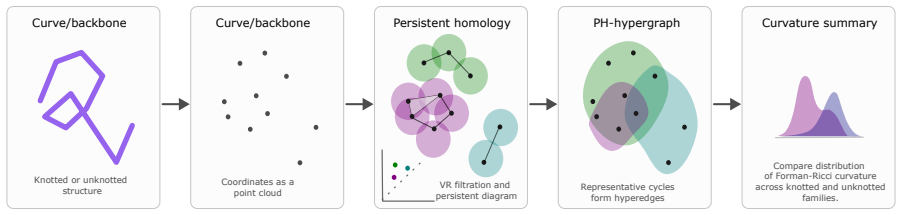
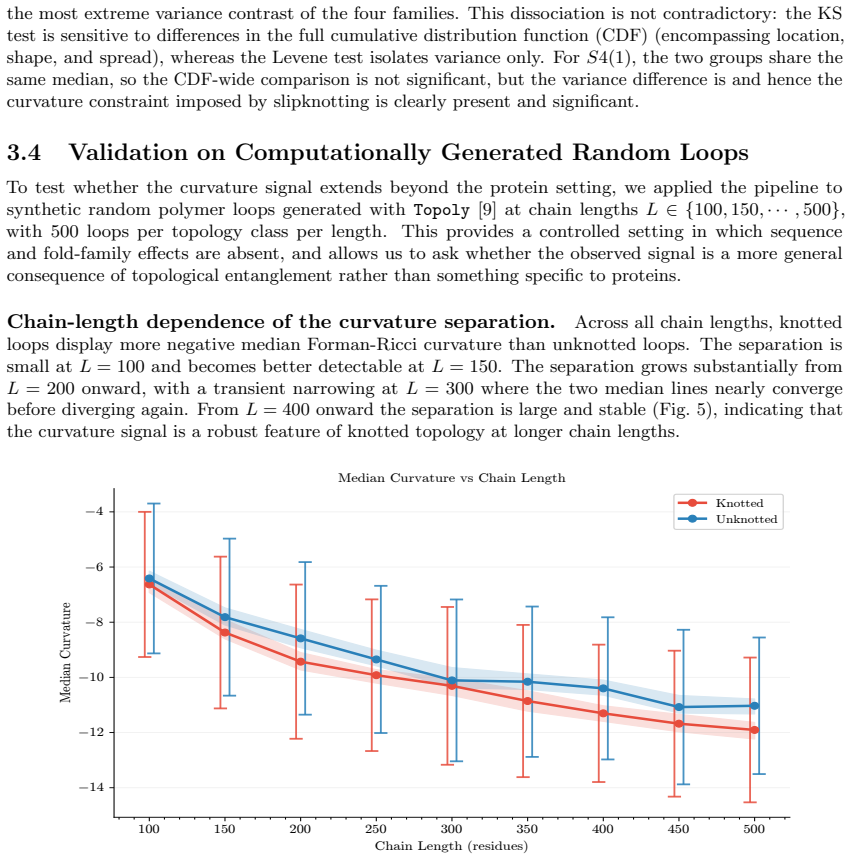
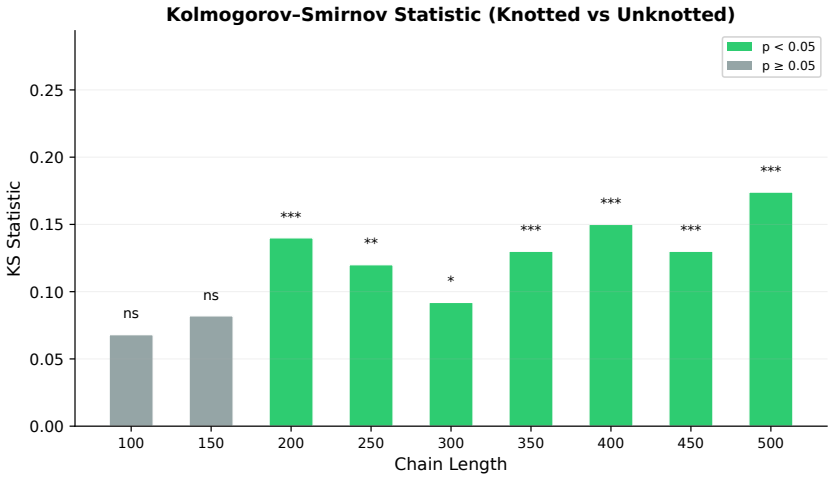
Starting from a point-cloud representation of a curve, one-dimensional persistent homology is computed and cycle representatives are extracted. A hypergraph curvature-based score is then assigned to these cycles. The method reveals systematic differences between knotted and unknotted structures in both protein families and synthetic examples, suggesting that knotting leaves a detectable persistent-homology-based signature.
What carries the argument
The hypergraph curvature score assigned to cycle representatives extracted from one-dimensional persistent homology of point clouds.
Load-bearing premise
The observed differences in hypergraph curvature scores between knotted and unknotted structures are due specifically to the presence of knotting rather than other geometric or sampling differences in the point clouds.
What would settle it
A dataset of knotted and unknotted curves matched for point density and overall geometry but showing no statistical difference in the hypergraph curvature scores on their persistent homology cycles would falsify the signature claim.
Figures
read the original abstract
We ask whether knotting can be recognised using persistent homology. Starting from a point-cloud representation of a curve, we compute one-dimensional persistent homology, extract cycle representatives, and assign a hypergraph curvature-based score to these cycles. Motivated by proteins but tested more broadly, the method reveals systematic differences between knotted and unknotted structures in both protein families and synthetic examples. This suggests that knotting leaves a detectable persistent-homology-based signature.
Editorial analysis
A structured set of objections, weighed in public.
Referee Report
Summary. The manuscript proposes detecting knotting in curves via persistent homology: point-cloud representations are used to compute 1-dimensional persistent homology, cycle representatives are extracted, and a hypergraph curvature score is assigned to these cycles. Applied to protein families and synthetic examples, the method is claimed to reveal systematic differences between knotted and unknotted structures, suggesting a detectable persistent-homology signature of knotting.
Significance. If the differences are shown to be attributable to topological knot type rather than geometric confounders and if quantitative validation is supplied, the approach could provide a new computational signature for knot detection in biological macromolecules and synthetic data. The manuscript does not mention machine-checked proofs, open reproducible code, or parameter-free derivations.
major comments (3)
- [Abstract] Abstract: the claim that the method 'reveals systematic differences' is unsupported by any quantitative results, error bars, sample sizes, statistical tests, or description of the hypergraph curvature score definition/computation, rendering the central empirical assertion unevaluable.
- [Results] Results (protein families and synthetic examples): no indication that geometric factors (local curvature distribution, point density, radius of gyration, total length) were matched or regressed out between knotted and unknotted point clouds; if these drive the curvature-score differences, the attribution to knot type does not follow.
- [Methods] Methods: the hypergraph curvature score on 1-cycles is central to the signature but is never defined or computed explicitly, preventing assessment of whether it isolates topological features.
minor comments (1)
- Notation for the hypergraph and its curvature is introduced without a clear reference to prior literature or a self-contained definition.
Simulated Author's Rebuttal
We thank the referee for their careful reading and constructive comments on our manuscript. We address each major comment below and indicate the revisions we will make.
read point-by-point responses
-
Referee: [Abstract] Abstract: the claim that the method 'reveals systematic differences' is unsupported by any quantitative results, error bars, sample sizes, statistical tests, or description of the hypergraph curvature score definition/computation, rendering the central empirical assertion unevaluable.
Authors: We agree that the abstract would benefit from additional quantitative detail to support the central claim. In the revised manuscript we will expand the abstract to include sample sizes from the protein and synthetic datasets, a concise definition of the hypergraph curvature score, and references to the statistical comparisons used. We will also ensure the Results section supplies the corresponding error bars and test statistics. revision: yes
-
Referee: [Results] Results (protein families and synthetic examples): no indication that geometric factors (local curvature distribution, point density, radius of gyration, total length) were matched or regressed out between knotted and unknotted point clouds; if these drive the curvature-score differences, the attribution to knot type does not follow.
Authors: We accept this point. In the revised version we will add a dedicated analysis that matches or regresses out the listed geometric covariates (radius of gyration, total length, point density) between the knotted and unknotted cohorts and reports the residual effect attributable to knot type. revision: yes
-
Referee: [Methods] Methods: the hypergraph curvature score on 1-cycles is central to the signature but is never defined or computed explicitly, preventing assessment of whether it isolates topological features.
Authors: We acknowledge the omission. The revised Methods section will contain an explicit mathematical definition of the hypergraph curvature score together with the precise algorithmic steps used to compute it from the extracted 1-cycles. revision: yes
Circularity Check
No significant circularity; empirical observation of score differences stands independently
full rationale
The paper's core procedure starts from point-cloud data, computes 1D persistent homology, extracts cycle representatives, and applies a hypergraph curvature score; it then reports observed systematic differences between knotted and unknotted examples. No equations, parameter fitting, or self-citation chains are described that would make any reported difference equivalent to its inputs by construction. The claim is an empirical finding on external data sets (proteins and synthetics) rather than a self-definitional or fitted-input prediction. The derivation chain therefore remains self-contained and does not reduce to any of the enumerated circularity patterns.
Axiom & Free-Parameter Ledger
Reference graph
Works this paper leans on
-
[1]
arXiv preprint arXiv:2210.07545 (2022)
Barbensi, A., Yoon, I.H., Madsen, C.D., Ajayi, D.O., Stumpf, M.P., Harrington, H.A.: Hypergraphs for multiscale cycles in structured data. arXiv preprint arXiv:2210.07545 (2022)
-
[2]
Journal of Applied and Computational Topology5(3), 391–423 (2021)
Bauer, U.: Ripser: efficient computation of vietoris–rips persistence barcodes. Journal of Applied and Computational Topology5(3), 391–423 (2021)
2021
-
[3]
Journal of the Royal Society Interface20(201), 20220727 (2023)
Benjamin, K., Mukta, L., Moryoussef, G., Uren, C., Harrington, H.A., Tillmann, U., Barbensi, A.: Homology of homologous knotted proteins. Journal of the Royal Society Interface20(201), 20220727 (2023)
2023
-
[4]
Nucleic acids research28(1), 235–242 (2000)
Berman, H.M., Westbrook, J., Feng, Z., Gilliland, G., Bhat, T.N., Weissig, H., Shindyalov, I.N., Bourne, P.E.: The protein data bank. Nucleic acids research28(1), 235–242 (2000)
2000
-
[5]
Computational and Mathematical Biophysics8(1), 1–35 (2020)
Bramer, D., Wei, G.W.: Atom-specific persistent homology and its application to protein flexibility analysis. Computational and Mathematical Biophysics8(1), 1–35 (2020). DOI 10.1515/cmb-2020-0001
-
[6]
Inverse Problems36(2), 025008 (2020)
Bubenik, P., Hull, M., Patel, D., Whittle, B.: Persistent homology detects curvature. Inverse Problems36(2), 025008 (2020)
2020
-
[7]
Celoria, D., Mahler, B.I.: A statistical approach to knot confinement via persistent homology. Proceedings of the Royal Society A: Mathematical, Physical and Engineering Sciences478(2261), 20210709 (2022). DOI 10.1098/rspa.2021.0709
-
[8]
Nucleic acids research47(D1), D367–D375 (2019)
Dabrowski-Tumanski, P., Rubach, P., Goundaroulis, D., Dorier, J., Su lkowski, P., Millett, K.C., Rawdon, E.J., Stasiak, A., Sulkowska, J.I.: Knotprot 2.0: a database of proteins with knots and other entangled structures. Nucleic acids research47(D1), D367–D375 (2019)
2019
-
[9]
Briefings in Bioinformatics22(3), bbaa196 (2021)
Dabrowski-Tumanski, P., Rubach, P., Niemyska, W., Gren, B.A., Sulkowska, J.I.: Topoly: Python package to analyze topology of polymers. Briefings in Bioinformatics22(3), bbaa196 (2021)
2021
-
[10]
Computational and structural biotechnology journal13, 459–468 (2015)
Fa´ ısca, P.F.: Knotted proteins: A tangled tale of structural biology. Computational and structural biotechnology journal13, 459–468 (2015)
2015
-
[11]
Bulletin of the American Mathematical Society 45(1), 61–75 (2008)
Ghrist, R.: Barcodes: the persistent topology of data. Bulletin of the American Mathematical Society 45(1), 61–75 (2008)
2008
-
[12]
Biophysical Journal118(12), 2926–2937 (2020)
Ichinomiya, T., Obayashi, I., Hiraoka, Y.: Protein-folding analysis using features obtained by persistent homology. Biophysical Journal118(12), 2926–2937 (2020). DOI 10.1016/j.bpj.2020.04.032
-
[13]
Nucleic acids research43(D1), D306–D314 (2015)
Jamroz, M., Niemyska, W., Rawdon, E.J., Stasiak, A., Millett, K.C., Su lkowski, P., Sulkowska, J.I.: Knotprot: a database of proteins with knots and slipknots. Nucleic acids research43(D1), D306–D314 (2015)
2015
-
[14]
Journal of molecular biology373(1), 153–166 (2007)
King, N.P., Yeates, E.O., Yeates, T.O.: Identification of rare slipknots in proteins and their implications for stability and folding. Journal of molecular biology373(1), 153–166 (2007)
2007
-
[15]
Statistical Applications in Genetics and Molecular Biology 15(1), 19–38 (2016)
Kovacev-Nikolic, V., Bubenik, P., Nikoli´ c, D., Heo, G.: Using persistent homology and dynamical distances to analyze protein binding. Statistical Applications in Genetics and Molecular Biology 15(1), 19–38 (2016). DOI 10.1515/sagmb-2015-0057
-
[16]
Advances in Complex Systems24(01), 2150003 (2021)
Leal, W., Restrepo, G., Stadler, P.F., Jost, J.: Forman–ricci curvature for hypergraphs. Advances in Complex Systems24(01), 2150003 (2021)
2021
-
[17]
Frontiers in artificial intelligence4, 681117 (2021)
Li, L., Thompson, C., Henselman-Petrusek, G., Giusti, C., Ziegelmeier, L.: Minimal cycle repre- sentatives in persistent homology using linear programming: An empirical study with user’s guide. Frontiers in artificial intelligence4, 681117 (2021)
2021
-
[18]
Nature Communications16(1), 7503 (2025)
Madsen, C.D., Barbensi, A., Zhang, S.Y., Ham, L., David, A., Pires, D.E.V., Stumpf, M.P.H.: The topological properties of the protein universe. Nature Communications16(1), 7503 (2025). DOI 10.1038/s41467-025-61108-2
-
[19]
Mansfield, M.L.: Are there knots in proteins? Nature structural biology1(4), 213–214 (1994)
1994
-
[20]
unknotted proteins: Evidence of knot-promoting loops
Potestio, R., Micheletti, C., Orland, H.: Knotted vs. unknotted proteins: Evidence of knot-promoting loops. PLOS Computational Biology6(7), e1000864 (2010). DOI 10.1371/journal.pcbi.1000864
-
[21]
Nature406(6798), 916–919 (2000)
Taylor, W.R.: A deeply knotted protein structure and how it might fold. Nature406(6798), 916–919 (2000)
2000
-
[22]
Physics Reports1075, 1–137 (2024)
Tubiana, L., Alexander, G.P., Barbensi, A., Buck, D., Cartwright, J.H., et al.: Topology in soft and biological matter. Physics Reports1075, 1–137 (2024). DOI 10.1016/j.physrep.2024.04.002 10
-
[23]
PLOS Computational Biology2(9), e122 (2006)
Virnau, P., Mirny, L.A., Kardar, M.: Intricate knots in proteins: Function and evolution. PLOS Computational Biology2(9), e122 (2006). DOI 10.1371/journal.pcbi.0020122
-
[24]
International Journal for Numerical Methods in Biomedical Engineering30(8), 814–844 (2014)
Xia, K., Wei, G.W.: Persistent homology analysis of protein structure, flexibility, and folding. International Journal for Numerical Methods in Biomedical Engineering30(8), 814–844 (2014). DOI 10.1002/cnm.2655
-
[25]
Journal of Applied and Computational Topology9(2), 11 (2025)
Zhang, S.Y., Stumpf, M.P., Needham, T., Barbensi, A.: Topological optimal transport for geometric cycle matching. Journal of Applied and Computational Topology9(2), 11 (2025)
2025
-
[26]
Journal of Open Source Software5(54), 2614 (2020)
ˇCufar, M.: Ripserer.jl: flexible and efficient persistent homology computation in julia. Journal of Open Source Software5(54), 2614 (2020). DOI 10.21105/joss.02614. URL https://doi.org/10. 21105/joss.02614 11 Appendix A: Data Preparation Protein IDs and chain identifiers were retrieved programmatically from KnotProt. The analysis is restricted to four cl...
discussion (0)
Sign in with ORCID, Apple, or X to comment. Anyone can read and Pith papers without signing in.