REVIEW 2 major objections 3 minor 40 references
A posteriori error estimates for the mortar staggered DG method
T0 review · 2 major / 3 minor · reviewed 2026-08-14 · deepseek-v4-flash
Pith's one-line read The paper proves that two residual-type error estimators for the mortar staggered discontinuous Galerkin method are both reliable and efficient for second-order elliptic problems, with no saturation assumptions.
desk verdict First a posteriori estimators for mortar SDG, but the energy-error reliability proof rests on a lemma that fails for the discontinuous coefficients the paper targets. read the letter →
The pith
A machine-rendered reading of the paper's core claim, the machinery that carries it, and where it could break.
The reading
What carries the argument
The two local estimators are assembled from element residuals, flux jumps, and mortar interface mismatch terms. For the potential $L^2$ error, the estimator $\eta_1$ contains $h_\tau^4\|f+\nabla\cdot z_h\|^2_{0,\tau}$, $h_\tau^2\|\rho^{-1}z_h-\nabla u_h\|^2_{0,\tau}$, jump terms on the staggered edges, and mortar flux difference terms; its proof uses the duality argument with an auxiliary elliptic problem. For the energy error, the estimator $\eta_2$ is built similarly with $\rho$-weighted residuals, and the proof introduces an auxiliary function $s\in H^1_0(\Omega)$ defined by $(\rho\nabla s,\nabla v)=(\rho\nabla u_h,\nabla v)$, which decomposes the energy error into a conforming part and a nonconforming part. The nonconforming part is controlled by the jumps of $u_h$ on the subdivision edges and non-mortar interfaces, and the conforming part is handled by the Scott-Zhang local quasi-interpolation operator. Efficiency is proved with standard element and edge bubble functions.
What would settle it
Run the mortar staggered DG scheme on a sequence of nonmatching meshes for a smooth solution and compute the quantity $\min_{v\in H^1_0(\Omega)}\|\rho^{1/2}\nabla(v-u_h)\|_0$ divided by $(\sum_{e\in F_p\cup T_{\Gamma,h}} h_e^{-1}\|\llbracket\rho^{1/2}u_h\rrbracket\|^2_{0,e})^{1/2}$; if this ratio grows unboundedly as the mesh is refined, Lemma 3.1 fails and the energy reliability bound collapses.
Extended reading notes
Core claim
For the mortar staggered discontinuous Galerkin discretization of $-\nabla\cdot(\rho\nabla u)=f$ with $u=0$ on $\partial\Omega$, the paper constructs two residual-type error estimators and proves that they are both reliable and efficient. Theorem 3.1 shows that the $L^2$-norm error $\|u-u_h\|_0$ is bounded by the estimator $\eta_1$ using a duality argument, and Theorem 3.2 shows that the weighted energy error $\|\rho^{1/2}\nabla(u-u_h)\|_0$ is bounded by the estimator $\eta_2$ using an auxiliary function that splits the energy error into a conforming and a nonconforming part. Theorem 4.1 gives matching lower bounds for both estimators. The analysis requires no saturation assumptions and no mesh restrictions on the mortar and non-mortar sides of the interfaces.
Load-bearing premise
The energy-error bound rests on an imported lemma, stated as Lemma 3.1, which asserts that the distance from the numerical solution to a genuinely continuous function is controlled by the size of its jumps across the interior subdivision edges and across the non-mortar interface; the paper does not prove this lemma for the mortar staggered DG spaces.
Editorial extensions
If this is right
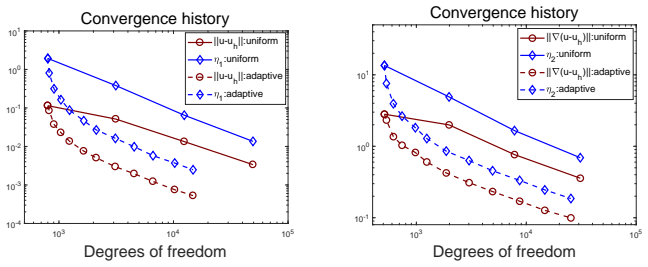
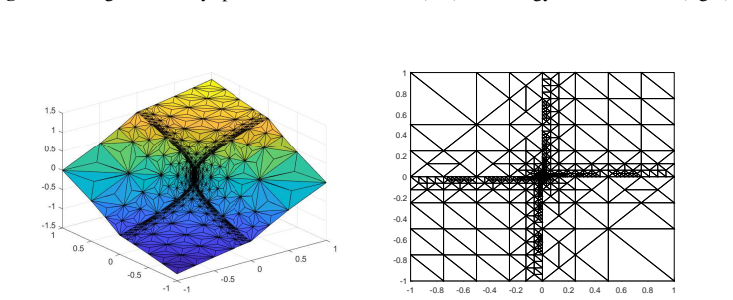
- Adaptive mesh refinement can be driven directly by $\eta_1$ or $\eta_2$; the numerical experiments show that optimal convergence rates are recovered for solutions with limited regularity.
- Both estimators give explicit upper and lower bounds, so they can be used to balance over- and under-refinement without relying on the usual saturation assumption.
- The energy estimator explicitly monitors the nonconforming error through jumps on subdivision edges and the non-mortar interface, which is important on nonmatching grids.
- The potential $L^2$ estimator includes mortar flux difference terms, extending reliable a posteriori control to the $L^2$ norm for nonmatching meshes.
- Removing the saturation assumption means the reliability proofs do not require comparing the computed solution to a finer-grid reference solution.
Reading between the lines
- The same conforming/nonconforming decomposition via an auxiliary function could transfer to other mortar or hybridizable discontinuous Galerkin methods on nonmatching meshes, as long as a subdomain-wise conforming interpolation operator is available.
- The absence of saturation assumptions suggests the estimators could be used as ingredients in a full convergence proof for an adaptive algorithm with Dörfler marking, though the paper itself does not establish contraction or optimal decay rates.
- If the hidden constants in the Scott-Zhang interpolation estimates and the imported distance lemma are made explicit, the reliability bounds could be turned into guaranteed upper bounds on the error; the present paper only establishes existence of constants independent of mesh size.
Signed reviews
Editorial analysis
A structured set of objections, weighed in public.
Referee Report
Summary. The manuscript develops two residual-type a posteriori error estimators for the mortar staggered discontinuous Galerkin (SDG) discretization of the scalar second-order elliptic problem (2.1) with piecewise-constant coefficients and nonmatching subdomain meshes. The first estimator, η1 defined in (3.4), targets the L2 error and is derived by a duality argument; the second, η2 defined in (3.9), targets the ρ-weighted H1 seminorm and is derived with the help of an auxiliary H1_0 function that splits the energy error into conforming and nonconforming parts. The authors claim reliability of both estimators (Theorems 3.1 and 3.2), efficiency (Theorem 4.1), and the absence of saturation assumptions, and they present adaptive refinement experiments, including a transmission problem with a corner singularity.
Significance. If the proofs were correct, the paper would make a useful contribution: it would extend residual-based a posteriori control to mortar SDG on nonmatching grids without saturation assumptions and with explicit interface and mortar-flux terms in the estimators. The derivation is constructive and the estimators are not fitted to numerical data; the numerical experiments illustrate plausible adaptive behavior. However, the reliability proof for the energy estimator rests on a nonconforming estimate that is false for discontinuous coefficients, so the main claim is not established as stated. The paper has merit and the issue appears fixable, but a substantive revision is required.
major comments (2)
- [§3.2, Lemma 3.1 and Theorem 3.2] Lemma 3.1 is not valid for the piecewise-constant coefficient ρ considered in §2, and Theorem 3.2 relies on it through (3.12). With the jump convention of §2, on an interface Γ_ij one has ⟦ρ^{1/2}u_h⟧ = ρ_i^{1/2}u_{h,i} − ρ_j^{1/2}u_{h,j}. Take any nonzero continuous function u_h ∈ H^1_0(Ω) that belongs to the SDG space; then min_{v∈H^1_0}‖ρ^{1/2}∇(v−u_h)‖ = 0, while the right-hand side of Lemma 3.1 is positive whenever ρ_i ≠ ρ_j and u_h does not vanish on Γ_ij. Thus the stated lemma is false. A correct nonconforming bound for the weighted energy norm must involve the jump of u_h weighted by a coefficient that accounts for both sides, for example a term of the form (ρ_i+ρ_j)h_e^{-1}‖⟦u_h⟧‖^2_{0,e}; it cannot use the jump of the weighted function ρ^{1/2}u_h. As written, the only interface contribution in η2, (3.8), is h_e^{-1}ρ‖⟦u_h⟧‖^2 with ρ taken from the element on the non-mortar side, and if that side has the smaller coefficient the estimator undercounts the contribution needed from the larger-coefficient side. Consequently Theorem 3.2 is not established for discontinuous coefficients, which is precisely the setting of Example 5.3.
- [§3.1, Theorem 3.1] The proof of Theorem 3.1 assumes the elliptic regularity estimate (3.6) for the dual problem, but the theorem as stated contains no such hypothesis. For the transmission problem (2.1) with interface corners, as in Example 5.3 where the solution has regularity 1+α < 2, the dual problem need not be H^2-regular. The L2 reliability bound is therefore conditional as written. The hypothesis should be stated explicitly and the theorem restricted accordingly, or an alternative proof that avoids full H^2 regularity of the dual problem should be supplied.
minor comments (3)
- [§3.2, Eq. (3.8)] In the edge terms of the local estimator, the text should clarify whether ρ is evaluated on the element τ or on a particular side of an interface; since ρ is discontinuous, an unambiguous convention is needed for the boundary and interface sums.
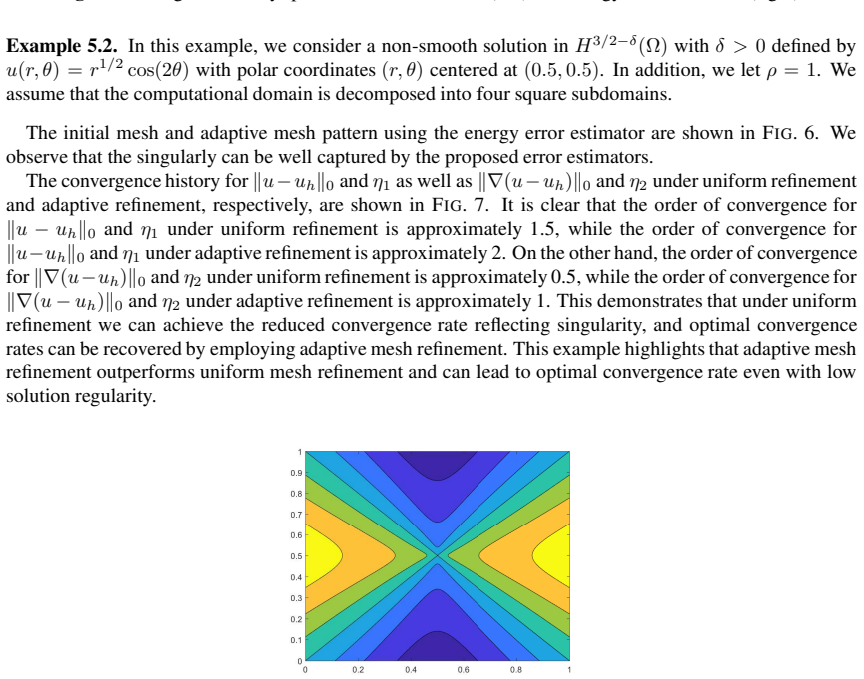
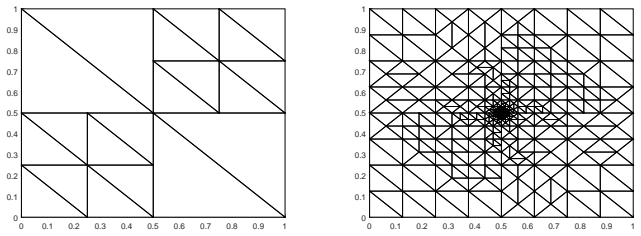
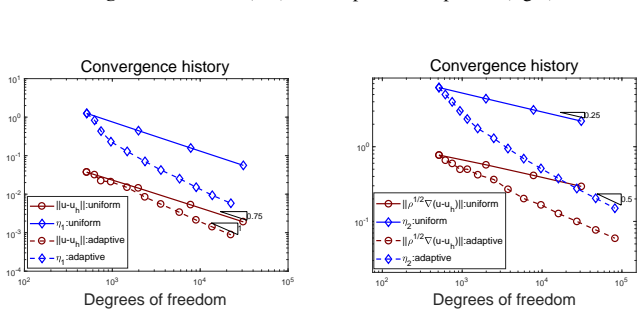
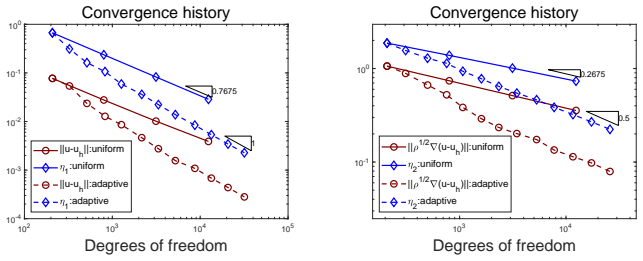
- [§5, Example 5.2] The legends in Fig. 7 appear truncated, for example '|| 1/2 (u-uh)||', and the intended quantity is presumably ‖ρ^{1/2}∇(u−u_h)‖; the labels should be corrected so the reported convergence history is unambiguous.
- [Throughout] There are several typographical errors, including 'Bot h' in the abstract and 'coefficients'; a careful proofreading pass is needed before publication.
Circularity Check
No circular derivation: estimators are residual-based and proved by standard duality/interpolation; only minor non-load-bearing self-citations.
full rationale
The two estimators η1 (3.4) and η2 (3.9) are constructed directly from residuals of the discrete mortar SDG equations (2.4): elementwise f+∇·zh, zh−ρ∇uh, flux jumps, interface flux mismatches, and solution jumps. No parameter is fitted to the error quantities that the estimators purport to predict. Reliability of η1 (Theorem 3.1) uses the duality argument with the elliptic regularity assumption (3.6) and interpolation estimates (3.3) sourced to Ciarlet and the earlier mortar SDG paper; these are external technical tools, not the target estimate. Reliability of η2 (Theorem 3.2) decomposes the energy error into a conforming part controlled by Scott–Zhang interpolation and a nonconforming part controlled by Lemma 3.1, cited from Wang–Xu and Karakashian–Pascal rather than assumed from the present paper. Efficiency (Theorem 4.1) uses standard bubble-function arguments. Lemma 2.1 is cited from the authors' earlier work [24], but it is used only in Remark 4.1 to note comparability of the right-hand-side terms; the efficiency theorem itself is proved without it. The possible concern that Lemma 3.1 as stated cannot hold for discontinuous ρ is a correctness/validity concern, not circularity, since the paper does not define the estimator in terms of the error it bounds. Overall the derivation chain is self-contained with respect to the claimed results, and self-citations are not load-bearing.
Assumptions & free parameters
assumptions (6)
- domain assumption The auxiliary dual problem (3.5) satisfies the elliptic regularity estimate ||w||_2 ≤ C||u-u_h||_0.
- domain assumption The domain partition is geometrically conforming and each subdomain triangulation is quasi-uniform and shape-regular.
- standard math Scott-Zhang local quasi-interpolation estimates in Lemma 3.2 hold for functions in H^1_0(Ω).
- domain assumption Lemma 3.1, bounding the conforming gap of the SDG solution by jumps on F_p and T_{Γ,h}, holds for the mortar SDG space.
- standard math A priori error estimates of Lemma 2.1 (from [24]) hold.
- standard math f_h is a piecewise linear approximation of f with standard approximation properties.
Cite this review
Pith. "Pith review of A posteriori error estimates for the mortar staggered DG method." pith.science (2026). https://pith.science/paper/LKQCMEZV
@misc{pith2026190803395,
  author       = {Pith},
  title        = {Pith review of: A posteriori error estimates for the mortar staggered DG method},
  year         = {2026},
  howpublished = {\url{https://pith.science/paper/LKQCMEZV}},
  note         = {Machine review of arXiv:1908.03395}
}
abstract
Two residual-type error estimators for the mortar staggered discontinuous Galerkin discretizations of second order elliptic equations are developed. Both error estimators are proved to be reliable and efficient. Key to the derivation of the error estimator in potential $L^2$ error is the duality argument. On the other hand, an auxiliary function is defined, making it capable of decomposing the energy error into conforming part and nonconforming part, which can be combined with the well-known Scott-Zhang local quasi-interpolation operator and the mortar discrete formulation yields an error estimator in energy error. Importantly, our analysis for both error estimators does not require any saturation assumptions which are often needed in the literature. Several numerical experiments are presented to confirm our proposed theories.
Figures
Figures from the paper (6 more)
Reference graph
Works this paper leans on
-
[1]
M. A INSWORTH , A posteriori error estimation for lowest order Raviart-Tho mas mixed finite elements , SIAM J. Sci. Comput., 30 (2005), pp. 189–204
work page 2005
-
[2]
I. B ABU ˇSKA AND W. C. R HEINBOLDT , Error estimates for adaptive finite element computations , SIAM J. Numer. Anal., 15 (1978), pp. 736–754. 15
work page 1978
-
[3]
I. B ABU ˇSKA AND W. C. R HEINBOLDT , A posteriori error estimates for the finite element method , Int. J. Numer. Methods Eng., 12 (1978), pp. 1597–1615
work page 1978
-
[4]
C. B ERNARDI AND F. H ECHT , Error indicators for the mortar finite element discretizati on of the Laplace equations, Math. Comp., 71 (2002), pp. 1371–1403
work page 2002
-
[5]
C. B ERNARDI , Y. M ADAY, AND A. T. P ATERA , Domain decomposition by the mortar element method, In: H. G. Kaper, M. Garbey, G. W . Pieper, Asymptotic and Numer ical Methods for Partial Differential Equations with Critical Parametera, pp. 269–286. Kluwer, D ordrect (1993)
work page 1993
-
[6]
C. B ERNARDI , Y. M ADAY, AND A. T. P ATERA , A new nonconforming approach to domain decompo- sition: the mortar element method , In: H. Brezis, J. L. Lions, Nonlinear Partial Differential Equations and their Application, College De France Seminar, vol. XI, p p. 13–51. Pitman, London (1994)
work page 1994
-
[7]
D. B RAESS AND R. V ERF ¨URTH , A posteriori error estimators for the Raviart-Thomas eleme nt, SIAM J. Numer. Anal., 33 (1996), pp. 2431–2444
work page 1996
-
[8]
C ARSTENSEN , A posteriori error estimate for the mixed finite element meth od, Math
C. C ARSTENSEN , A posteriori error estimate for the mixed finite element meth od, Math. Comp., 66 (1997), pp. 465–476
work page 1997
Show all 40 references
-
[9]
C ARSTENSEN AND J
C. C ARSTENSEN AND J. G EDICKE , Robust residual-based a posteriori ArnoldWinther mixed fin iteele- ment analysis in elasticity , Comput. Methods Appl. Mech. Engrg., 300 (2016), pp. 245-26 4
2016
-
[10]
C ARSTENSEN AND J
C. C ARSTENSEN AND J. H U, A unifying theory of a posteriori error control for nonconfo rming finite element methods, Numer. Math., 107 (2007), pp. 473-502
2007
-
[11]
C ARSTENSEN , D
C. C ARSTENSEN , D. K IM, AND E.-J. P ARK , A priori and a posteriori pseudostress-velocity mixed finite element error analysis for the Stokes problem , SIAM J. Numer. Anal., 49 (2011), pp. 2501-2523
2011
-
[12]
C HEUNG , E
S. C HEUNG , E. T. C HUNG AND H. K IM, A mass conservative scheme for fluid-structure interaction problems by the staggered discontinuous Galerkin method , J. Sci. Comput., 74 (2018), pp. 1423–1456
2018
-
[13]
E. T. C HUNG AND B. E NGQUIST , Optimal discontinuous Galerkin methods for wave propagati on, SIAM J. Numer. Anal., 44 (2006), pp. 2131–2158
2006
-
[14]
E. T. C HUNG AND B. E NGQUIST , Optimal discontinuous Galerkin methods for the acoustic wa ve equation in higher dimensions , SIAM J. Numer. Anal., 47 (2009), pp. 3820–3848
2009
-
[15]
E. T. C HUNG , B. C OCKBURN , AND G. F U, The staggered DG method is the limit of a hybridizable DG method. Part II: the Stokes flow , J. Sci. Comput., 66 (2016), pp. 870–887
2016
-
[16]
E. T. C HUNG , E.-J. P ARK , AND L. Z HAO, Guaranteed a posteriori error estimates for a staggered discontinuous Galerkin method , J. Sci. Comput., 75 (2018), pp. 1079–1101
2018
-
[17]
E. T. C HUNG AND W. Q IU, Analysis of an SDG method for the incompressible Navier-Sto kes equa- tions, SIAM. J. Numer. Anal., 55 (2017), pp. 543–569
2017
-
[18]
P. G. C IARLET , The Finite Element Method for Elliptic Problems , North-Holland Publishing, Ams- terdam, 1978
1978
-
[19]
D U AND E
J. D U AND E. T. C HUNG , An adaptive staggered discontinuous Galerkin method for th e steady state convection-diffusion equation, J. Sci. Comput., 77 (2018), pp. 1490–1518
2018
-
[20]
J. D U, E. T. C HUNG , M. L AM, AND X.-P. W ANG , Discontinuous Galerkin method with staggered hybridization for a class of nonlinear Stokes equations , J. Sci. Comput., 76 (2018), pp. 1547–1577
2018
-
[21]
E RN AND M
A. E RN AND M. V OHRAL ´IK, Polynomial-degree-robust a posteriori estimates in a unifi ed setting for conforming, nonconforming, discontinuous Galerkin, a nd mixed discretizations , SIAM J. Numer. Anal., 53 (2015), pp. 1058–1081
2015
-
[22]
O. A. K ARAKASHIAN AND F. P ASCAL , A posteriori error estimates for a discontinuous Galerkin approximation of second-order elliptic problems, SIAM J. Numer. Anal., 41 (2003), pp. 2374–2399. 16
2003
-
[23]
K. Y. K IM, A posteriori error analysis for locally conservative mixed methods, Math. Comp., 76 (2007), pp. 43–66
2007
-
[24]
H. K IM, E. T. C HUNG , AND C.-Y. L AM, Mortar formulation for a class of staggered discontinuous Galerkin methods, Comput. Math. Appl., 71 (2016), pp. 1568–1585
2016
-
[25]
K IM AND E.-J
D. K IM AND E.-J. P ARK , A posteriori error estimators for the upstream weighting mixed methods for convection diffusion problems, Comput. Methods Appl. Mech. Engrg., 197 (2008), pp. 806–82 0
2008
-
[26]
K IM AND E.-J
D. K IM AND E.-J. P ARK , A priori and a posteriori analysis of mixed finite element met hods for nonlinear elliptic equations , SIAM J. Numer. Anal., 48 (2010), pp. 1186–1207
2010
-
[27]
M. G. L ARSON AND A. M ˚ALQVIST , A posteriori error estimates for mixed finite element approx i- mations of elliptic problems , Numer. Math., 108 (2008), pp. 487–500
2008
-
[28]
J. J. L EE AND H. K IM, Analysis of a staggered discontinuous Galerkin method for l inear elasticity, J. Sci. Comput., 66 (2016), pp. 625–649
2016
-
[29]
R IV `ERE AND M
B. R IV `ERE AND M. F. W HEELER , A posteriori error estimates for a discontinuous Galerkin m ethod applied to elliptic problems , Comput. Math. Appl., 46 (2003), pp. 141–163
2003
-
[30]
L. R. S COTT AND S. Z HANG , Finite-element interpolation of non-smooth functions satisfying bound- ary conditions, Math. Comp., 54 (1990), pp. 483–493
1990
-
[31]
V ERF ¨URTH , A review of a posteriori error estimation and adaptive mesh- refinement techniques , Teubner-Wiley, Stuttgart (1996)
R. V ERF ¨URTH , A review of a posteriori error estimation and adaptive mesh- refinement techniques , Teubner-Wiley, Stuttgart (1996)
1996
-
[32]
V OHRAL ´IK, A posteriori error estimates for lowest-order mixed finite e lement discretization of convection-diffusion-reaction equations, SIAM J
M. V OHRAL ´IK, A posteriori error estimates for lowest-order mixed finite e lement discretization of convection-diffusion-reaction equations, SIAM J. Numer. Anal., 45 (2007), pp. 1570–1599
2007
-
[33]
V OHRAL ´IK, Guaranteed and fully robust a posteriori error estimates fo r conforming discretiza- tions of diffusion problems with discontinuous coefficient s, J
M. V OHRAL ´IK, Guaranteed and fully robust a posteriori error estimates fo r conforming discretiza- tions of diffusion problems with discontinuous coefficient s, J. Sci. Comput., 46 (2010), pp. 397–438
2010
-
[34]
W ANG AND X
F. W ANG AND X. X U, Some new residual-based a posteriori error estimators for t he mortar finite element method, Numer. Math., 120 (2012), pp. 543–571
2012
-
[35]
M. F. W HEELER AND I. Y OTOV, A posteriori error estimates for the mortar mixed finite elem ent method, SIAM J. Numer. Anal., 43 (2005), pp. 1021–1042
2005
-
[36]
B. I. W OHLMUTH , A residual based error estimator for mortar finite element di scretization, Numer. Math., 84 (1999), pp. 143–171
1999
-
[37]
B. I. W OHLMUTH , Hierarchical a posteriori error estimators for mortar finit e element methods with Lagrange multipliers, SIAM J. Numer. Anal., 36 (1999), pp. 1636–1658
1999
-
[38]
Z HAO AND E.-J
L. Z HAO AND E.-J. P ARK , A staggered discontinuous Galerkin method of minimal dimen sion on quadrilateral and polygonal meshes , SIAM J. Sci. Comput., 40 (2018), pp. 2543–2567
2018
-
[39]
Z HAO AND E.-J
L. Z HAO AND E.-J. P ARK , A priori and a posteriori error analysis of a staggered disco ntinuous Galerkin method for convection dominant diffusion equatio ns, J. Comput. Appl. Math., 346 (2019), pp. 63–83
2019
-
[40]
Z HAO, E.-J
L. Z HAO, E.-J. P ARK , AND D.- W. S HIN , A staggered discontinuous Galerkin method for the Stokes equations on general meshes , Comput. Methods Appl. Mech. Engrg., 345 (2019), pp. 854–87 5. 17
2019
Reviewed August 14, 2026 · model on record in the stance chip above.
Discussion (0). Continue with ORCID to comment.