Specification-aware Robustness Margins for Symbolic Controllers
Pith reviewed 2026-06-29 03:03 UTC · model grok-4.3
The pith
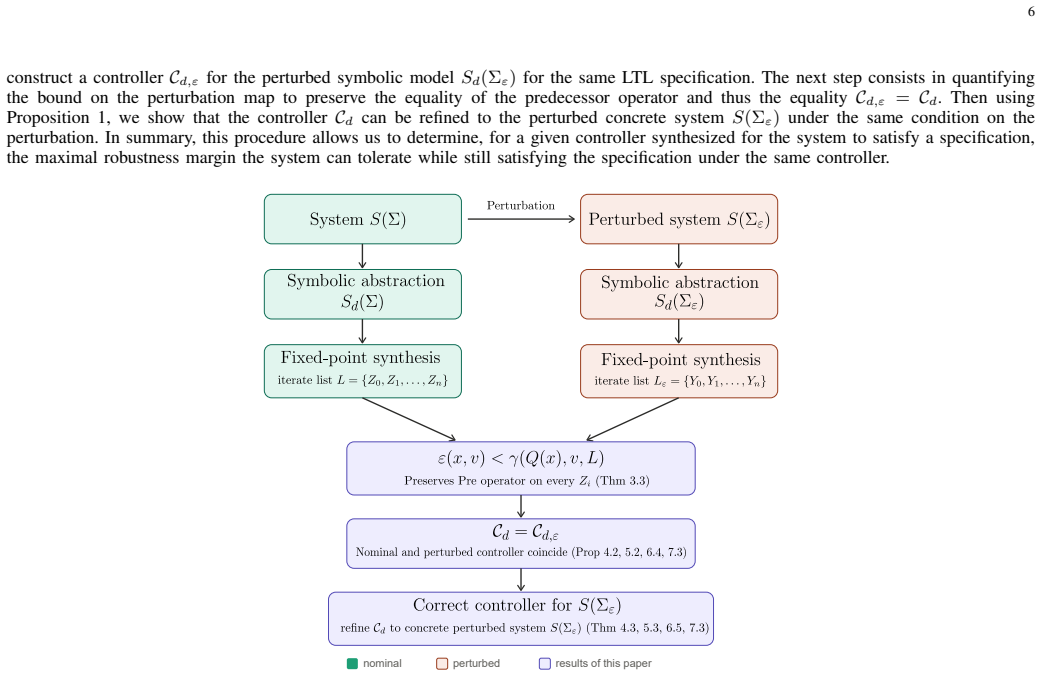
Symbolic controllers synthesized for LTL specifications remain correct on perturbed linear systems up to a margin computed from the fixed-point sets.
A machine-rendered reading of the paper's core claim, the machinery that carries it, and where it could break.
Core claim
Controllers synthesized based on the symbolic model can be refined back to a perturbed version of the concrete system while preserving their correctness, with the maximal robustness margin depending explicitly on the sequence of sets generated during the fixed-point computation and yielding customized, less conservative guarantees for each of safety, reachability, persistence, and recurrence specifications.
What carries the argument
Specification-dependent robustness margin derived from the sequence of sets produced by the fixed-point algorithm in symbolic controller synthesis.
If this is right
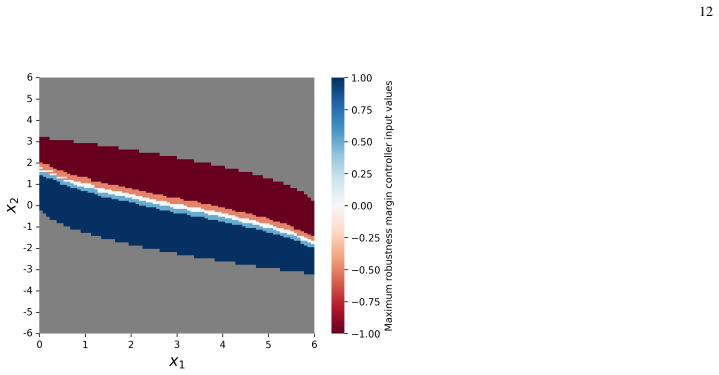
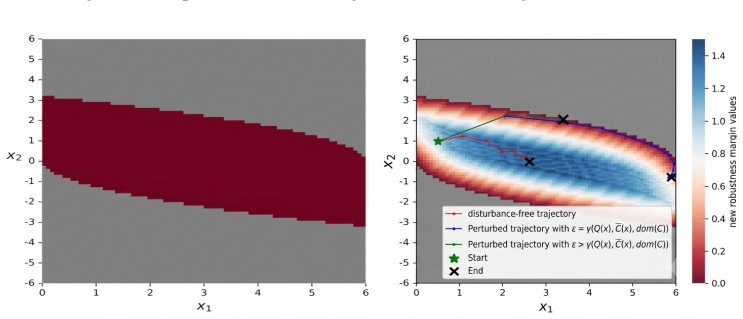
- For safety specifications the margin equals the minimum distance between the computed invariant set and the unsafe region adjusted by the perturbation bound.
- For reachability the margin is determined by the distance from the target set to the boundary of the attractor set obtained in the fixed-point iteration.
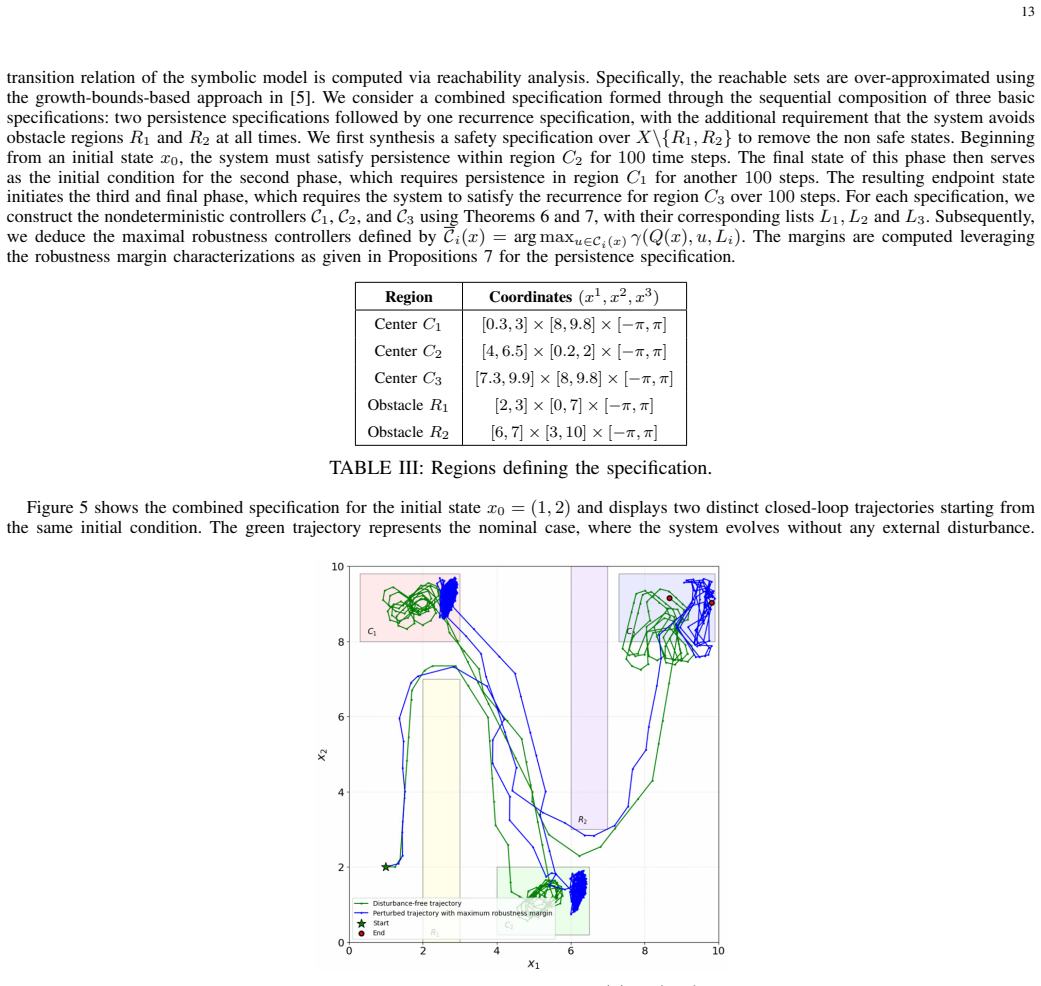
- For persistence and recurrence specifications the margin accounts for the cyclic visits to the respective sets in the fixed-point sequence.
- The same controller works for any perturbation below the derived margin without requiring re-synthesis.
- The bounds are strictly tighter than those from uniform abstraction-error analysis because they exploit the particular sets generated for the given specification.
Where Pith is reading between the lines
- The same margin computation could be reused at runtime to monitor whether an observed disturbance has exceeded the certified limit.
- The approach may extend to hybrid or nonlinear systems if an analogous fixed-point sequence can be computed on their abstractions.
- Designers could trade off specification strength against larger allowable perturbations by choosing different LTL formulas and recomputing the margin.
- The method supplies a concrete test for when a symbolic controller can be deployed on hardware whose parameters drift within a known range.
Load-bearing premise
The symbolic controller was synthesized correctly for the exact nominal system and the concrete dynamics belong to the linear class for which the abstraction-refinement relation holds under bounded perturbations.
What would settle it
Take one of the paper's two example systems, apply a perturbation larger than the computed margin for its specification, and check whether the closed-loop trajectory violates the specification under the original controller.
Figures


read the original abstract
We address the problem of robust controller synthesis for a class of linear temporal logic (LTL) specifications over families of perturbed systems using symbolic control techniques. Given a dynamical system, a specification, and a symbolic controller synthesized using the fixed-point algorithm of the specification, the objective is to find the maximal perturbation we can apply to the system while the system continues to satisfy the same specification under the same controller. We first provide general results, by demonstrating that controllers synthesized based on the symbolic model can be refined back to a perturbed version of the concrete system while preserving their correctness. Focusing on four fundamental temporal logic specifications, namely safety, reachability, persistence, and recurrence, we introduce a general measure of the maximal robustness margin. Then, for each class of specifications, we derive a customized version of the measure and establish the corresponding theoretical guarantees. Importantly, the robustness margin depends explicitly on the sequence of sets generated during the fixed-point computation, allowing for specification-dependent and less conservative bounds compared to generic abstraction-based approaches. The theoretical developments are illustrated on two examples, demonstrating the practical applicability and effectiveness of the proposed approach.
Editorial analysis
A structured set of objections, weighed in public.
Referee Report
Summary. The paper addresses robust controller synthesis for LTL specifications over families of perturbed linear systems via symbolic control. Given a dynamical system, an LTL specification, and a symbolic controller obtained from the standard fixed-point algorithm, it seeks the maximal perturbation bound such that the same controller still enforces the specification on the perturbed concrete system. General refinement results are stated showing that symbolic controllers can be transferred to perturbed concrete dynamics while preserving correctness. For the four core specifications (safety, reachability, persistence, recurrence) the authors derive customized, specification-dependent robustness margins that are expressed directly in terms of the sequence of sets produced by the fixed-point computation; these margins are claimed to be less conservative than generic abstraction-based bounds. The developments are illustrated on two numerical examples.
Significance. If the refinement relation holds under the stated conditions, the work supplies a concrete, computable way to obtain specification-aware robustness margins that exploit the internal structure of the synthesis algorithm rather than relying on uniform over-approximations. This could reduce conservatism in symbolic controller design for safety-critical linear systems subject to bounded disturbances. The explicit dependence on the fixed-point sets and the provision of theoretical guarantees for each specification class constitute the main technical contribution.
major comments (2)
- [General results] General results paragraph: the claim that a controller synthesized on the nominal symbolic model refines to a perturbed concrete system while preserving LTL correctness is load-bearing for all subsequent margin derivations, yet the precise hypotheses on system linearity, the form of the perturbation (additive, multiplicative, etc.), and the preservation of the abstraction-refinement relation up to the computed margin are not stated explicitly. Without these conditions the refinement step cannot be verified.
- [Customized margins] Customized margin derivations for safety/reachability/persistence/recurrence: each margin is asserted to be maximal and to depend explicitly on the fixed-point sequence, but the manuscript must supply a self-contained argument showing that any larger perturbation would violate the specification for at least one trajectory admitted by the concrete dynamics; the current abstract-level statement leaves open whether the maximality proof relies on additional unstated assumptions about the disturbance set.
minor comments (2)
- [Examples] The two illustrative examples should include explicit numerical values of the computed margins together with a comparison against a generic (non-specification-aware) robustness bound to substantiate the claim of reduced conservatism.
- [Notation] Notation for the sequence of sets generated by the fixed-point algorithm should be introduced once and used consistently when defining the four customized margins.
Simulated Author's Rebuttal
We thank the referee for the constructive feedback and the recommendation for major revision. We address each major comment below and will revise the manuscript accordingly to improve clarity and completeness.
read point-by-point responses
-
Referee: [General results] General results paragraph: the claim that a controller synthesized on the nominal symbolic model refines to a perturbed concrete system while preserving LTL correctness is load-bearing for all subsequent margin derivations, yet the precise hypotheses on system linearity, the form of the perturbation (additive, multiplicative, etc.), and the preservation of the abstraction-refinement relation up to the computed margin are not stated explicitly. Without these conditions the refinement step cannot be verified.
Authors: We agree that the hypotheses require more explicit statement. The general results assume linear dynamics with additive perturbations belonging to a known compact set containing the origin; the refinement relation is preserved precisely when the perturbation bound does not exceed the derived margin, because the symbolic controller is synthesized on an abstraction that over-approximates the perturbed transitions. We will revise the opening of the general results section to list these assumptions in a dedicated paragraph and restate the precise conditions under which the abstraction-refinement relation holds up to the margin. revision: yes
-
Referee: [Customized margins] Customized margin derivations for safety/reachability/persistence/recurrence: each margin is asserted to be maximal and to depend explicitly on the fixed-point sequence, but the manuscript must supply a self-contained argument showing that any larger perturbation would violate the specification for at least one trajectory admitted by the concrete dynamics; the current abstract-level statement leaves open whether the maximality proof relies on additional unstated assumptions about the disturbance set.
Authors: The maximality arguments appear in the proofs for each specification class and rely on constructing an explicit disturbance sequence (within the assumed compact disturbance set) that forces at least one trajectory to exit the relevant fixed-point set when the perturbation exceeds the margin. These proofs are self-contained once the disturbance set is fixed, but we acknowledge that the main text currently summarizes rather than reproduces the key steps. We will expand the main-text statements of the four margin theorems to include a concise outline of the maximality argument and explicitly restate the standing assumption that the disturbance set is compact and contains the origin. revision: yes
Circularity Check
No circularity: margins derived directly from fixed-point sets without reduction to inputs or self-citations
full rationale
The paper's central derivation starts from the standard fixed-point algorithm for symbolic synthesis (an external input) and computes specification-dependent robustness margins explicitly from the generated sets. General refinement results are stated as demonstrated within the work for linear systems under bounded perturbations, with no quoted self-citation chains, fitted parameters renamed as predictions, or ansatzes smuggled via prior author work. The customized margins for safety/reachability/etc. are presented as direct functions of those sets, preserving independent content. This is the common case of a self-contained extension of known abstraction-refinement techniques.
Axiom & Free-Parameter Ledger
axioms (2)
- domain assumption The fixed-point algorithm produces a correct symbolic controller for the nominal unperturbed system.
- domain assumption The dynamical system is linear and the abstraction relation is preserved under bounded perturbations.
Reference graph
Works this paper leans on
-
[1]
An overview of autonomous vehicles sensors and their vulnerability to weather conditions,
J. Vargas, S. Alsweiss, O. Toker, R. Razdan, and J. Santos, “An overview of autonomous vehicles sensors and their vulnerability to weather conditions,” Sensors, vol. 21, no. 16, p. 5397, 2021
2021
-
[2]
Grid forming converters in renewable energy sources dominated power grid: Control strategy, stability, application, and challenges,
H. Zhang, W. Xiang, W. Lin, and J. Wen, “Grid forming converters in renewable energy sources dominated power grid: Control strategy, stability, application, and challenges,”Journal of modern power systems and clean energy, vol. 9, no. 6, pp. 1239–1256, 2021
2021
-
[3]
Tabuada,Verification and control of hybrid systems: a symbolic approach
P. Tabuada,Verification and control of hybrid systems: a symbolic approach. Springer Science and Business Media, 2009
2009
-
[4]
Contract-based design of symbolic controllers for safety in distributed multiperiodic sampled-data systems,
A. Saoud, A. Girard, and L. Fribourg, “Contract-based design of symbolic controllers for safety in distributed multiperiodic sampled-data systems,” IEEE Transactions on Automatic Control, vol. 66, no. 3, pp. 1055–1070, 2020
2020
-
[5]
Feedback refinement relations for the synthesis of symbolic controllers,
G. Reissig, A. Weber, and M. Rungger, “Feedback refinement relations for the synthesis of symbolic controllers,”IEEE Transactions on Automatic Control, vol. 62, no. 4, pp. 1781–1796, 2017
2017
-
[6]
Multi-layered abstraction-based controller synthesis for continuous-time systems,
K. Hsu, R. Majumdar, K. Mallik, and A.-K. Schmuck, “Multi-layered abstraction-based controller synthesis for continuous-time systems,” inProceedings of the 21st International Conference on Hybrid Systems: Computation and Control, 2018, pp. 120–129
2018
-
[7]
Compositional and efficient controller synthesis for cyber-physical systems,
A. Saoud, “Compositional and efficient controller synthesis for cyber-physical systems,” Ph.D. dissertation, Universit ´e Paris Saclay (COmUE), 2019
2019
-
[8]
Set propagation techniques for reachability analysis,
M. Althoff, G. Frehse, and A. Girard, “Set propagation techniques for reachability analysis,”Annual Review of Control, Robotics, and Autonomous Systems, 2021
2021
-
[9]
Finite abstraction of mixed monotone systems with discrete and continuous inputs,
S. Coogan and M. Arcak, “Finite abstraction of mixed monotone systems with discrete and continuous inputs,”Nonlinear Analysis: Hybrid Systems, vol. 23, pp. 254–271, 2017
2017
-
[10]
Symbolic models for stochastic control systems without stability assumptions,
M. Zamani, P. M. Esfahani, A. Abate, and J. Lygeros, “Symbolic models for stochastic control systems without stability assumptions,” in2013 European Control Conference (ECC). IEEE, 2013, pp. 4257–4262
2013
-
[11]
Approximately bisimilar symbolic models for incrementally stable switched systems,
A. Girard, G. Pola, and P. Tabuada, “Approximately bisimilar symbolic models for incrementally stable switched systems,”IEEE Transactions on Automatic Control, vol. 55, no. 1, pp. 116–126, 2009
2009
-
[12]
Computing abstractions of nonlinear systems,
G. Reissig, “Computing abstractions of nonlinear systems,”IEEE Transactions on Automatic Control, vol. 56, no. 11, p. 2583–2598, 2011
2011
-
[13]
Baier and J.-P
C. Baier and J.-P. Katoen,Principles of model checking. MIT press, 2008
2008
-
[14]
Classification of simulation relations for symbolic control,
J. Calbert, A. Girard, and R. M. Jungers, “Classification of simulation relations for symbolic control,” 2024. [Online]. Available: https://arxiv.org/abs/2410.06083
-
[15]
Alternating refinement relations,
R. Alur, T. A. Henzinger, O. Kupferman, and M. Y . Vardi, “Alternating refinement relations,” inCONCUR ’98: Concurrency Theory, 9th International Conference, Nice, France, September 8-11, 1998, Proceedings, ser. Lecture Notes in Computer Science, vol. 1466. Springer, 1998, pp. 163–178
1998
-
[16]
Finite abstractions with robustness margins for temporal logic-based control synthesis,
J. Liu and N. Ozay, “Finite abstractions with robustness margins for temporal logic-based control synthesis,”Nonlinear Analysis: Hybrid Systems, 2016
2016
-
[17]
Resilience to intermittent assumption violations in reactive synthesis,
R. Ehlers and U. Topcu, “Resilience to intermittent assumption violations in reactive synthesis,” inProceedings of the 17th international conference on Hybrid systems: computation and control, 2014, pp. 203–212
2014
-
[18]
Towards robustness for cyber-physical systems,
P. Tabuada, S. Y . Caliskan, M. Rungger, and R. Majumdar, “Towards robustness for cyber-physical systems,”IEEE Transactions on Automatic Control, vol. 59, no. 12, pp. 3151–3163, 2014
2014
-
[19]
A notion of robustness for cyber-physical systems,
M. Rungger and P. Tabuada, “A notion of robustness for cyber-physical systems,”IEEE Transactions on Automatic Control, vol. 61, no. 8, pp. 2108–2123, 2015
2015
-
[20]
Synthesis of input-to-state attractivity controllers for transition systems with disturbances,
W. A. Apaza-Perez and A. Girard, “Synthesis of input-to-state attractivity controllers for transition systems with disturbances,”IEEE Transactions on Automatic Control, 2024
2024
-
[21]
Temporal logic resilience for dynamical systems,
A. Saoud, P. Jagtap, and S. Soudjani, “Temporal logic resilience for dynamical systems,”IEEE Transactions on Automatic Control, 2025
2025
-
[22]
Maximally resilient controllers under temporal logic specifications,
Y . A. Si, R. Das, N. Monir, S. Soudjani, P. Jagtap, and A. Saoud, “Maximally resilient controllers under temporal logic specifications,” in2025 IEEE 64th Conference on Decision and Control (CDC), 2025. 15
2025
-
[23]
Computation of feasible assume-guarantee contracts: A resilience-based approach,
N. Monir, Y . A. Si, R. Das, P. Jagtap, A. Saoud, and S. Soudjani, “Computation of feasible assume-guarantee contracts: A resilience-based approach,” in2025 IEEE 64th Conference on Decision and Control (CDC), 2025
2025
-
[24]
Symbolic ltlf synthesis,
S. Zhu, L. M. Tabajara, J. Li, G. Pu, and M. Y . Vardi, “Symbolic ltlf synthesis,” inProceedings of the Twenty-Sixth International Joint Conference on Artificial Intelligence, IJCAI-17, 2017, pp. 1362–1369
2017
-
[25]
Symbolic models for nonlinear control systems affected by disturbances,
A. Borri, G. Pola, and M. D. Di Benedetto, “Symbolic models for nonlinear control systems affected by disturbances,”International Journal of Control, vol. 85, no. 10, pp. 1422–1432, 2012
2012
-
[26]
Incremental abstraction computation for symbolic controller synthesis in a changing environment,
Y . Bai, K. Mallik, A.-K. Schmuck, D. Zufferey, and R. Majumdar, “Incremental abstraction computation for symbolic controller synthesis in a changing environment,” in2019 IEEE 58th Conference on Decision and Control (CDC). IEEE, 2019, pp. 6261–6268
2019
-
[27]
Accurate abstractions for controller synthesis with non-uniform disturbances,
Y . Bai and K. Mallik, “Accurate abstractions for controller synthesis with non-uniform disturbances,” inFormal Methods and Software Engineering. Springer International Publishing, 2020, pp. 297–307
2020
-
[28]
Symbolic control: Unveiling free robustness margins,
Y . Aitsi, A. Girard, and A. Saoud, “Symbolic control: Unveiling free robustness margins,” in23rd European Control Conference (ECC25), 2025
2025
-
[29]
V . I. Istratescu,Fixed point theory: an introduction. Springer Science & Business Media, 2001, vol. 7
2001
-
[30]
Gr ¨adel, W
E. Gr ¨adel, W. Thomas, and T. Wilke,Automata, logics, and infinite games: a guide to current research. Springer, 2003
2003
-
[31]
Program derivation by fixed point computation,
J. Cai and R. Paige, “Program derivation by fixed point computation,”Science of Computer Programming, vol. 11, no. 3, pp. 197–261, 1989
1989
-
[32]
B. A. Davey and H. A. Priestley,Introduction to Lattices and Order, 2nd ed. Cambridge University Press, 2002
2002
-
[33]
Approximation metrics for discrete and continuous systems,
A. Girard and G. J. Pappas, “Approximation metrics for discrete and continuous systems,”IEEE Transactions on Automatic Control, vol. 52, no. 5, pp. 782–798, 2007
2007
-
[34]
Symbolic control of stochastic systems via approximately bisimilar finite abstractions,
M. Zamani, P. M. Esfahani, R. Majumdar, A. Abate, and J. Lygeros, “Symbolic control of stochastic systems via approximately bisimilar finite abstractions,”IEEE Transactions on Automatic Control, vol. 59, no. 12, pp. 3135–3150, 2014
2014
-
[35]
On the synthesis of discrete controllers for timed systems,
O. Maler, A. Pnueli, and J. Sifakis, “On the synthesis of discrete controllers for timed systems,” inAnnual symposium on theoretical aspects of computer science. Springer, 1995, pp. 229–242
1995
-
[36]
Pybullet, a python module for physics simulation in robotics, games and machine learning,
E. Coumans and Y . Bai, “Pybullet, a python module for physics simulation in robotics, games and machine learning,” 2016–2021. [Online]. Available: https://pybullet.org APPENDIX We have the following auxiliary result for which the proof is straightforward, and thus omitted. Lemma 4.Consider the discrete-time control systemΣin (2) and its associated symbol...
2016
discussion (0)
Sign in with ORCID, Apple, or X to comment. Anyone can read and Pith papers without signing in.