Measuring Opportunity Cost with Stock Lifetime Value
Pith reviewed 2026-07-03 02:15 UTC · model grok-4.3
The pith
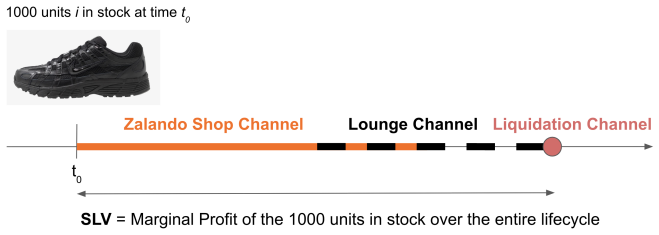
SLV aggregates expected profit from current inventory through its full selling lifecycle to measure true opportunity cost in short e-commerce experiments.
A machine-rendered reading of the paper's core claim, the machinery that carries it, and where it could break.
Core claim
SLV aggregates the expected profit from current inventory through the end of its selling lifecycle, providing a way to evaluate interventions against their true profit impact.
What carries the argument
Stock Lifetime Value (SLV), which sums projected profit contributions of each current stock unit across its remaining selling window rather than stopping at the experiment close.
If this is right
- Article-level and customer-level A/B tests can use SLV efficiency as the primary metric and still align with realized long-term profit.
- Pricing algorithms can optimize directly against SLV, removing the mismatch between measurement and decision objectives.
- Treatment effects observed in short windows can be annualized into the financial reporting metrics required by business stakeholders.
- The same framework extends to any inventory-constrained setting where value decays over time or demand shifts across periods.
Where Pith is reading between the lines
- SLV might reduce the need for long-running experiments in other retail categories that face similar stock decay, such as electronics or perishables.
- If demand shifts are strongly seasonal, SLV projections could be improved by incorporating calendar-aware adjustments without lengthening test windows.
- The metric creates an implicit bridge between online experimentation and traditional inventory accounting, potentially allowing finance teams to treat experimental results as direct inputs to profit forecasts.
Load-bearing premise
Expected profit from current inventory through the end of its lifecycle can be estimated reliably from short experimental windows without material bias from unmodeled seasonality, demand shifts, or stock dynamics.
What would settle it
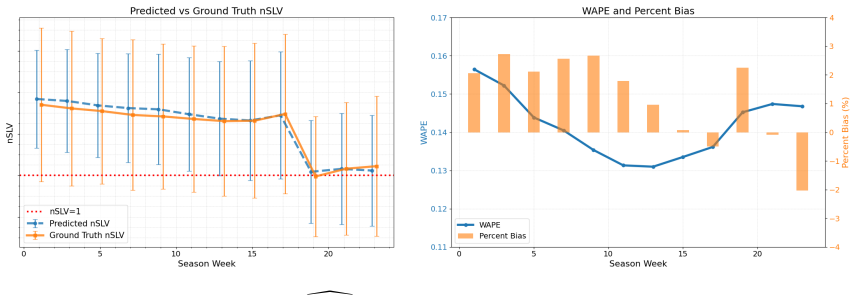
Compare SLV estimates computed from a one-week experiment against the actual realized profit of the same inventory cohort tracked over its full 18-month lifecycle and check for statistically significant divergence.
Figures

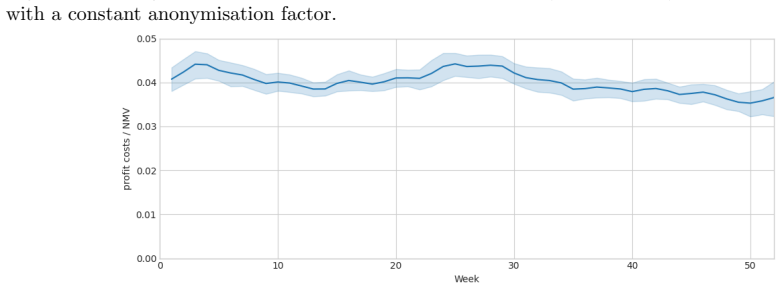
read the original abstract
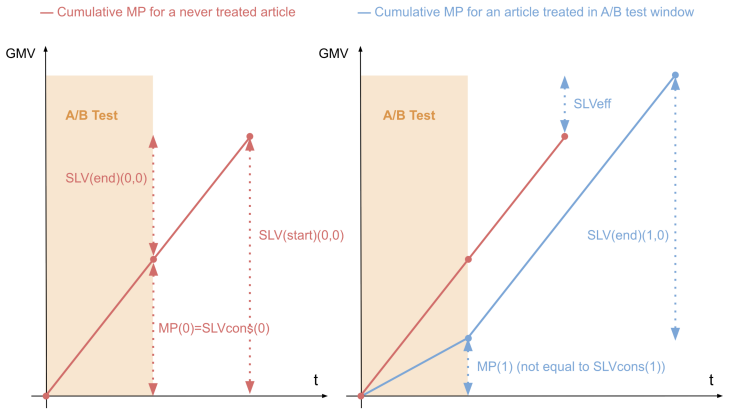
Measuring the long-term opportunity cost of interventions remains a critical challenge in e-commerce A/B testing. While strategic levers (such as dynamic pricing, ranking algorithms, and promotional campaigns) trigger shifts in consumer behaviour that persist over months, operational constraints necessitate fast decision-making cycles that are typically limited to weekly experimental windows. Standard metrics like revenue and conversion are inherently short-sighted, biasing decisions toward immediate gains. We introduce Stock Lifetime Value (SLV), a stock-centric metric that captures long-term opportunity cost within short experiments by aggregating expected profit from current inventory through the end of its selling lifecycle. We develop the methodology in the context of fashion e-commerce at Zalando, where stock constraints and seasonal lifecycles make the trade off between short-term and long-term outcomes particularly relevant. SLV aggregates the expected profit from current inventory through the end of its selling lifecycle, providing a way to evaluate interventions against their true profit impact. We discuss three applications: (a) SLV efficiency as a metric for article-level and customer-level A/B tests, validated against realized 18-month lifecycle outcomes; (b) SLV as an optimization target for pricing algorithms, aligning the metric used for measurement with the objective used for decision-making; and (c) a framework for annualizing treatment effects into financial reporting metrics required by business stakeholders. While our empirical setting is fashion retail, the framework applies broadly to any inventory-constrained environment where value decays over time or interventions shift demand across periods.
Editorial analysis
A structured set of objections, weighed in public.
Referee Report
Summary. The manuscript introduces Stock Lifetime Value (SLV), a stock-centric metric that aggregates expected profit from current inventory through the end of its selling lifecycle to measure the long-term opportunity cost of interventions in e-commerce A/B testing. Developed in the fashion retail setting at Zalando, it presents three applications: (a) use of SLV efficiency in article- and customer-level A/B tests with claimed validation against realized 18-month outcomes; (b) SLV as an optimization target for pricing algorithms; and (c) a framework for annualizing treatment effects into financial reporting metrics. The approach is positioned as applicable to any inventory-constrained environment with time-decaying value.
Significance. If the SLV construction and extrapolation can be shown to deliver unbiased long-term profit estimates from short windows, the metric would address a practical gap in aligning experimental design with inventory-constrained profit maximization, potentially improving decision quality in retail A/B testing and pricing.
major comments (2)
- [Abstract] Abstract: The claim of validation against realized 18-month lifecycle outcomes supplies no derivation, functional form for the extrapolation, data description, or error analysis. This is load-bearing for the central assertion that SLV captures true profit impact without material bias.
- [Abstract] Abstract: The methodology for estimating expected profit from short experimental windows is not specified, leaving unaddressed whether the aggregation relies on untested assumptions about demand stability, seasonality, or stock dynamics over the full lifecycle. This directly affects the reliability of all three applications.
minor comments (1)
- [Abstract] The sentence describing SLV aggregation is repeated verbatim in the abstract; this should be consolidated for conciseness.
Simulated Author's Rebuttal
We thank the referee for the constructive comments on the abstract. The points raised are valid regarding the level of detail provided in the abstract itself. We address each below and will revise the abstract accordingly while preserving the manuscript's core contributions.
read point-by-point responses
-
Referee: [Abstract] Abstract: The claim of validation against realized 18-month lifecycle outcomes supplies no derivation, functional form for the extrapolation, data description, or error analysis. This is load-bearing for the central assertion that SLV captures true profit impact without material bias.
Authors: We agree the abstract is too concise on this point. The full manuscript provides the derivation and functional form for extrapolating from short windows to 18-month outcomes (in the validation subsection of the applications), describes the Zalando fashion retail dataset used, and reports error metrics comparing SLV-based predictions to realized profits. We will revise the abstract to briefly reference the validation approach and direct readers to the relevant sections. revision: yes
-
Referee: [Abstract] Abstract: The methodology for estimating expected profit from short experimental windows is not specified, leaving unaddressed whether the aggregation relies on untested assumptions about demand stability, seasonality, or stock dynamics over the full lifecycle. This directly affects the reliability of all three applications.
Authors: The abstract does not detail the estimation process. The main text specifies the methodology, including models for expected profit that incorporate historical sales patterns, seasonality adjustments, and stock depletion dynamics, along with a discussion of assumptions (e.g., in the limitations section). We will revise the abstract to include a high-level description of the estimation and note the key assumptions. revision: yes
Circularity Check
No circularity: SLV introduced as conceptual aggregation without equations reducing to fitted inputs or self-citations
full rationale
The provided abstract and description introduce SLV as a stock-centric metric that aggregates expected profit from current inventory through end-of-lifecycle, with applications validated against 18-month outcomes. No equations, functional forms, fitting procedures, or self-citations are visible that would allow any derivation step to reduce by construction to its own inputs. The central claim remains a definitional proposal for a new metric rather than a fitted prediction or self-referential uniqueness theorem. This is the most common honest finding when no load-bearing reductions are exhibited.
Axiom & Free-Parameter Ledger
Reference graph
Works this paper leans on
-
[1]
Greenwade
George D. Greenwade. The C omprehensive T ex A rchive N etwork ( CTAN ). TUGBoat. 1993
1993
-
[2]
Large-Scale Price Optimization for an Online Fashion Retailer , year =
Li, Hanwei and Simchi-Levi, David and Sun, Rui and Wu, Michelle Xiao and Fux, Vladimir and Gellert, Torsten and Greiner, Thorsten and Taverna, Andrea , booktitle =. Large-Scale Price Optimization for an Online Fashion Retailer , year =
-
[3]
Foresight: The International Journal of Applied Forecasting , volume =
Makridakis, Spyros and Spiliotis, Evangelos , title =. Foresight: The International Journal of Applied Forecasting , volume =. 2021 , pages =
2021
-
[4]
LightGBM Parameters , howpublished =
-
[5]
Forecasting: Principles and Practice , year =
Hyndman,. Forecasting: Principles and Practice , year =
-
[6]
Forecasting: theory and practice , year =
Petropoulos, Fotios and Apiletti, Daniele and Assimakopoulos, Vassilios and Babai, Mohamed Zied and Barrow, Devon K and Taieb, Souhaib Ben and Bergmeir, Christoph and Bessa, Ricardo J and Bijak, Jakub and Boylan, John E and others , journal =. Forecasting: theory and practice , year =. doi:10.1016/j.ijforecast.2021.11.001 , publisher =
-
[7]
2022 , doi =
Kumar, Ravi and Boluki, Shahin and Isler, Karl and Rauch, Jonas and Walczak, Darius , title =. 2022 , doi =
2022
-
[8]
Forecasting with artificial intelligence: theory and applications , pages=
Deep Learning based Forecasting: a case study from the online fashion industry , author=. Forecasting with artificial intelligence: theory and applications , pages=. 2023 , publisher=
2023
-
[9]
Friedman, Jerome H. , journal =. Greedy function approximation: A gradient boosting machine. , year =. doi:10.1214/aos/1013203451 , publisher =
-
[10]
Making and Evaluating Point Forecasts , year =
Gneiting, Tilmann , journal =. Making and Evaluating Point Forecasts , year =. doi:10.1198/jasa.2011.r10138 , publisher =
-
[11]
Forecasting with trees , year =
Januschowski, Tim and Wang, Yuyang and Torkkola, Kari and Erkkilä, Timo and Hasson, Hilaf and Gasthaus, Jan , journal =. Forecasting with trees , year =. doi:10.1016/j.ijforecast.2021.10.004 , publisher =
-
[12]
LightGBM:
Guolin Ke and Qi Meng and Thomas Finley and Taifeng Wang and Wei Chen and Weidong Ma and Qiwei Ye and Tie. LightGBM:. Advances in Neural Information Processing Systems 30: Annual Conference on Neural Information Processing Systems 2017, December 4-9, 2017, Long Beach, CA,. 2017 , editor =
2017
-
[13]
2023 , eprint=
TSMixer: An All-MLP Architecture for Time Series Forecasting , author=. 2023 , eprint=
2023
-
[14]
2023 , note=
Hierarchical Forecasts: A case study from pricing in e-commerce , author =. 2023 , note=
2023
-
[15]
2024 , doi =
Streeck, Robert and Gellert, Torsten and Schmitt, Andreas and Dipkaya, Asya and Fux, Vladimir and Januschowski, Tim and Berthold, Timo , title =. 2024 , doi =
2024
-
[16]
Hierarchical Forecasting at Scale , year =
Sprangers, Olivier and Wadman, Wander and Schelter, Sebastian and de Rijke, Maarten , journal =. Hierarchical Forecasting at Scale , year =. doi:10.1016/j.ijforecast.2024.02.006 , eprint =
-
[17]
2024 , doi =
Schultz, Douglas and Stephan, Johannes and Sieber, Julian and Yeh, Trudie and Kunz, Manuel and Doupe, Patrick and Januschowski, Tim , title =. 2024 , doi =
2024
-
[18]
M5 accuracy competition: Results, findings, and conclusions , year =
Makridakis, Spyros and Spiliotis, Evangelos and Assimakopoulos, Vassilios , journal =. M5 accuracy competition: Results, findings, and conclusions , year =. doi:10.1016/j.ijforecast.2021.11.013 , publisher =
-
[19]
, title =
Loh, Eleanor and Khandelwal, Jalaj and Regan, Brian and Little, Duncan A. , title =. 2022 , doi =
2022
-
[20]
Human-Machine Interactions in Pricing: Evidence from Two Large-Scale Field Experiments , year =
Huelden, Tobias and Jascisens, Vitalijs and Roemheld, Lars and Werner, Tobias , journal =. Human-Machine Interactions in Pricing: Evidence from Two Large-Scale Field Experiments , year =. doi:10.2139/ssrn.4763132 , publisher =
-
[21]
2016 , number =
Kris Johnson Ferreira and Bin Hong Alex Lee and David Simchi-Levi , journal =. 2016 , number =
2016
-
[22]
Gah. Oper. Res. , title =. 2019 , number =
2019
-
[23]
Predict, then Optimize
Adam N. Elmachtoub and Paul Grigas , journal =. Smart "Predict, then Optimize" , year =
-
[24]
From Predictive to Prescriptive Analytics , year =
Dimitris Bertsimas and Nathan Kallus , journal =. From Predictive to Prescriptive Analytics , year =
-
[25]
Multicriteria Optimization , year =
Matthias Ehrgott , publisher =. Multicriteria Optimization , year =
-
[26]
Pricing and revenue optimization , year =
Phillips, Robert L , publisher =. Pricing and revenue optimization , year =
-
[27]
Probabilistic demand forecasting at scale , year =
B\". Probabilistic demand forecasting at scale , year =. Proc. VLDB Endow. , pages =. doi:10.14778/3137765.3137775 , abstract =
-
[28]
2024 , doi =
Tichy, Malte and Babounikau, Iliau and Wolke, Nikolas and Ulbrich, Stefan and Feindt, Michael , title =. 2024 , doi =
2024
-
[29]
Forecasting with gradient boosted trees: augmentation, tuning, and cross-validation strategies: Winning solution to the M5 Uncertainty competition , journal =. 2022 , note =. doi:https://doi.org/10.1016/j.ijforecast.2021.12.003 , url =
-
[30]
The weighted sum method for multi-objective optimization: new insights , year =
Marler, R Timothy and Arora, Jasbir S , journal =. The weighted sum method for multi-objective optimization: new insights , year =
-
[31]
The review of economic studies , volume=
Semiparametric difference-in-differences estimators , author=. The review of economic studies , volume=. 2005 , publisher=
2005
-
[32]
2026 , eprint=
High-Frequency Pricing at Scale for E-Commerce , author=. 2026 , eprint=
2026
-
[33]
Long-Term Causal Inference with Imperfect Surrogates using Many Weak Experiments, Proxies, and Cross-Fold Moments , year =
Bibaut, Aur\'. Long-Term Causal Inference with Imperfect Surrogates using Many Weak Experiments, Proxies, and Cross-Fold Moments , year =
-
[34]
Proceedings of the 14th ACM International Conference on Web Search and Data Mining , pages =
Duan, Weitao and Ba, Shan and Zhang, Chunzhe , title =. Proceedings of the 14th ACM International Conference on Web Search and Data Mining , pages =. 2021 , publisher =
2021
-
[35]
Proceedings of the 21st ACM SIGKDD International Conference on Knowledge Discovery and Data Mining , series =
Hohnhold, Henning and O'Brien, Deirdre and Tang, Diane , title =. Proceedings of the 21st ACM SIGKDD International Conference on Knowledge Discovery and Data Mining , series =. 2015 , pages =
2015
-
[36]
Gupta, Somit and Kohavi, Ron and Tang, Diane and Xu, Ya and Andersen, Reid and Bakshy, Eytan and Cardin, Niall and Chandran, Sumitha and Chen, Nanyu and Coey, Dominic and Curtis, Mike and Deng, Alex and Duan, Weitao and Forbes, Peter and Frasca, Brian and Guy, Tommy and Imbens, Guido W. and Saint Jacques, Guillaume and Kantawala, Pranav and Katsev, Ilya a...
2019
-
[37]
Proceedings of the 18th ACM SIGKDD International Conference on Knowledge Discovery and Data Mining , series =
Kohavi, Ron and Deng, Alex and Frasca, Brian and Longbotham, Roger and Walker, Toby and Xu, Ya , title =. Proceedings of the 18th ACM SIGKDD International Conference on Knowledge Discovery and Data Mining , series =. 2012 , pages =
2012
-
[38]
and Kang, Hyunseung , title =
Athey, Susan and Chetty, Raj and Imbens, Guido W. and Kang, Hyunseung , title =. Review of Economic Studies , year =
-
[39]
Management Science , year =
Yang, Jeremy and Eckles, Dean and Dhillon, Paramveer and Aral, Sinan , title =. Management Science , year =
-
[40]
2023 , note =
Zhang, Vickie and Zhao, Michael and Dimakopoulou, Maria and Le, Anh and Kallus, Nathan , title =. 2023 , note =
2023
-
[41]
arXiv preprint arXiv:2003.12408 , year =
Kallus, Nathan and Mao, Xiaojie , title =. arXiv preprint arXiv:2003.12408 , year =
-
[42]
Journal of the Royal Statistical Society: Series B (Statistical Methodology) , volume =
Imbens, Guido and Kallus, Nathan and Mao, Xiaojie and Wang, Yuhao , title =. Journal of the Royal Statistical Society: Series B (Statistical Methodology) , volume =. 2025 , note =
2025
-
[43]
Estimating Long-term Causal Effects from Short-term Experiments and Long-term Observational Data with Unobserved Confounding , booktitle =
Van Goffrier, Graham and Maystre, Lucas and Gilligan-Lee, Ciar\'. Estimating Long-term Causal Effects from Short-term Experiments and Long-term Observational Data with Unobserved Confounding , booktitle =. 2023 , note =
2023
-
[44]
, title =
Prentice, Ross L. , title =. Statistics in Medicine , volume =. 1989 , doi =
1989
- [45]
-
[46]
2025 , month =
Heterogeneous Treatment Effects at. 2025 , month =
2025
-
[47]
Counting your customers
“Counting your customers” the easy way: An alternative to the Pareto/NBD model , author=. Marketing science , volume=. 2005 , publisher=
2005
discussion (0)
Sign in with ORCID, Apple, or X to comment. Anyone can read and Pith papers without signing in.